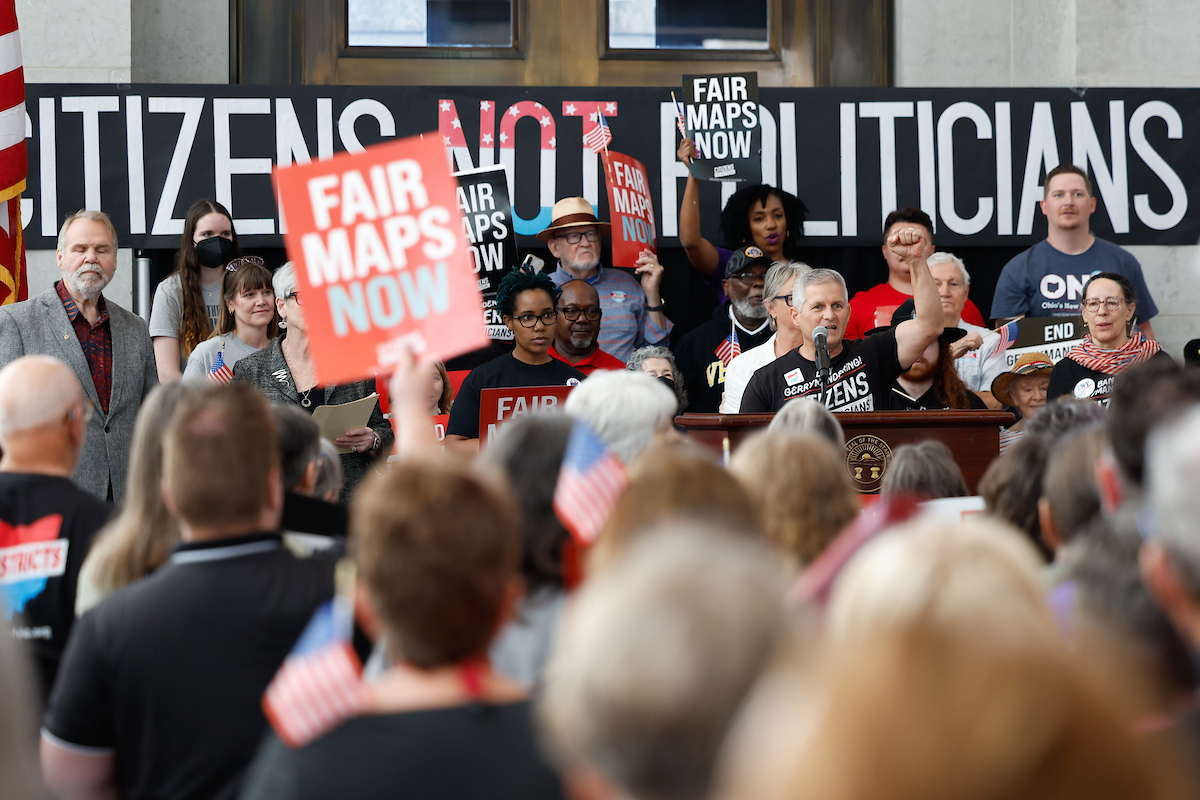
As part of a group “working to restore faith in public elections,” two former Ohio elected officials are urging Ohioans to trust the process, and accept the results.
Former U.S. Representative Zack Space and former Ohio Secretary of State Ken Blackwell participated in a Wednesday panel discussion at the University of Cincinnati on election integrity and trust in the electoral process. The discussion was part of UC’s “Digital Futures Flashpoint” series.
Space, a Democrat, said he and the Republican Blackwell don’t agree on their choice of presidential candidate in the November election, or their choice in Ohio’s U.S. Senate race, or even on certain policies.
“But we agree on this: if you cast your vote … you can rest assured that it will be counted,” Space said.
Blackwell – who served in the George H.W. Bush administration, was an honorary co-chair of the George W. Bush campaign in 2004 and was a part of former President Donald Trump’s transition team in 2016 – said the strength of the elections system in Ohio should be believed.
“We need to turn up the volume to help people believe their vote does matter,” Blackwell said. “We can detect flaws in the system and fix flaws in the system. That’s something we do well in Ohio.”
In Blackwell’s tenure as Ohio’s secretary of state from 1999 to 2007, he dealt with his own share of election controversies and questions. With regard to an investigation into “irregularities reported in the Ohio presidential election” in 2004, U.S. House Rep. John Conyers, Jr., the ranking Democrat on the House Judiciary Committee, said “there were massive and unprecedented voter irregularities and anomalies in Ohio.”
Several counties were hampered by broken voting machines, not enough voting machines, and a directive by Blackwell on provisional ballots.
“In many cases these irregularities were caused by intentional misconduct and illegal behavior, much of it involving Secretary of State J. Kenneth Blackwell, the co-chair of the Bush/Cheney campaign in Ohio,” Conyers wrote.
GET THE MORNING HEADLINES.
State Democrats sued about a directive issued by Blackwell for that election that kept ballot boards from giving ballots to voters who were in the wrong precinct. A U.S. District judge blocked the directive, but an appellate court ruled in favor of Blackwell, throwing out certain provisional ballots.
Blackwell addressed the criticism over the long lines on Wednesday, saying the problem, particularly in Montgomery County, was a campaign that had engaged university students to vote, to the point where polling places were not prepared with enough machines, and long lines ensued.
Though he faced much criticism at the time, on Wednesday, he changed the narrative.
“The reality was it was a very positive sign,” Blackwell said, saying the increased voter turnout and the success of the student engagement was a good thing.
For this election year, Blackwell and Space are putting their heads together as part of the Democracy Defense Project, a bipartisan coalition of former elected officials from Arizona, Georgia, Michigan, Nevada, New Hampshire, Pennsylvania, Wisconsin and Ohio.
“An erosion of faith in our democracy and the proliferation of politicians undermining election integrity to bolster their own campaign, reputation or party’s influence have caused false narratives about ‘stolen elections’ to take root,” according to the project’s website. “The mistrust that many voters have for our electoral system puts our democracy at grave risk.”
The targets of the group include boosting confidence in election results and improving voter participation, according to the DDP website.
While the Ohio members of DDP agree that it is unlikely America will know the results of the presidential election next Tuesday night, with close calls and litigation anticipated, they urged the public to have faith in the election through the work that local boards of elections do and the protections in place for votes.
“There is a point by which the challenges are resolved and if it doesn’t go your way, you have to accept it,” Blackwell said.
YOU MAKE OUR WORK POSSIBLE.
_______________
Susan Tebben
Susan Tebben is an award-winning journalist with a decade of experience covering Ohio news, including courts and crime, Appalachian social issues, government, education, diversity and culture. She has worked for The Newark Advocate, The Glasgow (KY) Daily Times, The Athens Messenger, and WOUB Public Media. She has also had work featured on National Public Radio.
Ohio Capital Journal is part of States Newsroom, the nation’s largest state-focused nonprofit news organization.
The Cincinnati Reds released a tribute video honoring Pete Rose on Tuesday night. The Hit King died on September 30. He was 83 years old.
Rose finished his career with 4,256 hits, three World Series Championships, 17 All-Star appearances and one MVP. He was inducted into the Reds Hall of Fame in 2016. There’s a statue of Rose outside of Great American Ballpark.
October 31, 2024 – Farah Siddiqi, Public News Service (OH)
In Ohio, the debate over Issue One has stirred strong emotions among residents and community leaders.
For many, the proposal to establish a citizens’ redistricting commission transcends politics. It represents a push for fair representation.
Marian Stewart, a retired pastor from Greene County, is a vocal supporter of the measure and frames the issue as a moral imperative.
“Rigging the maps is not fair; it’s cheating,” Stewart asserted. “Disenfranchising voters and limiting accountability does not value or respect all of our voices. It’s just wrong. That’s why I joined with faith leaders across Ohio in voting yes on Issue One.”
Stewart’s words echoed the concerns of many Ohioans who believe gerrymandered districts limit the political voice of everyday citizens. Proponents argued Issue One will ensure a fairer process by empowering a bipartisan citizens’ commission to draw electoral maps.
Critics of the measure, including some conservative groups, countered it could introduce new forms of political bias into redistricting. The opposing group had the language of the ballot issue changed to include the word “gerrymander.”
For advocates of Ohio’s labor community, the proposal is about ensuring working people’s interests are not drowned out by political manipulation.
Ted Linscott, president of the Southeast Ohio Central Labor Council, described how unfair districts can sideline Ohio’s working-class voices.
“Working people need fair voting districts so their voices can be heard,” Linscott contended. “Workers don’t need extreme right or left. We need fairness.”
The League of Women Voters of Ohio has been advocating for anti-gerrymandering reforms since 1981, underscoring the need for a responsive government.
Jen Miller, the group’s executive director, views Issue One as an important step toward accountability, noting the first initiative had support from the Ohio Republican Party but was opposed by Democrats, who held power at the time.
“The first thing that mappers did was look at the addresses of their favorite candidates and incumbents and draw lines around them, rather than drawing districts that keep communities together and make sure that Ohioans have meaningful elections,” Miller pointed out.
Ohio’s Issue One has drawn support from a diverse coalition, including labor unions, faith leaders and civic organizations, all advocating for a more representative government. As voters head to the polls, they are faced with a question beyond party lines: Should Ohio’s electoral districts be shaped by politicians or by the people they serve?
The Loveland’s Board of Zoning Appeals has voted to allow the demolition of this home at 200 Railroad Avenue.
Loveland, Ohio– The Loveland Board of Zoning Appeals (BZA) dismissed an appeal by resident Deidre Hazelbaker attempting to prevent the demolition of a home in Loveland’s Historic Downtown last night.
After the Loveland Historic Planing Commission gave a approval to demolish the house, Hazelbaker appealed the decision to the BZA. She was not allowed to make her case before the Board. Nine residents had signed up to speak about the demolition and were not allowed the opportunity to speak.
BZA members David Black, Sean Kiehl, and Tim Marsh voted unanimously to dismiss the case after City attorney Joe Braun told them that Hazelbaker did not have “standing” and was not eligible to file the appeal. Tim Marsh chairs the BZA and presided over the meeting.
This video is Hazelbaker responding after the meeting about the BZA decision:
This video is a recording of the BZA meeting:
Scroll to see the full agenda before the Board.
[pdf-embedder url=”https://lovelandmagazine.com/wp-content/uploads/2024/10/2024-10-30-Board-of-Zoning-Appeals-Full-Agenda-1866.pdf” title=”2024-10-30 Board of Zoning Appeals – Full Agenda-1866″]
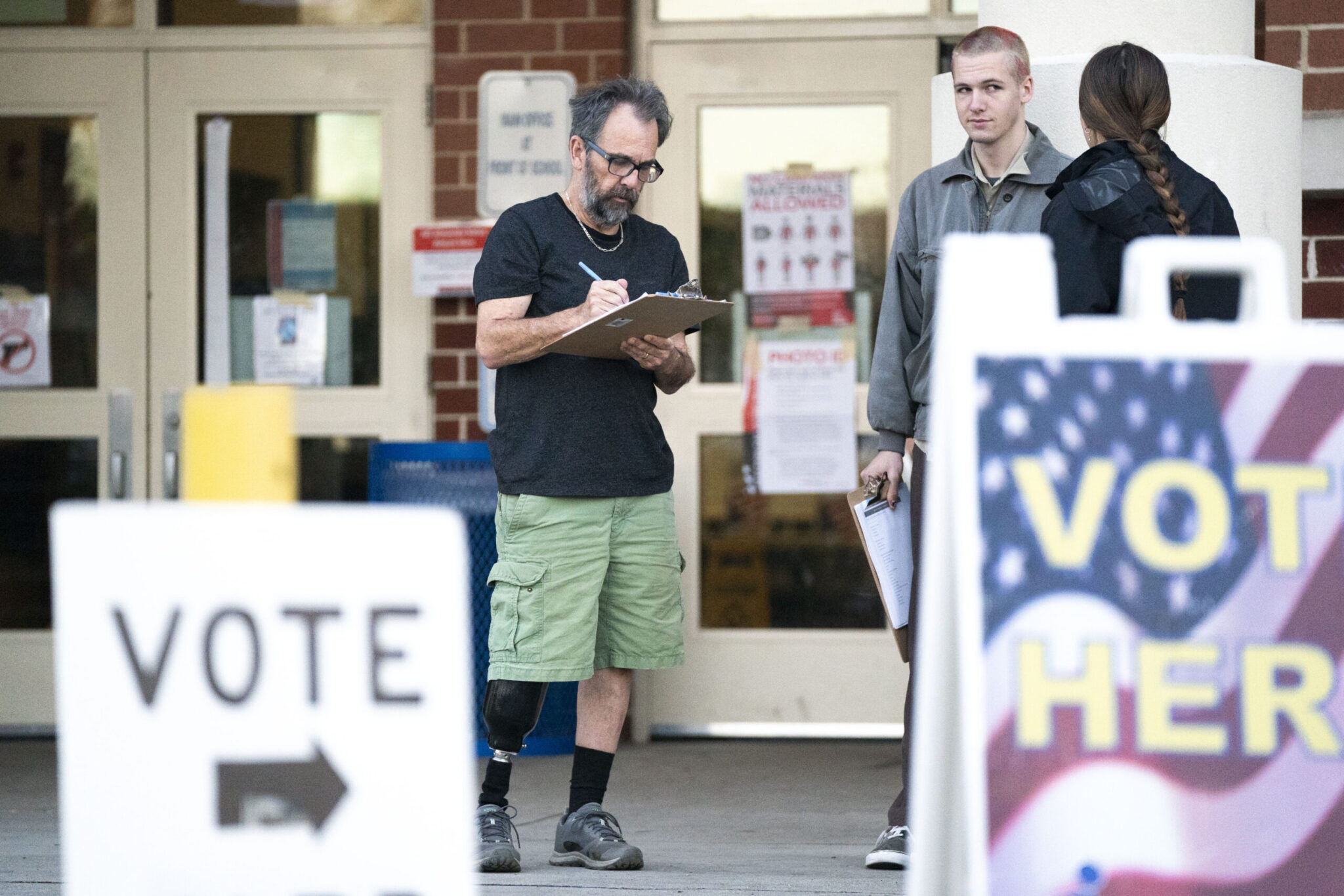
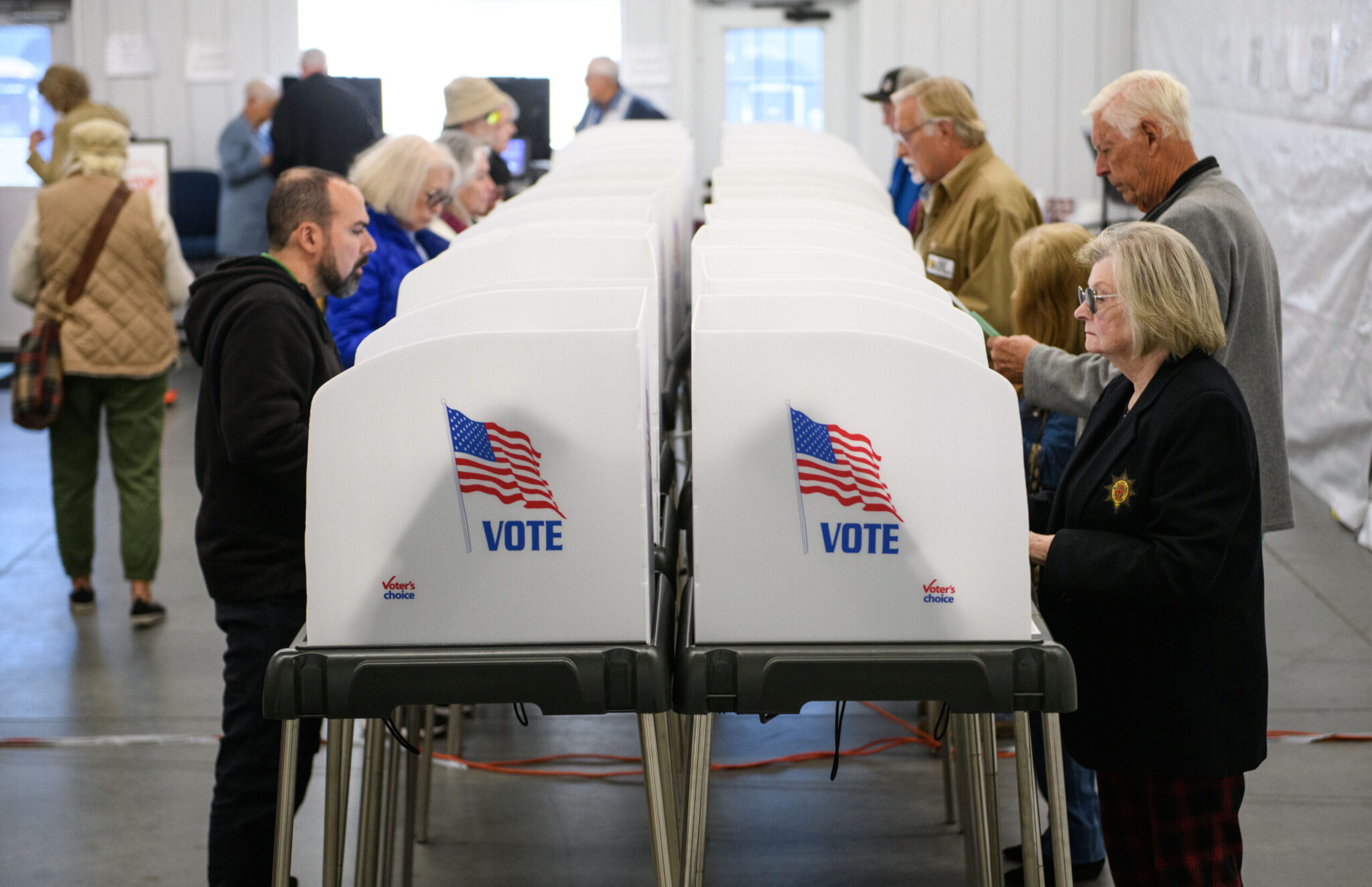
A man participates in exit polling after voting in the South Carolina Republican presidential primary at Dreher High School on Feb. 24, 2024 in Columbia, South Carolina. (Photo by Sean Rayford/Getty Images)
WASHINGTON — A pro-democracy organization warned Monday that disinformation and violent rhetoric could make the weeks that follow Election Day especially fraught, pushing the country past the upheaval that arose four years ago during the last presidential transition.
The comments from three members of the Defend Democracy Project came just days before voting ends on Nov. 5, though with several races extremely close, the country may not know for days who won the presidential contest as well as control of Congress.
That could leave considerable space for speculation as state election workers count mail-in ballots and potentially undertake full recounts, similar to four years ago.
“I think the biggest vulnerability will continue to be the mis- and disinformation that will happen in the aftermath of the election,” said Olivia Troye, who previously worked for Vice President Mike Pence as a special adviser on homeland security and counterterrorism.
Troye raised concerns that Republican presidential nominee Donald Trump may make false claims about election fraud and encourage violence similar to what took place on Jan. 6, 2021, should he lose the Electoral College again.
Troye referenced an election bulletin from the Federal Bureau of Investigation and the Department of Homeland Security she said cautioned that “candidates, elected officials, election workers, members of the media, judges involved in these cases” could all become targets of post-election violence.
“And they’re also concerned about the visible attacks and violence on polling places or ballot drop boxes,” Troye said, referencing the burning of ballots inside drop boxes in Oregon and Washington states early Monday morning.
Michael Podhorzer, chair of the Defend Democracy Project, said during the virtual briefing for reporters that one of the reasons many state officials didn’t go along with requests to “find votes” for Trump in the days following the 2020 election was because President Joe Biden had “two states to spare.”
“And that created a prisoner’s dilemma for every Republican election official who might have done the wrong thing,” Podhorzer said. “So if you take the call to (Georgia Secretary of State) Brad Raffensperger, he understood that even if he could find those votes that Trump wanted, unless two Democratic secretaries of state overturned their results, Donald Trump was not going back to the White House.
“And what that meant was that there wasn’t any single actor, in the way there was in 2000 in Florida, who could actually change the results of the election.”
That could be different this time, should Democratic presidential nominee Kamala Harris win by a small margin, potentially just one state’s Electoral College votes, he said.
Accepting the results
The Associated Press-NORC Center for Public Affairs Research released a survey Monday showing 86% of registered voters believe whoever loses the presidential election should accept the results, though just 33% expect Trump will concede if he fails to secure the votes needed to win the Electoral College.
About 77% of those surveyed expected Harris to accept the results should she lose the presidential race.
Anxiety about post-election violence was rather high among the registered voters surveyed, with 76% saying they are extremely or somewhat concerned about violent attempts to overturn the election results.
Eighty-two percent said they were at least somewhat concerned about “increased political violence directed at political figures or election officials.”
Voters are also worried about foreign interference in the elections, with 78% of the registered voters surveyed saying they are extremely or somewhat concerned about it “influencing what Americans think about political candidates.”
The co-chairs of Issue One’s National Council on Election Integrity — former U.S. Reps. Barbara Comstock, R-Va., Donna Edwards, D-Md., Tim Roemer, D-Ind., and Zach Wamp, R-Tenn. — released a written statement Monday addressing a fake video produced by Russian actors about ballots in Pennsylvania. The statement also criticized a Maryland Republican congressman who said North Carolina should just give its Electoral College votes to Trump.
“Foreign adversaries are seeking to influence U.S. elections by sowing division and spreading false information to undermine confidence in our system of self-government,” the co-chairs wrote. “In addition, people who want to win at all costs continue to spread false claims about election integrity and may create chaos, delay results, and challenge the outcome of our fair electoral process.”
The four wrote the suggestions from Maryland Rep. Andy Harris, chairman of the far-right U.S. House Freedom Caucus, that North Carolina simply grant its 15 Electoral College votes to Trump “before votes are counted are dangerous and against the rule of law.”
“By rejecting the so-called independent state legislature theory in Moore v. Harper, the Supreme Court affirmed that state legislatures do not have the power to replace the popular will with a slate of electors,” they wrote.
Issue One describes itself as a “crosspartisan” organization that works to “unite Republicans, Democrats, and independents in the movement to fix our broken political system and build an inclusive democracy that works for everyone.”
GOP blowback on Puerto Rico insults at Trump rally
GET THE MORNING HEADLINES.
Democrats and Republicans united somewhat Monday to express anger about comments a comedian made about Puerto Rico during a Trump rally on Sunday at Madison Square Garden.
Tony Hinchcliffe, who spoke in the hours leading up to Trump’s comments, called Puerto Rico a “floating island of garbage in the middle of the ocean right now.”
Hinchcliffe later said Latinos “love making babies” and made additional lewd comments.
Congressional Hispanic Caucus Chair Nanette Diaz Barragán, D-Calif., released a statement Monday calling the comments shameful and dangerous.
“This type of language emboldens prejudice, encourages violence, and undermines the values of unity and respect that our country is built on,” Barragán wrote. “It’s deeply troubling to see Republican leaders celebrate this rhetoric instead of promoting unity and truth.”
Vice President Harris told reporters traveling with her that the comedian’s comments were part of the reason voters are “exhausted” and “ready to turn the page” on Trump.
“It is absolutely something that is intended to, and is fanning the fuel of trying to divide our country,” Harris said.
Florida Republican Sen. Rick Scott posted on social media that the comedian’s comments about Puerto Rico were “not funny and it’s not true.”
“Puerto Ricans are amazing people and amazing Americans! I’ve been to the island many times. It’s a beautiful place. Everyone should visit!” Scott wrote. “I will always do whatever I can to help any Puerto Rican in Florida or on the island.”
Florida Republican Rep. Carlos A. Giménez posted on social media that the comedian’s comments were “completely classless & in poor taste.”
“Puerto Rico is the crown jewel of the Caribbean & home to many of the most patriotic Americans I know,” Giménez wrote. “@TonyHinchcliffe clearly isn’t funny & definitely doesn’t reflect my values or those of the Republican Party.”
Puerto Rico’s delegate to the U.S. House, Jenniffer González-Colón, a Republican, called the comedian’s remarks “despicable, misguided, and revolting.”
“What he said is not funny; just as his comments were rejected by the audience, they should be rejected by all!” González-Colón wrote. “There can be no room for such vile and racist expressions. They do not represent the values of the GOP.”
Ariana Figueroa contributed to this report.
Jennifer Shutt
Jennifer covers the nation’s capital as a senior reporter for States Newsroom. Her coverage areas include congressional policy, politics and legal challenges with a focus on health care, unemployment, housing and aid to families.
Ohio Capital Journal is part of States Newsroom, the nation’s largest state-focused nonprofit news organization.
Published in 1972 and winning the Chistopher Award for the most inspirational book of the year, Trina Paulus’s Hope For The Flowers has been one of the most powerful books published in our time. The story of two caterpillars following the crowd to the top of the caterpillar pillar is a versatile metaphor that can apply to all of our lives, and at any age.
I had the opportunity to visit the HOPE Celebration at The Grail in Loveland. Upon walking into the oratory, I was stunned by the gorgeous setup. Illustrations of Hope For The Flowers were spun across all four walls, in the order of the story. Right at the front of the oratory was an adorable set of yellow flowers and sketches of butterflies.
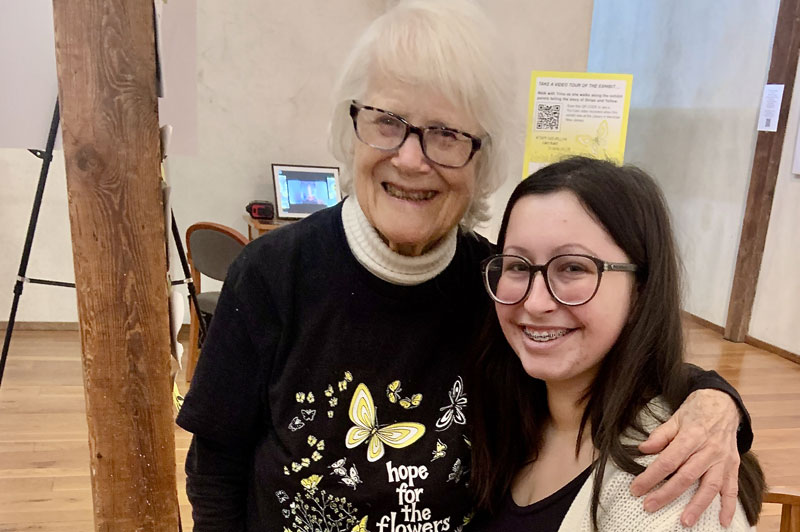
Photo provided by Grailville
At the celebration, I was able to converse with Trina. Needless to say, Trina is an amazingly successful woman, and it seems to me like she was destined for the greatness she has achieved. As a child, Trina would, “draw pictures of a caterpillar, a cocoon, and a butterfly” when someone would pass away. She has always loved the idea that once a caterpillar is brave enough to complete the stages of metamorphosis, they come out the other side a dazzling new creature.
A while back, before the publication of Hope For The Flowers, Trina embarked on a journey in Egypt, doing what she does best: helping and inspiring others. Her work in Egypt is still alive today, helping women and young girls in Upper Egypt learn to embroider and weave, among other things.
On this visit, Trina revisited her “second home” in Loveland, she went straight to work, doing art projects and readings with children and adults. Trina visited Loveland Primary School and Loveland Elementary School, helping the young students with Hope For The Flowers-inspired art projects, only using the colors yellow and black. As an artist, Trina taught me that there are different kinds of black: some that are more red and some that are more blue. Trina taught the young students to make the green that is in Hope For The Flowers only using black and yellow. Greatness can be achieved, even with a scant amount of resources.
Trina Paulus is one of the kindest people I have ever come across. Her cordial demeanor and positivity make for the most pleasant of interactions. Trina’s inspiring and commendable background of working at The Grail, creating Hope For The Flowers, activism, and sculpting is something many people never even dream of. What can’t she do?
In this LOVELAND MAGAZINE TV video Paulus talks about the current public exhibition of her Abraham and Isaac statue which was once hidden from the public and stored in a garage at Grailville.
Below you can watch the interview with Trina Paulus by Alana Johnson conducted on December 09, 2011.
The Trina Paulus Abraham and Isaac statue is a poignant and significant piece of art. It is wretched, distressing, tragic – and beautiful. It was stored temporarily for several years just outside of Loveland. Loveland Magazine Reporter Alana Johnson went with Paulus to an unlit garage at the Grailville Conference and Retreat Center to see it for the first time. Paulus hadn’t seen her statue for several years.
Paulus said at the time, “Over here you will see a hand with the knife in it… and over here… you’ll see the hand with his son. I’ve done a lot of thinking about this over the years – the great Christian mystery of the crucifixion and the resurrection and… The very unpleasant thing that God can ask everything of us sometimes… The whole mystery of why we die, and why we die so miserably sometimes… In our time it’s a very unpopular story.”
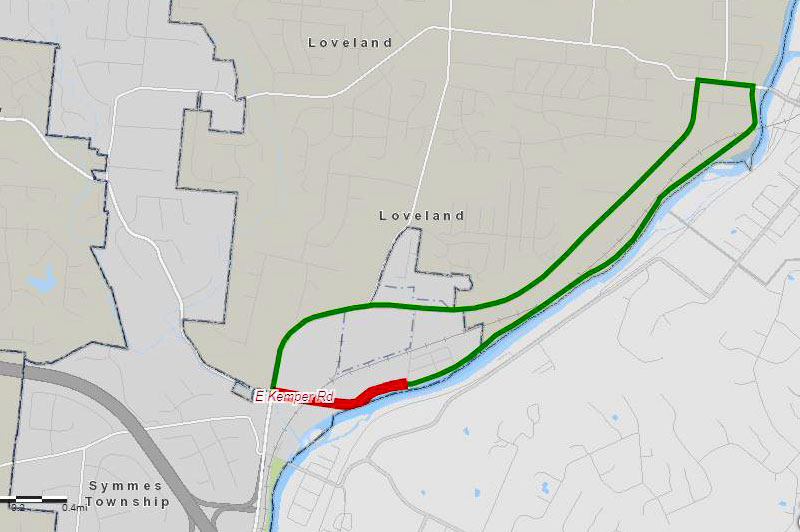
Symmes Township, Ohio – From Nov. 10 at 5 PM through Nov. 12 at 5 PM (weather permitting), a sanitary sewer will be installed along East Kemper Road between Loveland-Madeira Road and Twightwee Road in Symmes Township. The contractor’s detour route will be Loveland-Madeira Road — West Loveland Avenue — South Riverside Avenue to East Kemper Road — and vice versa. If you have questions, please contact the Hamilton County Engineer’s Office at (513) 946-8430.
The Loveland’s Historic Preservation and Planning Commission has voted to allow the demolition of this home at 200 Railroad Avenue.
Loveland, Ohio– The Board of Zoning Appeals will meet at 5:30 PM on Wednesday, October 30 at Loveland City Hall to decide the fate of a home in Historic Downtown that is at 200 Railroad Avenue.
After the Loveland Historic Planing District gave the approval to demolish the house, Loveland resident Deidre Hazelbaker appealed the decision.
Scroll to see the full agenda and supporting documents that Hazelbaker submitted to the Board.
[pdf-embedder url=”https://lovelandmagazine.com/wp-content/uploads/2024/10/2024-10-30-Board-of-Zoning-Appeals-Full-Agenda-1866.pdf” title=”2024-10-30 Board of Zoning Appeals – Full Agenda-1866″]
Mike Ahern, an Independent voter from Blacklick speaks to supporters at the Citizens Not Politicians rally, July 1, 2024, at the Statehouse in Columbus, Ohio. (Photo by Graham Stokes for Ohio Capital Journal. Republish photo only with original story.)
This article was originally published in Bolts, a nonprofit newsroom covering the nuts and bolts of power and political change, from the local up.
When Songgu Kwon went to the polls earlier this month, he was eager to help Ohio adopt an independent redistricting commission. The comic book writer and illustrator, who lives near Athens, dislikes the process with which politicians have carved up Ohio into congressional and legislative districts that favor them, enabling Republicans to lock in large majorities. So he was pleased that voting rights groups had placed Issue 1, a proposal meant to create fairer maps, on the Ohio ballot this fall.
“I’m in support of any measures that make the process more fair to reflect the will of the people, instead of letting the politicians decide how to gerrymander,” says Kwon.
In the voting booth, he reviewed the text in front of him. His ballot read that voting ‘yes’ would set up a panel “required to gerrymander the boundaries of state legislative and congressional districts,” and that it would “repeal constitutional protections against gerrymandering.”
So Kwon voted ‘no’ on the measure—given what he’d just read, he thought, that had to be the way to signal support for independent redistricting. He’d gone in planning to vote ‘yes,’ but he was thrown off by this language he saw; he guessed that he must have been wrong or missed some recent development. “The language seemed really specific that if you vote ‘yes’, you’re for gerrymandering,” he now recalls in frustration.
But when he left the polling station and compared notes with his wife, he quickly figured out that he’d made a mistake: He had just voted to preserve the status quo. To bring about the new independent process and remove redistricting from elected officials, as was his intention, he would have had to vote ‘yes.’
Kwon says he got confused by the language that was crafted and placed on the ballot by Republican Ohio officials. The official most directly responsible for this language, Secretary of State Frank LaRose, had a direct hand in drawing the gerrymandered maps that Kwon opposes and that the reform would unwind.
“I didn’t think that they would go so far as to just straight up lie and use a word that means one thing to describe something else,” Kwon told me. “They are using the term gerrymandering to describe an attempt to actually fix the gerrymandering.”
He added, “I thought this was a serious document, and that there would be some standard.” Other Ohioans have come forward with similar stories in recent days, complaining they meant to vote ‘yes’ but got tricked by the ballot language into not doing so.
Now the fate of Ohio’s redistricting reform hinges on whether its proponents can dispel this confusion and get the word out to all the residents who intend to support it.
The result will determine who gets to draw future state congressional and legislative districts, and it may shift seats as early as 2026. But more than that, the dispute adds to a larger saga over the viability of direct democracy in Ohio. Just last summer, the GOP pushed an amendment that would have made it much less likely for future citizen-initiated measures to succeed. That proposal failed, but Mia Lewis, associate director of Common Cause Ohio, told me at the time that she expected Republican leaders to “come back and try again” this year. Now she says that’s exactly what they did when they skewed this latest measure’s ballot language.
Lewis helped organize Issue 1 this year. And just like in the summer of 2023, she said, state officials “are threatened by the idea that the people of Ohio would have power.”
“They have understood that Ohioans don’t want gerrymandering, they have nothing good to say about voting ‘no’,” she said, “so the only thing they can say is, if you vote ‘yes,’ on this, you’re requiring gerrymandering, which is the exact opposite of the truth.”
Issue 1 would amend the state constitution to create a new panel to draw Ohio districts. It would be made up of 15 citizens selected by retired judges from a pool of applicants; the body would need to include five registered Republicans, five registered Democrats, and five people who are neither. Elected officials would be barred from serving on the commission.
An independent commission would mark a huge change from current law, which grants the authority to draw districts to a panel of elected officials, including the governor, the secretary of state, and appointees of legislative leaders. The constitution already requires that new maps respect certain principles of fairness. But when Ohio’s high court in 2022 struckdown GOP gerrymanders seven separate times, ordering the process to be more equitable, GOP leaders ignored the rulings and ran out the clock until they landed a more conservative court in the 2022 midterms. Issue 1 would also codify more stringent fairness criteria for the new commission to respect.
The coalition that drafted Issue 1 collected enough signatures to put it on the ballot. But as the secretary of state, LaRose got the opportunity to write the measure’s official summary. LaRose had been an active player in the redistricting process that drew the current maps that favor the GOP, but wrote his proposed summary in a way that suggested Issue 1 would make it likelier that Ohio gets gerrymandered. Proponents of Issue 1 immediately complained that his text was misleading.
They got more angry after LaRose’s draft went up for review in front of the Ohio Ballot Board, a five-person body that includes LaRose and has a GOP majority. During that process, Republican state Senator and board member Theresa Gavarone proposed the specific wording that Kwon says tripped him up most: She suggested using the term “gerrymander” to describe the way Issue 1 would require a commission to divide up the state.
Gavarone’s proposed tweak was met by gasps and startled laughter from the audience. (This can be heard in the recording’s 1:35:20 mark.) State Representative Terrence Upchurch, one of two Democrats on the board, then laughed in bewilderment when given the opportunity to respond to Gavarone. Still, a majority of the board approved LaRose’s draft and Gavarone’s amendment.
Ohio Ballot Board Chair, Secretary of State Frank LaRose listens to board member State Sen. Theresa Gavarone, R-Bowling Green at a meeting of the Ohio Ballot Board. (Photo by Graham Stokes for Ohio Capital Journal. Republish photo only with original story.)
Voting rights groups rushed to court, asking for the language to be struck down. But the state supreme court, which has a narrow GOP majority, rebuffed them in September and upheld most of the ballot summary.
The four Republican justices said it was accurate to say that the new independent commission would “gerrymander” Ohio since it would be tasked with taking partisanship into account, even if it’s to draw a more evenly divided map.
The three Democratic justices disagreed furiously. Justice Jennifer Brunner wrote in a dissent, “We should be requiring a nearly complete redrafting of what is perhaps the most stunningly stilted ballot language that Ohio voters will have ever seen.”
According to Derek Clinger, an Ohio-based lawyer who has litigated past ballot language cases in front of the Ohio Supreme Court, many states use a system like Ohio’s: They ask elected partisan officials to draft ballot summaries. Still, some do it differently. Oregon, for instance, randomly selects citizens to meet and write statements summarizing each ballot measure.
But what frustrates Clinger is that Ohio’s state constitution does contain “workable standards” that are meant to enable oversight onto the decisions made by state officials; it states that language on the ballot can’t “mislead, deceive, or defraud the voters.” Clinger said, “You have this standard, but you had a majority [on the state supreme court] that disregarded that.”
Some Ohio justices take the view that they’re not supposed to play a strong oversight role. Pat DeWine, a Republican justice who is also the son of Ohio’s governor, even has a forthcoming law review essay on the matter. DeWine admits that the Ohio Ballot Board “is composed of partisan actors who may have incentives to draft language that at least subtly favors one side or the other.” But the court should be wary of second guessing them, he writes: It “polices only the outer boundaries of the board’s discretion.”
Clinger, who now works at the State Democracy Research Initiative, a research hub at the University of Wisconsin Law School, disagrees. He points to a separate dispute that unfolded in Utah this fall: There, Republicans advanced a referendum meant to allow lawmakers to more easily overturn citizen-initiated measures, while also crafting ballot language claiming that their proposal would “strengthen the initiative process.”
The Utah supreme court voided this measure in September, writing that a referendum must be placed “on the ballot in such words and in such form that the voters are not confused thereby.”
“Despite the partisan implications of the case, the Utah Supreme Court seemed able to assess in good faith whether the ballot language fairly described the proposal,” Clinger said. “The big takeaway for me is that the personnel of the court is so important.”
The composition of Ohio’s supreme court is on the line this fall since the state is holding elections for three of its seven seats. The GOP could expand its majority from 4-3 to 6-1, but Democrats also have an opportunity to flip the court in their favor.
Neither Gavarone nor LaRose responded to Bolts’ requests for comment for this story. LaRose said in a statement last month that the court’s decision was “a huge win for Ohio voters, who deserve an honest explanation of what they’re being asked to decide.”
If Issue 1 passes, the state would have to quickly set up a new commission to create new maps by the 2026 midterms. But for now, proponents of the reform are focused on getting the measure across the finish line.
A poll conducted this month by YouGov found that support for Issue 1 had a large lead of over 20 percentage points. But the survey did not use the actual language that people are seeing on their ballot; instead, it asked how respondents would vote after telling them that “a ‘yes’ vote would establish a new bipartisan redistricting commission” and “ban partisan gerrymandering.” That’s precisely the explanation that proponents are fretting won’t be on the measure.
“I’m not going to rest easy at all until election results have come in,” Lewis said. She says she is worried about “a lot of confusion and purposeful misinformation” during the campaign, like the incorrect claims by GOP opponents of the measure that law enforcement officers and veterans would not be eligible to be on the redistricting commission, for instance.
Mia Lewis, right, and other Ohio advocates on the day they turned in signatures for Issue 1 in July (Photo from Paul Becker, Becker1999/Flickr)
Citizens Not Politicians, the committee running the “yes” campaign, is working to reach voters and explain what the measure actually does. The group launched an ad this fall in which former Chief Justice Maureen O’Connor tells voters that politicians opposed to Issue 1 have “lied” to them. O’Connor, a Republican, voted to strike down GOP gerrymanders in 2022; since leaving office two years ago, she has helped champion Issue 1.
The committee behind the “no” campaign, Ohio Works, is running ads as well. They have used the same strategy as the Ohio Ballot Board, of trying to associate Issue 1 with gerrymandering. In response to the criticism that some voters feel tricked by this characterization, a spokesperson for Ohio Works has said that, “If people go in and intend to vote for Issue 1, read the ballot language and vote no, they are not confused.”
But Kwon, the comic book writer, gives this warning to other Ohio voters: “Be careful. When you read the description, they’re going to refer to any attempt to change the current districting as gerrymandering. That’s what really threw me.”
“I would just say that, if you’re voting ‘yes,’ you’re voting to reform the current districting system,” he added.
Kwon feels frustrated that he unintentionally undercut a reform he supports and canceled out his wife’s vote. But together they’ve been burning up their friend network ever since to share word of his misfortune.
He said, “If me sharing the story prevents somebody from getting tricked like I was, or one or two people from getting tricked, hopefully that will balance it out.”
Daniel Nichanian, Bolts
Daniel Nichanian is the founder and editor-in-chief of Bolts.






 After the Loveland Historic Planing Commission gave a approval to demolish the house, Hazelbaker appealed the decision to the BZA. She was not allowed to make her case before the Board. Nine residents had signed up to speak about the demolition and were not allowed the opportunity to speak.