Symmes Township, Ohio – Symmes Township will be offering free Christmas tree recycling for its residents again this year from Thursday, December 26th until Friday, January 31st. A designated area has been provided behind the Township Administration building for drop off. Remove all ornaments, tinsel and plastic wrapping so the trees can be easily mulched.
Loveland, Ohio – The City of Loveland provides residents with a Christmas Tree removal service. Public Works crews will collect your tree from the curb from January 2nd until the 15th.
City Hall asks you to please remove all decorations, lights, tree stands, and tree bags before placing your Christmas trees at the curb.
For questions about the Christmas tree recycling program call City Hall at (513) 683-0150.
Loveland, Ohio – Construction on the Cherokee Drive Water Main Replacement Project in the Loveland Heights will require a road closure and detour.
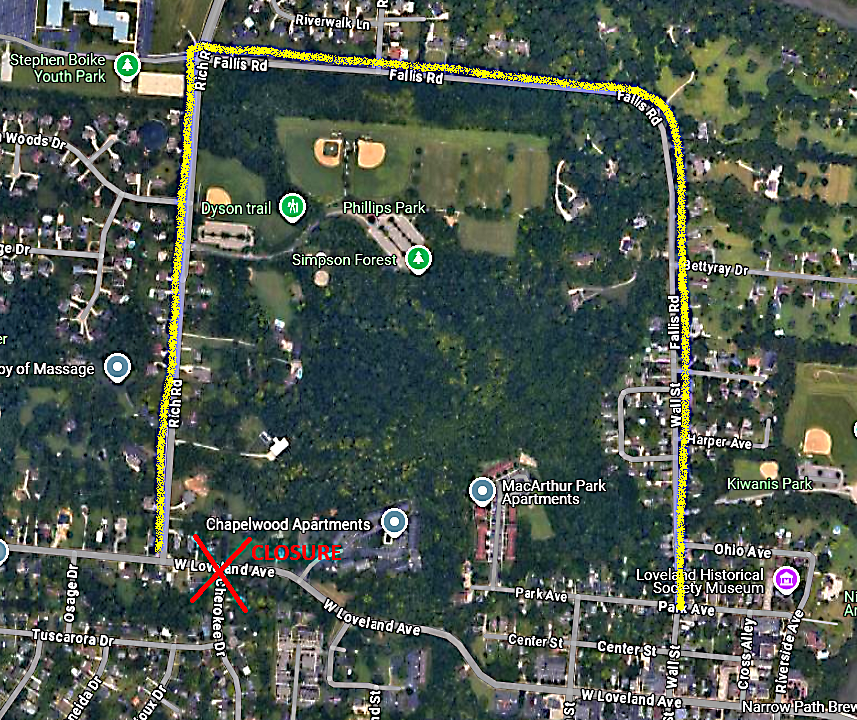
West Loveland Avenue will be closed at Cherokee Drive to allow crews to connect new water main beneath the road surface. Contractors plan a three-day road closure daily from 9 AM until 3 PM on Tuesday, Jan. 7 through Thursday, Jan. 9.
Motorists will be instructed to use the following detour routes:
TO TRAVEL WESTBOUND:
• West Loveland Avenue to Wall Street to Fallis Road to Rich Road to West Loveland Avenue
TO TRAVEL EASTBOUND:
• West Loveland Avenue to Rich Road to Fallis Road to Wall Street to West Loveland Avenue
According to City Hall, “The Heights area has an aging, undersized, and brittle cast iron water main that is degrading, which makes breaks occur more frequently. In this project, the city is installing more than 2,700 feet of new water main to replace the outdated water lines. Additionally, the project involves replacing valves, modifying the storm sewer to improve drainage, and installing additional fire hydrants.”
Advocates condemned Ohio lawmakers for passing another anti-LGBTQ bill as the General Assembly wrapped up late Wednesday night, urging Gov. Mike DeWine to veto the legislation, though DeWine has indicated he will sign it.
The Ohio Senate passed House Bill 8 and the Ohio House concurred with changes made to the bill, sending it to DeWine’s desk. He will have 10 days to either sign the bill into law or veto it, once he receives it. DeWine has indicated he favors the legislation.
The controversial bill requires educators to out a students’ sexuality to their parents, requires public schools to let parents know about sexuality content materials ahead of time so they can request alternative instructions, and requires school districts to create a mandatory religious release time policy.
“We are deeply disappointed that the legislature decided once again to attack LGBTQIA+ youth by passing yet another bill that will make schools less safe and inclusive for queer and transgender people,” Kaleidoscope Youth Center, an organization that serves LGBTQIA+ youth, said in a statement.
TransOhio said passing H.B. 8 is a “harmful step backward” for students.
“By requiring a religious release program and restricting discussions on gender and sexuality, the law imposes a narrow worldview on public education and limits teachers’ ability to provide inclusive, fact-based instruction,” TransOhio said in a statement. “By mandating the reporting of students’ assumed gender identities and behaviors to parents, the law breaches student privacy, erodes trust, and puts vulnerable children at risk of harm.”
Those who supported H.B. 8 called it the ‘Parents’ Bill of Rights’, but those who opposed it called it the ‘Don’t Say Gay Bill,’ due to its similar language to Florida’s ‘Don’t Say Gay’ law that passed in 2022.
“While this bill is presented as a “Parents’ Bill of Rights,” its provisions pose significant risks to the well-being of LGBTQ+ youth and raise troubling questions about the separation of church and state in public education,” Stonewall Columbus said in a statement.
The Ohio Education Association said this bill will take time away from educators being able to teach students and will create more challenges for marginalized students.
“It unnecessarily entangles state government in regulating communications between parents and educators, sowing distrust rather than fostering the collaboration needed to ensure all students can learn, grow, and thrive,” OEA President Scott DiMauro said in a statement.
The bill, which underwent several changes since it was first introduced in February 2023, received much opposition.
“Despite the outcry from hundreds of students, parents, and social workers, conservatives want to broaden curriculum censorship, weaken current civil rights protections for LGBTQ+ individuals, and impose new disclosure and alternative curriculum mandates on teachers and counselors,” Lauren Blauvelt, executive director of Planned Parenthood Advocates of Ohio, said in a statement.
“These requirements would create conflicting, burdensome obligations for educators, making it overly difficult for them to comply,” Blauvelt said.
The Ohio Center for Sex Education said this bill is at odds with studies that show comprehensive sexuality education programs reduce the rates of sexual activity, sexual risk behaviors, sexually transmitted infections, and adolescent pregnancy.
“This bill’s vague language creates an environment of fear and division, putting LGBTQ+ students at risk and eroding the trust that educators work hard to build with their students and families,” Jenna Wojdacz, the center’s assistant vice president, said in a statement.
Equality Ohio, along with several other organizations, is asking DeWine to veto the bill.
“Overnight when most school-age children are asleep, the legislature rushed through another shameful attack on LGBTQ+ youth,” Equality Ohio Executive Director Dwayne Steward said in a statement.
LifeWise Academy, a Hilliard-based religious instruction program, celebrated the passage of H.B. 8.
“Families understand the benefits of Bible-based character education during school hours, given the increasing demand for our program in communities throughout Ohio and the country,” LifeWise CEO Joel Penton said in a statement.
LifeWise enrolls 50,000 students across 29 states, including about 160 Ohio school districts.
Megan Henry is a reporter for the Ohio Capital Journal and has spent the past five years reporting in Ohio on various topics including education, healthcare, business and crime. She previously worked at The Columbus Dispatch, part of the USA Today Network.
Ohio Capital Journal is part of States Newsroom, the nation’s largest state-focused nonprofit news organization.
WASHINGTON — President Joe Biden Thursday commuted the sentences of roughly 1,500 people who were placed in home confinement during the coronavirus pandemic, and granted pardons for 39 individuals with convictions for nonviolent crimes.
“America was built on the promise of possibility and second chances,” Biden said in a statement. He noted many of the 1,500 were serving long sentences that would be shorter under current laws, policies and practices.
As the Biden administration winds down, it’s the largest single-day grant of clemency in modern day history.
The president added that his administration will continue to review clemency petitions before his term ends on Jan. 20. There are more than 9,400 petitions for clemency that were submitted to the White House, according to recent Department of Justice clemency statistics.
“As President, I have the great privilege of extending mercy to people who have demonstrated remorse and rehabilitation, restoring opportunity for Americans to participate in daily life and contribute to their communities, and taking steps to remove sentencing disparities for non-violent offenders, especially those convicted of drug offenses,” Biden said.
Those 39 people who received pardons included 67-year-old Michael Gary Pelletier of Augusta, Maine, who pleaded guilty to a nonviolent offense, according to the White House, which provided brief biographies of the pardoned individuals.
After his conviction, Pelletier worked for 20 years at a water treatment facility and volunteered for the HAZMAT team, assisting in hazardous spills and natural disasters. He now grows vegetables for a local soup kitchen and volunteers to support wounded veterans.
Another pardon was granted to Nina Simona Allen of Harvest, Alabama.
Allen, 49, was convicted of a nonviolent offense in her 20s, the White House said. After her conviction, she earned a post-baccalaureate degree and two master’s degrees and now works in the field of education. Additionally, she volunteers at a local soup kitchen and nursing home.
Hunter Biden pardon
The clemency action came after the president gave a full pardon for his son, Hunter Biden, on gun and tax charges and any other offenses, from 2014 until December. The president previously stated he would not pardon his son, but changed his mind because he said his son was constantly targeted by Republicans.
Additionally, advocates and Democrats have pressed Biden to exert his clemency powers on behalf of the 40 men on federal death row before President-elect Donald Trump returns to the White House. Democrats have pushed for this because Trump expedited 13 executions of people on federal death row in the last six months of his first term.
The co-executive directors of Popular Democracy in Action, a progressive advocacy group, Analilia Mejia and DaMareo Cooper, said in a joint statement that Biden should “not stop now.”
“Thousands more of our people who have been wronged by an unjust system are still waiting for freedom and compassion,” they said.
Those with nonviolent offenses who were pardoned by the president, according to the White House:
Alabama
Nina Simona Allen
California
Gregory S. Ekman
Colorado
Johnnie Earl Williams
Connecticut
Sherranda Janell Harris
Delaware
Patrice Chante Sellers
District of Columbia
Norman O’Neal Brown
Florida
Jose Antonio Rodriguez
Illinois
Diana Bazan Villanueva
Indiana
Emily Good Nelson
Kentucky
Edwin Allen Jones
Louisiana
Trynitha Fulton
Maine
Michael Gary Pelletier
Maryland
Arthur Lawrence Byrd
Minnesota
Kelsie Lynn Becklin
Sarah Jean Carlson
Lashawn Marrvinia Walker
Nevada
Lora Nicole Wood
New Mexico
Paul John Garcia
New York
Kimberly Jo Warner
Ohio
Duran Arthur Brown
Kim Douglas Haman
Jamal Lee King
James Russell Stidd
Oklahoma
Shannan Rae Faulkner
Oregon
Gary Michael Robinson
South Carolina
Denita Nicole Parker
Shawnte Dorothea Williams
Tennessee
James Edgar Yarbrough
Texas
Nathaniel David Reed III
Mireya Aimee Walmsley
Lashundra Tenneal Wilson
Utah
Stevoni Wells Doyle
Virginia
Brandon Sergio Castroflay
Washington
Rosetta Jean Davis
Terence Anthony Jackson
Russell Thomas Portner
Wisconsin
Jerry Donald Manning
Audrey Diane Simone
Wyoming
Honi Lori Moore
Last updated 1:50 p.m., Dec. 12, 2024
Ariana Figueroa
Ariana covers the nation’s capital for States Newsroom. Her areas of coverage include politics and policy, lobbying, elections and campaign finance.
Ohio Capital Journal is part of States Newsroom, the nation’s largest state-focused nonprofit news organization.
The Ohio Board of Pharmacy on Monday launched a tool to help people with low vision, hearing loss, or who face language barriers find pharmacies that can serve them.
For many, the pharmacy is the most frequent point of contact with the healthcare system. Pharmacists can consult about their medications and help them manage chronic conditions such as hypertension and diabetes.
The new website will help people with accessibility challenges find pharmacies that can serve their specific needs.
For example, for patients with low vision can find pharmacies that provide oversize-font labels, prescription readers and braille labels.
It can point those with hearing loss to pharmacies that have video-relay services and teletypewriters. And it can tell non-English speakers where to find pharmacies with translation services for Spanish, Chinese, Nepali, Somali, and other languages.
GET THE MORNING HEADLINES.
In a statement, Board of Pharmacy Executive Director Steven W. Schierholt said the new webpage is an attempt to make pharmacy services more widely accessibility.
“The launch of this convenient online search tool highlights the Board’s ongoing commitment to ensure pharmacy services are accessible to all Ohioans,” he said. “The Board is hopeful that this new webpage will help patients and their loved ones quickly identify pharmacies offering services they need to keep them healthy and safe.”
However, working against accessibility is a wave of pharmacy closures. For the better part of a decade, independent and small-chain pharmacies have said that huge prescription middlemen — CVS Caremark, OptumRx and and Express Scripts — have been driving them from the field with low reimbursements, fees and clawbacks.
More recently, large chain pharmacies have been closing in droves.
CVS is at the end of a three-year process in which it closed 900 pharmacies across the country. Walmart last year asked 16,000 of its pharmacists to cut their hours.
Bankrupt Rite Aid this year announced the closures of hundreds of stores in Ohio and Michigan. And Walgreens this year said it would close “a significant portion” of 2,000 underperforming stores. That prompted Dave Burke, executive director of the Ohio Pharmacists Association, to say he was worried that pharmacy is becoming an untenable business.
“If Walgreens can’t make a go of this in 25% of their locations, my fear is that this becomes a much larger problem where other people who provide pharmacy services exit the market in whole or in part,” he said in September.
The Federal Trade Commission is investigating whether the giant health conglomerates that own the three big pharmacy middlemen are engaged in anticompetitive practices.
YOU MAKE OUR WORK POSSIBLE.
___________
Marty Schladen
Marty Schladen has been a reporter for decades, working in Indiana, Texas and other places before returning to his native Ohio to work at The Columbus Dispatch in 2017. He’s won state and national journalism awards for investigations into utility regulation, public corruption, the environment, prescription drug spending and other matters.
Ohio Capital Journal is part of States Newsroom, the nation’s largest state-focused nonprofit news organization.
Loveland, Ohio – Cincinnati Gives has officially come to an end, and the LIFE Food Pantry says they are thrilled to share the results. They share on FaceBook, “Thanks to your amazing generosity and encouragement, we raised over $21,000 to support LIFE Food Pantry—and earned a $1,000 bonus along the way!”
This was their first year participating in the competition, and they are “overwhelmed” with gratitude for the amazing support they’ve received from our community. “Your generosity and enthusiasm remind us why we do what we do—working together to make a difference for those in need.”
Clermont County, Ohio – Clermont County officials today announced an upcoming solicitation for proposals to hire a consultant to manage the Clermont County Animal Shelter as well as a request for bids to expand outdoor kennel capacity and new volunteer policies and procedures.
“These recommendations are part of a comprehensive plan to improve our physical facilities and daily operations to ensure our dogs continue to receive top-quality care,” said Angie Livesay, Deputy Assistant County Administrator and Acting Kennel Administrator.
Livesay outlined the recommendations to the Board of Clermont County Commissioners during its regular meeting Wednesday, Dec. 11. The board voted unanimously to approve the recommendations for the bid proposals.
Under the proposed new management structure, all current and future staff at the shelter will remain county employees. The consultant would provide a contracted resident management team for daily operations under the policy direction of the commissioners.
Livesay was appointed by the commissioners to serve full time as Acting Kennel Administrator in July 2024.
The legal notice of the “Request for Proposals for Clermont County Dog Kennel Management” will be posted on the county’s website next Thursday, Dec. 19. Proposals will be due Thursday, Jan. 9, 2025.
In addition, the county announced that it will begin advertising a request for bids from contractors to expand the shelter’s outdoor kennel capacity to add 61 kennels up from the current 23. The legal notice for the expansion project will be posted to the county’s website.
Livesay also recommended a comprehensive update to the shelter’s policy for volunteers. The board will review the policy and vote on it at the Dec. 18 meeting.
A copy of the policy will be posted on the county’s website once it is finalized and approved by the commissioners.
A message from OneOhio Recovery Foundation and Substance Abuse and Mental Health Services Administration
Your presence can be a present for someone this season. Support and following up with loved ones are just some of the actions we can all take to help others who may be in crisis.
Helping someone with mental health, drug, or alcohol use can be hard. If someone in your life is struggling, having a supportive conversation can be a big step for both of you. You can’t force someone to get care, so, the best thing you can do for a person is to be there for them and listen without judgment.
If you or someone you know is struggling or in crisis, help is available. Call or text 988 or chat 988lifeline.org. You’ll be able to speak with a trained crisis counselor any time of day or night.
Is the holiday stress getting to you? Believe in the magic of #SelfCare. It’s ok to focus on yourself, your self-care, and your overall health and wellness this season.
How to Cope
Has it gotten harder to get through each day? If you’re having issues with mental health, drugs, or alcohol or waiting for treatment to start, here are some small steps you can take.
Reach out if you’re in crisis
If you or someone you know is struggling or in crisis, help is available. Call or text 988 or chat 988lifeline.org. You’ll be able to speak with a trained crisis counselor any time of day or night.
Accept where you are now
Know that where you are is okay. Healing isn’t a straight line—there will be ups and downs along the way. Speak to yourself with kindness, as though you’re speaking to a friend.
Try some of the things below to help your body and mind. Taking care of yourself is healing yourself. Self-care is different for everyone, so you may have to try a few things before finding what works for you.
It’s OK not to feel merry and bright. This season can bring up feelings of loneliness and grief. Hope, help and healing are within reach. Reach out to someone to speak about what’s weighing on you.
Coping with Bereavement and Grief
Bereavement and grief are individual, yet universal experiences that nearly everyone faces within their lifetime. Everyone experiences loss in their own personal way. Many can navigate grief with the support of those who are already in their lives, but others may need more help. There are resources and organizations available to ensure individuals receive the appropriate care they need. The type of support required can be influenced by the nature and timing of the loss, the specific resources available, and many other factors.
Understanding Bereavement and Grief
In the simplest of terms, bereavement is a period of grief and mourning after a loss, while grief is a person’s emotional response to a loss. Below are more comprehensive definitions based on the opinions of several experts in the field.
Bereavement
The overarching experience of coping with loss and change. It is the emotional and psychological condition experienced after a loss, typically due to death, but it can also apply to non-death-related losses. Bereavement often encompasses both inward and outward expressions of grief and the cultural, social, and personal practices that help individuals process and adjust to the loss, often through rituals and support from loved ones. It usually involves a period of grieving.
Grief
The emotional, mental, and/or physical response to a loss, often due to death but also encompassing other life changes, such as the end of relationships, loss of identity, or illness. Sometimes people experience periods of grief in anticipation to a loss. Grief is deeply personal and can occur differently in everyone, shaped by the nature of the relationship, the degrees of support, circumstances of the loss, cultural influences, and individual coping mechanisms as well as other considerations. While it can be an intense experience, it is considered a natural human reaction to loss that generally subsides over time for most people.
Additional definitions provided by the National Cancer Institute and the American Psychological Association for bereavement and grief.
Examples of how grief can be expressed:
Sadness
Anger
Guilt
Confusion
Relief
Anxiety
Numbness
Helplessness
Fatigue
Loss of appetite
Sleep disturbances
And many more…
Strategies for coping with grief and loss:
Support from friends, family, and/or other known community members
Cultural, social, religious, faith, or other beliefs or rituals
Local or virtual grief support groups
Community-based or virtual grief counseling services
Grief peer support services
Artistic expression
Physical movement and exercise
Outreach to a mental health professional
Prolonged Grief Disorder (PGD)
Although most people experience periods of grief and bereavement after the death of an individual without long-term mental health concerns, some may experience symptoms that could benefit from additional help. In 2022, the American Psychiatric Association added Prolonged Grief Disorder (PGD) to the DSM-5-TR after clearly distinguishing PGD as its own distinct diagnosis. Major features of the criteria for PGD include, but are not limited to:
Intense yearning or thoughts about the deceased
Significant and persistent degree of distress
Significant decrease in functioning
Symptoms that last more than one year in adults and six months in children and youth
PGD is only one form of grief that can cause extraordinary challenges for individuals. People can also experience other difficult grief reactions. People who are, or think they are, experiencing PGD or are having an especially hard time processing their grief, may seek clinical care, such as individual or group psychotherapy to support them through their loss. Many may also find other supports, such as grief peer support, helpful with this experience.
Alcohol, Substance Use, and Recovery
Has it gotten harder to get through each day? If you’re having issues with mental health, drugs, or alcohol or waiting for treatment to start, here are some small steps you can take.
Reach out if you’re in crisis
If you or someone you know is struggling or in crisis, help is available. Call or text 988 or chat 988lifeline.org. You’ll be able to speak with a trained crisis counselor any time of day or night.
Accept where you are now
Know that where you are is okay. Healing isn’t a straight line—there will be ups and downs along the way. Speak to yourself with kindness, as though you’re speaking to a friend.
Try some of the things below to help your body and mind. Taking care of yourself is healing yourself. Self-care is different for everyone, so you may have to try a few things before finding what works for you.
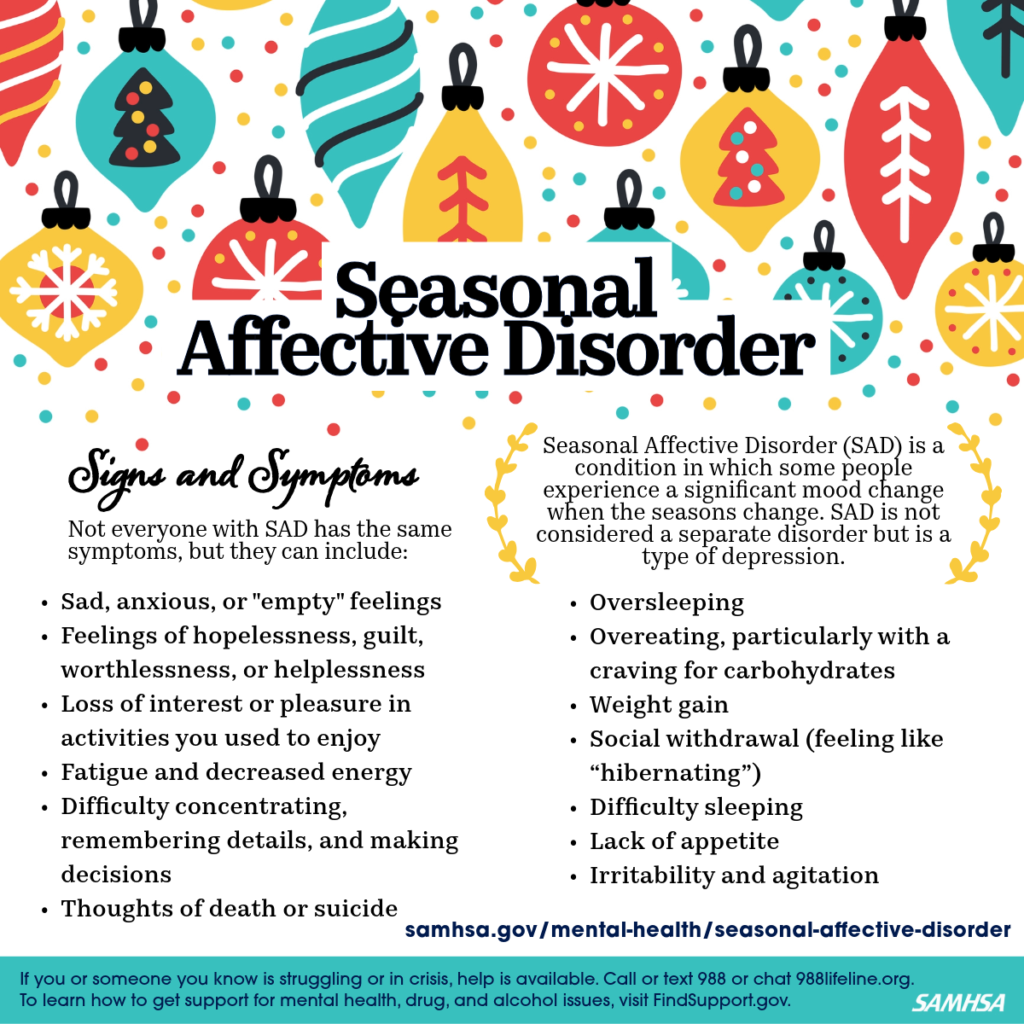
Is the weather outside frightful? For some, the shorter days and colder temperatures can bring on symptoms of a type of depression. Is it just the ‘winter blues’ or seasonal affective disorder (SAD)? Seasonal affective disorder, or SAD, is a condition in which some people experience a significant mood change when the seasons change. SAD is not considered a separate disorder but is a type of depression.
Causes
Seasonal Affective Disorder (SAD) is triggered by changes in seasons. This form of depression usually occurs during the fall and winter months when there is less sunlight, and the days get shorter. SAD usually lifts during the spring and summer months.
Symptoms
Not everyone with SAD has the same symptoms, but they can include:
Sad, anxious, or “empty” feelings
Feelings of hopelessness, guilt, worthlessness, or helplessness
Loss of interest or pleasure in activities you used to enjoy
Fatigue and decreased energy
Difficulty concentrating, remembering details, and making decisions
Thoughts of death or suicide
Oversleeping
Overeating, particularly with a craving for carbohydrates
Weight gain
Social withdrawal (feeling like “hibernating”)
Difficulty sleeping
Lack of appetite
Irritability and agitation
Testing for SAD
Talk to your health care provider or mental health specialist if you are concerned and think you may be suffering from SAD.
Get Help
SAD may be effectively treated with a specific type of light therapy for many. Antidepressant medicines and talk therapy may also be needed reduce SAD symptoms, either alone or combined with light therapy. Additionally, vitamin D supplements may improve symptoms.
Learn how to talk about mental health to help you speak to a loved one who you may think is experiencing any mental health concerns.
“Enjoy beloved holiday classics performed by an extraordinary ensemble of student, amateur, and professional brass musicians from Greater Cincinnati and Northern Kentucky.”
Loveland, Ohio – Cincinnati’s community Brass Choir will present their annual Christmas concert in conjunction with Loveland High school percussionists. The ensemble will be conducted by Kirby Cain and will feature holiday classics.
Founded in 1994 and sponsored by Mt. Auburn Presbyterian Church, the Brass Fellowship brings together student, amateur and professional brass musicians from the Greater Cincinnati and Northern Kentucky area.
Members of the brass ensemble come from many vocations including music, education systems, and the law, but all share a passion for music. The Brass Fellowship strives to unearth the rich literature of over 400 years of brass choir music and regularly present it to the public at the highest level of musicianship possible.



![[Gridlock Alert] West Loveland will be closed at Cherokee Drive Jan. 7 through 9](https://lovelandmagazine.com/wp-content/uploads/2024/12/w.-love-detour.png)









![[A Holiday Toolkit] Supporting Mental and Behavioral Health During the Holiday Season](https://lovelandmagazine.com/wp-content/uploads/2024/12/holiday-help.png)
 Your presence can be a present for someone this season. Support and following up with loved ones are just some of the actions we can all take to help others who may be in crisis.
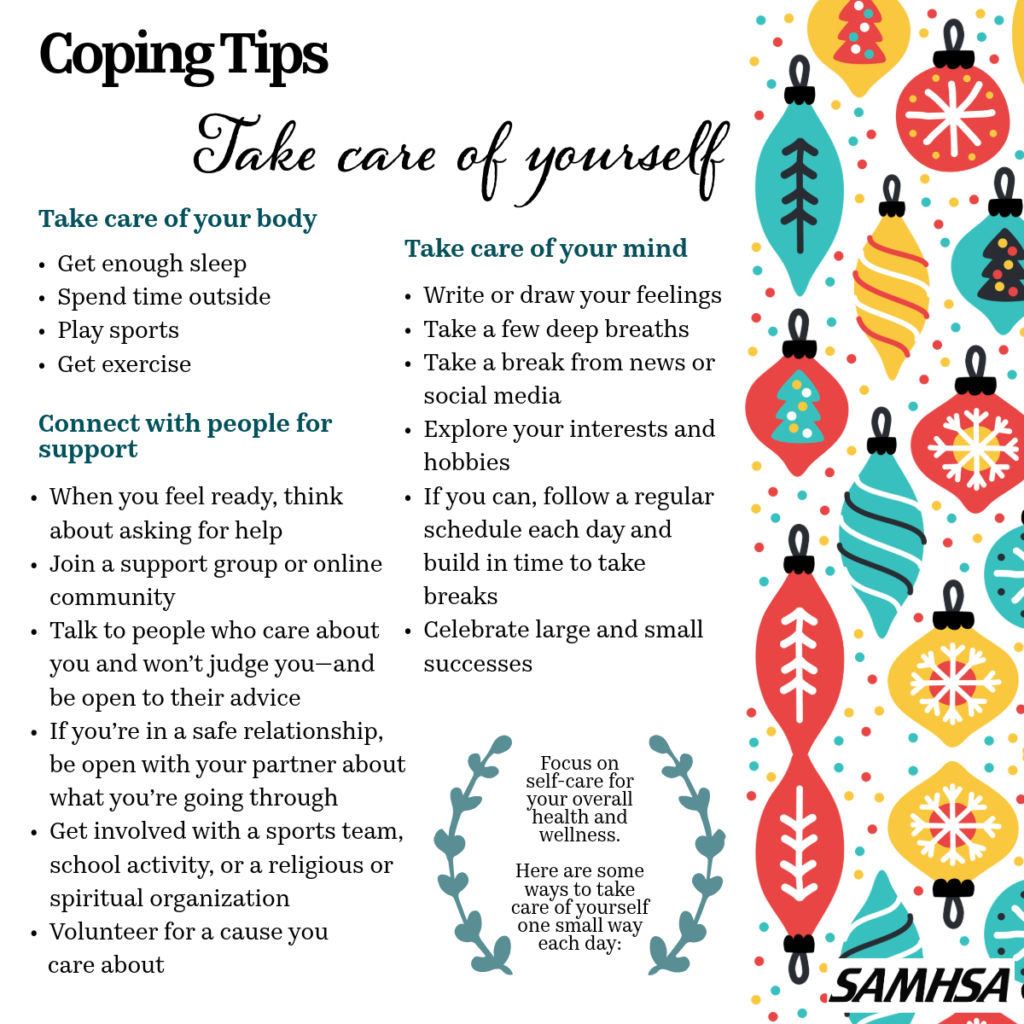 Is the holiday stress getting to you? Believe in the magic of #SelfCare. It’s ok to focus on yourself, your self-care, and your overall health and wellness this season.
 It’s OK not to feel merry and bright. This season can bring up feelings of loneliness and grief. Hope, help and healing are within reach. Reach out to someone to speak about what’s weighing on you.