Author: Fran Hendrick

  • Moving Sale at Wildflower House in Historic Loveland Starts Today

    Moving Sale at Wildflower House in Historic Loveland Starts Today

    Wildflower House, the office of Fran Hendrick, P.C.C., is moving to an online space!

    Ten Days Only! Call 513-677-9800 for appointment to preview items available for sale from this charming office in Loveland’s Historic District.

    Items will be pre-sold (starting today!) and available for pick-up Monday-Wednesday, October 28-30.

    Some really nice things, in great shape! — including: 2 matching overstuffed armchairs, 4 matching World Market wood tables in various sizes, pretty light wood secretary desk, 5 matching small round wicker side tables, 1 small wicker chest of drawers, 1 lateral file, 10 super-comfy World Market folding wood relaxation chairs with full length cushions, white restroom/bedroom cabinet, monitor, a set of matching rugs – and many small items.

    View Items that are for Sale

  • Helping girls maintain a positive body image

    Helping girls maintain a positive body image

    by Fran Hendrick

    I‘ve had a few questions about helping girls maintain a positive body image — so I’ve put together some thoughts, recommendations, and a couple of good resources for you in this quick video. If you have additional resources that have been helpful to you and your daughter, by all means, put them in a comment!

    Resources


    Loads of great resources at A Mighty Girl – The world’s largest collection of books, toys and movies for smart, confident, and courageous girls.


    Mothers, Daughters, and Body Image: Learning to Love Ourselves as We Are – by Hillary L. McBride


    Professional clinical counselor, parenting columnist, and instructor Fran Hendrick has provided coaching and counseling for hundreds of women and girls for twenty-five years. Clients appreciate Fran’s calm, empathic style, her practical strategies and solid advice, and her playful spirit. In addition to her therapy practice at Wildflower House in Loveland, Fran provides consultation, through private video chat and by phone, for moms participating in her online course “Helping Confidence Bloom: The Step-by-Step Approach to Raising Confident Girls”.


  • Splashing In – Welcome!

    Splashing In – Welcome!

    by Fran Hendrick

    Professional clinical counselor, parenting columnist, and instructor Fran Hendrick has provided coaching and counseling for hundreds of women and girls for twenty-five years. Clients appreciate Fran’s calm, empathic style, her practical strategies and solid advice, and her playful spirit. In addition to her therapy practice at Wildflower House in Loveland, Fran provides consultation, through private video chat and by phone, for moms participating in her online course “Helping Confidence Bloom: The Step-by-Step Approach to Raising Confident Girls”.

    “I don’t want my daughter to struggle with confidence and anxiety issues. I want to learn what I can do to help her become strong and confident – and really have fun with her life.”

    This is the concern – and the heartfelt wish — that many of my clients share with me. 

    Join Fran’s Raising Confident Girls Facebook Group – especially for moms.

    What I find both fascinating and empowering is that your daughter’s trust and confidence are not built by big actions and grand gestures; they’re actually built in the small moments of everyday life. Moments like when she’s late for school – or puts down her iPad to help her little brother with his spelling; says she hates what you’re having for dinner – or does her first headstand. 

    Believe it or not, these are the moments where what you say and do can make all the difference in building her confidence – or unintentionally eroding it. (And – by the way – what we generally think of as praise is likely to backfire completely!)

    It’s easy to miss the opportunity in these moments, not because you don’t want to be there for her but because you aren’t fully aware of what she needs from you. It’s easy to get discouraged and even feel powerless to help your daughter become less anxious and more assertive; or to help her persist at a hard task instead of feeling stupid and quitting in a storm of frustration. What you need is a lens that allows you to see things you couldn’t see before – along with the insight, tools, and a clear framework to know what to do or say. 

    And it’s so important! Confidence is not only a goal in its own right. Beyond that, a strong sense of self-confidence and self-worth provides lifelong protection against depression.

    I’m not one to step up to a microphone without major provocation. But the statistics on depression and self-harm in girls and women today in this country demand it.

    I’m not one to step up to a microphone without major provocation. But the statistics on depression and self-harm in girls and women today in this country demand it. According to the National Institute of Mental Health, a whopping 17.3% of girls ages 12-17 have experienced a major depressive episode1, along with 8.2% of adult women2.  It has even been estimated that girls’ self-esteem, their greatest protection against depression, peaks (yes, peaks) before they are ten years old!

    What makes this all the more unacceptable is that it is largely preventable! We have the knowledge to raise girls to feel whole, adequate, and joyful so they experience the world confidently and in bright colors. The knowledge exists to protect our girls from depression, from lifelong battles against feeling not good enough, from desperation – in short, to prevent rivers of tears and needless pain.

    They can joyfully become exactly who they’re meant to be.

    But for parents to actually be able to implement that knowledge in the small moments that make up everyday life with children requires a clear approach, intentional action — and a strong dose of self-reflection, because it can be scary. With that investment, our girls can be spared the lifetime of depression and anxiety that so many women experience. They can joyfully become exactly who they’re meant to be.

    They kick upwards, their arms reach for the sky, they seem to fairly prance, all with their own dance steps, their own vivid colors, their own lively style.

    On my desk at Wildflower House, I have a colorful drawing, spontaneously crayoned by a spectacular six-year-old girl. In it, twelve children jubilantly dance two-by-two in all directions across the fluorescent green paper. They kick upwards, their arms reach for the sky, they seem to fairly prance, all with their own dance steps, their own vivid colors, their own lively style. 

    That is how our girls should feel! I believe our daughters simply must be given that opportunity. Parents need a clear approach to evade those awful statistics and, in their place, to create something wonderful.

    I invite you to be part of improving the odds for today’s little girls, especially the ones within your own reach.

    “So let’s fix it together.”

    Why? Because each little girl has the potential to bloom uniquely. Because it is a sacred responsibility to learn to nurture, to discover that. And because there should be, there must be no lost voices. Each individual human being is entitled to self-expression.  Without it, our sparks dim and become buried out of our reach, hopelessness gains ground, despair sets in.  Human beings should not be locked away inside themselves. Ever.

    So let’s fix it together. 

    You really can build your daughter’s confidence right there in the midst of simple everyday conversations. I’ve designed this new column to show you how.

    I hope you’ll join me!

    Located at 111 N. Wall Street in Downtown Loveland, Wildflower House, Fran’s cozy personal development studio for coaching, counseling, and classes provides a space for women and girls to confidently become exactly who they’re meant to be. 

  • “My daughter’s never been in class without her best friend!”

    “My daughter’s never been in class without her best friend!”

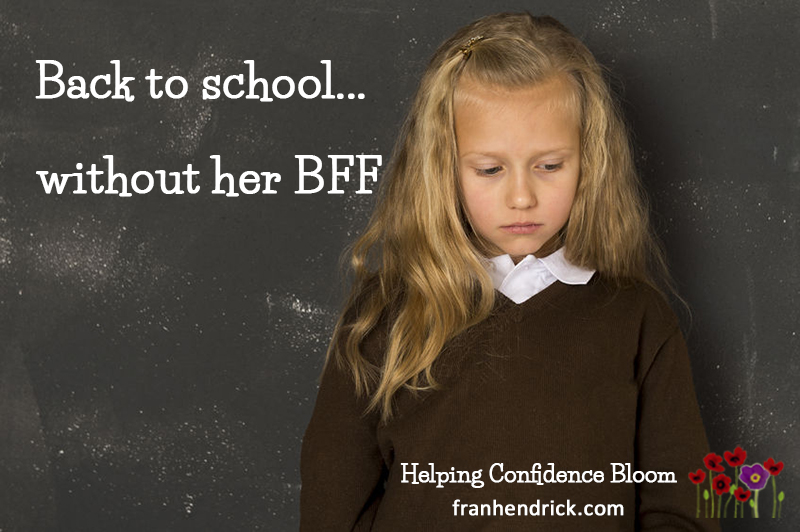
    Crisis Alert! It’s pretty scary for girls to find out that their BFF isn’t in their class this year. Handling that crisis is the topic of the second of four Back to School posts. If that’s what’s happening in your house right now, this post is for you.

    Melissa and Avery

    Melissa slumped into the chair in my office with a soft thud. Her nine-year-old daughter Avery, she explained, was in the midst of a meltdown because she’d just learned that, for the first time ever, her best friend Lila would not be in her class at school. Avery was inconsolable.

    “She’s so scared!” Melissa exclaimed, on the verge of tears herself. “What am I going to do?”

    I knew Melissa wished I could just hand her a tip or two that would magically turn this situation around. But there really is no one-size-fits-all when it comes to helping children grow. Success would come from Melissa understanding her multiple roles in helping Avery through this crisis. We needed to get to work and tailor a plan that would be a fit for Avery – and for Melissa, too.

    If you’ve had a chance to read the Back to School post on Separation Anxiety, you’re already familiar with the process we used to tackle Avery’s painful problem. It’s four manageable steps that guide you into creating a plan that uniquely fits your daughter’s needs and strengths. Here’s how that worked with Melissa and Avery.

    1. Picture in your mind what you’re trying to accomplish.

    Melissa wanted Avery to be able to make new friends. As we delved more deeply, she could see that beneath that goal was another. She was seeking to build Avery’s confidence – that potent feeling that exactly who she is is perfectly fine, accompanied by an unspoken assumption that of course other kids will want to be friends with me! She began to sense that telling Avery how to approach another child, introduce herself, how to find her way into a group – all of these things were necessary, but without confidence radiating from within, they could come across in an empty way. Melissa was after something bigger for her daughter.

    2. Take a good look at your fears.

    It was her own fears that made Melissa sink into the chair with worry. It was going to be very hard for her to be the solid source of strength Avery needed her to be, that is, to anchor Avery in this crisis, until she got a handle on her own fears.

    For Melissa, like many moms, there was something terribly sad about imagining a child alone on the playground. To her, that meant that the child was very lonely, depressed even, possibly rejected by the other children, and longing for a friend. She herself had been painfully isolated as a child, and she feared that it would be the same for Avery. And she was afraid that Avery would not be able to bounce back from this. When she began to see how she could actively build Avery’s capacity for resilience, her worry gave way to determination, and her own strength kicked in.

    3. Accept your child’s fears. Try to get a good picture of what’s swirling through her mind.

    I was careful about working with Melissa on this, because so often there’s a temptation to get a child to articulate what’s worrying her so that you can say, “Oh, that’s not going to happen!” When she imagined how those words would make her feel if she were facing a scary situation, she quickly realized that this would not be the ticket to empowering Avery to make friends. The goal was to gain some clues about how to help Avery by listening to what was going on in her inner world.

    Armed with that understanding, Melissa took Avery on a drive for ice cream and they talked. That is, Melissa sprinkled gentle questions in and then listened carefully. Avery, she learned, was missing Lila terribly — even though school had not yet begun. She believed that they wouldn’t see each other anymore. And she couldn’t summon up in her imagination a picture of making a new friend. Lila was naturally outgoing; Avery naturally more reserved. Meeting new people had usually been Lila’s role – not Avery’s. Avery didn’t think she knew how to do it. The insight this conversation gave Melissa helped her understand how she could help.

    4. Make a plan that utilizes your daughter’s strengths.

    Without realizing it, Melissa had already set a plan in motion. She had begun by regaining her own sense of calm so she could anchor her daughter. Knowing that Avery was able to put her thoughts and feelings into words, she had set the stage for a conversation. She had then listened very carefully to understand Avery’s thoughts and feelings. She had served as a mirror to Avery, by reflecting back to her an accurate picture of what was going on inside her. By doing that she conveyed to Avery that her feelings could be understood and they were okay, and that Melissa was not afraid of Avery’s feelings.

    Now she could move into the next part of her plan: providing information and perspective. Melissa reminded Avery that in fourth grade the kids go to different rooms for different subjects and that it was possible that she and Lila would be in the same room for at least one subject. Also, there would be lunch and recess where they could talk and play together. Avery decided to set up a play date with Lila soon after school started.

    Melissa asked Avery about the new girl who had joined her class at the end of third grade. Avery, on her own, had swooped in and immediately included her in everything! She had made a friend with no trouble at all. And – that friend would be in her new class.

    She reminded Avery of her previous teachers and asked Avery about times she had gone to them when she needed help. Her new teacher would be there to help her, too. In fact, other kids and parents said she was really wonderful.

    Finally, she talked with Avery about how much she had learned from Lila about making friends. It was true – Avery had watched Lila for years. This is so powerful – and we, as parents, can easily underestimate it. When children are exposed to someone who is consistent and skilled and kind over a period of time – and then suddenly they are faced with a situation to handle on their own – everything they’ve absorbed from this mentor kicks in. It might not be easy; it’s still a big challenge – but Avery would very likely find that she could connect with other children the way she had learned from Lila. As they continued to talk, Avery began to feel more confident and optimistic about returning to school.

    But Melissa was not finished. She now had a handle on how to help, and she intended to continue, this time by taking intentional steps to build Avery’s resilience. That’s a topic for another day – and a good one, because there’s a lot moms can do.

    Back to Melissa’s goal

    Did you notice how the word “shy” never came up in any of these conversations? That was not an accident. Children believe exactly what we tell them about themselves, and Melissa didn’t want to build “shyness” into Avery’s sense of self. Instead, she focused on the specifics of what Avery was feeling. She was missing her best friend. She was unsure what to do without her there. Melissa addressed the specifics of Avery’s concerns and focused on building her confidence.

  • “I don’t want to go to school, Mommy!” – Helping with separation anxiety

    “I don’t want to go to school, Mommy!” – Helping with separation anxiety

    Separation Anxiety

    2 Girls, 2 Stories, 2 Plans

    by Fran Hendrick, P.C.C.

    Sending your little girl off for the first day of preschool or kindergarten is not for the meek at heart! You’re not alone if you’ve been thinking about it for weeks and worrying about it when you’re meant to be sleeping. Even if your little one is feeling excited and confident, there’s still the issue of how you’re feeling!

    For many moms, it’s a big wrench. You’ll no longer control your daughter’s entire environment; the rhythm of your day is changed; your role feels…confusing; and it might be just plain hard to imagine cheerfully waving, See you soon! without racing back home for a good cry.

    Wait – this post is supposed to be about her separation anxiety, not yours! But I want to acknowledge both, because, especially if this is your first child – or your youngest – your life is changing, and she’s becoming a tiny bit more independent of you. That’s an adjustment on the inside for you, and for many moms it even feels like grieving. There are gains, too, of course — new opportunities for both of you, your daughter’s growing awareness and insight; all the new things she can do. Your relationship will grow as she grows, so while it’s true that babyhood is gradually fading, something new and wonderful is emerging. Still, even positive, exciting changes involve loss – and a few tears.

    If your daughter is anxious about going to school, you’re probably stressed, too. And, there is no one-size-fits-all answer to this age-old problem. That’s because there are a number of factors to consider, and they’re different for each child and each mom.

    To sort this out, I’d like to introduce you to two spectacular little girls and their equally spectacular moms.  Definitely take a moment to download the “Mommy, I don’t want to go to school!” Strategy Sheet. This tool will walk you through creating your own plan to help your daughter.

    Libby and Evie

    When Libby and I began talking about separation anxiety, her daughter Evie, active, outdoorsy, and with a mischievous streak, was three years old. Libby, realizing that preschool wasn’t far off, had tried to prepare Evie by introducing her to the delightful playroom at her gym. Libby had a good feeling about the playroom teacher and had spent some time observing her before bringing Evie in to meet her. She had carefully explained to Evie that she would get to play in the playroom with Miss Lynn for a few minutes while Evie worked out. Evie was hesitant, but allowed herself to be taken to the playroom. She was interested in the colorful toys – but when it came time to say goodbye, she attached herself sobbing to Libby’s leg.

    Libby, who had grown up in very painful circumstances and had truly been emotionally abandoned by her parents, could not stand for her child to experience the pain she still experienced due to that childhood emptiness. She comforted Evie, and they went home. Evie, who didn’t lean toward talking about her feelings, was glad to get home and get on with her day. But Libby well knew that preschool was looming, and she wanted to know how to help.

    Anna and Zoe

    Zoe was a very articulate five-year-old headed for kindergarten when her mom, Anna, found herself faced with the puzzle of how to help Zoe separate confidently and enjoy her time at school. Zoe was terribly sad about having to go to school, despite having visited and become familiar with her teacher and the classroom. She loved her books, pencils, and paper – at home, with mommy. Zoe’s fears felt alien to Anna, because she herself had welcomed the adventure of the school bus with confidence and even bravado.  It tore Anna’s heart to see her daughter so unhappy, and she worried that Zoe would be traumatized by this new demand on her. Besides that, she was afraid Zoe would make a scene and she would look like a Bad Mom. Zoe was sad, and so was her mom.

    Could two little girls and their moms be more different? What helps each of them will be just as different as their temperaments and personalities are. So rather than throwing random tips your way, I’m going to give you a process for figuring out how to help. Figuring out what’s most helpful to each of your kids is a series of first tries and next tries, and that’s just fine.

    1. Picture in your mind what you’re trying to accomplish.

    I’m thinking that you want starting school to be exciting. You’d like your daughter to be able to separate confidently and to feel competent, safe, and secure as she acclimates to school. You hope she’ll make friends. I think you’d probably like her to feel that you’re on her side, that you’re working together as a team to help her.

    Knowing what you’re going for will help you choose words and actions that will support your goals.

    2.  Take a good look at your fears.

    Before you can be a solid anchor for your daughter, you first have to understand your own fears. Libby was afraid that Evie would be overwhelmed by the kind of deep sadness she herself had felt as a child left to her own devices to handle all the difficulties of growing up. Libby needed some help to realize that Evie lived with reliable, gentle support from a caring mom – very different from Libby’s own childhood. A planned separation would not generate the same feelings in Evie that Libby had felt.

    Anna, in contrast, feared that she would look and feel like a failure if Zoe had a meltdown. Further, she was afraid that this separation really might be too much for Zoe and would harm her emotionally. Anna began to understand that Zoe’s difficulties were simply signals indicating what help she needed from her mom in order to grow. Starting school might be difficult for Zoe, but it was not a reflection on Anna and certainly not a sign of having failed as Zoe’s mom. Further, she was able to see that she could monitor the situation and intervene if the challenge was more than Zoe could handle.

    2. Accept your child’s fears

    No fear ever went away because someone said it was “nothing to be afraid of” any more than the order to “calm down!” have ever calmed anyone down. Instead of seeking to talk your daughter out of her fear, dive in and try to understand what her fears are. If she can’t put them into words, take your best guess. There are a number of fears that we’re all susceptible to – including fear of the unknown (starting school), fear of rejection (not being liked), fear of feeling stupid (not knowing what to do); and fear of failing (doing it all wrong). You can see that each of these suggests a direction to take to help your daughter.

    4. Make a plan that utilizes your daughter’s strengths.

    Remember first tries and next tries? Your plan is your first try. Your revisions are your next tries. Whatever plan you devise, it should help you achieve the goals you envisioned.

    DON’T FORGET TO DOWNLOAD THE STRATEGY SHEET.

    THIS TOOL WILL HELP YOU QUICKLY DEVISE A PLAN.

    Here’s what Libby and Anna decided to do.

    Once she realized that helping Evie separate was absolutely not abandonment, Libby decided to continue taking her to the playroom at the gym. She began by sitting in the playroom with Evie, but not participating or even interacting with her. Soon she was able to leave for a few minutes with Evie’s agreement, gradually increasing her stays from 5-10 minutes to a half hour or more.  When it came time for preschool, she steeled herself for whatever sidelong glances might come from the other mothers or the teacher and used the same strategy. Within two days, Evie was sending her on her way and enjoying her mornings in preschool.

    Anna took a different approach with her analytical daughter. Once she realized that Zoe’s fears did not signify her success or failure as a mom, she was free to empathize with Zoe. Zoe was extremely capable verbally, and the two read books about school and talked about what would happen in school, who would help her, and how each day Mommy would be waiting for her at the bus stop. Anna got Zoe a school bus to use to play out all her fears. She anticipated and answers Zoe’s concerns about what she was supposed to do and what would happen if she did something wrong. They talked about first tries and next tries. All of this strengthened Zoe enough to get on the bus. Next Anna introduced the concepts of time and scale – how long and how much. After school, Anna asked Zoe, “How long were you sad today? Was it a big sad? Medium-sized?” Zoe proudly realized that her sad times where shorter and smaller. She glowed with her accomplishment.

    By understanding how to devise very different approaches tailored to their daughters’ unique needs and strengths, both Anna and Libby were able to help grow their children’s confidence so they could successfully take the leap into their new schools.

    Coming next: What if, for the first time, my daughter isn’t in the same class as her BFF and seems lost?