
Author: Loveland Magazine

  • Sidebar: What You Need to Know to Vote This Year

    Sidebar: What You Need to Know to Vote This Year

    Tuesday, November 3, 2020

    How to register to vote: You can register online here:https://olvr.ohiosos.gov/ You can also download an application, print it, and mail it to your county board of elections.

    When to register to vote: To vote in the Nov. 3 election, your application must be received by mail, or delivered to the board of elections office, or online no later than Monday, Oct. 5. Boards of elections are open Oct. 5 until 9 p.m.

    Who can register to vote: U.S. citizens, at least 18 years old on or before the next general election, and a resident of Ohio for at least 30 days before the election.

    Should I check my voter registration?: Yes. You can do so here:https://voterlookup.ohiosos.gov/voterlookup.aspx

    Documents needed to register online: Ohio driver’s license or state ID with number; name; date of birth; address; last four digits of your Social Security number.

    How to request an absentee ballot: If you choose not to vote at a public polling location on election day, you can request a ballot in advance – called absentee voting. The Ohio Secretary of State will mail applications to every registered voter, which can be completed and returned, or voters can print the form from the Secretary of State website:https://www.ohiosos.gov/publications/#abr Additionally, some Ohio newspapers have printed the form in the daily paper so voters can cut it out, complete it and mail it in.

    When to request an absentee ballot: You can request an absentee ballot 90 days before an election, which this year is Aug. 5. The window to request is open until THREE days before the election but in practicality that deadline leaves little time for the postal service to get the ballot to you and for you to return it.

    When and how to return an absentee ballot: Your completed ballot must be postmarked – at the latest — the day before the election. Placing the ballot in a mailbox does not guarantee that it will be post marked. Deliver it personally to a post office and request that it be marked. It’s your responsibility to make sure it has enough postage. Alternatively, you can drop it off in person at your county board of elections during business hours and before the polls close at 7:30 p.m. on Election Day. You don’t have to wait until Election Day to deliver.

    Can I track my absentee ballot?: Yes. Check out the voter toolkit here:https://www.ohiosos.gov/elections/voters/toolkit/

    How, where and when to vote early in-person: Early in-person voting centers, set up by the county board of elections, open Oct. 6, or 28 days before Election Day. You’ll need identification, such as a driver’s license, bank statement, utility bill, pay stub, military or state ID to vote. And depending on public health orders, you may need a face mask.

    How to be a poll worker: Ohio relies on 35,000 registered voters to work the polls on Election Day. Because many poll workers are of retirement age, they face increased health risks due to Covid 19. There is high interest in expanding the hiring pool to include younger people. Poll workers receive training. Pay varies by county. You can sign up here: https://www.ohiosos.gov/elections/precinct-election-officials/peosignup/


    Election Day Voting Location


    Clermont County Board of Elections Web Site

    Hamilton County Board of Elections Web Site

    Warren County Board of Elections Web Site

    Ohio Secretary of State Web Site


    Republished with the permission of the Ohio Center for Investigative Journalism and Eye On Ohio.

    — About the project: Your Voice Ohio is the largest sustained, statewide media collaborative in the nation. Launched nearly five years ago, more than 60 news outlets have participated in unique, community-focused coverage of elections, addiction, racial equity, the economy and housing. Nearly 1,300 Ohioans have engaged with more than 100 journalists in dozens of urban, rural, and suburban communities across the state. Over and over again, Ohioans have helped journalists understand their perspectives and experiences while sharing ideas to strengthen their local communities and the state. Doug Oplinger, formerly of the Akron Beacon Journal, leads the media collaboration. The Democracy Fund, John S. and James L. Knight Foundation, and Facebook are the primary funders of Your Voice Ohio. The Jefferson Center for New Democratic Practices, a non-partisan non-profit engagement research organization, designs and facilitates Your Voice Ohio community conversations. 

  • In Ohio, 55.5% killed in car accidents were not wearing seat belts

    In Ohio, 55.5% killed in car accidents were not wearing seat belts

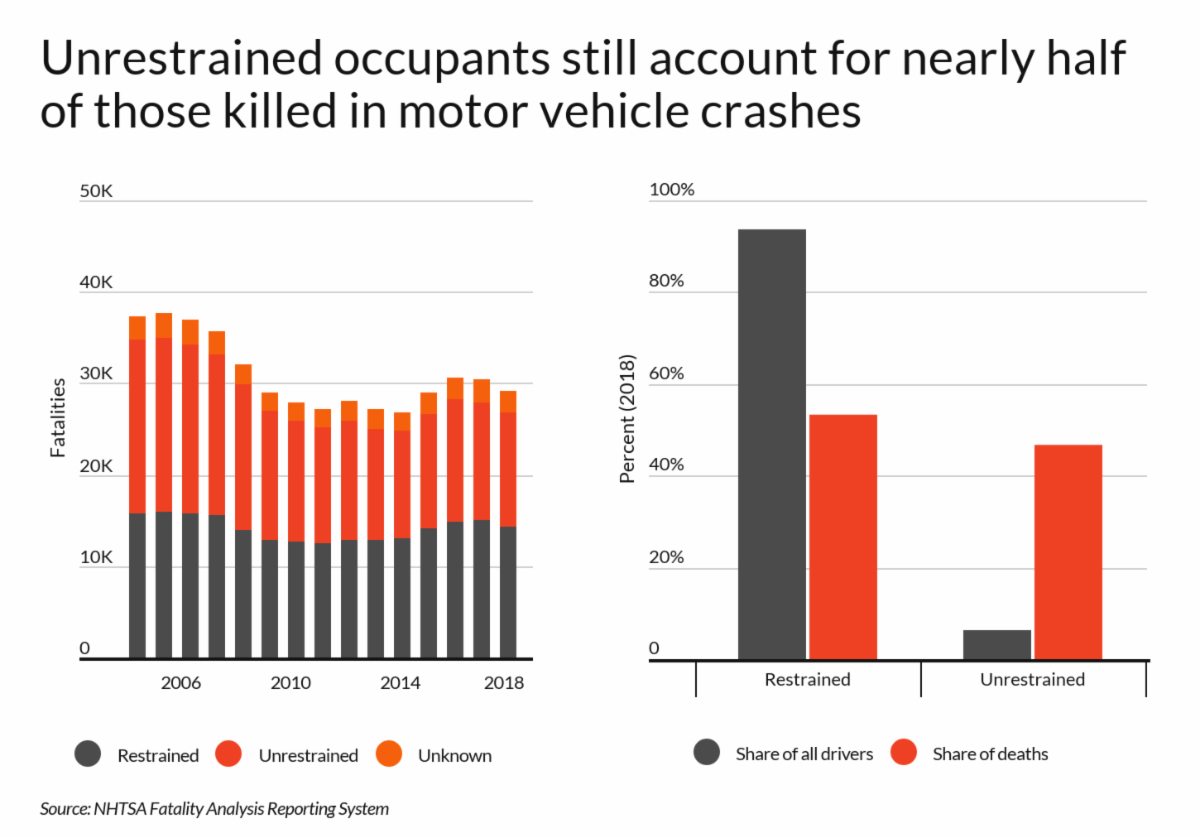
    The number of motor vehicle fatalities has been trending down for decades, driven in large part by more people wearing seat belts. In 2004, more than 19,000 occupants killed in car crashes were unrestrained at the time, compared to 12,426 in 2018. While data from the Centers for Disease Control and Prevention indicates that just 6.3 percent of U.S. adults don’t wear a seat belt all (or most) of the time, unrestrained occupants still account for nearly half of individuals killed in car crashes, according to the National Highway Traffic Safety Administration.

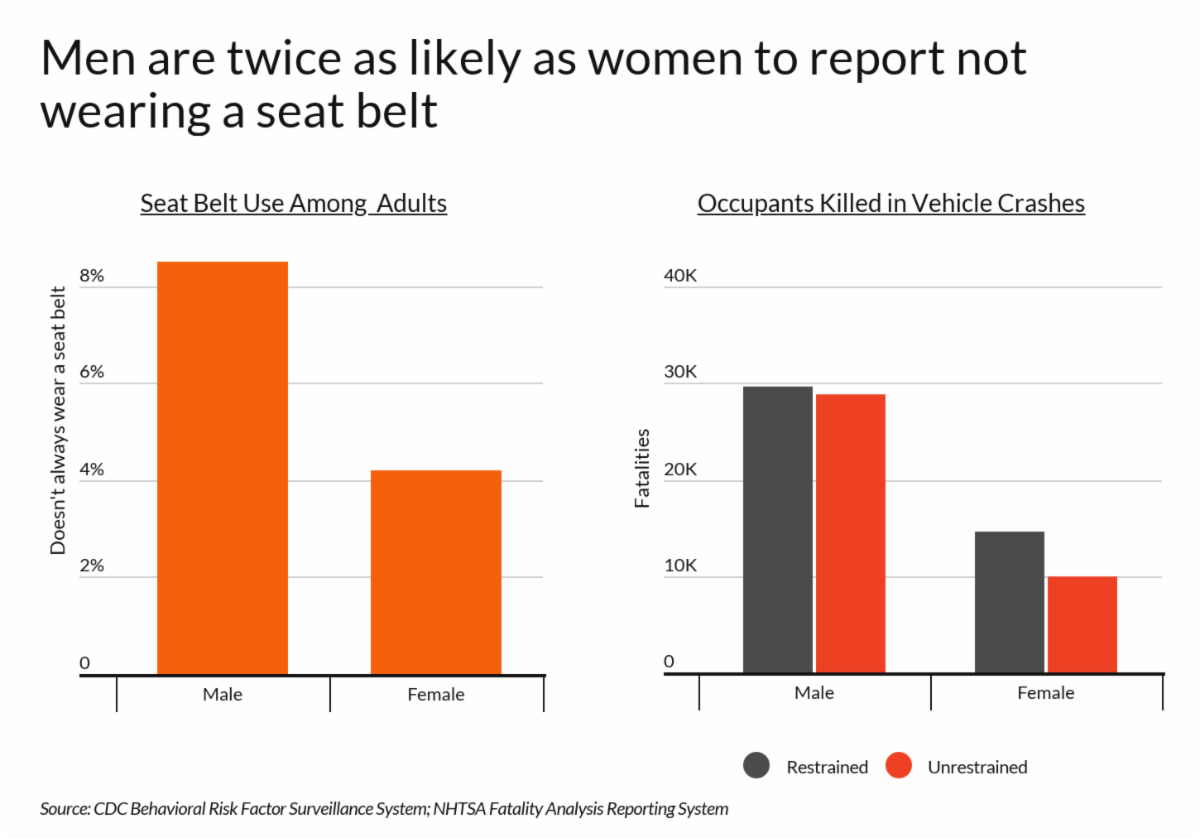
    Despite improvements in restraint use overall, rates vary widely by gender. According to the CDC, men are twice as likely as women to report not wearing a seat belt (8.5 percent compared to 4.2 percent). Men are also about 2.5 times as likely as women to die in car crashes, based on traffic fatality data collected by the NHTSA from 2016-2018. Among all occupants killed in car crashes, men are about three times as likely as women to have not been wearing a seat belt.

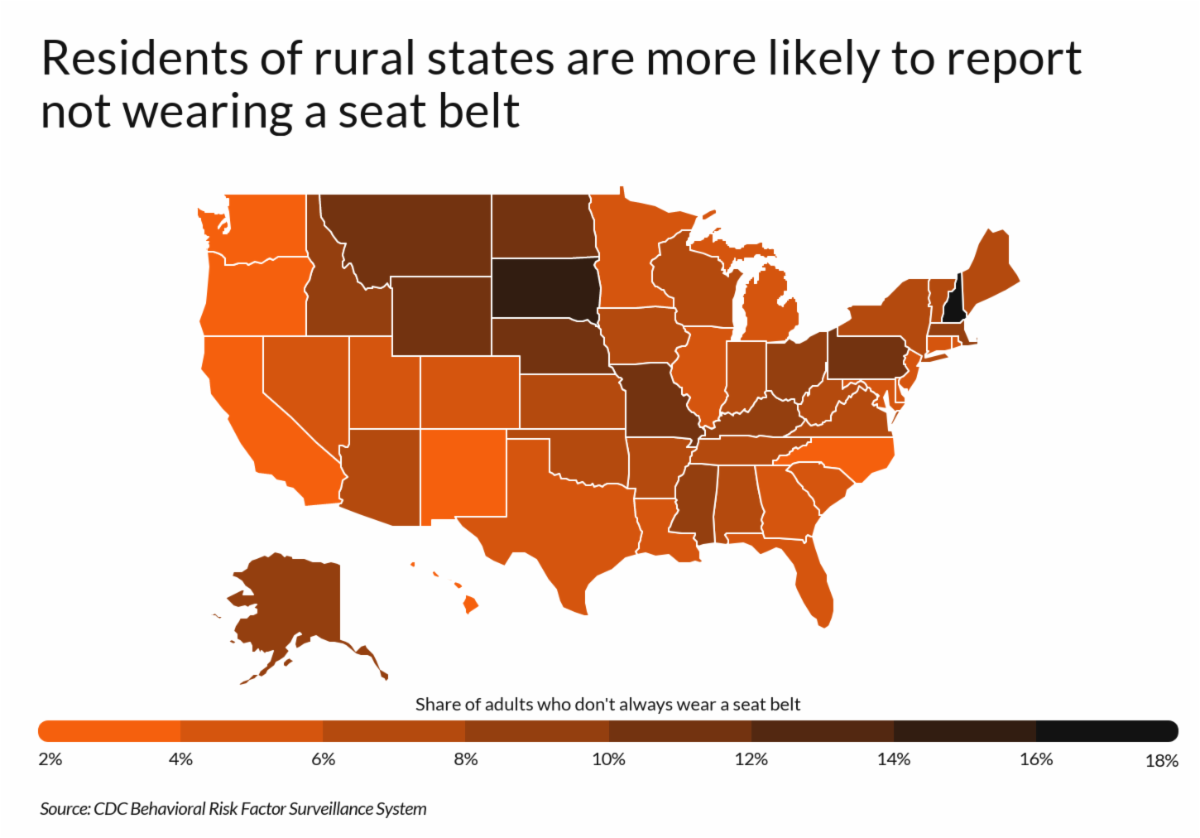
    Location also plays a role in the widespread adoption of seat belts. In general, states with large rural populations are more likely to report large proportions of residents not wearing seat belts. For example, adults in New Hampshire and South Dakota—which have some of the smallest urban populations—are more than twice as likely as average to report not wearing seat belts (17.2 percent and 15.0 percent, respectively). By contrast, California, Oregon, and Washigton—where more than eight in 10 residents live in urban areas—report the highest rates of restraint use in the country.

    To find which states’ residents are least likely to wear seat belts, researchers at CoPilot, a car shopping app, analyzed restraint use statistics from the CDC’s Behavioral Risk Factor Surveillance System. They also analyzed how many unrestrained occupants were killed in car crashes in each state from 2016 to 2018.

    In Ohio, 8.6% of commuters don’t wear seat belts, the 10th highest share of commuters of all U.S. States. Out of all Ohio commuters killed in car accidents, 55.5% were not wearing seat belts. Here is a summary of the data for Ohio:

    • Share of adults who don’t always wear a seat belt:8.6%
    • Unrestrained occupants killed in car crashes (% of total):55.5%
    • Total unrestrained occupants killed in car crashes (2016-2018):1,467
    • Number of car commuters:5,005,125

    For reference, here are the statistics for the entire United States:

    • Share of adults who don’t always wear a seat belt:6.3%
    • Unrestrained occupants killed in car crashes (% of total):46.7%
    • Total unrestrained occupants killed in car crashes (2016-2018):38,752
    • Number of car commuters:131,881,855

    For more information, a detailed methodology, and complete results, you can find the original report on CoPilot’s website: https://www.copilotsearch.com/posts/cities-that-dont-wear-seatbelts/

  • City exploring options for new downtown fire station

    City exploring options for new downtown fire station

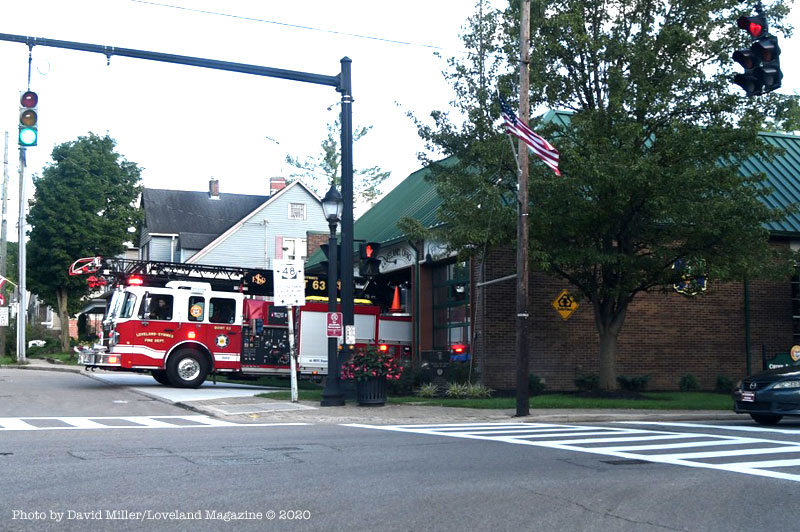
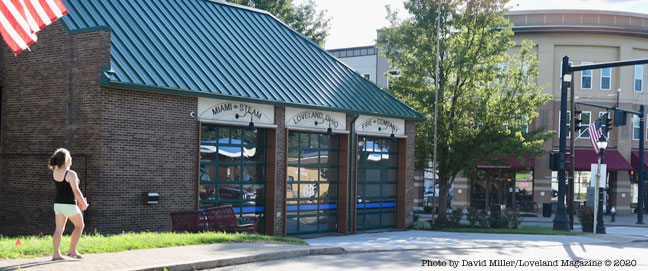
    Loveland, Ohio – The City and the Loveland Symmes Fire Department are exploring options for re-locating Fire Station 63 currently located in Historic Downtown on Second Street. It houses an engine company, a ladder company, and a medic unit. Station 63 is also home to Loveland’s original horse drawn steamer.

    Fire Station 63 in Historic Downtown

    The focus group will meet on Monday August 24 to review a “Fire Station 63 Relocation Report” prepared by MSA Design. You can review the report HERE. The report was paid for from “Fire Funds” at a cost of $12,000.

    The report recommends locating a new Station 63 at 227 East Loveland Avenue.

    Two other locations were studied, one at the corner of Oakland Road and Founders Drive, and the other on a street that may or may not be built connecting Oakland Road to O’Bannonville Road. Both of these alternate locations would have been on a portion of property if the Loveland City School District had purchased land from Grailville for new school buildings. The report says that since the exact locations that might be available for the construction of a new station at Gralville are unknown at this time, neither of these alternate options were studied in great detail.

    In the executive summary of their report MSA says in part”

    “The Department has been working out of a facility in downtown Loveland for many years. Over time, the suitability of this location has been compromised by increased traffic near the station. Additionally, a great deal of redevelopment has been going on in downtown Loveland, making the current station site a potential economic development opportunity. The construction of a new station would also allow the Department to adjust the size and layout to better serve their needs now and into the future.”

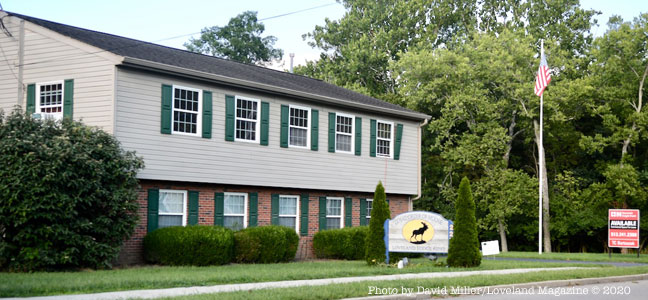
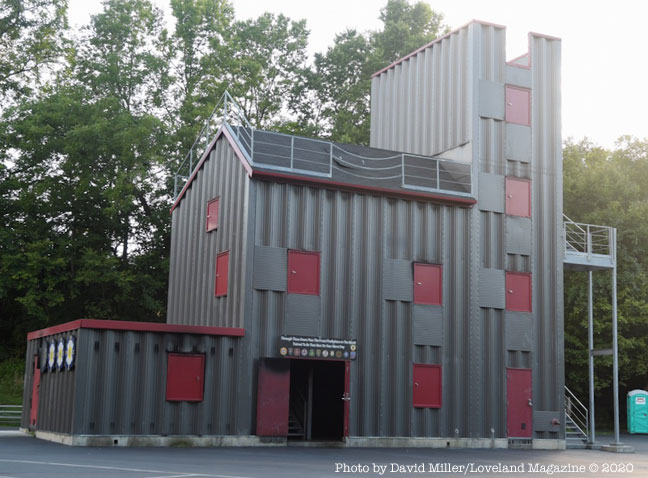
    The site proposed for a new facility is east of its current location, at 227 East Loveland Avenue. The site consists of two parcels, one of which is already owned by the Loveland Firefighters Association, while the other is owned by City taxpayers. The Firefighters Association’s parcel houses an existing meeting hall (Fraternal Order of Moose Lodge) while the City resident’s parcel houses the Fire Department’s fire training tower, a public works facility and parking with access to outdoor recreational facilities including the East Loveland Nature Preserve.

    The Fraternal Order of Moose Lodge on East Loveland Avenue where a new fire station might be built.

    MSA’s report says that a new Station 63 could be constructed on the East Loveland Avenue site for between 5 and 5.8 million dollars ($300 – $350 per s.f.) in today’s dollars. MSA notes the fact that these numbers are given in 2020 dollars and that should be considered when budgeting for a future project.

    City Manager Dave Kennedy told Loveland Magazine today that if a new station is built it will be paid for using the City’s Fire Fund. He anticipates that the City will sell bonds, and he does not anticipate a tax increase to pay off the bonds.

    Members of the Fire Station 63 Relocation Focus Group are, Kathleen Eldredge, Allison Ellis, and Larry Flynn. Also in the group is LSFD Captain Bruce Hawk, representing the fire department, Councilmen Andy Bateman and Ted Phelps representing City Council, and City Manager Dave Kennedy representing City staff.

    A fire training tower is already located on property where a replacement for Fire Station 63 might be built.

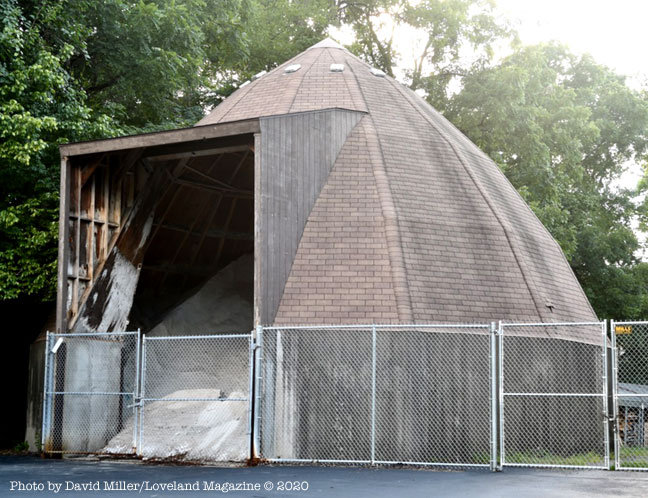
    Kennedy said, “The Firefighter Association owns (part of) the land, They have indicated that if the City desires to build a fire station on that site they would donate the property to the city as they did the property to build the salt dome, the fire tower, and the nature trail parking lot. In the end the City of Loveland would own all of the land and all improvements provided the committee recommends and the City choses that site.”

    The City stores road salt on property where a replacement for Fire Station 63 might be built.

    The current fire station sits on part of the land from the old City Hall and fire station that was destroyed in a fire in the early 1970’s and is owned by the City of Loveland

    Kennedy said about the current fire station, “Returning the property to commercial use could be a possibility or council could choose another public use. At the end of the day the highest best use for the city with all factors considered would be presented to council.” He added that the proceeds of any sale of the current station and property, “would go back to the fund that was utilized to construct the Fire Station which was the fire fund.”

    Kennedy added, “The current fire station is nearly 50 years old and was built to accommodate our volunteer fire department at that time. The Fire Station was built after the city hall and fire station was destroyed by fire in the early 1970’s. Operating out of the fire station is challenging for today’s modern fire service with on duty career firefighters. The station doesn’t provide quick access to apparatus and is challenging to respond from because of location and size of the front apron. Fire apparatus barley fits into the facility and is often damaged due to the size of the garage doors. The station doesn’t have safety and health features that are necessary for the hazards facing firefighters today.”

    The City Manager was asked, however did not offer an estimate of when a recommendation might be forwarded to City Council or an estimate of when construction might start if they do.

  • Act 3 of the Importance of being Earnest

    Act 3 of the Importance of being Earnest

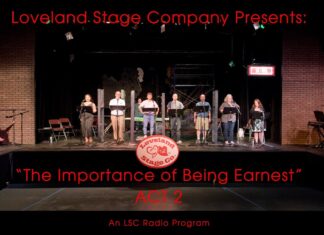
    Loveland, Ohio – Act 3 of The Importance of Being Earnest recorded live at the Loveland Stage Company by LSC Radio in beautiful Historic Downtown Loveland, Ohio is now ready for your viewing pleasure.

    If you want to watch Act 1 & 2 first:

    Watch Act 2 of The Importance of Being Earnest by the…

    cc

    ccc

    Watch Act 3 of The Importance of Being Earnest by the…

    Cast

    Adrianna Boris – Jack
    You may have seen Adrianna on the LSC stage as Philia in “A Funny Thing Happened on the Way to the Forum,” or around town as Rizzo in “Grease” at Mariemont and Footlighters.  Other favorite roles have included Julia in “The Wedding Singer,” Cecily in “The Importance of Being Earnest,” and the Witch in “Into the Woods”. Thanks to Micheal and the whole team at LSC for bringing us together for this project!
    Carissa Griffith-Sloan – Foley Artist
    Carissa is no stranger to the LSC stage. She has appeared onstage in a number of LSC productions including The Drowsy Chaperone (u/s Drowsy), White Christmas (Martha), Young Frankenstein (Frau Blucher), and many others. Another favorite role was Grempkin in Peter and the Starcatcher at Footlighters.  Carissa would like to thank her husband, John, for always being her favorite scene partner, and everyone involved with putting this production together.
    David Taylor – Composer, Piano
    David is a keyboard player who enjoys the challenge of creating great sounds and performing.  He has performed for many community theatre companies and high school drama productions in the Cincinnati and Northern Kentucky areas including several CMT productions.  Favorite shows he has performed in and created the sounds for include The Producers, Young Frankenstein, The Toxic Avenger, Seussical the Musical, Big Fish, and Shrek.  By day, David is a Financial Analyst for Coesia managing the forecasts and budgets for all of the North America, Mexico, and South America regions.


    Jacqlyn Schott – Algernon
    There’s magic in the number three and Jacqlyn couldn’t be more elated to return to Loveland’s stage for the third time as a part of such a fun trio! Three of her favorite past credits include Spider (James and the Giant Peach), Caroline Bramble (Enchanted April), and directing Ordinary Days. This fall, Jacqlyn will be reprising the role of director for Little Shop of Horrors and hopes you’re already planning on return visits to LSC so “you too can be a star!” As always, she thanks her loved ones for their never-ending support.
    Jill Gornet – Lane/Merriman
    Jill is excited to be co-producing Gypsy, which is one of her favorite musicals. She was co-producer for Bugsy Malone, Jr., Don’t Drink the Water and A Funny Thing Happened on the Way to the Forum. Jill won an Orchid as the producer of The Drowsy Chaperone. She was last seen on-stage at LSC in Memphis (Clara/ensemble), White Christmas (quintet/ensemble), Will Rogers Follies (quartet) and Fiddler on the Roof (Rifke/ensemble). Retired from USPS, she sings with Sharonville Chorus at retirement/assisted living homes. Jill would like to thank her family and friends for their love and support.
    John Sloan – Gwendolen
    John is back once more at Loveland Stage Company.  He has appeared in too many LSC shows to list them all, but favorites include: Young Frankenstein (Igor), Oklahoma! (Jud Fry), Thoroughly Modern Millie (Ching-Ho), and The Producers.  He last appeared in The Drowsy Chaperone (Gangster #1) which was directed by his lovely wife, Carissa, and has directed the recent LSC productions of A Funny Thing Happened on the Way to the Forum and Don’t Drink the Water.  Thanks to Micheal for this opportunity.  Enjoy the show and thank you for supporting the arts!
    Joshua Marcus – Miss Prism
    This is Joshua’s first performance with Loveland Radio, but has previously been seen on stage in, The Drowsy Chaperone (George) and Cole, An Entertainment (Performer). He is excited to be a part of another amazing Loveland production. Joshua would like to thank his wife, Leah, and his children, Hanna and Samuel, for their love, support.
    Melinda Murray-Hubbard – Chausible
    Melinda is glad to be back once again with LSC after performances in Cole, An Entertainment and The Drowsy Chaperone. She has also recently been seen as Sponge in Bart’s Bards’ James and the Giant Peach, and was a costume assistant for the LSC production of Bugsy Malone, Jr. Dr. Hubbard is always up for something new, and this show fits the bill! She thanks her incredible family for supporting her and the amazing folks at LSC for this opportunity. Ya’ gotta get a gimmick!
    Thomas Cavano – Lady Bracknell
    Tom has been involved with community theater in the Cincinnati area for over 30 years. He first performed with LSC in 2008 (The King and I). Since then, he has performed in numerous LSC productions, directed three award-winning shows (Spelling Bee, The Producers, and Young Frankenstein), co-produced many shows, the most recent being Memphis, and has taken an active role in off stage work including set construction, design, decor and stage crew.
    Vincent Eldridge – Cecily
    Vincent has thoroughly enjoyed being a part of this genderswapped version of The Importance of Being Earnest. He has been seen on stage as Gangster #2 in The Drowsy Chaperone at LSC, as part of the Octet in Sweeney Todd with Queen City Productions, as was in the Gender Bender last October with Mason Community Players. When he’s not on stage, he enjoys learning the art of lighting and was the lighting designer for The Little Mermaid and Sorry, Wrong Number/The Hitch-Hiker. Outside of theatre he spends his free time painting and trying his best at woodworking. He’d like to give a shout out to the rest of the cast, the crew, and the director for making this a wonderfully fun experience!

    Crew

    Bob Kessler – Tech Director
    Bob works as both a Director of Photography in the regional video community, and as an artist at Kessler Studios, a Loveland-based stained glass and mosaic firm. Bob has served as the Lighting Chair for the Loveland Stage Company since 2013, and has volunteered as Lighting Director on many plays at LSC: Cole: An Entertainment, Memphis, 9 to 5, Jekyll & Hyde, Fiddler On The Roof, I Remember Mama, Oklahoma!, and The Producers.
    Charlie Rader – Camera Operator
    Dave Bauer – Audio Director
    The webmaster of LSC’s award-winning website, Dave brings a lifetime of passion for all things music, sound and photography.  By day, Dave works in schools in Southwest Ohio maintaining computer systems and making sure teachers have the technology they need.  By nights and weekends, Dave is the owner of Technology Concierge Services and is the sound designer for two local bands.  This is Dave’s first involvement in an LSC production.
    Greg Smith – Lighting Design
    An Orchid award-winning Lighting Designer, Set Designer and Producer, Greg always enjoys doing lighting design for a musical at LSC.  The opportunities for creativity are endless when working with such a talented cast and crew.
    Micheal Harris-Kiser – Director
    Micheal is a multiple award-winning director, actor, and set designer. Studying acting at The American Academy of Dramatic Arts, Micheal has pursued his passion for theatre in various fields. He is co-founder of Stage and Steel in Pittsburgh, PA. He has performed with many groups throughout the city. His set designs have graced many a stage. He serves as secretary for the LSC board, as well as secretary for The Greater Cincinnati ACT board. He is extremely happy to bring this great musical to you.
    Nancy Hartman-Downing – Camera Operator
    Nancy has been Owner/President of Cleveland Specialties Company since 1986, which designs and manufactures paperboard and plastic packaging products for the food and dairy industry. Her experience is in administration, sales, accounting and computer technology. She holds a B.A. in Business Administration from Baldwin-Wallace College. She currently serves as President for Loveland Woman’s Club. Nancy has been involved with LSC since 2006 doing fundraising, photography, publicity, ticket sales, program ad sales, as well as serving on the Board of Directors as Treasurer. She enjoys working with such a talented group and looks forward to continuing her involvement into the future.

    The Covid-19 pandemic has hit all of us very hard. Among those most impacted have been the people of the entertainment industry – actors and actresses, musicians, performing artists of all types. Also affected, those behind the scenes, riggers and stagehands, lighting and sound designers, makeup and costume designers, carpenters, electricians and all those who make the art of live performance possible.

    Their desire to “get back at it” is fierce. They love doing what they do.

    Everyone involved in Loveland Stage Company counts ourselves among those mentioned above. And while our “day gig” may or may not have been as seriously impacted, our desire to “get back at it” is strong.

    Out of the lemons of the Covid-19 pandemic, Loveland Stage Company proudly brings you LSC Radio! While we can’t be on stage performing live for you right now, we can bring performances that hearken back to the “good old days” of radio broadcasts. In addition, we’ll have video cameras rolling so you can see our “broadcast” as it happened. We can continue to maintain social distancing and other best practices required these days and still perform for you!

    Loveland Stage Company will bring you a new production in both audio only and video with audio approximately once a month. But we’re not doling it all out at once! Oh, no. Each Act of our production will be released once weekly (we anticipate on Friday) for your weekend viewing/listening pleasure! All productions will be listed below and accessible from here or the main menu above (under LSC Radio).

  • OhioVets.gov now aligned on InnovateOhio Platform

    OhioVets.gov now aligned on InnovateOhio Platform

    Columbus, Ohio – You may not have noticed that the comprehensive website for the Ohio Department of Veterans Services –OhioVets.gov – is new and improved. However, they are now aligned with the InnovateOhio Platform (IOP). As part of IOP, the site is now better connected with other state agency websites.

    A press release announcing the merger says that IOP also enables them to become more customer-centric and data-driven to better serve Ohioans. “When you visit OhioVets.gov, you’ll immediately see a cleaner and easier-to-use format.”

    Here are some specific improvements to the site:

    ·A more powerful search feature that quickly can take you to any resource found on the website

    ·A “News” section featuring timely information including links to online articles highlighting the accomplishments of Ohio veterans

    ·A complete archive of ODVS newsletters and annual reports, which outline department initiatives and outreach

    ·A timeline of events that includes dates and directions to upcoming public meetings

    ·A daily chart detailing COVID-19 statistics and measures in place at the Ohio Veterans Homes in Sandusky and Georgetown

    · A more robust “Veterans Benefits” section of the website with updated listings, including a military voting page

    The structure of the website has been streamlined to make information easier to access. Some of our most popular landing pages remain intact. For example, the Ohio Veterans Hall of Fame can be accessed from the “What We Do” branch of the website. Similarly, Ohio Women Veterans resources can be found in the “Resources for Veterans” branch of the site.

    Improving veteran employment remains an important aspect of OhioVets.gov. By delving into the “Jobs & Education” branch of the site, you’ll find updates on our Ohio Veterans Workforce Team, veteran-hiring initiatives, and more.

    ODVS’s commitment to “serving those who served” can be found while discovering the Ohio Veterans Homes (OVH) section on the site have to offer. Visible on the new OVH branch of the site are new videos, updated forms, and interactive tours, among other features.

    In general, the new ODVS website provides more ways of engagement and better documents our interactions with Ohio’s former service members and military families. A good example of this can be seen by browsing our popular On the Road videos page.

    So remind your friends they can go to the footer of any ODVS web page and register for updates.

    InnovateOhio Platform

  • Clermont authorities report increase in meth, cocaine and LSD after spring slowdown

    Clermont authorities report increase in meth, cocaine and LSD after spring slowdown

    Lt. Nick DeRose noted that the county also has experienced a rise in cocaine traffic – almost all laced with fentanyl – and LSD in recent weeks.

    Batavia, Ohio – Clermont County law enforcement and treatment specialists are noticing an uptick in methamphetamine (or meth) after a slowdown during the spring shutdown of the economy.

    The Clermont County Opiate Task Force touched base on drug and alcohol trends in the era of COVID-19 in an Aug. 13 meeting.

    For Help 24/7 Call: 528-SAVE (7283)

    Sheriff’s Office Lt. Nick DeRose, commander of the Clermont County Narcotics Task Force, said both volume and prices of meth have increased substantially in July and August. He noted that the county also has experienced a rise in cocaine traffic – almost all laced with fentanyl – and LSD in recent weeks.

    Fentanyl is a powerful synthetic opioid analgesic that is similar to morphine but is 50 to 100 times more potent. Lysergic acid diethylamide (LSD), also known colloquially as acid, is a hallucinogenic drug. Effects typically include altered thoughts, feelings, and awareness of one’s surroundings. Many users see or hear things that do not exist. Dilated pupils, increased blood pressure, and increased body temperature are typical, according to a news release issued by the County.

    “COVID slowed things down, but come June there was a major increase – mainly a mixture of meth with fentanyl,” said Lt. Matt Green of the Union Township Police Department. “Some are doing meth and cocaine and not knowing they’ve been laced with fentanyl.”

    The department has handled 40 overdoses in the past two months, Green said.

    The report also noted that people who use meth experience a roller coaster of emotions, members of the task force reported. Many meth users are fidgety with nervous energy. They often experience psychosis, with symptoms including delusions, hallucinations, talking incoherently, and agitation. The person with the condition usually isn’t aware of his or her behavior.

    Dr. Shawn Ryan of BrightView said meth causes the body to produce an amount of brain hormones “off the chart.” He added that it’s difficult to normalize the hormones as part of a treatment plan.

    Jamie Lutson of Clermont County Municipal Court Probation said she had noticed a big increase in females addicted to meth. “Some say they are using the drug to stay awake so they can work and take care of their children.”

    Lutson added that alcoholic relapses occurred more frequently as treatment programs “came to a screeching halt.”

    Lee Ann Watson, associate director of the Clermont County Mental Health & Recovery Board and co-chair of the Opiate Task Force, said the group will use the input to help target efforts to address the situation.

  • Feds release unemployment guidance, could be a long time before supplements reach Ohioans

    Feds release unemployment guidance, could be a long time before supplements reach Ohioans

    By Marty Schladen Ohio Capital Journal

    As promised, the U.S. Department of Labor last week released guidance to the states on how it will disburse money to supplement unemployment checks. But it’s far from clear when — or whether — hundreds of thousands of out-of-work Ohioans will see those funds.

    A $600-a-week federal supplement had been credited with keeping millions of unemployed Americans — and the economy — afloat, but it expired at the end of July. 

    The Democratically controlled House passed an extension of the benefit. The Republican-controlled Senate introduced a bill cutting the supplement to $200 a week, but failed to pass it.

    Then President Donald Trump on Aug. 8 signed a memorandum that would repurpose federal disaster relief funds to provide $300 a week in additional support. But it would exclude people getting less than $100 a week in state benefits — a group comprising many minimum-wage workers and service workers who get a low hourly wage and tips on top of that.

    The administration of Gov. Mike DeWine signed on to the plan on Monday, saying that additional guidance was needed from the Labor Department before any predictions could be made about when funds would be disbursed.

    The money can’t come quickly enough for many Ohioans. 

    According to the U.S. Census’ Household Pulse Survey for the week of July 9-14, nearly 1 million Ohio adults sometimes or often did not have enough to eat in the past week. In addition, more than 400,000 hadn’t paid the previous month’s rent and 360,000 homeowners hadn’t made the previous month’s mortgage payment.

    “This is before the $600 (federal unemployment supplement) expired,” Zach Schiller, research director for the think tank Policy Matters Ohio, said.

    Earlier in the week, DeWine also underscored the urgency of getting money out to unemployed Ohioans. He praised Trump for taking the actions he did and he called on Congress to get busy — something that’s unlikely to happen until early September at the soonest.

    However, state officials have to clear several hurdles before they can start distributing the federal dollars Trump has attempted to repurpose.

    For example, “States will need to develop a self-certification process in accordance with FEMA instructions for claimants to certify weekly that they are unemployed or partially unemployed due to disruptions caused by COVID-19,” the Labor Department guidance says.

    And state officials will have to reprogram antiquated, overwhelmed unemployment systems to process the benefit.

    “We are examining the DOL guidance on lost wages assistance to see what kind of system programming is needed in order to pay these unemployment benefits,” Dan Teirney, DeWine’s press secretary, said in an email. “As noted in the guidance, all states are required to develop a self-certification process for claimants based on instructions from FEMA.”

    He said that once state officials figure all that out, they’ll make beneficiaries whole, but it’s hard to know when that will be.

    “While (the Ohio Department of Jobs and Family Services) intends to pay these retroactive benefits as quickly and efficiently as possible, there are several procedural and programming steps that must take place before that can happen,” Tierney said.

    There is also a serious question about whether the Trump plan is legal. Georgetown University law professor David Super last week wrote that it is a clear violation of the Stafford Act, the federal law governing disaster assistance.

    Schiller criticized the scheme as ill-conceived at a time when so many Ohioans are in desperate need of assistance.

    “Altogether, the whole thing is kind of a half-baked measure,” he said.


    Marty Schladen

    Marty Schladen has been a reporter for decades, working in Indiana, Texas and other places before returning to his native Ohio to work at The Columbus Dispatch in 2017. He’s won state and national journalism awards for investigations into utility regulation, public corruption, the environment, prescription drug spending and other matters.
  • Loveland Frogman Race 2020 is Saturday Sep 12

    Loveland Frogman Race 2020 is Saturday Sep 12

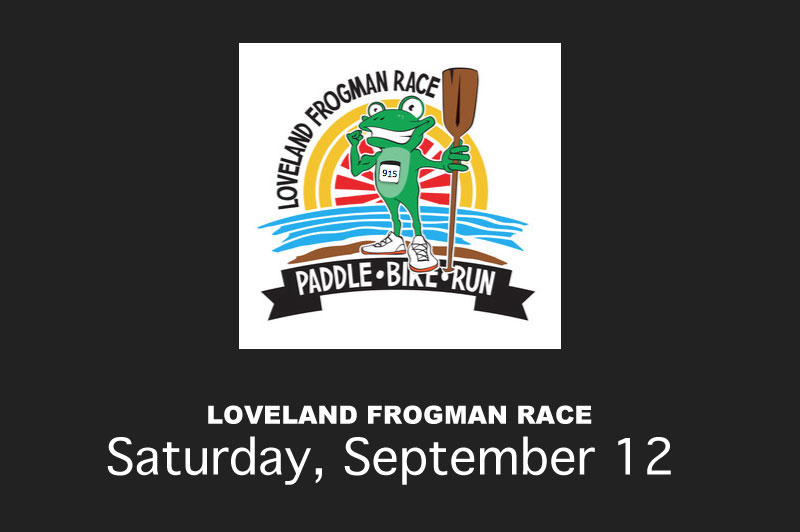
    Saturday, September 12
    8:30 AM Start
    7:30 AM Registration Opens

    Location

    Downtown Loveland – All transitions are located at Loveland Canoe & Kayak (174 Karl Brown Way)
    Miami Township – Bike Path & Miami Riverview Park

     
    Join us for the 6th annual Frogman event: The Frogman Race is comprised of:

    5 Mile Kayak
    8 Mile Bike
    5K Run

    You may compete as a two person team (use a tandem kayak)
    or individually (use a kayak). 

    REGISTER NOW >Please note: The minimum age for competing on a team is 10 years old
    and as an individual is 16 years old.

    $130/Team
    $70/Individual
    ($10 discount if registered before August 16)

    The race will begin at 8:30 a.m. with a staggered start.
    Registration/Check-in will begin at 7:30 a.m.

    Please note this race has been reviewed and approved by the Hamilton County Board of Health. All participants must adhere to race safety and health regulations, including social distancing, masks, and sanitizing.

    NO spectators will be permitted at the 2020 event.
    Packet Pick up will be at JackRabbit Running Store of Loveland on Friday, September 11.

    Race will begin and end with all transitions at Loveland Canoe & Kayak (174 Karl Brown Way). All participants will be bused to start line (Carl A. Rahe Access).  Singles in kayaks will start the event, followed by team canoe divisions.

    Race Divisions:

    Team (16+), Parent/Child Team (10+), Male (16+), Female (16+), Senior (55+)

    Event t-shirts will be available for purchase (pre-order only) for $20 each.

    Canoes, kayaks, life jackets, and paddles will be provided.  Participants are to provide their own bicycle (road bike is recommended).  Life jackets must be worn at all times while on the water.  Bike helmets must be worn at all times while on your bike.  No headphones are allowed during any portion fo the race.  Failure to comply with the safety rules will subject contestants to disqualification.

    A photo ID is required and waiver must be signed and submitted in order to receive your race packet and bib/timing chip.  This is a rain or shine event and there are NO refunds.  In the event of severe weather the start may be delayed and the course may be altered for safety reasons.

    Please respect your fellow participants.  There will be all types of skill levels competing so please stay aware of your surroundings at all times.

    Bike’s can be rented locally at Loveland Bike Rental and Montgomery Cyclery.

    This race can be used as a Warm-up to Morgan’s Little Miami Triathlon.

  • A new Library website and app are headed your way Monday

    A new Library website and app are headed your way Monday

    by Kelly Sheehy, Content Specialist, Downtown Main Library

    There’s big news at the Library. We’re creating a new website and app to improve your experience online. It’s been nearly a decade since your Library’s website had a refresh.  With more than 3,400,000 unique visits per year and an ever-increasing amount of browsing done from mobile devices, the time is right for an upgrade.

    In fact, last year during our community listening sessions that took place at all 41 Library locations to inform the creation of our Facility Master Plan, one consistent piece of feedback we got was that our website was outdated and difficult to navigate. We heard you loud and clear!

    We’re doing everything we can to ensure that our new website and app will be easy to use, and will connect you quickly to the information you’re looking for. The site and app will automatically adjust to any screen size, from smartphones to large monitors. We’ll also be using inclusive design features that bring our site up to date for customers who are partially sighted or use screen readers.

    Smarter search 

    Our new website and app will use a natural-language search, just like you’re used to on the rest of the web. Natural language detection means you’ll more easily find what you’re looking for.

    All in one place 

    Our current website has separate platforms for our catalog, events calendar, and website information, like our location pages. The new site and app will seamlessly integrate all three so you can have a consistent experience.

    Better browsing, together 

    You’ll be able to browse new titles, award winners, and lists created by Library staff and other readers. Ratings, comments, and tags will help you choose the perfect item from the Library’s collection.

    Creating your own login means you’ll have access to a customized experience with personal record-keeping tools like My Shelves, My Lists, and My Profile.

    Other new features include:  

    • Place a hold in one click
    • Save items to read, watch, or listen to later
    • Track what you’ve read, watched, or listened to
    • Share, rate, and review your favorite materials
    • View lists of favorite materials created by other customers and staff members
    • Relax with improved security and privacy – the only information that’s shared with others is what you choose to share!

    Coming Soon 

    You can expect to see our new and improved look later this summer. We’ll keep you posted on new developments as they arise. We can’t wait to share the new site with you—we think you’ll love it!

    In-person Services Resume

    Find out when limited in-person service returns to your branch.

  • JUST ANNOUNCED: Hamilton County Nonprofit Relief Program

    JUST ANNOUNCED: Hamilton County Nonprofit Relief Program

    Hamilton County has received $142 million in CARES Act funding to combat the ongoing impacts of COVID-19 in the community.

    Many nonprofit organizations located in Hamilton County have provided and will continue to provide essential social and family services to Hamilton County residents during the COVID-19 public health emergency.

    To assist those organizations with necessary expenditures incurred due to the public health emergency with respect to COVID-19, Hamilton County has allocated up to $5 million to nonprofit organizations as a part of its CARES Act Plan. While nonprofit organizations that have increased expenses due to the COVID-19 public health emergency are eligible to apply for funding through this Program, funds provided as a part of this Program can only be used for necessary expenditures incurred due to the public health emergency with respect to COVID-19.

    In addition, Hamilton County through the Hamilton County CARES Act Plan has allocated $500,000 for nonprofit organizations that provide domestic violence supportive services which have experienced increased expenses due to the COVID-19 public health emergency. Except in the case of a nonprofit organization that has a distinct program that addresses domestic violence supportive services, an organization can only submit one application for funding. Organizations that receive funding for domestic violence supportive services and another program must have internal controls in place to separately account for any funding received. For questions regarding the program, please email NPRelief@hamilton-co.org.

    Sign-up here for email notifications on future opportunities.

    ELIGIBILITY REQUIREMENTS

    In order to apply for funding nonprofit organizations must meet the following eligibility criteria:

    1. Organized as a nonprofit entity under the laws of the State of Ohio and recognized as a 501(c)(3) tax exempt organization by the Internal Revenue Service.
    2. Is operated for charitable purposes.
    3. Its principal place of business and location(s) where services are rendered is in Hamilton County.
    4. Provides essential social and family services to Hamilton County residents, which include, without limitation, access to food, domestic violence supportive services, workforce development, substance abuse, services benefiting senior citizens, and foreclosure prevention.
    5. Has the ability to demonstrate and document that from March 15, 2020 to November 15, 2020, it has incurred increased costs or will incur increased costs due to the public health emergency with respect to COVID‐19.
    6. Will not use Hamilton County CARES funding in place of or instead of local, state, federal, or other funds already designated for that expense or activity.
    7. Registered with State of Ohio Attorney General’s Office: https://www.ohioattorneygeneral.gov/Business/Services-for-Charities/Charitable-Registration.aspx.
    8. Can provide independently reviewed or audited financial statements.
    9. Is currently in compliance with all treasury regulations, including those applicable to its status as an organization recognized as tax exempt under I.R.C. 501(c)(3) and a nonprofit organization under Ohio law.
    10. Has been in operation and provided essential social and family since at least January 2019.
    11. Has prior experience in successfully managing federal, state or local financial assistance and/or grant funding.
    12. Will not use funding from this Program for rental assistance, homeless shelters that receive Emergency Solutions Grant, or pandemic child care. However, in the case of child care organizations, those organizations with allowable expenditures greater than those paid from the Hamilton County Pandemic Childcare Program are eligible to apply for this assistance.

    INELIGIBLE SERVICE PROVIDERS AND PROGRAMS

    The following service providers and programs are ineligible to apply for Hamilton County CARES Nonprofit Relief Program:

    1. Schools and universities;
    2. Arts/Arts Enrichment organizations;
    3. Hospitals, medical practice groups, health care organizations;
    4. Rental assistance programs; and
    5. Homeless shelters that are within the Continuum of Care.

    FUNDING AMOUNTS AND PAYMENT BY HAMILTON COUNTY

    Expected Funding – Minimum of $25,000 – Maximum of $250,000

    It is expected that funding amounts will be between $25,000 and $250,000.  Those organizations approved to receive under $50,000 will receive 100% of its funding once the application has been approved and the required agreement has been signed by all parties.  Those organizations approved to receive over $50,000 will receive 50% of its funding once the application has been approved and the required agreement has been signed by all parties and the remaining funds will be provided after the submission and review of the final close-out report.

    As outlined in the Hamilton County CARES Act Plan, $500,000 has been set aside for organizations providing domestic violence supportive services and will be subject to the limitation and payment rules set forth above.

    Non-profit organizations that receive funding from the Program must submit final close out reports including source documentation to Hamilton County by November 30, 2020 that evidences and substantiates its increased expenses caused by, or in response to, the COVID-19 public health emergency.  Such source documentation may include, without limitation, payroll records, invoices, receipts or cancelled checks.  Hamilton County will review close out reports and source documentation to ensure all expenses are CARES eligible. If any expenses are deemed ineligible or not properly documented, the non-profit shall return those funds within 7 days of request.

    All unused/unexpended funds shall be returned to Hamilton County by November 30, 2020, without need for demand by Hamilton County.

    INELIGIBLE EXPENSES

    1. Revenue replacement;
    2. Construction costs (supplies and materials are not ineligible);
    3. Overhead costs;
    4. Costs for political activity, including lobbying;

    All costs which are ineligible per the most recent U.S. Treasury guidance dated July 8, 2020: https://home.treasury.gov/system/files/136/Coronavirus-Relief-Fund-Frequently-Asked-Questions.pdf.

    Guidance to State and Local Governments page link: https://home.treasury.gov/system/files/136/Coronavirus-Relief-Fund-Guidance-for-State-Territorial-Local-and-Tribal-Governments.pdf.

    If additional guidance is issued, it will be shared with applicant agencies.

    PROCESS

    Applications will be reviewed for completeness and eligibility by Hamilton County staff. Incomplete applications will not be scored. If a nonprofit organization does not meet the eligibility criteria, its application will not be scored. No amendments or additions can be made once the application is submitted.

    Applications will then be reviewed and scored by members of the Community Development Advisory Committee who complete this task for County HUD funded programs. Hamilton County will ultimately determine the amount of funding to be provided to a nonprofit organization.

    The following will be used for scoring applications:

    ISSUE EVALUATION SCORING
    Completeness Submitted all documentation Yes/No
    Eligibility Meets all criteria Yes/ No
    Increased Demand for Service Percent increase in the number of additional residents or households served from March 15, 2020 to July 31, 2020 compared to typical service levels during that same time period in 2019 30 points if 50% increase or more
    20 points if 36% to 49% increase
    10 points if 21% to 35% increase
    5 points if 10% to 20% increase
    0 if 1% to 9% increase
    Anticipated Demand for Service Anticipated percent increase in the number of additional residents or households served from August 1, 2020 to November 15, 2020 compared to typical service levels during that same time period in 2019 0 to 10 points
    Type of Service Provided Services address an essential need as a result of the public health emergency with respect to COVID-19 20 points for essential social and family services, including without limitation, access to food, substance abuse assistance, domestic violence support services, mental health services, and foreclosure assistance
    10 points for other services including workforce development, employment training, senior services or other social and family service
    Creativity and Adaptation of Service Delivery Necessary changes and adaptations made by the organization to permit it to continue serving clients during the COVID-19 public health emergency Up to 20 points for implementing effective and necessary changes in order to maintain service delivery (changing to virtual services, developing partnerships with other service providers, implementing or improving phone/email communication options for clients, retrofitting buildings)
    Budget Narrative Budget justification and description of increased expenses and how they were necessary and in response to COVID-19 public health emergency 0 to 10 points
    Max Total Points 90

    HOW TO APPLY

    The deadline to apply is August 26 at 12 p.m. Register at the following link:

     https://portal.neighborlysoftware.com/hamiltoncountyoh/participant/

     Program Application User Guide.