Author: Loveland Magazine

  • Statement by Dr. Crouse in regard to derogatory comments on social media about Military service

    Statement by Dr. Crouse in regard to derogatory comments on social media about Military service

    A post allegedly made by a Loveland School staff member that many in the community consider disrespectful to military service and the choice many Loveland students make upon graduation has spread through social media. Loveland Magazine, as well as many of our readers, have seen the alleged post however we are not at this time prepared to publish the alleged post or identify the staff member involved.

    Any comments to this story that attempt to publish the comment or identify the staff member will be immediately deleted as we will follow the guidance of the District and trust their handling the matter.

    Statement by Dr. Crouse in regard to derogatory comments on social media

    Disparaging our veterans or discouraging those who might one day serve our country in uniform is not acceptable conduct and I do not in any way condone those actions. I am sorry for the distress that comments by a district staff member have caused, and we are taking appropriate actions as a result.
        We have the highest regard for veterans in our schools and fully support our students who enter the military.  In fact, we now celebrate a military “signing day” to recognize those students in the same way in which we recognize athletic signing decisions.         Our district also publicly recognizes its veterans at special events, invites them to speak in our classrooms and takes advantage of special recognition opportunities, such as Veterans Day and Memorial Day. Veterans have dedicated parking spots at each of our campuses.
        We hold our employees to a high professional standard both in and outside of school.  We do not condone any behavior that is offensive, rude, or disrespectful.  While I cannot comment further on the specifics of this or any personnel matter, concerns such as this one that are brought to our attention are investigated fully and directly addressed with the staff member individually.  Where disciplinary action is warranted, it is applied as appropriate within the limits of Ohio law.
        While we are careful not to impose our opinions on our staff or violate their rights, as a public employer, we have had and will continue to have the highest expectations of our staff.
            – Dr. Amy Crouse, Superintendent


  • Breakfast with the Bots on April 4

    Breakfast with the Bots on April 4

    Loveland, Ohio – Loveland Robotics Boosters’ second annual fundraiser Breakfast with the Bots will take place in the Loveland High School cafeteria on Saturday, April 4 at 8 AM until noon.
       $8 buys you unlimited pancakes, bacon, coffee, juice and fun pancake toppings.
       There will be something for all ages to check out: a FIRST Lego League (FLL) Expo for the younger kids, VEX Robotics for both middle school and high school, and LHS FIRST Tech Challenge (FTC) teams 10464 (The Bionic Tigers) and 5040 (Nuts and Bolts) will be on site as well.
       Tickets are available on

    www.lovelandroboticsboosters.org and also at the door (cash and credit cards accepted). Sponsors are Original Pancake House and Sugar Creek Foods!


  • Ohio Sec. of State moves 2 Clermont County voting locations

    Ohio Sec. of State moves 2 Clermont County voting locations

    Clermont County, Ohio – Out of an “abundance of caution” concerning the coronavirus, Ohio Secretary of State Frank LaRose has ordered the relocation of polling locations in retirement living or senior care facilities. The webpage boe.clermontcountyohio.gov will have the most up-to-date information on what locations have changed.

    Currently, the locations being relocated are:

    Old Locations:

    S.E.M. Villa, 201 Mound Street, Milford, Ohio (Milford City D voters)

    And

    S.E.M. Terrace, 5371 South Milford Road, Milford, Ohio (Milford City E voters)

    New Location:

    Pattison Elementary School, 5330 S. Milford Road, Milford, Ohio

    Additionally, the BOE encourages voters to take advantage of Ohio’s early voting opportunities. The deadline to request an absentee ballot for the March 17 election is noon on March 14. Absentee ballots must be postmarked by the day before the election in order to be counted, or you can drop it off at the Clermont County Board of Elections on March 17 from 6:30 AM until 7:30 PM.

    For any additional questions regarding state response to coronavirus, visit VoteOhio.gov/CoronaFacts.

    Secretary LaRose will be holding a press conference at 10 AM today to discuss Ohio election preparedness in light of the increased concerns about Coronavirus. WATCH


  • Governor DeWine signs emergency order regarding coronavirus (COVID-19)

    Governor DeWine signs emergency order regarding coronavirus (COVID-19)

    DeWine said, the 3 confirmed cases in Ohio creates a “potentially dangerous condition.”

    DeWine orders that normal purchasing and contracting requirements for State agencies that need to procure necessary resources or supplies be suspended.

    The Department of Health will issue guidelines for private businesses regarding work and travel restrictions.

    Voting locations in nursing homes will be re-located.

    Voting locations in schools will be evaluated.

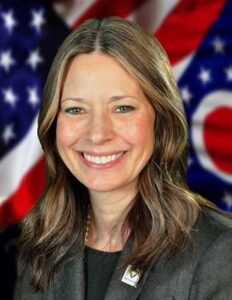
    Dr. Amy Acton, Ohio Director of Health

    Dr. Amy Acton, Ohio Director of Health said today, “People need to know that it won’t be life as normal in this country for a while.” She also said that in order to protect the most vulnerable in your household or the most vulnerable you come in contact with you must act as if you yourself have the virus.

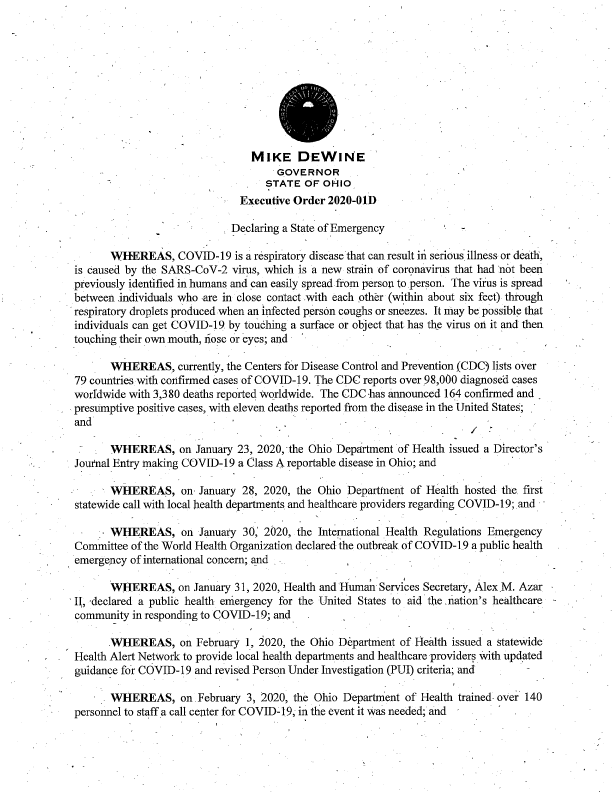
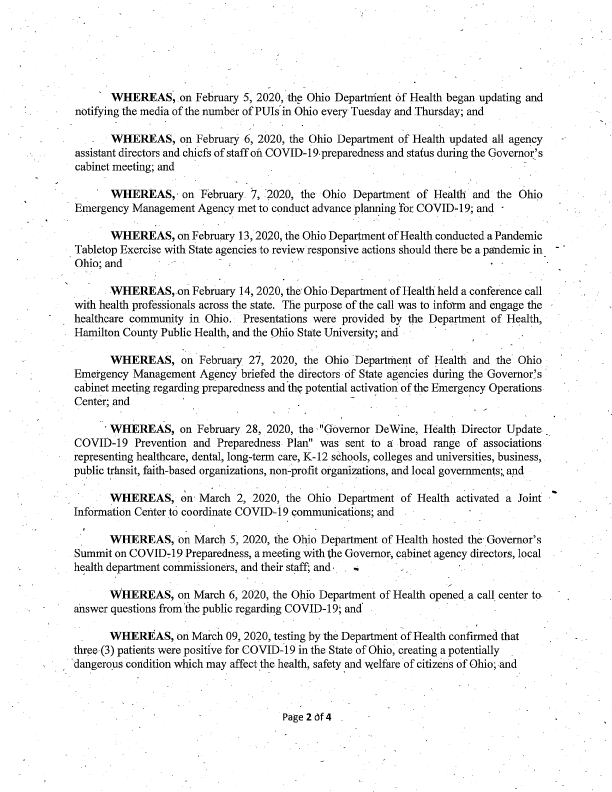
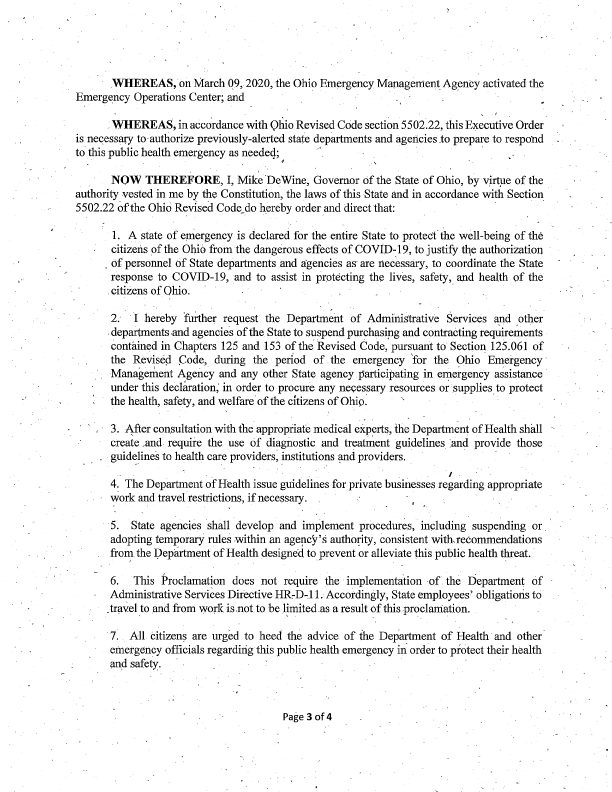
    Ohio Governor Mike DeWine today took a number of actions in response to the coronavirus (COVID-19). He signed Executive Order 2020-01D, declaring a state of emergency for the entire State to protect the well-being of Ohioans from the dangerous effects of COVID-19. The state of emergency allows state departments and agencies to better coordinate in their response.

    Read the full Executive Order below.

    In addition, Governor DeWine partially activated the state Emergency Operations Center at 1 PM today.

    Also, Governor DeWine, joined by Ohio Department of Health Amy Acton M.D., MPH today announced that three Ohioans tested positive for COVID-19. These are the first cases in Ohio. The three individuals live in Cuyahoga County and have had known contact with those with confirmed diagnoses of COVID-19. Each of the individuals is in their 50s.

    For the latest information on COVID-19, visit coronavirus.ohio.gov.  In addition, those with questions about COVID-19 can call the Ohio Department of Health hotline at 1-833-4-ASK-ODH.

    This video is from News 5 Cleveland of a Press Conference held today.

    Watch the complete Press Conference HERE on the Ohio Channel


  • Ohio Governor and Health Director announce COVID-19 testing protocol

    Ohio Governor and Health Director announce COVID-19 testing protocol

    We encourage all Loveland Area residents to visit the website, www.coronavirus.ohio.gov. This site provides regular updates, answers to frequently asked questions, tips for preventing infectious disease, a household checklist, and informational videos.

    A call center is also open to answer questions from the public regarding coronavirus (COVID-19).

    The call center will be open 7 days a week from 9 AM to 8 PM and can be reached at 1-833-4-ASK-ODH (1-833-427-5634).

    Columbus, Ohio – Ohio Governor Mike DeWine and Ohio Department of Health Director Amy Acton, M.D., MPH announced late Saturday afternoon the state’s protocol for maximizing coronavirus (COVID-19) testing resources now that in-state testing is available.

    “As the COVID-19 situation evolves, the Ohio Department of Health, working in conjunction with hospitals, primary care providers, and other health care experts, has a plan to maximize our testing resources. We are prioritizing the patients who are the most vulnerable to be tested in the Department of Health’s State Laboratory, while ensuring those that need COVID-19 testing will be able to be tested,” said Governor DeWine.

    “We want to reassure Ohioans so there is no confusion. Information is critical to managing an outbreak of any infectious disease, and testing at our state lab offers the greatest ability for all of us to make the best decisions to protect the health of the greatest number of people. We will now be able to turn around results in an estimated 24-48 hours,” said Dr. Acton.

    Since the press release did not say how many samples could be tested, Loveland Magazine followed up with this announcement and placed a phone call through a number provided to the media. What we found out is that the ODH has 2 test kits at their lab in Columbus with the capability to test 300-400 samples and they have requested, “a couple more” kits.

    Ohio Hospitals are being instructed to send samples to ODH in Columbus. All other health care providers, such as primary care physicians have to send samples to one of the two private labs in Ohio that have the capability and certification to test for COVID-19. The spokesperson provided no information on how many tests the private labs can perform.

    For those who are hospitalized and meet the following criteria, samples will be sent to the ODH state lab:

    • Have a fever or signs/symptoms of lower respiratory illness, (e.g., cough or shortness of breath) and have had close contact with a laboratory-confirmed COVID-19 patient within 14 days of symptom onset.
    • Have a fever and signs/symptoms of lower respiratory illness, and a history of travel from affected geographic areas with widespread or sustained community transmission within 14 days of symptom onset.
    • Have a fever with severe acute lower respiratory illness and lack of alternative diagnosis (e.g., negative respiratory viral panel, negative rapid flu).

    For individuals who are not hospitalized but meet the above criteria, calling a physician or other healthcare provider is appropriate. If that healthcare provider determines a COVID-19 test is necessary, those samples are sent to private labs who now have the capability to test.

    ODH will continue to confirm all positive tests, regardless of where testing took place. In addition, ODH in partnership with local health departments will continue to monitor the impact of COVID-19 in Ohio.

    ODH will now also share updates on confirmed cases and Persons Under Investigation (PUIs) for coronavirus disease 2019 (COVID-19) every day on the ODH website by 2 p.m. That now includes weekends.

    The ODH call center is open 7 days a week from 9:00 a.m. to 8:00 p.m. to answer questions regarding COVID-19.

    The call center can be reached at 1-833-4-ASK-ODH (1-833-427-5634). For COVID-19 information and resources visit http://coronavirus.ohio.gov.

  • COVID-19 Household Checklist

    COVID-19 Household Checklist

    The Ohio Department of Health offers these guidelines to prepare your household for an outbreak of any infectious disease.

    Please stay calm and prepare, seek out accurate information, and be kind, staying mindful of actions that could perpetuate any discrimination or stigma associated with COVID-19 or other infectious diseases.

    For additional information, please visit coronavirus.ohio.gov.

    PREVENTION

    • Use personal prevention protection methods at all times, whether at home, work, school, community events, or elsewhere:
      • Wash hands often with soap and water for at least 20 seconds; dry hands with a clean towel or air dry hands.
      • Use alcohol-based hand sanitizer when soap and water are unavailable.
      • Cover your mouth with a tissue or sleeve when sneezing or coughing.
      • Avoid touching your eyes, nose, or mouth with unwashed hands.
      • Stay home when you are sick.
      • Avoid contact with people who are sick.
    • Keep soap, hand sanitizer, and tissues on hand. Make them easily accessible at home and carry with you when possible.
    • Keep household cleaning spray or wipes readily available. Always use according to label instructions.
    • Clean “high-touch” surfaces daily. These include counters, tabletops, doorknobs, light switches, bathroom fixtures, toilets, phones, keyboards, tablets, and bedside tables. Also clean any surfaces that may have blood, stool, or body fluids on them.
    • Don’t share personal items such as water bottles.
    • Keep informed of recommendations of public health officials and your local health department web site.

    Note: The use of face masks by people who are not sick is not recommended to protect against respiratory diseases. Face masks should be used by people who show symptoms of COVID-19 to help prevent spread of the disease and by health care workers and others taking care of someone in a close setting.

    PLANNING

    • Keep an adequate supply of water, food, and pet food in your home. If you take prescription drugs, contact your health care provider, pharmacist, or insurance provider about keeping an emergency supply at home.
    • Talk to caregivers about backup plans in the event a primary caregiver becomes ill.
    • Meet with immediate family, relatives, and friends to discuss possible needs in the event of an infectious disease outbreak.
    • Talk with neighbors about planning. Join neighborhood information webpages or emails.
    • Plan ways to care for people at higher risk, including the very young, older people, people with chronic diseases, and people with compromised immune systems.
    • Identify community organizations that may be able to help if you need information, health care services, support or other resources.
    • Create an emergency contact list of family members, friends, neighbors, health care providers, teachers, employers and others.
    • Keep a working thermometer and respiratory medications, like decongestants, expectorants, and analgesics (ibuprofen, acetaminophen), on hand.
    • Choose a room and, if possible, a bathroom, in your home that could be used to separate family members who become sick.
    • Learn about the preparedness plans of your children’s childcare facilities, schools, and/or colleges.
    • Plan for childcare should schools temporarily close.
    • Ask about your employers’ preparedness plans, including sick-leave policies and telework options.
    • Be prepared to cancel or postpone your attendance at large events, such as sporting events, conferences, and worship services, and to stay away from crowds.
    • Be prepared for cancellation or disruptions of public transportation services.
    • Be prepared to cancel non-essential travel plans.
    • Get a flu shot this season if you haven’t already. It won’t protect against COVID-19, but it can help protect against flu or lessen symptoms if you get it, lessening the strain on health care facilities.

    Developed February 29, 2020, with information from Centers for Disease Control and Prevention publications.


    Click the “Download” button to view this resource in PDF format.

  • Ohio School Safety Summit registration now open

    Ohio School Safety Summit registration now open

    Columbus, Ohio – The Ohio School Safety Center is pleased to announce that registration for the first Ohio School Safety Summit June 10 – 12 at the Greater Columbus Convention Center is now available.

    This summit will provide an opportunity to foster cross-discipline conversations regarding student safety and wellness. Conference presentations and training opportunities will include experts in each of the following critical areas: physical security, emergency management, mental health, school climate, suicide prevention, critical incident response, cyber safety, transportation, and threat assessment.

    Register Here

    This event is free and open to the public. Additional details about the summit can be found here.

    Who Should Attend this Conference?

    The OSSC welcomes participants with a passion for improving school safety to attend the conference. The subject matter will be particularly relevant to educators, transportation advisors, school administrators, school resource officers, first responders, mental health professionals, state agency partners, elected officials, and other school safety and security professionals.

  • AG Yost Rolls Out Robocall Enforcement Unit

    AG Yost Rolls Out Robocall Enforcement Unit

    Columbus, Ohio – An anti-robocall initiative launched today by Attorney General Dave Yost gives Ohio more muscle to fight back against the growing nuisance.

    With National Consumer Protection Week underway, Yost announced the formation of a Robocall Enforcement Unit and the development of a tool that lets consumers report malicious robocalls to his office.

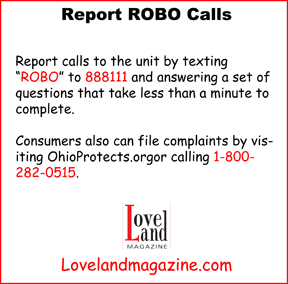
    Yost is urging Ohioans to report calls to the unit by texting “ROBO” to 888111 and answering a set of questions that take less than a minute to complete. Consumers also can file complaints by visiting OhioProtects.orgor calling 1-800-282-0515.

    “Ohioans are tired of playing defense against annoying robocalls,” Yost said. “Now it’s Ohio’s turn to play offense – and we need your help.”

    The new unit, part of Yost’s Consumer Protection Section, is dedicated to rooting out bad actors at every level of the robocall industry. The unit is made up of attorneys and investigators, including some who are already involved in legal action against companies responsible for the onslaught of calls.

    Ohioans were hit with an estimated 2.2 billion robocalls in 2019, according to YouMail, a service that tracks robocall traffic.
    The Robocall Enforcement Unit will take a multipronged approach to the problem by partnering with anti-robocall groups at the national level, investigating suspected violators, taking aggressive enforcement action and seeking legislation to expand the state’s authority over robocalls.

    Yost is urging Ohioans to report calls to the unit by texting “ROBO” to 888111 and answering a set of questions that take less than a minute to complete. Consumers also can file complaints by visiting OhioProtects.orgor calling 1-800-282-0515.

    Print Robo Call Reminder and keep by your phone.

    Even if a robocall does not cause a financial loss, reporting it to the Robocall Enforcement Unit can help investigators identify trends and protect other Ohioans from becoming victims.

    When it comes to robocalls, Yost said, the bottom line is this: Just don’t answer.

    Other tips to help combat robocalls include:

    • Never interact with a suspected robocaller in any way.
    • Avoid providing personal or financial information by phone.
    • Register your phone number with the Do Not Call Registry online at DoNotCall.govor by phone at 1-888-382-1222.
    • Research services offered by your phone provider to block unwanted calls.
    • Install a trusted and reliable app on your cellphone to block or warn of suspicious calls.


  • Loveland Schools: Keeping you in the loop – Coronavirus

    Loveland Schools: Keeping you in the loop – Coronavirus

    Loveland, Ohio – On Friday the Loveland City School District released this statement:

        The Loveland City School District works with other government entities in our area, including the City of Loveland, the Loveland-Symmes Fire Department and local law enforcement, to monitor and coordinate efforts in regards to any situation that could potentially pose a threat to the health, safety or welfare of our community. This collaboration has been in place for many years and allows the district to stay on the forefront of planning for, responding to, and mitigating emergencies. (An example was the pandemic flu response plan implemented during the H1N1 flu outbreak in 2009.)
        We continue to monitor the situation with the COVID-19 coronavirus through communications with local and state health partners as well as updates from the Centers for Disease Control and Prevention (CDC) and will take appropriate steps to implement our response plan as necessary.
    In the meantime, district maintenance personnel continue to bleach and disinfect classrooms and school buses regularly – high touch point areas and rooms identified with known cases of illness, like the flu, are especially targeted. Loveland Schools are among approximately 20 school districts in the area that have “T360” machines on hand to facilitate efficient sanitation of critical areas in the school buildings and on buses.
        We will keep you informed throughout this process. At this time, we encourage our families to avoid spreading all viruses through common sense prevention: thorough handwashing; avoiding touching the “T-zone” (mouth, nose, eyes); coughing/sneezing into elbow or tissue; and keeping sick children home from school.
        Attached is a letter issued this week by Hamilton County Public Health to parents and guardians in our schools.