Author: Loveland Magazine

  • Loveland’s Katelyn Heckenmueller and Caelan Quigley selected for All-State Jazz Ensemble

    Loveland’s Katelyn Heckenmueller and Caelan Quigley selected for All-State Jazz Ensemble

    Photos provided by Loveland Schools

    Three additional LHS musicians make the cut for the Cincinnati Youth Jazz Orchestra

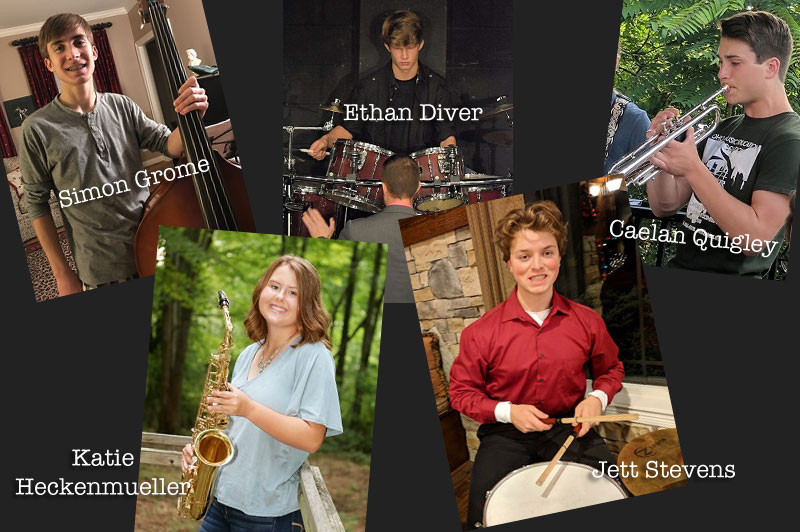
    Loveland, Ohio – The LovelandHigh School Jazz Program has kicked off the new school year with a series of accolades and recognitions: Seniors Katelyn Heckenmueller (saxophone) and Caelan Quigley (trumpet) have both been selected for the 2019 All-State Jazz Ensemble, which will rehearse and perform at the Ohio Music Education Association (OMEA) Professional Development Conference in Cleveland, January 31 – February 2.

    In addition, Senior Ethan Diver (drums), and Juniors Simon Grome (bass) and Jett Stevens (drums) have been selected to the Cincinnati Youth Jazz Orchestra (CYJO), run by the University of Cincinnati College-Conservatory of Music (CCM).
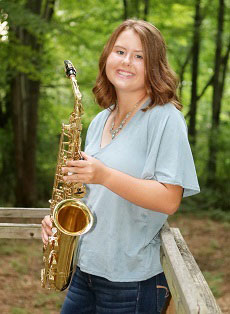
    Katelyn (Katie) Heckenmueller plays alto and soprano saxophones in the LHS Wind Ensemble and Jazz Orchestra. Having taken private lessons on alto sax for the past five years, she was selected to participate in the District 14 Honor Jazz Band in 2017. Heckenmueller, who plans to continue to play jazz in college, is particularly influenced by Dexter Gordon, whose “pocket and distinctive tone sound effortless.”  
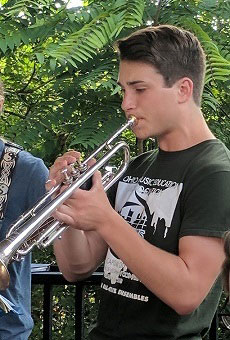
    Caelan Quigley is one of two students in Loveland High School Jazz Program history to be selected for the All-State Jazz Ensemble twice. As a junior in 2018, he performed at the OMEA Conference in Columbus under the direction of Brad Leali, two-time Grammy-winning member of the Count Basie Orchestra. Quigley was the lead trumpet player in the CCM Summer Jazz Program in 2017. He plans to attend college, potentially combining studies in engineering and music. Quigley credits his jazz accomplishments to the work with his long-time private teacher and mentor, Norman Parr, and his first-rate music education at Loveland.

    Ethan Diver has been playing drums for eight years, but is fairly new to jazz, which he started playing about a year ago. He has played snare drum in marching band and has been a member of the LHS showband for the past three years. In addition to playing with the CYJO big band, he also gigs with two combos. Diver teaches private lessons and takes lessons from Jeff Mellott.
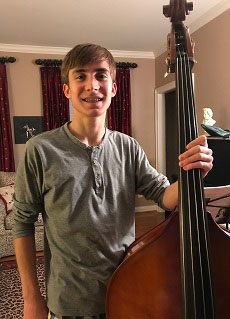
    Simon Grome has played bass for six years. He has spent that entire time studying privately under Matthew Holt. His biggest influences include Victor Wooten and John Patituccibecause of their innovative sounds and techniques. Grome does not plan on pursuing a degree in music, but expects it to remain an integral part of his future adult life.
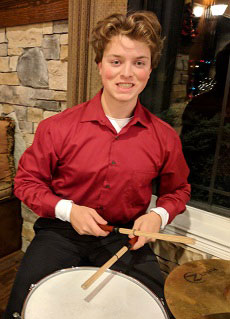
    Jett Stevens started by playing the piano in kindergarten. In fourth grade, he joined Mallet Madness at Loveland Elementary School, playing mallet percussion and auxiliary percussion. In seventh grade, he joined LMS Stage Band and Guitar Club. Throughout high school, he has been involved in Wind Symphony, CCM Summer Prep Jazz, Symphonic Band, Jazz Orchestra, Loveland Musical Orchestra, Jamey Aebersold Jazz Camp, Show Choir Band, Orchestra Band, Marching Band and several bands with friends. In addition to being selected for the Cincinnati Youth Jazz Orchestra, Stevens also earned spots in the District 14 Honor Jazz bands (2015 to 2017) and District 14 Honor Concert Band (2015).

    “It is a great privilege to work with such talented students who are passionate about jazz music,” said Erin Fitzpatric, LHS music teacher and jazz program director who joined the district in August. “Being selected to participate as a member of the OMEA All-State Jazz Ensemble is one of the highest honors for a high school jazz student. The ensemble consists of the best high school jazz musicians in the state – out of the hundreds of applicants who auditioned this year, only five students were selected for the trumpet and saxophone sections”

    “Being selected to participate as a member of the OMEAAll-State Jazz Ensemble is one of the highest honors for a high school jazz student. The ensemble consists of the best high school jazz musicians in the state – out of the hundreds of applicants who auditioned this year, only five students were selected for the trumpet and saxophone sections.”

    The CYJO also gathers some of the best high school jazz musicians in the region. Students audition in the beginning of the school year for a spot in the band that offers a year of high-level challenge with emphasis on developing professional musical, improvisational, and performance skills. The band rehearses weekly and performs a variety of styles within the big band genre in concerts on the UC campus and throughout the community.

    “The CYJO offers a great opportunity to play with other skilled high school jazz musicians from neighboring districts and build friendships that extend beyond Loveland,” said Fitzpatric.

    Now in his fifth year of teaching full time, Fitzpatric earned his Bachelors of Music at CCM as a music education major with a jazz trumpet specialization. For the past three years, he taught 6-12th grade band, jazz, and guitar at Taylor High School in Cleves, Ohio. While he teaches music during the week, Fitzpatric also performs with several bands in his free time.

    I look forward to showcasing the talents of the jazz bands at our first concert of the year on October 18,” said Erin Fitzpatric.

    “I really enjoy teaching music throughout the week and performing with bands around town on the weekends. I’m particularly excited about the opportunity to teach at Loveland where we have an incredible group of young musicians as well as a top-notch staff in the Music Department. I look forward to showcasing the talents of the jazz bands at our first concert of the year on October 18,” he said.


      Loveland chiropractor Douglas Portmann, DC at Wards Corner Chiropractic & Sports Rehab is one of the best chiropractors in the Loveland area.



  • Did you know Ohio Homeland Security has a cybersecurity center?

    Did you know Ohio Homeland Security has a cybersecurity center?

    Ohio Homeland Security’s Richard C. Baron Cybersecurity Center was established in 2016 for the purpose of enhancing the state’s posture against cyber-related crimes, criminal cases, and threats.

    The Ohio State Highway Patrol’s Computer Crimes Unit (CCU) and Ohio Homeland Security’s cyber analysts work together with other public and private sector partners within the center.

    The CCU provides technical support for criminal cases and Ohio Homeland Security’s analysts conduct case support for the CCU as well as work alongside other state analysts to identify trends and cyber-related threats facing Ohio.


      Take Home Tano is about fresh, wholesome food for the frenzied family   Our goal is to meet the needs of busy families.


  • Building Tiger Nation up-date

    Building Tiger Nation up-date

    Building Tiger Nation Student Experience (October 11, 6-7:30 p.m. & October 16, 10:30 a.m.-1 p.m.):

    Please join the Department of Teaching and Learning from Loveland City School District to provide input into the design of our Portrait of a Tiger. This portrait will become the district’s promise to our community as we continue to design programs and opportunities for our current and future Tigers. Our Portrait of a Tiger will both help guide the educational adequacy work in conjunction with our master facilities planning and will also become the compass beyond the facilities planning phase. To accommodate schedules, we will be holding two community meetings, identical in nature, to gain community input into this process. Please join us on either October 11, 2018, from 6:00 – 7:30 p.m. in the Loveland Intermediate/Middle School Media Center, or on October 16, 2018, from 10:30 a.m. to 1:00 p.m. (lunch provided), also in the Loveland Intermediate/Middle School Media Center.

    Building Tiger Nation Initial Finance Committee Meeting (October 18, 6:30-8:30 p.m.)

    School finance is a main component of planning and Building Tiger Nation. We will start outlining our goals and purposes as a finance committee at an initial meeting on Thursday, October 18. At this meeting, we will also begin our deep dive into school finance, debunk some myths, and share insights to gain a better understanding of how schools in Ohio are funded. We will open up to discussion, answer questions and receive audience feedback. The meeting is open to the public – if this is an area of interest to you, please join us! (October 18, 6:30-8:30 p.m. in the Loveland Intermediate/Middle School Media Center.)

    Building Tiger Nation Ambassador Meeting – Feedback on Community Presentation #2 – Educational Adequacy Data (November 8, 6:30-8:30 p.m.)

    Join us for a “run through” practice of the presentation planned for the November 28 Community Meeting #2 – Educational Adequacy Assessment Data.  Ambassadors will be asked to give feedback. (November 8, 6:30-8:30 p.m. LIS/LMS, location TBA.)

    Building Tiger Nation Community Meeting #2 – Educational Adequacy Assessment Data (November 28, 6:30-8:30 p.m.)

    Please attend this informational event to learn about the educational adequacy of our buildings as compared to the stakeholder vision for the Tiger student experience and research related to 21st century learning. The purpose of these assessments is to provide data for decision-making for the master facilities plan to be presented to the Board of Education in the spring of 2019 (November 28, 6:30-8:30 p.m. – LIS/LMS Cafeteria.)

    News on Building Tiger Nation

    For the latest news on the Loveland Schools facilities master planning process, make sure to visit www.buildingtigernation.org.


      RP Diamond is the exclusive retailer of LOVELAND HIGH SCHOOL SPIRIT WEAR Welcome to  RP Diamond Printing & Embroidery located at 370 Loveland Madeira Road.


  • The Ballotpedia of Ohio Issue 1, Drug and Criminal Justice Policies Initiative

    The Ballotpedia of Ohio Issue 1, Drug and Criminal Justice Policies Initiative

    From Ballotpedia, the digital encyclopedia of American politics and elections.

    Ohio Issue 1, the Drug and Criminal Justice Policies Initiative, is on the ballot in Ohio as an initiated constitutional amendment on November 6, 2018.

    Read about Issue One HERE.


  • Facts about Ohio’s abortion rate

    Facts about Ohio’s abortion rate

    The Ohio Department of Health’s 2017 Annual Abortion Report presents information derived from both the “Confidential Abortion Reports” and “Post-Abortion Care Reports for Complications” in Ohio. 

    Readers should note that abortion statistics in this report are limited to terminations occurring in Ohio; they do not include Ohio residents who obtained abortions outside the state. 

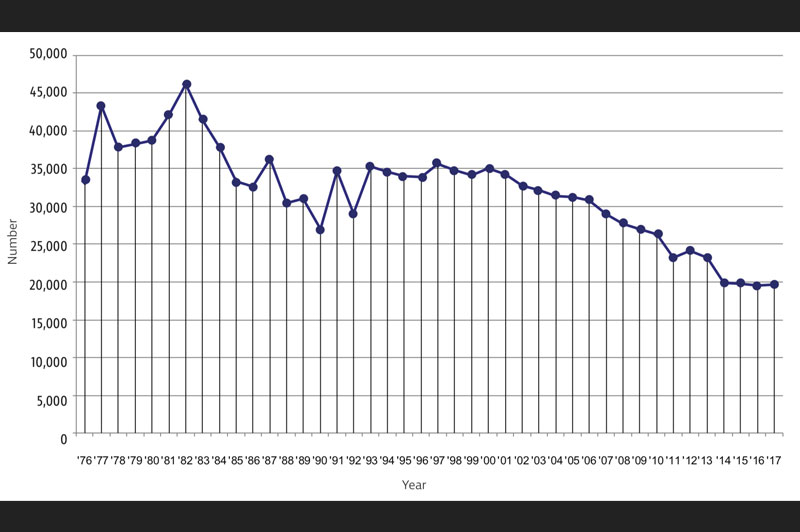
    Induced abortion statistics have been prepared in Ohio since 1976. Several trend comparisons in the 2017 Annual Abortion Report date back to 2003. A total of 20,893 induced pregnancy terminations were reported in Ohio for 2017, including 19,615 obtained by Ohio resident women (93.9%). This represents a 1% increase in induced pregnancy terminations from 2016 to 2017. Overall, since 2001 there has been a steady decline in terminations. When examined from 2001 to 2017, the annual decline averaged approximately 830 per year 

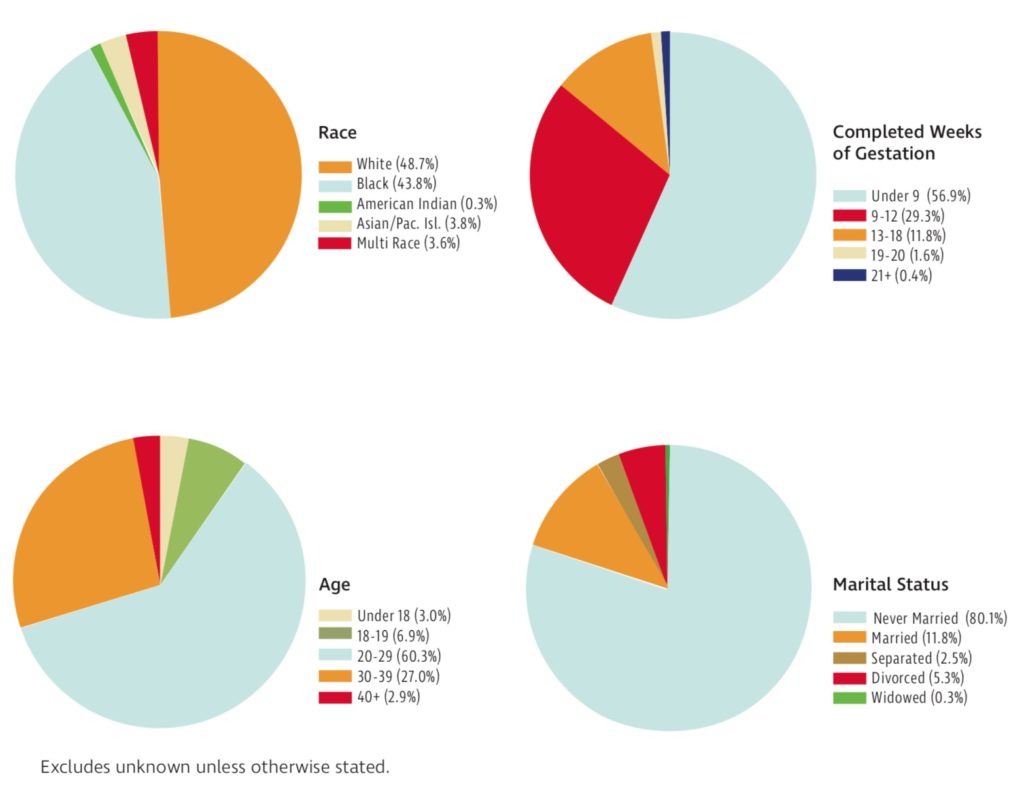
    Approximately one in ten women who obtained abortions in 2017 were under 20 years of age, with another one-third between the ages of 20-24 years of age. 

    While the age distribution of women obtaining abortions has remained relatively unchanged since 2001, the age-specific abortion rates for women under age 25 have steadily decreased. Approximately 85% of women with known marital status who obtained abortions were never married, divorced, or widowed. Fifteen percent of women who obtained abortions and whose marital status was known were married or separated. 

    Forty-nine percent of resident women who obtained abortions and for whom race was reported were White; 44% were African American; 4% were Asian/ Pacific Islander; and 4% reported more than one race (Figure 2). Five percent of women with known ethnicity who obtained abortions were of Hispanic origin. 

    The 2017 Ohio abortion rate was 8.9 per 1,000 resident women ages 15-44 years old; unchanged from the rate in 2016. The 2017 Ohio resident abortion ratio was 144 abortions per 1,000 live births; slightly increased from the ratio in 2016. 

    More than half of all induced abortions involved pregnancies of less than nine weeks (56%), with approximately 29% involving pregnancies of nine to 12 weeks. The proportion involving abortions of less than nine weeks increased from 49% in 1997, while the proportion between nine and 12 weeks declined from 35% to 29%. There were 454 abortions in 2017 involving pregnancies of 19 or more completed weeks of gestation. That represents a decrease from the 508 reported in 2016. The abortion reporting form requests method used to determine gestational age: ultrasound was used in 92% of cases. The vast majority of reported abortions were obtained in six major metropolitan areas of Ohio. 

    Curettage was the most used method of termination in 2017 (58%). That method has decreased since 2001, when 87% of terminations were by curettage. Mifepristone was reported as the medication for non-surgical termination for 5,279 abortions, followed by 489 terminations using misoprostol, and 40 terminations using methotrexate.

    View the full report and many more details HERE.

    Also READ this discussion of abortion laws under the U.S. Constitution and any restrictions by individual states in Wikipedia.

    Abortion in Ohio: What are the CURRENT LAWS?

    Ohio Abortion Law

  • President Trump to rally in Lebanon Friday

    President Trump to rally in Lebanon Friday

    Lebanon, Ohio – President Trump will be holding a MAGA Rally at the Warren County Fairgrounds on Friday, October 12th at 7 PM.

    DOORS OPEN 4 PM (ET)
    Warren County Fairgrounds
    Building E
    665 North Broadway
    Lebanon, OH 45036

    To Register

    You may only register up two (2) tickets per mobile number per event. All tickets are subject to first come first serve basis.


  • Portrait of a Tiger

    Portrait of a Tiger

    What does it have to do with Building Tiger Nation?

    Loveland, Ohio – On Wednesday, September 26, a group of parents, teachers, district staff and administrators met to start outlining Loveland’s “Portrait of a Tiger.” This initial Student Experience meeting was dedicated to sharing information and beginning the process of identifying the qualities and skills our community wishes for students to have as they leave Loveland High School.

    The Loveland community is invited to attend the next Student Experience meetingS on Thursday, October 11 and 16.

    “This is important work that we have been doing and will continue to do, but right now we have a unique opportunity to explore how our mission for Tiger learning and growth ties into the larger scheme of planning the future of our school facilities,” says Andrea Conner, Loveland City School District Director of Teaching and Learning. “The ideas generated in this meeting, and those that will be brought up in meetings over the next couple of months, allow us to hone in on what skills and opportunities we believe all students should have for the future.”

    The presentation centered around thinking differently about education, and how to prepare students for life after high school and the rapidly changing workforce that awaits them. Through various interactive elements, the ideas and priorities of the audience were captured throughout the meeting.

    “With the help of technology, we were able to ask questions and get direct feedback on what is important to our stakeholders as it relates to the experience they want their student to have,” said David Knapp, Loveland Schools’ Director of Technology and Innovation. “This, along with the feedback we’ll receive in our upcoming meetings with community members, staff in all our buildings, and from the students themselves, will be collected systematically so that we can identify common themes and priorities.”

    The Loveland community is invited to attend the next Student Experience meeting on Thursday, October 11 (6:00-7:30 p.m.) in the Loveland Intermediate/Middle School Media Center. (This meeting will also be held on October 16, 10:30 a.m. – 1 p.m. in the same location.)

    For more information regarding Loveland’s master planning process, visit www.buildingtigernation.org.


    Welcome to All About Kids We invite you to come visit one of our convenient locations, talk to our staff and teachers and learn why.


  • Child Support Services offers amnesty for civil warrants

    Child Support Services offers amnesty for civil warrants

    Batavia, Ohio – Clermont County Child Support Services will offer amnesty during October to noncustodial parents who have outstanding civil warrants relating to a child support hearing. The amnesty does not include criminal cases that are filed in Common Pleas Court.

    During the month of October, parents who have failed to appear for a court hearing, or to report to jail to serve a sentence relating to child support only, should contact the Child Support Services.

    The child support agency will suspend or withdraw civil bench warrants for those parents who arrange to make payments toward their child support, who are employed or registered with Ohio Means Jobs, or who meet certain other criteria. There will be no fee for this service.

    “The goal of the amnesty program is to reduce the number of outstanding civil warrants and to try to get these parents back on track and heading in the right direction,” said Brenda Gilreath, assistant director of Child Support Services. “This amnesty program will allow the parents who have warrants an opportunity to reach a legal resolution by working on a compliance plan – and the resolution is at no cost for the service.”

    In March 2017, Child Support Services held an amnesty, and were encouraged by the response. One hundred twenty noncustodial parents had their warrants removed and began paying child support. “Our message then, and our message now, is that this is the right thing to do,” said Gilreath. “Parents who are in jail cannot hold a job, and cannot pay child support. If the parent is serious, we will do everything we can to help them so that they can help their children.”

    The child support program serves more children than any other public program in Ohio, second only to the Department of Education. In 2017, the Clermont County agency collected almost $36 million in child support. The agency currently has 719 civil warrants associated with child support cases, representing $10.3 million in past due support.

    To find out more, or to start arrangements, noncustodial parents can call the warrant caseworker at 513.732.7334 at any time (leave a voicemail after hours), or visit the Child Support  Office from 8 a.m. – 2 p.m. Monday through Thursday during the month of October. Appointments are not necessary during these hours but are encouraged.

    Noncustodial parents can also email shonna.johnson@jfs.ohio.gov. Find out more information on the Child Support Services website,  www.clermontsupportskids.org.

    Media: For more information, contact Theresa Bechtel Ellison, Lead Attorney, or Brenda Gilreath, Deputy Director, at 513.732.7429.


      Take Home Tano is about fresh, wholesome food for the frenzied family   Our goal is to meet the needs of busy families.
  • Judge Jerry R. McBride: Why Issue One should be opposed

    Judge Jerry R. McBride: Why Issue One should be opposed

    by Judge Jerry R. McBride

    If you are concerned about neighborhood safety, then you should NOT support Issue One on the ballot this fall. It will hinder law enforcement, prosecutors, and judges in their ability to deal with the biggest drug crisis in this state’s history.As a result, it will result in more drugs on the streets, more crime, more deaths from overdoses, and more costs to local communities and taxpayers.

    Jerry R. McBride is a Clermont County, Ohio, Common Pleas Court Judge

    Judges have the ability to comment on issues that affect the administration of justice. Issue One will have a devastating effect on the administration of justice on Ohio. As one trial judge, this is my take on Issue One:

    ISSUE ONE DOES NOT BELONG IN THE STATE CONSTITUTION

    A state constitution should set forth the powers and functions of the branches of government, certain general values and principles upon which the citizens of the state generally agree, and the basic rights which are afforded to the citizens of the state. It should set forth matters which are so fundamental and important that they will not be subject to change over time. This proposed constitutional amendment does not in any way belong in a state constitution. It seeks to change sentencing law as it exists in the state of Ohio based on an assumption that change needs to be made. If change does need to be made, then it should be made through the process of enacting legislation, as is done on a regular basis in this state, and not through a constitutional amendment.

    ISSUE ONE DIRECTLY CONTRADICTS THE CONCEPT OF TRUTH IN SENTENCING AND IGNORES THE RIGHTS OF VICTIMS.

    There should be truth in sentencing, not lip service to truth in sentencing. Issue One allows a credit to be given by the Department of Rehabilitation and Correction for participation in rehabilitative, work, or educational programming of up to 25% of a sentence plus 30 days. While this may sound good at first glance, it is contrary to the concept of truth in sentencing. When a victim is told what a sentence will be, he/she should be able to rely on that being the sentence unless a hearing is scheduled on a possible reduction in the sentence. Why should a sentence be reduced just because an inmate “participates” in programming? Isn’t that the bare minimum that should be expected from an inmate? Why should an inmate be rewarded for doing the bare minimum? If a sentence is to be reduced, it should be reduced by the sentencing judge based upon an assessment that the risk of recidivism has been reduced, not because somebody has shown up to work. And if the judge makes the assessment that the sentence should be reduced, a hearing will be required and the victim will have an opportunity to be present and to be heard, which is the way it should be. Additionally, what does it mean to “participate” in these activities? This essentially allows the prison authorities to reduce a judge’s sentence,and it should be the judge who imposed a sentence who determines whether that sentence should be reduced.

    ISSUE ONE IS DANGEROUS IN THAT IT INTERFERES WITH THE JUSTICE SYSTEM’S ABILITY TO DEAL WITH THE DRUG CRISIS

    It is highly inappropriate in the midst of the biggest crisis in this state in terms of drug abuse for the possession and use of dangerous drugs to be treated essentially the same as minor traffic and criminal offenses. Possession of dangerous drugs leads to overdoses, to more serious criminal offenses, to deaths. The possession and use of dangerous drugs are not minor offenses to the persons who are addicted to drugs, to the victims of crime involving persons under the influence of drugs, to the parents and family members who are praying that their loved ones will not overdose and die. To suggest that we need to include treatment in our approach to this drug crisis is highly appropriate, and in fact it is already being done routinely across this state. However, to suggest that we should reduce the level of these offenses so that they are no longer classified as serious offenses is highly inappropriate.

    ISSUE ONE TREATS USE OF DANGEROUS DRUGS AS LESS SERIOUS THAN JUST ABOUT EVERY OTHER CRIME

    The proponents of the constitutional amendment, in saying that a jail sentence cannot be imposed, are saying that possession and use of such drugs as heroin, methamphetamine, and cocaine should be treated more lightly than reckless driving, shoplifting, lying to a police officer, gambling, and persistent disorderly conduct, all of which can result in the imposition of jail sentences. Is this really the message that we should be sending to drug addicted adults who represent a risk of committing more serious offenses as long as they persist in the use of dangerous drugs?

    ISSUE ONE ELIMINATES THE ABILITY OF A JUDGE TO IMPOSE A JAIL SENTECE FOR A FIRST OR SECOND POSSESSION OFFENSE, EVEN IF THE DRUG IS HEROIN, METHAMPHETAMINE, OR COCAINE

    In all likelihood, probation will be appropriate for a person who commits a drug possession offense which is the first or second within a 24-month period. However, that will not always be the case. For instance, probation may not be appropriate at all if the offense is committed at the same time as a more serious offense such as a burglary or an assault. Similarly, probation may not serve the purpose of protecting the public if the drug possession or use offense is committed by a convicted sex offender for whom use of a dangerous drug or alcohol represents a significant risk of reoffending and for whom intermediate sanctions may provide no real protection to the community. As for the term probation, does that include treatment in a halfway house or in a lock-down community based correctional facility?

    If it doesn’t include residential treatment, including lockdown residential treatment, ittakes away some of the most effective tools which can be used in trying to rehabilitate an offender. Needless to say, the problem with creating an absolute standard that requires that a person who uses or possesses drugs receive the lowest level of sanction available is that applying that standard under the facts of given case may not be consistent with the seriousness of the offense or the likelihood of recidivism.

    ISSUE ONE PUTS HANDCUFFS ON JUDGES IN THEIR ABILITY TO GET OFFENDERS TO STOP USING DRUGS

    The proposed amendment would eliminate the possibility of imposing a jail sentence at all for a violator on a first or second drug possession or use offense within 24 months and would eliminate the possibility of a court imposing a prison sentence for a felony violator unless the violator commits a new criminal offense. However, this leads to some very real dilemmas. If that is to be the law, what is a court to do with someone who simply refuses to attend treatment or to comply with any of the intermediate sanctions or who simply says that he/she will not comply with anything that the court orders? What is a court to do with someone who says he/she will comply with community control sanctions but then refuses to do anything which is ordered? Under the language of the proposed constitutional amendment, a felony offender could simply tell a judge at the time of the sentencing hearing that he/she will comply with the community control sanctions that are ordered, and then after being placed on community control, refuse to do anything that the court orders. At that point, a prison sentence could not be imposed. What is the possible sense in that? How does that serve to protect the public? The probation department has a statutory duty to report violations to the court, but if the offender continually absconds or fails to comply with the sanctions that are ordered, how can the probation department perform that function? The answer is very simple- it can’t.

    ISSUE ONE JUST GIVES LIP SERVICE TO THE CONCEPT OF GRADUATED SANCTIONS

    Issue One strips away the full range of tools which enable a judge or probation department to be effective in not only rehabilitating an offender, but also in protecting the public. It is difficult to argue with the concept of graduated responses, and the use of intermediate sanctions, by courts and probation departments. It is consistent with the use of evidence-based practices. However, the application of graduated responses or intermediate sanctions to a violator in a given case will depend on the seriousness of the original offense, the risk of recidivism, and the nature of the violation. In this regard, a graduated response policy will typically include probation (monitored or with conditions), intermediate sanctions (which may include such things as house arrest, residential or outpatient treatment, day reporting, a short jail term, or other requirements), and jail or prison. Issue One, however, arbitrarily takes away the option of jail or prison even for someone who thumbs his or her nose at the system and who refuses to undergo treatment or to make other changes that are necessary to reduce the likelihood of recidivism. It also arbitrarily takes away the option of jail or prison for someone for whom lesser sanctions are simply not appropriate.

    ISSUE ONE CONTRADICTS THE IMPORTANT CONCEPT OF SEPARATION OF POWERS

    The proposed amendment provides that each court must prepare guidelines for graduated responses that may be imposed in sentencing offenders and that the guidelines must be approved by the Department of Rehabilitation and Correction, which is part of the executive branch. Such a provision, which is proposed to be part of the state constitution, violates an already existing constitutional principle, which is the separation of powers. Additionally, there is no reason to believe that the Department of Rehabilitation and Correction has any expertise in deciding what factors a court should consider in determining which graduated response should be applied in a given case in sentencing an individual. That is pure and simple a judicial function.

    UNDER ISSUE ONE, THERE WILL BE LESS, NOT MORE, MONEY FOR TREATMENT

    The proponents of this constitutional amendment assume that the costs of their proposal will be covered by a substantial reduction in the number of prison beds. However, since the cost of housing fourth and fifth degree felons in the prison system is a very small part of the overall prison cost, since the projections as to cost reductions by the Department of Rehabilitation and Corrections have been inaccurate in the past, and since the increase in prison population has primarily resulted from longer sentences, and that is not addressed at all by the constitutional amendment, there is no real reason to believe that the assumptions of the proponents in this regard are correct.

    ISSUE ONE WILL RESULT IN GREATER COSTS TO LOCAL COMMUNTIES WITH WORSE RESULTS

    In the unlikely possibility that the proponents of Issue One are correct that there will be more money for treatment, and that appears to be fool’s gold, the most significant costs of this proposed constitutional amendment are the following- it undermines the efforts being made by courts and the law enforcement community to deal with the drug crisis, it undermines the ability of courts to effectively sentence offenders, and worst of all, it will not make the public any safer at all, and given the problems identified above, will likely lead to the public being more at risk. The cost of the proponents of Issue One pursuing their ill-conceived political agenda will be to put more people at risk of being victims, will not result in more or better treatment for drug users, and will result in greater cost- both human and monetary- to local communities. That is the reason that law enforcement, prosecutors, and judges throughout Ohio are opposing Issue One as being both ill-conceived and dangerous.


      Relaxed atmosphere and friendly service welcomes you back time and time again! Located in the heart of the Historic Loveland District Just outside Cincinnati, Ohio.


  • Meghan Lolli, Eleanor Cronin, and Jordan Morrison recognized for raising $3K

    Meghan Lolli, Eleanor Cronin, and Jordan Morrison recognized for raising $3K

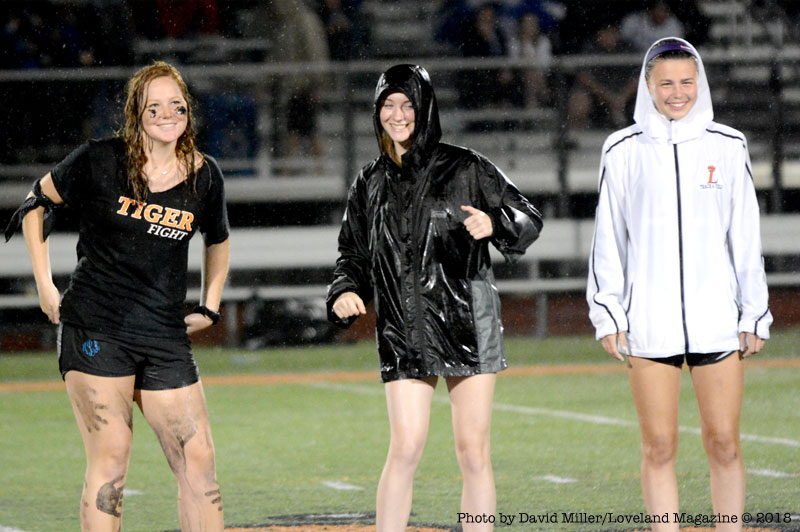
    Meghan Lolli, Eleanor Cronin, and Jordan Morrison
    Loveland, Ohio – Loveland High School’s Student Council hosts a fundraiser every year. This year’s charity game was for A Kid Again. Students participated in a dodgeball tournament to raise $3,000.
    Meghan Lolli, Eleanor Cronin, and Jordan Morrison were recognized at half-time of the varsity football game against Miamisburg on September 7.


    Jarvis Global is an investment advisory firm in Symmes Township, Ohio which offers private portfolio management and retirement services to high net worth individuals.