The Gavel outside the Supreme Court of the State of Ohio, September 20, 2023, at 65 S. Front Street, Columbus, Ohio. (Photo by Graham Stokes for Ohio Capital Journal. Republish photo only with original article.)
The Ohio Secretary of State’s Office released the names of March 19 primary candidates for the Supreme Court of Ohio. Candidates include some incumbents, one appointee going for an incumbent’s seat, and a few new faces.
The candidates that filed are:
Michael Donnelly – Donnelly has been a justice on the court since 2019. Before joining the court, he spent his legal career in Cuyahoga County as a judge for the court of common pleas, elected to the position in 2004, 2010 and 2016, according to a profile on the SCO website. He also served on the Mental Health and Developmental Disabilities Court for the county after serving as an assistant county prosecutor.
Melody Stewart – Stewart has been on the court since 2018, after serving on the Eighth District Court of Appeals starting in 2006. She was assistant law director in Cleveland and East Cleveland, and has worked at Cleveland State University’s law school, the University of Toledo College of Law, Ursuline College and Case Western Reserve University’s School of Law.
Joseph Deters – Deters was appointed to the court by Gov. Mike DeWine in Jan. 2023 to fill the seat vacated when Justice Sharon Kennedy was elected as chief justice. Instead of running for the seat he currently occupies, Deters is running to replace Justice Melody Stewart on the court. Deters was previously the Hamilton County’s prosecutor and clerk of courts, and served as Ohio Treasurer in 1998 and 2002.
Lisa Forbes – Currently a judge for Ohio’s Eight District Court of Appeals, Forbes was elected to the position in 2020, after serving as a private litigator in Ohio.
Terri Jamison – Jamison and Forbes will face off this March, something the 10th District Court of Appeals judge is familiar, having run against Justice Pat Fischer in the 2022 general election. Jamison worked as an assistant public defender in the Franklin County Public Defender’s office before working in private practice. She moved on to the Franklin County Court of Common Pleas in 2021 and was elected to the court of appeals in 2020.
Dan Hawkins – Franklin County Court of Common Pleas judge Hawkins is running to fill the seat Deters hopes to vacate if he’s elected to take over Stewart’s seat. Hawkins was elected to the Franklin County court in 2019.
Megan Shanahan – Shanahan is currently a judge with the Hamilton County Court of Common Pleas, hoping to unseat Justice Donnelly on the court. Shanahan was to the county court in 2011, after being appointed in 2015. She was re-elected to the bench in 2022.
Deters, Shanahan and Hawkins all have the endorsement of the Ohio Republican Party, who said in a statement the “makeup of the Ohio Supreme Court is at stake, and Ohioans stand ready to elect strong, conservative justices who will uphold the law as it is written.”
The Ohio Democratic Party has endorsed incumbents Stewart and Donnelly, along with Forbes, according to their website of candidates.
The supreme court races are currently on the partisan ballot, but another incumbent, Justice Jennifer Brunner, has sued to overturn the law allowing party affiliation to be included in supreme court justice races. Democratic Sen. Bill DeMora of Columbus also introduced Senate Bill 201 this month, hoping to reverse the law change made in 2021, saying it impacts a judge’s ability to be impartial.
SUSAN TEBBEN
Susan Tebben is an award-winning journalist with a decade of experience covering Ohio news, including courts and crime, Appalachian social issues, government, education, diversity and culture. She has worked for The Newark Advocate, The Glasgow (KY) Daily Times, The Athens Messenger, and WOUB Public Media. She has also had work featured on National Public Radio.
Research from the University of Cincinnati shows that exposure to PFAS may delay the onset of puberty in girls. The research was published in the journal Environmental Health Perspectives.
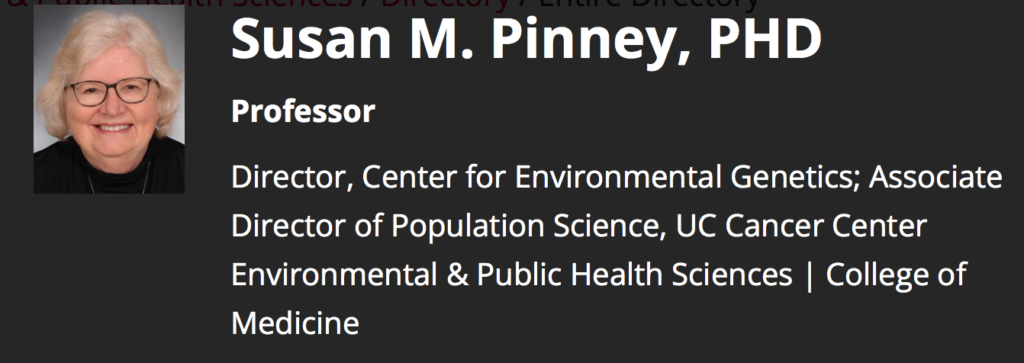
This study is the first longitudinal research that included the component of the role hormones play in the delay, according to Susan Pinney, PhD, of the Department of Environmental and Public Health Sciences in the UC College of Medicine and corresponding author of the study.
She says the delay of puberty in girls can lead to negative long-term health outcomes, including a higher incidence of breast cancer, renal disease and thyroid disease.
“Puberty is a window of susceptibility,” Pinney says. “Environmental exposures during puberty, not just to PFAS, but anything, have more of a potential for a long-term health effect. What these have done is extended the window of susceptibility, and it makes them more vulnerable for a longer period of time.”
The published research describes the findings from studying a total of 823 girls who were 6 to 8 years old when they were enrolled in the study — 379 were in the Greater Cincinnati area, the other 444 were in the San Francisco Bay Area. Researchers wanted to start the girls in the study before they hit the beginning of breast development. Then they followed them with exams every six to 12 months to see when they experienced the first signs of breast development and pubic hair.
Susan Pinney, PhD, of the Department of Environmental and Public Health Sciences/Photo/Colleen Kelley/UC Marketing + Brand
The results found that 85% of the girls in the two cohorts had measurable levels of PFAS. Pinney says this PFAS research is unique because the hormone component was included and they discovered evidence of decreased hormones. The hormones that were decreased with PFAS exposure were consistent with findings of the delay of the onset of puberty.
“The study found that in girls with PFAS exposure puberty is delayed five or six months on average but there will be some girls where it’s delayed a lot more and others that it wasn’t delayed at all,” Pinney says. “We are especially concerned about the girls at the top end of the spectrum where it’s delayed more.”
The study also found that over 99% of the girls in the two cohorts had measurable levels of PFOA, one of the most important of the PFAS.
Pinney points to several factors playing a role in PFAS exposure in Greater Cincinnati. The Ohio River is the main source of drinking water in the area and a DuPont plant near Parkersburg, West Virginia, released PFAS into the river for decades which flowed downstream to major water intakes on both sides of the river near eastern Hamilton County. PFAS were also present in firefighting foam and there is a firefighting training ground near those same water intakes.
Pinney, who has studied this topic for years in collaboration with the now-retired Frank Biro, MD, of Cincinnati Children’s Hospital and the Department of Pediatrics at the UC College of Medicine, says this and other studies raise the question of, considering the known dangers of PFAS, how did we get to this point? She points to the fact that the United States doesn’t follow the “precautionary principle” which is the principle that the introduction of a new product or process whose ultimate effects are disputed or unknown should be resisted.
“The evidence of PFAS being dangerous goes all the way back to the 1980s when chemists were doing studies, noticed that PFAS had the same chemical structure as other dangerous chemicals and they reported on it,” Pinney says. “It’s taken a very long time for us to recognize it as a human toxin. Meanwhile, all of these toxins got into our environment, and it’s going to take a long time before they leave.”
Pinney says one of the reasons is that PFAS do not degrade. Studies are being done to explore methods of breaking up the chemicals.
“It seems to take a long time to convince regulators about the health effects of PFAS,” she says. “We as scientists need to be more forceful with regulators and say, ‘Hey guys, you read the same science we read.’
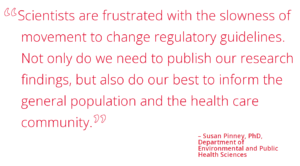
“The whole thing has been a learning experience for me. Scientists are frustrated with the slowness of movement to change regulatory guidelines. Not only do we need to publish our research findings, but also do our best to inform the general population and the health care community. Efforts toward environmental cleanup have begun but it is very costly.”
Featured image at top: vitranc/iStock
Republished with permission of the author. Bill David Bangert is the Public Information Officer for the University of Cincinnati.
Dr. Susan M. Pinney received her PhD from the University of Cincinnati and is a professor of Epidemiology at UC. She conducts a variety of large molecular epidemiology studies, with research focused on the genetic epidemiology of lung cancer, environmental factors that influence the age at pubertal milestones, and health effects of uranium exposure. Since 1990 she has been the Research Director of the Fernald Community Cohort with data and biospecimens collected over 18 years.
The Associated Press says, “Look for flu and COVID-19 infections to ramp up in the coming weeks.”
NEW YORK (AP) — Look for flu and COVID-19 infections to ramp up in the coming weeks, U.S. health officials say, with increases fueled by holiday gatherings, too many unvaccinated people and a new version of the coronavirus that may be spreading more easily.
High levels of flu-like illnesses were reported last week in 17 states — up from 14 the week before, the Centers for Disease Control and Prevention said Friday.
“Folks are traveling a lot more this season. They want to see their families,” said the CDC’s Dr. Manisha Patel. “And all of that sort of adds to the mix” in the spread of viruses.
Health officials are keeping an eye on a version of the ever-evolving coronavirus, known as JN.1. The omicron variant was first detected in the U.S. in September and now accounts for an estimated 20% of cases. The CDC expects it to reach 50% in the next two weeks, Patel said.
In a recent letter to Ohio Gov. Mike DeWine, the U.S. Department of Health and Human Services said Ohio is among the top states with children losing Medicaid coverage.
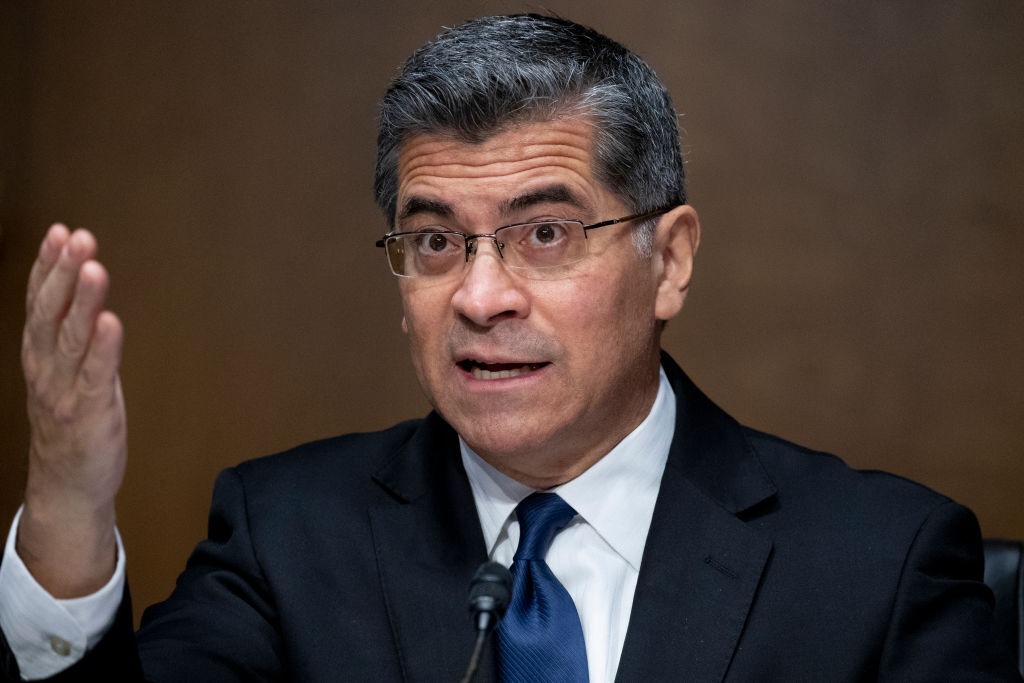
HHS Secretary Xavier Becerra sent a letter to DeWine urging the state to “ensure that no child in your state who still meets eligibility criteria for Medicaid or (the Children’s Health Insurance Program) loses their health coverage” for any reason, including “red tape” or “other avoidable reasons” as COVID-19 enrollment provisions start to fade away.
The letter said Ohio’s Medicaid and CHIP — a program that gives health coverage to children whose families aren’t eligible for Medicaid — enrollment declined by more than 86,000 children as of Sept. 2023.
That represents a 6% drop since March of this year, and makes Ohio the fourth-highest in declines across the U.S. during that period, the U.S. Department of Medicaid found.
Texas was the highest with a decline of 524,909, followed by Florida with 366,633 and Georgia with 149,080.
Becerra said keeping Medicaid enrollment up is especially important for communities of color, with more than half of children in the U.S. on Medicaid or CHIP in Hispanic, Black, Asian/Pacific Islander, American Indian or Alaska Native communities, according to the U.S. Department of Medicaid.
“My department stands ready to do all that we can to help your state advance this goal, including by providing Ohio with the flexibility to pause procedural disenrollments for children while it adopts other strategies to ensure eligible children remain enrolled,” Becerra wrote.
Procedural disenrollments happen when program participants don’t complete the renewal process, which can happen because the state does not have correct contact information, or simply because the participant doesn’t meet the renewal timeline.
Those disenrollments had been halted in March 2020, but the halt ended on March 31 of this year.
According to a tracker by KFF — nonpartisan health policy researchers formerly known as the Kaiser Family Foundation — Ohio has seen more than 514,000 individuals disenrolled as of Dec. 13, 2023, and across the states KFF studied, 71% of disenrolled participants lost their coverage because of procedural disenrollment.
In Ohio, that number was slightly higher than the national amount, at 74%. Only 26% of those who lost coverage in Ohio were disenrolled because they were determined to be ineligible, according to KFF.
Nationally, the analysis showed four in 10 Medicaid disenrollments were children for the 21 states who released data by age group.
Becerra noted suggestions from HHS for Ohio to improve enrollment rates by allowing Medicaid managed care organizations to help with renewals, and giving an extra year for those who haven’t gone through the renewal process yet.
He also encouraged improvements to the auto-renewal process, and increased outreach efforts to places such as schools and community organizations.
The Ohio House Democratic Caucus was quick to jump on the letter’s contents, with state Rep. Dr. Beth Liston, D-Dublin, writing on behalf of the caucus to urge DeWine to continue the pause on procedural disenrollment for the next year, “while Medicaid works with the Centers for Medicare & Medicaid Services to adopt policies ensuring that children remain enrolled.”
“No child in Ohio should go without access to the care they need,” Liston wrote in a letter to DeWine. “Every Ohioans deserves to know that their family will have coverage when they need it most.”
DeWine’s spokesperson, Dan Tierney, verified to the OCJ that the HHS “has communicated with our administration and noted Ohio is farther ahead in redeterminations than other states, which means Ohio Medicaid is doing a better job complying with these directives than other states, which is something to be commended.”
Tierney also said with Medicaid/CHIP numbers, perspective is also needed.
“Ohio is our nation’s seventh largest state, so it is unsurprising that Ohio ranks where it does in this ranking of raw numbers,” he said.
SUSAN TEBBEN
Susan Tebben is an award-winning journalist with a decade of experience covering Ohio news, including courts and crime, Appalachian social issues, government, education, diversity and culture. She has worked for The Newark Advocate, The Glasgow (KY) Daily Times, The Athens Messenger, and WOUB Public Media. She has also had work featured on National Public Radio.
The Cincinnati/Northern Kentucky International Airport (CVG) is planning for 330,000 travelers to fly in and out of the airport for the December holiday (12/21/23-1/2/24). This is an 18% increase over 2022 volumes. The busiest days will be December 21-23 and January 2.
The busiest time for departures is expected to be between 5 AM and 7 AM and arrivals remain steady from mid-morning through 11 PM. Demand is the highest for these destinations: New York City, Houston, Denver, London, and Orlando.
Tips for travelers:
All passengers are advised to arrive in the Terminal at least two hours before a domestic flight and three hours before an international flight.
Don’t confuse departure time with the final boarding time: travelers should check with their carrier on what time the doors close prior to departure.
Check TSA’s website for what you can bring through security.
Visit cvgairport.com to view expected TSA wait times, parking availability, and food options including CVG’s newest restaurants: Skyline, Frisch’s, Braxton Taproom, and Wendy’s.
There are several parking options at CVG, including the Terminal garage (general and reserved); valet; ValuPark; and Economy Lot.
A new taxi service, located at Ground Transport East, launched on December 5th at CVG. The company is called zTrip and more information can be found at ztrip.com.
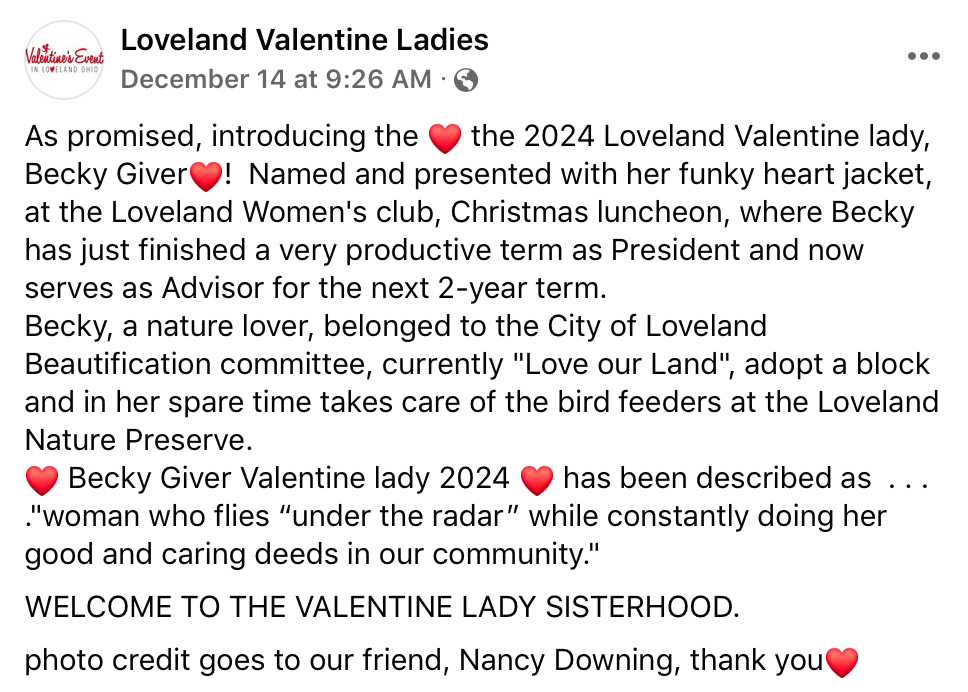
Loveland, Ohio – On Thursday, the Loveland Valentine Ladies announced on their FaceBook page that Becky Giver will be 2024’s lady with the biggest Loveland heart.
COLUMBUS, Ohio — DECEMBER 13: Advocates for the trans community protest outside the Senate Chamber while inside lawmakers debated and passed HB 68 that bans gender-affirming care for transgender youth and bars transgender kids from participating on sports teams, December 13, 2023, at the Statehouse in Columbus, Ohio. (Photo by Graham Stokes for Ohio Capital Journal. Republish photo only with original article.)
A bill that would block doctors from providing gender-affirming care to trans youth and prevent trans athletes from participating in Ohio women’s sports is going to Ohio Gov. Mike DeWine’s desk.
The Ohio Senate passed House Bill 68 in a 24-8 vote Wednesday afternoon and the Ohio House concurred with the Senate amendments in a 61-27 vote Wednesday night. DeWine now has 10 business days to sign or veto the bill.
“We await a final bill to review before offering formal comment,” DeWine’s press secretary Dan Tierney said in an email Wednesday afternoon.
State Senator Nathan Manning, R-North Ridgeville, was the lone Republican who joined Senate Democrats in voting against the bill.
HB 68, introduced by Rep. Gary Click, R-Vickery, would block doctors from providing gender-affirming care to trans youth, including puberty blockers and hormone therapy.
The bill would ban physicians from performing gender reassignment surgery on a minor, but many opponents have testified that no Ohio children’s hospital currently performs gender-affirming surgery on those under 18. An amendment was added to HB 68 Wednesday that added a grandfather clause that would allow doctors who already started treatment on patients to continue.
Gender-affirming care is supported by every major medical organization in the United States. Children’s hospitals across Ohio, the Ohio Children’s Hospital Association and the Ohio Academy of Family Physicians all oppose HB 68.
House Minority Leader Allison Russo, D-Upper Arlington, said she hopes DeWine will listen to the medical professionals who oppose the bill.
“The bill is so cruel on so many levels but at the end of the day this violates parents rights to make decisions about their children’s own healthcare,” she said. “It’s putting the government in the middle of families and their healthcare providers.”
Twenty-two other states have passed a law that blocks gender affirming care, according to the Human Rights Campaign.
Gender-affirming surgery for minors is not common with less than 3,700 performed in the U.S. on patients ages 12 to 18 from 2016 through 2019, according to a study published in August in JAMA Network Open. It’s unclear how many of those patients were 18 when they underwent those surgeries.
Ohio House Speaker Jason Stephens, R-Kitts Hill, said the bill empowers parents.
“The important part is protecting children and making sure parents know what’s going on,” he said.
State Senator Bill DeMora, D-Columbus, called HB 68 a disgusting piece of legislation.
“Current hospital policies ensure gender-affirming care for minors who seek it is safe, medically necessary, and appropriate,” DeMora said in a statement. “It’s clear that this bill is targeting youth already at an increased risk of suicide and violence, and subjecting them to even more risk.”
He took a moment to speak directly to transgender people during the Senate session.
“Your life has meaning and purpose,” DeMora said. “You are seen, valued and loved.”
Trans athlete ban
House Bill 6 — which prevents trans athletes from participating in Ohio women’s sports — was rolled into HB 68 back in June. The would prevent males from playing female sports, but everyone would still be able to play on co-ed teams.
If a trans girl wants to play on a team with cis girls in Ohio, she must go through hormone treatments for at least one year or show no physical or physiological advantages, according to the Ohio High School Athletic Association.
Twenty-three states have passed similar laws in regards to transgender athletes since 2020, according to ESPN.
COLUMBUS, Ohio — DECEMBER 13: An advocate for the trans community protests outside the Senate Chamber while inside lawmakers debated and passed HB 68 that bans gender-affirming care for transgender youth and bars transgender kids from participating on sports teams, December 13, 2023, at the Statehouse in Columbus, Ohio. (Photo by Graham Stokes for Ohio Capital Journal)
“It is two bills, so much for single subject,” Senate Minority Leader Nickie J. Antonio, D-Lakewood, said.
“This bill strips rights away from parents and bans children’s access to evidence-based healthcare,” Antonio said in a statement after the bill passed the Senate. “Physicians need to be able to have comprehensive care discussions with patients and their families, but this bill puts them in an impossible position.”
Hundreds of people submitted opponent testimony against the bill last week during a marathon Senate Government Oversight Committee meeting.
“We don’t make laws just for the hundreds of people that come and testify,” Senate President Matt Huffman said when asked about this. “We make laws for over 11 million people.”
Opponents speaks out and protest
LGBTQ+ advocates who oppose HB 68 had a press conference Wednesday morning to speak out against HB 68 — arguing families shouldn’t have to decide whether it’s safe to stay in Ohio.
“Ohio is home and I will not be legislated to leave,” said Densil Porteous, Executive Director of Stonewall Columbus.
COLUMBUS, Ohio — DECEMBER 13: Advocates for the trans community protest outside the Senate Chamber and repeatedly shouted “shame” when they heard that lawmakers had passed HB 68 that bans gender-affirming care for transgender youth and bars transgender kids from participating on sports teams, December 13, 2023, at the Statehouse in Columbus, Ohio. (Photo by Graham Stokes for Ohio Capital Journal)
This bill will make it more challenging for trans and non-binary people, said Dara Adkison, a member of TransOhio.
“HB 68 will cause people to leave Ohio and no one should be forced from their home for any reason, but especially not because of extreme laws undermining their freedom and safety,” Adkison said.
Mallory Golski, the civic engagement & advocacy manager for Kaleidoscope Youth Center, spoke in place of a high school student who couldn’t attend the event because they had school tests to take.
“The people who this bill targets are teenagers,” Golski said. “They are young people who shouldn’t have to make a decision about whether they should show up to school or show up to the statehouse to convince lawmakers of their inherent dignity.”
She knows many transgender kids who are happier when they receive gender affirmation or care.
“Taking that away from trans minors would be a detriment,” Golski said.
Evangelical Lutheran Deacon Nick Bates and father of a 13-year-old nonbinary child said bills like HB 68 force trans children and adults back into hiding.
“Sadly, HB 68 and other bills targeting trans and non-conforming youth take this peace, comfort and joy up the chimney like the Grinch stealing the Christmas tree,” Bates said.
Megan Henry is a reporter for the Ohio Capital Journal and has spent the past five years reporting in Ohio on various topics including education, healthcare, business and crime. She previously worked at The Columbus Dispatch, part of the USA Today Network.
The Ohio State Board of Education appointed Paul Craft to be the next State Superintendent of Public Instruction during Tuesday’s monthly meeting.
Paul Craft (Buckeye Valley Local Schools Photo)
Craft’s first day as superintendent will be Jan. 1 and his annual salary will be $190,000, according to the state board resolution.
“Ohio is home to outstanding educators and school personnel, and I’m excited to lead the work to ensure we have an excellent education workforce ready to make a difference for students,” Craft said in a statement.
He is currently the superintendent of Buckeye Valley Local Schools, a role he has served in since August 2022. He was also the superintendent of Delaware City Schools for nine years and previously worked in Upper Arlington City Schools, according to his LinkedIn profile.
He was also the CEO of Metropolitan Educational Technology Association (META) Solutions for three years and previously served in the Ohio Army National Guard for over 30 years, according to his LinkedIn.
Craft received his undergraduate degree in secondary education and leadership from the University of Montana and his masters in educational leadership from Ohio State University.
“We want to make sure Ohio is a national leader when it comes to our teaching workforce, and Paul Craft will position us to advance the work focused on having excellent educators in our classrooms,” Paul LaRue, president of the State Board of Education of Ohio, said in a statement.
The other finalists for state superintendent were Jeffrey Greenley, the superintendent of Belpre City Schools, and Julia Simmerer, the Ohio Department of Education and Workforce Senior Executive Director for the Center for Teaching, Leading, and Learning.
The vote came down to Craft and Greenley. Fifteen members voted for Craft while board members Michelle Newman and Christina Collins voted for Greenley after coming out of executive session.
“We received a lot of wonderful letters in support of Mr. Greenley and his qualifications, so I really wanted to proudly put his name forward, but I will proudly vote in support of this resolution,” Newman said before voting to appoint Craft.
All board members voted in favor of the resolution to appoint Craft as superintendent.
Chris Woolard is currently the interim state Superintendent of Public Instruction and search firm Ray & Associates helped the board find superintendent candidates.
Megan Henry is a reporter for the Ohio Capital Journal and has spent the past five years reporting in Ohio on various topics including education, healthcare, business and crime. She previously worked at The Columbus Dispatch, part of the USA Today Network.
A press release from the Ohio High School Athletic Association
Columbus, Ohio – The Ohio High School Athletic Association Board of Directors and staff have been discussing expanding tournament divisions in several sports, Executive Director Doug Ute has announced. The OHSAA will hold statewide meetings in January to present data and gather feedback on the topic, which seeks to address the wide enrollment differences from the top to bottom of the current divisional structure. Changes could mirror the OHSAA’s current football model, which puts a smaller number of the state’s largest schools in Division I.
Of note, the proposal does not add any additional tournament games and would be expected to be a revenue neutral expansion. The Board of Directors could act on a proposal as soon as early 2024. The sports currently being discussed include the sports of girls volleyball, girls and boys soccer, girls and boys basketball, softball and baseball.
Currently, more than 200 schools enter the postseason tournament in some divisions to compete for a state championship.
“Almost since day one when I became executive director (in September 2020), many administrators and coaches have expressed interest in expanding tournament divisions in several of our sports,” Ute said. “As everyone knows, we have seven tournament divisions in the sport of football, so why not give student-athletes, schools and their communities the same, or at least comparable, opportunities to compete for a state championship in some of our other sports.
“The Board of Directors has been very supportive when discussing this, and I have been pleased that we seem to be on the same page and could possibly have a proposal in front of the Board in the very near future,” Ute said. He added that the OHSAA will discuss adding tournament divisions in other sports in the future.
While the OHSAA Board of Directors has not recently been asked to act on formal proposals specifically on expansion, the Board has heard proposals that addressed the enrollment disparity between the schools at the top to the bottom of Division I in both 2006 and 2019. The only modification the OHSAA currently has in place addressing that issue is in football, where Division I is comprised of the top 10 percent of schools based on enrollment and the other six divisions are divided as evenly as possible. Currently in the sports of baseball, basketball, soccer, softball and girls volleyball, the enrollment difference from the top to the bottom of schools in Division I is an average of 939 students, with highs of 955 in boys soccer (an enrollment range of 346 to 1,301); 954 in boys basketball (346 to 1,300); 944 in baseball (356 to 1,300) and 940 in girls volleyball (319 to 1,249).
The OHSAA has studied the number of tournament divisions and formats in other states and has found that several states, including many that have fewer schools, have more tournament divisions than Ohio. Other than football, the OHSAA has not expanded divisions in team sports since the 1980s. Ute also said that as many schools throughout the state have lost enrollment, the trend has been for those schools to leave their conferences or leagues and join ones that more closely resemble them from an enrollment standpoint. Placing schools into tournament divisions with those that have similar enrollments is one of the key elements that would be addressed by expansion.
“Our No. 1 goal is to do what’s best for the student-athletes,” Ute said. “We believe our member schools and their participants would support this. From a financial standpoint, we would not be playing more contests overall, we simply would be putting the same number of teams into more divisions. So, our initial thought is this would not have an impact on the OHSAA financially one way or the other.”
School administrators will be sent information on the statewide meetings in January, and the OHSAA will also continue to collect input from the various state coaches associations.
Any proposed changes in the number of tournament divisions would need to be approved by the OHSAA Board of Directors, as those guidelines are part of the OHSAA General Sports Regulations, not the OHSAA Constitution or Bylaws. Any changes to the OHSAA Constitution or Bylaws would require a vote of the membership.





 By
By 

 Pinney points to several factors playing a role in PFAS exposure in Greater Cincinnati. The Ohio River is the main source of drinking water in the area and a DuPont plant near Parkersburg, West Virginia, released PFAS into the river for decades which flowed downstream to major water intakes on both sides of the river near eastern Hamilton County. PFAS were also present in firefighting foam and there is a firefighting training ground near those same water intakes.
 Republished with permission of the author. Bill David Bangert is the Public Information Officer for the University of Cincinnati.