Professional clinical counselor, parenting columnist, and instructor Fran Hendrick has provided coaching and counseling for hundreds of women and girls for twenty-five years. Clients appreciate Fran’s calm, empathic style, her practical strategies and solid advice, and her playful spirit. In addition to her therapy practice at Wildflower House in Loveland, Fran provides consultation, through private video chat and by phone, for moms participating in her online course “Helping Confidence Bloom: The Step-by-Step Approach to Raising Confident Girls”.
“I don’t want my daughter to struggle with confidence and anxiety issues. I want to learn what I can do to help her become strong and confident – and really have fun with her life.”
This is the concern – and the heartfelt wish — that many of my clients share with me.
What I find both fascinating and empowering is that your daughter’s trust and confidence are not built by big actions and grand gestures; they’re actually built in the small moments of everyday life. Moments like when she’s late for school – or puts down her iPad to help her little brother with his spelling; says she hates what you’re having for dinner – or does her first headstand.
Believe it or not, these are the moments where what you say and do can make all the difference in building her confidence – or unintentionally eroding it. (And – by the way – what we generally think of as praise is likely to backfire completely!)
It’s easy to miss the opportunity in these moments, not because you don’t want to be there for her but because you aren’t fully aware of what she needs from you. It’s easy to get discouraged and even feel powerless to help your daughter become less anxious and more assertive; or to help her persist at a hard task instead of feeling stupid and quitting in a storm of frustration. What you need is a lens that allows you to see things you couldn’t see before – along with the insight, tools, and a clear framework to know what to do or say.
And it’s so important! Confidence is not only a goal in its own right. Beyond that, a strong sense of self-confidence and self-worth provides lifelong protection against depression.
I’m not one to step up to a microphone without major provocation. But the statistics on depression and self-harm in girls and women today in this country demand it.
I’m not one to step up to a microphone without major provocation. But the statistics on depression and self-harm in girls and women today in this country demand it. According to the National Institute of Mental Health, a whopping 17.3% of girls ages 12-17 have experienced a major depressive episode1, along with 8.2% of adult women2.It has even been estimated that girls’ self-esteem, their greatest protection against depression, peaks (yes, peaks) before they are ten years old!
What makes this all the more unacceptable is that it is largely preventable! We have the knowledge to raise girls to feel whole, adequate, and joyful so they experience the world confidently and in bright colors. The knowledge exists to protect our girls from depression, from lifelong battles against feeling not good enough, from desperation – in short, to prevent rivers of tears and needless pain.
They can joyfully become exactly who they’re meant to be.
But for parents to actually be able to implement that knowledge in the small moments that make up everyday life with children requires a clear approach, intentional action — and a strong dose of self-reflection, because it can be scary. With that investment, our girls can be spared the lifetime of depression and anxiety that so many women experience. They can joyfully become exactly who they’re meant to be.
They kick upwards, their arms reach for the sky, they seem to fairly prance, all with their own dance steps, their own vivid colors, their own lively style.
On my desk at Wildflower House, I have a colorful drawing, spontaneously crayoned by a spectacular six-year-old girl. In it, twelve children jubilantly dance two-by-two in all directions across the fluorescent green paper. They kick upwards, their arms reach for the sky, they seem to fairly prance, all with their own dance steps, their own vivid colors, their own lively style.
That is how our girls should feel! I believe our daughters simply must be given that opportunity. Parents need a clear approach to evade those awful statistics and, in their place, to create something wonderful.
I invite you to be part of improving the odds for today’s little girls, especially the ones within your own reach.
“So let’s fix it together.”
Why? Because each little girl has the potential to bloom uniquely. Because it is a sacred responsibility to learn to nurture, to discover that. And because there should be, there must be no lost voices. Each individual human being is entitled to self-expression. Without it, our sparks dim and become buried out of our reach, hopelessness gains ground, despair sets in. Human beings should not be locked away inside themselves. Ever.
So let’s fix it together.
You really can build your daughter’s confidence right there in the midst of simple everyday conversations. I’ve designed this new column to show you how.
I hope you’ll join me!
Located at 111 N. Wall Street in Downtown Loveland, Wildflower House, Fran’s cozy personal development studio for coaching, counseling, and classes provides a space for women and girls to confidently become exactly who they’re meant to be.
Among environmentalists, John Muir is like a rock star!
Columnist Stephen McClanahan is retired from P&G and now active in environmental advocacy, search/rescue and emergency medical/disaster response.
Perhaps you’ve heard of John Muir.If you haven’t, you should.He almost single-handedly convinced Teddy Roosevelt to establish the national parks system in the US.His explorations of and writings about helped establish some of our iconic wilderness areas we know and cherish today, including Yosemite, Sequoia, Mount Rainer, Petrified Forest, and the Grand Canyon to name a few.Among environmentalists, he’s like a rock star; he started the Sierra Club.But perhaps his greatest gift was teaching us how connected things in the natural world are to one another.He’s quoted as saying:“When we try to pick out anything by itself, we find it hitched to everything else in the Universe.”
“When we try to pick out anything by itself, we find it hitched to everything else in the Universe.” – John Muir
I think that fundamental truth is a critical one to understand and internalize and celebrate and live by.You and I are completely and irrevocably rooted to the earth.Always have been and we will die that way. Innumerable connections that are complex, intertwined, interdependent and beautiful. In “The Hidden Life of Trees”, author and forester Peter Wohlleben opens his wonderful little book with a story.He passed by the hollowed-out stump of an ancient tree that had fallen hundreds of years ago and when he took his knife and scraped away a bit of it, he found it was green.Green as in chlorophyll; green as in alive.And as you discover in the pages that follow, the roots of this ‘dead’ stump were being fed by the roots of neighboring trees.They were caring for each other because they were connected!
They were caring for each other because they were connected!
Here are a few of the more obvious connects we kind of rely on. Right now, at this very moment, you and I are breathing in air which contains just the right amount of oxygen, thanks solely to photosynthetic plants.As you recall from botany, these chlorophyll-containing creatures possess the amazing ability to capture energy from the sun and use it to power complex chemical reactions to make the sugars they need to live. Conveniently for us, in the process of doing this, they take up the carbon dioxide that you and I have exhaled and provide for us the oxygen we need to live. Not a bad deal.Take away the oxygen and we won’t last long.We have unbreakable bond with the green side of things; plants need soil with nutrients, microorganisms, worms, leaf litter, water (from regular rains), sunshine to drive photosynthesis, a relatively narrow and controlled temperature range, and so on and so on. Because they need those things, we need those as well.(Internalize this and you will never view an earthworm the same again!) As the expression goes, we live together, we die together. Connected.
We have unbreakable bond with the green side of things.
Everything we have ever consumed for dinner came solely and completely from the earth.100% of it.Ergo, what’s in the best interests of fruits and grains and vegetables is in my best as well.No bees, no pollination, no food. No food, no life.Connected.
These connections extend all the way down to the very atoms that make our bodies.They too have been borrowed from the earth; before us, they existed in some other organism or inanimate object.After us, they will recycle into something else.Connected.
Every spring, the herons come and fish in Stephen McClanahan’s backyard pond.
We have a small pond in the backyard that some fish call home.Every spring, the herons come and feed.As I watch this act of nature unfold, I think.One minute, the creature exists as a fish; a few hours later, it is part of a magnificent bird. What will it become next?What was it before it was a fish?Connected.
Success!
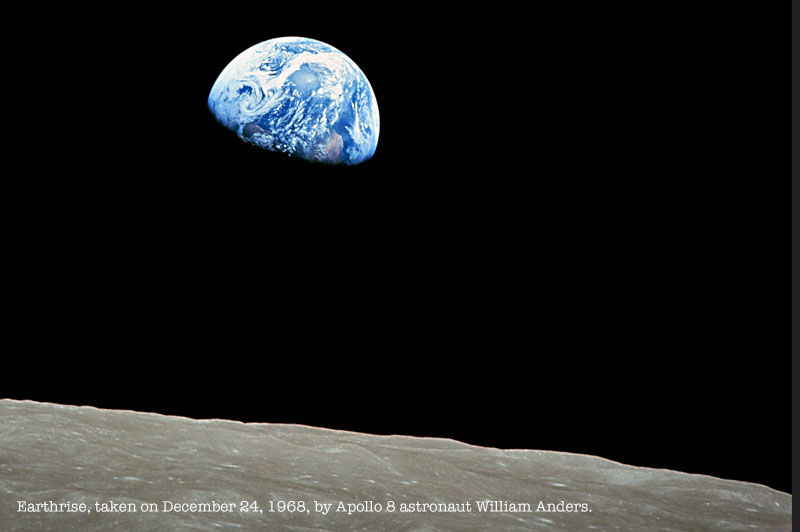
One of my idiosyncrasies is an interest in words, where they come from, what they really mean. Look up synonyms of ‘connected’ and you find ‘linked, combined, akin, allied, joined, coherent, coupled, banded together’. The word ‘nexus’ (i.e., a joining, tie, link, binding) has a similar Latin root as connect.I think if we could put all these words together and hold them simultaneously in our brains, we might get a glimpse of the real oneness of nature upon which all life depends. And this isn’t just some metaphysical quip – this is the reality of all that is.If there’s one photo or image that drives this home for me more than any other, it is that of Earthrise, taken on Christmas eve, 1968 by astronaut William Anders when Apollo 8 was in lunar orbit. I cannot look at this without deep stirrings; our earth is home and we are firmly rooted in it. Connected.
Loveland, Ohio – Define love. Is it the moment you first look into your child’s eyes, is it when you see you mother and father gently graze each other’s hand or is it when you lock eyes with the person you know you were truly meant to be with for the rest of your life? We all have an idea of what love is, based on how we were raised or what society has taught us, so why do we find it so hard to truly express love towards the ones we care for the most? Why is it often so hard to say “I love you?” I couldn’t think of a better person to ask these common questions to than Loveland’s newest Valentine Lady, Kathy Lorenz.
Growing up, Lorenz, who was born and raised in Pennsylvania, was taught to love many things; three of them being education, reading, and learning. Lorenz ran with those three passions and ended up developing a love for teaching.
Kathy Lorenz with writer Cassie Mattia at Loveland Magazine for a DNA test.
“I wanted to be a French teacher, but at the time I graduated, there was no use for French teachers. I worked in HR, Greetings Cards, and I was an Editor for a Magazine for a while,” Lorenz said.
Kathy Lorenz taught in the Romance Language Department at U.C.
When Lorenz’s children were 2 and 4 she moved to Loveland with her husband where she finally got the chance to teach at UC in the Romance Language Department as a French Teacher. Lorenz spent 25 years at UC inspiring one student after another to reach their highest goals while still enjoying life’s most treasured gifts. One of those gifts being the ability to travel and see the world.
After Lorenz received her Doctorate in 1991 she decided she wanted to extend her love for education into Loveland by becoming a part of the school board. Lorenz has been on the school board ever since!
“While I taught at UC I got to take students to France,” Lorenz said, “I took about 10 trips with students to France. I always thought wow this is the best job in the world, I get to make memories, teach my students, and travel!”
After Lorenz received her Doctorate in 1991 she decided she wanted to extend her love for education into Loveland by becoming a part of the school board. Lorenz has been on the school board ever since! She is the current Vice-President of the Board and has been elected President several times. She has served for the past 18 years as Loveland’s representative to the Great Oaks Board of Directors. She holds a Ph.D. from the University of Cincinnati and a former member of the Governor’s Task Force Ohio. Lorenz was named Rotary Northeast 2017 Educator of the Year.
Kathy Lorenz said, “We have really great families and really great kids. Parents in Loveland truly care about getting their kids educated.”
“I am passionate about education, which is why I have been on the school board so long. Public education doesn’t get the respect it deserves and isn’t considered by a lot of people the necessity I think it is,” Lorenz explained, “I think if you don’t have public education it’s pretty hard to have a democracy. I want to have the best public education we can have in Loveland for the kids. We have really great families and really great kids. Parents in Loveland truly care about getting their kids educated.”
Over the years Lorenz has made the quite the impact on her students and the people of the Loveland community, which she says is easy to do when you have such good people surrounding you.
“I’ve always tried to be a good citizen of the Loveland area because I know so many people who are. I have such good examples of people who have done good things,” Lorenz explained, “I have been willing to say I will do this or do that especially being on the school board. I think this is how people can have an impact on Loveland. The school board has really given me a voice which has allowed me to impact the community.”
“The Valentine’s Ladies showed up for the dinner and brought me flowers and balloons and told me I had been selected to be this year’s, Valentine Lady.
Although Lorenz has a clear passion for education, many people know her best for being a huge advocate for spreading love and its meaning all around Loveland. In December, Lorenz was nominated by 2015 Valentine Lady Suzanne Lundy to be Loveland’s 33rd Valentine Lady, a position that is highly coveted in Loveland.
“My daughter asked me if I wanted to go to The Works for dinner. She was a part of arranging the whole announcement thing,” Lorenz said, “The Valentine’s Ladies showed up for the dinner and brought me flowers and balloons and told me I had been selected to be this year’s, Valentine Lady. I did not expect it at all! I always admired Valentine’s Ladies and how they represented Loveland and I always thought wow I want to be a part of that group. I was very surprised and very honored.”
Kathy Lorenz said, “Love is unconditional and complete.”
The duties of a Valentine Lady typically consists of going to the local schools, Pre-K through 3rd grade, and sharing with them the history of the Valentine Lady and how they can send Valentines from Loveland around the world. The kids also get involved in a coloring contest as well as a poetry contest. Lorenz also plans on adding on to the Valentine Lady agenda by spending time talking to the kids about love and how you can find it in the most ordinary places.
“I would like to tell the kids how we find love in all kinds of different places. You find love at home, with your friends and at school so I created a book with photos of hearts that you can find all over the place,” Lorenz said, “I have a rock that’s shaped like heart, a picture of a spider web that looks like a heart and I also have picture of a horse with a white spot on his head in the shape of a heart. I want to talk to the kids about where you find love, what it means and how you say I love you. We love all kinds of people for all kinds of different reasons,” Lorenz explained, “When my children were born I knew finally what the word love totally meant. Knowing that I could have those children and that I could help those children become the people they are and knowing that they looked at me in a certain way has made me be a better person. Love is unconditional and complete. Love is this connection we have with people. I try to say I love you to the people that truly mean something to me in my life because I don’t think we say it enough.”
Kathy Lorenz passed the Loveland DNA test administered by columnist Cassie Mattia
Inspired by her words and actions, many people among the Loveland community claim Kathy Lorenz is not only one of the kindest people in Loveland but is truly What’s In Loveland’s DNA.
My second feature story in a continuing search for Loveland’s kindest, sweetest people and what they’re made of. What is our DNA match?
Cassie Mattia is a columnist for Loveland Magazine and lives in Historic Downtown. Reach out to Cassie at cassiemattia@lovelandmagazine.com
Loveland, Ohio– The City of Loveland is known for many things such as its beautiful scenery, its historic buildings, and the famous Loveland Bike Trail, but what a lot of people don’t know is Loveland has become one of the top destination spots in Ohio for families. And the Bersani family is dedicated to that family-friendly atmosphere. What could be better than grabbing an ice cream cone from Loveland Sweets after a sunny afternoon canoeing on the Little Miami River? Well, that’s something Loveland Canoe and Kayak Owners Mark and Robyn Bersani couldn’t agree more with!
Mark and Robyn live right above their canoe and kayak shop on Karl Brown Way in Historic Downtown Loveland with their 5 dogs and their daughter Elena and quite frankly couldn’t be happier with where the journey to owning Loveland Canoe and Kayak has taken them.
The Bersanis knew they had some challenges ahead of them, but were committed to making Loveland Canoe and Kayak a family affair and family-friendly.
“We were not canoeists or kayakers we were outdoors people. We loved being outdoors and doing physical things,” Bersani said, “We were training for the Chicago Marathon in 2003 and we were running on the Loveland Bike Trail and Robyn said ‘Hey the Canoe business is for sale we should buy it! Robyn said ‘I’m off in the summer I don’t like to sit still and we will hire some kids and we will do it!’ We went into the process of negotiation. Initially, we were not going to get it because someone else had a better offer than things fell through and they came back to us and we put together an offer and essentially ‘We bought a Zoo,” Bersani explained. The business was formally owned by Bruce Crutchfield who at one time had a caged chimpanzee at the business named Sam who canoeists and locals fed a regular diet of beer and cigarettes.
The Bersanis didn’t always live in Loveland, in fact, they lived in Buffalo where their parents went to school together, which led them to eventually meet each other in high school.
Elena Bersani is not only an incredible hard-worker, an outstanding runner and Loveland’s very own “Sweetheart,” according to her parents, but she also has a soft spot for the Loveland-Symmes Fire Department.
“It took me 7 years to get a date,” Bersani joked, “But it was well worth the wait! We moved to Dallas a year after we got married. I started in Telecom and Robyn started teaching then I got transferred to New Orleans. We moved back up here to Cincinnati not knowing much about it except that we both had driven through it and thought it was beautiful coming from the Kentucky side,” Mark Bersani said, “Robyn started teaching in the Kings district and at that point, I had been in sales for 25 years in Telecommunications.”
After finally closing on the canoe and kayak property right before Memorial Day in 2004, the Bersanis knew they had some challenges ahead of them, but were committed to making Loveland Canoe and Kayak a family affair.
It was a challenge early on because Robyn and I had a vision for the business that was different from what others had seen it as before we took over,” Mark Bersani explained, “We wanted it to be a place where families could come and enjoy nature. At the time people knew the place as a sort of ‘Cabrewing’ venue. It was frustrating at times as we were trying to change the culture and dynamics. It wasn’t always easy but we were committed.”
The Bersani’s daughter Elena admitted at a young age of just 11 years old some of the people that came through Loveland Canoe and Kayak in the beginning quite frankly scared her.
Robyn Bersani was the first to experience what a difference the family-friendly atmosphere they created with Loveland Canoe and Kayak made for many locals and out-of-towners.
“It took 2 or 3 years of education, policy enforcement and talking with the local authorities to see what we could do to achieve our vision of that family-friendly environment,” Mark Bersani said, “People told me if you do away with alcohol your business is going to be gone. I was told if you make the decision to go alcohol free and you stick with it you’re going to have a couple of years that are going to be really difficult and then it’s going to get better because people are going to find out that they can bring their families, sports teams and scout troops because of what the business stands for. People from Loveland started pulling me aside after they saw what we were doing and would tell me thank you for doing this because they used to have to go an hour up the river to do this with their families because they did not want to be around the alcohol and what it brought along with it,” he explained.
Robyn Bersani was the first to experience what a difference the family-friendly atmosphere they created with Loveland Canoe and Kayak made for many locals and out-of-towners.
“Five of the original kids we hired stayed with us for 9 summers because of the atmosphere we created. My principal at Kings called me in the office and I thought she was going to tell me I can’t be a teacher and run the canoe and kayak business and she called me in and said ‘My son needs a job!,” Robyn Bersani said, “It’s the little things like the comments from people saying, ‘Thank you so much this was the best day my son and I have ever had.’ When people get out there on the river they realize how good it makes them feel. Our vision always was to get families out together in nature,” she said.
Robyn Bersani, who has now been a 3rd grade teacher for 28 years at Kings, knows a little something about inspiring our younger generation to not only reach their goals but to not be afraid to try something new even if they don’t succeed at it the first time.
“It took 2 or 3 years of education, policy enforcement and talking with the local authorities to see what we could do to achieve our vision of that family-friendly environment,” Mark Bersani said.
“I always wanted to be a teacher from a young age, but my parents pushed me to do something different, so I got a bachelor’s degree in psychology,” Robyn Bersani explained, “But then I thought to myself what better way to serve the world than to educate children. I want to prove things to the world like there are more important things than how an 8-year-old scores on a standardized test!”
Of course, Robyn Bersani isn’t the only one in the Bersani family making an impact on the Loveland community; both Mark and Elena Bersani do their fair share of helping and encouraging others. Mark is on the board of the Adventure Crew, which is a non-profit where the objective is to get urban kids in outdoor activities.
“We get about 125 kids out into nature and get them to experience things they would never get to experience otherwise,” Mark Bersani said, “This year they have skiing on the curriculum, they ,of course, will have biking on the Loveland Bike Trail and kayaking in the Spring and the Fall. This is all funded through donations and grants.”
“Elena has a place in her heart for firemen so she will make cookies and brownies for them all the time,” Robyn Bersani said.
Mark also takes part in what they call a “River Clean-up,” where they spend the day taking trash out of the State and National Scenic Little Miami River.
“We are big on doing what we can to stop the trash that is thrown into the river. With the River Clean-up, I have found a hot tub, a boat and one time I pulled out 65 tires!”, Marl Bersani said, “People don’t realize that 90 percent of trash and plastic in the oceans comes from rivers and streams. We used to get our dumpster emptied twice a week now it’s once every 4 to 5 weeks, so we have definitely made an improvement.”
Elena Bersani is not only an incredible hard-worker, an outstanding runner and Loveland’s very own “Sweetheart,” according to her parents, but she also has a soft spot for the Loveland-Symmes Fire Department.
“Elena has a place in her heart for firemen so she will make cookies and brownies for them all the time,” Robyn Bersani said, “I think she recognizes how much they have done for our family and our business and of course all they do for the Loveland community. The Fire Department has really looked out for us.”
Elena ran cross country for Kings and made it to State in 2010. She also attended the Art Institute where she focused on her love for baking, which led her to win “Best in Show” for her cannoli’s.
“Both of our girls have worked in the business for a number of years. They have unbelievable work ethics that we tried to instill through our example,” Robyn Bersani said, “It has always been important to us to be good role models and of course get involved in the community. We do a lot of things to somehow give back to the community. We try to donate to the community and local non-profits as much as we can so they can further their causes.”
The Bersani family have also been a part of some very successful fundraisers, such as Paddlefest, where 2,000 people paddle along the Ohio River, in which proceeds go towards the Adventure Crew, and one of Loveland’s most famous events the Frogman 5k. Last year in October the Bersani’s took part in a Film Festival that was held in Loveland’s very own Nisbet Park, where proceeds went towards the Little Miami Conservatory.
Loveland Magazine columnist Cassie Mattia interviewing the Bersani family. She writes, “Mark and Robyn live right above their canoe and kayak shop on Karl Brown Way in Historic Downtown Loveland with their 5 dogs and their daughter Elena and quite frankly couldn’t be happier with where the journey to owning Loveland Canoe and Kayak has taken them.”
“It’s the big picture. It’s about being involved in the community as a business owner and resident. We want to connect with people and share resources. Everyone in this community really watches out for each other,” Robyn Bersani said, “We love telling the story of Loveland!”
The Bersanis are looking forward to the up and coming canoe and kayaking season and hope to see families from all over Ohio come and experience the beauty of Loveland and the Little Miami River. If you would like to learn more about the Loveland Canoe and Kayak you can visit their Facebook page, their website at lovelandcanoe.com or check out their location at 174 Karl Brown Way.
Read more about the Bersani family adventures…
Loveland, Ohio (Nov 9, 2015) – Mark Bersani and his wife Robyn own Loveland Canoe and Kayak on the bank of the State and National Scenic, Little Miami River in downtown. This Summer the weather was not kind to their business. Too much rain and too often, keeping river levels unsafe for canoers and kayakers. Business was dismal.
Mark’s staff made a dare. If they could muster enough customers to match last season, Mark would get tattooed, a tattoo like many of his young staff had already gotten.
This LOVELAND MAGAZINE TV VIDEO is the rest of that story….
I trust that karma took take care of the boot-stealing scoundrel.
Columnist Stephen McClanahan is retired from P&G and now active in environmental advocacy, search/rescue and emergency medical/disaster response.
Ever tried to hike up a volcano?I have once; right now, the score stands: volcano 1/me 0.
My run at it took place in Guatemala.You might know the country from its Mayan culture and the famous ruins at Tikal in the flat northern lowlands. The southwestern part, however, is where the action lies if you’re volcano hunting.Lots of mountainous with numerous volcanos, some of which are active. It’s part of the ‘ring of fire’ that rims the greater Pacific. Guatemala sits atop three tectonic plates; frictional movement between these massive mysterious underground islands creates a very geologically active country.
The people there are some the kindest, generous and most humble you will ever meet.
The mountains there are stunningly beautiful, somewhat like the Appalachians, heavily forested with steep rises and falls.But because the average elevation is about 6000 feet, the weather in the mountains is very temperate with highs in the 70’s and comfortable lows almost every day of the year – kind of hard to beat. Since the country lies relatively close to the equator, the days are almost always 12 hours long with the sun setting around 6 pm the entire year; the combination of elevation and latitude makes for long, enjoyable evenings.And the people there are some the kindest, generous and most humble you will ever meet.
It sits on the shore of Lake Atitlan, is less than 10000 feet in elevation and, as is kind of important if you want to live, was dormant at the time.
I’m blessed to have been there many times, first on business and later with my wife because of friends made there.Now, being somewhat of an outdoors enthusiast and given there aren’t too many volcanos around Ohio, I decided that, on one trip, I was going to climb one. After all, how many folks in Loveland can boast of climbing a volcano?Bragging rights were within reach! We chose the volcano near San Pedro as knowledgeable local folks claimed it to be one of the simpler volcanoes to start with.It sits on the shore of Lake Atitlan, is less than 10000 feet in elevation and, as is kind of important if you want to live, was dormant at the time. Our good friend Luis made the arrangements; we met our guide at the base of San Pedro early one Saturday morning and off we went.
A view across Lake Atitlán from Panajachel to Volcán San Pedro. (From Wikipedia, the free encyclopedia)
Now if you’re paying attention and doing the math, you’d discover we only had about 4000 feet to climb to summit, since we were starting off from an elevated base.Surely, I thought, we can do this – how hard could it be?The answer was hard, the kind of hard where your lungs and heart are screaming at you for what you are doing. Funny thing about a volcano – every step is up from the previous one. Like climbing an endless set of stairs, only without steps to put your feet on. There are no flat spots or downhills where you can coast; its only up, up and more up.
Funny thing about a volcano – every step is up from the previous one.
Sometimes steeply up, requiring the use of hands as well as feet. After a few hours of huffing, we had climbed a fair distance and the view was becoming spectacular.But the truth was that we had only ascended about half way and our cardiovascular systems were exploding.
The volcano was teaching us humility; our next lesson was about to transpire. On one of our increasingly frequent breaks to catch our breath and gulp water, we heard something moving, coming up behind us; we were startled to see a rather elderly man, easily 20-30 years our senior, climbing up with a heavy load on his back.To him, the trek was child’s play. Up he went, right past us, pausing only for a simple greeting and he was gone.
Did you know they grow coffee on the sides of volcanoes?The elderly coffee farmer who just passed was simply going to tend his crops that grow well in the rich volcanic soils high up on the slopes.So, while we were sucking air, he was on his way to work!
We didn’t make the summit that day; with lengthening shadows and crushed prides, it was time to descend (remember that thing about being dark at 6 pm?).When we returned to our departure point, we found Luis relaxed under a shade tree.The smirk on his face told me he knew what we just learned. Have I mentioned how humble the Guatemalan people are?
The epilogue of this story concerned my hiking boots.
The epilogue of this story concerned my hiking boots.I had purchased a pair just before the trip, and had spent the necessary time at home breaking them in.They felt great on the volcano and performed well.I was very pleased with myself. For the flights home, I lovingly packed them into my checked luggage and delivered them into the care of the airline.Not unexpectantly on such flights, I arrived in Cincinnati, but my bag didn’t.Not to worry as I was confident it would find its way home.Sure enough, the next morning, a currier arrived at my house with bag in tow.As is good practice, before agreeing to accept delivery, I decided to take a quick look – after all, it had been a full day since I had seen my boots and I just wanted to lay eyes on them again.
I erupted, sort of like a volcano.Steam, ash, fire, poisonous vapors poured forth from my mouth.
At this point, I should tell you that I am generally a peaceful and rational human being.But I totally lost it when, much to my dismay, my beautiful boots were no where to be found. No summit and now, no boots! And to add total insult to the injury, there lay another pair of old worn-out, dirty, smelly work shoes amid the rest of my clothes!When the realization finally dawned on me that someone had helped themselves to my new boots by exchanging them for their stinky old shoes (ostensibly to conceal the heist), I erupted, sort of like a volcano.Steam, ash, fire, poisonous vapors poured forth from my mouth.My children were aghast – they’d not seen this side of their father (much). In hindsight, I sort of felt sorry for the currier as he took the brunt my wrath but was innocent of the crime (I checked his shoes just to be sure).The story ended, when after a few letters and several phone calls to people as high up the management chain of the airline as I could reach, I finally received money back for my boots.And I trust that karma took take care of the boot-stealing scoundrel.Yet, I was never whole again. There is something sacred about a man’s boots and violations run deep. To this day, when camping and it comes time to take them off at the end of the day, I always make sure they remain guarded and close by; you can never be too sure.
Map from From Wikipedia, the free encyclopedia. Read more about the Ring of Fire.
Columnist Stephen McClanahan is retired from P&G and now active in environmental advocacy, search/rescue and emergency medical/disaster response.
Glacier National Park sits in northern Montana; it runs contiguous with Waterton Lakes National Park of Canada to create a large, magnificent wilderness.If you ever have the opportunity to really experience the area, don’t pass it by.Glacier was set aside as a national park in 1910 by Cincinnati-borne President William Howard Taft. The park is named for the numerous glaciers that are there (or at least used to be but more on that in a bit).
Several years ago, I had the opportunity to spend a week backpacking in Glacier with some friends.During the time of our adventure, the country was celebrating the bicentennial anniversary of the Lewis and Clark expedition.It so happened that during the week we choose, we were about 20 miles from their location exactly 200 years earlier. That was kind of cool.
Our hike took us across the southern portion of the Park, away from the popular tourist areas.We followed trails through the Nyack creek and Two Medicine Pass areas.We went through some remarkably remote wilderness that, as the rangers were keen to remind us, is home to the grizzly bear.Now, before you can get a backpack permit, you must watch a short film that reminds you that,
Relative to the bear, you are lunch.
relative to the bear, you are lunch.And to avoid such a fate, you are advised to hike a monster-sized canister of bear spray that you can fire once the grizzly is within 30 feet of eating you. Being that this is kind of a last resort tactic, you are also advised to hike with bear bells dangling from your pack.The tingling of the bell is to alert the predator, thereby avoiding a surprise lunch date.Sounds easy enough; the bear spray secures nicely to your pack and is largely out of the way but after a few days of tingling of the bells, you just about lose your mind and being eaten by a bear no longer seems the worse fate you are facing.
After a few days of tingling of the bells, you just about lose your mind and being eaten by a bear no longer seems the worse fate you are facing.
Strange things can happen in the deep wood.One late afternoon when the sun had sat, and night was falling, a solo hiker wandered into our camp.Mind you, we were probably 30 miles from the nearest point of civilization in a less frequented section of a large national park, deep in remote wilderness.The young man was wet, hungry and lost but in surprisingly high spirits; after feeding him and consulting our maps, we discovered he missed a turn several miles back.Astonishingly, we learned the lad was from basically the same home town in Kentucky as my wife; it is a small world.By sunrise the next morning, he was gone, leaving only a note of thanks for food and companionship.
Conversation that alternated between discussions on theology and scatology.
A member of our team happened to be a pastor.One afternoon, we were thoughtfully engaged in conversation that alternated between discussions on theology and scatology (if you don’t know that one, it’s the study of animal pooh – kind of important to know if grizzlies or other unfriendly creatures are about since you’ve canned the bells).
Some may find it irreverent to think of holding together these two conversation topics; I think they are all part of the same fabric – creation and Creator. Did you know there are amazingly interesting processes (intricate, complex and interdependent) by which nature takes that pooh and recycles it back into the web of life?Without the creatures that perform these miracles, life would not be possible; you and I wouldn’t exist. So, in a profound way, theology and thoughts of pooh do belong together.
We are so deeply connected to the earth and, when in remote places, it’s natural to reflect on such things. I find nature to be a great teacher if I’m willing to become the student.I, like many others, find nature to fully reflect the Creator.
The first in a continuing search for Loveland’s kindest, sweetest people and what they’re made of. What is our DNA match?
Carolyn Bingaman at her desk at Accounting PlusCassie Mattia is a resident of Historic Downtown Loveland
Loveland, Ohio – Every city is known for something. Some cities are known for their restaurants, some are known for their national parks and trails and some are known for their shopping. The city of Loveland, of course, does not fall short when it comes to having some of the best restaurants, parks, trails, and shopping, but where Loveland really leaves its mark is through its people. So just what’s in Loveland’s DNA?
The area of Loveland was first settled in 1795 by Colonial Thomas Paxton and was later incorporated as a chartered city in 1961. History runs deep within Loveland’s roots giving the city a very long line of DNA. Many Loveland residents have not only lived in the “sweetheart” city for years but have also created a long line of DNA themselves within the city with their children now building a life in Loveland too. One could say that families build long lines of DNA in places across the United States all the time, so why is it unique that it happens in Loveland too? To that, I would say yes families do this all the time, but what is unique about families doing this in Loveland is that these same families dedicate their lives to making Loveland the absolute best place to live, work and go to school. That just doesn’t happen in every place.
Carolyn Bingaman has been a part of Loveland’s DNA since the age of 19 years old when she and her husband moved to Loveland. Fred “Allen”, an Air Force veteran, died in 2010. He and Carolyn were married for 53-years and Allen’s obituary said his motto was, “Try every day to be a blessing to someone”.
“We bought a house up in one of the only subdivisions in Loveland. We were going to move to Milford, but they didn’t have any openings in any subdivisions, so we came to Loveland. At first, I was thinking oh gosh Loveland…but then I fell in love. There has been a lot of changes since then. We have lived in the same house for 53 years,” Bingaman said.
Shortly after moving to Loveland, Bingaman began not only building a DNA strand of her own with her husband and 5 children but also began leaving her mark on the community through sports.
“Loveland had a great women’s and children’s softball teams. My husband and I played every Thursday night and I also had a women’s team that I coached,” Bingaman said, “We had so much fun! We played where the bus garage is now, at the Loveland Elementary School. There were bleachers there and lights and a concession stand,” Bingaman added.
To Loveland residents who know Carolyn, she could be described as very kind and modest about all the good she does for Loveland’s community, but what many don’t know is that she is also a strong advocate for women’s rights. What inspired Carolyn to fight for equal rights? Well, it all began on a Thursday night right before her women’s softball team was about to play a game.
“I was told by the men (Dave Hirsh and Roger Muething) in charge of the softball fields that I needed to be self-reliant and that I needed to stop asking them to get me bats and other supplies for the softball games. So, one night we had a game and we didn’t have a home plate. I knew there were some plates in the cupboard in the front building so I went up and borrowed a home plate with prongs on it. I went back and pounded it into the ground and started the game. Later, I saw people up by the building running around and yelling wondering where something was and one of the men came up and said, ‘Is that my home plate?’ I said ‘Yup!’ From then on, we always had our equipment and never had to go find our own,” Bingaman said.
Carolyn was very motivated starting at a young age. She knew most women during the ’60s and ’70s were expected to stay at home, take care of the children and make dinner for their husbands, but that just wasn’t what she saw for herself.
“I was not the best at math in school, but I did get A’s and B’s. When my husband and I came here I got a job with the Browns who at the time owned half of Loveland. Bob Lonagrover was their accountant,” Bingaman explained, “I began working at their supermarket. I worked the registers counting money and making deposits. Bob was instrumental in saying you must learn how to type, and Barkley Gest said why don’t you learn how to do something else so you can advance your skills. I took their advice and I just kept growing and growing my skills and eventually, I got the opportunity to work at Totes on Kemper Road. Totes was famous all over the country for their “stretch-on” footwear. I worked in the accounting department and ended up becoming the secretary to the vice-president of manufacturing,” Bingaman said.
Bingaman working her way up in a “man’s world” was something that inspired women all over Loveland. Unfortunately, after working for Tote’s for 9 and a half years, Carolyn made the decision to leave the company.
“I filed an EEOC suit in 1974 against Tote’s because they wouldn’t let me have a job I deserved. Paul Hackmen had lost his sight and had to retire. I did his job and mine for 4 or 5 months, but then they wouldn’t give it to me formally,” Bingaman explained, “Tote’s ended up hiring a man to take Paul’s place and wanted me to train him for the position I had been doing. I asked if they were going to give me the title. I didn’t even care about the money. I told them I would be quitting if they didn’t give me the job title because I worked hard for it and deserved it. There were a lot of women that worked there that did a lot of work and didn’t get credit for it,” Bingaman stated, “I ended up winning with the EOC and the right to sue, but I had to find another person for class action. My lawyer wanted to get another woman to speak out against Tote’s so that we could get more money, but I told him he would never get another lady to speak out against Tote’s because they would be gone in a second as I was,” Bingaman said.
I asked Carolyn if Totes didn’t give her the job title because she was a woman and she answered without hesitation, “Yes, that was why.” Carolyn now has a law in the books named after her.
After Carolyn gained the knowledge and confidence she needed to be successful in the business world she decided to open her own accounting firm called “Accounting Plus,” which has now been open for over 40 years. Carolyn believes that her biggest impact on Loveland has come through her business.
“People know if they have a question they know they can come here (Accounting Plus) and ask a question and I won’t charge them for just a question that I have an answer for. I have the same clients that I had 40 years ago. They wouldn’t dare leave me because I care so much for them that I would go get them,” Bingaman said.
Carolyn says that ever since she came to Loveland she has been in love with it. She loves the people more than anything and whether she knows it or not the people love her too. Pat Furterer, a longtime friend of Carolyn’s, couldn’t say enough about Carolyn and her impact on the Loveland community.
“Carolyn is a very unassuming, kind, gracious and generous donor to many organizations in Loveland. She has supported the Loveland Stage Company for years,” Pat Furterer said, “She supports the Loveland Historical Society as well. I feel she would make a great Valentine Lady representing the city!”
Loveland Magazine’s very own David Miller also had a few things to say on the impact Carolyn has had on him and the community.
“I used to work with Carolyn at Totes before and after I went to Vietnam. She, before, during and after treated me like she was my slightly, older sister taking care of me. She does an awful lot for Loveland and is very modest about it. She is very kind,” Miller said. “Not many, outside of my own family really cared that I was in Vietnam, but Carolyn did, and she worried about my safety. Hers was a deep personal concern for all who were serving during the war, and when I got home she wasn’t one to shy away from asking me about my experience. She wasn’t afraid to hear my answers.”
Carolyn is also responsible for the beautiful scenery Loveland residents and visitors enjoy during the spring and summer, “I love the flowers! I have planted flowers for I don’t know how many years in Loveland. Many women help,” Bingaman said.
Although Carolyn Bingaman is very humble there is not a question in anyone’s mind in the Loveland community that she is a huge part of, and matches Loveland’s DNA.
If you think you know someone in the community that has made a huge impact on Loveland and would be a great candidate for our Loveland’s DNA segment feel free to email us at lovelandmagazine@cinci.rr.com.
Columnist Stephen McClanahan is retired from P&G and now active in environmental advocacy, search/rescue and emergency medical/disaster response.
In younger days, when my body didn’t complain as often or loudly, I was into caving, along with a few of my friends.Amateur spelunkers with no formal training and homemade, improvised equipment.A dangerous combination for sure, but the allure of exploring dark, foreboding holes in the ground proved overwhelming and so caution was thrown to the wind.We all grew up in Kentucky and thanks to its geology, caves are in abundance, particularly across the southern part of the state. Whenever the opportunity arose, we’d grab our gear and head out, camping and caving for 2 or 3 days at a time.For a few years running, we found ourselves on such adventures between Christmas and New Year’s.Of course, it’s frequently cold during that time of year and so, we’d end up camping inside the cave since it’s
Mr. Ranger invited us into the back of his cruiser, gave us a free ride to the county seat and showed us a nice little room to sit.
considerably warmer there.We once made the ill-advised choice of executing such a strategy at Carter Caves State Park.It turns out that Park Rangers frown on camping inside their caves, even when there’s no one else around; who knew?When we exited the caves, Mr. Ranger invited us into the back of his cruiser, gave us a free ride to the county seat and showed us a nice little room to sit.Fortunately for us, cooler heads prevailed and after a few hours, we were asked to leave…quickly.I think we hitch hiked (also sort of illegal) back to our camp before packing for home.Ah, the indiscretions of youth.
It’s highly unlikely to collapse when you’re inside.
But I digress.I really want to tell you about caves and caving.If you can put up with the crawling, climbing, wiggling, wading and all manner of body contortions needed to navigate what nature has made, you are in for some truly amazing experiences. Of course, you need to get beyond the notion that the earth is going to fall on you; nature has taken a long, long time to build the cave and it’s highly unlikely to collapse when you’re inside. In my experiences, caves come in all shapes and sizes; some consist of a single passage way, others have more branches than you can count (and you had better pay attention on the way in, so you can find your way out).Some are easy; most are not.Some are almost dry; others require you to wade or crawl through water if you want to keep going.Some come to abrupt ends; some seem to go on forever. Some have large passageways; others make you squeeze if you want through.All are dark, really, really dark.
There are a few safety rules you just don’t want to break.
There are a few safety rules you just don’t want to break. The first is to let someone know you’re inside and it’s your intention to come out. The second is to carry lots of sources of light.Cell phones don’t count. I grew up using carbide lamps (the kind miners used) but today’s LED headlamps are far superior. The third is never go in alone; caving is a team affair. And just ask the boys from Thailand, don’t go into a cave if it’s raining somewhere close by as mother nature likes to use them for drainage. One of pleasant surprises you’ll likely encounter if you join a caving group is the spirit-de-corps that ensues from the adventure; there’s a coziness that comes from everyone stripping out of their wet, muddy clothes into something dry and warm at the end of a trip that’s hard to beat.
I vividly recall once crawling into a small chamber, maybe 18 inches high (I remember being on my belly) and several feet wide, only to find literally hundreds of highly crystalline, pencil-thin, delicate, sparkling white columns spanning floor to ceiling within the entire chamber.
One of many enjoyments of caving is experiencing various rock formations that exist in these environments. Variety and creativity are abundant.Not to get too much in the weeds, but caves in Kentucky form in limestones underneath sandstones.The sandstones are largely resistant to water whereas the limestone is not.Over time, bit by infinitesimally small bit, limestones can dissolve, leaving behind what we call a cave.But limestones are dynamic; they can also reform mineral when calcium carbonate is precipitated. A slow drip can form a crystalline mineral that emerges from the ceiling (a stalactite) or can grow one from the floor onto which it is falling (stalagmite).Lots of other formations occur, such as flowstones, large columns, deep pits, waterfalls and more. Many of these formations are brilliantly white and reflect light like a diamond. I vividly recall once crawling into a small chamber, maybe 18 inches high (I remember being on my belly) and several feet wide, only to find literally hundreds of highly crystalline, pencil-thin, delicate, sparkling white columns spanning floor to ceiling within the entire chamber. What I was seeing had taken millions of years to form.Not many people experience that kind of treat.
Did I mention that some caves are large?I’ve had personal experience with at least one of these that is somewhere in southeastern Kentucky (and I’m not referring to Mammoth Cave).My friends and I made a couple of attempts to penetrate this one, but it got the better of us each time.I remember the first long section was easy, requiring only a crawl for a quarter of a mile or so. Kind a singular tube, nothing too special. But then, the crawl tube abruptly emptied into an enormous
It was like a giant sports stadium deep inside the earth, only pitch dark with the haunting echoes of water falling somewhere.
chamber, wide and deep. It was like a giant sports stadium deep inside the earth, only pitch dark with the haunting echoes of water falling somewhere.And to make it far more challenging, our passage way entered this chamber at least 100 feet off its floor (remember the old trick of tossing a small rock and counting the time for it to strike bottom, then trying to remember your high school physics so you can
Otherwise we’d probably still be there.
calculate the distance it traveled?). We foolishly attempted to drop ropes and descend, but fortunately we lacked the needed length to even reach bottom, otherwise we’d probably still be there.We really hadn’t given much thought to ascending, only descending (maybe that ought to be added to the set of rules above).
My son is a caver and, as part of the hydrogeology department of Western Kentucky University in Bowling Green and sometimes gives guided tours through parts of Mammoth Cave to various geology field teams.I tagged along on one of these recently, for old times’ sake.I had not been in a cave in many years, but the spirit of adventure and exploration instantly returned.It’s an enchanted world down under and I highly recommend getting in on the action.And it’s still really, really dark.
Loveland Sweets is a purveyor of hand-crafted chocolates, caramels, marshmallows, and ice creams. Our house-made candies are prepared in small batches.
Meet Loveland Magazine’s newest columnist. A long-time resident of Miami Township, Stephen McClanahan is retired from P&G and now active in environmental advocacy, search/rescue and emergency medical/disaster response. The title of his column will be Love-the Land.
It’s all my son’s fault that I became interested in adventure motorcycling.When my friends ask me what this is, I tell them it’s kind of like backpacking down remote roads but with a motorbike under me.I try to get away to experience places I’ve never seen yet at the same time, I strive to move in a way that leaves no trace of me having been there as well as minimizing my presence in the moment.
A few years ago, my son and I took a couple of weeks and traveled some of the incredible lands in the western US.One afternoon when we were on a backcountry road in Colorado, we stopped due to some road work.As I grew impatient, I looked to my side; there was a peculiar rock sticking up from the ground, probably 30-40 feet into the air.I surveyed the area; there were several of these formations.It turns out that it’s a good thing to take trips like this with my son who happens to have majored in the geological sciences; since I’m his father, I get to ask as many questions, intelligent or otherwise, as I wish, and he must answer.(Simple rules to my advantage; what’s not to like?)
Since I’m his father, I get to ask as many questions, intelligent or otherwise, as I wish, and he must answer.
I asked about the rocks sticking out of the ground and after a few moments, his answer arrived.And I literally spend the next several hours of motorcycling contemplating what I heard.The rocks didn’t stick up out of the ground; they formed within the earth and over time, the ground eroded away leaving the rock exposed.It turns out that the rock is of a mineral that is more weather and erosion resistant than its surroundings, so it survived the rains, the winds, the heat, cold.I’m a chemist; I understood this piece; some chemical bonds are stronger than others.But the question that left me dazed followed; how long has this been going on?My son commented that it was likely somewhere in the ballpark of 300-400 million years.
So here I am, sitting on my bike, impatient over the few minutes needed for new asphalt to be smoothed.And sitting next to me is rock that is in the process of being exposed for more than 300 million years.
So here I am, sitting on my bike, impatient over the few minutes needed for new asphalt to be smoothed.And sitting next to me is rock that is in the process of being exposed for more than 300 million years. Three hundred million years!I tried to contemplate the juxtaposition of these two points in time, of me and this rock. My focus was so small – the minutes I had to wait before continuing to ride.The rock has been waiting on me for hundreds of millions of years. I tried to seriously understand 300 million years and not just let it pass as another number.I started small.What does 10 years feel like?I could put my head around that.What about 100; could I really imagine what a century was like?Maybe.Moving on, I tried to understand 1000 years, a millennium.I lost it here; I couldn’t honestly say I fully understood what 1000 years was really like. Yet the rock next to me was 300,000 millennia old! And compared to many other objects in the world, the exposed rock was young.
l find there is always ample evidence of something much larger at work than me.
My experience is that the world is full of these kinds of intense places that shape me if I immerse myself in them.And l find there is always ample evidence of something much larger at work than me. In this case, I was reminded that, compared to the vastness of time from which our natural world emerged, I am a mere fleeting mist.
Meet Loveland Magazine’s newest columnist. A long-time resident of Miami Township, Stephen McClanahan is retired from P&G and now active in environmental advocacy, search/rescue and emergency medical/disaster response. The title of his column will be Love-the Land.
It’s interesting how experiences come into your life that forever alter who you are.Years ago, a group of friends backpacked the Elizabeth Pass trail in Sequoia National Park, about a 50-mile loop.One day when we decided we had found a good place for camp, John and I went for an early evening scramble up a nearby boulder-strewn hill.It was good to move without packs and we were enjoying the climb over chunks of rock the size of cars.
When we summited, we discovered that we had stumbled upon a sizeable alpine lake, completely still in the fading sunlight of the cloudless day.
We sat and tried to absorb the mirrored water that was in front of us, but the silence was overwhelming, crushing us in its utter tranquility. Nothing moved, absolutely nothing.No wind, bird in flight or ripple on the water existed, a lake as quiet as the boulders that rimmed it. The complete stillness washed over us, and we too became totally silent, trying to not to disturb the beautiful, holy moment in which we were immersed.No doubt that we were on sacred ground and were deeply blessed for being in its presence.
Twenty years in the passing and I remember that time as if it were now. It is seared into my brain. When I read ‘be still and know I am God’, I begin to have a deeper understanding of what it means. Nature has a way of doing that to you, if you will let yourself be exposed.
I certainly have not had every adventure that I dream of, but I cherish every one that has come my way. Each has taught me something about life and my place in it.
In the coming weeks and months, I hope to share thoughts, experiences and moments with you that derive from my journeys out there.
In the coming weeks and months, I hope to share thoughts, experiences and moments with you that derive from my journeys out there.I hope to paint pictures for you of what lies in store for those willing to experience what is sometimes referred to as the back country. Yes, it costs some creature comforts and demands some efforts to venture into the wilderness, but what it gives in return is priceless.
As you can probably surmise from my words, I am at home in the wild; it is so utterly beautiful and majestic, and I cannot help but want to share it. By doing so, I hope to create and embolden your desire to immerse yourself in a bit of the world out there.So, let’s journey together.