Tag: $1.3 billion ratepayer bailout

  • Ohio Attorney General Dave Yost settles with FirstEnergy for $20 million

    Ohio Attorney General Dave Yost settles with FirstEnergy for $20 million

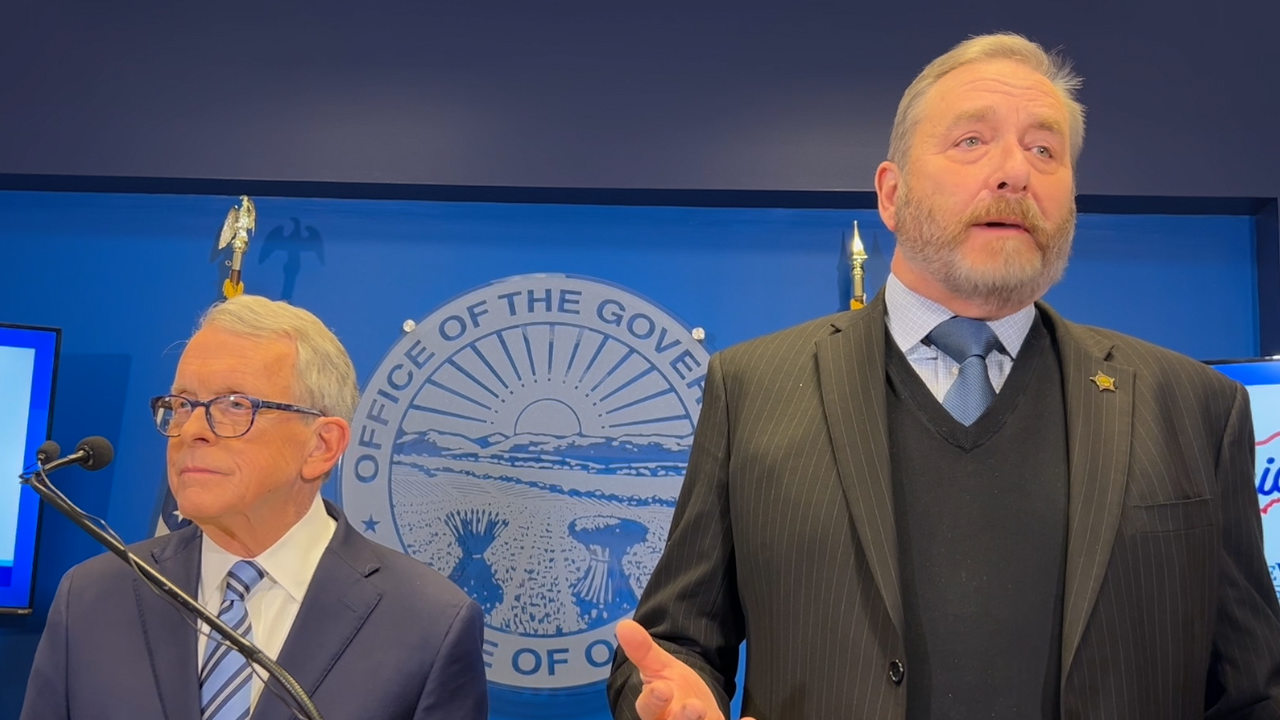
    Ohio Governor Mike DeWine (left) and Ohio Attorney General Dave Yost (right) answer questions during a press conference. (Photo by WEWS).

    Unannounced amount dwarfed by scale of epic utility ripoff that featured more than $61 million in bribes and a $1.3 billion bailout

    By:  Ohio Capital Journal

    Ohio Attorney General Dave Yost has agreed to settle the largest bribery and money laundering scandal in state history with the massive utility that funded it.

    At just $20 million, the settlement amounts only to less than a third of the bribes Akron-based FirstEnergy paid and it is dwarfed by the benefits Ohio utilities have received from ratepayers as a consequence of the corrupt legislation those bribes paid for.

    Yost’s office sends out frequent press releases, but not one regarding Monday’s settlement, which was first reported by the Cincinnati Enquirer, citing an SEC filing by FirstEnergy.

    In response to questions, his office said Yost had “voluntarily walled himself off from the case months ago to avoid any suggestion that the case was politically driven or any outcome was influenced by politics or political decision making.” But it didn’t explain how.

    The statement comes after more than a year of questions about the attorney general’s own involvement in the fight to pass and protect the $1.3 billion ratepayer bailout that mostly went to FirstEnergy.

    Yost’s office added that the company was cooperating in state prosecutions of two former executives, and that the company had reformed in the years since the scandal.

    “The non-prosecution agreement signed between FirstEnergy, the Ohio Attorney General’s Office and the Office of the Summit County Prosecuting Attorney requires FirstEnergy to provide evidence, access to witnesses and testimony in the ongoing criminal cases against (former CEO) Chuck Jones and (former Vice President) Michael Dowling, as well as in civil proceeding relating to the passage of” the corrupt bailout bill, spokesman Steve Irwin said in an email.

    By agreeing to the pact, FirstEnergy won’t be charged criminally. The company paid the federal government $230 million in 2021 to get criminal charges dropped in that instance.

    In dropping the charges, the state and federal governments allowed FirstEnergy to dodge a big financial hit. Consultants told the company it could face nearly $4 billion in fines if indicted, the Cleveland Plain Dealer reported Tuesday.

    According to weeks of testimony in federal court in Cincinnati last year, FirstEnergy executives began wooing Larry Householder and other state leaders in late 2016. The executives had bet heavily on coal and nuclear generation that was losing money because they failed to anticipate that the fracking boom would make gas-fired electricity generation cheaper.

    So the executives — CEO Jones and Vice President Dowling — undertook a frantic search for a bailout.

    They flooded $61 million in corporate money into 501(c)(4) dark money groups. From there, the money went to elect friendly Republicans who would vote to make Householder speaker of the Ohio House at the start of 2019.

    From that perch, Householder shepherded the corrupt bailout, House Bill 6.

    Sam Randazzo, Gov. Mike DeWine’s pick to chair the Public Utilities Commission, helped write and lobby for the bailout even though he was supposed to be a neutral regulator. FirstEnergy later said it paid a $4.3 million bribe to Randazzo, who died by suicide in April.

    DeWine, whose administration had several senior officials connected to FirstEnergy, signed the bill the same day that it passed. But it ran into instant opposition in the form of a fierce campaign to repeal the bailout.

    The FirstEnergy executives — who are now under state indictment — were so alarmed at the repeal effort that they put up $36 million to stop it. The resulting campaign included false, xenophobic TV commercials, bullying people gathering signatures to put a repeal on the ballot and even allegations of assault.

    Yost gave HB 6 supporters a big assist in the heat of the repeal fight.

    Before a repeal could go on the ballot, supporters had to gather 1,000 valid signatures from registered voters and submit a ballot summary to the attorney general. Yost had to approve that before repeal advocates could start gathering the necessary 265,000 additional voter signatures. And they had just 90 days after DeWine signed the corrupt bailout on July 23, 2019 to do it.

    The summary and 1,000 signatures were submitted within 10 days. But then Yost rejected the ballot language on the first go-round. By the time they had submitted different language and more signatures — and Yost approved it — their time to gather more than a quarter-million signatures had been cut by 40% and the repeal failed.

    While Yost — a hopeful to become governor in 2026 — hasn’t commented on his conduct during this period, some of the conspirators did.

    During last year’s trial, federal prosecutors presented messages between former Ohio GOP Chairman Matt Borges, who is serving a five-year prison sentence for his involvement, to Juan Cespedes, who has pleaded guilty to his.

    In one, Borges said the attorney general told him that he thought the bailout was a bad law, but he wasn’t speaking publicly as a favor to Borges and FirstEnergy. Yost “‘would be out front (in opposition) if not for (FirstEnergy) support and your involvement,’” Borges quoted Yost as supposedly saying.

    In another, Borges — who had run some of Yost’s past campaigns — said of the repeal summary, “If there’s any way the law will allow him to reject the language, he will do it.”

    Irwin, Yost’s spokesman, justified the settlement by saying FirstEnergy had reformed.

    “FirstEnergy today is not the company it was five years ago – the corporation has undertaken, and continues to undergo, reforms to strengthen its internal ethics programs, to increase transparency, and promote reporting of questionable conduct by its employees and leadership,” Irwin said. “It has also restructured its board and leadership to remove the individuals responsible for the conduct that gave rise to the House Bill 6 scandal. This is an important step in bringing the disgraced corporate leaders who used their positions of power to betray FirstEnergy’s ratepayers and employees and the people of Ohio to account for their crimes.”

    However, institutional investors are in court arguing that FirstEnergy is trying to limit the blast radius of the scandal. They accuse the company of trying to protect other executives and board members who might have been culpable — or at least might have known of the scheme.

    Indeed, the company is battling furiously not to turn over an internal investigation it commissioned in the wake of the scandal. After being denied an attempt to appeal an order to turn it over, the company filed a risky petition for a writ of mandamus on July 30.

    After the HB 6 scandal broke in 2020, Yost donated $24,000 in contributions from FirstEnergy and Cespedes to charity. It’s an open question when he’ll explain what he knew and did in a scandal that imprisoned Householder for 20 years and led to two suicides — including that of indicted lobbyist Neil Clark.

    Meanwhile, ratepayers are still paying big money as a consequence of HB 6. Its provisions solely benefitting FirstEnergy were repealed after the scandal broke. But the state’s leadership has refused to repeal the rest of the bill.

    It includes a measure that has so far paid $343,000,000 to subsidize two aging coal plants owned by a group of Ohio utilities. One’s not even in Ohio.

    Marty Schladen
    Marty Schladen

    Marty Schladen has been a reporter for decades, working in Indiana, Texas and other places before returning to his native Ohio to work at The Columbus Dispatch in 2017. He’s won state and national journalism awards for investigations into utility regulation, public corruption, the environment, prescription drug spending and other matters.

    Ohio Capital Journal is part of States Newsroom, the nation’s largest state-focused nonprofit news organization.

    MORE FROM AUTHOR

  • As Borges delay is denied, former FirstEnergy execs say “no doubt” the feds are after them

    As Borges delay is denied, former FirstEnergy execs say “no doubt” the feds are after them

    Litigation, prosecutions in massive corruption scandal move forward

    BY:  Ohio Capital Journal

    Judges denied two delays in recent days that would have been key to a bribery and money laundering scandal that took place in Ohio between 2017 to 2020. Lawyers in one suit called it “one of the largest corruption and bribery schemes in U.S. history.”

    Denial of a delay in one court case means that a player will still be sentenced late next month.

    In denying the other, the judge in that case agreed with two former FirstEnergy executives who said federal law enforcement has them in its crosshairs. But she ordered that they be questioned under oath anyway.

    One of those denied was former Ohio Republican Party Chairman Matt Borges, who on March 9 was convicted of racketeering along with former Ohio House Speaker Larry Householder, R-Glenford. Two others who were also charged in 2020 pleaded guilty and a third died by suicide.

    Borges and Householder played very different roles in a scheme to use more than $60 million from Akron-based FirstEnergy to make Householder speaker at the start of 2019 so Householder could pass and protect a $1.3 billion ratepayer bailout that mostly benefited FirstEnergy. But both made heavy use of funds that were passed through 501(c)(4) “dark money” accounts that enabled them to disguise its FirstEnergy source.

    Householder directed the effort in 2018 to elect friendly representatives who would make him speaker. He led the 2019 legislative fight to pass the bailout. And he engineered the nasty, dishonest battle to beat back an attempted repeal.

    Borges’ role was much more limited. He acted as a go-between with statewide officials such as Attorney General Dave Yost and Secretary of State Frank LaRose — and he paid a worker on the repeal campaign $15,000 as the worker shared inside information about its likelihood of success.

    Even though Householder’s role in the scandal was much bigger than that of Borges, each faces a sentence of up to 20 years in prison on the one count of racketeering of which he was convicted. Householder is scheduled to be sentenced in the Potter Stewart U.S. Courthouse in Cincinnati on June 29. Borges was scheduled for sentencing the next day.

    But after his conviction, Borges asked the court for extra time to file post-trial motions asking that his conviction be thrown out. U.S. District Judge Timothy Black agreed, giving him until April 24.

    Borges didn’t file anything by that deadline. But on May 15, Borges again asked permission to file post-trial motions. He argued that his conviction was on much shakier ground in light of two decisions handed down on May 11 by the U.S. Supreme Court: Ciminelli vs. United States and Percoco vs. United States.

    Judge Black, however, on Monday agreed with Assistant U.S. Attorney Emily Glatfelter that the legal theories those decisions dealt with were “neither charged, nor argued, nor instructed” in Borges’ case. Black added that it’s important to keep the case moving.

    “Finally, this case has been litigated, tried, and a verdict returned. Defendant Borges is now scheduled for sentencing on June 30, 2023. Disrupting the schedule would needlessly undermine the interests in judicial efficiency and finality,” the judge wrote.

     Former FirstEnergy CEO Charles “Chuck” Jones. Source: FirstEnergy, via Flickr 

    Similarly, a separate federal judge declined to postpone sworn depositions of the two former FirstEnergy executives who directed more than $60 million in corporate cash to Householder-controlled dark money groups that fueled the scandal. She did so even as she acknowledged that former CEO Chuck Jones and former Vice President Michael Dowling “fear they are next in line for indictment” and don’t want to incriminate themselves in their depositions.

    U.S. Magistrate Judge Kimberly Jolson is helping to manage the administration of a massive class-action suit against FirstEnergy, Jones and Dowling over the Householder scandal. Investors say the recklessness of the scheme cost them big — especially when it came to light and stock values plummeted.

    Alleging federal securities fraud, lawyers for pension funds and other investors have said in court filings, “FirstEnergy and its most senior executives bankrolled one of the largest corruption and bribery schemes in U.S. history.”

    Judge Jolson already slapped Sam Randazzo — Gov. Mike DeWine’s chairman of the Public Utilities Commission of Ohio — for not producing documents related to the $4.3 million FirstEnergy paid him just as DeWine was nominating Randazzo. Even though he was supposed to be regulating the utility, Randazzo, who has not been charged, helped draft the corrupt bailout law.

    Last Friday, Jolson also rejected attempts by Jones and Dowling — the former FirstEnergy executives — to delay sworn depositions to September or even later. The depositions had been scheduled for this week and next, but plaintiffs and defendants agreed to a short delay while Jolson considered the request.

    In asking to hold off until Sept. 8, Jones and Dowling said that having to give a deposition under oath put them in a position in which they were damned if they did, and damned if they didn’t.

    Answering questions could put them in criminal jeopardy, but if they took the Fifth, the jury in the class-action case is free to conclude they have something bad to hide, Jones and Dowling argued. They added that it’s certain that the feds are coming after them.

    “Although the defendants in (the Householder trial) have been found guilty (but are yet to be sentenced) and charges have not yet been brought against Jones or Dowling, there can be no doubt that the government’s investigation into Jones and Dowling remains ongoing,” their motion said.

    Judge Jolson replied that she had to weigh those concerns against those of FirstEnergy investors, who already have been fighting the case for nearly three years.

    Jones and Dowling “say the stay is temporary, (but) their grounds supporting the stay could extend for months or even years,” Jolson wrote. “Presently, they request that the depositions be delayed until at least September 8, 2023. (Jones and Dowling) have chosen this date because it is the first date on which investigations and proceedings conducted by PUCO might resume—after a third six-month stay of those proceedings was recently granted at the request of” federal prosecutors.

    The judge added it didn’t help the former executives’ argument that they haven’t been indicted yet because waiting until that question is resolved is a recipe for further delay.

    Jolson said she understood the executives’ dilemma.

    “In sum, there is substantial overlap between the issues in this case and the criminal investigation surrounding the Householder case,” she wrote. “And (Jones and Dowling) are faced with legitimate concerns regarding the invocation of their Fifth Amendment rights.”

    Jolson added, however, that granting a delay would privilege the former executives who funded the corrupt bailout scheme over the aggrieved investors and the public.

    “A stay of these key depositions at this moment — with no clear end in sight — would throw a wrench into the works of discovery and impede or even halt the litigation,” she wrote. “It would privilege the interests of (Jones and Dowling) above those of Plaintiffs, the public (whose interests are particularly implicated given that this is a class action), and the Court.”


    Marty Schladen
    MARTY SCHLADEN

    Marty Schladen has been a reporter for decades, working in Indiana, Texas and other places before returning to his native Ohio to work at The Columbus Dispatch in 2017. He’s won state and national journalism awards for investigations into utility regulation, public corruption, the environment, prescription drug spending and other matters.

    MORE FROM AUTHOR

  • Ohio’s billion-dollar bailout bribery trial showcasing rampant arrogance, corruption, and enabling

    Ohio’s billion-dollar bailout bribery trial showcasing rampant arrogance, corruption, and enabling

    by David DeWitt

    Every day more details emerge from Ohio’s billion-dollar bailout bribery trial showcasing gargantuan levels of arrogance, corruption, and enabling among energy executives and Ohio’s most powerful Republican politicians.

    Yesterday in federal court, prosecutors played recordings of late Ohio right-wing lobbyist Neil Clark that showed in extravagant detail how dirty Ohio politicians and power players really are.

    Pointing to the U.S. Supreme Court’s disastrous Citizens United ruling, Clark described to undercover FBI agents how to make dark money contributions in a way calculated to get a public official’s attention, saying those should come in chunks of $15,000, $20,000, $25,000 or more.

    “Based on a Supreme Court decision, businesses can do this and nobody can do anything about it,” Clark said. “Politicians can get a bunch of money and say, ‘I didn’t know.’”

    And that exactly how many Ohio politicians have been operating, this trial is showing: Selfish, reckless, greedy, amoral, large-scale, pay-to-play grift.

    The scope of corruption at every turn in Ohio is a bit staggering, so let’s take a look at all we’ve learned so far, all together in one place:

     Indicted former Ohio House Speaker Larry Householder. Official photo.

    Executives from financially struggling FirstEnergy flew Ohio House speaker aspirant Larry Householder and associate Jeff Longstreth to D.C. on the FE corporate jet in January 2017 for some swanky steakhouse dinners.

    Two weeks later, Longstreth opened a bank account for a dark money group called Generation Now and that same day emailed then-FirstEnergy Vice President Michael Dowling “wiring instructions” so the company could put money in the account. A day later another dark money group was opened, Partners for Progress, which was funded exclusively by FirstEnergy, an FBI agent testified.

    Partners for Progress was the dark money project of then-FirstEnergy lobbyist Dan McCarthy. It received $5 million from FirstEnergy within a few weeks of when McCarthy founded it.

     Juan Cespedes. Photo provided.

    During a meeting between Householder and FirstEnergy lobbyists in October 2018, a lobbyist named Robert F. Klaffky slid an envelope containing a check for $400,000 across the table and under Householder’s hand as they discussed a $1.3 billion ratepayer bailout of failing nuclear and coal plants, former FirstEnergy lobbyist Juan Cespedes testified.

    “Our client cares very much about this issue,” Klaffky told Householder.

    “Well yes they do,” Householder replied after peeking into the envelope.

    Cespedes has testified that the campaign checks were “specifically tied” to the bailout.

    “We were trying to establish the fact that our support was specifically tied to the legislation,” Cespedes said.

    All told, Householder’s dark money political machine amassed $61 million in utility company contributions to elect a legislature that would make him speaker and pass the bailout.

    This included allocating millions in dark money for ads promoting Householder that called dark money “dirty.”

    In its deferred prosecution agreement, FirstEnergy admitted that it funneled those millions into the operation through the entities to make Householder speaker and to beat back attempts to repeal the bailout he championed, House Bill 6.

    Why did it go through the dark money groups like that? It was thought to be bad optics if the struggling company were publicly giving the money, Cespedes said in testimony.

    An FBI agent testified that hundreds of thousands in FirstEnergy money went to Householder personally for expenses ranging from paying off his credit card bills to cleaning the pool at a home he owned in Florida and settling a coal mine lawsuit for him.

     Ohio Lt. Gov. John Husted. Official photo by Vivien McClain Photography.

    Text messages between FirstEnergy executives show that Householder and FirstEnergy officials expected help from the administration of Gov. Mike DeWine and Lt. Gov. Jon Husted in passing House Bill 6 through the Ohio Senate.

    Starting in 2017, FirstEnergy donated more than $1 million to nonprofit groups and political campaigns to help elect DeWine.

     Vivien McClain Photography

    In the Neil Clark recording played at trial, he pegs FirstEnergy contributions toward DeWine at around $3 million.

    “The governor got about $3 million from FirstEnergy,” Clark said on June 6, 2019, explaining that even so, Mike DeWine was an inconsistent supporter of the bailout.

    “The governor, when he knew Larry (Householder) didn’t have the votes, he ran away from him,” Clark said. “Now he wants to come back.”

    Clark also said that DeWine is highly influenced by campaign contributions.

    “I don’t want to say he’s a pay-to-play guy, but (DeWine is) clearly influenced by people who have money,” Clark said.

    After winning election, DeWine and Husted dined with FirstEnergy executives in December 2018.

    In early 2019, DeWine appointed the FirstEnergy lobbyist operating Partners for Progress, Dan McCarthy, to be his legislative affairs director, meaning McCarthy was in charge of representing DeWine’s interests before the General Assembly.

    DeWine also appointed as chairman of Ohio’s utility watchdog a former FirstEnergy consultant who FirstEnergy said they bribed $4.3 million just before he took his seat on the Public Utilities Commission of Ohio.

    Even though he was supposed to be regulating the utility, the official, Sam Randazzo, played a role in writing the bailout legislation, according to documents released by the Ohio House.

    While it was under consideration in the legislature, 2019 text messages show then-FirstEnergy VP Dowling telling then-CEO Chuck Jones that Husted was working on extending the timeline for the subsidies: “Just had long convo with JHusted…JH is working on the ten years, he’s afraid it’s going to end up being eight.”

     Former FirstEnergy CEO Charles “Chuck” Jones. Source: FirstEnergy, via Flickr

    Text messages shown at trial indicate that former Ohio Republican Party Chairman Matt Borges was assigned to try to enlist Ohio Attorney General Dave Yost’s help with the bailout. Borges, a FirstEnergy lobbyist after leaving his post as Ohio GOP chair, had previously served as Yost’s campaign manager and a political advisor.

    The texts showed that in June of 2019, Yost thought the proposed utility bailout was a bad law, but he didn’t publicly oppose it because of $24,000 in campaign support he’d received from FirstEnergy.

     Ohio Attorney General Dave Yost. Official photo.

    In a text to Cespedes, Borges said “Don’t repeat this,” but Yost believed the bailout was a bad law.

    Yost “‘would be out front (in opposition) if not for (FirstEnergy) support and your involvement,’” Borges quoted Yost as saying.

    DeWine signed House Bill 6 the same day it was passed by the legislature.

    Also that same day, Jones sent a photo-shopped image of Mount Rushmore to the bribed utility watchdog, Randazzo.

    The faces of Mount Rushmore were replaced with Randazzo, two FirstEnergy executives and another utility company executive with the caption: “HB6 F— ANYBODY WHO AIN’T US.”

    An effort to repeal the bill was soon mounted.

     Sam Randazzo, then a private sector attorney, testifies before the PUCO in March 2018. Source: The Ohio Channel.

    During the repeal effort, FirstEnergy executives were fighting it. Jones texted Dowling to say, “DeWine’s on board. I talked to him on Wednesday.” A DeWine spokesperson said the governor has no recollection of his conversation with Jones.

    As the repeal battle raged, FirstEnergy’s Dowling worked to keep the name of a senior aide to DeWine — McCarthy — off of a $10 million infusion of corporate cash into the fight. He did so even after an assistant told him it would violate IRS rules to not list McCarthy on the transaction, according to text messages presented in court.

    Borges paid $15,000 off the books in 2019 in an attempt to gather inside information about the campaign to repeal the $1.3 billion utility subsidy, Cespedes testified.

    Borges and Cespedes also texted about protecting Ohio Secretary of State Frank LaRose if he faced pressure to recuse himself as chair of the Ohio Ballot Board over the repeal effort.

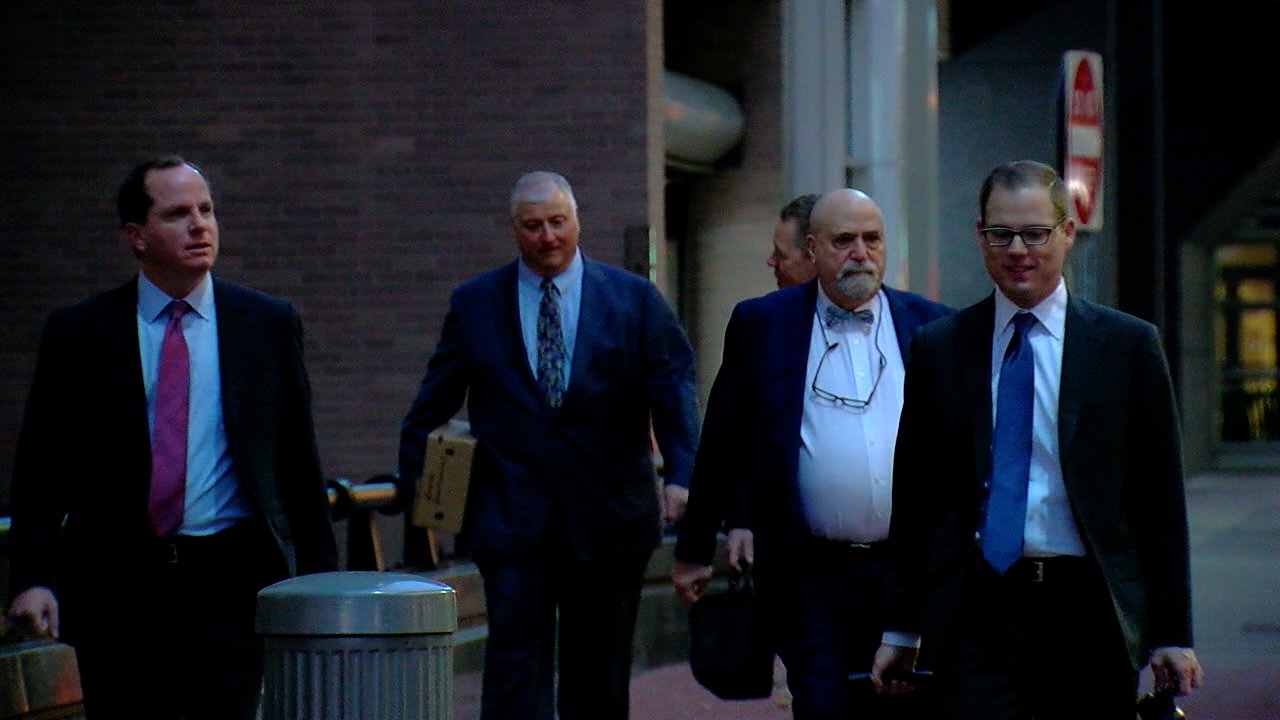
     Center, former Ohio Republican Party chair, and statehouse lobbyist, Matt Borges with his attorneys outside of the federal courthouse. Photo courtesy of WEWS.

    “He’s going to be a friend in this process,” Borges texted to Cespedes. “So let’s be prepared to speak up for him.”

    Cespedes responded, “We will support him more than anyone.”

    Additional texts said Borges was in touch with LaRose.

    “LaRose is expecting us to be publicly supportive of him,” Borges wrote in a July 2019 text.

    In another text, Borges wrote that LaRose wanted to meet with John Kiani, now chair of Energy Harbor (then FirstEnergy Solutions).

    Kiani reportedly stood to make $100 million personally from the $1.3 billion swindle of Ohio ratepayers, by selling the power plants after enticing buyers with the bailout.

    That same chairman in an email referred to Borges’ scheme to spy on the repeal effort as a “black op” and said he was prepared “to do whatever it takes” to defeat it, Cespedes testified.

     Ohio Secretary of State Frank LaRose. Official photo.

    Kiani had plans to operate the two FirstEnergy Solutions nuclear power plants in Ohio for a short period, get a government bailout and then sell the power plants in a deal in which he stood to make $100 million, Cespedes testified.

    Kiani remains the executive chairman of Energy Harbor.

    Randazzo has not been charged and denies wrongdoing. McCarthy has also not been charged, but did resign from the DeWine administration.

    DeWine has steadfastly defended McCarthy as well as his selection of Randazzo.

    DeWine and Husted, as well as Yost and LaRose, were reelected to second four-year terms in 2022.

    Husted, Yost, and LaRose are all poised to continue to seek political advancement in Ohio.

    Generation Now, Cespedes, and Longstreth have pleaded guilty.

    FirstEnergy entered into its deferred prosecution agreement.

    Neil Clark died by suicide in 2021, nine months after being indicted by federal prosecutors.

    The federal racketeering trials of Householder and Borges are ongoing and expected to last until March.

    Jurors will review all the evidence and decide their fate.

    It will be up to Ohioans to decide how long we will continue to allow our politicians to rob and abuse us in service to themselves and private interest profiteering.

    Every day we learn more about how Ohio government has really been operating under the design of unscrupulous thieves and grifters, rotting the institutions of our state into a national joke and embarrassment: a grotesque totem to pay-to-play corruption; a decayed and decrepit husk of representative democracy.

  • Angling for appeal? Householder attorneys go after judge in corruption trial

    Angling for appeal? Householder attorneys go after judge in corruption trial

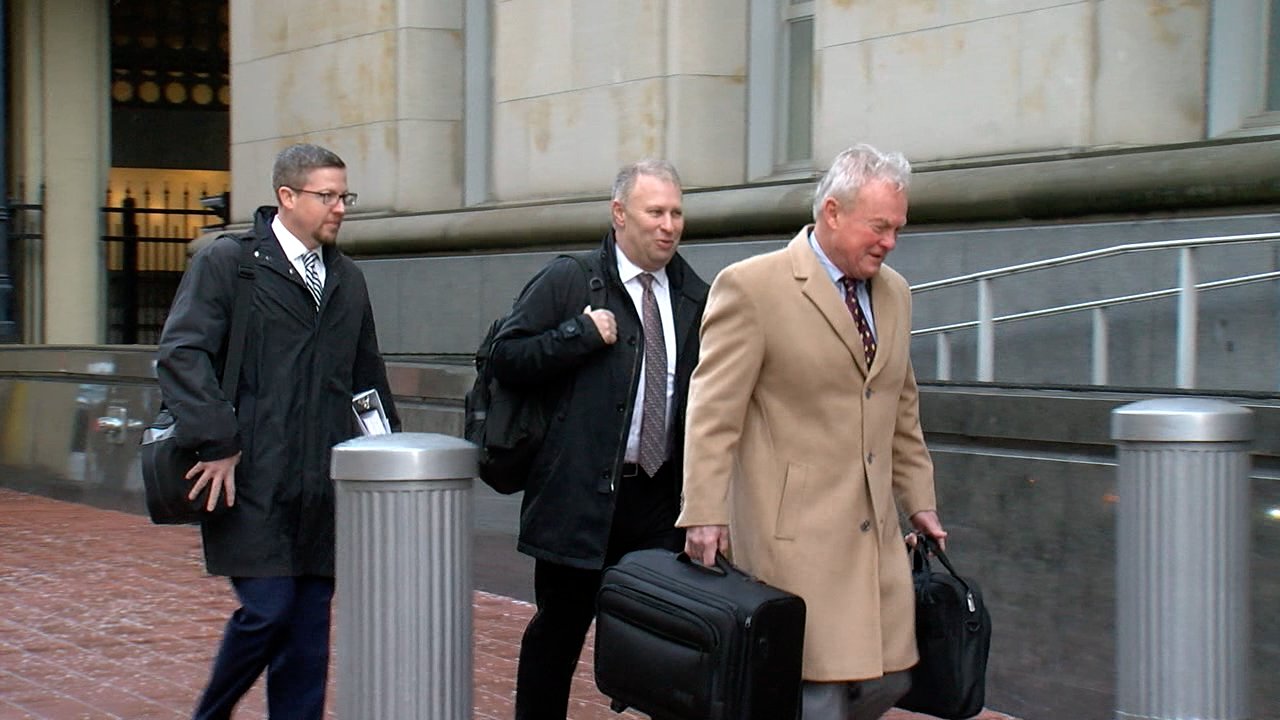
    Former Ohio House Speaker Larry Householder, a Perry County Republican, second from left, with attorneys outside of his racketeering trial. Photo courtesy of WEWS.

    BY: MARTY SCHLADEN – Ohio Capital Journal

    CINCINNATI — There has been speculation since the start of a massive public corruption trial that lawyers for the main defendant — former Ohio House Speaker Larry Householder — were banking on getting any conviction tossed out on appeal.

    There might have been evidence of that on Tuesday when one of the attorneys took the rare step of accusing the judge in the case of bias against his client. The attorney also suggested that the judge harbored a political grudge against Householder going back more than 22 years.

    Testimony resumed Tuesday in the case after repeated delays — first because of weather and then because a juror tested positive for covid. 

    When it did, federal prosecutors continued presenting extensive evidence to support allegations that Ohio utilities paid $61 million into Householder-controlled 501(c)(4) dark money groups and Householder used the money to elect friendly Republicans to make himself speaker in early 2019. Householder is accused of pushing through a $1.3 billion ratepayer bailout that primarily benefited his primary benefactor — Akron-based FirstEnergy — in return.

    Prosecutors have said it was likely the largest bribery and money-laundering scheme in Ohio history.

    Federal prosecutors are known to usually file charges only when they’re almost certain to get a conviction. That’s perhaps even more true when the case is against an elected official.

    And over the course of testimony so far, Assistant U.S. Attorney Emily Glatfelter has introduced reams of evidence in the form of emails and text messages, as well as transcripts of wiretaps and witness testimony — including that of co-defendants who have pleaded guilty.

    Householder’s attorneys have argued that their client raising money and electing candidates who would support his speaker’s bid was just politics as usual. They also argue that Householder only wanted to prop up failing nuclear and coal plants because he wanted to save jobs and protect the tax bases of the communities where they were located.

    Householder also is alleged to have pocketed $500,000 in utility money himself, but his lawyers say those were loans he fully intended to repay.

    However, the attorneys’ conduct on Tuesday might indicate that they’re looking past the jury trial.

    Before the jury entered the courtroom, Householder attorney Mark Marein rose to complain to U.S. District Judge Timothy Black  — about the conduct of Black himself.

    “We all collectively believe that the court holds animosity toward us,” Marein said, referring to Householder’s legal team. He added, “I question whether (Judge Black) should be presiding over this.”

    Black scolded Householder’s lawyers last week for muttering and making faces during Glatfelter’s opening statement. Among his criticisms, Black called the conduct “bush league.”

    The judge also dismissed a juror who refused to wear a mask in court. That prompted speculation that Householder’s lawyers were displeased because such a juror might be more sympathetic to their client, a pro-Trump Republican.

    But Marein gave a wholly different reason for suspecting that the judge was biased against Householder. He said that Black might be holding a grudge from 2000, when Black ran for the Ohio Supreme Court and Householder worked against the candidacy. 

    Both Marein and Black acknowledged that Marein was making the statements simply to get them into the record — presumably so they would be there in the event of an appeal. 

    There is some precedent for overturning public corruption convictions over complaints of judicial bias and prosecutorial misconduct. 

    In 2009, the conviction of former Alaska Senator Ted Stevens was thrown out after the FBI was found to have withheld exculpatory evidence and other misconduct. And in 2016, the U.S. Supreme Court unanimously overturned the conviction of former Virginia Gov. Bob McDonnell, ruling that the trial court judge allowed prosecutors to use an overly broad definition of bribery.

    But accusing a judge of bias in the middle of a trial has risks. Lawyers have said that if one genuinely believes a judge is biased, accusing that person of it in open court could simply make things worse. And in some instances, such accusations have resulted in professional sanctions against the lawyers making them.

    There were a few other developments of interest Tuesday:

    • Prosecutors played a recording of a wiretapped phone conversation between Householder and political operative Neil Clark in December 2017. Clark was also charged in the corruption scandal, but later died by suicide. In a laughing, profanity-strewn passage, the two talked about how Republicans legislators in 2010 drew a portion of Columbus into former U.S. Rep. Pat Tiberi’s district. “Tiberi wanted a safer district,” Householder said, later adding, “He doesn’t like me because he thinks I f*****d with him.” The maps drawn in 2011 were said to have some of the most gerrymandered in the country. Last year, a Republican-controlled panel repeatedly refused orders from the state Supreme Court to draw them more evenly.
    • Householder allies and FirstEnergy officials in August 2017 discussed a third tranche of $250,000 from the company to a Householder-controlled dark-money group at the posh Greenbrier resort in West Virginia, where that state’s Coal Association was holding its annual meeting. The money flowed soon thereafter. That meeting follows a round of swanky dinners in Washington, D.C., involving Householder and FirstEnergy officials the previous January during former President Donald Trump’s inauguration. Two dark-money groups were set up within weeks and one quickly received the first $250,000 from FirstEnergy, even though was hemorrhaging money.

    The trial resumes Wednesday. It’s expected to last into March.