Loveland Magazine is one of the 400 news outlets worldwide, with a combined audience of over 2 billion people “Covering Climate Now”, a global journalism initiative committed to bringing more and better coverage to the defining story of our time.
The initiative, was co-founded by The Nation and Columbia Journalism Review
Mihaela Manova is “Covering Climate Now” in Loveland, Ohio as an editor for Loveland Magazine
In today’s Covering Climate Now post (written by Joseph Winters for Grist), Winters sheds light on journalism’s “bothsidesism” in an effort to distinguish the decline of acknowledgement and action for climate change in the media.
Ever wonder why Americans have been so slow to support climate action? A new study lays some of the blame on media bias —for 30 years, three of the country’s most influential sources of news gave too much credence to arguments that the world shouldn’t take decisive action to mitigate climate change.
“Opponents of climate action have been given an outsize opportunity to sway this debate,” said Rachel Wetts, the author of the study. Her results were published Monday in the Proceedings of the National Academy of Sciences.
Wetts analyzed 1,768 press releases from business, government, and social advocacy organizations from 1985 to 2013, categorizing them by their stance on climate action. She then ran the press releases through plagiarism detection software to see how often they were featured in the country’s largest-circulation newspapers: The New York Times, The Wall Street Journal, and USA Today.
She found that even though 10 percent of the press releases contained messaging against climate action — arguments like, “It would be too expensive to reduce greenhouse gas emissions” — 14 percent of them wound up in print. By contrast, the more prevalent press releases arguing for personal, corporate, or political action to tackle climate change were only covered 7 percent of the time. And the least-covered press releases came from groups with the most expertise on science and technology, such as the American Academy of Arts and Sciences and IBM.
Edward Mailbach, director of the George Mason University Center for Climate Change Communications, called these conclusions unsettling. “Rather than marginalize self-interested voices and give prominence to expert voices, these papers did just the opposite,” he said.
How to explain the results? Wetts said one reason for the imbalance might be tied to journalistic norms of objectivity, which reporters and editors often interpret as a need to give at least two sides to every story, no matter the science. She called this “false balance,” because it can put unsubstantiated opinions on the same footing as well-established facts. In the case of climate change, she said that the practice has lent legitimacy to those who deny climate change, leading readers to believe that denial is “more than a fringe stance.”
Previous research has suggested that this practice — also known as “bothsidesism” — began to decline in the mid-2000s. But Wetts’ analysis found no statistically significant change in coverage over the 30-year period of the study. She also said that the trend couldn’t be explained by excessive coverage of anti-climate press releases in the business-friendly Wall Street Journal. Claims that steps to curb carbon emissions would be too costly or undermine U.S. energy independence, for instance, also found favor in the liberal-leaning New York Times.
As climate denial falls out of fashion, what’s been called “climate delay” has taken some of its space. This is when people acknowledge the reality of climate change but seek to put off large-scale efforts to address it, sometimes redirecting responsibility for the climate crisis to consumers and emphasizing the downsides of urgent action.
Wetts scanned press releases for both climate denial and delay — anything that argued against climate action — regardless of whether they accepted the science.
“Maybe people are covering climate deniers somewhat less,” Wetts said, “but then they’re substituting in other conservative voices instead. They’re talking about people who are opposed to climate action for some other reason besides denying the science.”
Jennifer Marlon, a senior researcher at the Yale Program on Climate Change Communication, acknowledged that the media environment has changed since the mid-2010s — The New York Times in particular has ramped up its climate coverage — but she suspects that false balance continues to influence the national conversation. For instance, newspapers might be better at contextualizing opponents of climate action, explaining that their views are outside the mainstream. “But those arguments are still out there and are very much in play,” Marlon said.
Wetts called on researchers to investigate the effects of media skew on public policy. The messages amplified by the media “can dampen political will to act on climate change,” she said in a statement, “with potentially serious consequences for how we as a society address — or fail to address — this issue.”
Mihaela Manova is a Loveland Magazine writer and is “Covering Climate Now” as an Editor for Loveland Magazine
By Mihaela Manova
I
n recent months, as advocacy towards a better future of equality skyrocketed, Instagram feeds exploded with links, pictures, and disgust towards the treatment of Black Americans in 2020, (the year of change in every way possible). While cheering on #BlackLivesMatter ( while of course donating/advocating/signing petitions) and the people involved in creating this new world, a topic within this movement has popped up repeatedly. And this topic is education. Education towards cultures, races, sexes, and especially the history of how some are born with privilege while others are not.
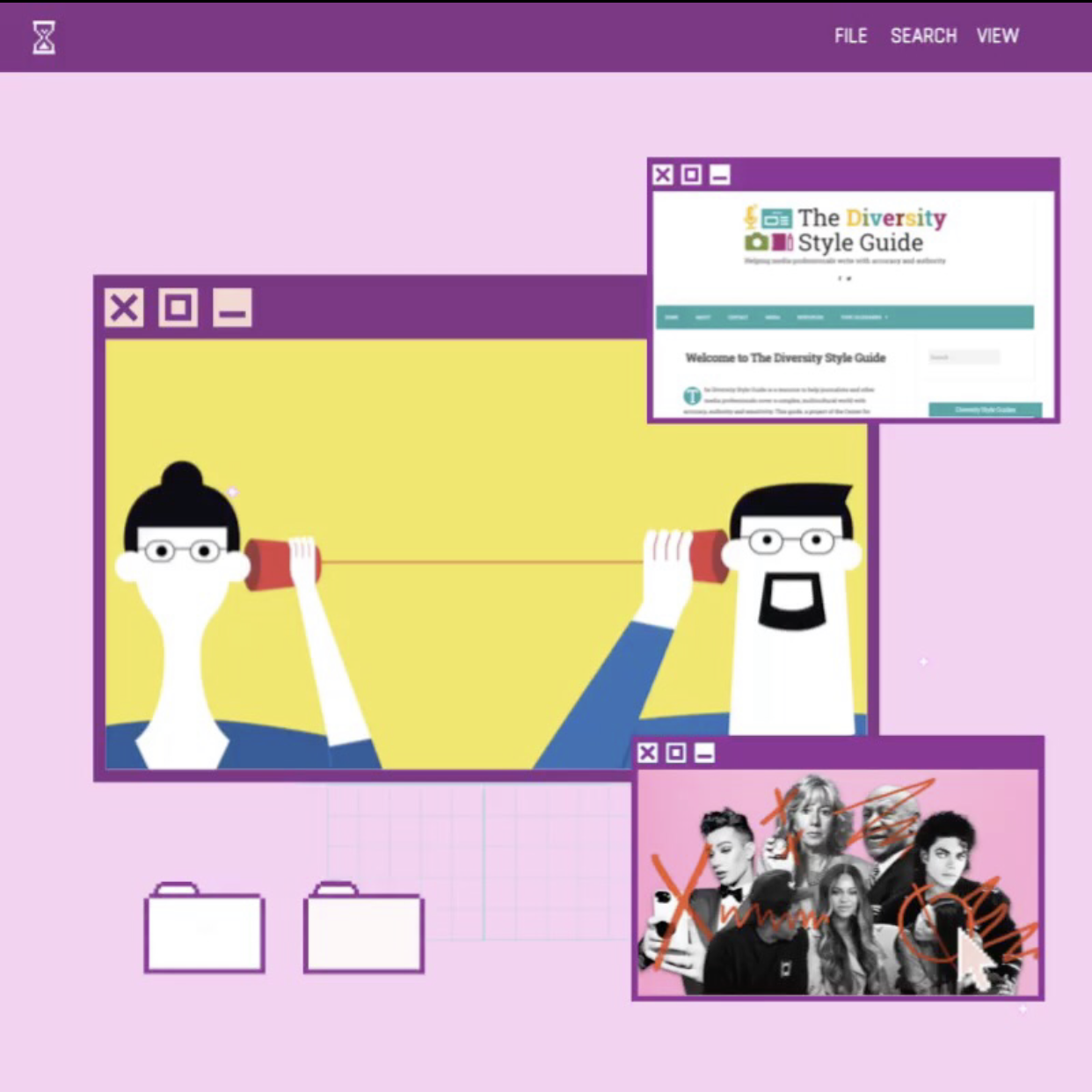
As an aspiring journalist who still has much to learn, I came across the Diversity Style Guide for journalists, an online dictionary with the intent to provide “accuracy, authority, and sensitivity” to complex topics that need to be covered. The themes included cover every parameter of race, sexuality, gender, immigration, etc. and are useful to journalists in being truthful and especially, cultured.
Here is what I learned.
“This is not a guide to being politically correct.”
What is The Diversity Style Guide?
To start off, this guide was developed as a project of the Center for Integration and Improvement of Journalism at the San Francisco State University. According to the website, it “brings together definitions and information from more than two dozen style guides, journalism organizations and other resources.” Historically, this resource was developed in the 1990s by CIIJ’s News Watch program which then paved the way for a newly updated one (this one).
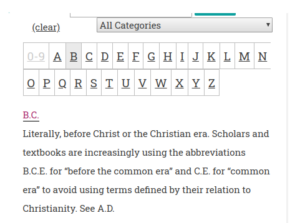
Conglomerated into this one guide, its contents include terminology related to “race/ethnicity, disability, immigration, sexuality and gender identity, drugs and alcohol, and geography.” An exemplar here shows the structure of how the guide works, alongside a glossary for easy use.
(From top to bottom) The glossary organizes each topic in alphabetical order, with the terms and definitions placed in a “dictionary” type of style.
While easy to use, the guide does have its disclaimer. “This is not a guide to being politically correct. Rather, it offers guidance, context and nuance for media professionals struggling to write about people who are different from themselves and communities different from their own.” In other words, one definition cannot portray and explain a complex topic, but the definition itself will offer guidance for those who are writing about it. The actual meanings and definitions of each term are prepared in a way that are taken directly from a credible source, linking those sources at the bottom of each entry’s definition.
Led by Rachele Kanigel, this free resource is managed and monitored by a team of professionals who help with the writing and editing of all definitions.
Why we need it today.
As of the past few weeks, people (both journalists and non-journalists) have scrambled to report on various news, most importantly the #BlackLivesMatter movement and the suppressed news stories that call justice for Elijah McClain and Breonna Taylor.
Posts were made for people to learn how to be proper allies, learn history and definitions of derogatory terms, to be told to stand up for Black Americans when you are in your place of privilege. Now, as a part of a needed, everlasting education on how we need to continue to stand together and fight for racial justice, we must open our minds and eyes to what is happening around us, even if it is not happening to us directly.
As an effort to continue the movement after the Instagram feeds turn back to selfies and beach photos, as journalists and people who provide commentary on the internet, we need to make an effort in understanding and spreading credible information pertaining to a person’s culture, race, sexuality, etc.
Good uses vs the bad
As a source like this can increase the right way to report people or events, there are two categories that companies, brands, or even publications fall under. Performative or genuine allyship to movements. Now, as this may seem more recent, a source like this online dictionary can define what Pride month is (for example), with then brands taking initiative to promote themselves in a genuine or fake manner.
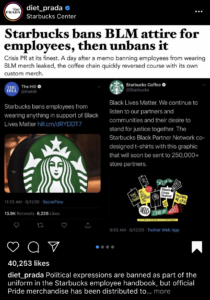
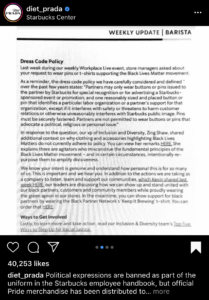
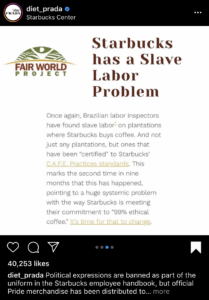
Take another example, a social media source under the name of DietPrada, exposing industry titan Starbucks for promoting #BlackLivesMatter after banning employees for wearing anything in support of that movement. In turn, social media users condemned them for their wishy-washy behavior when concerning this serious movement. In the same post, DietPrada reports of past misdeeds that the company has been practicing in an addition to the breaking news.
Here are their posts:
One of DietPrada’s posts, talking about the hypocrisy of industry titan Starbucks.
Details of Starbucks dress code policyThe past of Starbucks
From our own staff
Tying this back to our own local town, we as journalists need to practice education on behalf of the pieces that we write and especially about the events/people we portray. We have asked our Loveland Magazine Staff a couple questions about the use of this style guide and the need for better awareness on the internet.
David Miller, Editor in Chief, Loveland Magazine
David Miller
Q: During your years in the publication, have you witnessed an evolution of more knowledge from writers (about sensitive topics) in the publication?
DM: My entrance probably came when my daughters were in high school and I realized I wanted them to have the same opportunities as men. I also specifically remember my younger daughter taking runs on the Loveland Bike Trail, knowing she probably should not be running alone and thinking “boys” at this age were safe. But why not girls”? It was those kinds of things, those common ordinary everyday pleasures that “girls” were deprived of.
I began asking myself and others, “Why do we call adult women, girls? Why do adult women call themselves, girls?”
Words are so very important. I’ve tried to remove the word “girl” from our pages as much as possible when we should be saying “women” or “young women”. It’s never been about being politically correct, but about opportunity and making our community in many ways, safer and not diminishing accomplishments and potential.
In our sports writing especially I am moving along slowly but surely to remove diminishing language. I bristle when I hear the term “Lady Tigers” but never “Gentlemen Tigers.” For instance, when referring to the sport of soccer, the mostly male dominated industry of sports writing whether it come from media sources or the male dominated league or conference leadership, we would see references to Loveland Tigers when referencing the men’s team, but Lady Tigers when referencing the women’s team. It seems diminishing.
We have changed the language to simply Women’s Soccer and Men’s Soccer. When receiving press releases about team up-dates, why are the men’s teams always listed first? We started being intentional and made sure we were mixing the order. If we would see an announcement about “Most Valuable Players Announced,” we have to be aware of the male dominated industry will invariably list the male recipient first.
Appropriate wording is that someone died by suicide. I have intentionally used phrases or language that might help lessen the stigma of mental illness.
There has been much discussion about whether the w in White and the b in Black should be capitalized. Actually that very discussion last month from a trusted colleague led me to the Diversity Style Guide from the Center for Integration and Improvement of Journalism at San Francisco State University. That is why I asked the staff at Loveland Magazine to review it for possible adoption by our newspaper.
One’s internal, deeply held sense of one’s gender is what we will respect. We will use gender-neutral pronouns. I have never shied away from asking the direct question about a person’s preference when the occasion or need arises.
“For transgender people, their own internal gender identity does not match the sex they were assigned at birth. Most people have a gender identity of man or woman (or boy or girl). For some people, their gender identity does not fit neatly into one of those two choices. Unlike gender expression, gender identity is not visible to others. See gender expression.” – The Diversity Style Guide
Here are two other things I have learned along my journey. The word Gypsy (sometimes capitalized as a proper noun when referring to the ethnic group and sometimes spelled Gipsy) has negative connotations and many Romani people see it as a racial slur. In general, it’s best to use Romani or Roma people when referring to the ethnic group unless people self-identify as Gypsies. The term gyp, which means to cheat or swindle, likely comes from Gypsy and is seen as a negative stereotype of Roma as swindlers and thieves and will not be used in Loveland Magazine.
The “R” word has long been banned from Loveland Magazine.
We will use and allow terms such as mentally disabled, intellectually disabled, developmentally disabled. Likewise, words like “Libtard” which is a blend of the word liberal and this slur will never be allowed in Loveland Magazine.
Cassie Mattia, Writer and Associate Editor
Cassie Mattia
Q: With your experience in the world of journalism, does having knowledge of knowing terms that are specific to (gender, sexuality, race, etc), make a journalist different from the standard?
CM: In my personal experience as a journalist that has experienced this world on multiple platforms, I think having knowledge of what terms to use specifically in regards to gender, sexuality, and race is definitely an added bonus! I would say the standard for a journalist in this day and age is that they know and use the terms correctly. Quite often many journalists get scrutinized for not using the proper terms in regards to gender, sexuality, and race, but in my opinion, if they were never taught the correct terms how can they be held accountable for using the wrong language?
If the journalist is taught these correct terms earlier such as in high school, college, and post-college within their careers then I think we can hold that standard across the boards. I taught myself at a young age what the appropriate language to use is when speaking about gender, sexuality, and race, but if I hadn’t taught myself these things I may have at one time or another offended someone within my writing by accident.
In order to reach the standard of knowledge in regards to gender, sexuality, and race teachers, professors, and even parents need to start teaching the future journalists of the world early about the correct use of gender, sexuality, and race terms!
Often attention comes to celebrities and recent influencers whose dark pasts have been uncovered by various people. Twitter, for example, is notorious for digging old posts and matching them up with views that celebrities/influencers have had those years, ones who would include racial or homophobic slurs.
In most times, the digging results in unfavorable circumstances for both the individual and their fans, who for the most part are offended or disappointed at their favorite person. To look objectively on this issue, our newest writer, Claire Beseler, answered a couple of questions relating to this topic.
Claire Beseler, Writer
Q: In the current media cycle of influencers and celebrities being cancelled due to ignorance and past acts of racism, homophobia, etc. is it better for them to be forced to be educated or just resort to them being cancelled? What are our thoughts on “cancel” culture?
Claire Beseler
CB: It’s much better to educate someone for doing something wrong or offensive than to “cancel” them. Most of the time, people aren’t being offensive on purpose especially if someone is part of the majority and un-oppressed, they may not know what some people find offensive. Everyone is human and makes mistakes, and we as a generation using social media should not resort to calling people out in such an ugly way, but rather learn to forgive, educate, and forget. One example of this that I keep thinking about is when Kevin Hart was set to host the 2019 Oscars. Some homophobic tweets resurfaced from 2009 causing a lot of drama.
As a member of the LGBTQ+ community, I can take offense to some of those statements but the time gap can really justify some things. America and the world 10 years ago was so insanely different than now. Gay marriage was not even legalized yet and those types of jokes were “deemed ok” by most of society. The fact that people were trying to cancel him for things that were said a decade ago just isn’t right to me. He apologized, and the world should have just moved on and let him host the Oscars, but he was so beaten down and bullied that he dropped out.
People can change and forgiveness and lessons should be given out before such aggressive “cyber-cancelling.”
The one time I believe cancel culture is ok to use is when someone does something wrong, gets called out, but then continues to be offensive or do the wrong thing even after people educate them. But even before cancelling those kinds of people, comes respectful listening and trying to educate them instead of all jumping on this bandwagon of putting down others because they made a mistake.
Loveland Magazine is one of the 400 news outlets worldwide, with a combined audience of over 2 billion people “Covering Climate Now”, a global journalism initiative committed to bringing more and better coverage to the defining story of our time.
The initiative, was co-founded by The Nation and Columbia Journalism Review
Mihaela Manova is “Covering Climate Now” in Loveland, Ohio as an editor for Loveland Magazine
In today’s column written by Mark Hertsgaard, the writer draws a parallel between the recent events of advocating against racism and the cause to stop climate change.
By The Climate Beat Newsletter/ Mark Hertsgaard June 3, 2020
S
hortly after the police killing of George Floyd, Varshini Prakash tweeted, “If we can imagine stopping the climate crisis then we sure as hell can imagine a day when white supremacy is ancient history too.” Prakash, 27, is the co-founder and executive director of the Sunrise Movement, an uprising of young climate activists who have done more than any other group to push the idea of a Green New Deal onto the public agenda. To Prakash and her fellow activists, the fight for a livable planet and the fight against racial injustice are the very same fight.
“Equity and justice have to be the lens through which we solve [the climate] problem,” Prakash has said. “If it does not work for and benefit the most disadvantaged among us … it will not fix the problem.” The climate problem, in the eyes of this new generation of activists, is systemic and rooted in privilege. The poor, people of color, and women suffer first and worst from the heat waves, droughts, and storms unleashed by global warming, though they did little to cause that warming. The rich, the white, and the comfortable whose investments and lifestyles drive global warming are often shielded from its impacts. The same social systems that drive the climate crisis also perpetuate the racism that killed George Floyd and countless other people of color, and it is those systems that need replacing.
Days after the Democrats gained control of the US House of Representatives in the 2018 midterm elections, Prakash and dozens of Sunrise members occupied the office of incoming House Speaker Nancy Pelosi, demanding that Democrats back policies that matched the scale and urgency of the climate emergency. After rising Democratic star Representative-elect Alexandria Ocasio-Cortez joined the protesters and applauded their efforts, a handful of articles appeared in Politico and other Washington-focused news outlets. Three months later, after extensive consultations with the Sunrise Movement and others, Ocasio-Cortez and Senator Ed Markey introduced a congressional resolution calling for a Green New Deal. Suddenly, the Green New Deal was national news, with stories running in leading newspapers, magazines, and even network TV news programs.
Now, Prakash and Ocasio-Corte, along with Vermont Senator Bernie Sanders, are attempting to make a Green New Deal part of the official platform of the Democratic party in the 2020 campaign. Prakash is serving on a task force established by Sanders and former Vice President Joe Biden, the Democrats’ presumptive nominee, to try to devise a climate policy all Democrats can support in November. Biden and Sanders each nominated members to the task force, including one co-chair: Ocasio-Cortez for Sanders, and John Kerry—who, as Secretary of State under president Barack Obama, helped negotiate the Paris Climate Agreement—for Biden.
Media coverage of the Green New Deal has been scanty since Ocasio-Cortez and Markey introduced their resolution in February 2019, even as Sanders and most other Democratic candidates endorsed various versions of a Green New Deal during the primaries. Now, as Democrats debate whether to make a Green New Deal part of their argument for defeating Trump, newsrooms have an opportunity to catch up with the story. Americans deserve to know before they vote in November what a Green New Deal is, how it would work, what it would cost, what position the contending political parties and candidates take on it, and what difference it could make in the effort to preserve a livable planet.
The work of the Biden-Sanders task force is a good place to start. Like most climate activists during the primaries, the Sunrise Movement blasted candidate Biden’s climate proposals as much too weak. Yet after the task force completed its second meeting, Prakash tweeted a video message saying she was “cautiously optimistic” that she and her new colleagues would agree to “a national mobilization this decade that creates tens of millions of good paying jobs with access to a union.” She added that at a time “when we have 30 million unemployed in this country, we can take this opportunity to rebuild from the horrific impacts of COVID-19 stronger, more resilient and more sustainable than before.” And she made a point of praising the contributions of two Biden appointees, including Gina McCarthy, Obama’s former Environmental Protection Agency chief, who reportedly told the task force that the benefits of any climate policy “need to get to people today and tomorrow, not by 2050.”
The debate around the Green New Deal offers an abundance of news angles. Whether Biden and the Democrats go all in on a Green New Deal is unquestionably a big political story. It’s also a major business story: Which sectors of the economy stand to benefit from a Green New Deal? Which will resist, and why? Local coverage can ask what the mayors, governor, and other key public and private officials in a given region think a Green New Deal would mean for jobs and investment within their jurisdiction. International stories can explore how a justice-centered Green New Deal compares to the green stimulus programs the European Union, the International Monetary Fund, and other pillars of the global establishment have urged to revive coronavirus-battered economies. And looming over everything is a final question: how would a Green New Deal affect our civilization’s chances of surviving what remains, even amid this pandemic, the gravest threat of our time?
**Covering Climate Now is looking for stories about the intersection of climate and racial and economic justice. If you have recent or evergreen stories on the subject of climate justice that you are willing to share with the CCNow collaboration for republication, please send the links to sharing@coveringclimatenow.org. We will distribute a package of stories in a later email.**
Important Notice: Covering Climate Now’s interview with the UN Secretary General, like the G7 summit, is being rescheduled. Therefore, CCNow’s planned coverage of green stimulus spending June 5 to 12 will also be delayed. But both items remain on our agenda, and we’ll be in touch soon with more information.
Now, here’s your weekly sampling of the latest in climate news, from across the Covering Climate Now collaboration.
As America grapples with systemic racism, environmental groups are foregrounding climate justice and also confronting their own racist pasts. Many green groups remain overwhelmingly white and focused on such affluent issues as land conservation rather than ensuring clean drinking water for communities of color—but things are beginning to change, Grist reports.
On a similar note, ICYMI, in April HuffPost reported on the solar industry’s persistent diversity problem—and the companies fighting to change it.
Vox details how Joe Biden’s campaign and the climate movement are finding an unlikely but hopeful union, after candidates who were viewed as stronger on climate failed to win the primary. On the one hand, an appeal to climate voters can help deliver Biden the left, activists say; on the other, Biden’s Main Street appeal, coupled with his focus on jobs and investment, may finally shepherd political centrists to the climate cause. In the words of one environmental group leader: “Joe Biden isn’t the climate champion that the movement wanted, but he may be the champion they need.”
In 2020, America consumed more renewable energy than coal for the first time since the 1800s, when wood was used to power ships and trains, Bloomberg Green reports. “This shows us the trend toward renewables is clearly well underway,” said one expert. “We see it speeding up.”
Per The Guardian: COP26 talks, originally scheduled for November in Glasgow, will be delayed by a year, due to travel concerns associated with coronavirus. Some country’s representatives expressed concern that the delay could hinder emissions reductions. The UN climate chief, Patricia Espinosa, however, expressed optimism: “If done right, the [economic] recovery from the Covid-19 crisis can steer us to a more inclusive and sustainable path.”
Thanks for reading, stay safe, and see you next week!
“The LHS Athletic Department already treated me like royalty, so this is the icing on that cake.” – David Miller
by Cassia Mattia
Loveland, Ohio – It’s always an honor to receive recognition. Whether it’s for something as simple as performing an act of kindness, like volunteering for a charity, or for something as big as being honored for doing outstanding work within your career. That day has come for Owner and Editor In Chief of Loveland Magazine, David Miller!
The Members of the Southwest District Athletic Board notified Miller just a few weeks ago that he was chosen as the recipient for OHSAA’s prestigious “Media Award.” Below is the history behind the Media Award:
“In 1991, the Ohio High School Athletic Association initiated a program entitled the Sportsmanship, Ethics, and Integrity Program. One aspect of the program was to honor those special individuals who bring great recognition to our high schools, coaches, and especially, our athletes through media’s different forms. Each of Ohio’s six athletic districts was asked to put a process in place to gather nominations of individuals who fit this special category.” – OHSAA’s Official Website
When Miller received the news about being selected as a recipient of the Media Award and found out that the Loveland High School (LHS) Athletic Department Staff were responsible for him being nominated Miller was beyond the moon!
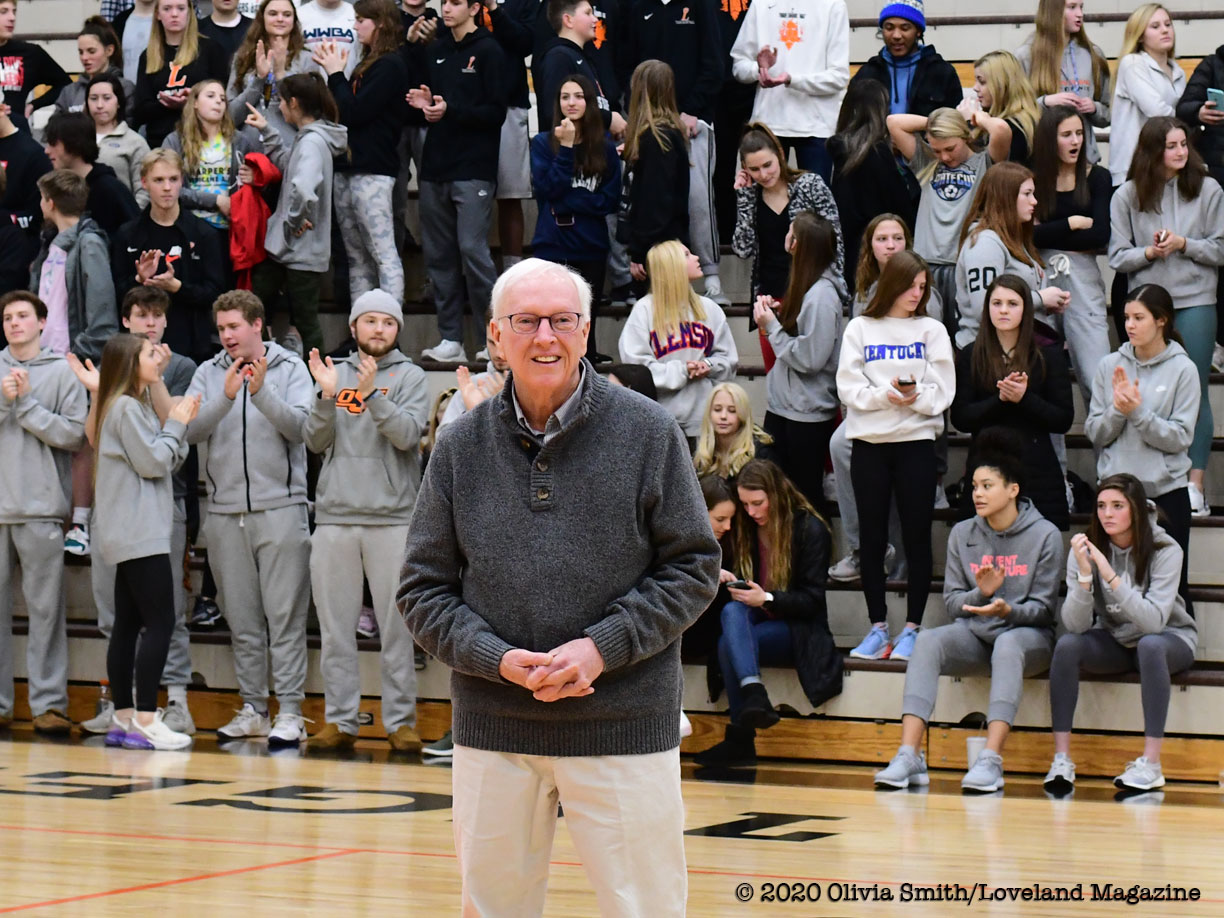
On Saturday, February 1st LHS’s Athletic Department wanted to celebrate Miller and his award so they invited him to be honored between quarters of the Loveland Men’s basketball game. Although Miller was nearly at a loss for words he wanted to take the time to thank LHS for helping him get to this point in his Journalism career.
“This really felt good for me to walk out on the court and be honored by the LHS Athletic Department,” Miller said, “Loveland’s Athletic program is incredible because it puts the students first as well as their academics. I remember being at the Senior awards ceremony at LHS last Fall and the parents were on one side and athletes were on the other. The gym was filled. The athletes were dressed in their best clothes and everyone sat and paid attention as each student-athlete received their accolades. They were so attentive and applauded for each award given,” Miller added, “I remember thinking to myself, what an impressive group of students and what an incredible amount of work went into preparing for the night! The respect the athletes have for one another is something the LHS Athletic Department doesn’t demand but they teach them how to honor and support one another.”
“Not every reporter in Ohio gets to be at games where an atmosphere of fun, safety, and respect is demonstrated by the young men and women at Loveland High School. I can’t thank the Athletic Department enough for that aspect of what they do,” said Miller.
“LHS has always made me feel welcome at their events and have always made every effort to help me get coverage for their athletes,” said Miller.
“They are so accommodating and are always giving back to those who make a difference in the Loveland community and recognizing me is one example of what they do every day.”
In praising the Athletic Department Miller stressed the hospitality they show him whenever he enters a court or field. “They are so accommodating and are always giving back to those who make a difference in the Loveland community and recognizing me is one example of what they do every day.” He added, “There is never a stupid sports question I ask that isn’t answered, and believe me, I can ask some stupid questions.” Miller talked about whenever he enters a court or field that he is greeted by someone in the Department thanking him for being there and asking him if there is anything he needs.
If being recognized in front of the wonderful people and student-athletes of LHS wasn’t enough Miller will also get the opportunity to be recognized during the finals at Ohio’s Division 1 Boys’ High School basketball game at Xavier University’s Cintas Arena. The ceremony will take place on Sunday, March 8th between quarters 3 and 4. Miller and 8 of his guests will also be treated to a sit-down dinner before the honorary ceremony. OHSAA also expressed their appreciation for Miller and everything he has done for Ohio High School sports.
“Congratulations! We truly appreciate what you have done and continue to do for our coaches and athletes,” OHSAA’s representatives said.
Miller will be joining a very talented group of journalists who previously received the Media Award. Check out past winners of OHSAA’s Media Award below!
SOUTHWEST DISTRICT
2018-19
John Bombatch (Xenia Gazette) and Dale Barger (Greenville Daily Advocate)
2017-18
Wade Linville (Brown County Press) and Elise Jesse (Cincinnati WLWT-TV)
2016-17
None
2015-16
Rick Cassano (The Journal-News) and Marc Pendleton (Dayton Daily News)
2014-15
Eric Frantz (J.J. Huddle) and Matt Hammond (Bellefontaine Examiner)
2013-14
Rob Kiser (Piqua Daily Call) and Mark Slaughter (Cincinnati WCPO-TV)
2012-13
None
2011-12
Jack Kramer (ScoresBroadcast.com) and Scott Ward (Greenville WTGR)
2010-11
Mike Dyer (Cincinnati Enquirer) and Ron Nunnari (Englewood Independent)
2009-10
Jack Pohl (Dayton WDTN-TV) and Chick Ludwig (Dayton Daily News)
2008-09
Enos Pennington (New Richmond Local Sports Radio) and Richard Crawford (Clermont Sun Newspapers)
2007-08
Sonny Fulks (Piqua WPTW) and Jerry Nardiello (Middletown Journal)
2006-07
Ken Barhorst (Sidney Daily News) and Tom Archdeacon (Dayton Daily News)
2005-06
Tom Groeschen (Cincinnati Enquirer) and Roger Barber (Wilmington WSWO-Radio and Wilmington WKFI-Radio)
2004-05
Ron Jackson (Dayton Daily News) and Omar Williams (Dayton WDTN-TV) and Guy Fogle (Dayton WDTN-TV)
2003-04
John Popovich (Cincinnati WCPO-TV) and Tom Gamble (Cincinnati WLW/WCKY-Radio)
2002-03
Jack Gordon (WPFB-Radio, Middletown) and Joe Neves (WPTW-Radio, Piqua)
2001-02
Bill Liermann (WKFI/WSWO-Radio, Wilmington) and Kert Radel (WMOH-Radio, Hamilton)
2000-01
Mark Huber (Wilmington News-Journal) and Mike Hartsock (WHIO-TV, Dayton)
1999-2000
Don McDermott (Greenville Daily Advocate) and Dave Schutte (Cincinnati Enquirer)
1998-99
Dave Long (Dayton Daily News) and Duane Bachman (WPTW-Radio, Piqua)
1997-98
Ted Landis (Brookville Star) and Warren Johnson (WPFB-Radio, Middletown)
Join us in congratulating David Miller for receiving OHSAA’s 2020 Media Award! Stay tuned for photos from the March 8th honorary ceremony!
Loveland, Ohio – The Loveland Board of Education met on Thursday, November 7, for a regularly scheduled work session and added three additional meetings for the remainder of the year to discuss how to move
Read all of the local election results…
forward after the failed levy vote on November 5. The board also decided to add a public input session to its next business meeting on November 19. The full meeting schedule through the end of the year is listed below. All meetings start at 6 PM and will be held in the LMS/LIS Media Center on 757 South Lebanon Road.
Results of Combined Operating and Bond Levy on Nov. 5 Ballot
Clermont Co.
YES – 1219
NO – 4101
Hamilton Co.
YES – 1185
NO – 4394
Warren Co.
YES – 43
NO – 139
TOTAL –
YES – 2447
22%
NO – 8634
78%
The combined operating and bond levy on last Tuesday’s ballot was turned back by a 78-22 percent margin.
On election night the Board issued a press release conceding defeat and Board President Art Jarvis said, “No one wins when our schools lose, and with the levy setback, the needs remain. As for immediate next steps, we will reflect on the vote and the needs in the district and ascertain what the community will support going forward. We have urgent facility and operating issues, but this was not the plan the voters wanted.”
If the Board decides to place a new operating or bond issue on the March 17, 2020, primary election ballot, it must be certified to, or filed with boards of elections by 4 PM on December 18.
Tuesday, November 19, 6 PM (business meeting), including public input session (Details to be announced)








 by Cassia Mattia