Tag: abortion amendment

  • If abortion measure fails, Ohioans on parole and probation could face graver restrictions

    If abortion measure fails, Ohioans on parole and probation could face graver restrictions

    For thousands of people under state supervision who face limits on their freedom to travel, a future without abortion rights could mean a choice “between health care and liberty.”

    BY:  

    When Ohioans go to the polls on Nov. 7 to vote on Issue 1, which would establish a constitutional right to abortion in the state, they will do so having already experienced what severe restrictions on abortion access look like.

    After the Supreme Court removed federal protections for abortion in its Dobbs decision last June, the state’s attorney general immediately petitioned a federal judge to enforce a 2019 law that banned abortion after six weeks. It included an exception for when the mother’s life is at stake but not for instances of rape or incest. The six-week ban remained in effect for nearly three months, until a lawsuit brought by abortion providers led to an indefinite stay of the law. During that 82-day window, the costs associated with abortion care skyrocketed, and people were forced to cross state lines to seek the procedure—including, notoriously, a ten-year-old whose heartbreaking story became embroiled in a national controversy. 

    The Abortion Fund of Ohio jumped into action, helping hundreds of Ohioans seek care elsewhere, in states where they could access abortion. The fund helped reroute them “out of state to be able to get the care that they were entitled to,” recalls Maggie Scotece, a doula and attorney who is currently serving as the organization’s interim executive director. (The organization is part of the coalition supporting Issue 1.)

    But the organization, which helps people fund and access abortions, also received confused calls from, or on behalf of, people who could not travel: minors in group homes or juvenile justice centers, and people on probation and parole.

    Hundreds of thousands of Ohioans have their freedom of movement greatly restricted because they’re under some form of state supervision, and the stakes of Issue 1 may be highest for them.

    According to data collected by the Prison Policy Initiative, Ohio ranks fourth nationally in the share of its population under any form of carceral control (this includes prisons, jails, probation, and parole), behind Idaho, Arkansas, and Georgia—“and that’s largely due to the massive number of people who are on probation,” said Wanda Bertram, a communications strategist at PPI.

    A 2023 PPI report found that, at any time, some 191,000 state residents are on probation, which is an alternative to incarceration that comes with heavy restrictions and surveillance, while around 22,000 more are on parole, a form of post-release supervision that in Ohio is baked into prison sentences. “Probation is handed out like candy here in Hamilton County,” said Sean Vicente, a Hamilton County (Cincinnati) public defender.

    Abortion is currently legal up to 21 weeks and 6 days in Ohio because of the legal dispute over the 2019 law. Meanwhile the campaign to pass Issue 1 and permanently codify abortion rights has raised millions of dollars and gained traction; recent polls have found that between 52 percent and 58 percent of prospective voters supported the measure.

    But Issue 1 has also garnered many opponents, especially among the state’s Republican leadership. If it fails, Scotece predicted that the state supreme court, which has a GOP majority, will “almost certainly” reinstate the six-week ban.

    If that happens, people on probation or parole would face an impossible choice, Vicente said“Do I travel out of state to take care of that health care issue and possibly get locked up? Or do I have an unplanned pregnancy? Do I have an ectopic pregnancy? Do I have a child via rape?”

    “It’s going to put poor people in a really tough spot where they have to truly decide between health care and liberty,” he told Bolts.

    Parole and probation are often conceived of as alternatives to incarceration that can keep more people in their communities. But both systems are so full of delays, requirements, and catch-22s that Vicente says he and his fellow public defenders often fear they are “setting up our clients to fail.”

    “The restrictions that are placed on people—and the ban on traveling out of state, which is common, is one of these—are often so onerous that people say that they would just rather be in prison,” Bertram said.

    At any given time, 39 percent of the people in Ohio’s jails are being detained because they violated the terms of their probation or parole, according to the PPI report. That’s double the national average of 20 percent.

    “I can understand it being that high, because anything can get you [violated],” said Malika Kidd, who helps women navigate reentry as the Program Director for the Lutheran Metropolitan Ministry in Akron and Cleveland“You can be around another person that was in prison and you can get violated, just in the same area with them. Somebody in your family can have a gun with them and you’re around it, you could be violated. If you get a traffic ticket and don’t let them know, you can be violated.”

    Though women are generally proportionally underrepresented within the criminal legal system, they are far more likely to be on probation than under other forms of correctional control, and both parole and probation compliance present special challenges for women. “Women are more likely to be the primary caregivers of children—all of the requirements that supervision imposes that get in the way of childcare are going to fall harder on women,” Bertram said. “That takes a huge amount of time out of your day.” There are fewer reentry programs serving women, who are more likely to be homeless upon their release—another factor that would make it difficult to comply with the often onerous requirements that accompany supervision. “It’s a combination of a lot of stuff that can overwhelm anybody,” said Kidd.

    Kidd is, in many ways, the face of women’s reentry in Ohio, but her experience with parole there illustrates how arbitrary and burdensome the system can be—and how it restricts people’s freedom of movement. In 2001, after police found cocaine in her car on a trip from Chicago to Cleveland, she was sent to prison for drug trafficking. Her son was just three years old; by the time she got out, he was 17.

    As part of her mandatory minimum sentence, Kidd was given a 5-year “post-control release” term. From the beginning, she says, her parole officer seemed biased against her and determined to make her life harder. The woman upped her risk level, calling her a flight risk because she is originally from Illinois, and forced her to wear an ankle bracelet, which tracked her movements and prohibited her from leaving Ohio. Some people on probation cannot even leave their county of residence without permission.

    Moreover, Kidd says her parole officer exacerbated the already toilsome process with delays in processing her requests for permission to travel outside the state. Ironically, some of Kidd’s requests were in order to speak at conferences about the myriad barriers associated with reentry. Her work was understanding about her spending hours at the parole office waiting for approval, she said, but “I’m sure there were plenty of other employers that weren’t as flexible as mine,” which could leave people to choose between potentially losing their job—a violation of parole conditions in itself—or giving up on the travel request.

    If abortion were once again banned in Ohio, people on parole or probation might be forced to choose between lying to the officer or judge assigned to their case about their reasons for travel, going out of state without permission, or being honest. The former two options both carry the risk of violating your supervision terms and being reincarcerated.

    Vicente said he couldn’t fathom any judges signing off on a travel request that involved going out of state to do something that would violate the law if done within state borders.

    He said, “You’re petitioning the court to say, ‘Hey, I know this is against the law here in Ohio, but I need my client to travel up to Michigan to get the care she needs. Judge, are you willing to allow her to travel out of state to break the law that’s currently in effect in Ohio?’ That I doubt any judges would sign off on.”

    “I think there’s gonna be a lot of frenzied and panicked calls, and it’s gonna put us in a tight spot as well,” Vicente added, wondering how his fellow public defenders would begin to advise their clients under such circumstances.

    An unexpected and unwanted pregnancy—and the stress, exhaustion, physical and hormonal changes, and increased number of health check-ups that tend to follow in its wake—could also make it harder to comply with the terms of supervision. “The medical needs are going to take priority over visiting the probation officer, which puts you in further jeopardy,” Vicente said. More people being forced to carry to term a pregnancy that they don’t want and can’t handle could ultimately contribute to the already high percentage of Ohioans jailed for violating the terms of their supervision.

    With polling showing public support for abortion and other reproductive health rights, Ohio Governor Mike DeWine recently proposed to soften Ohio’s six-week ban if it were to come back into effect and to allow some exceptions, for example in the case of rape. But other Republican lawmakers have already resisted such changes.

    Republicans also tried to change the rules of the initiative process in Ohio to undermine this abortion rights measure, which was petitioned onto the ballot by organizers who collected hundreds of thousands of signatures. GOP lawmakers called a special election in August asking voters to raise the threshold to pass a constitutional amendment from a simple majority to 60 percent. That proposal failed by a wide margin in August.

    The GOP’s proposal to change the rules in August was also called Issue 1, which has led to concerns of voter confusion as abortion rights proponents who fought the summer’s Issue 1 are now campaigning for people to approve the new Issue 1.

    If Issue 1 fails, it would add to the existing barriers that preventOhioans from accessing reproductive care.

    Even though abortion is currently legal up to nearly 22 weeks on paper, access is extremely limited in practice, Scotece of the Abortion Fund of Ohio said. While Ohio had more than 40 clinics in the ‘90s, anti-abortion groups have been “incredibly successful” in seeking to close them down, she told Bolts. The state now has just nine clinics concentrated in Ohio’s big cities, only three of which perform abortions up until the legal limit.

    Meanwhile, Scotece stressed that Ohio is already one of the leading states for the criminalization of pregnancy, whether it be arrests and prosecutions for self-managed abortions or the use of narcotics while pregnant. A 2021 study done by researchers at the University of California San Francisco that surveyed people who searched for abortion care via Google showed that intensifying abortion restrictions in the U.S. have led to an increase in self-managed abortions, including by attempting to hurt oneself or ingest drugs and alcohol—which would likely further expose people to criminalization.

    “We already know that folks who are low income, folks that are already under state scrutiny, whether it’s for parole or the family policing system, are more likely to be criminalized for pregnancy and pregnancy outcomes regardless of whether or not that is related to abortion,” Scotece said.

    Codifying the right to abortion and other reproductive care, and creating legal protections for people and organizations that assist others in accessing abortions, won’t solve all of these problems, Scotece added. But it will create a new test that Ohio courts must use when considering the constitutionality of a law that restricts or criminalizes abortion in the state.

    Kidd is not actively campaigning for Issue 1, but told Bolts she supports it. “It’s a woman’s right and I think these good old boys should not decide what a woman should do with her body.”

    This article was originally published in Bolts Magazine.

  • Gathering signatures to put abortion amendment on November ballot is ‘going very well’

    Gathering signatures to put abortion amendment on November ballot is ‘going very well’

    Abortion rights groups attempting to get the measure on the ballot need to get 413,000 signatures by July 5.

    BY: Ohio Capital Journal

    Less than two weeks until the deadline, Ohio Physicians for Reproductive Rights is saying abortion right advocates will get the signatures needed to put a measure on the November ballot that would enshrine abortion rights in the Ohio Constitution.

    Abortion advocates attempting to get the amendment on the ballot need to collect 413,000 signatures by July 5.

    “The signature gathering effort has been going very well and we are on track to be successful,” Dr. Lauren Beene, OPRR co-founder and general pediatrician in Northeast Ohio, said Thursday during a media call. “We will have reached our goals to be able to submit before the deadline coming up in July.”

    OPRR said they were unable to quantify how many signatures have been gathered so far because the number constantly changes.

    “We’re actually in the verification and counting phase right now,” Beene said.

    This comes as the one-year anniversary of the Dobbs decision nears, which overturned Roe v. Wade and gave states the power to regulate abortion access. OPRR, which formed after the Dobbs decision, has grown to more than 4,000 individual healthcare members.

    Abortion is currently legal in Ohio up to 21 weeks as the six-week abortion ban is held up in court.

    Issue 1

    Before the November election, abortion advocates first must look to the Aug. 8 special election when Ohioans will vote on Issue 1, which would raise the threshold for a constitutional amendment to pass from a simple majority of 50% plus one to 60%.

    Ohio Secretary of State Frank LaRose recently said Issue 1 is, “100% about keeping a radical pro-abortion amendment out of our constitution.”

    “Issue 1 is obviously extremely important to us,” OPRR co-founder and pulmonologist Dr. Marcela Azevedo said. It is targeted towards our issue. … We are pretty aware that this is just another desperate attempt to thwart the will of voters with a goal of ending majority rule and transferring the power from the people to politicians and lobbyists in Columbus. This constitutional amendment is just another ploy.”

    Heartbeat bill

    After the Dobbs decision last June, Ohio’s six-week abortion ban was in place for about 11 weeks until a Hamilton County judge put a temporary restraining order on the heartbeat bill.

    “Living under a time period where you’re doing the right thing for patients and it’s illegal was not something I would have thought it would have experienced in my career,” said Dr. Amy Burkett, a board-certified OB/GYN in northeast Ohio and OPRR member. “Doing the right thing was not supported by my state legislature.”

    That’s how the constitutional amendment was born.

    “Our solution to the ambiguity and confusing nature of the poorly written heartbeat ban is our constitutional amendment right,” Beene said. “What we are putting forth what people have been coming out of the woodwork to sign.”

    She said the decision for someone to get an abortion should be between them and their doctor.

    “You have to make sure what’s most important is that when our patients need access to care, that access to care is available and available immediately,” Beene said.

    OPRR members said it’s tough to quantify how many people were referred out of state by Ohio doctors while the six-week ban was in place, but said it’s not always possible for patients to go out of state.

    “That’s a huge burden to patients to have to go somewhere else for the care that’s considered evidence based health care,” Burkett said. “They need funds for travel. If it’s overnight they’re missing more work, they may need childcare.”

    Ohio had 21,813 abortions in 2021, according to the Ohio Department of Health.

    Follow OCJ Reporter Megan Henry on Twitter.


    Megan Henry
    MEGAN HENRY

    Megan Henry is a reporter for the Ohio Capital Journal and has spent the last five years reporting on various topics including education, healthcare, business and crime at The Columbus Dispatch, part of the USA Today Network.

    MORE FROM AUTHOR

  • Ohio Ballot Board moves abortion amendment initiative forward

    Ohio Ballot Board moves abortion amendment initiative forward

    Supporters now set sights on collecting enough signatures by July to put the measure to Ohio voters in November

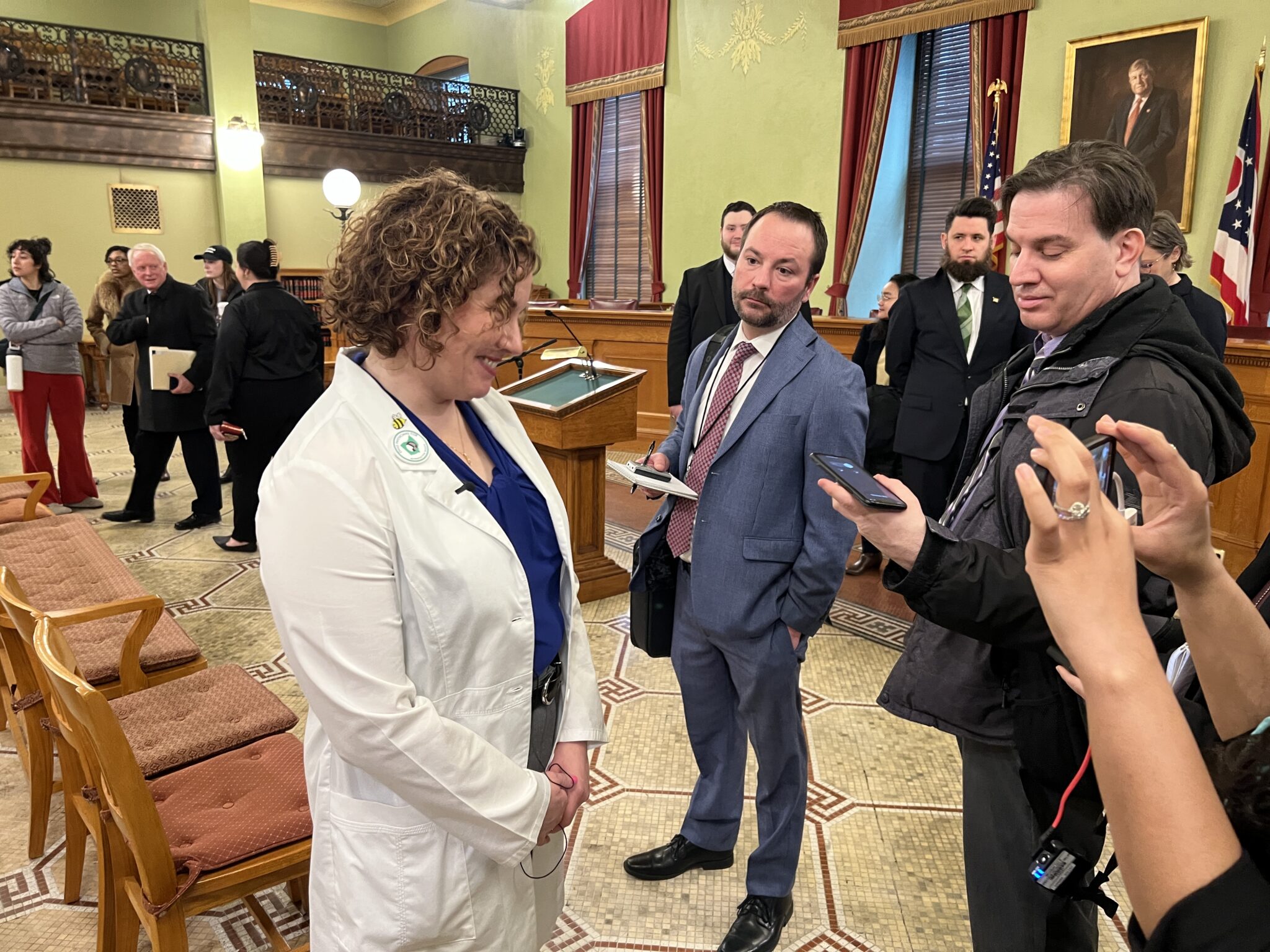
    Dr. Amy Burkett, OB/GYN and member of Ohio Physicians for Reproductive Rights, speaks to media Monday following the Ohio Ballot Board’s vote to verify the language of a proposed constitutional amendment on abortion. Photo: Susan Tebben, OCJ

    This article has been updated to include the proposed constitutional amendment (bottom)

    BY: SUSAN TEBBEN – Ohio Capital Journal

    The Ohio Ballot Board verified Monday that a proposed amendment for the November ballot to cement abortion rights in the Ohio Constitution can now move forward to the full signature-gathering stage.

    In a short Monday meeting, the board, composed of Secretary of State Frank LaRose; Republican state Sen. Theresa Gavarone, Democratic state Sen. Paula Hicks-Hudson, Democratic state Rep. Elliot Forhan, and Bill Morgan, voted unanimously that the proposed ballot initiative only involved one constitutional issue.

    The board only heard from two people outside of the board after LaRose insisted that content be kept away from the merits of the amendment or opinions about abortion itself.

    John Grove, of Cincinnati Right to Life, still took time to try to discredit the amendment itself, called it “intentionally unjust and misleading.”

    Attorney Don McTigue spoke on behalf of the groups proposing the amendment, choosing not to dive into the legal aspects of the amendment, instead saying the “common purpose of the amendment” was individuals having control of one’s own reproductive decisions.

    Gavarone acknowledged that the purpose of the Ballot Board business was “procedural,” but still input her opinion before the unanimous vote was recorded.

     COLUMBUS, OH — FEBRUARY 22: State Sen. Theresa Gavarone, R-Bowling Green, during the Ohio Senate session, February 22, 2023, at the Statehouse in Columbus, Ohio. (Photo by Graham Stokes for Ohio Capital Journal. Republish photo only with original story.)

    “I am horrified at the thought of this amendment, I mean, the right to kill babies being put into Ohio’s constitution,” Gavarone said.

    Now that the proposal has been certified by the Ohio Attorney General and verified by the Ohio Ballot Board, groups attempting to get the measure on the ballot can move forward with collecting the more than 400,000 valid signatures needed to officially get the measure to statewide voters.

    Laura Strietmann, executive director for Cincinnati Right to Life, said pro-life organizations throughout the state have joined together as well, with a full strategy to fight against the measure.

    “We are unified in protecting women in Ohio, in stopping this bill from becoming law,” Strietmann said after the vote.

    Abortion rights groups say they are prepared to go forward with field planning, volunteers and petition circulators as early as the end of this week, according to Jordyn Close, deputy director for the Ohio Women’s Alliance and board president for Abortion Fund of Ohio.

    The organizations are planning to hit the ground running to get more than enough signatures in a short amount of time. The deadline to submit signatures so the proposal can appear on the November ballot is July.

    Part of the plan to bring support to the measure includes informing voters about the true aims of the constitutional amendment on which they would be voting. Claims have already been made by opposition groups that the amendment would bar all abortions, including for baby’s who have reached full term, something supporters of the amendment say won’t happen.

    “We are not interested in doing full-term abortion,” said Dr. Amy Burkett, board-certified OB/GYN in northeast Ohio, and member of Ohio Physicians for Reproductive Rights. “This is about protecting the rights to reproductive health care including abortion, up to viability.”

    Viability, Burkett said, should be determined by the physician and patient “based on the technology that is available at the time.”

    Amendment supporters aren’t shying away from their pro-abortion stance, despite the trend toward using “pro-choice” as a way of including all options.

    “When we talk about reproductive freedom and bodily autonomy, we have to be really specific about what (opposition groups) are attacking,” Close said. “And that is abortion access.”

    ————————-

    Amendment Summary and Text:

    TITLE: The Right to Reproductive Freedom with Protections for Health and Safety

    SUMMARY
    The Amendment would amend Article I of the Ohio Constitution by adding Section 22, titled “The Right to Reproductive Freedom with Protections for Health and Safety.”

    The Amendment provides that:
    1. Every individual has a right to make and carry out one’s own reproductive decisions, including but not limited to decisions on contraception, fertility treatment, continuing one’s own pregnancy, miscarriage care, and abortion.
    2. The State shall not, directly or indirectly, burden, penalize, prohibit, interfere with, or discriminate against either an individual’s voluntary exercise of this right or a person or entity that assists an individual exercising this right, unless the State demonstrates that it is using the least restrictive means to advance the individual’s health in accordance with widely accepted and evidence-based standards of care.
    3. However, abortion may be prohibited after fetal viability. But in no case may such an abortion be prohibited if in the professional judgment of the pregnant patient’s treating physician it is necessary to protect the pregnant patient’s life or health.
    4. As used in this Section, “Fetal viability” means “the point in a pregnancy when, in the professional judgment of the pregnant patient’s treating physician, the fetus has a significant likelihood of survival outside the uterus with reasonable measures. This is determined on a case-by-case basis”; and “State” includes any governmental entity and political subdivision.
    5. This Section is self-executing.

    FULL TEXT OF PROPOSED AMENDMENT

    Be it Resolved by the People of the State of Ohio that Article I of the Ohio Constitution is amended to add the following Section: Article I, Section 22. The Right to Reproductive Freedom with Protections for Health and Safety

    A. Every individual has a right to make and carry out one’s own reproductive decisions, including but not limited to decisions on:

    1. contraception;
    2. fertility treatment;
    3. continuing one’s own pregnancy;
    4. miscarriage care; and
    5. abortion.

    B. The State shall not, directly or indirectly, burden, penalize, prohibit, interfere with, or discriminate against either:

    1. An individual’s voluntary exercise of this right or
    2. A person or entity that assists an individual exercising this right, unless the State demonstrates that it is using the least restrictive means to advance the individual’s health in accordance with widely accepted and evidence-based standards of care. However, abortion may be prohibited after fetal viability. But in no case may such an abortion be prohibited if in the professional judgment of the pregnant patient’s treating physician it is necessary to protect the pregnant patient’s life or health.

    C. As used in this Section:

    1. “Fetal viability” means “the point in a pregnancy when, in the professional judgment of the pregnant patient’s treating physician, the fetus has a significant likelihood of survival outside the uterus with reasonable measures. This is determined on a case-by-case basis.”
    2. “State” includes any governmental entity and any political subdivision.

    D. This Section is self-executing.