BY: MARTY SCHLADEN – Ohio Capital Journal
Days after Gov. Mike DeWine said the medical community will be consulted as Ohio considers future abortion legislation, a group of more than 1,400 doctors implored him to answer questions about a law he’s already signed.
The Ohio medical community has said that to date, DeWine and Republican lawmakers have shown little interest in what doctors have to say when it comes to abortion. Then, late last week, DeWine seemed to reinforce that impression, declining to respond to a list of nine questions that Ohio Physicians for Reproductive Rights sent him and Democratic gubernatorial nominee Nan Whaley.
The group was formed in the wake of the June 24 U.S. Supreme Court Decision overturning the right to an abortion under Roe v Wade. In Ohio and nationally, medical groups said that decision ignores the health care aspects of abortion.
DeWine’s non-response is unacceptable, said Lauren Beene, a Cleveland-area pediatrician and a director of Ohio Physicians for Reproductive Rights.
“These are very important questions that people need to know his stance on because … this can have a lot of implications on a person’s health and their ability to get medical care,” she said, explaining that Ohio’s abortion restrictions can discourage doctors from living here — or even women worried about having the full range of medical options.
“If you have somebody who’s running for governor who can’t or won’t answer the question of whether or not he supports a bill that would make all abortion illegal except in the most dire of circumstances,” Beene said, “from a medical perspective (that) doesn’t really make any sense. What does that even mean? It’s not good at all.”
She was referring to proposed legislation that would go even further than Senate Bill 23, a law DeWine signed in 2019 and which took effect when the U.S. Supreme Court overturned Roe v. Wade on June 24.
SB 23 outlaws almost all abortions after about five or six weeks of pregnancy and it doesn’t make exceptions for victims of rape and incest. It makes some exceptions to protect the life and health of mothers, but doctors have complained that they’re vague and practitioners are reluctant to risk felony charges for running afoul of them.
Several doctors interviewed by the Capital Journal have said they repeatedly tried to warn DeWine and the legislature of the hazards of SB 23 before it was passed and signed in 2019, but they were ignored. Then, shortly after enforcement began in the summertime, many of the things they warned of came to pass.
Just a week into enforcement, an Indianapolis doctor reported that she aborted the pregnancy of a 10-year-old rape victim from Columbus who couldn’t get one under the Ohio law DeWine had signed. In the following weeks, Ohio doctors told of having to call lawyers first as patients’ lives were fading in front of them — and even then being terrified of the consequences while performing lifesaving terminations.
Then, in sworn affidavits, doctors and other workers at Ohio abortion clinics reported other horrors under SB 23. They included two more rape victims under 18 who couldn’t get abortions in Ohio; two cancer patients who couldn’t get the abortions they needed to start chemotherapy; and three women whose fetuses had severe abnormalities or other conditions that made a successful pregnancy impossible. Even so, they, too, couldn’t get abortions in Ohio.
SB 23 was in force for 11 weeks before a Cincinnati judge temporarily paused it.
Now DeWine and Attorney General Dave Yost are in court trying to get the stay lifted. But through it all, DeWine has refused to say whether he thinks it’s a good thing that SB 23 makes women and girls have their rapists’ babies — nor has he said much about women facing the medical problems described in the abortion clinics’ affidavits.
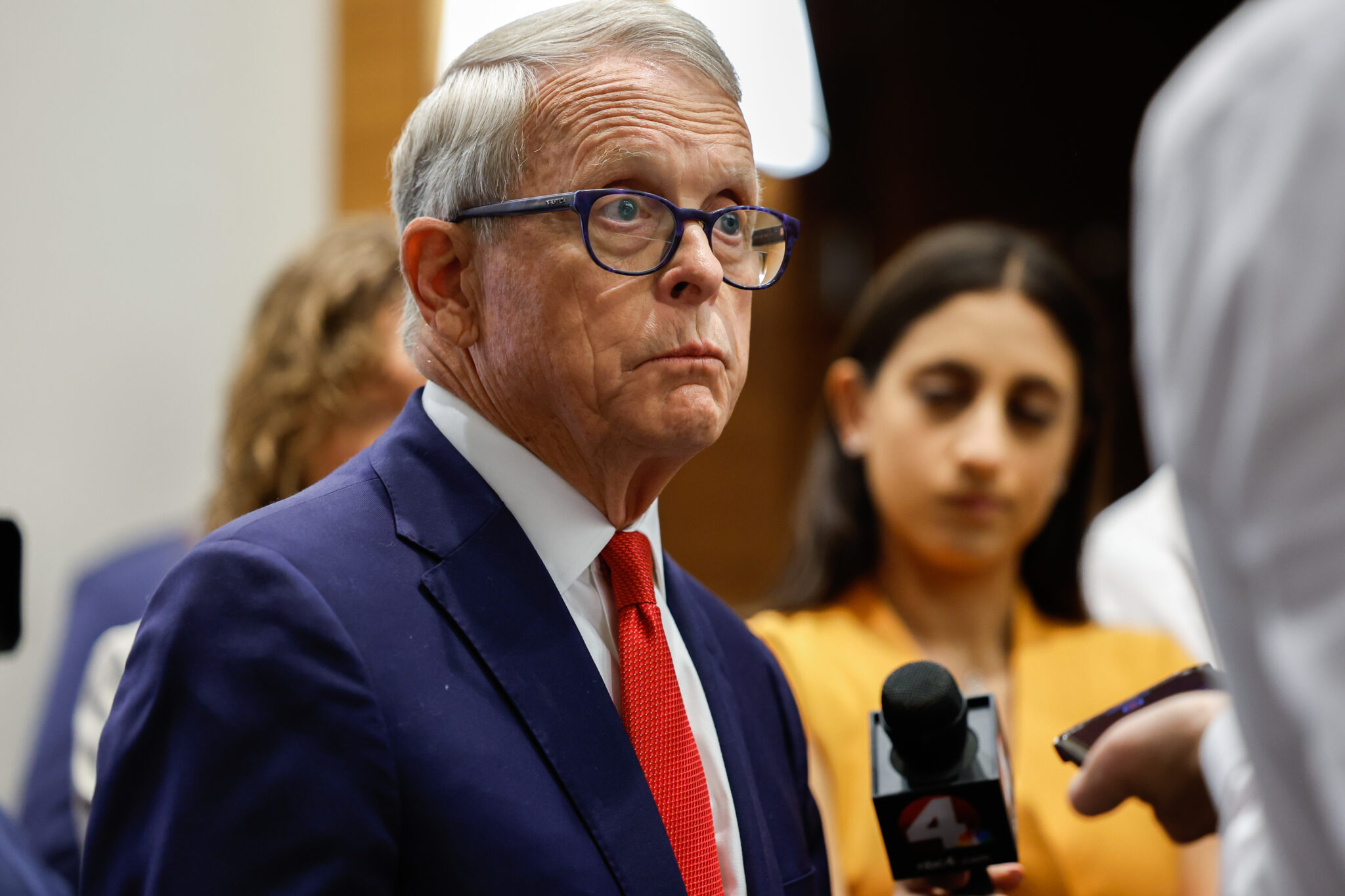
DeWine has refused to debate Whaley, but last week in a joint appearance with her before the Cleveland Plain Dealer editorial board, he gave his most extensive recent comments about abortion in Ohio.
DeWine said policymakers will listen to the medical community as further abortion restrictions are considered. However, he only did so after seeming to repeat Yost’s false assertion that under SB 23, a 10-year-old can get an abortion based on her age alone.
The law mentions no age at which a rape victim is too young to be forced to have that baby. And several obstetricians told the Capital Journal that while pregnancy in a 10-year-old is riskier than the average pregnancy, that’s also the case for the obese, diabetics, older mothers — and women with a host of other conditions that SB 23 makes no exceptions for.
But in the future, DeWine said, medical experts will be heard.
“As we go through debates and discussions, my belief would be that that 10-year-old would have been able to have an abortion in Ohio because of that,” DeWine told Whaley and the editorial board, referring apparently to SB 23’s health exceptions. “If I’m wrong — if I was wrong — and we’re going to hear more from medical professionals, then these are the things that we’ll need to work out, that the legislature will work out as it debates this bill.”
Despite being asked twice by Whaley, DeWine didn’t answer whether he agreed with the provision in SB 23 forcing such young girls to have their rapist’s babies. DeWine also hasn’t said whether he agrees with the law’s requirement that victims of rape and incest must carry their pregnancies to term regardless of their age.
In their written questions, Ohio Physicians for Reproductive Rights asked the governor to state his position on proposals that would go even further, including House Bill 704 “that would declare a fertilized egg, a single cell, to be legally the same as a human being.”
DeWine didn’t respond. When asked about the doctors’ questions, DeWine Press Secretary Dan Tierney on Tuesday said in an email, “The Governor has no additional comments beyond his previous statements at this time.”
For Beene, one of the directors of the doctors’ group, DeWine’s silence is telling.
“We have doctors in all specialties all across the state,” she said. “And if we have questions and he won’t answer them, what does that say to the public? For us as physicians, we’re very frustrated with him not wanting to answer.”
Follow Marty Schladen on Twitter.