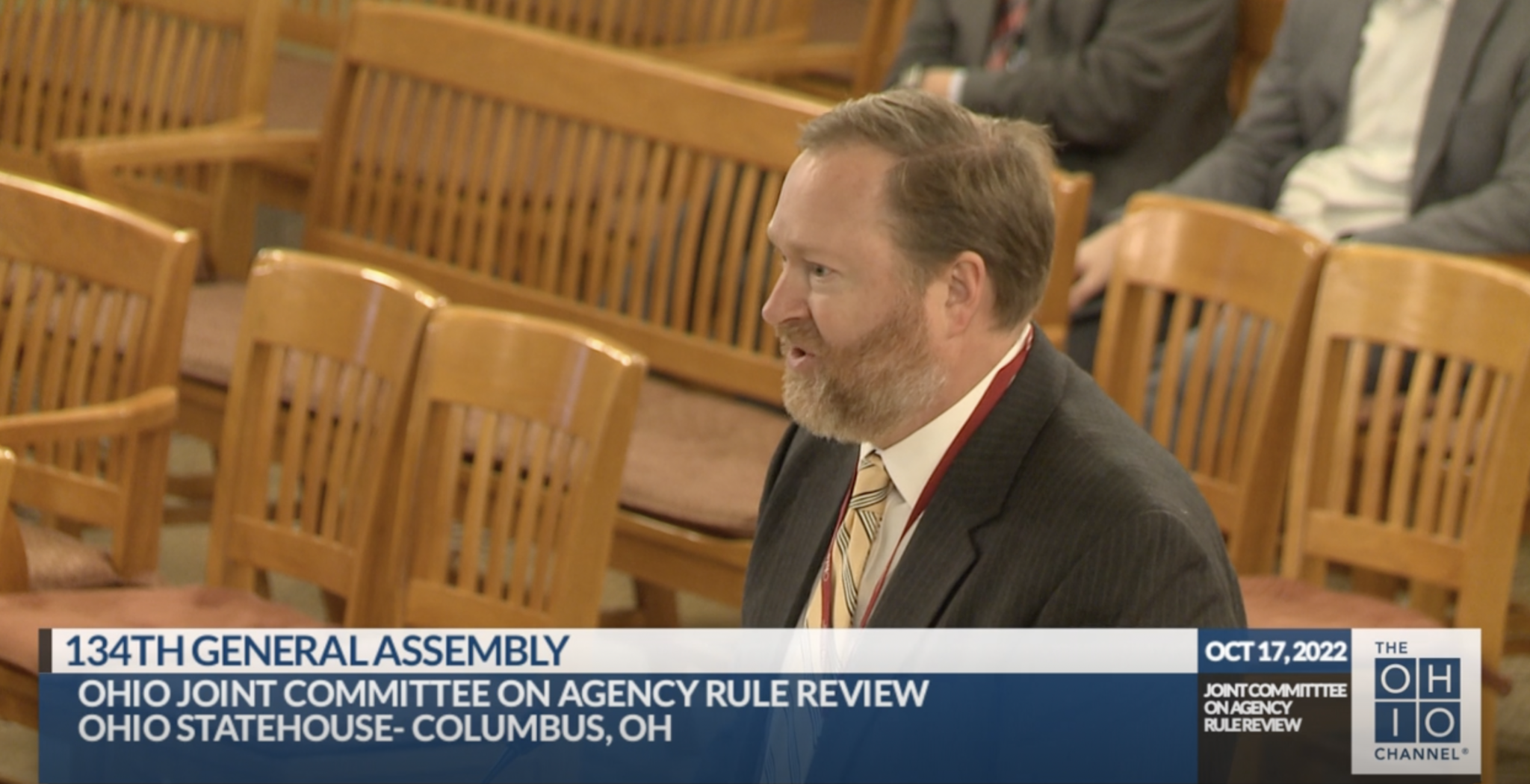
Ohio Department of Health Assistant Director Lance Himes answers questions from the Joint Committee on Agency Rule Review. Photo courtesy of The Ohio Channel
Rule passes despite court case holding back abortion ban and Dem objections
BY: SUSAN TEBBEN – Ohio Capital Journal
An Ohio legislative committee passed a rule on methods of identifying a fetal heartbeat that matched language in a previously passed abortion law, despite the fact that the law can’t currently be enforced.
The Joint Committee on Agency Rule Review passed an administration rule from the Ohio Department of Health entitled “appropriate methods for determining presence of fetal heartbeat,” despite Democratic efforts to invalidate the rule.
Democrats on the committee objected to the rule, saying it violated not only existing state rules for medical care related to abortions, but also case law about how a rule is passed.
In the rule, a fetal heartbeat is defined as “cardiac activity or the steady and repetitive rhythmic contraction of the fetal heart with the gestational sac.”
ODH Assistant Director Lance Himes said the definition of cardiac activity was taken “verbatim from Senate Bill 23.”
A physician should determine the presence of a fetal heartbeat in a method “consistent with the person’s good faith understanding of standard medical practice,” according to the rule.
This includes ultrasound equipment which allows the physician “to give the pregnant woman the option to view or hear the fetal heartbeat.”
What isn’t defined in the rule is when a “medical emergency exception” applies, a concern doctors have expressed with regard to the abortion law, even testifying to that effect in court hearings on the law.
“I would defer to the physicians who are interpreting this law and rule to determine, in their judgment, which is standard medical practices as defined in the statute and rule, for their determination as to whether it would be a medical emergency,” ODH Assistant Director Lance Himes told JCARR.
In writing this rule, Himes said the ODH was “not tasked with further defining medical emergency.”
The passage by JCARR this week represents the official passage of the rule, which was previously just an emergency rule put in place when Senate Bill 23 was implemented, hours after the U.S. Supreme Court decision in Dobbs, that overturned Roe v. Wade.
State Rep. Kristin Boggs, D-Columbus, took issue with the rule being passed without public input and said the passage of the rule as an emergency, then “stacking” the non-emergency rule on top was “in violation of our JCARR standards and in violation of (Ohio Revised Code).”
Himes acknowledged that no public hearing was held on the rule, but said Ohio Revised Code does not require one and “we did not have a stakeholder request out there for input.”
“The regular rule filing does offer forums like JCARR for individuals to come and make public comment … but a public hearing was not required,” Himes said.
Boggs also said the fact that SB 23 is currently unenforceable – a Hamilton County judge blocked the law indefinitely as the ACLU and Planned Parenthood clinics attempt to get the law thrown out – means there’s “no statutory authority to put forward this rule at this time.”
“So right now, as I see it, there are two reasons that have merit that would suggest that even passing this rule today would invalidate it in the future,” Boggs said.
State Sen. Andrew Brenner, R-Delaware, pushed back against the idea that the rule did not follow JCARR processes.
“This actually is going through the JCARR process, because that’s what we’re doing right now,” Brenner said. “So I don’t know how that would be a violation of doing something right now that we’re doing.”
State Rep. Michael Skindell, D-Lakewood, said the new rule conflicts with a Medicaid rule allowing for reimbursement of services if an abortion is the result of rape or incest and one from the Department of Veterans Services regarding abortion services when a pregnant person’s life is in danger or in the case of rape or incest. He argued the six-week ban would create a situation in which those services could not take place, therefore violating the Medicaid and Veterans Services rules.
“This (ODH) rule violates it once there’s a detectable heartbeat,” Skindell said.
Himes did not speak to the Medicaid rule, but said the ODH administrative rule “only sets forth the appropriate methods for determining a heartbeat. It does not speak to the legality of abortion related to rape or incest.”
Skindell entered a motion to invalidate the rule, which was defeated on a 5-4 vote along party lines.