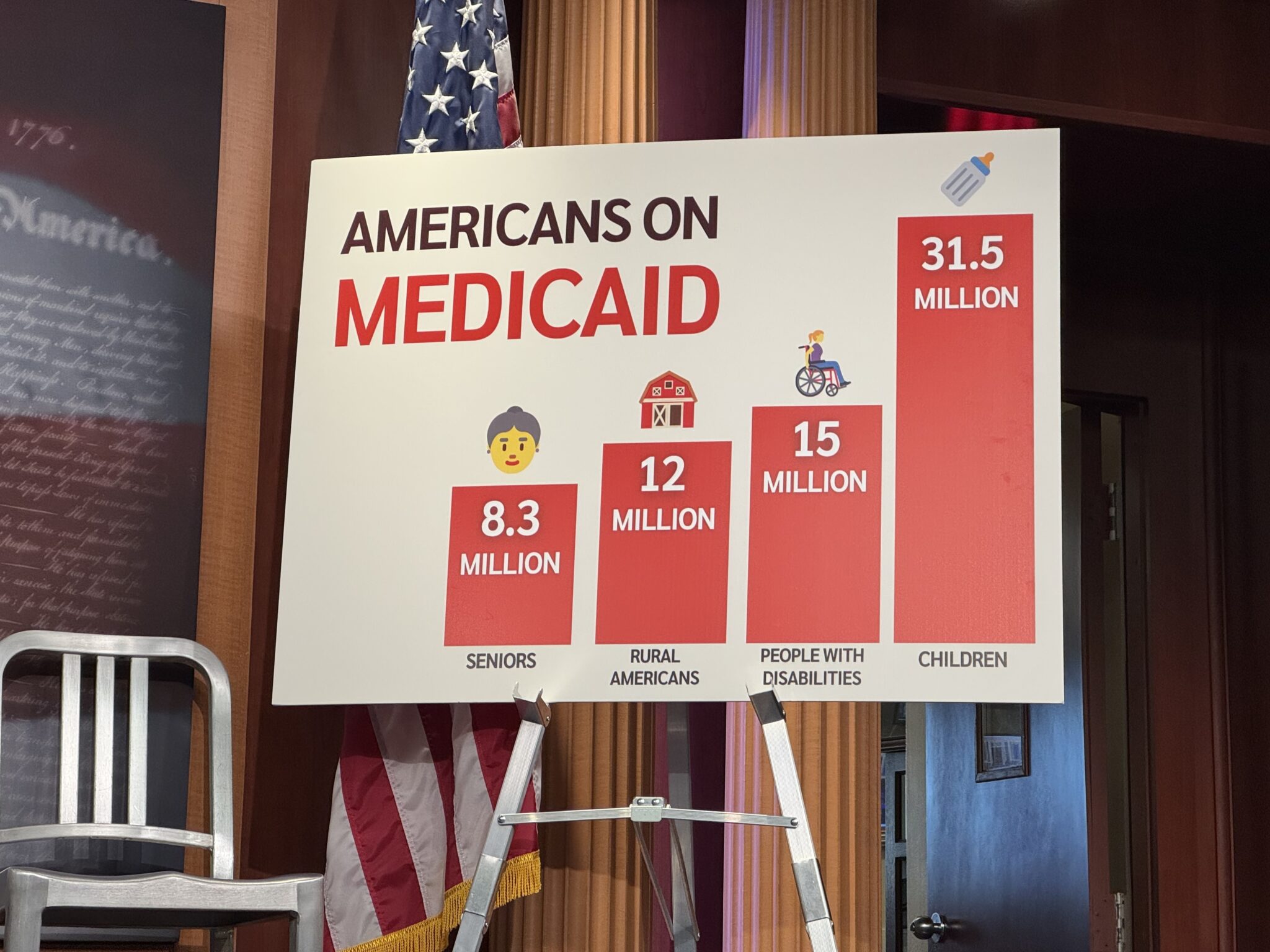
Medicaid sign at a press conference. (Photo by Shauneen Miranda/States Newsroom)
A raft of proposals coming from Republican lawmakers in Washington, D.C. and Columbus will slash health care and other vital programs for the poor in rural Ohio and in its cities, recent analyses say.
An advocacy group is trying to pressure the state’s Republican U.S. senators to vote against it.
Republican lawmakers in D.C. and Columbus are hashing out budgets. As they do, they’re looking for ways to cut spending to finance tax cuts weighted heavily toward the wealthy.
The reconciliation bill — President Donald Trump’s “One Big Beautiful Bill” — passed by the U.S. House of Representatives would provide about would cut taxes by more than $3 trillion and give 70% of the money to the richest 10% according to the nonpartisan Congressional Budget Office.
At the state level, Policy Matters Ohio said that a flat-tax proposal passed by the Ohio Senate would cost the state $1.1 billion a year and give 96% of the benefit to the state’s top 20% of income earners.
Some Republicans at both levels also have plans to make deep cuts to the social safety net.
The Robert Wood Johnson Foundation and the Urban Institute last week published an issue brief saying that cuts to Medicaid and the Affordable Care Act marketplace would result in a $1 trillion loss in health spending for poor and working people. Ohio alone would lose $31 billion as part of that, the analysis said.
The Medicaid cuts would cost Ohio’s hospitals $9.5 billion — and they’d have to shoulder more uncompensated care as more Ohioans would become uninsured. The Congressional Budget Office estimates that the One Big Beautiful Bill Act would create 16 million more uninsured Americans by 2034.
“The Medicaid cuts Congress is considering would be the largest funding reduction in the program’s history, and it is hard to overstate just how devastating the impacts would be,” Katherine Hempstead of the Robert Wood Johnson Foundation said in a written statement. “Such drastic changes to Medicaid financing would have ripple effects that go well beyond people covered by the program, further squeezing hospitals, limiting access to care for entire communities, and destabilizing state and local economies.”
Significant federal funding cuts to Medicaid would be particularly hard on Ohioans. Gov. Mike DeWine’s proposed budget has a provision that would end the state’s 11-year-old Medicaid expansion. That would cost 770,000 Ohioans — most of whom are working — their health coverage.
The Commonwealth Fund in May said the Buckeye State would be one of the five hardest hit by the proposed cuts. And they would come at a critical time, the organization said in a report released Wednesday.
Ohio ranked 30th overall for health system performance. It scored particularly badly in terms of infant mortality, preventable hospitalizations, and mortality disparities between Black and other Ohioans.
Not only would Republican spending proposals slash health funding for lower-income Americans, it would decimate food assistance for the poorest.
“The House-passed Republican reconciliation plan would cut nearly $300 billion from the Supplemental Nutrition Assistance Program (SNAP) through 2034, based on Congressional Budget Office (CBO) estimates — by far the largest cut to SNAP in history,” the Center on Budget and Policy Priorities wrote in May.
“As a result of these cuts and other policies in the legislation — which are being used to pay partly for trillions in tax cuts skewed to the wealthy — millions of people would lose some or all of the food assistance they need to afford groceries, when many low-income households are struggling to afford the high cost of food and other basic needs.”
If those proposed cuts become reality, Ohio’s foodbanks won’t able to ameliorate the hunger they create, the executive director of the Ohio Association of Foodbanks said earlier this month.
GET THE MORNING HEADLINES.
Tax cuts weighted toward the wealthiest and cuts in benefits to the most vulnerable have the group Families Over Billionaires trying to put pressure on Republican senators to vote no on the One Big Beautiful Bill Act. As part of a seven-state, $5 million buy, a commercial went up in Ohio this week.
“We sent Senators (Bernie) Moreno and (Jon) Husted to Washington to lower costs,” the narrator says. “So now that they’re in charge, what are they doing about it? They’re kicking 16 million people off of health care, taking food from 18 million kids, and driving costs through the roof for 80 million families. All to give the super-rich a $250,000 tax cut while your costs go up. They pay less and you pay more. That’s the billionaire tax scam. Tell your senators to vote no.”
The Congressional Budget Office estimated that 16 million would lose health coverage under the Republican plan. The Urban Institute estimates that 18.3 million children would lose food assistance. Economists widely expect Trump’s tariffs — taxes on imports — to cause significant inflation. The Center on Budget and Policy Priorities estimates that the 1% of wealthiest households would get an average annual tax cut of $250,000.