Columbus, Ohio – Ohio Attorney General Dave Yost has asked the U.S. Supreme Court to pause a federal rule that forces states and power plants to comply with “unrealistic” and “unlawful” regulations targeting air pollution.
In a filing with the court, Yost and the attorney general of Kansas oppose a recent Environmental Protection Agency rule that gives coal-fired power plants an ultimatum: Capture and store 90% of carbon emissions or shut down within eight years.
“The EPA has resorted to ‘take it or leave it’ tactics to force its climate agenda on states and their power industries,” Yost said. “Protecting the air we breathe shouldn’t cost us our rights.”
The attorneys general assert that the EPA lacks authority under the Clean Air Act to impose such regulations, noting a court ruling in a separate case that blocked the agency from forcing power plants to shift from fossil-fuel power to other types of energy.
The EPA is taking an indirect approach to achieve the same unlawful outcome, the filing says, by giving states and power plants “impossible choices” that inevitably favor the agency’s climate agenda and strip states of their rights.
Under the rule, the filing says, the EPA presents power plants with the no-win option to either risk billions of dollars on unproven emissions technology to meet unachievable benchmarks or shut down.
Likewise, states can choose to immediately expend significant resources to comply with a rule that is likely to prove illegal or stand by as the federal government infringes on their sovereignty, the attorney generals write.
In July, the U.S. Court of Appeals for the D.C. Circuit allowed the EPA’s rule to take effect as legal challenges continue. Yost and Kansas Attorney General Kris Kobach seek a stay from the U.S. Supreme Court to put a hold on the rule while the case proceeds.
Loveland, Ohio – The Southwest Ohio Air Quality Agency has issued an Air Quality Alert for Butler, Clermont, Hamilton, and Warren counties in Ohio; Boone, Campbell, and Kenton counties in Kentucky; and Dearborn County in Indiana.
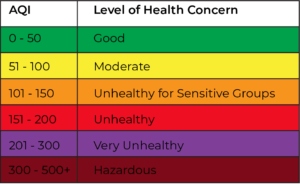
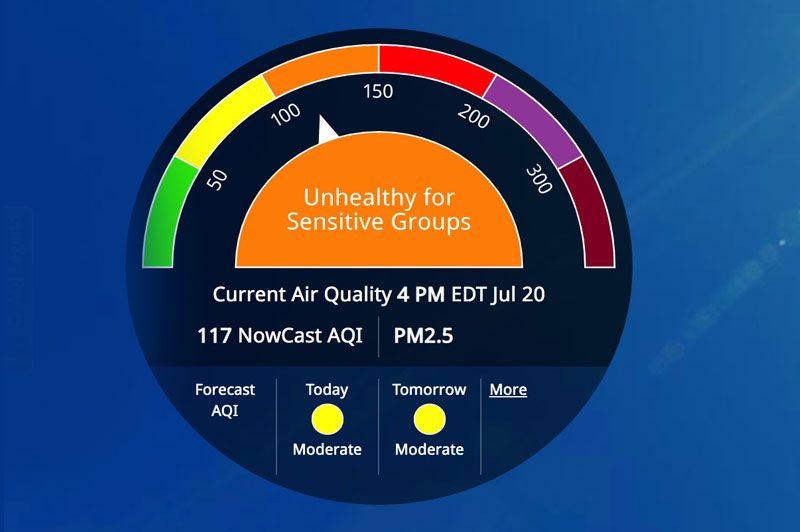
The Agency expects to see levels of ozone in the “unhealthy for sensitive groups” range on the Air Quality Index (AQI).
For more details on the Air Quality Index and its corresponding health messages, refer to AirNow. You may also choose to sign up for EnviroFlash, a free service and app that notifies you of daily air quality conditions based upon your personal settings that you control.
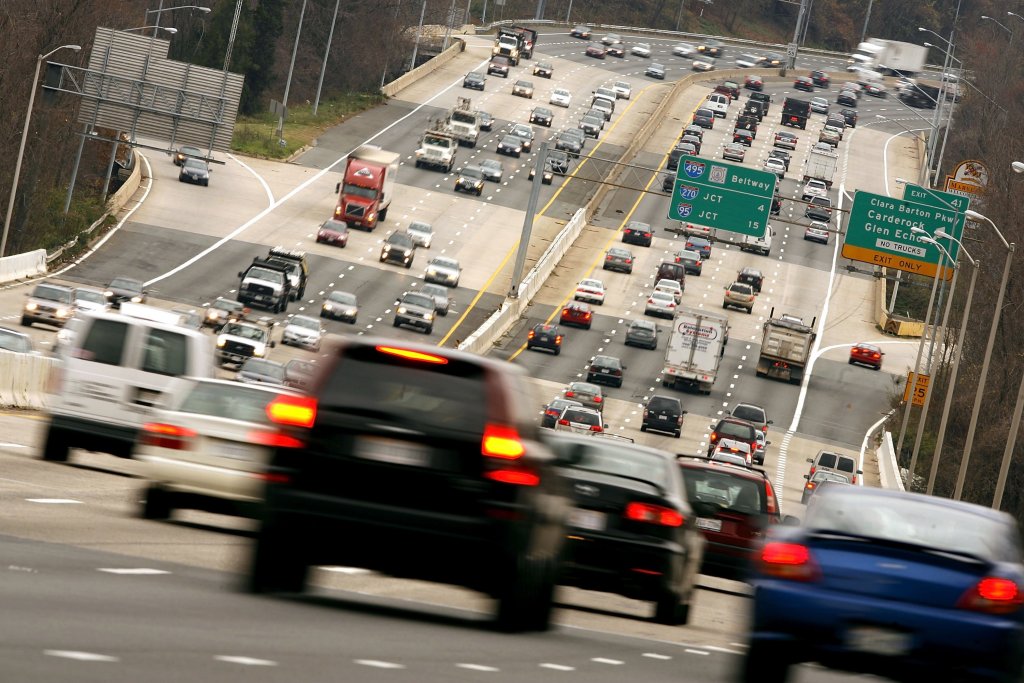
Traffic on a highway. Photo by Chip Somodevilla/Getty Images.
Improving air quality in the state would lead to better health for Ohioans, and could be done through policy changes, according to a policy think tank.
In a recent examination of the connections between air pollution and health, the Health Policy Institute focused on maternal and infant health, lung and heart conditions and cognitive conditions, all of which could see better outcomes with increased monitoring and control of air pollutants.
“Exposure to air pollution can also increase the severity, lethality and prevalence of COVID-19 due to its negative impact on cardiopulmonary diseases and immune responses,” the HPIO said in a policy brief on the issue.
Sources of air pollution range from power plants to vehicle exhaust, and even natural sources like dust.
Improvements have been made through the federal Clean Air Act in 1970, which sought to regulate emissions through EPA oversight, and through implementation of plans in each individual state.
“The EPA can also take civil or criminal action against an entity that has violated environmental law, such as not installing a required air pollution control device,” the HPIO stated.
But Ohio “ranks poorly on outdoor air quality” according to the institute’s research, and performs worse than most other states.
Graph provided by the Health Policy Institute.
More than 32% of Ohioans commute more than 30 minutes to work alone, verses 4.1% who walk, cycle or use public transportation, according to a 2021 Health Value Dashboard cited in the policy brief.
But more than the choice of commute, some Ohioans are unwittingly in danger of air pollution effects based solely on where they live and the zoning policies in those communities. Even “redlining,” the use of discriminatory practice of denying mortgages and other financial services based on race or ethnicity, can cause minorities to end up in more polluted areas.
“Historically, zoning policies and redlining placed industrial plants and highways closer to predominantly Black neighborhoods and prohibited Black people from living in areas that did not have these sources of pollution near them,” the HPIO stated.
According to research from the National Equity Atlas, Black Ohioans face a risk of air pollution 1.5 times higher than white residents of the state.
Part of the problem in Ohio was the passage of the scandal-ridden House Bill 6, a bailout of energy companies that led to, among other things, a bribery investigation and, beginning this month, the criminal trial of former House Speaker Larry Householder.
Parts of the legislation were repealed in March 2021 related to the bailout, but measures that severely cut energy-efficiency programs and standards for renewable energy stayed in place.
“By reducing the renewable energy benchmark, Ohioans are more likely to continue to use fossil fuel-based energy and be more at risk of air pollution exposure,” the HPIO policy brief stated.
Ohio’s legislature also passed Senate Bill 52 in 2021, which hampers the development of energy sources such as wind farms and solar facilities and allows local governments to turn down wind and solar proposals.
Local governments have done their part to reduce air pollution, however, with the Central Ohio Transportation Authority planning a fleet transition to non-diesel by 2025 after receiving federal funding for the effort.
After a settlement between Volkswagen and the U.S. Environmental Protection Agency over an emissions scandal, Ohio is set to receive $75 million over 10 years to be used to fund emission-reduction projects.
“The latest round of grants, awarded in November 2021, were estimated to remove 33 tons of nitrogen oxides and 16 tons of other air pollutants annually,” the HPIO stated.
Moving forward, the policy institute said more legislation could set targets for “renewable energy procurement” and use air quality monitors to capture data on exposure. Increased funding for public transportation and an “environmental legislature review process” were also recommended by the HPIO.
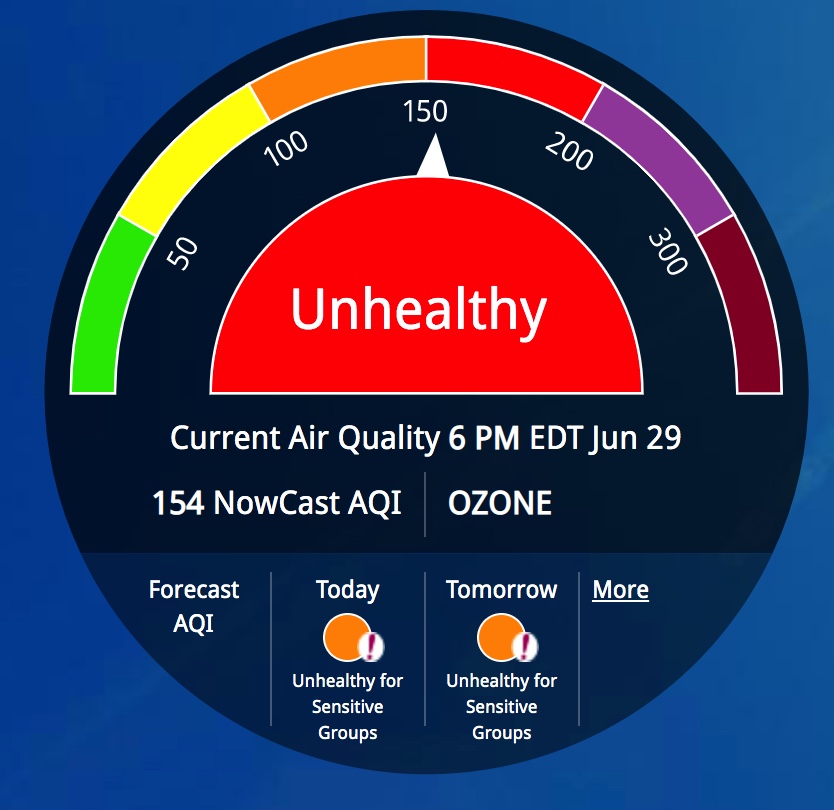
Loveland, Ohio – The current Air Quality Index is 154 and the primary pollutant is Ozone.
This is unhealthy for People with lung disease, children and teens, older adults, and people who are routinely active outdoors for six or more hours a day –- take any of these steps to reduce your exposure:
Avoid strenuous outdoor activities.
Keep outdoor activities short.
Consider moving physical activities indoors or rescheduling them.
Everyone else –takeany of these steps to reduce your exposure:
Choose less strenuous activities (like walking instead of running) so you don’t breathe as hard.
Shorten the amount of time you are active outdoors.
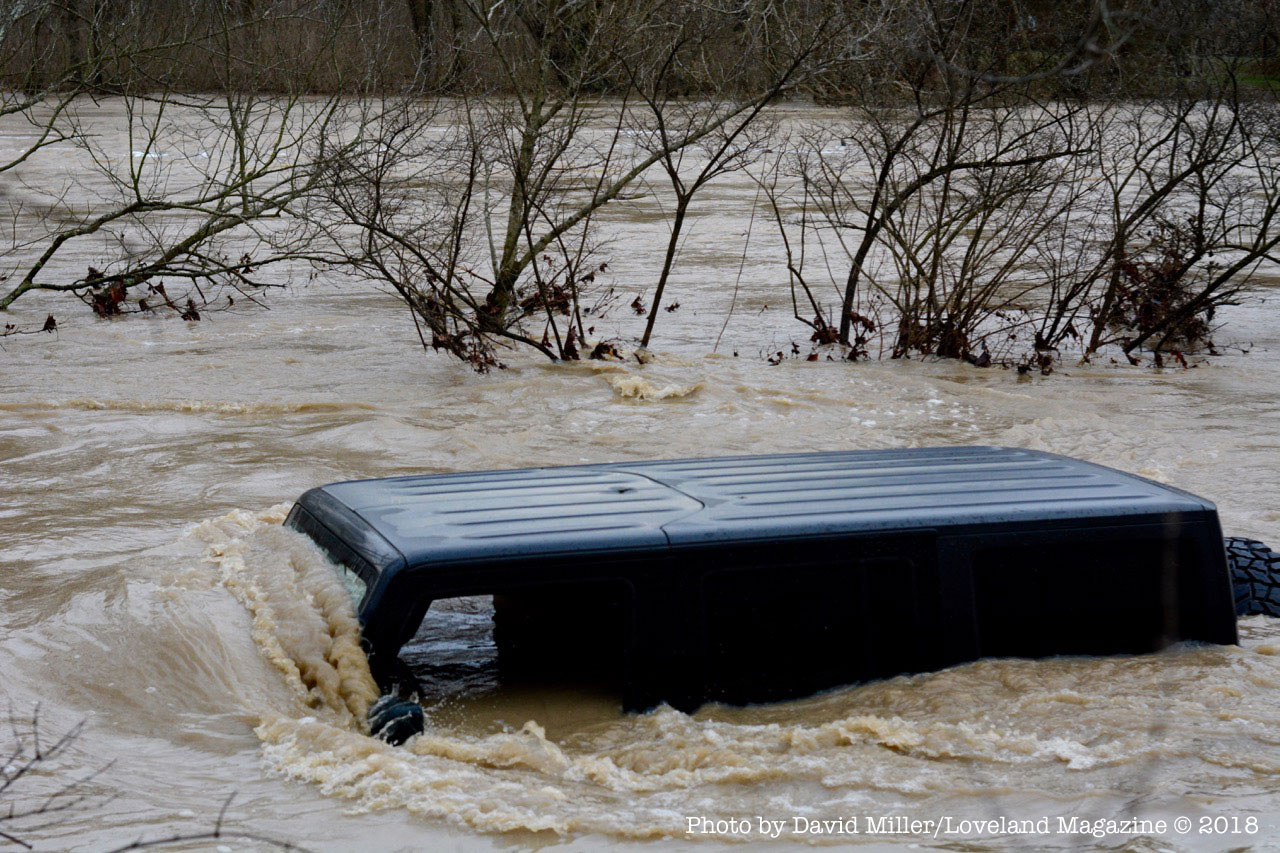
The above photo is of flooding in Loveland on February 25, 2018
“The notion of the common good also extends to future generations.
– Richard Rohr
Lauren Enda lives in Loveland at Hidden Creek
by Lauren Enda
Weather is changing in Ohio. According to Cincinnati’s Office of Environmental Sustainability, Ohio is getting hotter, wetter, and suffering with more extreme weather and periodic droughts. More storms and more rain increase runoff and flooding. Hamilton County has had nine 100-year storms in the last 10 years. This is a startling statistic and should be troubling for everyone, especially those who live near water. Therefore, the city of Loveland should be looking very closely at what, and how much, is developed. Replacing permeable surfaces (grass, gravel, earth) with impervious surfaces (concrete and asphalt) are a major cause of flooding in urban areas. This article will present a high-level overview of the environmental risks associated with the proposed parking garage.
The proposed parking garage for Historic Downtown as envisioned by City Hall.
What happens when we heedlessly and perhaps needlessly, dig out trees, remove soil, disturb the water tables, and pour tons of concrete without appropriate studies? Replacing permeable surfaces with impervious surfaces could lead to unwanted and dangerous side effects.
Most dangerous to the residents and businesses of Loveland is water runoff and flooding. According to the United States Geological Survey, “…rainfall in forested watersheds is absorbed into soils, stored as groundwater, and slowly discharged to streams… Flooding is less significant in these more natural conditions because some of the runoff during a storm is absorbed into the ground, thus lessening the amount of runoff into a stream… As watersheds are urbanized, much of the vegetation is replaced by impervious surfaces, thus reducing the area where infiltration to groundwater can occur. More simply, in a developed watershed, much more water arrives into a stream much more quickly, resulting in an increased likelihood of more frequent and more severe flooding.”1
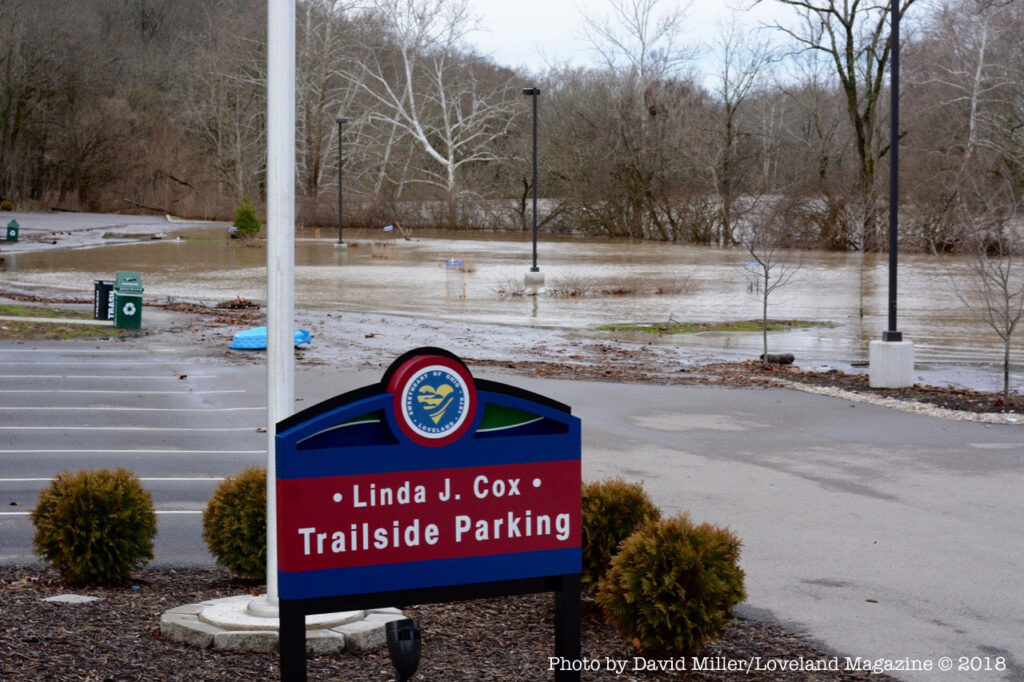
The Linda Cox Trailside Parking lot in February 2018
The Little Miami River and O’Bannon Creek could be at risk. Studying runoff, flooding and erosion in and near the Linda J. Cox parking lot may be a good place to start before Loveland adds more concrete or asphalt downtown. The increasing number and severity of storm events is not going away, but will worsen, raising the flood risk even higher. Can we afford to have more flood events? Is Loveland prepared for, or even starting to prepare for, this eventuality?
But flooding is not the only problem with water running from a massive parking garage into the Little Miami. The water itself brings contaminants from paved parking surfaces like oil, leaking brake fluid, antifreeze, and trash, which are then put directly into the river. The summary of a 2014 report in the journal “Environmental Challenges” quotes that, “Impervious car park surfaces represent a major source of urban water pollution.”2
The risk of increased flooding and contaminated runoff are bad enough, but the proposed garage will bring pollution to Loveland in other ways.
Air pollution: More cars downtown will mean more exhaust fumes rising into the air.
Noise pollution: More traffic and more cars will bring more noise to our tranquil downtown.
Light pollution: Parking garages are magnets for crime and other undesirable activities and therefore must be extremely well lit – 24 hours a day, 7 days a week. This light pollution will destroy the picturesque nighttime setting we currently enjoy.
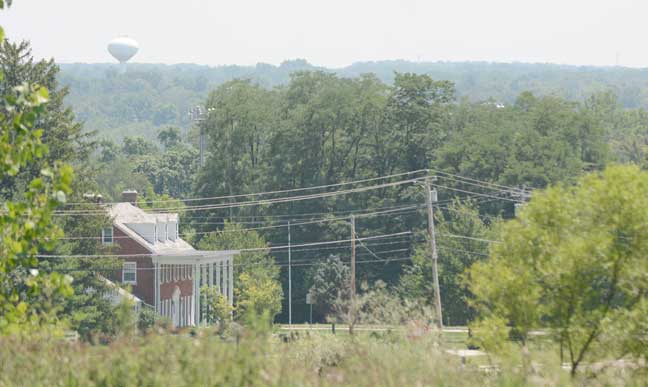
The smoggy Loveland horizon from Loveland High School during an Air Pollution Alert in July of 2016
An additional, but by no means trivial, impact on our environment, is the concrete itself. Concrete has a massive carbon footprint, which is concerning if we care about the future of our children and grandchildren. According to a 2018 report by the BBC, “Concrete is the most widely used man-made material in existence. If the cement industry were a country, it would be the third largest (carbon dioxide) emitter in the world – behind China and the US.”3 Let’s not make uninformed or hasty decisions about building with a material that is so hurtful to the environment.
Finally, expanses of concrete or asphalt create what is called a “micro-climate: “The climate of a small, specific place within an area as contrasted with the climate of the entire area.”4 According to multiple studies, urban areas with paved surfaces are hotter than the surrounding areas by as much as 7 degrees. We have all witnessed this phenomenon when standing in a parking lot in the summer. Does Loveland want to introduce a “heat island” to our downtown?
“Success can be measured in different ways.”
Loveland resident Lauren Enda
I do not claim to be an environmental scientist, a climate expert, or a soil or water conservation guru. Perhaps as a community we can learn more about the current, and future, environmental impacts of today’s decisions. What will these decisions look like in 2030 or 2040 when the problems facing Loveland will perhaps be much larger than simply having to park a block further away? Will our children be glad for more concrete, or will they wish for a safer, cleaner, more sustainable Loveland? Success can be measured in different ways.
An unbiased environmental study by experts who will not benefit with the building of the proposed garage would help Loveland make decisions for today, and for our future, in an uncertain and changing world.
Loveland, Ohio – Without a warning or notice by the Southwest Ohio Air Quality Agency the air pollution in Loveland has spiked today into the “Unhealthy for Sensitive Groups” range.
Active children and adults, and people with respiratory diseases, such as asthma, should be avoiding all outdoor exertion; everyone else, especially children, should limit outdoor exertion.
Use the widget on Loveland Magazine’s Home Page to check air quality in your community at any given time of the day.
Protecting the air we breathe Ohio EPA air manager Jennifer Van Vlerah talks about what ground-level ozone is, how it can affect you and what Ohio EPA is doing to reduce ozone levels. For more information about ozone levels and local air quality, please visit Ohio EPA’s Air Quality Map.
The Ohio EPA is predicting that the ozone level will be 107 on Friday.
Predicted Air Quality Index (AQI) for the Loveland Area
107
Unhealthy for Sensitive Groups
Health Message:Active children and adults, and people with lung disease, such as asthma, should reduce prolonged or heavy exertion outdoors.
Steps you should take to protect you or your children’s health
Reduce prolonged or heavy outdoor exertion. Take more breaks, do less intense activities. Watch for symptoms such as coughing or shortness of breath. Schedule outdoor activities in the morning when ozone is lower.
People with asthma should follow their asthma action plans and keep quick relief medicine handy.
Do Your Share!
Carpool, bike or walk instead of driving.
Use your most fuel efficient vehicle and drive gently.
Keep your motorcycle in the garage. They don’t have the pollution controls modern passenger vehicles do.
Refuel your vehicle after 8 PM; do not top off when refueling and tighten the gas cap.
Avoid idling your vehicle. (Avoid drive-thru windows.)
Combine trips and eliminate unnecessary vehicle trips
Do not use of gasoline-powered lawn equipment
Do not use of oil-based paints and stains
Never burn leaves or other yard trimmings.
Do not use fire pits.
Conserve electricity by turning off unnecessary lights.
Turn your air conditioner thermostat up and use room fans for cooling.
Save the power boating for another day.
Initiate an Air Pollution Alert Day policy where you work; whether that be a company you own, an employee, a local government agency you work for, or a school district.
Sign up for Enviroflash and Start Receiving Your Air Quality Forecast
Children and Air Pollution
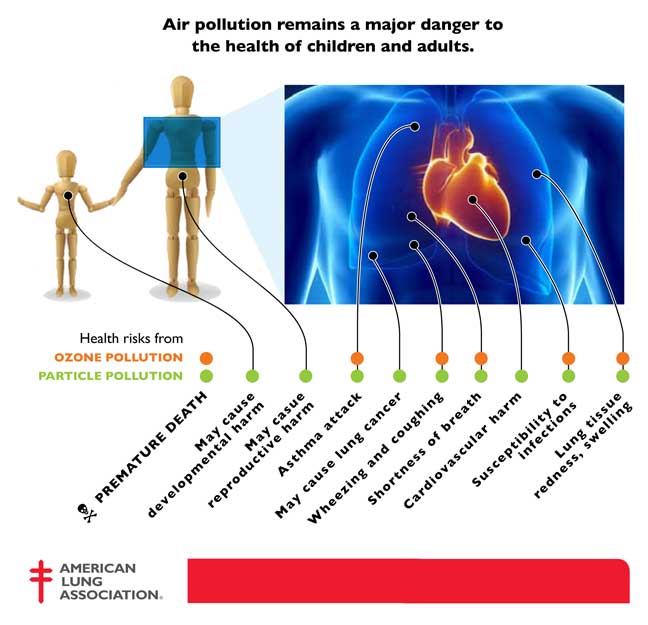
Children face special risks from air pollution because their lungs are growing and because they are so active and breathe in a great deal of air.
Just like the arms and legs, the largest portion of a child’s lungs will grow long after he or she is born. Eighty percent of their tiny air sacs develop after birth. Those sacs, called the alveoli, are where the life-sustaining transfer of oxygen to the blood takes place. The lungs and their alveoli aren’t fully grown until children become adults. In addition, the body’s defenses that help adults fight off infections are still developing in young bodies. Children have more respiratory infections than adults, which also seems to increase their susceptibility to air pollution.
Furthermore, children don’t behave like adults, and their behavior also affects their vulnerability. They are outside for longer periods and are usually more active when outdoors. Consequently, they inhale more polluted outdoor air than adults typically do.
The Ohio EPA is predicting that the ozone level will be 115 on Sunday.
Predicted Air Quality Index (AQI) for the Loveland Area
115
Unhealthy for Sensitive Groups
Health Message:Active children and adults, and people with lung disease, such as asthma, should reduce prolonged or heavy exertion outdoors.
Steps you should take to protect you or your children’s health
Reduce prolonged or heavy outdoor exertion. Take more breaks, do less intense activities. Watch for symptoms such as coughing or shortness of breath. Schedule outdoor activities in the morning when ozone is lower.
People with asthma should follow their asthma action plans and keep quick relief medicine handy.
Do Your Share!
Carpool, bike or walk instead of driving.
Use your most fuel efficient vehicle and drive gently.
Keep your motorcycle in the garage. They don’t have the pollution controls modern passenger vehicles do.
Refuel your vehicle after 8 PM; do not top off when refueling and tighten the gas cap.
Avoid idling your vehicle. (Avoid drive-thru windows.)
Combine trips and eliminate unnecessary vehicle trips
Do not use of gasoline-powered lawn equipment
Do not use of oil-based paints and stains
Never burn leaves or other yard trimmings.
Do not use fire pits.
Conserve electricity by turning off unnecessary lights.
Turn your air conditioner thermostat up and use room fans for cooling.
Save the power boating for another day.
Initiate an Air Pollution Alert Day policy where you work; whether that be a company you own, an employee, a local government agency you work for, or a school district.
Sign up for Enviroflash and Start Receiving Your Air Quality Forecast
Children and Air Pollution
Children face special risks from air pollution because their lungs are growing and because they are so active and breathe in a great deal of air.
Just like the arms and legs, the largest portion of a child’s lungs will grow long after he or she is born. Eighty percent of their tiny air sacs develop after birth. Those sacs, called the alveoli, are where the life-sustaining transfer of oxygen to the blood takes place. The lungs and their alveoli aren’t fully grown until children become adults. In addition, the body’s defenses that help adults fight off infections are still developing in young bodies. Children have more respiratory infections than adults, which also seems to increase their susceptibility to air pollution.
Furthermore, children don’t behave like adults, and their behavior also affects their vulnerability. They are outside for longer periods and are usually more active when outdoors. Consequently, they inhale more polluted outdoor air than adults typically do.
Reduce prolonged or heavy outdoor exertion. Take more breaks, do less intense activities. Watch for symptoms such as coughing or shortness of breath. Schedule outdoor activities in the morning when ozone is lower.
People with asthma should follow their asthma action plans and keep quick relief medicine handy.
Air Quality Forecast for Friday, May 25
(Click the Real-Time Air Quality link and watch in real-time as the pollution rolls across our region.)
Air Quality Index (AQI)
115
Unhealthy for Sensitive Groups
Health Message: Active children and adults, and people with lung disease, such as asthma, should reduce prolonged or heavy exertion outdoors.
ACTION DAY
Do Your Share!
Carpool, bike or walk instead of driving.
Use your most fuel efficient vehicle and drive gently.
Keep your motorcycle in the garage. They don’t have the pollution controls modern passenger vehicles do.
Refuel your vehicle after 8 PM; do not top off when refueling and tighten the gas cap.
Avoid idling your vehicle. (Avoid drive-thru windows.)
Combine trips and eliminate unnecessary vehicle trips
Do not use of gasoline-powered lawn equipment
Do not use of oil-based paints and stains
Never burn leaves or other yard trimmings.
Do not use fire pits.
Conserve electricity by turning off unnecessary lights.
Turn your air conditioner thermostat up and use room fans for cooling.
Save the power boating for another day.
Initiate an Air Pollution Alert Day policy where you work; whether that be a company you own, an employee, a local government agency you work for, or a school district.
Sign up for Enviroflash and Start Receiving Your Air Quality Forecast
Children and Air Pollution
Children face special risks from air pollution because their lungs are growing and because they are so active and breathe in a great deal of air.
Just like the arms and legs, the largest portion of a child’s lungs will grow long after he or she is born. Eighty percent of their tiny air sacs develop after birth. Those sacs, called the alveoli, are where the life-sustaining transfer of oxygen to the blood takes place. The lungs and their alveoli aren’t fully grown until children become adults. In addition, the body’s defenses that help adults fight off infections are still developing in young bodies. Children have more respiratory infections than adults, which also seems to increase their susceptibility to air pollution.
Furthermore, children don’t behave like adults, and their behavior also affects their vulnerability. They are outside for longer periods and are usually more active when outdoors. Consequently, they inhale more polluted outdoor air than adults typically do.
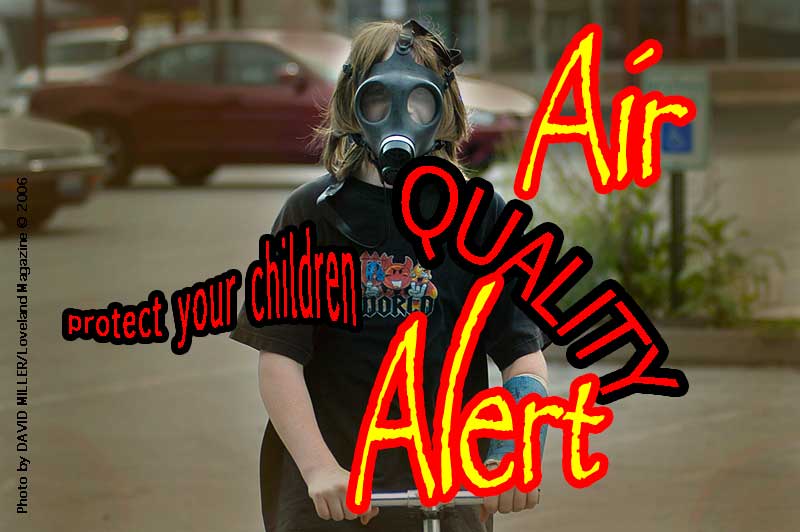
It will take action by each of us Monday to lower the risk to our children
Loveland, Ohio– The Southwest Ohio Air Quality Agency has issued an Air Quality Advisory on Mondayfor Loveland. and the surrounding counties of Butler, Clermont, Hamilton and Warren in Ohio, and Boone, Campbell and Kenton counties in Kentucky.
The Agency expects to see levels of ozone in the “unhealthy for sensitive groups” range on the Air Quality Index (AQI).
Health Message: Active children and adults, and people with lung disease, such as asthma, should reduce prolonged or heavy exertion outdoors.
Use this Real-Time Air Quality link to see the current air quality and a map of the area that “loops” throughout the day showing smog moving into and out of the Loveland area.
On Air Quality Advisory days, everyone can help reduce ozone formation by taking the following actions:
Bike, or walk instead of drive.
Refuel your vehicle after 8 p.m.; do not top off when refueling and tighten the gas cap.
DON’T RIDE YOUR MOTORCYCLE
Do not idle your vehicle; exhaust contributes considerably to ozone formation.
Combine trips or eliminating unnecessary vehicle trips.
Avoid use of gasoline-powered lawn equipment on Air Quality Advisory days.
Avoid use of oil-based paints and stains on Air Quality Advisory days.
Never burn leaves or other yard trimmings.
Suspend use of fire pits, campfires and grills on Air Quality Advisory days.
Conserve electricity by turning out lights and unplugging unused appliances and electronics.
Children face special risks from air pollution because their lungs are growing and because they are so active
Just like the arms and legs, the largest portion of a child’s lungs will grow long after he or she is born. Eighty percent of their tiny air sacs develop after birth. Those sacs, called the alveoli, are where the life-sustaining transfer of oxygen to the blood takes place. The lungs and their alveoli aren’t fully grown until children become adults.1 In addition, the body’s defenses that help adults fight off infections are still developing in young bodies.2 Children have more respiratory infections than adults, which also seems to increase their susceptibility to air pollution.3
Furthermore, children don’t behave like adults, and their behavior also affects their vulnerability. They are outside for longer periods and are usually more active when outdoors. Consequently, they inhale more polluted outdoor air than adults typically do.
Air Pollution Increases Risk of Underdeveloped Lungs
A Southern California Children’s Health study looked at the long-term effects of particle pollution on teenagers. Tracking 1,759 children who were between ages 10 and 18 from 1993 to 2001, researchers found that those who grew up in more polluted areas face the increased risk of having underdeveloped lungs, which may never recover to their full capacity. The average drop in lung function was 20 percent below what was expected for the child’s age, similar to the impact of growing up in a home with parents who smoked.5
Community health studies are pointing to less obvious, but serious effects from year-round exposure to ozone, especially for children. Scientists followed 500 Yale University students and determined that living just four years in a region with high levels of ozone and related co-pollutants was associated with diminished lung function and frequent reports of respiratory symptoms. 6 A much larger study of 3,300 school children in Southern California found reduced lung function in girls with asthma and boys who spent more time outdoors in areas with high levels of ozone.
For 17 years, the American Lung Association has analyzed data from official air quality monitors to compile the State of the Air report. The more you learn about the air you breathe, the more you can protect your health and take steps to make our air cleaner and healthier.
Drive less. Combine trips, walk, bike, carpool or vanpool, and use buses, subways or other alternatives to driving. Vehicle emissions are a major source of air pollution. Support community plans that provide ways to get around that don’t require a car, such as more sidewalks, bike trails and transit systems.
Use less electricity.Turn out the lights and use energy-efficient appliances. Generating electricity is one of the biggest sources of pollution, particularly in the eastern United States.
Don’t burn wood or trash. Burning firewood and trash is among the largest sources of particle pollution in many parts of the country. If you must use a fireplace or stove for heat, convert your woodstove to natural gas, which has far fewer polluting emissions. Compost and recycle as much as possible and dispose of other waste properly; don’t burn it. Support efforts in your community to ban outdoor burning of construction and yard wastes. Avoid the use of outdoor hydronic heaters, also called outdoor wood boilers, which are frequently much more polluting than woodstoves.
Make sure your local school system requires clean school buses, which includes replacing or retrofitting old school buses with filters and other equipment to reduce emissions. Make sure your local schools don’t idle their buses, a step that can immediately reduce emissions.










 ACTION DAY