[vc_row][vc_column][vc_column_text]
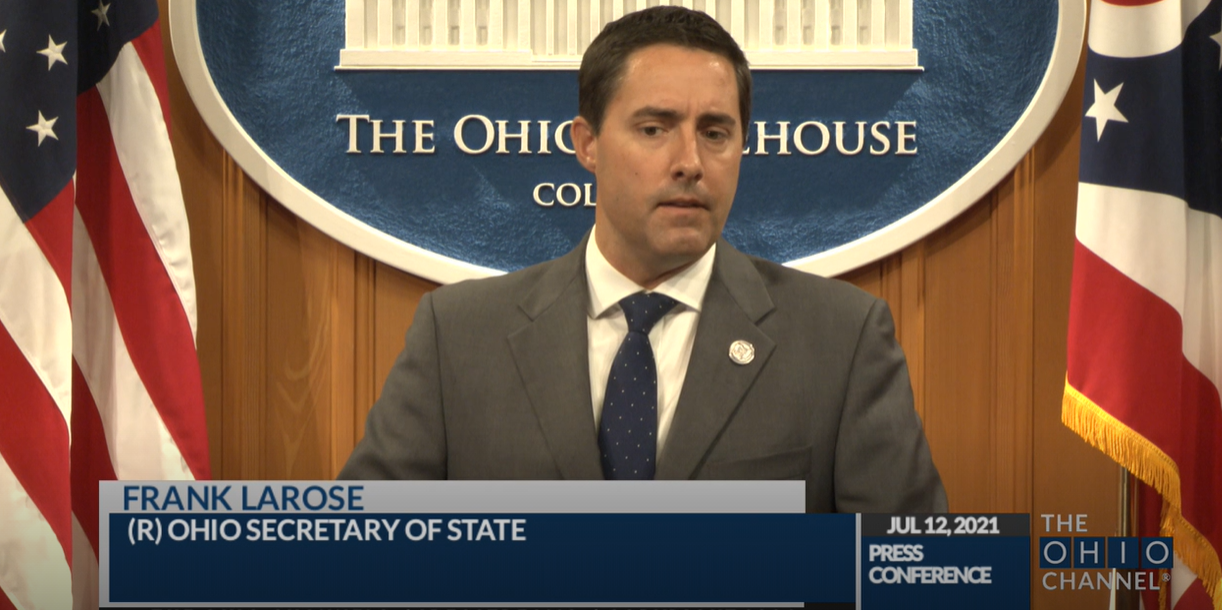
Secretary of State Frank LaRose announces the referral of 117 cases of alleged voting and voter registration fraud stemming from the 2020 elections. Photo courtesy The Ohio Channel.
Ohio Secretary of State Frank LaRose on Wednesday offered another rationale for making it much more difficult for voters to amend the Ohio Constitution. Now he’s saying it’s needed to fight a possible power grab like one that grew out of a massive bribery and money-laundering scandal.
But LaRose didn’t mention in his op-ed that his name came up repeatedly in a criminal trial related to the scandal and that he appeared to be in close communication with some of its central figures.
Nor did his office respond when asked whether LaRose ever spoke out against the corrupt utility bailout before the FBI started arresting people in July 2020.
Slippery explanations
The secretary of state — who is said to be eyeing a run for U.S. Senate next year — has been pushing to increase the portion of votes needed for a citizen-initiated amendment from 50% to 60%. As he and his allies have, they’ve given a shifting set of reasons for why that’s needed.
Last November, during a lame-duck session of the legislature, LaRose and state Rep. Brian Stewart, R-Ashville, held a press conference saying that the change was necessary to prevent wanton amendments to the Ohio Constitution by monied special interests. But they didn’t point to any examples of how that had happened in the past.
Many suspected an ulterior motive.
LaRose sat on a Republican-dominated redistricting commission that last year ignored seven Ohio Supreme Court rulings saying that the legislative and congressional maps the commission produced violated anti-gerrymandering amendments overwhelmingly approved by Ohio voters. That prompted Maureen O’Connor, the outgoing Republican chief justice, to urge Ohioans to pass new, more-tightly written amendments this year.
Ohio was also roiled when a highly restrictive abortion law took effect last June just after the U.S. Supreme Court overturned Roe v. Wade and horror stories poured out of abortion clinics and hospitals. An effort quickly started to get an amendment on the ballot protecting abortion rights after other protections easily passed in other states.
But at last year’s presser, LaRose denied that his goal was to block anti-gerrymandering or abortion-rights amendments. The constitutional change he was advocating was a long-term, fundamental one that he didn’t seek to block such short-term disputes, he claimed.
Just weeks later, however, Stewart, LaRose’s sidekick at the presser, sent a letter to his GOP colleagues in the House explaining the real reasons for making it harder for Ohioans to amend their constitution: to stop abortion-rights and anti-gerrymandering amendments that appear to be favored by strong majorities of Ohioans.
[/vc_column_text][vc_raw_html]JTNDYmxvY2txdW90ZSUyMGNsYXNzJTNEJTIydHdpdHRlci10d2VldCUyMiUzRSUzQ3AlMjBsYW5nJTNEJTIyZW4lMjIlMjBkaXIlM0QlMjJsdHIlMjIlM0VIZXJlJTI2JTIzMzklM0JzJTIwdGhlJTIwZnVsbCUyMGxldHRlci4lMjBJdCUyMGFsc28lMjB0aWVzJTIwdGhlJTIwaXNzdWUlMjB0byUyMHJlZGlzdHJpY3RpbmclMjByZWZvcm0lMkMlMjBhbmQlMjByZXNwb25kcyUyMHRvJTIwdGhlJTIwb3JnYW5pemVkJTIwbGFib3IlMjBncm91cHMlMjB0aGF0JTIwcmFsbGllZCUyMGF0JTIwdGhlJTIwT2hpbyUyMFN0YXRlaG91c2UlMjB5ZXN0ZXJkYXkuJTIwJTNDYSUyMGhyZWYlM0QlMjJodHRwcyUzQSUyRiUyRnQuY28lMkZpbGhXTFBpV00wJTIyJTNFcGljLnR3aXR0ZXIuY29tJTJGaWxoV0xQaVdNMCUzQyUyRmElM0UlM0MlMkZwJTNFJTI2bWRhc2glM0IlMjBBbmRyZXclMjBUb2JpYXMlMjAlMjglNDBBbmRyZXdKVG9iaWFzJTI5JTIwJTNDYSUyMGhyZWYlM0QlMjJodHRwcyUzQSUyRiUyRnR3aXR0ZXIuY29tJTJGQW5kcmV3SlRvYmlhcyUyRnN0YXR1cyUyRjE2MDMxMzAzODQ3NDQ1MzQwMTYlM0ZyZWZfc3JjJTNEdHdzcmMlMjU1RXRmdyUyMiUzRURlY2VtYmVyJTIwMTQlMkMlMjAyMDIyJTNDJTJGYSUzRSUzQyUyRmJsb2NrcXVvdGUlM0UlMjAlM0NzY3JpcHQlMjBhc3luYyUyMHNyYyUzRCUyMmh0dHBzJTNBJTJGJTJGcGxhdGZvcm0udHdpdHRlci5jb20lMkZ3aWRnZXRzLmpzJTIyJTIwY2hhcnNldCUzRCUyMnV0Zi04JTIyJTNFJTNDJTJGc2NyaXB0JTNF[/vc_raw_html][vc_column_text]The attempt to rush a bill through lame duck last year failed.
Now Stewart, LaRose and their allies are trying to pass it through Ohio’s now-unconstitutionally gerrymandered legislature. If it passes, it would put the measure requiring 60% of the vote to amend the state constitution on the ballot. And, since the vote would be under the existing rules, it would require just 50% of the vote to pass.
Also on the pile of accusations that it’s a naked power grab is that LaRose, Stewart and their allies want to put the measure on the ballot in a low-turnout August election. They’re doing so just months after passing a bill that had LaRose’s support to eliminate such elections as costly and unnecessary — and three months before the abortion amendment is expected to hit the ballot.
A new reason
While he’s being accused of attempting a power grab, LaRose says he’s trying to stop them.
On Tuesday, The Columbus Dispatch published an op-ed in which he furnished yet another reason to make it harder for voters to change the state Constitution. He cited an attempt by former House Speaker Larry Householder to pass an amendment changing the state’s term limits so Householder could stay speaker for another 16 years.
It was part of a breathtaking scheme in which Householder and his allies took more than $61 million from Akron-based FirstEnergy and other utilities, used the money to make him speaker in January 2019, and then pass and protect a $1.3 billion ratepayer bailout that mostly went to FirstEnergy.
Fresh off the passage of the bailout, Householder raised millions in early 2020 from FirstEnergy and AEP for his scheme that would allow him to stay longer in office. But it died with his arrest that July.
It might seem ironic that LaRose would use a corruption scandal to gut a 1912 reform measure that was aimed at curbing corrupt, unresponsive government, but that’s what he argued. He said all it takes to change the Constitution now “is a well-funded, dishonest political campaign and a simple majority vote.”
LaRose added that Householder planned to call his tenure-extension scheme “Ohioans for Legislative Term Limits, a deceptive name for a constitutional amendment that would more than double his term in office. It should come as no surprise that FirstEnergy Corporation, the company at the center of Householder’s racketeering scandal, agreed to bankroll the amendment campaign.”
Significant omissions
While he accused his opponents of “hysterical hyperbole” as he tries to make it 20% harder for voters to succeed in the already difficult process to amend the Ohio Constitution, there were some important things LaRose didn’t say in his Op-Ed.
For starters, FirstEnergy didn’t only bankroll Householder in 2018 as the now-convicted former speaker elected a team of lieutenants who would hand him the speaker’s gavel. The utility also bankrolled LaRose to the tune of $25,000 that year as he ran for secretary of state.
It was part of nearly $50,000 that the energy company — which signed a deferred prosecution agreement in the Householder scandal — has given LaRose, the campaign-finance tracker FollowTheMoney.org reports.
And while LaRose is decrying the bailout now that there have been arrests and convictions, there was reason to know there was something wrong with it well before they took place.
Insiders knew that somebody was burying Capitol Square in cash throughout the 2019 passage of House Bill 6, the corrupt utility bailout. That was especially true as FirstEnergy dumped what the FBI later determined was $36 million into a blatantly-dishonest-but-successful fight to beat back a repeal.
Because the funds were non-disclosable 501(c)(4) dark money, it was impossible for the public to know exactly where they were coming from until the feds stepped in and used subpoenas and other special powers to find out.
But HB 6 was such bad legislation and the campaign to stop the repeal so over-the-top that there was plenty of reason to suspect that somebody was being bought off to pass it. It was a massive corporate bailout that Householder and others were trying to officially declare a tax. Republican lawmakers who didn’t want to cast such a damaging vote described withering pressure from House leadership.
Former friends
LaRose’s office didn’t answer Wednesday when asked if the secretary of state ever spoke out against HB 6 before the FBI started making arrests.
In the Cincinnati corruption trial that ran from late January to mid-March, federal prosecutors presented several communications to the jury that might indicate that LaRose was actually sympathetic to the effort to pass and protect the corrupt bailout.
On July 23, 2019, as the repeal effort got underway, text messages flew between two prominent figures in the scandal: Matt Borges, the former Ohio Republican Party chairman who was convicted along with Householder; and Juan Cespedes, a lobbyist who pleaded guilty and cooperated with prosecutors.
Borges told Cespedes he had received “a message from the secretary of state on the ballot-measure issue.”
The men were hoping for help from LaRose. He’s chairman of the Ohio Ballot Board, which, along with Attorney General Dave Yost, has to approve the language of constitutional amendments before they’re circulated for the hundreds of thousands of needed voter signatures — and before they’re placed on the ballot.
In the case of the HB 6 repeal, Yost initially sent the language back for revisions, then he and the ballot board approved it. But that wasn’t before the original 90 days opponents had to gather the signatures was whittled down to 53.
In the end, time ran out before opponents could gather them. But at the beginning of the effort, Borges seemed to be talking to LaRose about what LaRose needed in exchange for his help.
“LaRose is expecting us to be publicly supportive of him,” Borges said. “Apparently petitioners (for the repeal of HB 6) are going to call on him to step down from the ballot board because of ‘conflicts.’ He can be our friend in this process, so let’s be prepared to speak for him.”
Continuing communication
Later in the repeal fight, FirstEnergy’s two top executives discussed asking LaRose’s help with Yost. In addition to hamstringing the petition effort, supporters of the corrupt bailout wanted to have it officially declared a tax, and thus legally exempt from repeal.
“I’ve been asked by (subsidiary FirstEnergy Solutions) to call Frank LaRose to get Frank to call Dave Yost,” Vice President Michael Dowling texted CEO Chuck Jones, according to messages put into evidence by prosecutors. “If Frank tells Yost that he believes HB 6 is a tax, Yost will come out publicly and say it, which (FirstEnergy Solutions) thinks helps with the Supreme Court. Frank is reluctant to make the call. I have a call in to Frank and I will ask him to do it.”
LaRose may have been reluctant about making that call. But he apparently wasn’t reluctant to keep talking to the people who funded the scandal he’s now condemning and using as a reason to make it harder for voters to amend the Ohio Constitution.
In October 2019 — shortly before the repeal effort failed — Jones sent a text to John Kiani, the chairman of the FirstEnergy subsidiary that was to receive $1 billion of the bailout. It indicated that both LaRose and Householder had been providing the FirstEnergy CEO with “private” information on the repeal effort.
“For what it’s worth, LaRose and Householder think it’s game over,” Jones told Kiani. “But that is a private conversation unless they’ve told you the same thing. And Householder has a ‘quick fix’ anyway.”
And then in November 2019 — just after the repeal failed — other messages indicated that LaRose wanted to cement a relationship with Kiani, the hard-charging former Enron executive whom Cespedes testified stood to make $100 million off the sale of FirstEnergy’s bailed-out nuclear and coal plants.
Borges texted Cespedes that LaRose, “told me he wants to get to know Kiani, and I said, ‘Are you sure about that?’”
Cespedes replied, “He will live to regret that.”[/vc_column_text][/vc_column][/vc_row]
____________________________________
 MARTY SCHLADEN