Tag: Amanda Becker

  • ‘It’s proof of our existence:’ This Cincinnati lesbian archive is recording history as it’s erased

    ‘It’s proof of our existence:’ This Cincinnati lesbian archive is recording history as it’s erased

    Crazy Ladies Bookstore in Northside was once brushed off as “crazy”.

    by Amanda Becker

    Read Amanda Becker’s Loveland, Ohio connection in her Bio below.

    This story was originally reported by Amanda Becker of The 19thMeet Amanda and read more of her reporting on gender, politics and policy.

    ___________

    As programs recognizing LGBTQ+ people are cut, an Ohio archive is doing what queer Americans always have: preserving their own history.


    Cincinnati, Ohio – The Ohio Lesbian Archives in Cincinnati’s Over-the-Rhine neighborhood started with a friendship.

    Phebe Beiser said that when she and co-founder Victoria “Vic” Ramstetter met in the 1970s, they bonded over being “hidden, secret, teenage lesbians,” growing up in what was then a conservative city and region where there were few gay role models. For a time in their 20s, they shared group houses in Clifton, where they now joke that they “survived the lesbian commune together.” They were young and idealistic. They wanted to “turn being an activist lesbian into something fun and interesting, and maybe help change the world.” Beiser, now in her mid 70s, told The 19th that they had a mantra: “We never wanted to be invisible again.”

    When the Crazy Ladies Bookstore, named for the women who history brushed off as “crazy,” opened in Northside in 1979, it became the center of gravity in the Cincinnati lesbian community of which Beiser and Ramstetter were a part. Women bought homes in the neighborhood, gathering at the feminist bookstore for coffee, tea and conversation about being women, and about being gay. In 1989, the Archives opened on an upper floor.
    POGO 970x250

    It seemed that the visibility of the Crazy Ladies Bookstore and the Ohio Lesbian Archives — and of the women who made them happen — would be cemented in history in 2023, when the Ohio History Connection, the state’s nonprofit historical society, “embarked on a three-year project to diversify Ohio’s historical markers to include ten new stories of LGBTQ+ Ohioans” via its Gay Ohio History Initiative, or GOHI. At the time, there were roughly 1,800 historical markers in Ohio’s program, but only two commemorated places, events or people from the state’s queer history. A third, recognizing Summit Station, a lesbian bar in Columbus that operated from 1970 to 2008, was dedicated during Pride Month that year. The Archives and bookstore were selected for joint recognition.

    That long-overdue acknowledgement has been derailed by the Trump administration’s sweeping war on DEI, which extends beyond diversity, equity and inclusion programs to seemingly include anything that acknowledges the country’s diversity of experience. But the archives — and the volunteers who sustain it — are undeterred, carrying on as the queer community has throughout history, documenting their existence.

    “We never wanted to be invisible again.”

    Phebe Beiser
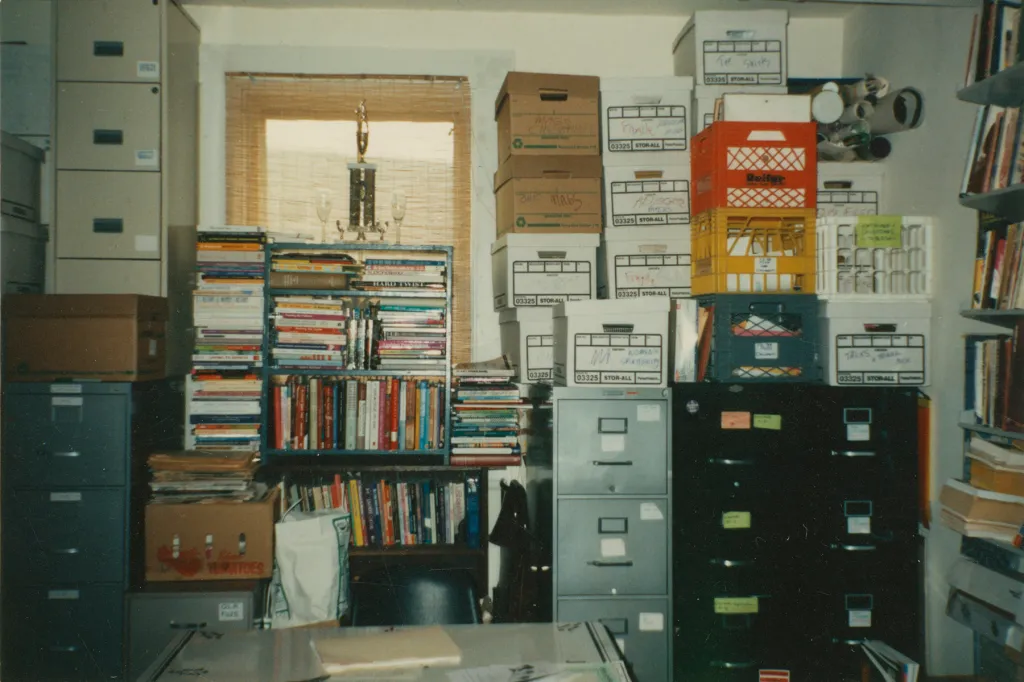
    Archival image of filing cabinets and boxes
    The Ohio Lesbian Archives first began in 1989 in a small room on the third floor above the Crazy Ladies Bookstore in Cincinnati, Ohio. (Cincinnati & Hamilton County Public Library)


    The Marking Diverse Ohio program was financed by a $250,000 grant from the Institute of Museum and Library Services, an independent agency created by a Republican-led Congress in 1996 that is the main source of federal funding for libraries and museums. Beiser and Branstetter were interviewed for an oral history. Ohio History Connection researchers visited the Archives to peruse the collection. A location was secured in a city park near where the since-shuttered Crazy Ladies Bookstore once was. By early this year, preparations to forever commemorate the Archives and bookstore with a plaque were all but complete. Its installation was expected in June, Pride Month.

    Then, in late March, President Donald Trump issued an executive order regarding “The Continuing Reduction of the Federal Bureaucracy,” singling out seven agencies for elimination — including the Institute of Museum and Library Services, or IMLS. Nearly all of its employees were put on leave and their emails were disconnected. Days later, his administration’s Department of Government Efficiency, or DOGE, canceled $25 million worth of  already-awarded IMLS grants, including the $250,000 for Ohio History Connection’s Marking Diverse Ohio program. The federal agency’s seemingly final Instagram post stated: “The era of using your taxpayer dollars to fund DEI grants is OVER.” The last photo listed erecting “LGBTQIA+ historical markers across Ohio” among the alleged government excesses that would be cut.


    A portrait of Jim Obergefell
    Read Next: 10 years after winning marriage equality, Jim Obergefell wants to aim higher

    Svetlana Harlan, a former project coordinator for Marking Diverse Ohio, recalled that when she looked at the list, and saw the program with other projects she admired,  “it almost seemed like a positive thing, I was like, ‘Oh yeah, these are nice initiatives!’”

    “And it turns out that [DOGE] was just taking over the account. So then I was like, ‘Oh, they’re cutting those. Oh, our name is on the list,’” she said.

    DOGE’s cancellation of the $250,000 IMLS grant to Ohio History Connection threw into question the future of the markers that were supposed to ensure that Ohio’s public displays of its history include LGBTQ+ people. Along with the Ohio Lesbian Archives and the Crazy Ladies Bookstore, there were markers in the works for an LGBTQ+ district in Akron; the first professor of gay and lesbian studies at Kent State University; 19th-century sculptor Edmonia “Wildfire” Lewis; LGBTQ+ journalism in Ohio; Toledo’s first LGBTQ+ member of city council; a Columbus hospice care center for HIV and AIDs patients; an open lesbian pastor in Athens; the screen-printing company Nightsweats and T-Cells in Lakewood; and the Rubi Girls, a Dayton-area drag group that has raised more than $3 million for HIV/AIDs and LGBTQ+ causes since the 1980s.
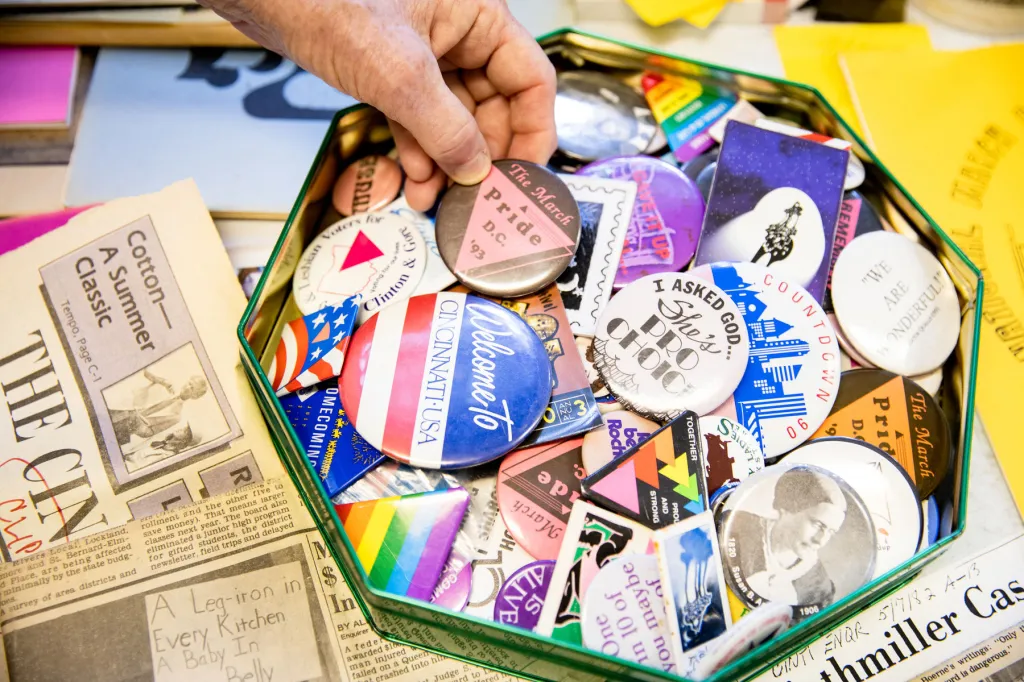
    Buttons and other archival materials spread out.
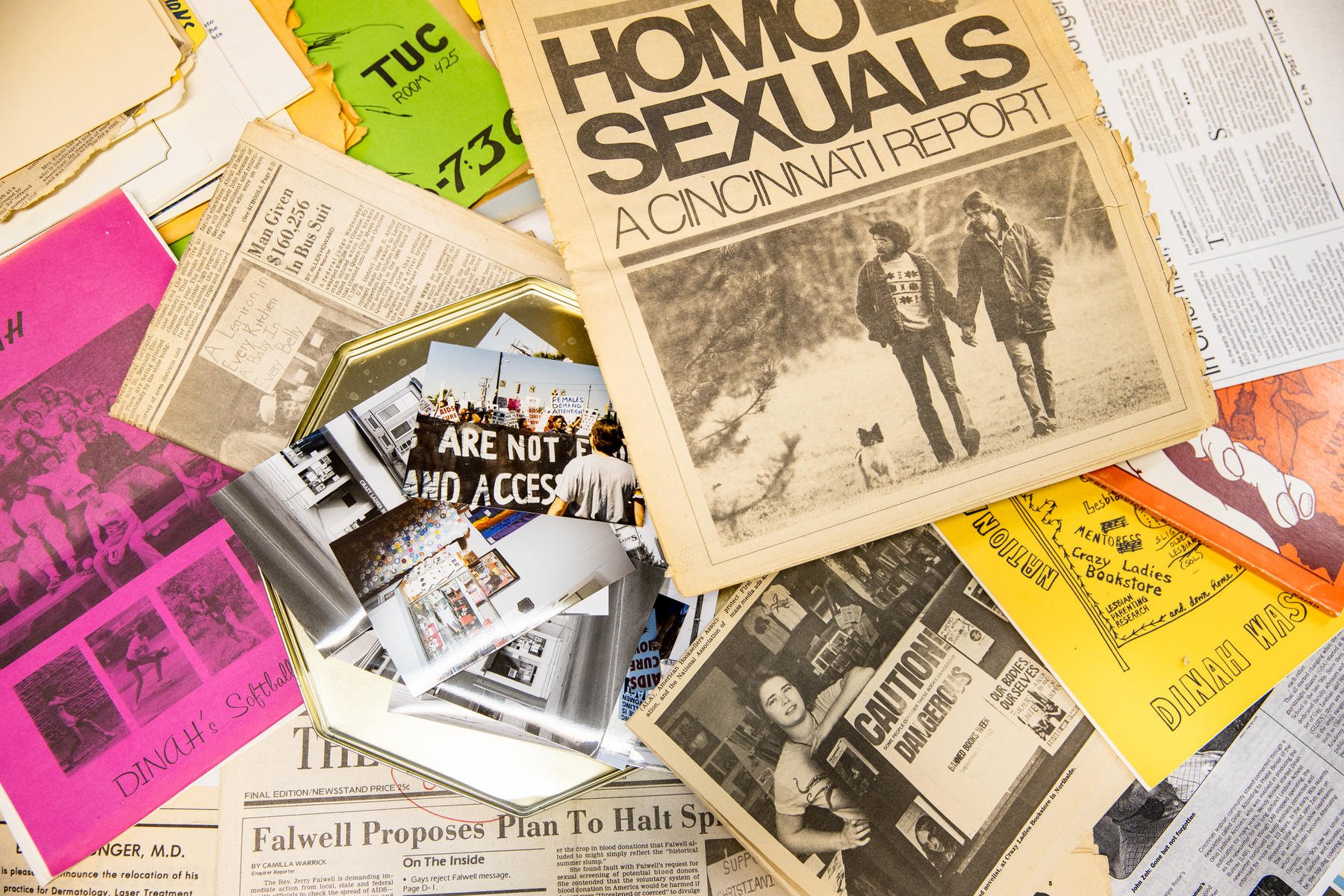
    Ephemera collected at the Ohio Lesbian Archives include buttons from past Pride marches, political campaigns and other symbols of lesbian life.
    (Courtesy Ohio Lesbian Archives)

    Preservation on hold

    Marking Diverse Ohio and other programs recognizing specific communities weren’t the only programs impacted in the state when DOGE cut IMLS grants and the federal agency essentially shuttered. And, given that more than $250 million is granted annually to libraries and museums nationally, the economic chaos at the country’s museums, libraries and historical institutions wasn’t confined to Ohio.

    In Ohio, other entities that received recent IMLS funding include the Frank Lloyd Wright-designed Westcott House in Springfield, for post-pandemic, on-site programming; the Cincinnati Zoo for a big cat breeding program; Dayton Metro Library programs that helped low-income Ohioans secure Internet access; and Cincinnati’s Contemporary Arts Center, which lost $175,000 slated for programming aimed at the 3,000 or more teens it serves each year.

    Institutions in Pennsylvania warned the economic upheaval could scuttle the digitization of The Rosenbach museum’s collection of rare books and manuscripts; the Woodmere Art Museum was mid renovation on a building to house its collection and expected to be reimbursed. In Wisconsin, small-town libraries said without the $3 million from the IMLS they’d received the year before they would have to reduce staff and therefore services. The American Library Association, or ALA, and the American Federation of State, County and Municipal Employees, or AFSCME, the labor union representing government workers, sued the Trump administration. ALA President Cindy Hohl said at the time that, “Libraries play an important role in our democracy, from preserving history to … offering access to a variety of perspectives.” AFSCME President Lee Saunders added: “Libraries and museums contain our collective history and knowledge.”

    Earlier this month, a federal judge ruled that the Trump administration could continue dismantling the Institute of Museum and Library Services as the case continues.

    People dance and laugh together at an outdoor day party.
    Read Next: A look inside the pop-up parties reimagining queer joy

    For now, Ohioans who want LGBTQ+ history represented among the 1,800 markers in the state will not get the federal funding that was granted and must search for alternative resources in their communities. A couple of the markers look poised to move forward with outside funding from community foundations and other organizations. Others, like the Ohio Lesbian Archives and the Crazy Ladies Bookstore, are still waiting. The remaining cost to install the marker would likely be $3,000-$5,000.

    When The 19th reached out to Ohio History Connection to ask if any alternative funding sources were being explored to install the Archives’ marker, spokesperson Neil Thompson said that he was “not able to provide any additional information for an Ohio Historical Marker application that is not in the public domain” and that it is only considered in the public domain once “the markers are finalized, cast and ready to be installed and dedicated.”
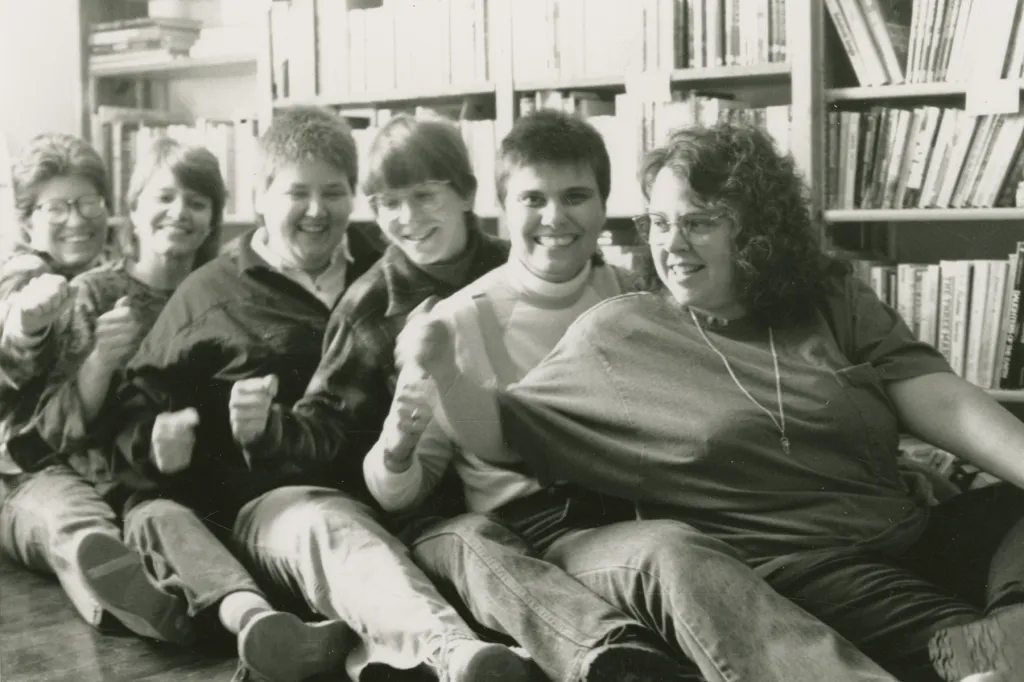
    A row of people lean into each other while seating on the floor in front of stacks of books.
    Phebe Beiser (far left), who co-founded the Ohio Lesbian Archives with her longtime friend Victoria ‘Vic’ Ramstetter, with Janice Uhlman, Elizabeth Van Dyke, Cathy McEneny, Morgan Kronenberger, and Ruth Rowan (left to right) at the Ohio Lesbian Archives in 1989. (Cincinnati & Hamilton County Public Library)

    ‘A reflection of themselves’

    The Ohio Lesbian Archives has always been a DIY endeavor, powered by a group of passionate volunteers.

    When the Crazy Ladies Bookstore’s founder, Carolyn Dellenbach, moved out of the area, she handed it over to its patrons to be run as a feminist collective. A lesbian newsletter called Dinah operated out of the upper floor — they referred to the National Organization for Women’s Task Force on Sexuality and Lesbianism, established in 1973, as FOSAL, or fossil, and Dinah was a play on dinosaur. Beiser laughed explaining the name: It was the 1970s; maybe there were drugs involved. For a time she wrote for Dinah and loved interviewing famous arrivals from the “women’s music circuit” when they came to town.

    At some point, the women working shifts at the bookstore, writing for Dinah and organizing talks and other events related to feminist and lesbian issues, realized that the community they had built, and the ephemera they were collecting and creating, were an important part of history — theirs, lesbians,’ Ohioans,’ and women’s.

    “We held on to them because we knew they could not be replaced,” Beiser said of the collection. “It’s proof of our existence …  so we held on to these things to never be invisible again.”

    We held on to them because we knew they could not be replaced. It’s proof of our existence.”

    Phebe Beiser

    Bookshelves crammed with books
    Books on lesbian history line the shelves of the Ohio Lesbian Archives. (Courtesy Ohio Lesbian Archives)


    In a 1991 issue of Dinah, letters to the editor included one from “Ma” who updated the “wimmin” in the community — they often spelled variations of their gender in ways that did not include “man” — that she was homesteading outside the city with her partner and building a log cabin. Another was from a woman who said she was “shocked” to find out that her being fired for being a lesbian was not a violation of civil rights laws and she was disappointed that the LGBTQ+ community did not come out to support her recent picket, writing: “I hope that in my lifetime I will see the gay and lesbian community get off their asses and together start fighting for their rights.”

    Across from the metal filing cabinet at the Archives that houses the Dinah issues, a modern-looking poster from before the Supreme Court decided Bostock v. Clayton County in 2020, which extended employment protections to LGBTQ+ Americans, reminded Ohioans that it was still legal for them to be fired for their sexual orientation or gender identity. Today, Trump’s Equal Employment Opportunity Commission is aiming to curtail those hard-won workplace protections established by Bostock.

    Lüdi Rich, a 27-year-old librarian, was working a recent Sunday afternoon at the Archives’ twice-weekly open hours, organizing books and research materials while the space was open to members of the community to drop in.

    Illustration of a couple in a shopping mall in progress and transgender Pride flag colored shirts. Behind them, other people shop, some wearing pride shirts.

    Read Next: How the ‘Everywhere is Queer’ app is helping LGBTQ+ people find queer-owned businesses

    When Rich moved to Cincinnati nearly two years ago, she didn’t know anyone in the area, so she looked online for queer spaces so she could start building her community. When she attended a panel on local queer history, one of the speakers was Beiser, a longtime librarian herself in the country’s second-largest public library system.

    Beiser mentioned at the panel that the Ohio Lesbian Archives would be having an open house that night at its new location next to Over-the-Rhine’s Washington Square Park, where Beiser was among those who met to march in Cincinnati’s first Pride Parade in April 1973. Rich asked Beiser how she could volunteer.

    A couple months later, Rich showed up for her first shift, “And I’ve been here working ever since,” she said.

    Nancy Yerian, the 34-year-old president of the Archives’ board, said that when she graduated from college in Massachusetts, she didn’t know if she could return to Cincinnati, where she grew up — until she discovered the Archives. “I thought that to live the kind of life I wanted to lead, I had to get out of what I thought was a very conservative place,” said Yerian, who has been volunteering at the Archives in some capacity since shortly after she finished school.

    “Finding the Archives and the people I’ve met through the organization and the community we’re creating, as well as the history we’re preserving — it gave me a lot of hope that I could create a life for myself here,” she added.

    It really is just us, preserving our history.”

    Lüdi Rich
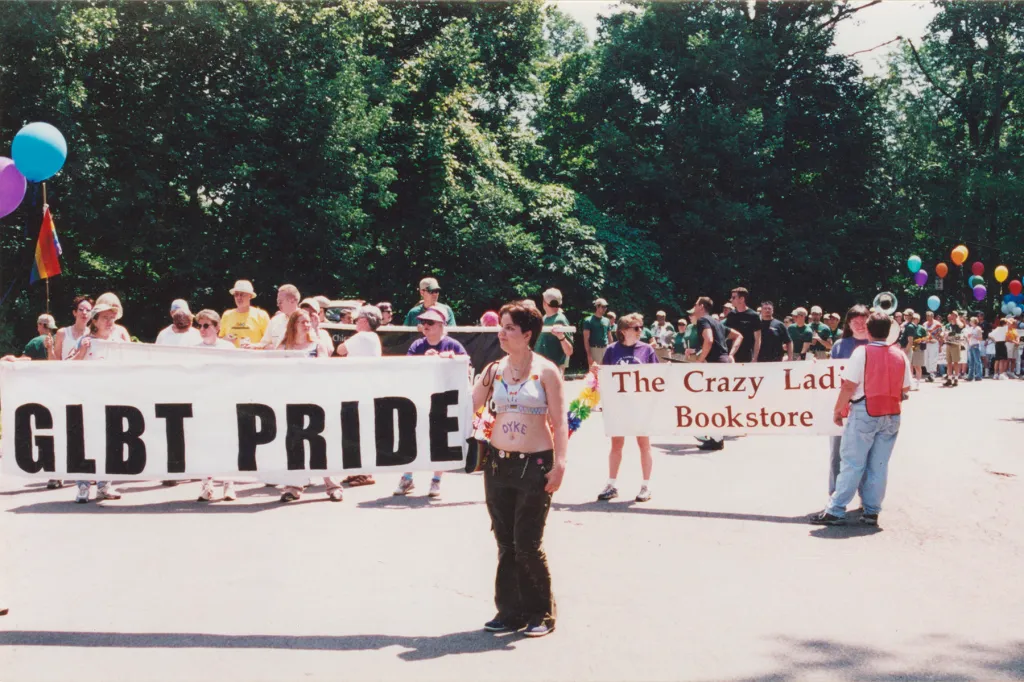
    Archival image of people marching down the street for Pride.
    The Crazy Ladies Bookstore marched in a Cincinnati, Ohio Pride parade. (Cincinnati & Hamilton County Public Library)


    The Archives’ volunteers have helped digitize old photos, some of which are now in a collection at the Cincinnati Public Library. They organize the books, arranged by first names instead of last, since so many women, especially in those early years, published works after taking on their husbands’ surnames. There are filing folders of Dinah newsletters. A cabinet holds multiple VHS and DVD copies of the early aughts television drama “The L Word.” A collection of buttons includes those from past Pride marches; supporting Hillary Clinton’s presidential campaigns; and one with “REMEMBER” and an inverted pink triangle, the Nazi symbol that Adolf Hitler used to identify gay and trans people. There is also one with the logo of the Crazy Ladies Bookstore, the silhouette of a woman reading while reclined in a chair, a cat by her side.

    “Many people who are coming to the archives are looking for a reflection of themselves and in many ways that’s why Vic and Phebe started it. It shows models of ways to be in the world and a feeling of not being alone and not being the first queer person or lesbian,” Yerian said.

    The Ohio Lesbian Archives, marker or not, is and will keep doing what it always has: making sure that lesbian Americans are visible in the country’s historical record.

    “It really is just us, preserving our history,” Rich said.

    Feeling overwhelmed by the news? The 19th is considering new ways to keep you informed. But we need your input! Fill out this quick survey to share your thoughts.
    https://19thnews.org/membership/

  • Older women front and center in ‘No Kings’ pro-democracy movement

    Older women front and center in ‘No Kings’ pro-democracy movement

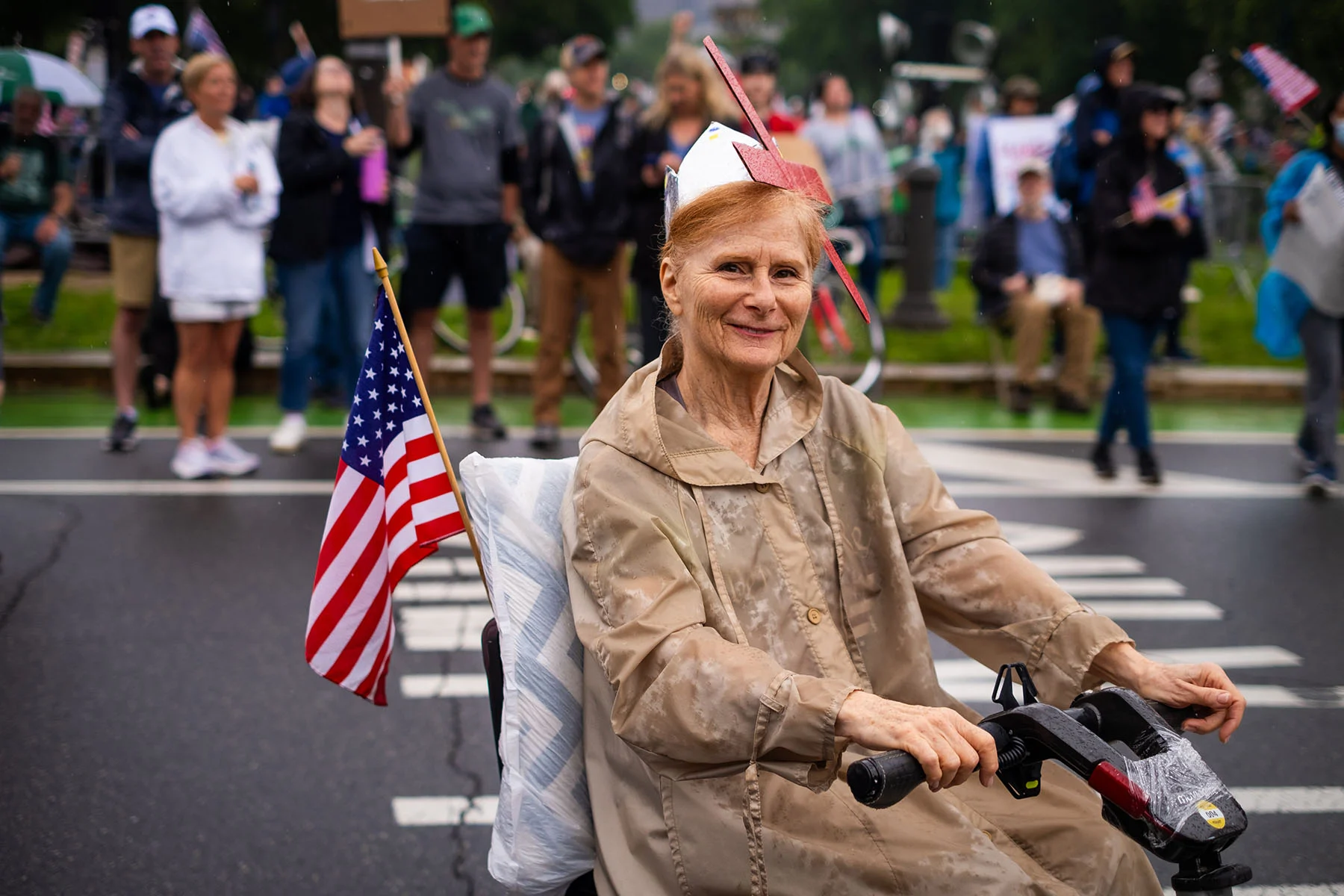
    A woman joins the No Kings protests near the Philadelphia Museum of Art on June 14, 2025. (Tara Pixley for The 19th)

    by Amanda Becker


    Read Amanda Becker’s Loveland, Ohio connection in her Bio below.

    This story was originally reported by Amanda Becker of The 19thMeet Amanda and read more of her reporting on gender, politics and policy.

    _____________

    Americans in their 60s, 70s and beyond showed up in force at this weekend’s protests, drawn by the Trump’s dismantling of public institutions and government programs.

    SPRINGFIELD, OHIO — The 2017 Women’s March was Barbara Hartwick’s first-ever political protest. She drove from the exurban community where she lived at the time to downtown Cincinnati, a left-leaning city of 300,000 people that anchors the otherwise conservative region. Still, Hartwick said, she felt too nervous to carry a sign or join in most of the crowd’s chants.

    Eight years later, having watched President Donald Trump’s political ascent, Hartwick, 63, has gone from a “hesitant” to an enthusiastic protester. When she joined the several hundred people outside Springfield’s city hall on Saturday — among them many retirees who, like her, took to the streets to oppose Trump’s agenda — she held up a sign that read: “Let the wild rumpus start!” She was inspired by the crown-wearing young boy in Maurice Sendak’s children’s book, “Where the Wild Things Are.” It was, she said, a nod to the “No Kings” nationwide rallies.

    Hartwick, a retired teacher, said she had “misconceptions” back in 2017 about what protests were like; she had never been politically active beyond voting. The march revealed to her “the camaraderie, the community of people there.” The crowd was “generally peaceful and positive” as they protested and it helped Hartwick realize that other women like her were also frustrated and disappointed with the direction of the country. She discovered that community spirit again Saturday in Springfield, the conservative-leaning city that Vice President JD Vance put on the map during the presidential campaign, when he made false accusations against the Haitian migrants legally living there to make the case for today’s militaristic immigration crackdown.

    Papas Coming Home 970x250

    Protests, Hartwick said, “give people hope.”

    Women led prominent protests during Trump’s first term against his presidency writ large, his treatment of women, his now-fulfilled pledge to appoint Supreme Court justices that would overturn the federal right to abortion, his family separations policy at the U.S. border and more. But while Black women have voted against the president in every election, White women voted for Trump in 2016, backed him again at the ballot box in 2020 and then a third time in 2024, according to exit polls. Democratic former Vice President Kamala Harris actually lost support from women overall last year as compared to 2020 across all age groups except one: those over 65.

    Headed into Saturday’s protests, the only age group across all genders and races with a lower opinion of Trump than 65+ voters was voters under the age of 30, according to a weekly tracking poll conducted by YouGov for the Economist magazine.

    Rural America is older than urban America, so in Saturday’s small-town and suburban protests, the graying nature of the coalition in the streets protesting Trump was visible enough that it caught the attention of local news outlets. The St. Louis Post-Dispatch posted a video of “senior citizens and others” at a protest in the moneyed suburb of Clayton, Missouri. West Virginia Public Radio reported that at a demonstration in Charleston, the state capital, “all ages were represented, but a large contingent of older West Virginians braved the sun and humidity to attend.” Trump had a higher margin of victory in the largely rural state than nearly any other.

    Longtime climate activist Bill McKibben, who founded the Third Act organization several years ago to build a community of Americans 60 and older to fight climate change and protect democracy, wrote a recent Los Angeles Times op-ed with Akaya Windwood, an adviser for the group, under the title: “Why older Americans are Trump’s biggest nightmare.”

    A research team led by American University’s Dana R. Fisher surveyed the host organizers of Saturday’s events and found that “consistent with the Resistance to the Trump administration during its first term, the majority of hosts and participants were female, predominantly White, and highly educated.” What has changed since the president’s first term, Fisher told The 19th, is that “the people in the streets are older than they were back in the first administration.”

    Fisher’s team’s preliminary findings showed that the median age on Saturday for participants in Philadelphia was 36 years old while the median age for protest event hosts nationwide was 67. Their field research in the first months of Trump’s second term shows that participants and organizers protesting the president are more likely to be women, more likely to be older and more likely to be White than participants and organizers of other recent protest movements.

    The 2017 Women’s March, held the day after Trump’s first inauguration, was, at the time, the largest single-day protest in U.S. history — between 3.2 million and 5.2 million people, or 1 to 2 percent of the country’s population, participated in more than 400 demonstrations nationwide. Saturday’s “No Kings” protests aimed for the lofty goal of about 12 million people, or about 3.5 percent of the country’s population, a number that reflects the level of participation that political scientists say is necessary to overcome a dictator or authoritarian leader.

    Organizers sought to do that by dispersing protests across more than 2,000 locations, many in places where public demonstrations are rare. Cities like Philadelphia and Chicago reported some of the largest crowds, but there were also well-attended events in small towns and mid-sized cities in politically conservative states like Ohio, Missouri, Tennessee and West Virginia.

    Jeremy Pressman, co-director of the Crowd Counting Consortium, a joint project of Harvard Kennedy School and the University of Connecticut, said it would be weeks before they can fully tally nationwide attendance. But, he told The 19th by email, it “looks very likely it was one of the largest days of protest in U.S. history.”

    It didn’t surprise Hartwick that older Americans, and especially older women, are souring on the president, whose administration has fired tens of thousands of federal workers and shuttered federal programs under the banner of anti-diversity equity and inclusion efforts. Plus, Republicans in Congress are debating legislation that would finance tax breaks for the wealthy by making deep cuts to the Medicaid health insurance program for lower-income Americans and nutrition programs on which many seniors rely.

    An aphorism in U.S. politics is that Americans become more conservative as they age; many older women who spoke to The 19th on Saturday noted that it isn’t a conservative approach, in the “small-c” sense of the word, to dismantle government programs and institutions and to upend democratic norms.

    “We don’t want to go back. It took a movement to get the right to vote. It took a movement to get Civil Rights. I’ve never in my lifetime lived when rights are taken away — until now,” Hartwick said, lamenting that to younger Americans, Trump’s policies and intensely divided politics likely seem normal.

    Also at the Springfield protest was Joan Justice, 84, holding a sign that said: “If there’s money for a parade? Then there’s money for Medicaid!” “I have friends who are in nursing homes and I know the money is running out and it really scares me,” Justice, also a retired educator, told The 19th of the program that covers long-term residential care for lower-income seniors because Medicare, the health insurance program for elderly Americans at all income levels, does not.

    Another “No Kings” protest in nearby Middletown, Ohio, a deeply conservative town of about 50,000 where Vance was raised by his grandparents, drew more than 400 and skewed older than Springfield. Among the people gathered at a busy intersection near a large supermarket, hardware store and a panoply of national restaurant chains was a 64-year-old woman who asked to be identified by her first name only, Rebecca, because, she said, she knows Trump opponents who have faced harassment. She was attending her first protest and said, “I want to start getting more active, I want to start writing my congressmen. My parents were Republicans and they would be appalled.”

    Standing nearby was Nannette, 74, who requested her surname be withheld for the same reason. She said that “Middletown is a small town, but I’m doing everything I can think of,” attending the April protests against cuts to the federal government that preceded those held on Saturday. “I was a lifelong Republican, and I tried to hold on, but January 6th was the end,” she said. When she sends mail, she puts her stamps with the American flag upside down as a subtle signal of distress.

    Hartwick said she sees a recent version of her past self in these older women who are overcoming fears about public demonstrations to protest the president, so she is “finding little opportunities to let people know it’s okay to not like what’s going on right now.”

    Just last week, Hartwick said, she was buying posterboard at her local Kroger supermarket when a woman in her late 60s or early 70s asked if she was making signs for a garage sale. “I said ‘no’ and she said ‘oh, what is it for?’ I said: ‘A protest.’ And she whispered: ‘The No Kings protest?’ I said ‘yes.’ And then she said: ‘Good luck.’”

    “People might be looking for someone else who feels the way they do because they don’t see it in their own community,” Hartwick said.


    https://19thnews.org/membership/

  • Their small farms helped stock food pantries. That program is going away.

    Their small farms helped stock food pantries. That program is going away.

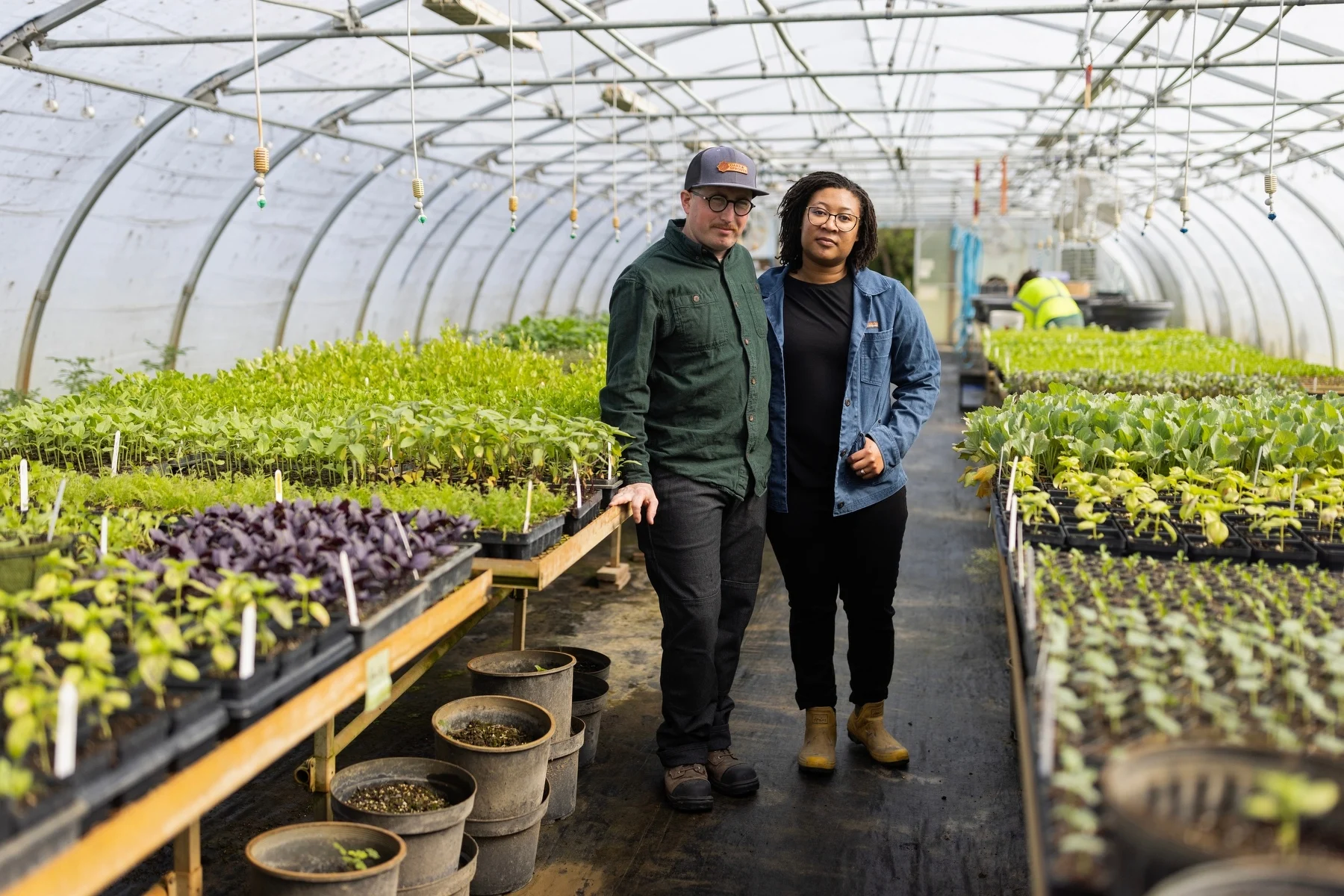
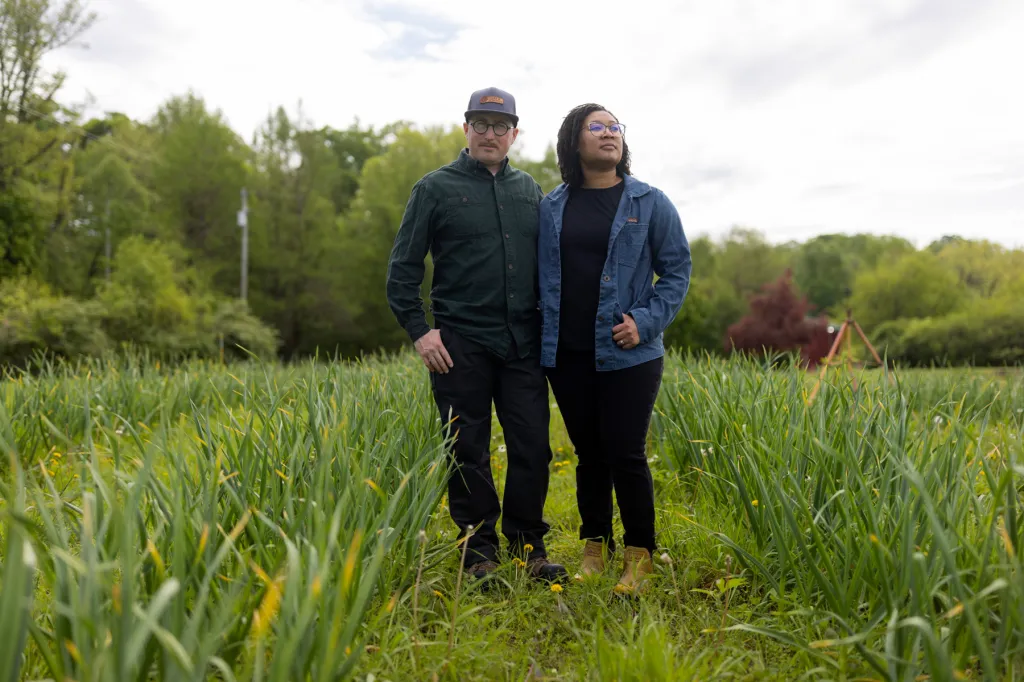
    Graham and Tonni Oberly say the goal of their Ohio farm Oak and Sprouts is to grow food in a way that is good for the land, their employees and their customers. (Maddie McGarvey for The 19th)

    by Amanda Becker


    Read Amanda Becker’s Loveland, Ohio connection in her Bio below.

    This story was originally reported by Amanda Becker of The 19thMeet Amanda and read more of her reporting on gender, politics and policy.

    _____________

    The Trump administration is ending a USDA assistance initiative as the country’s food pantries are “stretched to the breaking point” and a hunger crisis looms.


    URBANA, OHIO — Oaks and Sprouts, Tonni and Graham Oberly’s family farm, got the email from the Ohio Association of Foodbanks just after five o’clock on the first Friday in March.

    The U.S. Department of Agriculture, or USDA, had notified the Ohio Department of Job and Family Services that it was ending a program that gave state, tribal and territorial governments federal dollars to stock food pantries from farms within a 400-mile radius. The Ohio Association of Foodbanks, in turn, shared the notice with the more than 150 farms that supplied the state’s food pantries with fresh produce, meat and dairy. One of them was Oaks and Sprouts, whose younger and diverse owners are just the type of growers the USDA’s Local Food Purchase Assistance program aimed to connect to food-insecure Americans.

    Last growing season, Oaks and Sprouts had a contract worth up to $25,000 with the program, a significant amount for the small farm. The produce made its way to food pantries in nearby Springfield and Dayton and, from there, to the Ohioans who rely on them to feed themselves and their families. For Tonni Oberly, a trained doula with a background in public health, joining that distribution chain connected her work at the farm to the focus of the city and urban planning doctorate she had recently completed: how place impacts the health of Black mothers and children.

    “Food is such an important part of that — access to food in your neighborhood, access to healthy food, the affordability of food — how food impacts our maternal and child health outcomes is really crucial,” Tonni explained on a crisp April day as she and Graham walked through the hoop house where they were germinating seeds for spring planting.

    The federal program had also allowed the Oberlys to diversify their farm’s revenue stream beyond the traditional sales to restaurants and at farmer’s markets. It had given them a measure of predictability as they built a regenerative farm on land previously cultivated by Graham’s aunt and uncle and, before that, his grandparents.

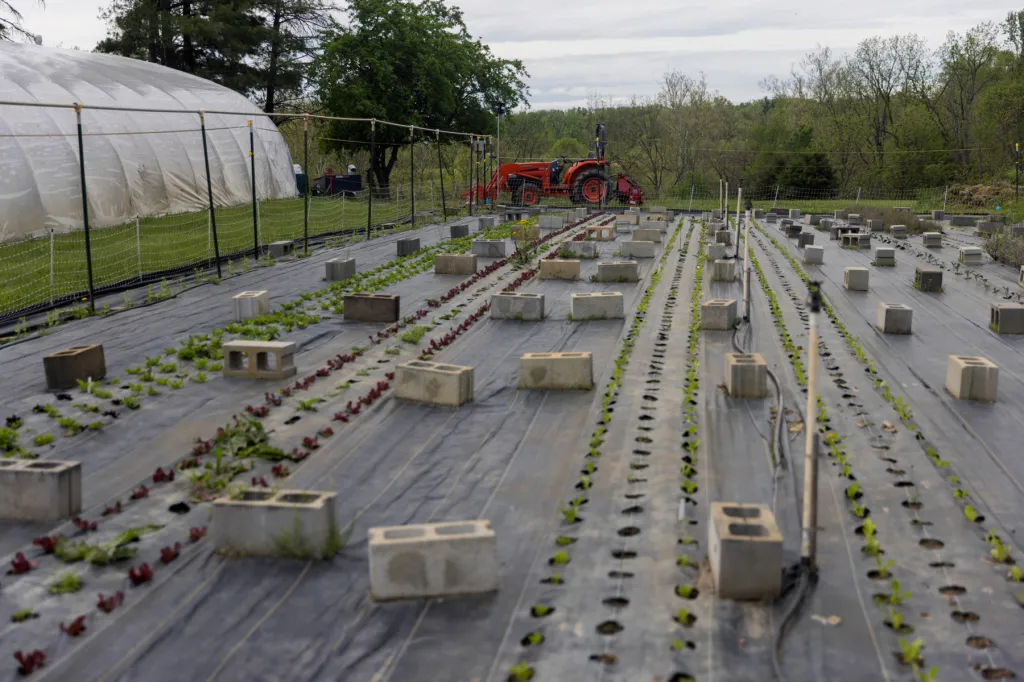
    “We can plant seeds and know that they’re sold, versus with the farmer’s markets, you plant and you hope people buy it — or even selling to restaurants, they don’t preorder months ahead of time,” Graham explained as he and Tonni stood on the  acre of land where they grow garlic, tomatoes, patty pan squash and lettuce varietals that include romaine, butterhead and salanova.

    The Oberlys estimate that they were able to hire two of their four seasonal employees last year because of their contract with the Local Food Purchase Assistance program, known as LFPA. They try to pay a good wage for the work — $17 an hour. That’s a decent amount for a place like rural Champaign County, where the median household income is about $20,000 less than nationally and the poverty rate is just over 10 percent. The farm’s goal, they explained, was to grow food in a way that is good for the land, their employees and their customers. Tonni named Oaks and Sprouts for a passage of scripture in Isaiah: “They will be called oaks of righteousness, a planting of the Lord for the display of his splendor.” It is a metaphor for living a righteous life.

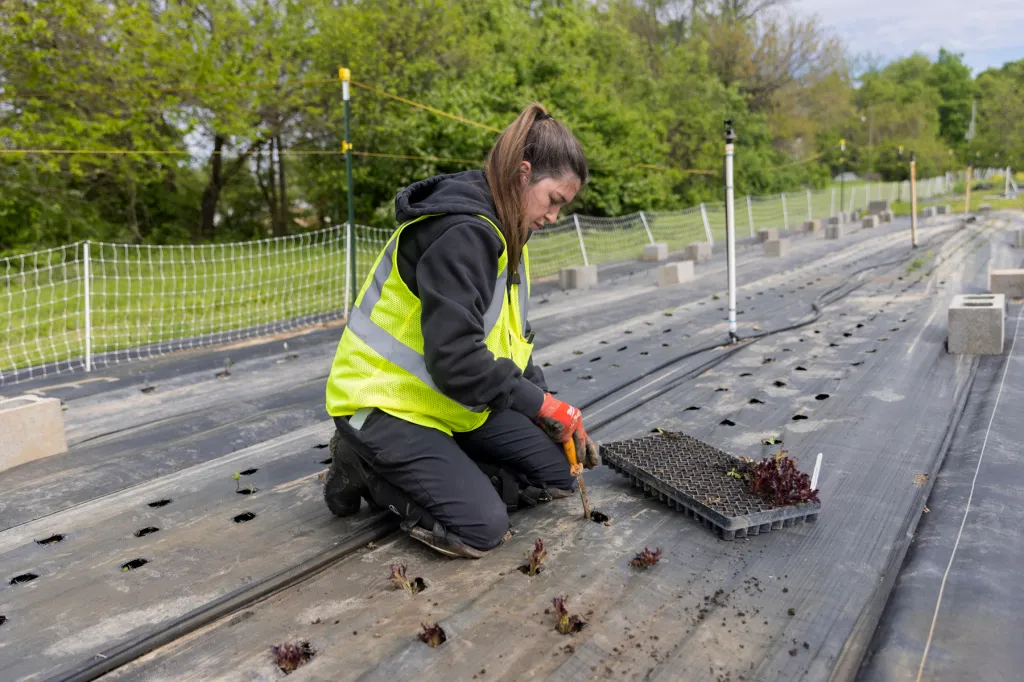
    A person plants produce in a field.
    The Oberlys estimate that they have been able to hire some of their seasonal employees because of their contract with the Local Food Purchase Assistance program.
    (Maddie McGarvey for The 19th)


    The email from the Ohio Association of Foodbanks landed as Oaks and Sprouts was in the thick of planning for its fifth growing season — the third in which the Oberlys planned on participating in the LFPA program. It attached a USDA notice saying that the Trump administration had “determined this agreement no longer effectuates agency priorities and that termination of the award is appropriate.” After the current contract year closes on June 30, the LFPA program, which authorized $900 million worth of locally raised healthy foods for anti-hunger organizations, would end.

    Created by the Biden administration in 2021, the Local Food Purchase Assistance program was at once an attempt to support small local farms and an acknowledgement that one of the most direct ways to bring healthy food to hunger-vulnerable populations is to buy it from underserved farmers nearby.

    But a USDA press release announcing its creation featured words like “equity” and “climate,” targets of President Donald Trump and his Department of Government Efficiency in their efforts to root out so-called “woke” federal programs. Even before Trump took office, the Oberlys’ program coordinator with Ohio CAN (Community + Agriculture + Nutrition), as LFPA is branded in this midwestern state, had warned them that its renewal could be in jeopardy.

    Still, Oaks and Sprouts, like the vast majority of the farms participating in Ohio CAN, began planning for the 2025 growing season. There were reasons to be hopeful. For starters, while the Local Food Purchase Assistance program was part of the Biden administration’s broader COVID-19 relief effort, its funding stream was first used for direct food purchases during Trump’s first term. Ohio CAN, like many state-level local food purchase programs, is also widely popular. Independent experts who analyzed its first year in the Republican-led state concluded that it was a “success by any measure.”

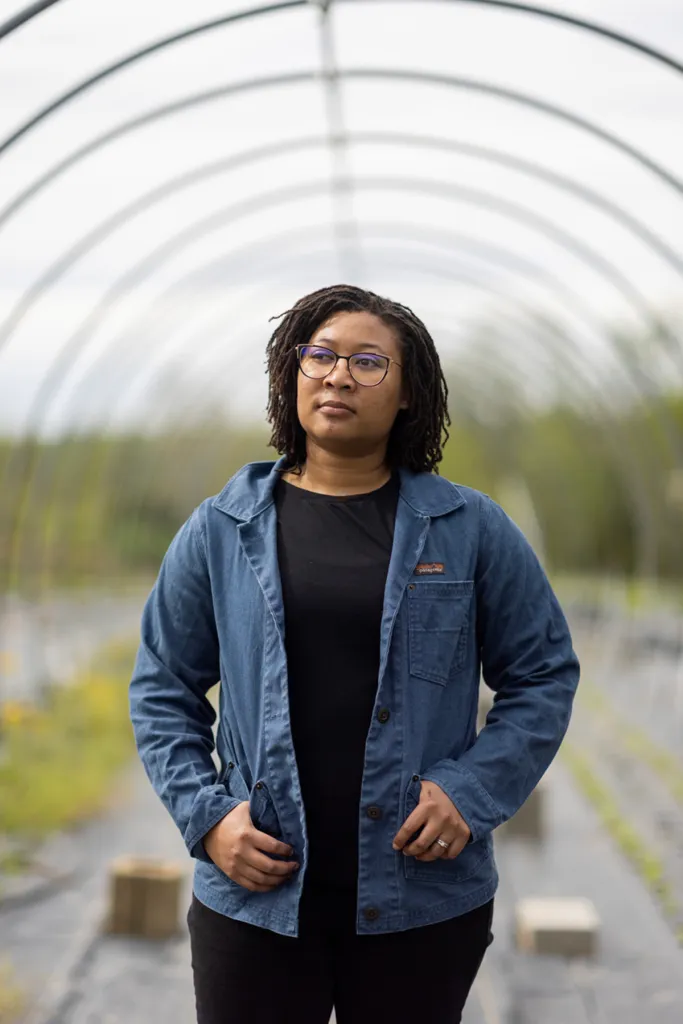
    A woman farmer stands in her greenhouse.
    Tonni Oberly sees her farm as a way to expand her work caring for Black mothers and children. Indigenous and Black Americans experience the highest rates of food insecurity, with Black children twice as likely as White children to face hunger.
    (Maddie McGarvey for The 19th)


    Trump’s picks to lead key federal agencies in his current term also seemed to be working in the program’s favor. Take Agriculture Secretary Brooke Rollins. One of the first things she did upon confirmation was to send state, local and tribal governments a letter that outlined her “vision for the Department’s 16 nutrition programs,” including a commitment to “create new opportunities to connect America’s farmers to nutrition assistance programs.”

    Then there’s Department of Health and Human Services Secretary Robert F. Kennedy Jr., a former environmental lawyer, the figurehead of the “Make America Healthy Again” movement and an outspoken critic of processed foods. One of his top priorities is encouraging states to prohibit the more than 40 million low-income Americans participating in the USDA’s Supplemental Nutrition Assistance Program, or SNAP, from using benefits to purchase soda and candy; so far this year, more than a dozen states have been considering such legislation. Many experts say a more effective way to encourage healthier eating is to improve access to fresh foods, exactly the type that LFPA farms were producing and selling to food pantries.

    More than 1.3 million Ohioans participated in SNAP during fiscal year 2024, or about 12 percent of the state’s population, according to a Center of Budget and Policy Priorities analysis of USDA data. While the majority of SNAP recipients are White, Black Ohioans are overrepresented when compared to the overall state population. An anonymous survey by the Ohio Association of Foodbanks showed that more than 40 percent of people who visited emergency food distribution centers in 2023 had at least one household member under the age of 18 and nearly as many reported living in a household with someone who is disabled.


    The country’s safety net to prevent hunger is a complicated web of federal programs. Most are housed within the USDA and many are jointly administered by federal and state governments. These include SNAP, previously known as food stamps; the Supplemental Nutrition Program for Women, Infants and Children, known as WIC; school meal programs; Meals on Wheels, focused on seniors; commodities purchases for food banks; and the Local Food Purchase Assistance program that Tonni and Graham Oberly’s farm participated in.

    Pulling on the thread of one program puts tension on the others. For example, once a family exhausts their SNAP benefits for the month, they may rely on one of the country’s more than 60,000 food pantries and emergency meal centers to feed themselves. As the USDA is ending programs like the LFPA, Congress is looking at other food assistance programs to find the $1.7 trillion in savings over the next decade needed to renew Trump’s 2017 tax package, which primarily benefited corporations and the wealthy.

    The confluence of cuts and changes, coming as more Americans than ever rely on government help for food, has hunger-relief advocates worried the safety net will unravel.

    Congress has proposed changes to SNAP that include recalibrating the formula used to calculate benefits, adding work requirements for some parents and forcing states to take on a larger portion of the funding. Rollins, for her part, sent a letter to states in April reminding them that it is ultimately the USDA that has the authority to grant their requests to waive the time limit on able-bodied adults receiving SNAP benefits unless they meet work requirements.

    Earlier this month, the Trump administration also ordered states to hand over SNAP recipients’ personal data, including their Social Security numbers, addresses and, in at least one state, citizenship status, National Public Radio reported. The directive came amid the administration’s broader push to amass Americans’ personal data and target immigrants.

    Though people in the country illegally are not eligible for SNAP benefits, their U.S. citizen children might be. Last month, USDA directed states to enhance identity and immigration status verification as part of Trump’s broader immigration crackdown, even though there is no evidence that immigrants are improperly participating in the program at significant levels. Advocates worry that in the current climate, using the SNAP program to collect participants’ data could have a chilling effect on seeking food assistance.

    The USDA also recently paused $500 million from a separate program that buys large quantities of food from farmers for food pantries, with food banks in Ohio, Wisconsin, Massachusetts and elsewhere losing millions of dollars worth of shipments as a result. When the administration ended the LFPA, it also terminated a $660 million program that linked local farms to schools and child care centers.

    The changes and uncertainty are coming at what Vince Hall, the head of government relations for Feeding America, the nationwide foodbank network, called an already “very precarious moment for food banks because there’s no resiliency left in the system.”

    “They’re stretched to the breaking point. They are serving unprecedented high demand, the highest in over a decade. They are dealing with a decline in donation revenue from the pandemic highs that has been quite steep. The decline of financial donations from the pandemic highs, combined with some of the highest — in fact, record — levels of demand at food distributions has just stretched them to the breaking point,” Hall said.

    “If we have policy adjustments that disqualify people from the SNAP program, or if we have a recession and unemployment goes up, or if we have a series of natural disasters, there are any number of things that can work to increase demand, and the food banks just aren’t ready,” he added.

    In an emailed statement, a USDA spokesperson noted that as of mid-May, states still had $246 million in unspent LFPA funds. “The secretary encourages states to utilize these dollars for schools, charitable feeding organizations, and other programs that serve those in need,” the statement said.

    Alabama has exhausted its funds; Ohio had about $435,000 left from $26.6 million allocated; just $1,500 remained in Tennessee’s coffers, according to an official tally.

    The spokesperson added: “On any given day, the Department issues more than $405 million worth of nutrition benefits across its 16 nutrition programs. There is no need for new programs, but perhaps more efficient and effective use of current.” These are not reassuring words to many of the program’s participating farmers and food pantry operators, whose best-case-scenario path forward is for the program to be revived under the administration’s own branding.


    Graham and Tonni Oberly had to pivot quickly.

    After they received the email from the Ohio Association of Foodbanks, they secured a spot for this season in a farmer’s market in Dayton that is larger than the one where they used to sell their produce nearby. They are adding cut flowers to their lineup and growing Chinese Cabbage for the first time, while also trying to expand the number of local restaurants to which they sell what they grow.

    But the modicum of predictability that the Local Food Purchase Assistance program gave this new farm for the past two seasons — the USDA considers farmers and ranchers “beginning” for their first decade and eligible for special assistance — will be gone this year. As will the direct line for Oaks and Sprouts to help address food insecurity in their own community.

    Graham Oberly grew up on the Ohio-West Virginia border in a family that fought mountaintop removal mining in Appalachia, earned a degree in natural resources management and worked as a sustainability coordinator for The Ohio State University before moving into farming.

    Oaks and Sprouts is a marriage of the Oberlys’ passions. The regenerative farm is a way for Graham to tend the land of his ancestors and preserve it for future generations. With the Local Food Purchase Assistance program, the farm was also a way that Tonni could expand her work caring for Black mothers and children.

    Two people stand for a portrait on their farm.
    Graham and Tonni Oberly’s Ohio farm Oaks and Sprouts serves a state where the rate of food insecurity is slightly higher than the national average.
    (Maddie McGarvey for The 19th)


    More than 47 million Americans — including one in five children — are considered food insecure, meaning they do not have enough food to eat or access to healthy foods. Rural Americans are more likely to face hunger due to lack of transportation, lower wages and racial discrimination. The highest rates of food insecurity are among Indigenous and Black Americans, according to a Feeding America analysis, with Black children twice as likely as White children to face hunger. USDA research also shows that households with children headed by a single mother are more likely to be food insecure. And food-insecure women are more likely to be obese than food-insecure men or children, with all of the related health issues, in part because they prioritize providing healthy foods for their children instead of themselves, according to the Food Research & Action Center.

    In Ohio, the food insecurity rate is slightly higher than the national average. In 2023, Ohioans visited the state’s food banks 14.7 million times, up more than a third over the year before. Ohioans are eligible for food bank use if their household is at or below 200 percent of the federal poverty level — and more than a quarter in the state qualify, or about 3.4 million people. Of the 43 percent who were also receiving SNAP benefits, nearly all of them — 93.4 percent — reported exhausting those benefits within the first three weeks of the month, according to the Ohio Association of Foodbanks.

    Biden’s $1.9 trillion COVID-era stimulus package provided direct assistance to taxpayers, $350 billion for state and local governments, and $130 billion to help safely reopen schools, among other provisions. The plan also earmarked $1 billion for USDA programs to build capacity in the country’s food-banking system amid unprecedented need and global supply chain disruptions.

    Half of that money went to additional purchases via The Emergency Food Assistance Program — and that is the $500 million canceled by Trump’s USDA in March. Another $400 million was slated for what became the Local Food Purchase Assistance program. Biden’s USDA renewed both pandemic-era programs due to their popularity.

    While more than 90 percent of all U.S. farms qualify as “small,” with gross cash annual farm incomes of $250,000 or less, they account for just 17 percent of the total value of food produced in the country, according to USDA statistics. Still, they play a critical role in diversifying the overall food ecosystem by supplying produce, dairy and meat that are not available from large-scale agribusiness. Many grow a variety of crops instead of focusing on one or two. Since they are often serving their own communities, they are less vulnerable to disruptions to complex global supply chains.

    In 1973, as global demand for U.S. farm exports exploded, Earl Butz, the agriculture secretary under Republican President Richard Nixon, told American farmers to “get big or get out.” Farmers mostly listened. In the years since, while the number of farm acres has remained roughly constant, the number of farms has continued to decline. When Tom Vilsack, the agriculture secretary under Biden, released data from the 2022 Census of Agriculture, he noted that in over five years, the country had lost 142,000 farms — a roughly 7 percent decline. “As a country, are we okay with losing that many farms? … Or is there a better way?” Vilsack asked.

    The Local Food Purchase Assistance program was an acknowledgement that one of the most direct ways to bring healthy food to hunger-vulnerable populations was to buy it from underserved farmers nearby. More than 95 percent of American farmers are White. They are also older — the average age of a U.S. farmer is just over 58, according to USDA statistics — and predominantly male; women make up only 36 percent of farm operators. Under Vilsack, who also served for the entirety of Democratic President Barack Obama’s two terms, agriculture policy aimed to address the decline in small farms by extending credit and other types of support to people historically less likely to farm — namely women and people of color.


    White men’s dominance over U.S. farming is not happenstance. It’s the result of more than 200 years of official government policy that reflects the fraught relationships the country has with race and land.

    In the 1830s, the U.S. government forcibly relocated thousands of Indigenous Americans from their ancestral lands in the east, where they had cultivated for generations, to a different climate in the west. Thousands of them died from disease, starvation, exhaustion and exposure to the elements during a brutal journey that came to be known as the Trail of Tears. In the 1860s, in the waning months of the U.S. Civil War, General William Sherman pledged that when the Union won, formerly enslaved Black people, who had farmed for White enslavers, would be eligible to receive 40 acres and a mule to farm their own land. President Andrew Johnson reversed course after he took office, returning the land to White people.

    A landscape of a farm with a tractor in the background.
    Two centuries of discriminatory lending practices and American federal policies that privileged white men has made owning a farm often inaccessible to women and people of color. The Local Food Purchase Assistance program addressed that issue and worked to bring healthy food to hunger-vulnerable populations by buying it from underserved farmers nearby.
    (Maddie McGarvey for The 19th)


    People of color — and women — struggled to access credit, including via the USDA, to buy the land and equipment needed to start even a small farm in the decades of Reconstruction that followed the Civil War, throughout the Civil Rights and feminist movements, and into the 1990s. Between 1999 and 2010, the USDA paid settlements in three class actions brought on behalf of Black, Latinx and Indigenous peoples — Pigford v. Glickman, Garcia v. Vilsack and Keepseagle v. Vilsack — arguing that the agency had discriminated against them when they sought loans and other assistance. In 2022, Biden’s Inflation Reduction Act created a $2.2 billion fund to compensate farmers and ranchers who experienced past discrimination, including women.

    The federal judge in the Pigford case, Paul L. Friedman, noted that “[a]s the Department of Agriculture has grown, the number of African American farmers has declined dramatically,” and the USDA and “the county commissioners to whom it has delegated so much power bear much of the responsibility for this dramatic decline.”

    “The Department itself has recognized that there has always been a disconnect between what President Lincoln envisioned as ‘the people’s department,’ serving all of the people, and the widespread belief that the Department is ‘the last plantation,’ a department ‘perceived as playing a key role in what some see as a conspiracy to force minority and disadvantaged farmers off their land through discriminatory loan practices,’” Friedman wrote.

    This history — and a tacit recognition of the role USDA played via its discriminatory practices — underpinned the ethos of the Local Food Purchase Assistance program.

    In its first year in Ohio, the program bought from 164 growers. A majority of them were classified as “socially disadvantaged,” which for the LFPA, the USDA defined as women; Black, Indigenous and other people of color; LGBTQ+ people; veterans; and small, emerging and disabled farmers. That year, nearly 12,000 pounds of grains, 223,000 pounds of dairy and milk, 39,000 pounds of eggs and more than 2.5 million pounds of produce that these farmers produced went into the state’s food pantries. The more than $9 million worth of food was distributed via five hubs and 12 regional food banks, according to a report independent researchers produced for the Ohio Association of Foodbanks.

    The researchers noted: “Overall, producers were drawn to participate in the Ohio CAN program because sharing high quality products with communities in need was often central to their core mission and personal values.” A farmer called the program a “godsend” and said they felt like they were on the “front lines of food insecurity and food instability.” One foodbank representative in a historically redlined area, where banks discriminated against residents of certain neighborhoods because of their race and ethnicity, said it was the first time a farmer had offered them okra and they hoped “we’ll be able to work more closely with her to get larger, larger quantities in next year.”

    The USDA’s decisions to end the Local Food Purchase Assistance program and to cancel planned commodities purchases for food banks have not been popular. The Iowa Farmers Union helped small farms facing lost contracts send press releases about the impact. Singer-songwriter Willie Nelson, a founder of the annual Farm Aid concert, penned an open letter to farmers encouraging them to protest the cuts. Food bank administrators from Oregon to Maryland to Florida have warned it will stress their ability to meet still-historic demand that has not diminished since the pandemic.

    There have also been public spats between Trump’s USDA and Democratic governors like Pennsylvania’s Josh Shapiro, who accused the agency of reneging on a three-year deal; Rollins said he didn’t have his facts right and was “trying to make this a political issue.”

    For the Oberlys in Ohio, the politics are personal. Their five-year-old farm was just starting to be woven into the constellation of state and federal programs that fed food-insecure neighbors while giving Oaks and Sprouts a toehold in a precarious industry that employs one in eight Ohioans, either directly or indirectly, and generates billions in the state each year.

    The end of the Local Food Purchase Assistance program severed the Oberlys’ direct path to care for the people in their community, along with their land. Or as Tonni Oberly put it: “Supporting the local food system is one of the best ways to support the local economy, it supports farmers and community members — it’s a win-win.”

  • Did politics kill Women’s History Month at Ohio University?

    Did politics kill Women’s History Month at Ohio University?

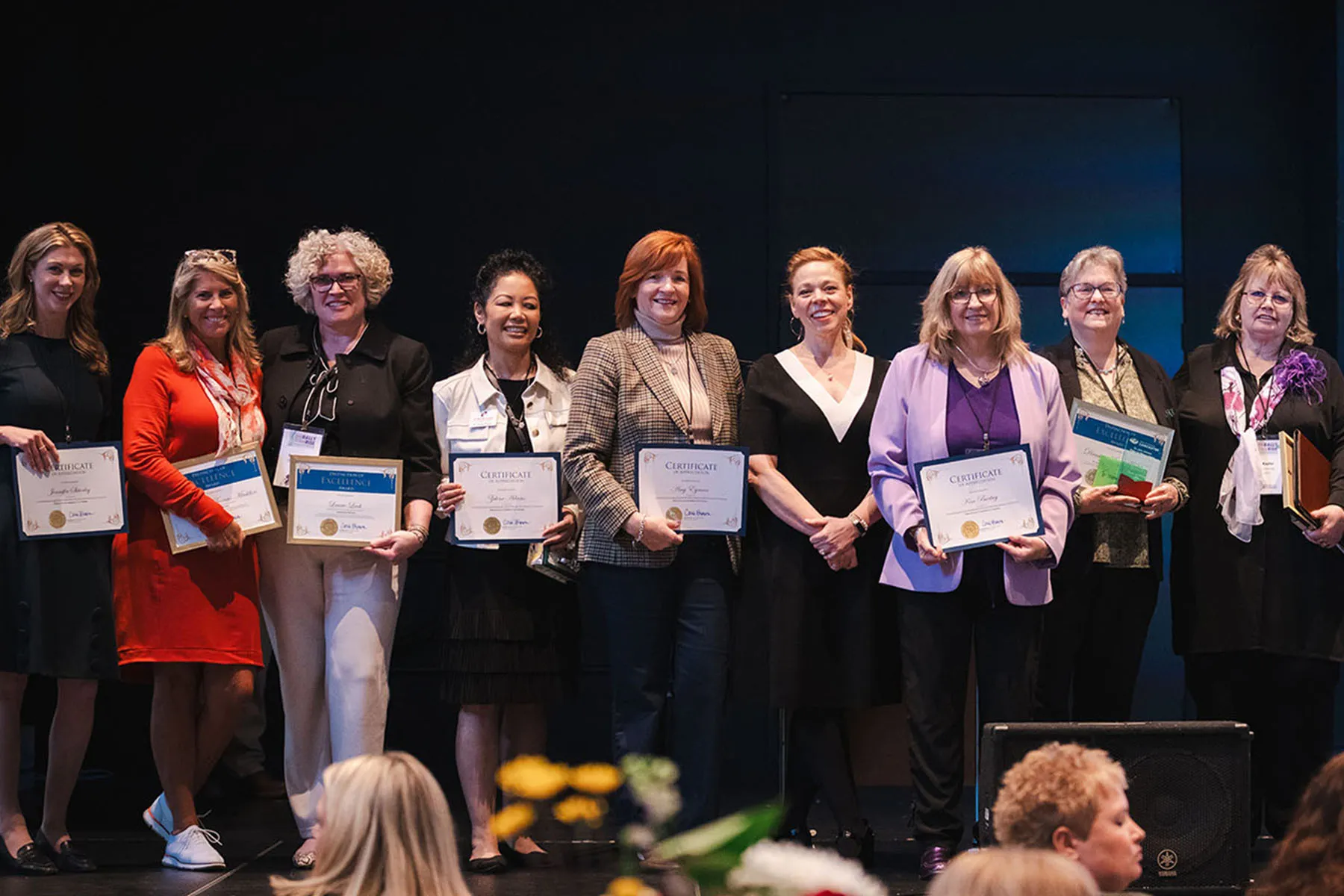
    Honorees at the We Rally & We Rise Women’s Conference pose for a group photo in Lancaster, Ohio, on March 21, 2025. Kim Barlag, third from right in a purple suit, helped organize the independent event after Ohio University canceled its longtime Women’s History Month celebration following new federal guidance on anti-discrimination policies. (Megan Cardenas/OH Creative Studios for We Rally We Rise)

    Amanda Becker

    Read Amanda Becker’s Loveland connection in her Bio below.

    This story was originally reported by Amanda Becker of The 19th. Meet Amanda and read more of her reporting on gender, politics and policy.

    Lancaster, Ohio –  Kim Barlag knew she couldn’t let women be canceled.

    For nearly two decades, Ohio University’s Lancaster campus hosted an annual conference to “promote and advance gender equity by recognizing the past, present, and future achievements of women from diverse ages and backgrounds.” Known as Celebrate Women, it featured awards honoring women in leadership, panels on business and civic engagement and service opportunities. The plan for this year was to collect food and school supplies for university students facing financial hardship.

    Celebrate Women became a much-anticipated Women’s History Month tradition in this central Ohio city of 40,000, just 30 miles southeast of Columbus, the state capital. But then, on the eve of its 19th year, politics intervened.

    On March 6, two weeks and a day before the event, Ohio University announced that the conference had been “placed on hold … in light of recent guidance from the Department of Education’s Office for Civil Rights,” which threatened to withhold federal funding to institutions that do not conform to the Trump administration’s notion of anti-discrimination. The university’s decision followed the cancellation of a reunion for Black alumni, another regular occurrence in previous years.

    When she heard the news about the women’s conference, Barlag, herself an alumnus and the president of the Chamber of Commerce in nearby Pickering, cycled through a series of emotions: disappointment, sadness, anger, resolve.

    “I guess I should have seen it coming after that happened, but I was still surprised,” she told The 19th. “I was pretty devastated. I shed a few tears. Then I thought: Action makes people feel better. How can we save this event? We needed to act fast.”

    She called and emailed other women leaders in the area — including some who, like her, had been scheduled to participate in Celebrate Women panels — to gauge their interest in reviving the conference as a non-university event. Their response, Barlag said, was “gung ho.” The plans for the new event came together quicker than Pam Kaylor, a communications professor who organized Celebrate Women for the university, was able to notify participants of the previous one’s cancellation.

    The independent event had a new name, We Rally & We Rise Women’s Conference, and it brought together some 300 women at the Crossroads Event Center in Lancaster last week. Many Celebrate Women sponsors shifted their support and some new sponsors signed on, angry about the cancellation — Barlag took to calling it “mad money.” Organizers handed out branded tote bags and notebooks. The event raised money for local nonprofit organizations. Speakers shared strategies to conquer anxiety and impostor syndrome. The boxed lunches were made by a nonprofit caterer that employs survivors of sex trafficking. The writing on the back of attendees’ name tags captured the vibe: “Welcome All BABS!!! BAD ASS BITCHES. Yes, you read that correctly.”

    As Barlag opened the conference, the audience’s enthusiastic response “set me off my game there for a minute” because “it was so powerful and inspiring,” she later said.

    “The energy was great — people were grateful to have a conference to attend, to be together, a show of force in support,” she added.

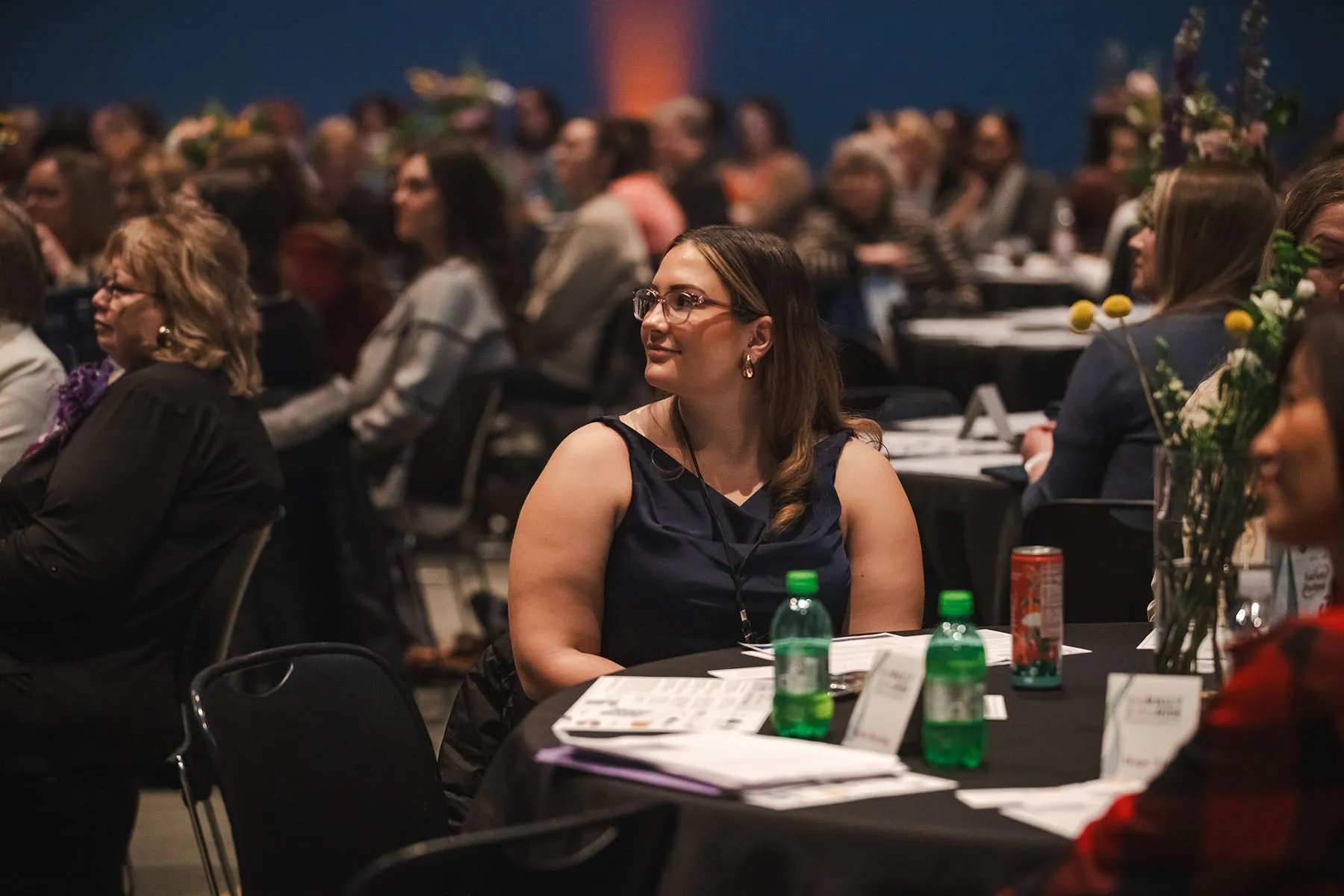
    A woman seated at a table smiles as she listens to speakers during the We Rally & We Rise Women’s Conference.
    A woman listens during the We Rally & We Rise Women’s Conference in Lancaster, Ohio, on March 21, 2025. Hundreds gathered at the independently organized event after the university-backed celebration was canceled. (Megan Cardenas/OH Creative Studios for We Rally We Rise)


    Lancaster may be close to the state’s capital, but it’s the county seat in an agricultural region of pig and cattle farms. Lancaster itself is known for its glassware — the hometown company, Anchor Hocking, is named for the Hocking River, which snakes through the city. Once one of the world’s largest manufacturers of glassware, Anchor Hocking went through a merger, then a bankruptcy. Like in so many small cities and towns, Lancaster’s historic downtown became a symbol of economic decline in the post-industrial Rust Belt. In recent years, though, Lancaster’s population began to tick up again.

    Fairfield County is a Republican stronghold in presidential elections. President Lyndon Johnson, in 1968, is the only Democrat who has won there since 1944. Republican President Donald Trump’s America-first economic message resonated with voters who have watched Lancaster struggle, then rebound. In 2024, close to 62 percent of the county’s voters cast ballots for Trump and Vice President JD Vance, who was then one of the U.S. senators for Ohio. The state, a one-time presidential bellwether that has in recent cycles grown more conservative, backed Trump over Democratic Vice President Kamala Harris by 55-to-44 percent.

    In this slice of Trump Country, personal interpretations of the reasons for the cancellation of Celebrate Women are a sort of political Rorschach test. Some left-leaning voters believe it was the inevitable result of Trump’s assault on diversity, equity and inclusion, or DEI, a broad concept that his administration has deployed to challenge and threaten institutions deemed too liberal. Some conservative-leaning voters believe the cancellation to be an overly cautious move by the university — and potentially a way to make the new administration look bad.

    One thing on which women on both sides agree is that they should not be silenced.

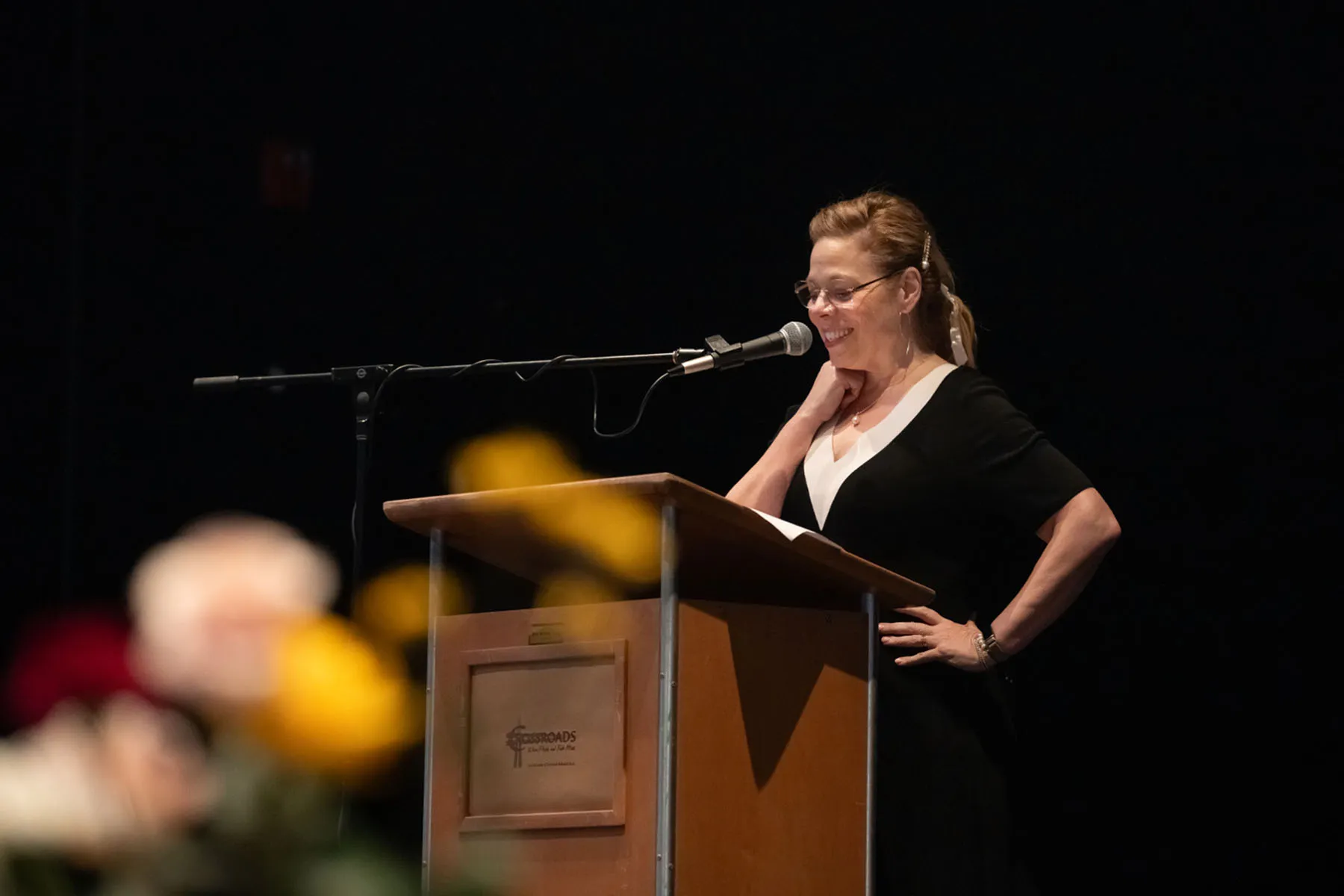
    “There is dissent about how we came to this place,” Fairfield County Auditor Carri Brown, an elected Republican, acknowledged during her opening remarks. But “when we’re told we cannot celebrate women, we’ll respond by saying, ‘Yes we can’ … and we’ll rally and we’ll rise!”

    When she described diversity as “not a bad word” but a “blessing,” the crowd applauded and some rose to their feet. “I have a very strong faith in America,” Brown said.

    Fairfield County Auditor Carri Brown delivers opening remarks on stage at the We Rally & We Rise Women’s Conference.
    Fairfield County Auditor Carri Brown delivers opening remarks during the We Rally & We Rise Women’s Conference.
    (Megan Cardenas/OH Creative Studios for We Rally We Rise)


    Ohio University’s decision to cancel the Celebrate Women event is the latest skirmish between conservative politicians and the elite institutions of higher education that they have long charged with being hostile to their political viewpoints, with so-called DEI efforts at colleges and universities now front and center to their case.

    A February 14 “dear colleague” letter from the civil rights office of Trump’s Department of Education to colleges and universities alleged an “embrace of pervasive and repugnant race-based preferences and other forms of racial discrimination” at the expense of White students. It noted that federal law “prohibits covered entities from using race in decisions pertaining to admissions, hiring, promotion, compensation, financial aid, scholarships, prizes, administrative support, discipline, housing, graduation ceremonies, and all other aspects of student, academic, and campus life.” Noncompliance would risk the federal funding that nearly all colleges and universities receive.

    Though the letter made no direct mention of gender, it put university administrators on alert as they sought to identify any programming that could jeopardize their funding. When the Department of Education, which Trump now seeks to dismantle, launched investigations against more than 50 education institutions, it included two in Ohio: the University of Cincinnati and the Ohio State University.

    Judith Cosgray, a librarian and leader of an arts nonprofit who has attended Celebrate Women on and off for the past 15 years, described its cancellation as a balloon deflating when its attendees most needed a lift.

    “I understand that they’re afraid of losing their funding, I understand that, but sometimes you’ve got to stand up, too,” Cosgray said in between conference sessions.

    In addition to the various executive orders and directives that Trump has made about DEI, the Ohio legislature, where Republicans hold a veto-proof majority in part due to unconstitutional gerrymandering, recently approved a higher education bill that bans DEI training, scholarships and offices, and contains admonitions about teaching “controversial” topics. It is expected to be sent to GOP Gov. Mike DeWine for his signature as early as this week.

    A spokesperson for DeWine did not respond to a request to comment on whether he will sign the anti-DEI legislation or if, by his estimation, events like Celebrate Women would fall under its purview. The office of GOP state House Speaker Matt Huffman likewise did not respond to the same question by publication time.

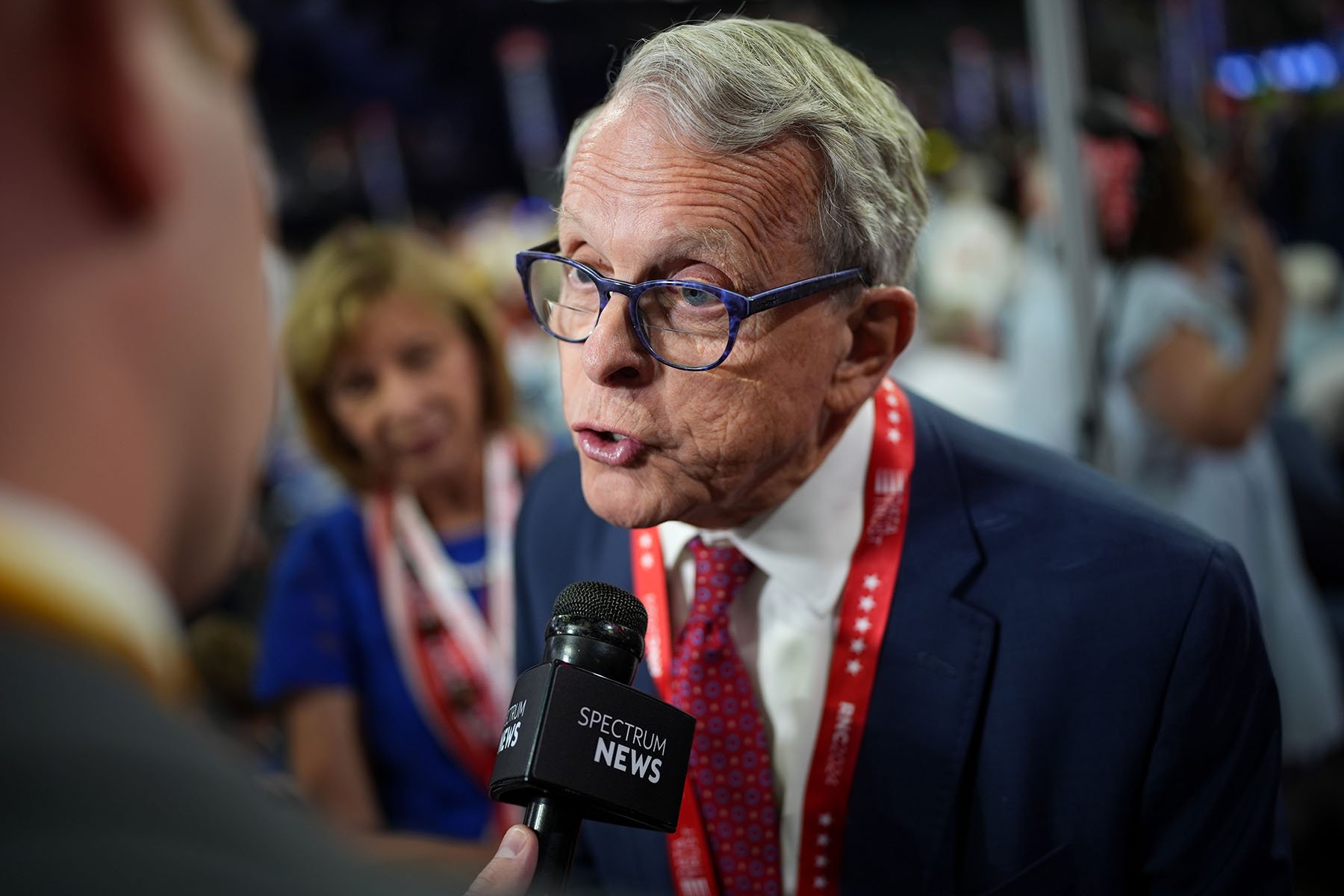
    Mike DeWine speaks to the press at the Republican National Convention.
    Ohio governor Mike DeWine speaks to the press on the first day of the Republican National Convention on July 15, 2024 in Milwaukee, Wisconsin.
    (Andrew Harnik/Getty Images)


    Celebrate Women isn’t the only recent example of how the assault on DEI across public life has led to a seeming prohibition on celebrating the accomplishments of women, with many actions taken during March, the month specifically earmarked to remember such events.

    Information about the first woman to pass Marine infantry training was among some 26,000 photos and online posts marked for deletion as part of a DEI purge at the Defense Department, the Associated Press reported. A page about Golden Girls actor Bea Arthur, one of the first to serve in the Marine Corps Women’s Reserve, also disappeared. There are reports that Arlington National Cemetery scrubbed its website of references related to notable women veterans.

    It isn’t limited to women. A Defense Department webpage that described the military service of Black civil rights icon and baseball player Jackie Robinson disappeared — and then reappeared. Information about the Tuskegee Airmen, the first Black military pilots who served in World War II, when the U.S. military was still segregated, has also vanished. Outcry over the removal of webpages about the Navajo Code Talkers who served during the same war led to their restoration. “History is not DEI,” Pentagon spokesperson Sean Parnell said as the department scrambled to respond.

    Tabitha Stover, a financial adviser who describes herself as liberal, attended Celebrate Women for the first time last year. Despite spending most of her life in Lancaster, she didn’t know anyone at the event, but found the group kind and inviting. She was disappointed to hear this year’s conference would not move forward, then heartened when We Rally & We Rise took its place. She has vacillated about who was to blame, but described it as an event that brings people together instead of driving them apart.

    Stover shared a table with a group of colleagues from the area branch of a national nonprofit organization focused on youth mentorship. Several of them are friends of hers on Facebook; she knows the women have what she called “very different” politics from one another.

    “And yet we’re all here sitting at the same table,” Stover said.

  • Trump disbands health equity panel examining Medicare and Medicaid

    Trump disbands health equity panel examining Medicare and Medicaid

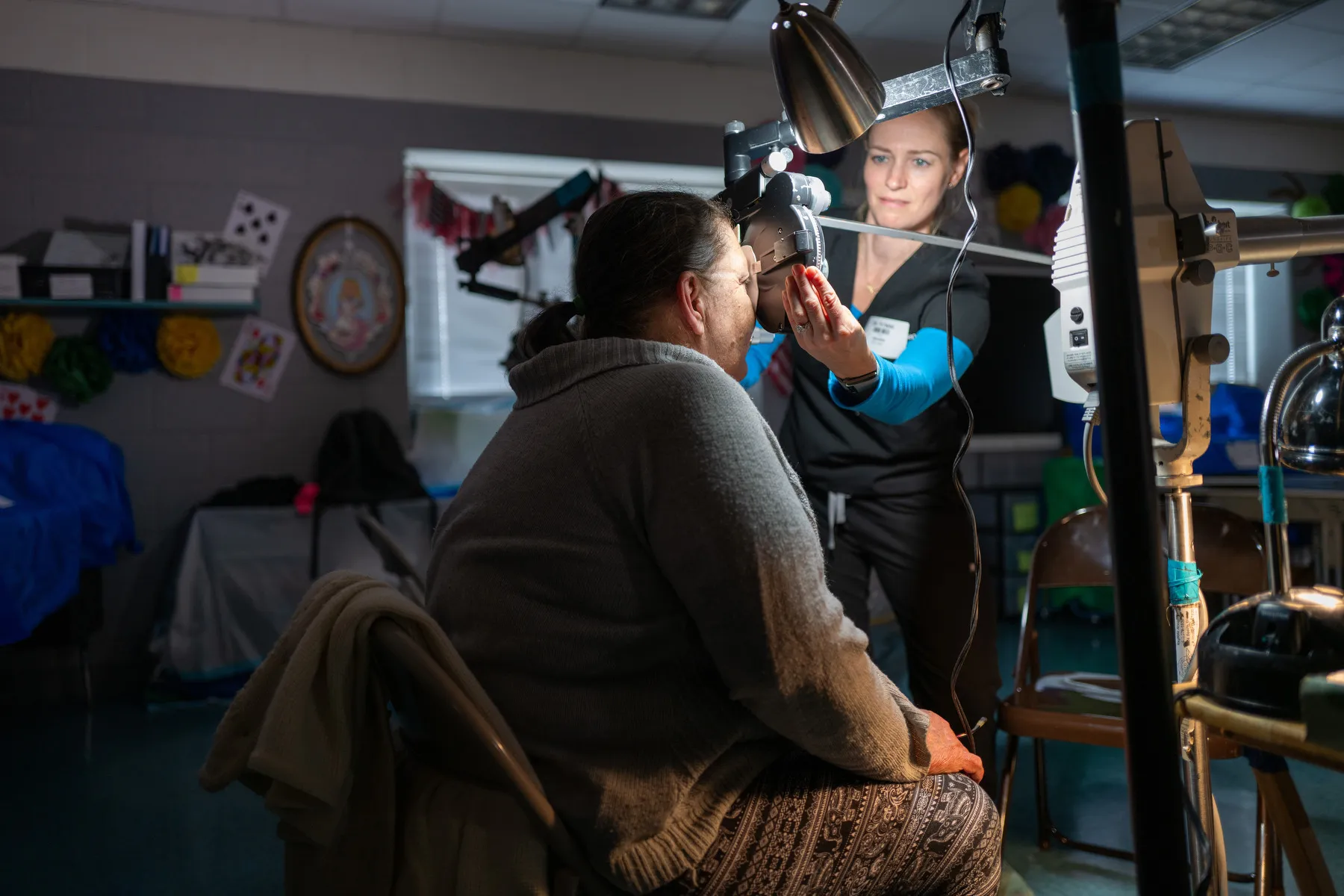
    A patient takes a vision test at a Remote Area Medical (RAM) mobile clinic in Virginia on October 7, 2023. (Spencer Platt/Getty Images)

    Read Amanda Becker’s Loveland connection in her Bio below.

    This story was originally reported by Amanda Becker of The 19th. Meet Amanda and read more of her reporting on gender, politics and policy.

    ________________

    The committee was designed to reduce barriers to care for people of color, LGBTQ+ people and rural Americans.  A new executive order deemed it “unnecessary.”

    President Donald Trump has directed the Centers for Medicare and Medicaid Services (CMS) to disband a committee to identify and reduce systemic barriers that people of color, LGBTQ+ people and rural Americans encounter when trying to access government health care programs.

    The directive came as part of an executive order on “commencing the reduction of the federal bureaucracy.”

    Trump directed the heads of relevant agencies to disband within two weeks entities that include the Health Equity Advisory Committee at CMS, the Advisory Committee on Voluntary Foreign Aid at the U.S. Agency for International Development, the Community Bank Advisory Council at the Federal Deposit Insurance Corporation, and Secretary’s Advisory Committee on Long COVID at the Department of Health and Human Services.

    “It is the policy of my Administration to dramatically reduce the size of the Federal Government,” Trump wrote in the order. “This order commences a reduction in the elements of the Federal bureaucracy that the President has determined are unnecessary.”

    The establishment of the CMS Health Equity Advisory Committee was prompted by an executive order “On Advancing Racial Equity and Support for Underserved Communities Through the Federal Government” that Democratic President Joe Biden signed on his first day in office.

    Xavier Becerra, the head of the Department of Health and Human Services under Biden, published the committee’s charter in July 2024, with the stated goal of making “recommendations on the identification and resolution of systemic barriers in the CMS programs that hinder access and quality for beneficiaries and consumers.”

    The committee’s purview included Medicare, the government health insurance program for the elderly and disabled; Medicaid, the government health insurance program for lower-income Americans; the Children’s Health Insurance Program (CHIP) for children from low-income families; and the marketplace of health insurance programs established by the Affordable Care Act. Its mandate included addressing systemic barriers to access that included structural racism, which Trump labeled a “divisive concept” during his first administration.

    A December 2024 notice in the Federal Register soliciting nominations for committee members said that the panel would, “focus on health disparities in underserved communities … such as but not limited to Black, Latino, and Indigenous and Native American persons, Asian Americans and Pacific Islanders and other persons of color; members of religious minorities; lesbian, gay, bisexual, transgender, and queer persons; persons with disabilities; persons who live in rural areas; and persons otherwise adversely affected by persistent poverty or inequality.”

    Health disparities in underserved communities are well documented, as are disparities in accessing medical care.

    Research shows that Type 2 diabetes, a condition that often worsens with age and requires frequent doctor’s visits, impacts Black and Latinx Americans at higher rates than White Americans. Rates are also higher in rural areas, with Alabama, Kentucky, Georgia and West Virginia reporting some of the highest. An April 2024 CMS report showed that Indigenous and Black Americans in particular faced barriers to accessing care for diabetes and related conditions.

    Non-White Americans with kidney failure are referred for transplants at lower rates and wait longer for them when they are. A November 2024 CMS report showed that rural patients were at a particular disadvantage when trying to access medical care for kidney disease.

    In the first month of his second presidency, Trump has focused on reducing the size of the federal government and dismantling diversity, equity and inclusion (DEI) and accessibility (DEIA) efforts within federal agencies. Civil rights groups on Wednesday sued the Trump administration over a series of DEI-related executive orders, arguing they were unconstitutional because Trump both exceeded his presidential authority and because the orders discriminated against Black and transgender Americans.

    Researchers have warned that the DEI orders are so broad that they could hamper efforts to study race- and gender-identity-related disparities across a variety of subjects, including health care.

    A list of diversity-related words that are allegedly banned from being used by federal agencies has been circulating in Washington. Reuters reported Thursday that some scientists at the Food and Drug Administration (FDA) had been told to stop using the words “woman,” “disabled” and “elderly” in external communications. The White House told the newswire that the agency had misinterpreted Trump’s executive orders.

    Trump said in an interview with Fox News this week that “Medicare, Medicaid, none of that stuff is going to be touched.” Hours later, he endorsed a GOP budget proposal in the House of Representatives that would gut Medicaid funding. A White House spokesperson told Politico that “the Trump administration is committed to protecting Medicare and Medicaid while slashing the waste, fraud, and abuse within those programs.”

  • Senate confirms Project 2025 architect to head OMB

    Senate confirms Project 2025 architect to head OMB

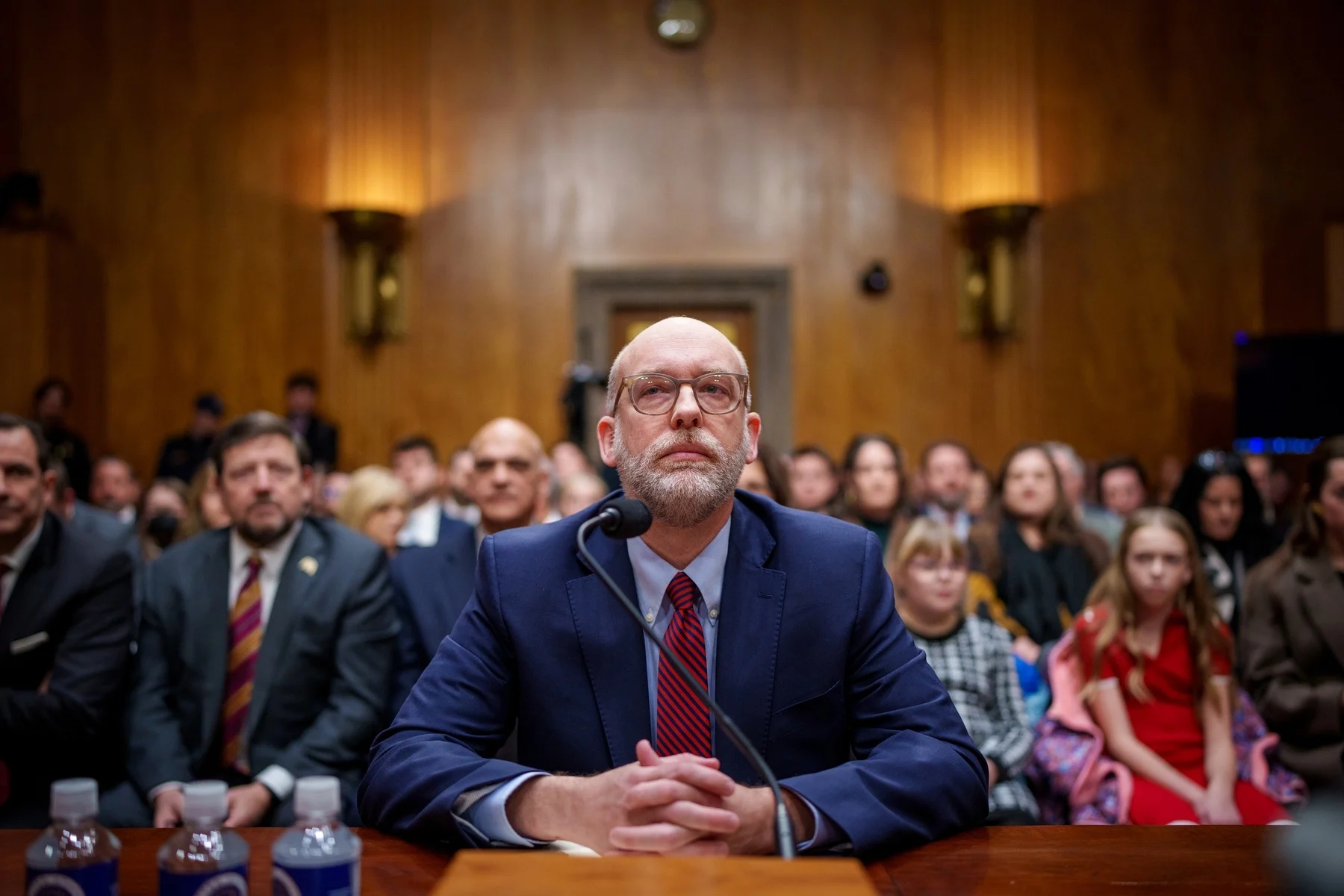
    Russell Vought sees the Office of Management and Budget as a “nerve center” that can be used to curtail DEI programs and purge the federal workforce of Trump’s perceived enemies.

    Read Amanda Becker’s Loveland connection in her Bio below.

    This story was originally reported by Amanda Becker of The 19th. Meet Amanda and read more of her reporting on gender, politics and policy.

    ________________

    The U.S. Senate on Thursday approved Project 2025 architect Russell Vought to lead the Office of Management and Budget (OMB) on a party-line vote after Democrats held the floor overnight in an attempt to delay the confirmation since they did not have the numbers to block it.

    Vought was confirmed by a vote of 53-47.

    For 30 hours, starting on Wednesday afternoon and into Thursday evening, Democrats took turns on the Senate floor to protest Republican President Donald Trump’s nomination of Vought, who also led OMB at the tail end of Trump’s first administration.

    “This is really important, that we raise the alarm as to what is happening,” said Sen. Chris Murphy of Connecticut, who spoke from 2-5 a.m., longer than most of his colleagues.

    During his first stint at OMB, an under-the-radar entity that wields immense influence over the federal government by crafting the president’s budget, Vought helped Trump come up with a plan to jettison job protections for thousands of federal workers and assisted with a legally ambiguous effort to redirect congressionally appropriated foreign aid for Ukraine. In the years since, Vought founded two pro-Trump groups whose work has focused on discrediting structural racism and curtailing diversity, equity and inclusion (DEI) programs. The chapter that Vought wrote for Project 2025 detailed how the budget agency could be used to withhold money appropriated by Congress and eliminate dissent within agencies by purging them of employees.

    Trump said repeatedly during his campaign that he had not read Project 2025 and did not know its authors, though at least 60 percent of its more than 350 contributors were linked to the president. These include appointees and nominees from his first administration, members of his prior transition team and unofficial advisers.

    Project 2025 is a 920-page roadmap from the conservative Heritage Foundation about how Trump’s second administration could use the federal government to enact a far-right Christian agenda. If implemented — and some of the Trump administration’s earliest moves track the blueprint’s objectives — it has the potential to redefine rights long held by all Americans, with disproportionate impacts for women, LGBTQ+ people, people of color and vulnerable populations like the elderly and disabled.

    “What was in Project 2025 that made it so widely hated across the political spectrum? A few things: firing civil servants, weaponizing the Department of Justice and the Federal Bureau of Investigation, unleashing force onto protestors, and targeting political opponents, restricting abortion nationwide, ripping retirement and health care benefits from seniors, dismantling public education,” Sen. Elizabeth Warren said Wednesday evening on the Senate floor in a speech opposing Vought’s nomination.

    Warren noted that Vought has called on Congress to outlaw medication abortion and encouraged discrimination against transgender people in the workplace. She continued: “Now, Donald Trump has named the lead architect of Project 2025, Russ Vought, to oversee the federal government’s entire budget office … to carry out the Republican blueprint to make our government force people to live in the image that Russ Vought and other extremist Republicans approve of.”

    Last week an OMB letter sent by acting director Matthew Vaeth instructing federal agencies to pause “all activities related to obligation or disbursement of all Federal financial assistance” sent shock waves across Washington. The White House moved to quell the backlash. A federal judge earlier this week issued a temporary restraining order, extending a pause on implementing the directive.

    Vought, in an interview with conservative activist Tucker Carlson shortly after Trump’s reelection, discussed how the incoming administration could force federal agencies to “come to heel and do what the president has been telling them to do.” He likened OMB to the “nerve center” through which Trump could ensure his policy directives trickle down through the federal agencies that employ more than 2 million Americans.

    Many of these federal workers received an email last week from the Office of Personnel Management (OPM), which acts as the federal government’s human resources department, with the subject line “Fork in the Road.” The email offered them a chance to opt into a “deferred resignation” program intended to trim the federal workforce and set an acceptance deadline of February 6. Already, federal employees identified as working on DEI programs had received letters notifying them that they were placed on leave and could be fired. Some have sued the administration.

    Labor unions representing federal employees also sued over the resignation offer and deadline, and a federal judge on Thursday blocked OPM from enforcing it. White House press secretary Karoline Leavitt said that about 40,000 workers had already accepted the offer and the White House expected that number to grow. Leavitt said she was not part of discussions about next steps or whether layoffs would follow if enough employees did not resign.

    “Americans need to know that OMB is extremely powerful, with oversight over the president’s budget and functionally all federal agency actions, including regulatory decisions,” Democratic Sen. Mazie Hirono of Hawaii said Thursday.

    “With such responsibility, the person leading this office needs to be level-headed and impartial. They need to put loyalty to the Constitution above loyalty to the President,” she added. “Mr. Vought, however, is the ultimate yes-man.”

    Read Project 25
    [pdf-embedder url=”https://lovelandmagazine.com/wp-content/uploads/2025/02/project-2025.pdf”]

  • You Must Stand Up: The Fight for Abortion Rights in Post-Dobbs America

    You Must Stand Up: The Fight for Abortion Rights in Post-Dobbs America

    “Meticulously researched and compulsively readable, You Must Stand Up documents in searing detail the challenges and horrors of the post-Roe landscape. This is required reading for anyone trying to make sense of our current moment.”

    —Melissa Murray, author of #1 New York Times bestseller The Trump Indictments: The Historic Charging Documents with Commentary

    Loveland, Ohio – Loveland Magazine recently started publishing news stories by Loveland native Amanda Becker. In 2024 Becker released a book titled, You Must Stand Up: The Fight for Abortion Rights in Post-Dobbs America.

    Chapter 12 is set in Ohio.

    Nieman Fellow Amanda Becker provides a real-time portrait of the creative resistance that unfolded in America’s first year without the protections of Roe v. Wade. Amidst daily shifts in health care access, new legal battles coming before partisan courts, and up-for-grabs state constitutions, Becker follows the leaders who rose to meet these challenges – doctors and staffers turning to new financial and medical models to remain open and providing abortions, volunteers who campaigned against antiabortion ballot initiatives, and medical students who fought to learn and provide what can be lifesaving care.

    By depicting the splintered reality of post-Dobbs America, and by capturing how Americans have developed new ways to best protect their constitutional rights, Becker ultimately shows how outrage can beget hope, and give rise to a new movement.

    “You Must Stand Up documents post-Roe America with care and nuance; it’s a necessary book for anyone who cares about the attacks on our bodies. Amanda Becker’s vivid retelling of on-the-ground activism reminds readers not only of what’s at stake—but what it takes to win.”

    —Jessica Valenti, author of New York Times bestseller Sex Object: A Memoir and founder of Abortion, Every Day

    READ SAMPLE

    LISTEN TO SAMPLE

    Get the Audio Book