Tag: #Amazonrainforest

  • Scientists launch ambitious conservation project to save the Amazon/ Covering Climate Now

    Scientists launch ambitious conservation project to save the Amazon/ Covering Climate Now

    Loveland Magazine is one of the 400 news outlets worldwide, with a combined audience of over 2 billion people “Covering Climate Now”, a global journalism initiative committed to bringing more and better coverage to the defining story of our time.
    The initiative, was co-founded by The Nation and Columbia Journalism Review

    Mihaela Manova is “Covering Climate Now” in Loveland, Ohio as an editor for Loveland Magazine


    Butterflies burst into the sky above an Amazonian river. Image © Fernando Lessa / The Nature Conservancy.

    With the Amazon rainforest predicted to be at, or very close to, its disastrous rainforest-to-savanna tipping point, deforestation escalating at a frightening pace, and governments often worsening the problem, the need for action to secure the future of the rainforest has never been more urgent.

    Now, a group of 150 leading scientific and economic experts on the Amazon basin have taken it upon themselves to launch an ambitious conservation project. The newly founded Science Panel for the Amazon (SPA) aims to consolidate scientific research on the Amazon and propose solutions that will secure the region’s future — including the social and economic well-being of its thirty-five-million inhabitants.

    “Never before has there been such a rigorous scientific evaluation on the Amazon,” said Carlos Nobre, the leading Amazon climatologist and one of the chairs of the Scientific Panel. The newly organized SPA, he adds, will model its work on the style of the authoritative reports produced by the UN Intergovernmental Panel on Climate Change (IPCC) in terms of academic diligence and the depth and breadth of analysis and recommendations.

    The Amazon Panel, is funded by the United Nation’s Sustainable Development Solutions Network and supported by prominent political leaders, such as former Colombian President, Juan Manuel Santos and the elected leader of the Coordinator of Indigenous Organizations of the Amazon River Basin, José Gregorio Díaz Mirabal. The SPA plans to publish its first report by April 2021.
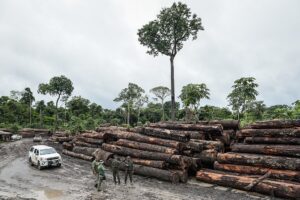
    Timber illegally logged within an indigenous reserve seized by IBAMA, Brazil’s environmental agency, before the election of Jair Bolsonaro. Under the Bolsonaro administration, IBAMA has been largely defunded. Image courtesy of IBAMA.

    Reversing the Amazon Tipping Point

    Over the last five decades, the Amazon rainforest lost almost a fifth of its forest cover, putting the biome on the edge of a dangerous cliff. Studies show that if 3 to 8% more forest cover is lost, then deforestation combined with escalating climate change is likely to cause the Amazon ecosystem to collapse.

    After this point is reached, the lush, biodiverse rainforest will receive too little precipitation to maintain itself and quickly shift from forest into a degraded savanna, causing enormous economic damage across the South American continent, and releasing vast amounts of forest-stored carbon to the atmosphere, further destabilizing the global climate.

    Amazon researchers are now taking a proactive stance to prevent the Amazon Tipping Point: “Our message to political leaders is that there is no time to waste,” Nobre wrote in the SPA’s press release.

    Amid escalating forest loss in the Amazon, propelled by the anti-environmentalist agenda of Brazilian President Jair Bolsonaro, experts fear that this year’s burning season, already underway, may exceed the August 2019 wildfires that shocked the world. Most Amazon basin fires are not natural in cause, but intentionally set, often by land grabbers invading indigenous territories and other conserved lands, and causing massive deforestation.

    “We are burning our own money, resources and biodiversity — it makes no sense,” Sandra Hacon told Mongabay; she is a prominent biologist at the Brazilian biomedical Oswaldo Cruz Foundation and has studied the effects of Amazon forest fires on health. It is expected that air pollution caused by this year’s wildfire’s, when combined with COVID-19 symptoms, will cause severe respiratory impacts across the region.

    Bolivian ecologist Marielos Penã-Claros, notes the far-reaching economic importance of the rainforest: “The deforestation of the Amazon also has a negative effect on the agricultural production of Uruguay or Paraguay, thousands of kilometers away.”

    The climate tipping point, should it be passed, would negatively effect every major stakeholder in the Amazon, likely wrecking the agribusiness and energy production sectors — ironically, the sectors responsible for much of the devastation today.

    “I hope to show evidence to the world of what is happening with land use in the Amazon and alert other governments, as well as state and municipal-level leadership. We have a big challenge ahead, but it’s completely necessary,” said Hacon.

    Cattle ranching is the leading cause of deforestation in the Brazilian Amazon, but researchers say there is enough already degraded land there to support significant cattle expansion without causing further deforestation. The SPA may in its report suggest viable policies for curbing cattle-caused deforestation. Image ©Henrique Manreza / The Nature Conservancy.

    Scientists offer evidence, and also solutions

    Creating a workable blueprint for the sustainable future of the Amazon rainforest is no simple task. The solutions mapped out, according to the Amazon Panel’s scientists, will seek to not only prevent deforestation and curb global climate change, but to generate a new vision and action plan for the Amazon region and its residents — especially, fulfilling development goals via a sustainable standing-forest economy.

    The SPA, Nobre says, will make a critical break with the purely technical approach of the United Nation’s IPCC, which banned policy prescriptions entirely from its reports. In practice, this has meant that while contributing scientists can show the impacts of fossil fuels on the atmosphere, they cannot recommend ending oil subsidies, for example. “We inverted this logic, and the third part of the [SPA] report will be entirely dedicated to searching for policy suggestions,” Nobre says. “We need the forest on its feet, the empowerment of the traditional peoples and solutions on how to reach development goals.”

    Researchers across many academic fields (ranging from climate science and economics to history and meteorology) are collaborating on the SPA Panel, raising hopes that scientific consensus on the Amazon rainforest can be reached, and that conditions for research cooperation will greatly improve.

    Indigenous Munduruku dancers in the Brazilian Amazon. The SPA intends to gather Amazon science and formulate socio-economic solutions in order to make sound recommendations to policymakers. Image by Mauricio Torres / Mongabay.

    SPA participants hope that a thorough scientific analysis of the rainforest’s past, present and future will aid in the formulation of viable public policies designed to preserve the Amazon biome — hopefully leading to scientifically and economically informed political decisions by the governments of Amazonian nations.

    “We are analyzing not only climate but biodiversity, human aspects and preservation beyond the climate issues,” Paulo Artaxo, an atmospheric physicist at the University of São Paulo, told Mongabay.

    Due to the urgency of the COVID-19 pandemic, the initiative’s initial dates for a final report were pushed forward by several months, and a conference in China cancelled entirely. But the 150-strong team is vigorously pushing forward, and the first phase of the project — not publicly available — is expected to be completed by the end of the year.

    The hope on the horizon is that a unified voice from the scientific community will trigger long-lasting positive changes in the Amazon rainforest. “More than ever, we need to hear the voices of the scientists to enable us to understand how to save the Amazon from wanton and unthinking destruction,” said Jeffrey Sachs, the director of the UN Sustainable Development Solutions Network, on the official launch website called The Amazon We Want.

    Banner image: Aerial photo of an Amazon tributary surrounded by rainforest. Image by Rhett A. Butler / Mongabay.

  • Headlines the media has forgotten in 2019

    Headlines the media has forgotten in 2019

    Mihaela Manova

    By: Mihaela Manova

    To begin the year of 2020 with a fresh mindset, we cannot let ourselves fall into the trap of forgetting the world’s most groundbreaking stories in 2019.Throughout last year,  many headlines have come and gone, but the ones that have made people feel have been drastically forgotten by the media and by us, the viewers. So, what has happened to the most important headlines of 2019?


    What happened to the Amazon Rainforest? 

    By googling the question “Is the Amazon Rainforest still on fire?” many posts mentioning the 2019 mass deforestation appear. The last post of any in-depth news article on behalf of the Amazon Rainforest was made October 18, 2019 by USA Today. The article provided a summary of the entire tragedy, when it began and the actions toward stopping it, but no updates on how the rainforest is doing now. The silence surrounding all of the media outlets makes people infer many different outcomes to the tragedy. But is that the best way to know if a tragedy has been helped? 

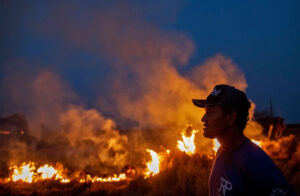
    “A labourer stares at a fire that spread to the farm he work on next to a highway in Nova Santa Helena municipality in northern Mato Grosso State, south in the Amazon basin in Brazil, on August 23, 2019. – Official figures show 78,383 forest fires have been recorded in Brazil this year, the highest number of any year since 2013. Experts say the clearing of land during the months-long dry season to make way for crops or grazing has aggravated the problem. More than half of the fires are in the Amazon.” – The Atlantic 2019 (Photo by Joao LAET / AFP) (Photo credit should read JOAO LAET/AFP/Getty Images)

    The Rainforest Alliance is an organization that redirected 100% of their donations to helping out the rainforest. From their websites “impact dashboard” they have collected over $190,000,000 through their initiatives. Others like G7 (world’s seven largest economies) have come up with $22 million while global warming activists like Leonardo DiCaprio has pledged $5 million in restoration. The Warner Music Group and One Tree Planted collaboration ended up with 100,000 trees planted in help for the salvation of the Amazon Rainforest. More likely, in 2020 the rainforest will be starting to get rebuilt, and even though it will take time for the trees to grow in that region, this region won’t be left to be forgotten by the many organizations that have dedicated their time for this cause.  

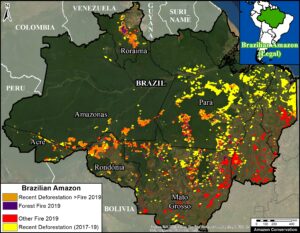
    The Brazilian wildfires in a more geographical perspective. Source: MAAP

    What about the crisis in Sudan? 

    The crisis in Sudan was one of the most talked about movements on social media during the summer in 2019. With over thousands of posts with the hashtag #Sudan or #HelpSudan, many people were witnesses to a war driven country and the aftermath to all of the fleeing families. One of the most reposted images reads, “There is a massacre happening in Sudan right now and the world is silent. The world is silent and this breaks my heart.” According to Refinery21 in June, “People in the Western world are finally sitting up and taking note of the political chaos in Sudan, which reached new levels of severity this week.”

    Following that statement, Refinery21 reports that there were more than 100 killings and 70 rapes during a single attack in the countries capital Khartoum as well as “bloated bodies” being dragged from the Nile river. 

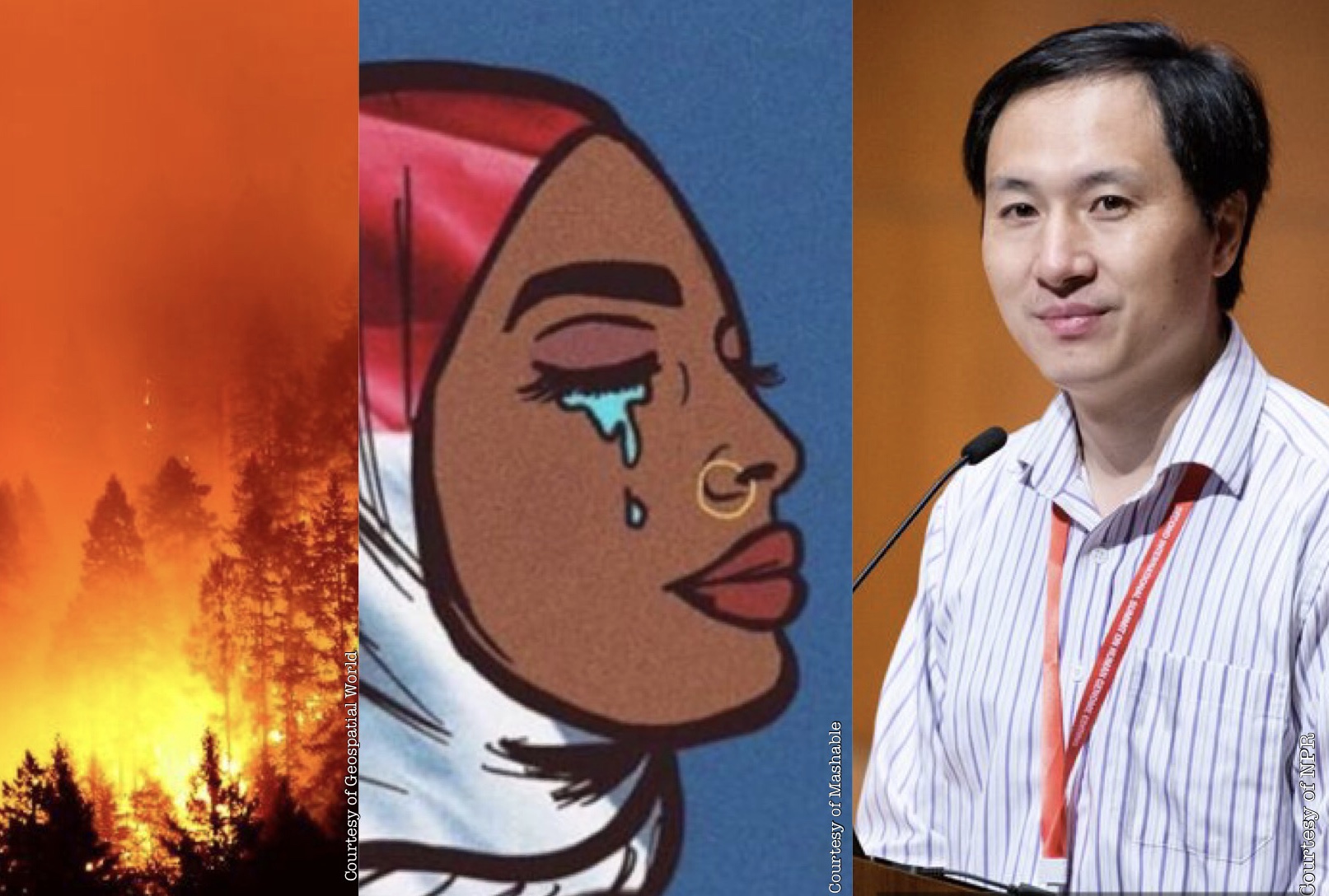
    (Source: Instagram) Images from artists across Instagram were spread to advocate for solidarity and awareness for Sudan due to some media outlets being silent.

    The root of the problem was a conflict “between pro-democracy civilians and the country’s security forces.” On December 28, 2019, VOA News reports that the Sudanese government and the nine rebel groups signed an agreement on beginning to end the bloody conflict in the Darfur region. They are looking forward to making a lasting peace in the region and as well as that there is “fresh hope for peace after Sudan’s transitional government, led by Prime Minister Abdalla Hamdok, (who) made peace in these areas a priority.”

    A look into how Instagram looked like in June 2019. Many users were supporting the cause by setting their profile photos to this signature blue color. (Source: The Atlantic)

    Organizations like Unicef were devoted and led campaigns to receive money for aiding the country’s children in vaccinations, clothes, food, and shelter. While the crisis was going on, Instagram users put their profile picture images in dark blue to advocate for the crisis in Sudan and to give attention to others who may browse and question the high numbers of dark blue profiles until they saw the movement for themselves.  


    What happened to the CRISPR scientists?

    Back in late 2018, new information was revealed about genetically modified baby embryos in resisting infection from the AIDS virus. Around sixteen scientists pioneered the research and one of them claimed to help make the first genetically modified babies. His name was He Jiankui. In 2019, his disappearance has sparked many questions into what has happened to this particular scientist. According to Science Alert’s article, they said that “He has not been seen publicly since January, his work has not been published and nothing is known about the health of the babies.” 


    In Science Alert’s article, they stated about all that is known in this situation. They began with his last appearance which was on the balcony of an apartment at his university. (The university that he worked in actually fired him after his work was known). Armed guards supposedly took He away and was no longer seen, but a lot of mystery surrounds this case because of the quietness of his family, coworkers, and even media relations person. Science Alert also mentions that the Chinese investigation confirmed the existence of the twin girls whose DNA He altered. 

    News outlets are continuing with their talk about CRISPR but no other updates have been made on He Jiankui. (Source: REUTERS)

    The twins and the other people involved in the second pregnancy were monitored by the Chinese government’s health departments. From the second pregnancy there was a third child, who is also monitored but no information has been given out about it. One of the reasons why the case was seriously broken down was that CRISPR gene alterations are actually made to be passed down in generations contrary to other genetic modifications.


    As 2019 showed us many different headlines that made us feel, think, and observe, we need to take a step back from the constant overflow of new information. As the media’s job is to provide relevant topics and not to dwell on things that have already passed, the problem is that the tragedies get discarded in the back of the viewers’ brains until the next one comes along. In the end, the media and the viewers need to work together to update and resolve these issues, because when we hear about new calamities every single day it only makes us portray the world as 100% worse than the reality.