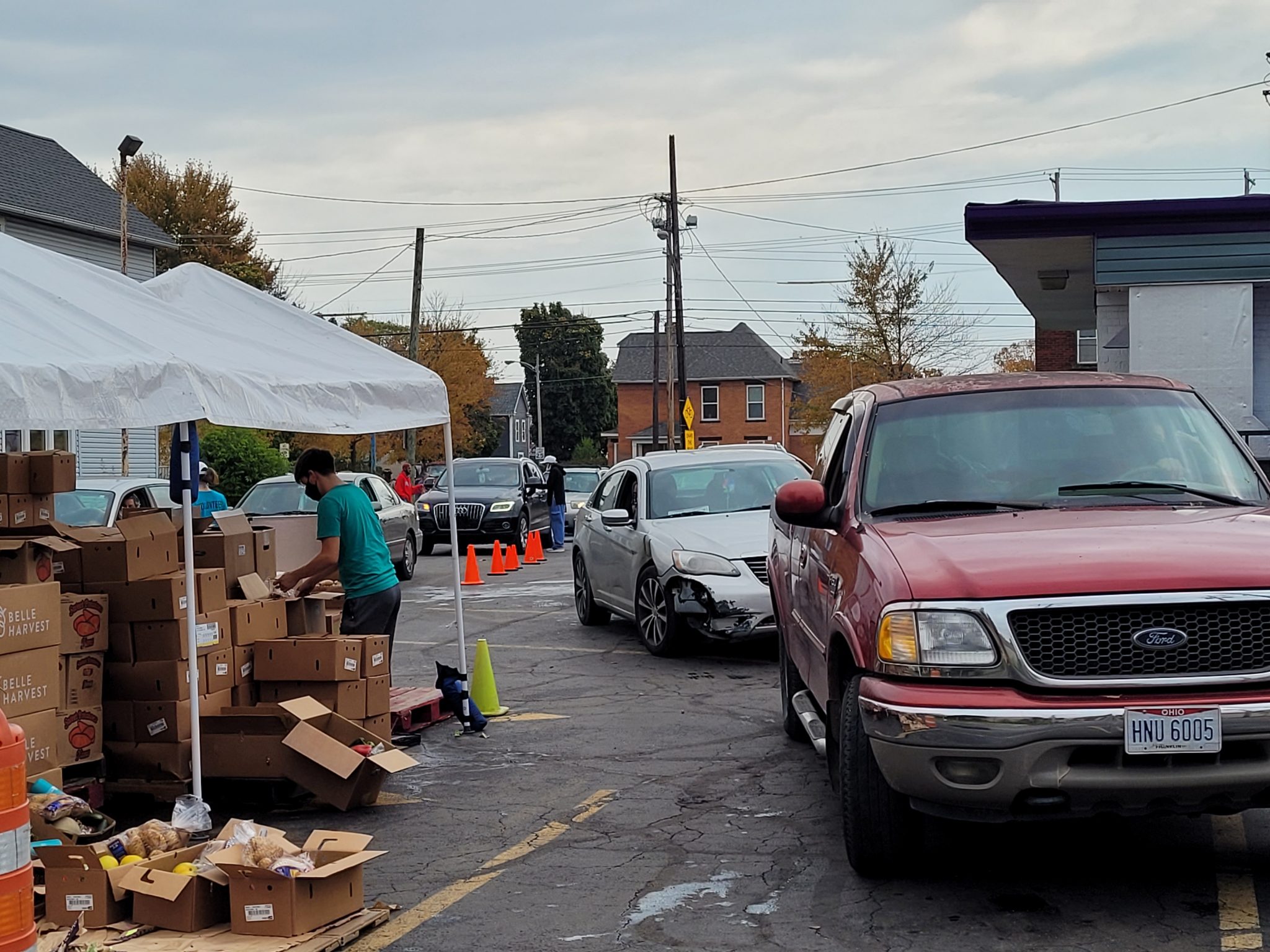
Two lines of cars wait for food assistance at the All People’s Fresh Market in Columbus. Photo by Marty Schladen, Ohio Capital Journal.
Nearly a quarter-million Ohio drivers have taken advantage of a program started at the end of 2020 that is intended to reduce license-reinstatement fees or waive them altogether, the Ohio Poverty Law Center said Monday.
The group released an analysis of the amnesty program, a bipartisan measure passed by the legislature. It found that nearly 223,000 drivers have participated and saved more than $136 million, with an average individual savings of $612.
“The program has provided a lot of relief from the financial barriers that prevent hundreds of thousands of lower-income Ohioans from driving legally,” Zack Eckles of the poverty law center said during a virtual press conference. “Driving is essential for economic participation in the state of Ohio.”
Suspensions stemming from driving under the influence of alcohol, drugs or with deadly weapons are not eligible for the amnesty. Instead, the program is aimed at people who just don’t have the funds to pay the fees to reinstate their licenses after being suspended for offenses such as driving with no proof of insurance.
“Although reinstatement fees are distinct from punitive fines, they have many characteristics of a fine,” the report said. “For example, they vary by the type of offense or increase in amount for repeated offenses, and they can be extremely burdensome. One particularly punitive reinstatement fee is for non-compliance suspensions, which occur when a driver does not show proof of insurance at a traffic stop or at the time of an accident. These non-compliance suspensions carry reinstatement fees of $100 for the first offense, $300 for the second offense, and $600 for the third and any subsequent offenses within a five-year period.”
To help ensure that only people who can’t afford reinstatement fees get reductions, the program requires that suspended drivers wait 18 months after at least one of their suspensions expire before they’re eligible. Presumably, people who can afford to pay won’t wait that long, but Eckles faulted the rule for holding those without funds “hostage” for 18 months before they can clear their fees and drive legally.
People eligible for Medicaid, Supplemental Security Income, Ohio Workers First, Supplemental Nutrition Assistance or the VA Pension Benefit are eligible to have their reinstatement fees canceled and don’t have to wait 18 months because their eligibility for those programs demonstrates their financial need. However, Ohioans eligible for the waiver made up only about 5% of those who have participated in the amnesty program.
Benefits of the amnesty extend well beyond making it easier for huge numbers of Ohioans to drive legally to work, school, medical appointments and the grocery store.
Of the drivers applying for fee reductions, 85% paid their fees in full, paying $23 million to the Bureau of Motor Vehicles that it otherwise likely wouldn’t have collected. And, with an estimated 75% of those with suspended licenses continuing to drive illegally, the amnesty program probably has greatly reduced the number of uninsured drivers because participants have to furnish proof of insurance to participate.
But even though nearly a quarter-million Ohioans participated in the program, that’s only a third of 748,000 that the BMV notified that they were eligible.
That has implications beyond increasing the number of legal drivers on Ohio roadways. The Legal Aid Society of Cleveland last year estimated that about 1 million Ohioans have debt-related license suspensions. With Ohio’s heavily gerrymandered legislature passing one of the strictest voter ID laws in the country, that could have a huge impact in a state with about 8 million registered voters.
To improve participation in the amnesty program, the Ohio Poverty Law center made three recommendations:
- Standardize reinstatement fees at $25
- Eliminate suspensions strictly resulting from unpaid fines and fees. “Driver’s license suspensions should only be imposed for dangerous driving, not for a person’s inability to pay a fee,” the report said.
- Expand the program so that all 14% of Ohioans living in poverty are eligible for full waivers
______________________________
 MARTY SCHLADEN