Tag: anti-abortion lobby

  • Ohio abortion rights amendment a go for November ballot

    Ohio abortion rights amendment a go for November ballot

    495,938 valid signatures certified to bring proposal to Ohio voters

    BY:  Ohio Capital Journal

    An abortion rights amendment proposed for the Ohio Constitution was certified on Tuesday to go forward for consideration by voters in November as nearly 500,000 signatures in support were verified by the Secretary of State’s office.

    In a letter to the campaign that collected signatures to put the ballot measure to Ohioans this year, Secretary of State Frank LaRose said 495,938 valid signatures were recorded, and a total of 55 counties fulfilled the percentage requirements for verification.

    “Therefore, in the absence of judicial direction to the contrary, I will direct the boards of election to place the proposed amendment on the November 7, 2023, general election ballot,” LaRose wrote.

    When advocates turned their boxes of signatures in to the secretary of state’s office on the July 5 deadline, they reported more than 700,000 signatures were submitted to be verified statewide.

    Despite the lower number, the final tally is well above Ohio’s legal requirements to put an amendment proposal on the ballot.

    Based on current law, abortion rights advocates needed to collect 413,487 signatures in 44 of 88 counties, a number based on election results from the last governor’s race.

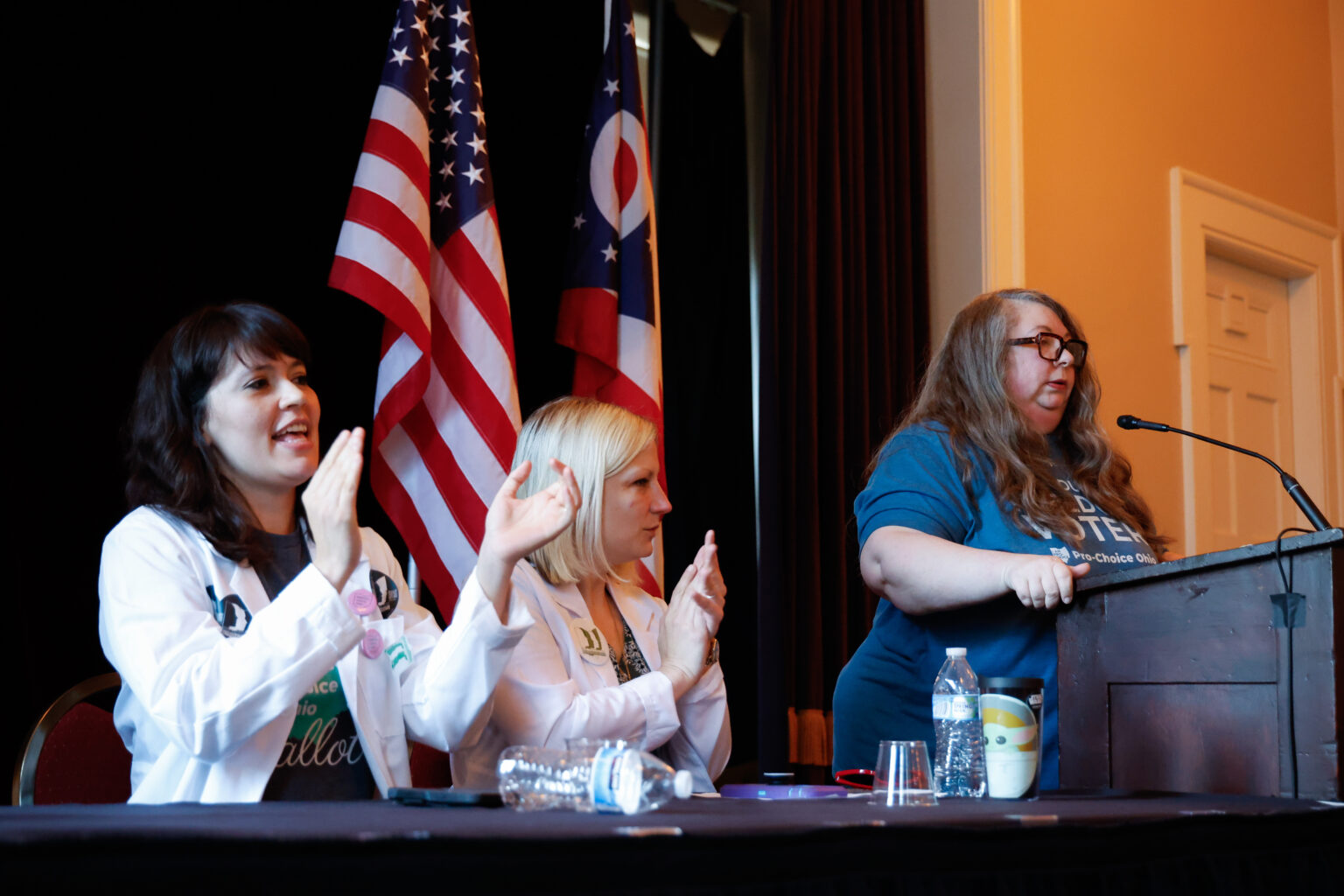
    Ohioans United for Reproductive Rights (OURR), a coalition of groups supporting the the codification of abortion rights in the state constitution, celebrated the news, but also set their sights on another hurdle at the ballot: Issue 1, hitting voters next month in the August 8 primary.

    Issue 1 would make it harder for Ohio voters to amend the constitution by raising the threshold from a simple majority to 60%. If passed, Issue 1 would require the abortion ballot measure to meet that threshold.

    It would also require proposals made after January 1, 2024, to meet signature requirements in all 88 counties instead of the current requirement of 44 counties.

    “Now that the petition drive is complete, we’re eager to continue the campaign to enshrine those rights in Ohio’s constitution and ensure that Ohioans will never again be subject to draconian reproductive health care policies imposed by extremists,” wrote Lauren Blauvelt and Dr. Lauren Beene, executive committee members for the OURR, in a statement.

    “This is a major step for Ohio, but it’s bigger than just one state,” said Kimberly Inez McGuire, executive director for Unite for Reproductive and Gender Equity. “This is about reversing the tide of abortion bans and securing a better future for us all.”

    GOP leaders including LaRose have admitted Issue 1 supporters are motivated by their desire to stop the abortion rights amendment.

    The campaign standing in opposition to the abortion amendment, Protect Women Ohio, and anti-abortion lobby Ohio Right to Life, decried the new development, pushing ahead with their efforts to block the amendment from passage.

    Peter Range, CEO of Ohio Right to Life, called the amendment “anti-life,” and said it is “even more imperative that every pro-life Ohioan votes yes on Issue 1 this August to ensure that our constitution, our preborn and our families are protected,” according to a statement sent by the group.

    Protect Women Ohio said they have spent “an initial” $8 million on TV, radio and digital ads in support of Issue 1, and against the November abortion amendment.

    With the amendment now allowed to go to the ballot, the Ohio Ballot Board chaired by LaRose will draft the language voters will read about the measure on their ballots.

    Recent polls show 57.6% of Ohioans support the abortion rights amendment, while 32.4% oppose it and 10% are undecided. On the Aug. 8 Issue 1 effort to change the threshold for passage of amendments from 50% to 60%, another recent poll showed 57.2% of Ohioans oppose Issue 1, while 26% support it, and 17% are undecided.


    Susan Tebben
    SUSAN TEBBEN

    Susan Tebben is an award-winning journalist with a decade of experience covering Ohio news, including courts and crime, Appalachian social issues, government, education, diversity and culture. She has worked for The Newark Advocate, The Glasgow (KY) Daily Times, The Athens Messenger, and WOUB Public Media. She has also had work featured on National Public Radio.

    MORE FROM AUTHOR

    ____________________

    Related Loveland Magazine Interview:

  • Federal redistricting lawsuit filed as notice of impasse hits Ohio Supreme Court

    Federal redistricting lawsuit filed as notice of impasse hits Ohio Supreme Court

    Photo by Getty Image

    BY: SUSAN TEBBEN – Ohio Capital Journal

    Update: The ACLU filed a request with the Ohio Supreme Court to ask for the Ohio Redistricting Commission’s reasoning behind deciding not to file new legislative redistricting maps by the February 17 deadline. Details below:

    The leader of an anti-abortion lobby and other Ohio citizens are suing the Ohio Redistricting Commission and the Secretary of State, accusing them of depriving them of rights under the U.S. Constitution.

    Attorneys from the Columbus firm of Isaac Wiles & Burkholder, LLC, asked the U.S. District Court for the Southern District of Ohio to declare current legislative districts “or lack thereof” in violation of the U.S. Constitution, and to adopt the last plan the ORC approved. That plan, a revision of the first plan struck down by the Ohio Supreme Court, was also struck down by the high court.

    Though not members of the lawsuit in their official capacities, several of the plaintiffs are leaders or staff at Ohio Right to Life, a lobby group who works on anti-abortion measures throughout the state.

    Mike Gonidakis, president of Ohio Right to Life, is the lead plaintiff in the case, along with Mary Parker, OR2L’s director of legislative affairs. Also listed in the lawsuit is Margaret Conditt, who is on the lobby’s website as a “member trustee.”

    Beth Vanderkooi, another plaintiff in the case, is the executive director of Greater Columbus Right to Life, and Ducia Hamm was previously listed as associate director of affiliate services for Heartbeat International, and religious anti-abortion organization.

    After declaring two rounds of previous maps unconstitutional gerrymanders, the state supreme court sent the commission back to work with a Feb. 17 deadline, which the ORC passed by without adopting new maps.

    Ohio’s state legislative districts are not “substantially similar in population,” according to the lawsuit.

    With Thursday’s “impasse” of the Ohio Redistricting Commission members, the plaintiffs in the lawsuit say they “are cut out of the political process.”

    “Either the 2010 legislative districts apply and their votes are diluted by the population growth reflected in the 2020 U.S. Census data,” the lawsuit stated. “Or alternatively, they are not members of any state legislative district and cannot vote for state house of representatives or senate candidates.”

    The commission filed their notice of impasse on Friday, laying out the commission’s actions and non-actions from Feb. 7, when the supreme court invalidated the ORC revised General Assembly plan, until Thursday, when no map was approved.

    “Among other discussion, (Senate) President (Matt) Huffman stated that the commission was at an impasse, as the commission is unable to ascertain and determine a plan that complies with the court’s order and the Ohio Constitution,” the notice, written by the Ohio Attorney General’s Office, informed the supreme court.

    The federal lawsuit filed late Thursday cites the 2020 census, which showed a net gain of more than 250,000 Ohioans over the last 10 years.

    Because “valid redistricting” has yet to occur, the plaintiffs say they can’t decide on candidates to support, make a decision to run for office or “educate themselves or others on the positions of candidates in their districts and prepare to hold those candidates responsible.”

    Gonidakis and the other Ohioans acknowledged that a nearly five-month legal battle on legislative redistricting is unlikely to have a resolution before the voter registration deadline of April 4 for the May primary, which is why they requested the use of a previous map for the primary.

    The parties in the lawsuit said they chose the previously submitted maps, maps adopted without bipartisan support and called unconstitutional by the supreme court, because they “properly distribute voting power and are based on 2020 census data.”

    They worry if elections were allowed to take place before the redistricting process is resulted, overpopulated districts could see vote dilution, and thus a “deprivation of political power and resources.”

    A lack of districts deprives Ohioans of the right to vote, in violation of the U.S. Constitution and fundamental rights of Americans, the lawsuit states.

    “There is no harm in the Redistricting Commission following the U.S. Constitution and plaintiffs receiving the right to vote,” according to the lawsuit.

    The court challengers ask that a three-judge panel be assigned to the case to keep the ORC and the Secretary of State from “acting on their behalf” and implementing, enforcing or conducting elections under the current state of redistricting.

    The lawsuit also asks the court to establish a schedule “to adopt a timely enacted and lawful plan and implement the new plan for Ohio’s state legislative districts.”

    The lawsuit does not allege racial gerrymandering or any vote dilution based on racial discrimination, which the U.S. Supreme Court has set as a standard for taking any redistricting cases.

    Senate President Matt Huffman, a member of the Ohio Redistricting Commission, accused Democrats of drawing maps to favor Dems while using racial gerrymandering. The Dems were the only ones to propose a map at Thursday’s meeting of the commission, and it was voted down along party lines after a lengthy dissection, mainly by Huffman.

    This is the second federal lawsuit to be filed regarding redistricting in Ohio. In December, a pair of Mahoning County residents sued accusing the ORC of discriminating against Black voters in legislative and congressional district lines.

    That lawsuit was put on hold after district lines were invalidated, and is still awaiting court decisions on maps before proceeding.

    Court challengers asks for impasse reasoning

    On Friday, attorneys for the League of Women Voters and other court challengers asked the court to order the commission to explain their “bald refusal” to abide by the February 7 court order.

    “What steps the commission itself undertook to comply with the court’s order – and why there could be no possible plan to comply with the (state) constitution – remain shrouded in generalities,” wrote Freda Levenson, attorney for the ACLU, in a Friday filing with the supreme court.

    Levenson called out Governor Mike DeWine’s comments after the commission adjourned without a map, in which he said it was a “mistake for this commission to stop and basically say that we’re at an impasse,” and that the choice was “not an option that the law gives us.”

    The notice of impasse “provides no concrete statement of any reason why a more proportionate plan could not be enacted,” according to court challengers, and provides no no explanation of steps taken to draw a compliant plan.

    “It provides a bare conclusion, as if it were sufficient to justify the refusal to comply with this court’s order,” the court document stated.

    Levenson asked that the court order the commission to file evidence by February 22 that “must concretely identify why a compliant plan could not be drawn” and specific reasons why the commission did not consider other plans. The court document also asked for a position from the court on whether it can order an extension of the candidate filing deadline for the May primary.