Tag: anti-abortion

  • The race for Ohio’s 2nd U.S. Congressional District features two political newcomers

    The race for Ohio’s 2nd U.S. Congressional District features two political newcomers

    Republican Rep. Brad Wenstrup currently represents the 2nd Congressional District, but he announced that he would not seek reelection in 2024

    Democrat Samantha Meadows is going up against Republican David Taylor and neither candidate has held office before.
    By: Ohio Capital Journal

    A political newcomer will represent Ohio’s 2nd U.S. Congressional District starting in 2025.

    Democrat Samantha Meadows is going up against Republican David Taylor and neither candidate has held office before.

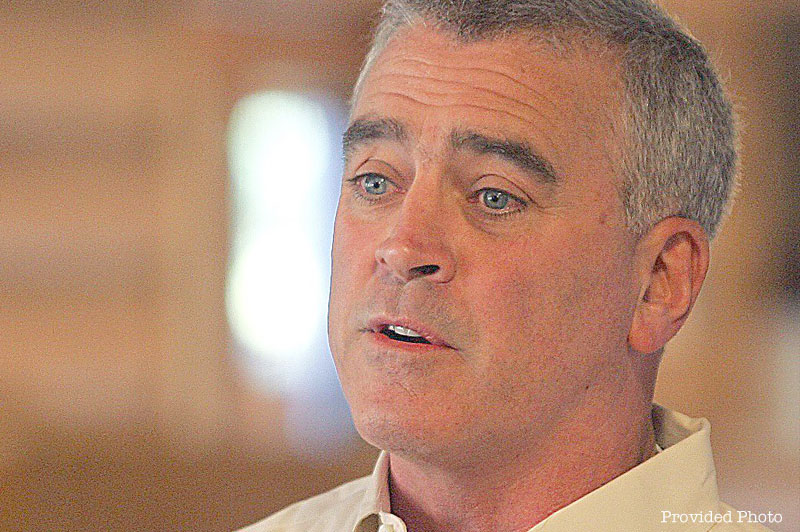
    Republican Rep. Brad Wenstrup

    Republican Rep. Brad Wenstrup currently represents the 2nd Congressional District, but he announced at the end of last year that he would not seek reelection in 2024 after serving six terms.

    The 2nd Congressional District covers 15 southern Ohio counties: Clermont, Clinton, Pike, Adams, Brown, Highland, Ross, Scioto, Pickaway, Hocking, Vinton, Jackson, Lawrence, Gallia, and Meigs counties, and part of Fayette County.

    The 2nd Congressional District historically leans Republican and President Donald Trump won in all of those counties during the 2020 election.

    Meadows

    This is Meadows’ second time running for the 2nd congressional district. She lost against Wenstrup in 2022 — receiving only 25% of the vote — but she thinks her odds of winning have increased since Wenstrup is retiring.

    “I am beating down doors …  I’m doing everything that I can to let people know that I, personally, as a candidate, care about them,” she said.

    Meadows doesn’t feel intimidated running as a Democrat in Republican-dominated counties.

     Democrat Samantha Meadows is running for Ohio’s second congressional district. (Headshot provided.) 

    “I know that a lot of folks down here are Republicans by anger rather than policy,” she said. “I have faith in our region that, no, this isn’t about Republican or Democrat. This is actually about a person that’s going to help us.”

    She grew up in McDermott in Scioto County, attended Shawnee State University and Ohio Christian University and went on to work as an EMT.

    “I’ve always felt compelled to be of service to my community,” she said. “… I always felt compelled to help others.”

    Through her work as an EMT, Meadows has seen firsthand the devastation of the opioid epidemic and she remembers the first Oxycontin overdose patient she helped treat. They administered Narcan and were able to revive the patient.

    “At that time, this was new to us,” she said.

    That same patient overdosed again a couple weeks later, but didn’t make it this time.

    “Addiction was one of the catalysts that made me run for office,” she said.  “Everybody knows somebody that’s either addicted or a family that’s going through those things.”

    Meadows said she never had any aspirations to be in politics, but decided she had to do something when she saw drug overdoses increase during COVID-19.

    “I had a moment where I literally looked at the TV and said, somebody’s got to do something about this. And so I was like, I’ll do it,” she said.

    Taylor

    Wenstrup retiring, how most of the 2nd District is Appalachian and “the laundry list of national crises we have going on both inside and outside our borders” is what led to Taylor to run for office.

    “The needs of the Appalachian community has been something that’s been in the front of my mind my whole life,” he said. “The opportunity to see this overlooked, underserved community that is the 2nd District of Ohio get the attention it deserves is what compelled me to get into politics.”

    Taylor had to endure a competitive primary against ten other Republicans — including state Sens. Shane Wilkin and Niraj Antani — to get on the November ballot. Taylor came out on top with 25% of the vote.

     Republican David Taylor is running for Ohio’s second congressional district. (Photo provided by Taylor’s campaign.) 

    “People don’t want career politicians right now,” he said. “They want somebody from the outside. I think actually, for the voters in the 2nd District, not being a person with a political background was actually a plus.”

    Even though the second district leans Republican, Taylor said he is treating the race as if the district was split 50-50 and has been traveling the district to meet people.

    “We’re running the tires off my pickup truck and going to all corners of the district,” he said.

    Taylor has lived a majority of his life in Clermont County, graduated from Miami University and the University of Dayton School of Law and worked for a prosecutor’s office.

    “In criminal law, you’re getting to the nitty gritty on every word in the law, because sometimes somebody’s freedom is at stake,” Taylor said. “So that will serve well in dealing with the legislation that’s written and passed or repealed.”

    He now owns his own concrete business Sardinia Ready Mix and said his experience of operating within a budget could help him in D.C.

    “Those are things that the government could use a large dose of so more people with that mindset, I think, would lead to better outcomes in Washington, D.C. and those returns come here to Ohio, specifically the second district,” he said.

    On the issues

    Taylor wants to defund and dismantle the U.S. Department of Education.

    “It’s another federal agency that overreaches the federal government’s mandate under the Tenth Amendment,” he said. “We have so many federal bureaucracies that are overstepping the mandate of the Constitution.”

    Meadows wants to better fund public schools.

    “We don’t have enough private schools in our district to take on an influx of public school kids,” Meadows said, referring to the voucher program.

    Meadows wants to protect reproductive rights.

    “The ability to have body autonomy and make our own decisions, that is absolutely terrifying that we don’t have that type of freedom, or that we’re trying to be denied that kind of freedom,” she said.

    Taylor is anti-abortion, but doesn’t support a total ban on abortion.

    “The issue is going to be a state issue from state to state, and that’s where it needs to stay,” he said.

    Both candidates support the Second Amendment.

    “But I also believe at the very least, we need to have a moratorium on the sale of assault rifles,” Meadows said. “I do believe that they are not necessary in the hands of an average American. They belong on the battlefield.”

    Taylor said he would fight against infringements on the Second Amendment.

    “Every time you have one of these incidents that causes (people) to call for gun control, multiple laws have been broken, so I’m not sure what law they think can be written that’s going to stop that,” Taylor said.

    Follow OCJ Reporter Megan Henry on Twitter.


    Megan Henry
    Megan Henry

    Megan Henry is a reporter for the Ohio Capital Journal and has spent the past five years reporting in Ohio on various topics including education, healthcare, business and crime. She previously worked at The Columbus Dispatch, part of the USA Today Network.

    Ohio Capital Journal is part of States Newsroom, the nation’s largest state-focused nonprofit news organization.

    MORE FROM AUTHOR

  • Ohio Issue 1: Attacks on parental rights do not appear in amendment

    Ohio Issue 1: Attacks on parental rights do not appear in amendment

    BY:  Ohio Capital Journal

    Editor’s Note: This article is part of a series looking at the language of Ohio Issue 1 and the reproductive rights it would impact. The full language of the amendment can be found here.

    __________

    The topic of parental rights does not appear in Ohio Issue 1 on the ballot Nov. 7.

    There is no mention of denying any rights to parents in the process of enshrining reproductive rights like abortion, contraception, miscarriage care and infertility treatment into the Ohio Constitution.

    “I don’t think Issue 1 would affect parent’s rights at all,” said Tracy Thomas, the Seiberling Chair for Constitutional Law and director of the University of Akron’s Center for Constitutional Law.

    Having studied reproductive rights cases in Ohio and nationwide, including the Dobbs case that overturned Roe v. Wade, Thomas said historically, “parental rights have consistently been retained.”

    “I would expect that those (rights) can all stay consistent,” Thomas told the Capital Journal.

    Ohio Attorney General Dave Yost also acknowledged that previous abortion rights court cases have upheld parental consent in a legal analysis of Issue 1 he released in early October.

    Yost went on to say “the amendment does not specifically address parental consent.”

    But, Yost argued, that consent “would certainly be challenged on the basis that Issue 1 gives abortion rights to any pregnant ‘individual,’ not just to a ‘woman.’”

    The term “individual” is currently used 36 times in the Ohio Constitution, including in the definition of “health care system,” the eligibility of officeholders, and clauses on temporary housing and corporate property.

    Only one use of the word “individual” is connected to a gender specifier: the constitutional language on marriage status “only one man and one woman” can be in a marriage “valid or recognized by this state,” and “relationships of unmarried individuals” can not hold the same legal status.

     COLUMBUS, Ohio — OCTOBER 06: Sister Amor of the Bridgettine Sisters of Columbus holds a sign on High Street during the Ohio March for Life against November’s Issue 1 reproductive rights amendment, October 6, 2023, outside the Statehouse in Columbus, Ohio. (Photo by Graham Stokes for Ohio Capital Journal. Republish photo only with original article.) 

    Still, Religious lobbies and anti-abortion rights groups that oppose the amendment have used that message as one of their primary arguments against the measure since the effort to get it on the ballot began.

    In a new ad for the Issue 1 opposition group Protect Women Ohio, a coalition including Ohio Right to Life and other anti-abortion rights groups, Gov. Mike DeWine and First Lady Fran DeWine feature as leaders against the measure.

    Fran DeWine is shown in the ad saying Issue 1 “would deny parents the right to be involved when their daughter is making the most important decision of her life.”

    Gov. DeWine admits in the ad that Ohioans “are divided on the issue of abortion,” but calls Issue 1 “not right for Ohio.”

    The Catholic Conference of Ohio pointed to the first line of the proposed amendment and the word “individual,” saying the use of the word would allow anyone under age 18 to “have an abortion, or make any reproductive decision without their parents’ consent or notification.”

    State Sen. Kristina Roegner, R-Hudson, the sponsor of the six-week abortion ban law that is currently on hold as court cases determine its fate, co-sponsored a resolution in the Ohio Senate on Oct. 11 officially standing against Issue 1.

    In opposing Issue 1, she said the measure was “extreme, nefarious” and would “harm women and take away parental rights.”

    The resolution passed with the GOP majority unanimously approving it. The seven Democratic senators all voted against the measure.

    The resolution itself proclaims “parents are the ultimate arbiter of what is best for their children.”

    In one paragraph of the resolution, sponsors Roegner and state Sen. Michele Reynolds, R-Canal Winchester, write that Issue 1 “will eliminate many, if not all, state laws regarding abortion,” including “parental notification requirements.”

    In the next paragraph, the resolution states Issue 1 “may” eliminate parental rights.

    Senate Minority Leader Nickie Antonio, D-Lakewood, pushed back against the resolution by bringing up a decade-old legal process present in Ohio called “judicial bypass.”

    Judicial bypass, as it stands now, has been around since 2012 in the state, after then-Gov. John Kasich signed a law that prohibits forcing a minor to have an abortion, but leaves in place a legal way for minors to petition juvenile court to bypass parental consent.

    The Ohio Supreme Court explained the process in Rule 23 of a 2015 amendment to its “rules of superintendence,” an internal operations document for all Ohio courts.

    The legal method uses the court system to allow underage individuals to make decisions for themselves where parental consent would typically be necessary, such as in cases of abuse.

    “If the court finds by clear and convincing evidence that the minor is sufficiently mature and well enough informed to decide intelligently whether to have an abortion, the court shall grant the petition and permit the minor to consent to the abortion,” the law states.


    Read Part 1 and 2…


    Susan Tebben
    SUSAN TEBBEN

    Susan Tebben is an award-winning journalist with a decade of experience covering Ohio news, including courts and crime, Appalachian social issues, government, education, diversity and culture. She has worked for The Newark Advocate, The Glasgow (KY) Daily Times, The Athens Messenger, and WOUB Public Media. She has also had work featured on National Public Radio.

    MORE FROM AUTHOR

  • Access to expensive fertility treatment in Ohio varies but the Issue 1 amendment seeks to protect it

    Access to expensive fertility treatment in Ohio varies but the Issue 1 amendment seeks to protect it

    BY:  Ohio Capital Journal

    Editor’s Note: This article is part of a series looking at the language of Ohio Issue 1 and the reproductive rights it would impact. The full language of the amendment can be found here.

    When Roe v. Wade was overturned in June 2022, the physicians at Ohio Reproductive Medicine took to their website, hoping to reassure patients that their care would still be available.

    “It is truly hard to fathom that in 2022, our reproductive freedom, a fundamental human right, is now at risk,” the statement on the website read.

    Though the Columbus business said it strongly opposed the overturning of Roe as a whole, the focus of their statement was on those undergoing or considering fertility treatments.

    “We ardently stand alongside our current and past patients — as well as anyone who wishes to build a family in the future with the help of fertility treatments,” according to the statement.

    The effects that repealing nationwide abortion access would have on fertility treatments like in-vitro fertilization (IVF) weren’t clearly spelled out by the U.S. Supreme Court in its Dobbs decision, but physicians have worried about what various bans mean when it comes to fertilized embryos and the definition of the start of life.

    A hard-fought battle

    Infertility can happen for 10% to 15% of couples, according to the American Society for Reproductive Medicine, and CDC data found 1 in 5 women in the U.S. couldn’t get pregnant after a year of trying.

    For those who have insurance and/or can afford fertility treatments, the process is long, arduous, and often involves disappointment along the way if an implanted embryo fails to turn into a pregnancy, or becomes a medical complication.

    Ohioans have expressed worry that they won’t be able to utilize fertility treatments in the same way if abortion is banned in the state, whether that be at six-weeks under current law (though that law is held up in court and not currently being enforced), or if other regulations fall into place keeping physicians from treating life-threatening ectopic pregnancies or miscarriages, which are considered “spontaneous abortions” by the medical community.

    After the Dobbs v. Jackson Women’s Health Organization ruling from the U.S. Supreme Court overturning nationwide abortion rights, the fears regarding fertility treatments came closer to home, as state Rep. Gary Click, R-Vickery, introduced a bill that would have considered the start of “personhood” to be the moment of conception.

    That, physicians said, could include fertilized embryos sitting in cryogenic chambers at their facilities.

    The “life begins at conception” message has been used by anti-abortion groups nationwide for many years, though the medical community does not universally agree on the beginning of life, or if there’s one certain point when cardiac activity begins in a fetus.

    At a rally one year ago to support anti-abortion causes, state Rep. Jena Powell, R-Arcanum, spoke of ways to “abolish abortion” in the state, making the claim that the “science is crystal clear” that “life begins at conception.”

    Powell urged support for the “personhood” bill.

    “The shackles are no longer holding us back as state legislators, and we can and we must be a voice for the unborn child in Ohio,” Powell said at the time.

    The cost of access

    Fertility treatments and the freezing of embryos has become a common practice, but that doesn’t mean it’s available to everyone, because it’s a costly endeavor with complicated insurance regulations.

    The Center for Reproductive Rights says barriers to access include “limited information, restrictive laws and policies, stigma, high costs and more.”

    “Issues surrounding assisted reproduction implicate core human rights — including the rights to health, sexual and reproductive health, decision making about reproductive life (such as if and when to have children), benefit from scientific progress, equality and non-discrimination and informed consent,” the center said in a statement.

    The center’s research on infertility and IVF access in the United States showed that in 2020, clinical infertility impacted about 12% of women ages 15-44, but only 24% of people in the U.S. seeking care for infertility could access it.

    “The limited number of private insurance markets and public programs covering infertility services, combined with high out-of-pocket expenses, result in significant economic barriers to needed infertility treatment,” the CRR stated in the report.

    Self-pay packages at the University Hospitals Fertility Center in Northeast Ohio, for example, price IVF, including lab work and one embryo transfer at $12,775.

    An egg donor package runs $14,030 for self-pay patients, and a surrogate (also called a “gestational carrier”) is priced at more than $15,000.

    Ohio law mandates that private health insurance cover basic services, including “medically necessary” services that could fall under fertility treatment. The Ohio Revised Code includes “infertility services” under “preventative health care services.”

    Though this could include the diagnosis of infertility and treatment of reproductive system problems, other services involved in the process may not be included.

    “Many procedures fall into a gray zone, including IVF, which leaves much interpretation and denial of claims,” according to Ohio Reproductive Medicine.

    In 2021, Ohio added “reproductive health services” into the Ohio Administrative Code, allowing Medicaid-eligible individuals access to “pregnancy prevention services,” including “contraceptive management,” pregnancy testing and “fertility awareness.”

    What is not covered under Medicaid is infertility treatment, including IVF, “assisted reproductive technologies,” artificial insemination, or surgery to “promote or restore fertility.”

    Ohio is not alone in keeping Medicaid recipients out of the fertility treatment landscape, as very few states nationally extend those services through Medicaid.


    Read Part 1:


    Susan Tebben
    SUSAN TEBBEN

    Susan Tebben is an award-winning journalist with a decade of experience covering Ohio news, including courts and crime, Appalachian social issues, government, education, diversity and culture. She has worked for The Newark Advocate, The Glasgow (KY) Daily Times, The Athens Messenger, and WOUB Public Media. She has also had work featured on National Public Radio.

    MORE FROM AUTHOR

  • Attorneys general from 23 GOP-led states including Ohio back suit seeking to block abortion pill

    Attorneys general from 23 GOP-led states including Ohio back suit seeking to block abortion pill

    BY: JENNIFER SHUTT – Ohio Capital Journal

    Attorneys general representing nearly two dozen Republican states are backing a lawsuit that would remove the abortion pill from throughout the United States after more than two decades, eliminating the option even in states where abortion access remains legal.

    The state of Missouri filed its own brief in the case Friday while Mississippi Attorney General Lynn Fitch filed a brief on behalf of her state as well as Alabama, Alaska, Arkansas, Florida, Georgia, Idaho, Indiana, Iowa, Kansas, Kentucky, Louisiana, Montana, Nebraska, Ohio, Oklahoma, South Carolina, South Dakota, Tennessee, Texas, Utah and Wyoming.

    “The serious nature of the FDA’s unlawful actions, and the agency’s decision to invite lawbreaking by private parties and government actors across the country, favors broad relief,” the 22 Republican attorneys general wrote in the multi-state brief.

    “The FDA and the Administration as a whole have no intention to respect the Constitution, the Supreme Court, or the democratic process when it comes to abortion. This Court’s decisive action is warranted,” they added.

    The case, Alliance for Hippocratic Medicine v. U.S. Food and Drug Administration, was originally filed in the U.S. District Court for the North District of Texas in mid-November by Alliance Defending Freedom, an anti-abortion legal organization.

    The lawsuit argues, on behalf of four anti-abortion medical organizations and four anti-abortion physicians, that the U.S. Food and Drug Administration exceeded its authority when it approved mifepristone to end pregnancies in 2000.

    The prescription medication was originally approved for up to seven weeks into a pregnancy but is now approved for up to 10. It is used as part of a two-drug regimen that includes misoprostol as the second pharmaceutical.

    The abortion pill, mifepristone, is legal at the federal level, though several GOP states have laws in place that restrict abortion to less than 10 weeks, setting up a dispute between state law and the federal government’s jurisdiction to approve pharmaceuticals.

    If the judge doesn’t pull the abortion pill entirely, the anti-abortion organizations’ lawsuit argues to move the dosage and prescribing process back to how it worked before 2016, when the FDA made changes to its approval.

    DOJ says suit ‘unprecedented’

    The U.S. Justice Department argued in its court filing the anti-abortion groups’ lawsuit “is extraordinary and unprecedented.”

    “Plaintiffs have pointed to no case, and the government has been unable to locate any example, where a court has second-guessed FDA’s safety and efficacy determination and ordered a widely available FDA-approved drug to be removed from the market — much less an example that includes a two-decade delay,” wrote attorneys for the U.S. Justice Department.

    The Republican attorneys general said in their Friday briefs that “while the FDA is authorized to evaluate new drugs for safety and effectiveness, States are primarily responsible for protecting the health and welfare of their citizens.”

    “Many States, including several amici here, have thus enacted laws to regulate abortion-inducing drugs and account for their dangers,” they wrote.

    “Such laws can include in-person examination and dispensing requirements, qualification requirements for prescribers, mandates for informed consent, bans on distribution by mailing, or some combination of these and other safety limitations.”

    The 22 attorneys general argued in their brief that the FDA’s approval of the abortion bill has two legal flaws.

    The first is that it “defies the agency’s own regulations” since the section the FDA first approved the drug under, Subpart H, “does not permit the agency to greenlight elective abortions on a wide scale.”

    The second, they wrote, is that allowing abortion medication to be sent via the mail is in direct contrast to a federal law that prohibits “using the mail to send or receive abortion-inducing drugs such as mifepristone.”

    Missouri Attorney General Andrew Bailey, in a separate brief, wrote that he agreed with the arguments made in the original lawsuit and by his fellow Republican attorneys general, but that he wanted to highlight facts “recently uncovered in litigation.”

    Missouri’s brief alleges that medication abortions, which have been used for more than two decades, “are much riskier than surgical abortions” and that “there is a lack of substantial information that the drugs will have the effect they purport.”

    Accessing abortions

    Dr. Jamila Perritt, president & CEO for Physicians for Reproductive Health, said during a press briefing this week on the court case that abortion medication is safe and effective, and that “when abortion is more difficult to access, we know that this means abortion gets pushed later and later into pregnancy as folks try to navigate these barriers.”

    If the judge in the case were to pull mifepristone, Perritt said, people in states where abortion is still legal would be able to access abortion using misoprostol alone since “there are approved regimens of managing medication abortion using only misoprostol.”

    Perritt added that “while it is equally safe … dosage and timing to completion of the abortion varies if mifepristone is not added to the equation.”

    Patients in legal states would also still have access to procedural abortion, Perritt noted.

    Reproductive health experts have said the suit is based on flawed evidence, selected studies and anecdotes.

    Dr. Iffath Abbasi Hoskins, president of the American College of Obstetricians and Gynecologists, said in a written statement in January that “restricting access to mifepristone interferes with the ability of obstetrician–gynecologists and other clinicians to deliver the highest-quality evidence-based care for their patients.”

    “Since 2020, continued usage of mifepristone for abortion care without the in-person dispensing requirement has been shown to be safe and effective,” she wrote when the FDA announced it would allow commercial pharmacies to fill prescriptions for mifepristone.

    The judge in the lawsuit, Trump appointee Matthew Joseph Kacsmaryk, could rule on whether to pull mifepristone from the market as soon as this month.

    Any ruling is likely to be appealed to the conservative-leaning 5th U.S. Circuit Court of Appeals and could eventually find itself in the U.S. Supreme Court.

  • “Born alive” abortion bill introduced again, despite current law, low statistics

    “Born alive” abortion bill introduced again, despite current law, low statistics

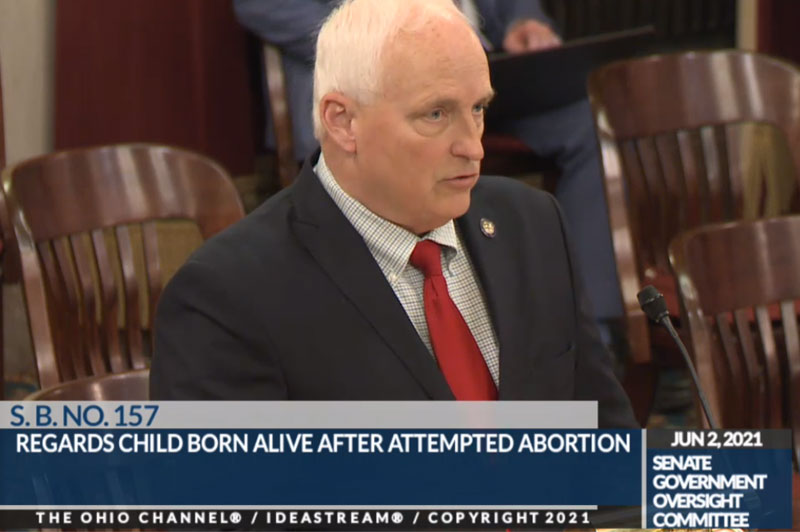
    State Sen. Terry Johnson, R-McDermott, testifies on a new bill regarding “born alive” abortions (Photo by The Ohio Channel)

    By Susan Tebben and Ohio Capital Journal

    Two medical professionals in the Ohio Senate reintroduced a bill that would criminalize physician inaction in “botched abortions,” but say the bill is more about having a reporting system, something that already exists in state law.

    The bill is sponsored by state Sen. Terry Johnson, R-McDermott, who currently works as a drug addiction treatment physician, and former ER doctor Sen. Steve Huffman, R-Tipp City, who still appears to work in a physicians group.

    Johnson said while the bill has punitive aspects for physicians, it is primarily a measure to “provide a reporting system” for abortion procedures in which the baby is born alive after a “failed abortion,” which research shows could only happen closer to the full term of a pregnancy. Full term is considered 40 weeks gestation.

    In Ohio, abortion is legal up to 20 weeks gestation.

    While he said data has settled the dispute in the General Assembly last year that cases of “born alive abortions” were rare or non-existent across the country, Johnson also said the new bill was necessary to find out if it occurred in the state.

    “We don’t want to overlook the fact that we would like Ohio to determine whether this actually happens in Ohio or not, and if it does, we can record it and we can take a cold, hard look at the results of that,” Johnson told the Senate Government Oversight & Reform Committee.

    When asked about current law on infant death, Johnson acknowledged that federal law already makes infant homicide a criminal offense. But when asked to provide an example of occurrences in Ohio, Johnson said the state doesn’t collect that data.

    “In states where they do have a reporting form and where they do pay attention to this, they can gather data and they prove that it happens,” Johnson said. “How would we know in Ohio? We don’t check it.”

    Source: Ohio Department of Health

    State law already requires information about abortions to be reported to the Ohio Department of Health by the physician who performs the abortion, using forms that don’t include identification of the person receiving the abortion. The forms are used to create a yearly abortion report.

    In compliance with current state law, physicians also have to report post-abortion complications, including the number and type of complications and the treatment for those complications, along with the gestational age for each procedure.

    The 2019 state abortion report — the most recent data from the state — said more than half of all abortions in Ohio happened at less than nine weeks gestation, and 26% happened nine to 12 weeks into pregnancy.

    Under the category of “failed abortions” in “post-abortion care for complications” data included in the report, 27 happened at less than nine weeks gestation, and the other 21 happened at nine to 12 weeks.

    None were reported in gestation higher than 12 weeks.

    Of the 356 abortions reported at 19 weeks or more gestation, only one pregnancy was found to be viable, with the majority of viability testing done through ultrasound.

    The CDC considers “early preterm” birth to be less than 34 completed weeks of gestation, and a women’s health webpage for the University of Utah Health says infants are not considered to be viable until after 24 weeks gestation, with the chance of survival before 24 weeks at less than 50%.

    Johnson said Senate Bill 157 is identical to Senate Bill 208, which he brought to the last General Assembly. That bill passed through the Senate but never received a committee hearing in the House before the GA ended at the end of 2020.

    In his testimony along with his cosponsor, state Sen. Huffman pointed to a report from the nationwide anti-abortion organization Family Research Council, citing CDC data of 143 occurrences of live births following abortion procedures between 2003 and 2014, amounting to about 13 per year.

    That report also cited a 2018 study that found the median survival time for those born after the termination of a pregnancy between 20 and 24 weeks gestation was only 32 minutes.