Tag: anti-gerrymandering amendment

  • Ohio Supreme Court approves redistricting summary with only two small revisions

    Ohio Supreme Court approves redistricting summary with only two small revisions

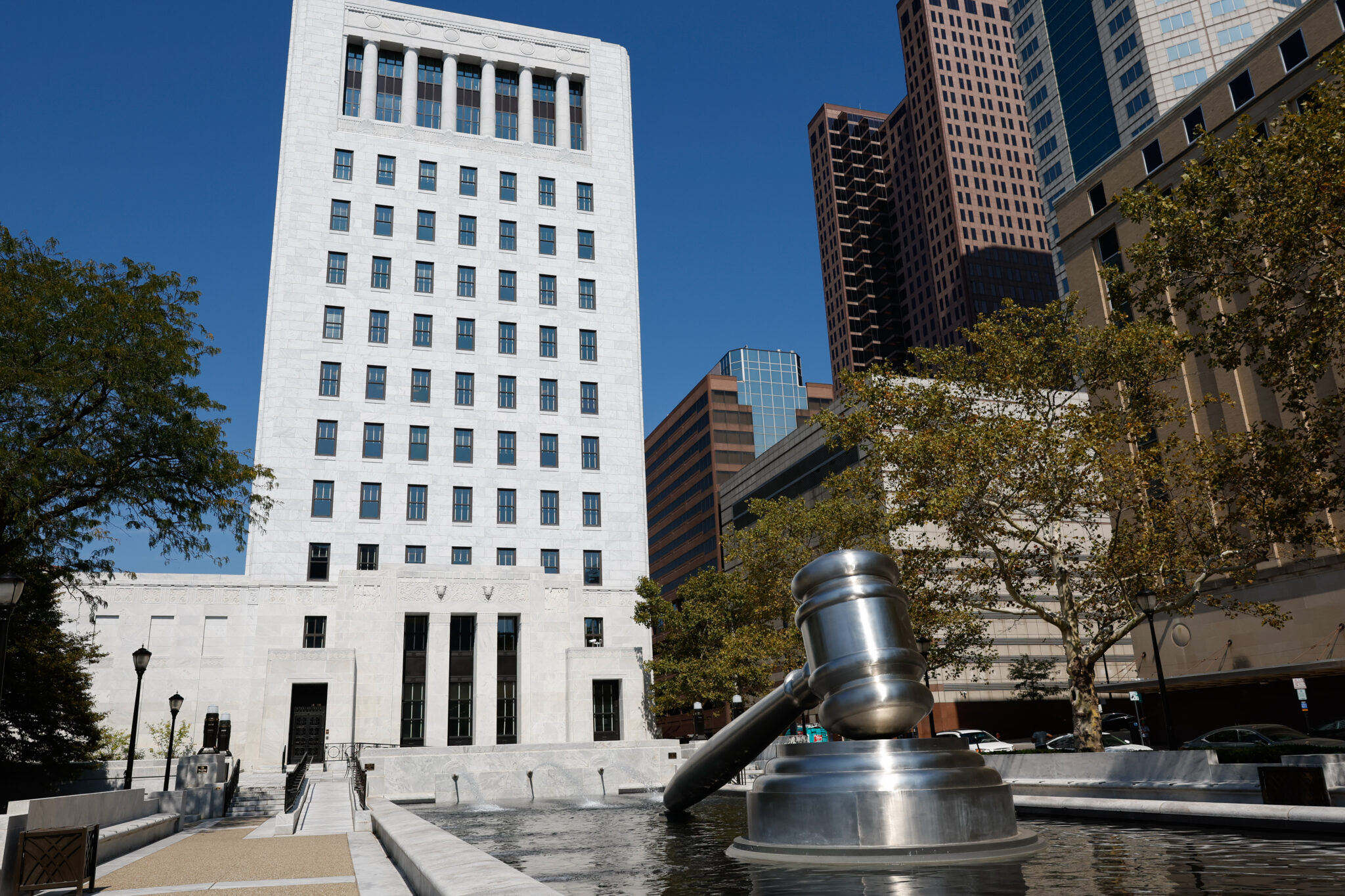
    The Gavel outside the Supreme Court of the State of Ohio, September 20, 2023, at 65 S. Front Street, Columbus, Ohio. (Photo by Graham Stokes for Ohio Capital Journal. Republish photo only with original article.)

    Republican majority rejects 6 of 8 changes requested by anti-gerrymandering advocates proposing the amendment

    By:  Ohio Capital Journal

    The Ohio Supreme Court largely approved ballot summary language for November’s Issue 1 anti-gerrymandering amendment on Monday, sending the language back to the Ohio Ballot Board for two revisions.

    A 4-3 Republican majority rejected 6 of 8 revisions requested by anti-gerrymandering advocates, while Democratic justices on the court said that was inadequate and that the summary needed “a nearly complete redrafting.”

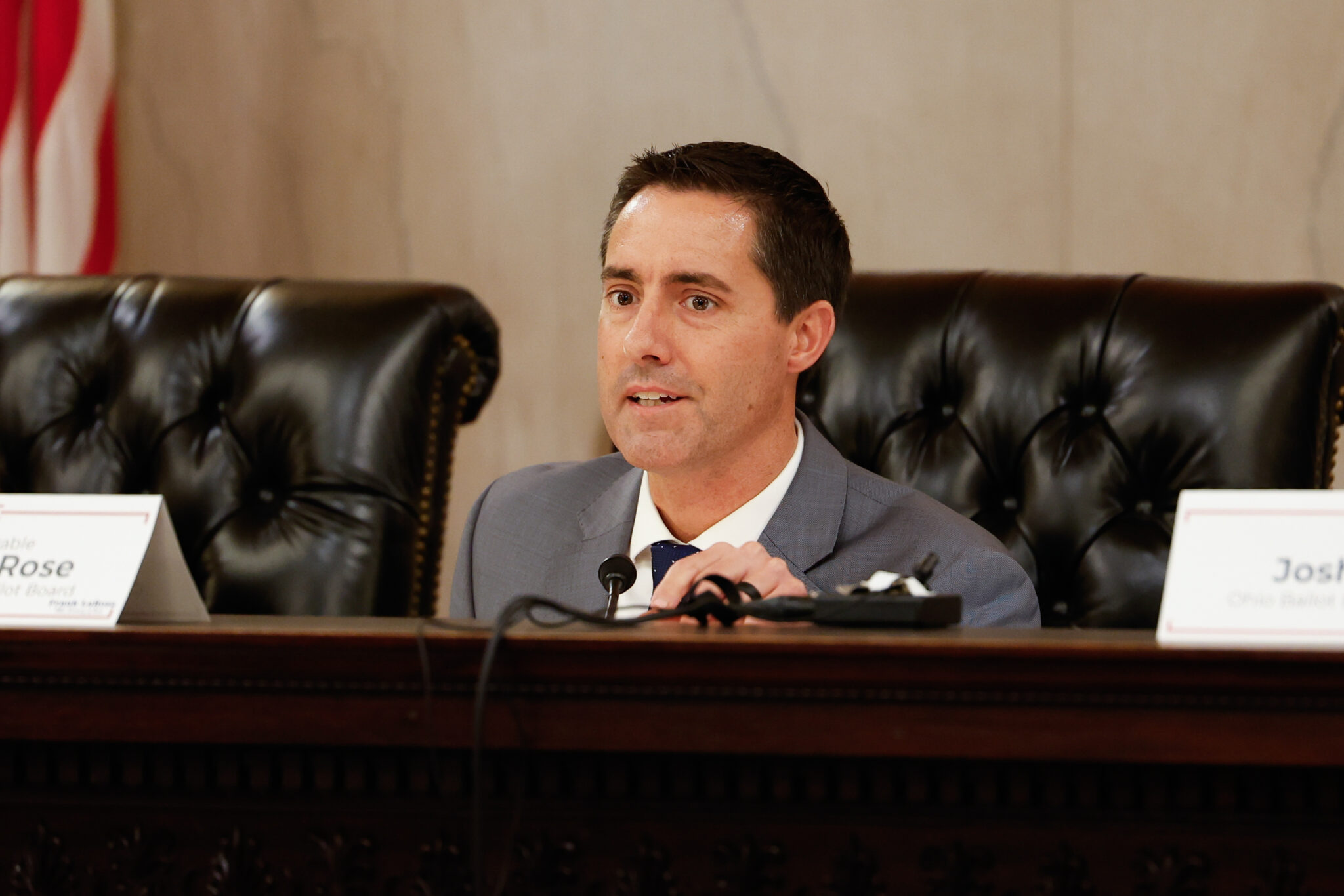
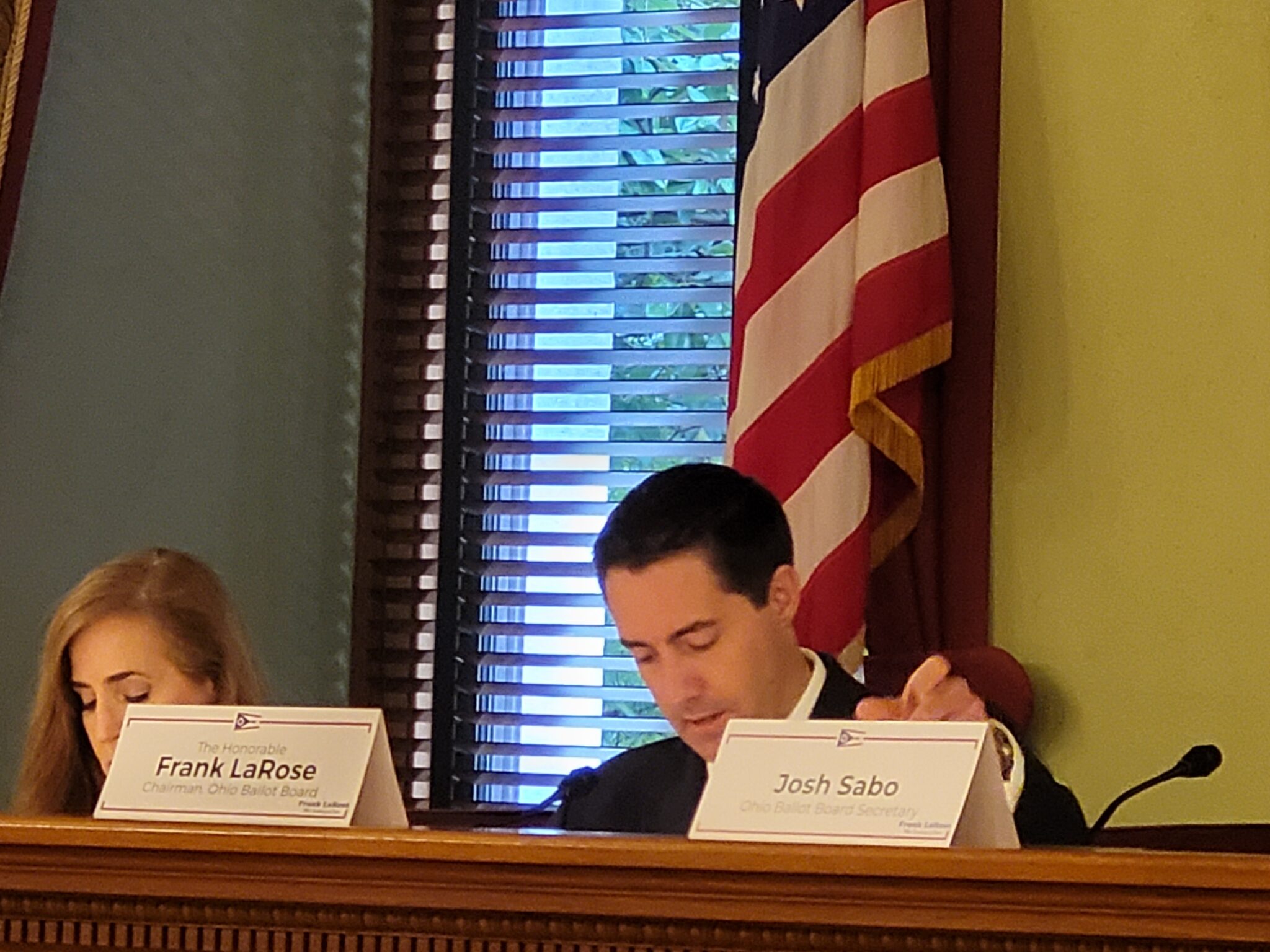
    The summary was written by Ohio Secretary of State Frank LaRose, who opposes the amendment, and approved 3-2 by the Ohio Ballot Board, which is chaired by LaRose. LaRose is also a member of the current Ohio Redistricting Commission that the amendment proposes to replace with citizen commissioners.

    While the court allowed most of the summary language in a decision released Monday night, it ordered the board to include in the summary “language that accurately conveys” that “the public would have the right to express itself to the new redistricting commission” under the terms of the amendment, written by anti-gerrymandering coalition Citizens Not Politicians.

    “Distilled, the proposed amendment would provide the rights of public participation in the redistricting process through meetings, hearings and an online public portal, and would forbid communication with the commission members and staff outside the public-meeting and portal context,” the court wrote.

    The other change ordered by the court compels the ballot board to make it clear that judicial review of the amendment is not limited to a “proportionality standard.”

    The current seven-member Ohio Redistricting Commission includes the Ohio House Speaker and Ohio Senate President, along with the governor, secretary of state, auditor of state, and two minority party legislative leaders.

    If approved by the voters, the amendment would replace the politician commission with the Ohio Citizens Redistricting Commission, which would have 15 members made up of five Republican citizens, five Democratic citizens, and five independents.

    The summary language does not change the text of the proposed redistricting reform or what the amendment would actually do; it’s just the summary language used to describe the amendment on voter ballots.

    An average of Ohio voter preferences over the last 10 years including 2022 show a 56-43 Republican-to-Democratic preference of Ohio voters, but Republicans control supermajorities of 67 out of 99 Ohio House seats and 26 out of 33 Ohio Senate seats. Ohio voters were forced to vote under unconstitutionally gerrymandered districts in 2022 after Republicans on the Ohio Redistricting Commission ran out of time to produce constitutional maps and a split federal court ruled the maps that were declared gerrymandered by a bipartisan majority on the then-Ohio Supreme Court had to be used.

    Republican politicians on the Ohio Redistricting Commission battled with the bipartisan court majority for nearly two years over the maps in 2021 and 2022, with five Statehouse maps and two U.S. Congressional district maps being rejected as unconstitutionally gerrymandered. The swing vote in those cases, Republican Supreme Court Justice Maureen O’Connor, was forced to retire due to age. She is now leading the Citizens Not Politicians amendment effort.

    One provision challenged by Citizens Not Politicians but allowed by the court states the amendment would “repeal constitutional protections against gerrymandering approved by nearly three-quarters of Ohio electors participating in the statewide elections of 2015 and 2018, and eliminate the longstanding ability of Ohio citizens to hold their representatives accountable for establishing fair state and legislative and congressional districts.”

    Citizens Not Politicians attorneys argued mention of the vote margin and method were not necessary, and the court said challengers laid out arguments that the language was “tantamount to an argument against adopting the proposed amendment.”

    But the court majority found that “at worst” including the vote margin and method could be “questioned on relevance grounds” not on “accuracy grounds.”

    “This information is factually accurate, and relators have not shown that the information would ‘mislead, deceive or defraud the voters,’” the court majority stated in their decision.

    The court also allowed language added by state Sen. Theresa Gavarone during the Aug. 16 board meeting, which states the amendment would “establish a new taxpayer-funded commission of appointees required to gerrymander the boundaries of state legislative and congressional districts to favor the two largest political parties in the state of Ohio.”

    Justices dismissed Citizens Not Politicians arguments that the language leads voters to believe the amendment would “require gerrymandering,” despite the fact that the amendment states it would ban partisan gerrymandering.

    The court said “the fact that the proposed amendment announces that it would ‘ban partisan gerrymandering,’ … is of little assistance in ascertaining whether the ballot language’s use of the word ‘gerrymander’ is improper.”

    The court explored various definitions of “gerrymandering” in coming to its decision, finding that the requirement the amendment uses to dictate the drawing of Statehouse and congressional maps “falls within the meaning of ‘gerrymander.’”

    “Because the board’s use of the term ‘gerrymander’ is consistent with dictionary definitions and how the United States Supreme Court has used the term, it does not mislead, deceive or defraud voters,” the decision stated.

    The court did not order any changes to the ballot title, though that was included in the changes requested by Citizens Not Politicians.

    “We conclude that the secretary did not err in crafting the ballot title,” the court wrote.

    While all the justices agreed to the changes, they were split on how many changes needed to be made.

    In his concurrence, Justice Patrick Fischer claimed “gerrymandering, though in a bipartisan manner, is absolutely ‘required under the proposed amendment,” and that the state constitution “would dictate” that independent and third-party voters would have their voice “removed from Ohio’s political world.”

    Justice Michael Donnelly agreed to the decision that ordered changes to the ballot language, but “vehemently” disagreed “that those corrections are even remotely adequate to prevent the ballot language as a whole from being misleading.”

    He and Justice Melody Stewart joined Justice Jennifer Brunner in an opinion that agreed to the changes, but said the majority opinion “reflects an abject failure of this court to perform an honest constitutional check on the ballot board’s work.”

    “We should be requiring a nearly complete redrafting of what is perhaps the most stunningly stilted ballot language that Ohio voters have ever seen,” Brunner wrote.

    She went on to say the ballot board language “is tantamount to performing a virtual chewing of food before the voters can taste it for themselves to decide whether they like it or not.”

    While the summary language will appear on ballots in the November general election, the actual language of the proposed amendment will be posted in polling places.

    The Ohio Secretary of State’s office said the ballot board will meet to make the revisions on Wednesday morning.

    Reactions

    Citizens Not Politicians released a statement saying they disagreed with “much of the decision” but agreed with the court’s “repudiation of the politicians on the ballot board for violating the Ohio Constitution.”

    Ballot Board chair Frank LaRose released his own statement, calling the court’s decision “a huge win for Ohio voters, who deserve an honest explanation of what they’re being asked to decide.”

    Former Ohio Redistricting Commission co-chair and Auditor of State Keith Faber said the court was “thoughtful in its approach and they got it right.”

    Senate President Matt Huffman and Gov. Mike DeWine have both spoken against the measure publicly.

    Faber’s fellow co-chair Senate Minority Leader Nickie Antonio said while the decision “enables Ohioans to make a more informed choice by addressing some of the most deceptive language, other misleading and argumentative language still remains.”


    Susan Tebben
    Susan Tebben

    Susan Tebben is an award-winning journalist with a decade of experience covering Ohio news, including courts and crime, Appalachian social issues, government, education, diversity and culture. She has worked for The Newark Advocate, The Glasgow (KY) Daily Times, The Athens Messenger, and WOUB Public Media. She has also had work featured on National Public Radio.

    Ohio Capital Journal is part of States Newsroom, the nation’s largest state-focused nonprofit news organization.

    MORE FROM AUTHOR

  • Citizens Not Politicians: Ohio Supreme Court should tell ballot board to ‘start over’

    Citizens Not Politicians: Ohio Supreme Court should tell ballot board to ‘start over’

    A July 1 rally of Citizens Not Politicians at the Ohio Statehouse. (Photo by Graham Stokes for Ohio Capital Journal. Only republish photo with original story.)

    By  Ohio Capital Journal

    Advocates pushing an anti-gerrymandering amendment in Ohio to remove politicians from mapmaking in favor of a citizen commission said the state’s ballot board should be forced to start over on summary language for the November proposal.

    Attorneys said the proposed amendment would ban partisan gerrymandering “by setting forth robust redistricting criteria to ensure fair maps, selection standards to ensure the new commission’s impartiality and accountability, and transparency measures to ensure public information and participation,” according to a merit brief filed Thursday.

    But they say the summary language written by Ohio Secretary of State Frank LaRose and adopted by a majority of the Ohio Ballot Board on Aug. 16 “would have voters believe exactly the opposite.”

    The Ohio Ballot Board decides what language voters will see on their ballots when they go to vote, but that summary language does not change what the proposed amendment would actually do. In a 3-2 vote, the Ohio Ballot Board approved summary language that supporters of the anti-gerrymandering amendment say is intentionally misleading and biased against the amendment. They have filed a lawsuit with the Ohio Supreme Court opposing the summary language.

    The merit brief is part of that lawsuit filed by Citizens Not Politicians, the group who has led the charge for the anti-gerrymandering amendment. The lawsuit asks the state’s highest court to order changes to the summary language made by the ballot board, chaired by Ohio Sec. of State LaRose.

    The proposed amendment signed by more than 535,000 verified Ohio voters would replace the current Ohio Redistricting Commission made up of seven politicians, including LaRose, with a 15-member citizens commission made up of Republicans, Democrats, and independents.

    Citizens Not Politicians Attorney Don McTigue pointed to a change made by state Sen. Theresa Gavarone, R-Bowling Green, during the ballot board’s meeting, in which she changed the word “manipulate” to “gerrymander” when describing the methods of redrawing congressional and statehouse district lines within the amendment.

    “Earlier this year, Attorney General Dave Yost certified that the Amendment’s summary was ‘fair and truthful,’” McTigue wrote. “That summary states, consistent with the amendment’s plain text, that the amendment would ‘ban partisan gerrymandering.’”

    The brief emphasizes what the original complaint filed on Aug. 19 asserted, which is that the opinion of whether or not the proposed amendment “offers better policy than the existing system” should be left up to the voters in November.

    “The Ballot Board’s job is to provide ballot language that gives voters the facts so that they can make up their own minds,” the brief states.

    That language should follow constitutional rules dictating the language and the title, something the LaRose language doesn’t do, according to Citizens Not Politicians.

    The Ohio Constitution states ballot language “shall properly identify the substance of the proposal to be voted upon,” and the language “shall not be held invalid unless it is such as to mislead, deceive or defraud the voters.”

    The Ohio Revised Code says the secretary of state or the ballot board is required to “give a true and impartial statement of the measures in such language that the ballot title shall not be likely to create prejudice for or against the measure.”

    The title of the redistricting amendment, as approved by the board majority, is “to create an appointed redistricting commission not elected by or subject to removal by the voters of the state.”

    “The Ballot Board’s attempt to put a thumb on the scale against the amendment is a thumb in the eye of Ohioans who expect their representatives on the Board to carry out their mandatory duties impartially,” McTigue wrote.

    The Ohio Attorney General has filed an answer to the complaint, but the filing has already received criticism from the Democratic members of the ballot board, who say they were not consulted on the legal document, nor have they been given outside counsel to speak on their behalf, despite the fact that the the two Democrats, state Sen. Paula Hicks-Hudson and state Rep. Terrence Upchurch, voted against the ballot board language.

    Hicks-Hudson and Upchurch ended up filing a brief themselves on Wednesday night, in which they did not fight arguments that the ballot board “as a whole violated its constitutional duty,” and said the “chosen ballot title is inaccurate, biased, argumentative and misrepresents the proposed amendment’s procedures for removing commissioners who fail to comply with their duties.”

    McTigue said the court “has never hesitated to strictly enforce the legal requirements for the text that appears on the ballot, in recognition of Ohioans’ century-old right to amend their constitution and laws through direct democracy.”

    “The court should do the same here, by directing (the ballot board) to start over and adopt ballot language and a ballot title that are consistent with their clear legal duties.”

    The Ohio Supreme Court was asked just last year to make changes to a ballot board-approved summary, in that case for the reproductive rights constitutional amendment that would eventually pass with 57% of the vote.

    The coalition that sued took issue with ballot language that used the phrases “unborn child” and “reproductive medical treatment,” along with using the phrase “the citizens of the State of Ohio” rather than just “the State of Ohio” when speaking of the prohibitions against “indirectly burdening, penalizing or prohibiting abortion.”

    In a similar way to the redistricting amendment author’s arguments that the LaRose language could mislead voters as to the intentions of the proposed amendment, the lawsuit against the reproductive rights amendment summary said it could mislead voters about the rights the amendment created, the restrictions in the amendment, discretion when it comes to fetal viability and state regulation of the amendment.

    The Ohio Supreme Court said they agreed “that the ballot language approved by the ballot board misleads the average voter about whose actions the amendment restricts.”

    “But the ballot language is not defective in any other respect,” the court wrote.

    The court asked the ballot board only to change the phrase “citizens of the State of Ohio” to “State of Ohio,” and approved the rest.

    Justice Michael O’Donnelly wrote in his concurring opinion that it was “unfortunate that advocacy seems to have infiltrated a process that is meant to be objective and neutral.”


    Susan Tebben
    Susan Tebben

    Susan Tebben is an award-winning journalist with a decade of experience covering Ohio news, including courts and crime, Appalachian social issues, government, education, diversity and culture. She has worked for The Newark Advocate, The Glasgow (KY) Daily Times, The Athens Messenger, and WOUB Public Media. She has also had work featured on National Public Radio.

    Ohio Capital Journal is part of States Newsroom, the nation’s largest state-focused nonprofit news organization.

    MORE FROM AUTHOR

  • Ohio Ballot Board approves controversial language to describe anti-gerrymandering amendment

    Ohio Ballot Board approves controversial language to describe anti-gerrymandering amendment

    Attorney Don McTigue speaks before the Ohio Ballot Board on Friday, Aug. 16, to discuss summary language that will appear before voters in November on the redistricting reform amendment. (Photo by Susan Tebben, Ohio Capital Journal.)

    By:  Ohio Capital Journal

    The Ohio Ballot Board passed controversial language written by Secretary of State Frank LaRose on Friday as the ballot summary that will explain to voters November’s anti-gerrymandering amendment. Supporters of the amendment have called the language deceptive and unconstitutional and have said they would challenge it in court.

    The board met on Friday morning to determine the summary that will appear on individual ballots, the final words Ohioans will see before they choose to accept or deny the measure.

    The proposed amendment would remove Ohio politicians from the process of drawing Statehouse and congressional district maps, and instead create a citizen commission to draw maps made up of Republicans, Democrats, and independents.

    The board was led by LaRose in passing his preferred ballot language for the amendment 3 to 2, with both Democratic members of the board, state Sen. Paula Hicks-Hudson and state Rep. Terrence Upchurch, voting against the approval. LaRose is one of the politicians who sits on the current Ohio Redistricting Commission, and one of the Republican members who repeatedly voted for maps that were declared to be unconstitutionally gerrymandered by a bipartisan majority on the Ohio Supreme Court before they were nevertheless forced on voters by a federal court in 2022 after time to draw constitutional maps had run out.

    One amendment was made to the LaRose language Friday, brought by board member and Republican state Rep. Theresa Gavarone. That change takes a paragraph that says the commission will be “required to manipulate the boundaries of state legislative and congressional districts…” and changes it to say the commission will be “required to gerrymander” those districts, a change that elicited shocked scoffs from the crowd gathered at the board meeting.

    The ballot measure seeks to create a 15-citizen redistricting commission to decide Statehouse and congressional voting districts throughout the state, which authors of the proposed amendment from the group Citizens Not Politicians say will be done in public meetings and include opportunities for public input as the process goes on.

    Citizens Not Politicians submitted its own proposed summary for ballot board consideration, and it said commission members would be non-elected citizens who “who have demonstrated the absence of any disqualifying conflicts of interest and who have shown an ability to conduct the redistricting process with impartiality, integrity and fairness.”

    Democrats attempted to approve the language provided by Citizens Not Politicians, but the motion was voted down 3 to 2, supported only by the Democratic members of the board.

    Hicks-Hudson also tried to amend the LaRose-written language to replace it with the Citizens Not Politicians language, but that motion was also struck down.

    “This is a dangerous proposal that threatens the integrity of the vote on Issue 1,” Hicks-Hudson said of the Secretary of State language.

    With the title that says the amendment would “create an appointed redistricting commission not elected by or subject to removal by the voters of the state,” the language approved by the board speaks of the elimination of “the longstanding ability of Ohio citizens to hold their representatives accountable for establishing fair state legislative and congressional districts,” and the purpose to “repeal constitutional protections against gerrymandering approved by nearly three-quarters of Ohio electors participating in the statewide elections of 2015 and 2018.”

    Attorney Don McTigue made the point that it’s impossible for citizens to hold their elected lawmakers responsible by voting in gerrymandered districts — which are by definition guaranteed to ensure the gerrymandered lawmakers’ victory.

    “The problem is that the whole accountability argument only works when you have fair districts, not when you have the severely gerrymandered districts that you have in this state,” McTigue said during the public comment portion of the board meeting.

    McTigue, who represents the creators and supporters of the ballot initiative, requested the use of the language Citizens Not Politicians submitted rather than the Secretary of State language, citing Ohio law dictating ballot language and title.

    “The (SOS) language is stunning in it being false and misleading, and it is unabashed in terms of its prejudicial language,” McTigue said. “There’s no reasonable person who … after reading that language could conclude that it is an honest attempt to provide fair ballot language that allows voters to make an independent decision about the issue.”

    He cited the 2015 and 2018 redistricting measures, in which the ballot board “distilled the most important aspects of the proposed redistricting changes to the Ohio Constitution.”

    The language, which LaRose said in the ballot board meeting was written by him “with the input of my team,” was harshly criticized by the measure’s leaders and supporters leading up to the meeting as misleading and biased language that violated constitutional rules.

    LaRose defended the language in his summary that said the amendment would “limit the right of Ohio citizens to freely express their opinions to members of the commission or to commission staff regarding the redistricting process or proposed redistricting plans,” saying the language might unduly shield members of the new commission from public scrutiny.

    McTigue pushed back, saying context is important in reading the summary, which is why he didn’t support the Secretary of State language.

    “I think that something can be misleading or deceptive if you don’t have the full context,” McTigue said.

    The Secretary of State’s language was released Thursday, giving board members and McTigue little time to read through it, something that was discussed in the meeting.

    “I think the record should be really clear that 24 hours isn’t necessarily a lot of time to deal with 900-some words that really, I’m not sure fit in to the confines of what the law requires and … making a really thoughtful evaluation of the language,” said Hicks-Hudson.

    Gavarone said the 900 words in the LaRose language “accurately explain what this is,” and noted the details on the process of redistricting were not included in the Citizens Not Politicians proposed summary language.

    LaRose also touched on the selection process for commission members in the amendment, saying the longest part of his summary language was explaining that process.

    “The way that you end up on the current commission (the Ohio Redistricting Commission) is pretty straightforward,” LaRose said. “(The proposed process) is a bit of a Rube Goldberg device that involves a lot of twists and turns … it’s a complex process.”

    He called the five-bullet summary proposed by the CNP “wholly inadequate” and said it could not “identify the substance” of the lengthy amendment.

    Noted opponents of the ballot measure include Senate President Matt Huffman and Ohio Gov. Mike DeWine, both of whom made public cases against the measure. Huffman said the effort would bring about an onslaught of legal trouble for the state, and DeWine said the focus on proportionality in the rules of the redistricting process would cause more problems than supporters claim it would fix, and “Ohio would actually end up with a system that mandates, that compels map-drawers to produce gerrymandered districts,” he said at a recent press conference.

    Supporters of the amendment have said they will appeal the decision of the Ohio Ballot Board in court, just as the supporters of the ballot measure on reproductive rights did to the Ohio Supreme Court after ballot board approval.

    Indeed, immediately after the board meeting adjourned, Citizens Not Politicians pledged to “seek remedy” from the Ohio Supreme Court by filing a brief next week on the language, according to Jen Miller of the League of Women Voters of Ohio.

    LaRose did not speak to reporters after the meeting.


    Susan Tebben
    Susan Tebben

    Susan Tebben is an award-winning journalist with a decade of experience covering Ohio news, including courts and crime, Appalachian social issues, government, education, diversity and culture. She has worked for The Newark Advocate, The Glasgow (KY) Daily Times, The Athens Messenger, and WOUB Public Media. She has also had work featured on National Public Radio.

    Ohio Capital Journal is part of States Newsroom, the nation’s largest state-focused nonprofit news organization.

    MORE FROM AUTHOR

  • Ohio anti-gerrymandering leaders say LaRose’s draft ballot text is deceptive and unconstitutional

    Ohio anti-gerrymandering leaders say LaRose’s draft ballot text is deceptive and unconstitutional

    By:  Ohio Capital Journal

    The office of Ohio Secretary of State Frank LaRose has drafted ballot language for the Ohio Ballot Board to consider Friday that supporters of an anti-gerrymandering amendment say is deceptive and unconstitutional. The Ballot Board decides the text of proposed amendments that voters actually see on their ballots when they vote.

    The anti-gerrymandering amendment before Ohio voters in November, according to the language drafted by LaRose’s office, would “eliminate the longstanding ability of Ohio citizens to hold their representatives accountable for establishing fair state legislative and congressional districts.”

    The Citizens Not Politicians group that authored the ballot initiative and collected more than 535,000 necessary signatures from Ohio voters to get the measure on the ballot, has proposed their own language for the ballot as well, saying it would remove politicians from the redistricting process in favor of a citizen board.

    The group is proposing a redistricting amendment that would replace Ohio’s politician-led redistricting commission with a citizen-led commission made up of Republicans, Democrats and independents. Currently, the Ohio Secretary of State is one of the politicians sitting on Ohio’s redistricting commission, along with the governor, the Ohio Auditor, two lawmakers from the majority party and two lawmakers from the minority party.

    The language drafted by the Secretary of State’s Office claims in its proposed title that the amendment’s purpose is, “To create an appointed redistricting commission not elected by or subject to removal by the voters of the state.”

    Moreover, the draft language says its purpose is to “repeal constitutional protections against gerrymandering approved by nearly three-quarters of Ohio electors participating in the statewide elections of 2015 and 2018.”

    Backers say the amendment is actually intended to protect voters against gerrymandering by removing politicians who stand to benefit from the process, and to not allow them to continue drawing gerrymandered district maps.

    After the 2015 and 2018 reforms were.passed by voters, Republican politicians on the Ohio Redistricting Commission including Ohio Secretary of State LaRose repeatedly voted for Statehouse and U.S. Congressional district maps that were declared unconstitutional gerrymanders by a bipartisan majority on the Ohio Supreme Court. Nevertheless, Ohio voters were forced to use the maps as the politicians refused to produce a maps that reflected voting preferences of Ohioans.

    The Ohio Secretary of State’s Office further claims in its proposed language that the new amendment would also “limit the right of Ohio citizens to freely express their opinions to members of the commission or to commission staff regarding the redistricting process or proposed redistricting plans.”

    It claims the amendment would “prohibit any citizen from filing a lawsuit challenging a redistricting plan in any court, except if the lawsuit challenges the proportionality standard applied by the commission, and then only before the Ohio Supreme Court,” and that new “taxpayer-funded costs” would be imposed by the amendment, with “an unlimited amount for legal expenses incurred by the commission in any related litigation.”

    Ohio Gov. Mike DeWine recently publicly opposed the ballot measure because of its emphasis on proportionality, alleging there was no way the measure could work as written. In opposing the measure, he said whether or not it passes in November, he’s considering going to the legislature to adapt Iowa’s redistricting process for Ohio. Iowa’s process leaves lawmakers with final say over maps.

    The proposed constitutional amendment penned by Citizens Not Politicians calls for a 15-person redistricting commission made up of citizens, rather than the Ohio Redistricting Commission that is currently made up entirely of elected officials.

    The language proposed by Citizens Not Politicians to the ballot board states the proposed amendment would “require that the commission consist of 15 members who have demonstrated the absence of any disqualifying conflicts of interest and who have shown an ability to conduct the redistricting process with impartiality, integrity and fairness.”

    The amendment would “provide that each redistricting plan shall contain single-member districts that are geographically contiguous, comply with federal law, closely correspond to statewide partisan preferences of Ohio voters and preserve communities,” according to the Citizens Not Politicians proposed language.

    The current Ohio Redistricting Commission made up of politicians produced six different Statehouse maps and two congressional maps over the two years it did its work. Five of the Statehouse maps were ruled unconstitutional by the Ohio Supreme Court and neither of the congressional maps passed constitutional muster, according to the state’s highest court. The second of the congressional maps remains the state’s congressional district map, despite being found to be unduly partisan by the state supreme court.

    The redistricting commission was criticized for disregarding hours of testimony from hundreds of Ohio citizens, and numerous citizen and group-proposed maps in favor of maps written by legislative staffers, and disregarding the authority of the Ohio Supreme Court when they were ordered to redraw maps within deadlines and utilize paid independent mapmakers coordinated by the court.

     Retired Republican Chief Justice of the Supreme Court of Ohio, Maureen O’Connor. (Poto by Graham Stokes for Ohio Capital Journal. Republish photo only with original article.) 

    Former Ohio Supreme Court Chief Justice Maureen O’Connor, a leader for Citizens Not Politicians, who has called for reforms to redistricting since she left the bench, said the Secretary of State’s proposed language violates the Ohio Constitution.

    “The self-dealing politicians who have rigged the legislative maps now want to rig the Nov. 5 election by illegally manipulating the ballot language,” O’Connor said in a statement. “We will make our case for fair and accurate language before the Ballot Board and if necessary take it to court.”

    O’Connor’s statement claims the language proposed by the Secretary of State’s Office violates an article of the Ohio Constitution that prohibits ballot language that “is such as to mislead, deceive, or defraud voters,” according to the law.

    Ohio law also states ballot titles “shall give a true and impartial statement of the measures in such language that the ballot title shall not be likely to create prejudice for or against the measure.”

    It’s not the first time even in the last year that ballot language has been criticized as a misleading representation of the proposed initiative. Last year’s reproductive rights ballot measure went through the same process, with language written by Ohio Secretary of State staff approved as the language to appear on the ballots.

    The creators of the ballot measure sued, with the Ohio Supreme Court approving the ballot language, but sending it back to the board for small changes.

    Despite the language, which critics said intentionally misrepresented the reproductive rights amendment, the measure passed with 57% of the vote last November.

    State Secretary of State LaRose is the head of the Ohio Ballot Board that will consider the language on Friday. The board is also made up of Republican state Sen. Theresa Gavarone, Democratic state Sen. Paula Hicks-Hudson, Democratic state Rep. Terrence Upchurch and citizen-member William Morgan.

    A spokesperson for the Secretary of State’s Office did not respond to request for comment on the language Thursday afternoon.


    Susan Tebben
    Susan Tebben

    Susan Tebben is an award-winning journalist with a decade of experience covering Ohio news, including courts and crime, Appalachian social issues, government, education, diversity and culture. She has worked for The Newark Advocate, The Glasgow (KY) Daily Times, The Athens Messenger, and WOUB Public Media. She has also had work featured on National Public Radio.

    Ohio Capital Journal is part of States Newsroom, the nation’s largest state-focused nonprofit news organization.

    MORE FROM AUTHOR

  • Signatures certified: Ohio anti-gerrymandering amendment on its way to November ballot

    Signatures certified: Ohio anti-gerrymandering amendment on its way to November ballot

    BY:  Ohio Capital Journal

    A proposed anti-gerrymandering amendment in Ohio that would remove politicians from the redistricting process in favor of a citizens commission has gathered enough signatures to proceed to voters on the November ballot.

    The Ohio Secretary of State’s Office certified 535,005 signatures for the Citizens Not Politicians ballot initiative that would create an independent redistricting commission and replace the Ohio Redistricting Commission made up entirely of elected officials.

    The coalition of voting rights groups and anti-gerrymandering advocates who made up Citizens Not Politicians submitted more than 731,000 signatures on July 1, well above the required 413,487. The Secretary of State’s Office reviewed the signatures for duplicate or invalid signatures, finalizing the total on Tuesday.

    The office also said the initiative received signatures from 58 of the 88 counties, and at least 5% of the total vote cast for governor in the last gubernatorial election. Ohio law requires measures to have signatures in at least 44 counties.

    “This certification is a historic step towards restoring fairness in Ohio’s electoral process,” retired Ohio Supreme Court Chief Justice Maureen O’Connor said in a CNP statement after the signatures were certified.

    The former chief justice came on to the effort early in the process after leaving the Ohio Supreme Court due to age limits. As a member the state’s highest court, she was part of a majority that rejected six maps, both Ohio Statehouse and congressional, adopted by the Ohio Redistricting Commission, which includes the governor, auditor of state, and secretary of state, along with legislative leaders, all of whom are elected officials, as dictated by the current redistricting laws.

    O’Connor told supporters at a rally when the signatures were submitted to the Secretary of State’s Office that the measure was “one of the most widely supported citizen-initiated constitutional amendments in Ohio’s history.”

    The initiative now heads to the Ohio Ballot Board, led by Secretary of State Frank LaRose, where the language of the initiative will be reviewed, and can be changed as it was with last November’s Issue 1 abortion amendment.

    According to CNP, the ballot board, which has not yet scheduled the meeting for the measure’s consideration, has until Aug. 22 to “write and adopt the language that will appear on the Nov. 5 ballot” based on constitutional requirements to “properly identify the substance of the proposal to be voted on.”

    “We are confident that Ohio voters will see simple, accurate language when they go to the polls on Nov. 5 to vote for this amendment,” O’Connor said in the CNP statement.

    In addition to creating a 15-member independent redistricting commission, the constitutional amendment would ban current or former politicians and party officials, along with lobbyists from having a seat on the commission, and “require the creation of fair and impartial districts, prohibiting any drawing of voting districts that discriminate against or favor any political party or individual politician,” according to the coalition.

    Supporters also say the amendment would create a more transparent process than has been seen in past redistricting efforts.

    Opponents of the measure include Ohio Senate President Matt Huffman, who took during a post-primary event by the Ohio Chamber of Commerce to make the case against the effort.

    He argued the new process would provoke an “extraordinary” amount of legal challenges, and he also defended the current process.

    “When allowed to work in the summer of 2023, (the redistricting process) did work,” Huffman said in March.

    After ballot board approval, the initiative will then be included in the November ballot issues statewide.


    Susan Tebben
    SUSAN TEBBEN

    Susan Tebben is an award-winning journalist with a decade of experience covering Ohio news, including courts and crime, Appalachian social issues, government, education, diversity and culture. She has worked for The Newark Advocate, The Glasgow (KY) Daily Times, The Athens Messenger, and WOUB Public Media. She has also had work featured on National Public Radio.

    Ohio Capital Journal is part of States Newsroom, the nation’s largest state-focused nonprofit news organization.

    MORE FROM AUTHOR


  • Ohio Ballot Board approves anti-gerrymandering amendment. Proposal to go forward

    Ohio Ballot Board approves anti-gerrymandering amendment. Proposal to go forward

    Ohio Secretary of State Frank LaRose and the rest of the Ohio Ballot Board approve the language of a proposed anti-gerrymandering amendment that is likely to appear on the ballot next year. (Photo by Marty Schladen, Ohio Capital Journal.)

    Signature gathering can proceed

    BY:  Ohio Capital Journal

    Activists who hope to pass an anti-gerrymandering amendment to the Ohio Constitution can now begin gathering the nearly half-million signatures on the need to get the measure on the November 2024 ballot after the amendment was approved as a single issue by the Ohio Ballot Board Thursday.

    Without much ceremony, the board unanimously agreed that the proposed amendment pertains to a single subject, which is required under Ohio law.

    The timing of the approval is significant because early voting on two other measures that are on this year’s ballot started yesterday (Thursday.) Voting has begun on Issue 1, a constitutional amendment protecting abortion rights, and Issue 2, a voter-initiated statute legalizing recreational marijuana. The general election for those measures is Nov. 7.

    Activists trying to get the anti-gerrymandering amendment on next year’s ballot have to gather about 415,000 verified signatures of registered voters. And because of a relatively high rate of rejections in previous efforts, they want to gather hundreds of thousands more than that.

    They say that having the summary language approved now enables them to do their work at county boards of election, where registered voters are gathering to cast ballots on this year’s abortion and marijuana measures. Petition circulators will also be able to work voter-rich environments near polling places on Election Day.

    The approval comes in the nick of time for the activists. Attorney General Dave Yost twice rejected the summary language for the petitions as not adequately reflecting the proposed amendment itself before approving it on its third attempt.

    Ohio is regarded as one of the most extremely gerrymandered states in the country. While Donald Trump carried the state with less than 54% of the vote in 2020, Republicans control 68% of seats in the state House, 78% in the state Senate and 66% of the state’s seats in the U.S. House of Representatives.

    That’s despite the fact that in 2015 and 2018, amendments to curb extreme partisan gerrymandering in the legislature and Congress both passed with more than 70% of the vote.

    After the 2020 Census, the Republican-dominated Redistricting Commission created by those amendments seven times ignored rulings by a bipartisan majority of the Ohio Supreme Court. The rulings said the districts the commission had drawn violated the anti-gerrymandering provisions of those same amendments.

    So now Ohio’s lawmakers are representing districts that the state’s highest court has ruled unconstitutional.

    Former Chief Justice Maureen O’Connor, a Republican, voted with the court’s three Democrats in ruling that the districts were unconstitutional, but she was forced to retire last year because of her age.

    Now she’s working with anti-gerrymandering activists to try to get the latest proposed amendment on next year’s ballot. It attempts to eliminate power grabs when district lines are drawn by creating an independent commission to draw them. That’s in contrast to the current one, which is composed entirely of elected officials.

    Ohio Secretary of State Frank LaRose voted with the other Republicans on the Redistricting Commission in support of the current, unconstitutional maps. In his role as head of the Ballot Board, on Thursday he voted to approve the latest proposed anti-gerrymandering amendment. But he emphasized that it was only a vote on whether its language regarded a single subject.

    “I will remind you again that we are not here today to debate the merits of the proposal, but only whether it constitutes a single proposed amendment to the Ohio Constitution,” he said.

    But Sen. Paula Hicks-Hudson, D-Toledo, commented on the merits, anyway.

    “I’d like to recognize and support the citizens of Ohio who have moved to create a fair opportunity… for their districts to be drawn to reflect all the things Ohioans believe are important and to have a government that is responsive to the citizens of the state of Ohio,” she said.

    After that, LaRose again emphasized that the vote wasn’t on the merits of the proposed anti-gerrymandering amendment.


    Marty Schladen
    MARTY SCHLADEN

    Marty Schladen has been a reporter for decades, working in Indiana, Texas and other places before returning to his native Ohio to work at The Columbus Dispatch in 2017. He’s won state and national journalism awards for investigations into utility regulation, public corruption, the environment, prescription drug spending and other matters.

    MORE FROM AUTHOR