Loveland, Ohio – On Monday afternoon I got a chance to sit down with Ohio Secretary of State candidate Bryan Hambley, the only declared Democratic candidate for the state-wide office. Two Republicans have also declared their intention to run, current Ohio Treasurer Robert Sprague from Findlay and Marcell Strbich who lives in Montgomery County.
Hambley is a cancer doctor who cares for leukemia patients at U.C. His wife Jana, is a trauma surgeon, and together they have two children ages 5 and 7 that attend Loveland schools.
I sat down with Hambley at a private meet the candidate night where we talked about what he could do as the Ohio Secretary of State to correct Ohio’s gerrymandered democracy, how the current Secretary of State has been responsible for deliberately confusing ballot language, how he would improve assistance to the caregivers that help disabled Ohioans cast their ballot, and improving civility among Ohio politicians.
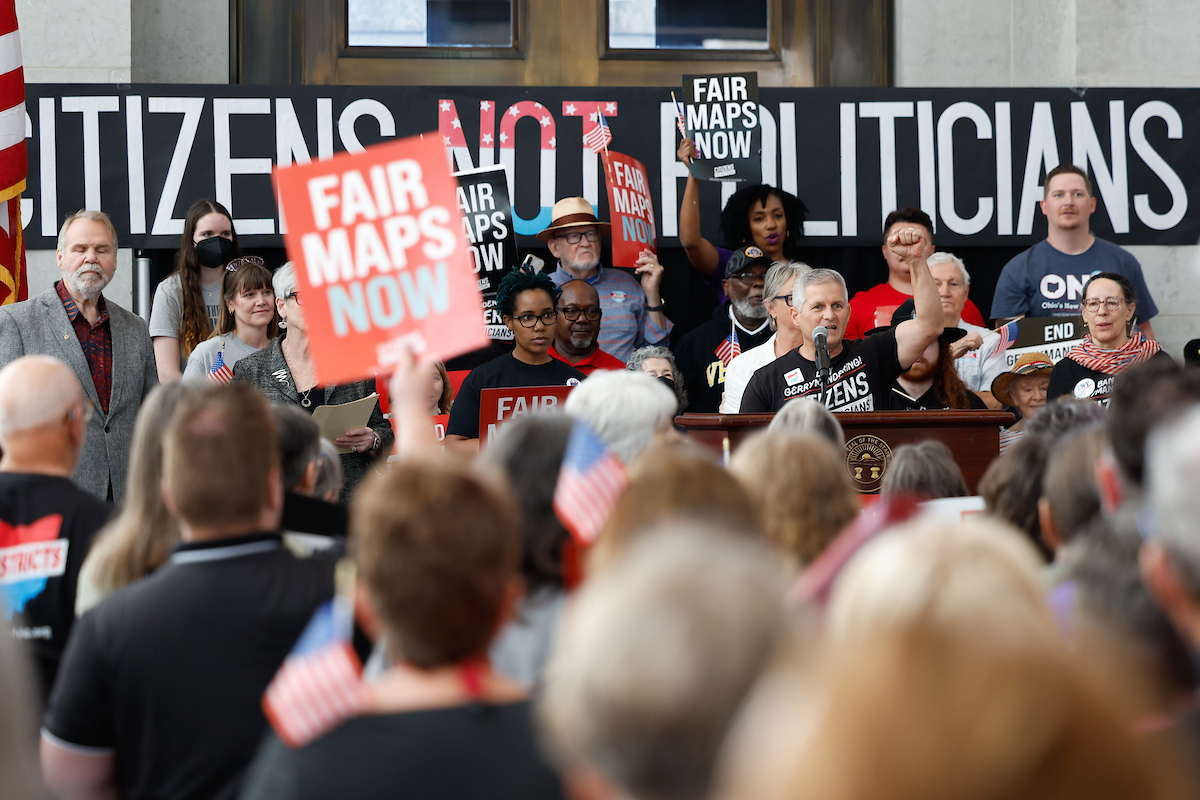
Mike Ahern, an Independent voter from Blacklick speaks to supporters at the Citizens Not Politicians rally, July 1, 2024, at the Statehouse in Columbus, Ohio. (Photo by Graham Stokes for Ohio Capital Journal. Republish photo only with original story.)
This article was originally published in Bolts, a nonprofit newsroom covering the nuts and bolts of power and political change, from the local up.
When Songgu Kwon went to the polls earlier this month, he was eager to help Ohio adopt an independent redistricting commission. The comic book writer and illustrator, who lives near Athens, dislikes the process with which politicians have carved up Ohio into congressional and legislative districts that favor them, enabling Republicans to lock in large majorities. So he was pleased that voting rights groups had placed Issue 1, a proposal meant to create fairer maps, on the Ohio ballot this fall.
“I’m in support of any measures that make the process more fair to reflect the will of the people, instead of letting the politicians decide how to gerrymander,” says Kwon.
In the voting booth, he reviewed the text in front of him. His ballot read that voting ‘yes’ would set up a panel “required to gerrymander the boundaries of state legislative and congressional districts,” and that it would “repeal constitutional protections against gerrymandering.”
So Kwon voted ‘no’ on the measure—given what he’d just read, he thought, that had to be the way to signal support for independent redistricting. He’d gone in planning to vote ‘yes,’ but he was thrown off by this language he saw; he guessed that he must have been wrong or missed some recent development. “The language seemed really specific that if you vote ‘yes’, you’re for gerrymandering,” he now recalls in frustration.
But when he left the polling station and compared notes with his wife, he quickly figured out that he’d made a mistake: He had just voted to preserve the status quo. To bring about the new independent process and remove redistricting from elected officials, as was his intention, he would have had to vote ‘yes.’
Kwon says he got confused by the language that was crafted and placed on the ballot by Republican Ohio officials. The official most directly responsible for this language, Secretary of State Frank LaRose, had a direct hand in drawing the gerrymandered maps that Kwon opposes and that the reform would unwind.
“I didn’t think that they would go so far as to just straight up lie and use a word that means one thing to describe something else,” Kwon told me. “They are using the term gerrymandering to describe an attempt to actually fix the gerrymandering.”
He added, “I thought this was a serious document, and that there would be some standard.” Other Ohioans have come forward with similar stories in recent days, complaining they meant to vote ‘yes’ but got tricked by the ballot language into not doing so.
Now the fate of Ohio’s redistricting reform hinges on whether its proponents can dispel this confusion and get the word out to all the residents who intend to support it.
The result will determine who gets to draw future state congressional and legislative districts, and it may shift seats as early as 2026. But more than that, the dispute adds to a larger saga over the viability of direct democracy in Ohio. Just last summer, the GOP pushed an amendment that would have made it much less likely for future citizen-initiated measures to succeed. That proposal failed, but Mia Lewis, associate director of Common Cause Ohio, told me at the time that she expected Republican leaders to “come back and try again” this year. Now she says that’s exactly what they did when they skewed this latest measure’s ballot language.
Lewis helped organize Issue 1 this year. And just like in the summer of 2023, she said, state officials “are threatened by the idea that the people of Ohio would have power.”
“They have understood that Ohioans don’t want gerrymandering, they have nothing good to say about voting ‘no’,” she said, “so the only thing they can say is, if you vote ‘yes,’ on this, you’re requiring gerrymandering, which is the exact opposite of the truth.”
Issue 1 would amend the state constitution to create a new panel to draw Ohio districts. It would be made up of 15 citizens selected by retired judges from a pool of applicants; the body would need to include five registered Republicans, five registered Democrats, and five people who are neither. Elected officials would be barred from serving on the commission.
An independent commission would mark a huge change from current law, which grants the authority to draw districts to a panel of elected officials, including the governor, the secretary of state, and appointees of legislative leaders. The constitution already requires that new maps respect certain principles of fairness. But when Ohio’s high court in 2022 struckdown GOP gerrymanders seven separate times, ordering the process to be more equitable, GOP leaders ignored the rulings and ran out the clock until they landed a more conservative court in the 2022 midterms. Issue 1 would also codify more stringent fairness criteria for the new commission to respect.
The coalition that drafted Issue 1 collected enough signatures to put it on the ballot. But as the secretary of state, LaRose got the opportunity to write the measure’s official summary. LaRose had been an active player in the redistricting process that drew the current maps that favor the GOP, but wrote his proposed summary in a way that suggested Issue 1 would make it likelier that Ohio gets gerrymandered. Proponents of Issue 1 immediately complained that his text was misleading.
They got more angry after LaRose’s draft went up for review in front of the Ohio Ballot Board, a five-person body that includes LaRose and has a GOP majority. During that process, Republican state Senator and board member Theresa Gavarone proposed the specific wording that Kwon says tripped him up most: She suggested using the term “gerrymander” to describe the way Issue 1 would require a commission to divide up the state.
Gavarone’s proposed tweak was met by gasps and startled laughter from the audience. (This can be heard in the recording’s 1:35:20 mark.) State Representative Terrence Upchurch, one of two Democrats on the board, then laughed in bewilderment when given the opportunity to respond to Gavarone. Still, a majority of the board approved LaRose’s draft and Gavarone’s amendment.
Ohio Ballot Board Chair, Secretary of State Frank LaRose listens to board member State Sen. Theresa Gavarone, R-Bowling Green at a meeting of the Ohio Ballot Board. (Photo by Graham Stokes for Ohio Capital Journal. Republish photo only with original story.)
Voting rights groups rushed to court, asking for the language to be struck down. But the state supreme court, which has a narrow GOP majority, rebuffed them in September and upheld most of the ballot summary.
The four Republican justices said it was accurate to say that the new independent commission would “gerrymander” Ohio since it would be tasked with taking partisanship into account, even if it’s to draw a more evenly divided map.
The three Democratic justices disagreed furiously. Justice Jennifer Brunner wrote in a dissent, “We should be requiring a nearly complete redrafting of what is perhaps the most stunningly stilted ballot language that Ohio voters will have ever seen.”
According to Derek Clinger, an Ohio-based lawyer who has litigated past ballot language cases in front of the Ohio Supreme Court, many states use a system like Ohio’s: They ask elected partisan officials to draft ballot summaries. Still, some do it differently. Oregon, for instance, randomly selects citizens to meet and write statements summarizing each ballot measure.
But what frustrates Clinger is that Ohio’s state constitution does contain “workable standards” that are meant to enable oversight onto the decisions made by state officials; it states that language on the ballot can’t “mislead, deceive, or defraud the voters.” Clinger said, “You have this standard, but you had a majority [on the state supreme court] that disregarded that.”
Some Ohio justices take the view that they’re not supposed to play a strong oversight role. Pat DeWine, a Republican justice who is also the son of Ohio’s governor, even has a forthcoming law review essay on the matter. DeWine admits that the Ohio Ballot Board “is composed of partisan actors who may have incentives to draft language that at least subtly favors one side or the other.” But the court should be wary of second guessing them, he writes: It “polices only the outer boundaries of the board’s discretion.”
Clinger, who now works at the State Democracy Research Initiative, a research hub at the University of Wisconsin Law School, disagrees. He points to a separate dispute that unfolded in Utah this fall: There, Republicans advanced a referendum meant to allow lawmakers to more easily overturn citizen-initiated measures, while also crafting ballot language claiming that their proposal would “strengthen the initiative process.”
The Utah supreme court voided this measure in September, writing that a referendum must be placed “on the ballot in such words and in such form that the voters are not confused thereby.”
“Despite the partisan implications of the case, the Utah Supreme Court seemed able to assess in good faith whether the ballot language fairly described the proposal,” Clinger said. “The big takeaway for me is that the personnel of the court is so important.”
The composition of Ohio’s supreme court is on the line this fall since the state is holding elections for three of its seven seats. The GOP could expand its majority from 4-3 to 6-1, but Democrats also have an opportunity to flip the court in their favor.
Neither Gavarone nor LaRose responded to Bolts’ requests for comment for this story. LaRose said in a statement last month that the court’s decision was “a huge win for Ohio voters, who deserve an honest explanation of what they’re being asked to decide.”
If Issue 1 passes, the state would have to quickly set up a new commission to create new maps by the 2026 midterms. But for now, proponents of the reform are focused on getting the measure across the finish line.
A poll conducted this month by YouGov found that support for Issue 1 had a large lead of over 20 percentage points. But the survey did not use the actual language that people are seeing on their ballot; instead, it asked how respondents would vote after telling them that “a ‘yes’ vote would establish a new bipartisan redistricting commission” and “ban partisan gerrymandering.” That’s precisely the explanation that proponents are fretting won’t be on the measure.
“I’m not going to rest easy at all until election results have come in,” Lewis said. She says she is worried about “a lot of confusion and purposeful misinformation” during the campaign, like the incorrect claims by GOP opponents of the measure that law enforcement officers and veterans would not be eligible to be on the redistricting commission, for instance.
Mia Lewis, right, and other Ohio advocates on the day they turned in signatures for Issue 1 in July (Photo from Paul Becker, Becker1999/Flickr)
Citizens Not Politicians, the committee running the “yes” campaign, is working to reach voters and explain what the measure actually does. The group launched an ad this fall in which former Chief Justice Maureen O’Connor tells voters that politicians opposed to Issue 1 have “lied” to them. O’Connor, a Republican, voted to strike down GOP gerrymanders in 2022; since leaving office two years ago, she has helped champion Issue 1.
The committee behind the “no” campaign, Ohio Works, is running ads as well. They have used the same strategy as the Ohio Ballot Board, of trying to associate Issue 1 with gerrymandering. In response to the criticism that some voters feel tricked by this characterization, a spokesperson for Ohio Works has said that, “If people go in and intend to vote for Issue 1, read the ballot language and vote no, they are not confused.”
But Kwon, the comic book writer, gives this warning to other Ohio voters: “Be careful. When you read the description, they’re going to refer to any attempt to change the current districting as gerrymandering. That’s what really threw me.”
“I would just say that, if you’re voting ‘yes,’ you’re voting to reform the current districting system,” he added.
Kwon feels frustrated that he unintentionally undercut a reform he supports and canceled out his wife’s vote. But together they’ve been burning up their friend network ever since to share word of his misfortune.
He said, “If me sharing the story prevents somebody from getting tricked like I was, or one or two people from getting tricked, hopefully that will balance it out.”
Daniel Nichanian, Bolts
Daniel Nichanian is the founder and editor-in-chief of Bolts.
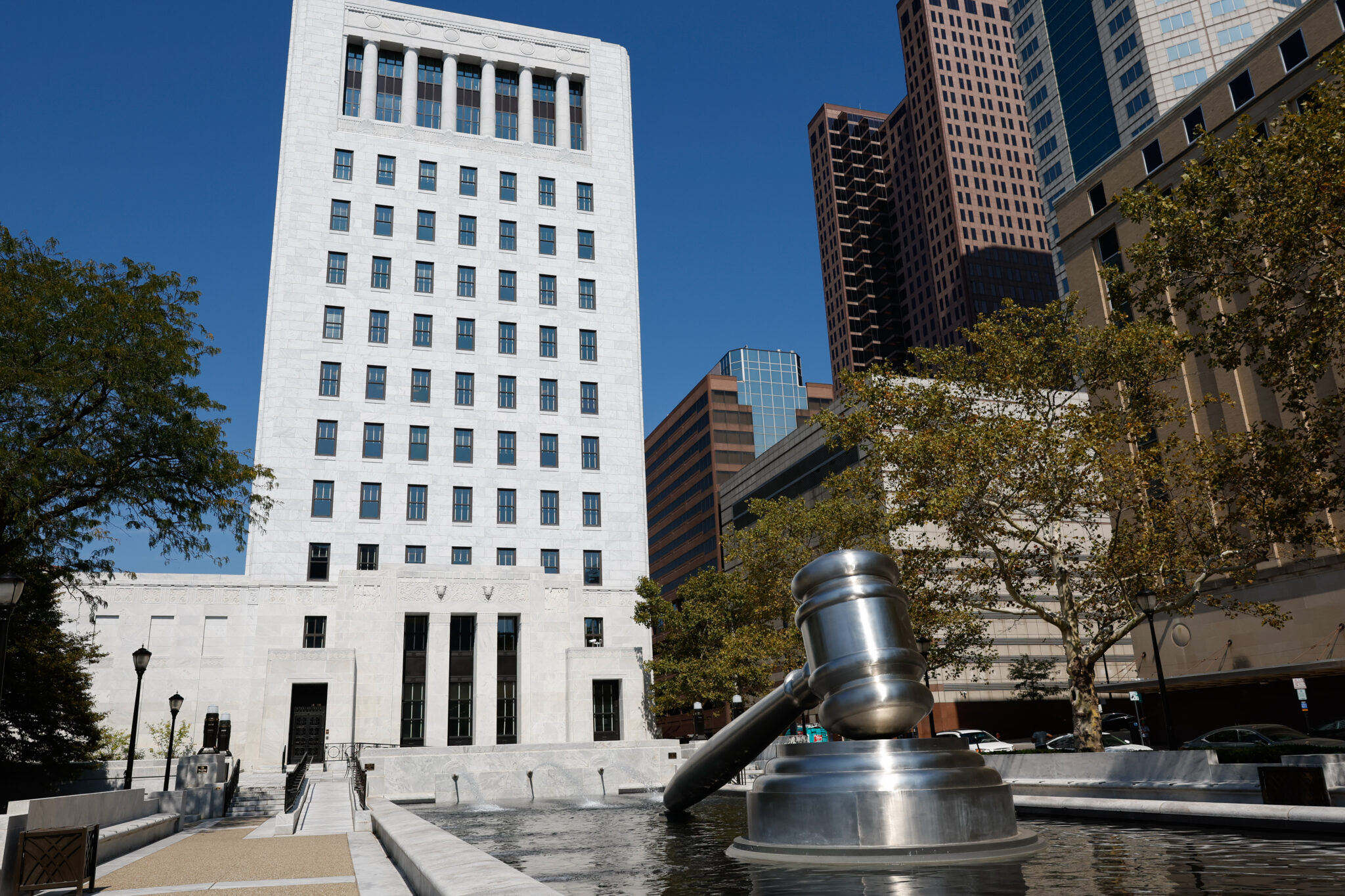
The Gavel outside the Supreme Court of the State of Ohio, September 20, 2023, at 65 S. Front Street, Columbus, Ohio. (Photo by Graham Stokes for Ohio Capital Journal. Republish photo only with original article.)
Republican majority rejects 6 of 8 changes requested by anti-gerrymandering advocates proposing the amendment
The Ohio Supreme Court largely approved ballot summary language for November’s Issue 1 anti-gerrymandering amendment on Monday, sending the language back to the Ohio Ballot Board for two revisions.
A 4-3 Republican majority rejected 6 of 8 revisions requested by anti-gerrymandering advocates, while Democratic justices on the court said that was inadequate and that the summary needed “a nearly complete redrafting.”
The summary was written by Ohio Secretary of State Frank LaRose, who opposes the amendment, and approved 3-2 by the Ohio Ballot Board, which is chaired by LaRose. LaRose is also a member of the current Ohio Redistricting Commission that the amendment proposes to replace with citizen commissioners.
While the court allowed most of the summary language in a decision released Monday night, it ordered the board to include in the summary “language that accurately conveys” that “the public would have the right to express itself to the new redistricting commission” under the terms of the amendment, written by anti-gerrymandering coalition Citizens Not Politicians.
“Distilled, the proposed amendment would provide the rights of public participation in the redistricting process through meetings, hearings and an online public portal, and would forbid communication with the commission members and staff outside the public-meeting and portal context,” the court wrote.
The other change ordered by the court compels the ballot board to make it clear that judicial review of the amendment is not limited to a “proportionality standard.”
The current seven-member Ohio Redistricting Commission includes the Ohio House Speaker and Ohio Senate President, along with the governor, secretary of state, auditor of state, and two minority party legislative leaders.
If approved by the voters, the amendment would replace the politician commission with the Ohio Citizens Redistricting Commission, which would have 15 members made up of five Republican citizens, five Democratic citizens, and five independents.
The summary language does not change the text of the proposed redistricting reform or what the amendment would actually do; it’s just the summary language used to describe the amendment on voter ballots.
An average of Ohio voter preferences over the last 10 years including 2022 show a 56-43 Republican-to-Democratic preference of Ohio voters, but Republicans control supermajorities of 67 out of 99 Ohio House seats and 26 out of 33 Ohio Senate seats. Ohio voters were forced to vote under unconstitutionally gerrymandered districts in 2022 after Republicans on the Ohio Redistricting Commission ran out of time to produce constitutional maps and a split federal court ruled the maps that were declared gerrymandered by a bipartisan majority on the then-Ohio Supreme Court had to be used.
Republican politicians on the Ohio Redistricting Commission battled with the bipartisan court majority for nearly two years over the maps in 2021 and 2022, with five Statehouse maps and two U.S. Congressional district maps being rejected as unconstitutionally gerrymandered. The swing vote in those cases, Republican Supreme Court Justice Maureen O’Connor, was forced to retire due to age. She is now leading the Citizens Not Politicians amendment effort.
One provision challenged by Citizens Not Politicians but allowed by the court states the amendment would “repeal constitutional protections against gerrymandering approved by nearly three-quarters of Ohio electors participating in the statewide elections of 2015 and 2018, and eliminate the longstanding ability of Ohio citizens to hold their representatives accountable for establishing fair state and legislative and congressional districts.”
Citizens Not Politicians attorneys argued mention of the vote margin and method were not necessary, and the court said challengers laid out arguments that the language was “tantamount to an argument against adopting the proposed amendment.”
But the court majority found that “at worst” including the vote margin and method could be “questioned on relevance grounds” not on “accuracy grounds.”
“This information is factually accurate, and relators have not shown that the information would ‘mislead, deceive or defraud the voters,’” the court majority stated in their decision.
The court also allowed language added by state Sen. Theresa Gavarone during the Aug. 16 board meeting, which states the amendment would “establish a new taxpayer-funded commission of appointees required to gerrymander the boundaries of state legislative and congressional districts to favor the two largest political parties in the state of Ohio.”
Justices dismissed Citizens Not Politicians arguments that the language leads voters to believe the amendment would “require gerrymandering,” despite the fact that the amendment states it would ban partisan gerrymandering.
The court said “the fact that the proposed amendment announces that it would ‘ban partisan gerrymandering,’ … is of little assistance in ascertaining whether the ballot language’s use of the word ‘gerrymander’ is improper.”
The court explored various definitions of “gerrymandering” in coming to its decision, finding that the requirement the amendment uses to dictate the drawing of Statehouse and congressional maps “falls within the meaning of ‘gerrymander.’”
“Because the board’s use of the term ‘gerrymander’ is consistent with dictionary definitions and how the United States Supreme Court has used the term, it does not mislead, deceive or defraud voters,” the decision stated.
The court did not order any changes to the ballot title, though that was included in the changes requested by Citizens Not Politicians.
“We conclude that the secretary did not err in crafting the ballot title,” the court wrote.
While all the justices agreed to the changes, they were split on how many changes needed to be made.
In his concurrence, Justice Patrick Fischer claimed “gerrymandering, though in a bipartisan manner, is absolutely ‘required under the proposed amendment,” and that the state constitution “would dictate” that independent and third-party voters would have their voice “removed from Ohio’s political world.”
Justice Michael Donnelly agreed to the decision that ordered changes to the ballot language, but “vehemently” disagreed “that those corrections are even remotely adequate to prevent the ballot language as a whole from being misleading.”
He and Justice Melody Stewart joined Justice Jennifer Brunner in an opinion that agreed to the changes, but said the majority opinion “reflects an abject failure of this court to perform an honest constitutional check on the ballot board’s work.”
“We should be requiring a nearly complete redrafting of what is perhaps the most stunningly stilted ballot language that Ohio voters have ever seen,” Brunner wrote.
She went on to say the ballot board language “is tantamount to performing a virtual chewing of food before the voters can taste it for themselves to decide whether they like it or not.”
The Ohio Secretary of State’s office said the ballot board will meet to make the revisions on Wednesday morning.
Reactions
Citizens Not Politicians released a statement saying they disagreed with “much of the decision” but agreed with the court’s “repudiation of the politicians on the ballot board for violating the Ohio Constitution.”
Ballot Board chair Frank LaRose released his own statement, calling the court’s decision “a huge win for Ohio voters, who deserve an honest explanation of what they’re being asked to decide.”
Former Ohio Redistricting Commission co-chair and Auditor of State Keith Faber said the court was “thoughtful in its approach and they got it right.”
Senate President Matt Huffman and Gov. Mike DeWine have both spoken against the measure publicly.
Faber’s fellow co-chair Senate Minority Leader Nickie Antonio said while the decision “enables Ohioans to make a more informed choice by addressing some of the most deceptive language, other misleading and argumentative language still remains.”
Susan Tebben
Susan Tebben is an award-winning journalist with a decade of experience covering Ohio news, including courts and crime, Appalachian social issues, government, education, diversity and culture. She has worked for The Newark Advocate, The Glasgow (KY) Daily Times, The Athens Messenger, and WOUB Public Media. She has also had work featured on National Public Radio.
Ohio Capital Journal is part of States Newsroom, the nation’s largest state-focused nonprofit news organization.
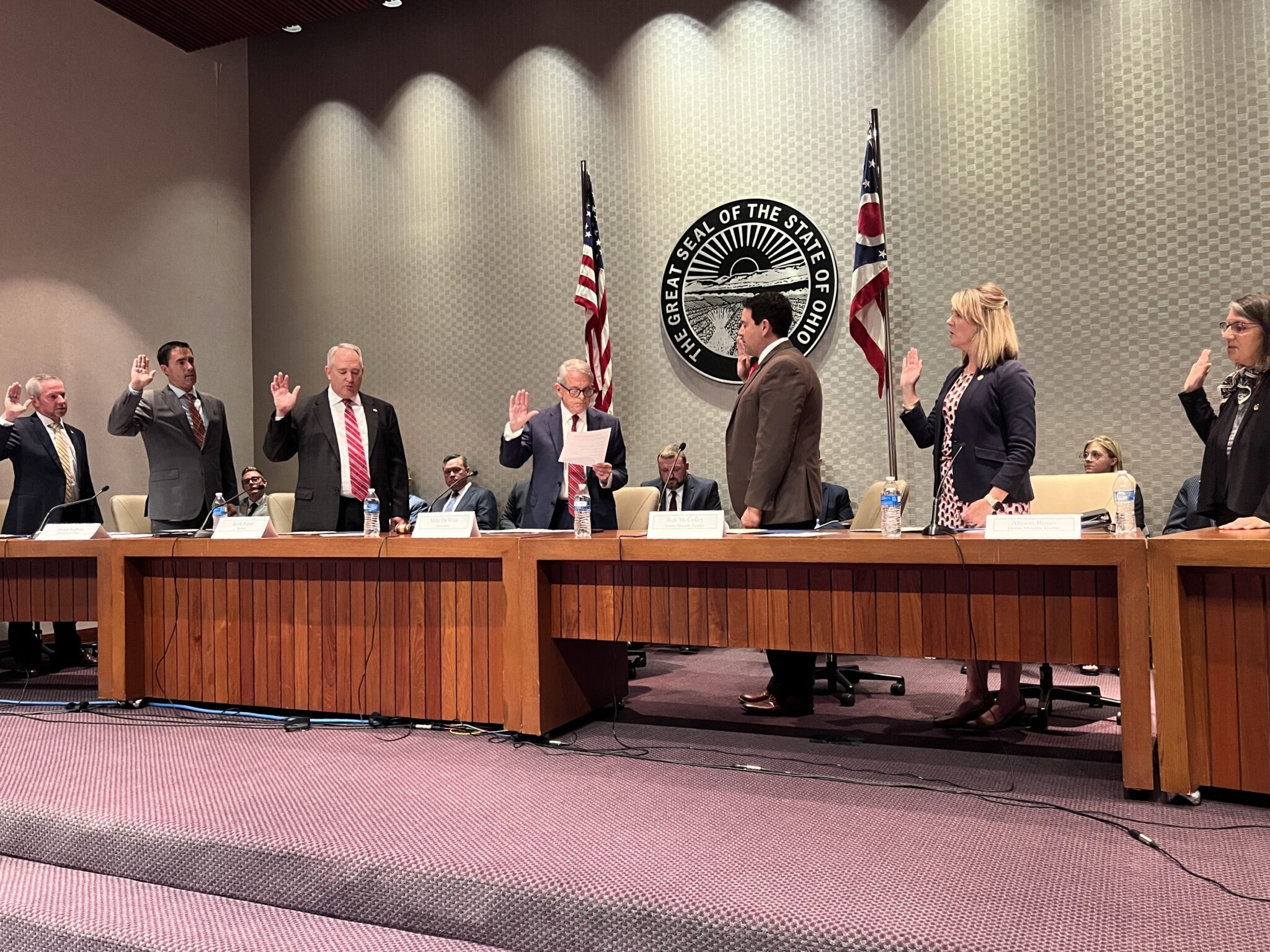
The members of the Ohio Redistricting Commission are sworn in by Gov. Mike DeWine on Wednesday. Left to right: State Rep. Jeff LaRe, Secretary of State Frank LaRose, Auditor of State Keith FSUSAN TEBBENaber, DeWine, Senate Majority Floor Leader Rob McColley, House Minority Leader Allison Russo and Senate Minority Leader Nickie Antonio. (Photo by Susan Tebben, OCJ.)
Signature collection continues for an anti-gerrymandering ballot measure in Ohio that would replace politicians on the redistricting commission with citizens. As the July deadline approaches, supporters are pointing to a new study showing how uncompetitive Statehouse races are.
The Brennan Center for Justice at NYU’s law school analyzed Ohio’s current maps alongside the results of the most recent primary election.
Authors of the study said the data “reveals one of the tangible ways Ohio’s gerrymandered maps undermine electoral competition, and how the districts leave millions of Ohio voters without a significant voice in the Ohio House elections slated for this November.”
“An overwhelming majority of Ohioans will cast ballots this November in legislative districts that were drawn to lock in general election outcomes, and few districts featured meaningful primary contests,” the Brennan Center report stated. “These are the predictable consequences of living in a gerrymandered state.”
One of the authors of the report, released Tuesday, is Yurij Rudensky, who spoke in support of the new ballot initiative proposed to hit voters in November. If it gets on the ballot and is passed by voters, the reforms would replace the current Ohio Redistricting Commission made up of elected officials with a citizen-run, judge-vetted commission to draw the next Statehouse and U.S. Congressional maps.
Rudensky spoke in a March panel, alongside former Ohio Supreme Court Chief Justice Maureen O’Connor and others, about the difference between the reforms passed in 2015 and 2018 and the proposed amendment that voters may see on their general election ballots.
At the March panel discussion, Rudensky hesitated to call the last two measures reforms because he argued no changes were made and the previous amendments merely demonstrated that “political insiders have no business being in the process.”
Since those amendments passed — reforms made through legislative negotiation before hitting the voters — the Ohio Redistricting Commission has been built on a Republican majority, with Gov. Mike DeWine, Senate President Matt Huffman, former House Speaker Bob Cupp, Secretary of State Frank LaRose and Auditor of State Keith Faber all standing on the commission during some or all of the proceedings over the two years it took for the group to pass six Statehouse maps and two congressional maps. State Rep. Jeff LaRe, R-Violet Twp., replaced Cupp and state Sen. Rob McColley, R-Napoleon, came in for Huffman toward the end of the two-year span.
The Statehouse maps were declared unconstitutionally gerrymandered five times by a bipartisan majority on the Ohio Supreme Court, but voters were forced by federal judges to use them for the 2022 Election.
In analyzing the current Ohio Statehouse maps, Rudensky and co-author Gina Feliz concluded that about 77% of the state’s population live in “districts where elections for state representatives are not in serious dispute.”
“That is, these districts are either uncontested, or they give one party a disproportionate advantage in the general election so that the district is uncompetitive, even if it’s formally contested,” the researchers wrote.
The report defines “uncompetitive” as districts where the partisan draw favors one party by 55% or more.
Source: Brennan Center analysis of Ohio Secretary of State’s Office Unofficial 2024 Primary Election Results.
Nearly half of the districts in the Ohio House didn’t have a primary contest in March to drive a November general election race, the Brennan Center research found, citing data from the Ohio Secretary of State.
“In all, there are 15 districts (out of 99 total) that will give voters no choice between Democratic and Republican candidates for state representative,” according to the study.
The report also recognized the low turnout in the state during the primary season, with an average of 18.8% of registered voters casting ballots in districts with competitive primaries.
Because of that, Rudensky and Feliz counted fewer than 450,000 voters who “all but decided who would serve as state representatives on behalf of more than 2.3 million registered voters and 3.5 million constituents.”
The report pointed to the proposed ballot initiative led by Citizens Not Politicians as a redistricting reform that could “center community needs and voter preferences rather than the interests of incumbents.”
Looking to a future that may have an independent redistricting commission, the voting rights group Common Cause put out its own report, a summary of a 2023 conference where members reflected on states who already have such a system in place, and those like Ohio that could see the change come in November.
“Unsurprisingly, all those who attended the conference believed in the possibilities of fair and representative maps and that independent redistricting commissions were the best strategy to achieve this goal,” Common Cause stated in the new report.
The “Roadmap for Fair Maps in 2030,” a summary of the 2023 National Citizen Redistricting Commissioners Conference, talked about the need to make redistricting a transparent process that is “responsive to community needs.” At the conference, the report said a “model commission” was organized for Ohio and neighbor state Indiana “to demonstrate how an alternative process based on community input and transparency can work.”
In a previous report, released shortly after the Ohio Redistricting Commission adopted the current Statehouse district maps, Common Cause gave the state a failing grade, calling the current map-drawing process and the results that came from it “unmitigated disasters.”
Ideally in redistricting, Common Cause members said the process should “ensure that commissions reflect the diversity of the jurisdiction” and engage community-based organizations and leaders to build resident trust and hold commissions accountable.
What should not be included in the process, according to the report, are legislature-appointed commissioners or any legislative role in the mapping process.
“Commission decisions on maps should be final, except for judicial review, with no approval from elected officials required,” the report stated.
The Citizens Not Politicians initiative was supported in the report as part of strategies to “increase fair representation in 2030,” the next time the process is set to start, though maps in Ohio would need to be redrawn in 2025 if the ballot measure passes in November.
Opposition to the initiative has been led by Huffman, who helped formulate the previous redistricting reforms. In an Ohio Chamber of Commerce event following the March primaries, he laid out his arguments against the initiative, saying litigation would pile up with the proposed system, and that “when allowed to work,” the current system did its job.
In order for the measure to appear on Ohio ballots in the general election, supporters must collect 413,487 valid state voter signatures by July 3.
SUSAN TEBBEN
Susan Tebben is an award-winning journalist with a decade of experience covering Ohio news, including courts and crime, Appalachian social issues, government, education, diversity and culture. She has worked for The Newark Advocate, The Glasgow (KY) Daily Times, The Athens Messenger, and WOUB Public Media. She has also had work featured on National Public Radio.
Ohio Capital Journal is part of States Newsroom, the nation’s largest state-focused nonprofit news organization.
The newest measure to change the Ohio Constitution and reform the redistricting process in Ohio has cleared its most recent hurdle: a typo.
The Ohio Ballot Board met Monday, quickly certifying a proposed constitutional amendment that would “replace the current politician-run redistricting process.” The board’s only role is to determine if an amendment follows the legal requirements that the measure only contain one amendment to the state’s constitution.
The certification came as no surprise, since the board had previously certified the amendment in October. This time around, the re-certification was needed after the creator of the proposed amendment, anti-gerrymandering group Citizens Not Politicians, noticed a typo in one of the deadlines mentioned in the amendment.
Attorney Don McTigue was present at Monday’s ballot board meeting, and said that nothing about the intent of the amendment changes with the correction of the error.
The amendment also went through multiple rounds of revisions, after Ohio Attorney General Dave Yost rejected the measure twice, saying amendment reviewers identified “omissions and misstatements” that the AG said would “mislead a potential signer as to the actual scope and effect of the proposed amendment.”
The amendment would replace the current redistricting process, also created through a constitutional amendment, and would eliminate the Ohio Redistricting Commission as it stands now, a seven-member panel made up of all elected officials, five from the GOP majority and two Democrats.
The commission would be replaced with a “citizen-led commission,” chosen by a bipartisan panel. If approved by the voters, the amendment would create the Ohio Citizens Redistricting Commission, which would have 15 members, five matching the political party of the governor at the time, five from the party of the gubernatorial candidate who received the second-most votes in the most recent election, and five unaffiliated members.
The statehouse districts adopted in September by the current commission are being challenged in a case before the state’s highest court, but no decision has been made.
The ORC has been rife with chaos and uncertainty as well, as the last two years contained multiple line-up changes, arguments over deadlines and lack of action, and even a stumbled start to the most recent adoption process.
In the new amendment proposal, the citizen-led commission would have to create a redistricting plan with political party proportions that “correspond closely to statewide partisan preferences of the voters of Ohio,” and the commission has to state how the districts’ partisan divide was determined.
The group who wrote the measure defines “correspond closely” as no more than a 3-percentage-point difference between the redistricting plans and the statewide voter preferences, “unless arithmetically impossible.”
The Ohio Supreme Court holds the jurisdiction for all court challenges of redistricting plans in the amendment, just as it does in the current system. That system was criticized, however, for not creating enough of an enforcement mechanism. The state supreme court rejected seven different district maps, but did not hold commission members in contempt for missing deadlines.
The commission also did not receive any consequences for eschewing a proposal from court-ordered mapmakers, brought in on the taxpayers’ dime, and passing a map that was nearly identical to a previous, unconstitutional statehouse map.
In the new process, if approved by voters, “special masters” would be chosen to “review the record before the commission and hold a public hearing” if a court challenged is filed against a redistricting plan. Then, a report must be issued “as to whether the commission abused its discretion in its determination that the adopted plan complies with the partisan fairness criteria required by the amendment for a redistricting plan.”
Once the report from the special masters is released, objections to the report can be filed with the Ohio Supreme Court, who will ultimately rule on the maps.
The commission would have an appropriation from the Ohio General Assembly of $7 million for 2025 redistricting under the new measure, plus more for the bipartisan panel who chooses the commission.
The cost of the special masters would come from the Ohio Supreme Court’s budget, according to the amendment language.
Signature collection for the initiative can begin again, now that the state ballot board has re-approved the measure. According to Citizens Not Politicians, the group must collect 413,487 valid Ohio voter signatures by July 3, 2024, to qualify for the general election next year.
SUSAN TEBBEN
Susan Tebben is an award-winning journalist with a decade of experience covering Ohio news, including courts and crime, Appalachian social issues, government, education, diversity and culture. She has worked for The Newark Advocate, The Glasgow (KY) Daily Times, The Athens Messenger, and WOUB Public Media. She has also had work featured on National Public Radio.
Once the Ohio two-year budget cycle is finished by June 30, Ohio Senate President Matt Huffman expects work to begin again on redistricting for Statehouse maps, with September as a likely date for them, he told reporters recently.
Both Ohio’s U.S. Congressional district maps and Statehouse maps were declared unconstitutional gerrymanders multiple times by a bipartisan majority of the former Ohio Supreme Court, but voters were nevertheless forced to vote under them in 2022 after Republicans on the Ohio Redistricting Commission ran out the clock and appealed to a federal court.
With swing vote former Ohio Supreme Court Republican Chief Justice Maureen O’Connor forced to retired due to age, Republicans added partisan labels to the 2022 Ohio Supreme Court races and won a majority of justices. Gov. Mike DeWine then appointed a family friend to an open seats after Justice Sharon Kennedy was elected chief justice.
The new right-wing 4-3 majority on the court is not expected by analysts to have a swing vote on the issue of gerrymandering going forward. O’Connor has called for further anti-gerrymandering reform by Ohio voters, which had passed such reform in 2015 and 2018 with more than 70% of the vote. That system left politicians in charge of the process, however. O’Connor has since called for an independent commission.
Ohio Republicans have also brought a case to the U.S. Supreme Court over the congressional district maps, seeking the court to declare under a theory called “independent state legislature doctrine” that the Ohio General Assembly has total control over the maps and the Ohio Supreme Court does not have jurisdiction.
Because the high court has yet to decide whether or not it will review the case, Huffman told reporters last week that the congressional maps could stay the same for the 2024 election.
“(The congressional map’s) a little bit more uncertain, it may simply be that we have the same congressional districts for the 2024 race as the one we have now,” Huffman said.
As for the Statehouse maps, it’s up to the governor to call the Ohio Redistricting Commission back into session, Huffman said. The commission is made up of a majority of Republican leaders, including the governor, Auditor of State Keith Faber and Secretary of State Frank LaRose, as well as a Republican and Democrat from each chamber of the state legislature.
Huffman – who was on the commission until he and then-House Speaker Bob Cupp removed themselves, saying they were needed for other legislative duties – sees a mid-September date as a likely end date for the Statehouse district discussion.
“The plan in my head…is that we would start in earnest after June 30, have hearings and all of the other negotiations and things that are to be done and to try to have a map by mid-September,” Huffman said.
He said he doesn’t know “how much all the districts will change” in the General Assembly maps, but action will be needed on them.
One change that could come into play for the Statehouse maps has to do with a recent U.S. Supreme Court decision in an Alabama redistricting case.
In the case, the court upheld a lower court decision that the state had likely violated the Voting Rights Act with a congressional map that had one majority Black district.
Amid redistricting deliberations in Ohio, a staffer who helped draw some of the earliest maps in the process said he was directed to ignore racial data in drawing state districts.
A lawsuit was filed by two Youngstown residents accusing redistricting officials of racial discrimination. The lawsuit did not see further action as maps were redrawn several times, and a federal court ordered the commission to redraw maps after they were used for the 2022 election.
Though the Alabama decision was considered a general win for the Voting Rights Act, it’s not clear how much change it will make in Ohio.
“It may prompt the legislature or the commission to approach the redraw differently, but I don’t see anything in the lawsuit that necessitates that change,” said Yurij Rudensky, senior counsel for the Democracy Program at the Brennan Center for Justice.
The Alabama decision upheld existing Voting Rights Act language that bars states from ignoring demographics.
“If it is such that the conditions on the ground could lock out voters of color from being able to participate in the process … there has to be an eye to how voters of different races are being grouped together,” Rudensky said.
Rudensky is also counsel in a lawsuit between the Ohio Organizing Collaborative and the ORC challenging district maps in the state.
A spokesperson for Ohio House Speaker Jason Stephens did not respond to requests for comment on the status of the redistricting process.
Asked whether Gov. Mike DeWine had a plan when it came to redistricting post-budget cycle, a spokesperson said “it is accurate we are focused on the biennial budget due June 30th, as is the General Assembly.”
SUSAN TEBBEN
Susan Tebben is an award-winning journalist with a decade of experience covering Ohio news, including courts and crime, Appalachian social issues, government, education, diversity and culture. She has worked for The Newark Advocate, The Glasgow (KY) Daily Times, The Athens Messenger, and WOUB Public Media. She has also had work featured on National Public Radio.
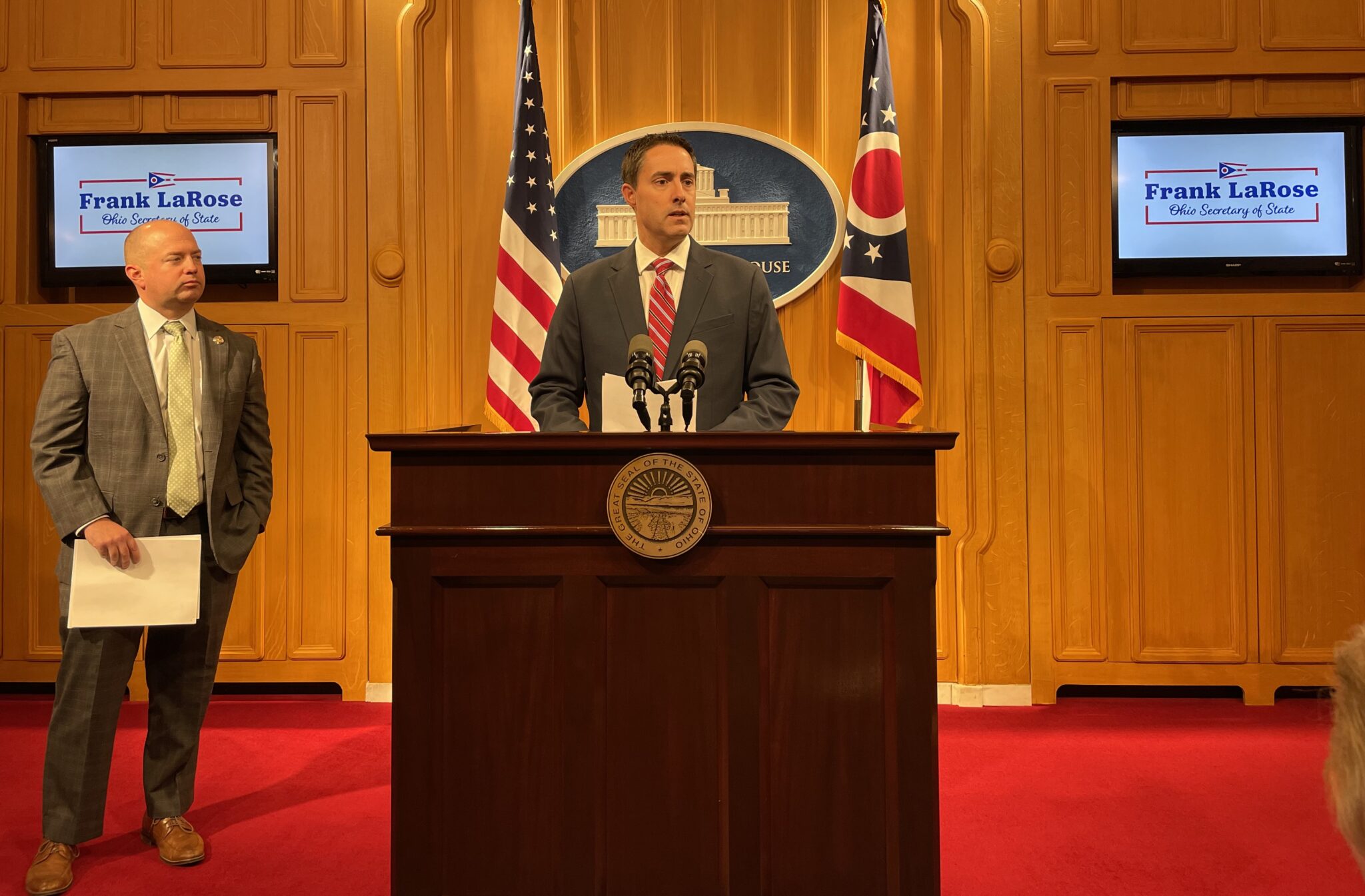
Secretary of State Frank LaRose (speaking) alongside Rep. Brian Stewart, R-Ashville, introducing a constitutional amendment requiring a 60% supermajority for all future citizen-led ballot amendments. (Photo by Nick Evans, OCJ.)
Ohio Secretary of State Frank LaRose denied that he wanted to block abortion protections or anti-gerrymandering measures when he announced that he wanted to hustle through a measure that would make it harder for voters to amend the Ohio Constitution.
But he’s failed to point to a single amendment in the Constitution as an example of what he’s trying to protect against by changing rules that have been in place for more than a century.
LaRose is proposing that — after advocates clear the already high hurdles to get proposed constitutional amendments on the ballot — they also be required to get at least 60% of the vote instead of the 50% plus one vote that’s currently needed.
Meanwhile, amendments initiated by Ohio’s gerrymandered legislature would continue to need only 50% of the popular vote to make their way into the state Constitution. Ironically, the amendment LaRose wants that would make it harder to pass voter-initiated amendments falls into that latter, easier-to-pass category.
LaRose’s stated reason why citizens should lose some of their ability to change the Ohio Constitution: It’s badly needed to protect against wealthy interest groups that want to insert self-serving measures into what LaRose called “the state’s founding document.”
“If someone is a special interest and they want to create a monopoly for themselves let’s say, or to try to do something that narrowly benefits their own interest, maybe it will make them think twice before they try to amend the Constitution,” LaRose said during a press conference on Nov. 17.
So how many times have such powerful special interests actually succeeded in initiating a harmful constitutional amendment?
LaRose didn’t cite any during his press conference. Instead, he said that of the 16 citizen-initiated amendments proposed in the past 22 years, just five have passed. And in response to a question, the secretary of state conceded that of the ones that passed, just two failed to get less than 60% of the vote.
LaRose’s office didn’t respond when asked for an example of a problematic amendment in the Ohio Constitution that his proposal would have prevented — or to other questions for this story. But while he and his staff didn’t cite any such examples, there are some citizen-initiated amendments coming that LaRose and the state’s other Republican leaders may well oppose.
One is a measure that would amend the Ohio Constitution to protect abortion rights.
When the U.S. Supreme Court in June overturned Roe v Wade, a 2019 law signed by Gov. Mike DeWine took effect. It outlawed the vast majority of abortions months earlier than they had been and almost immediately, horror stories started to pile up.
This month’s elections showed that in states where abortion was on the ballot, it proved to be a powerful motivator for supporters of abortion rights. And, with the Republican dominated legislature expected to pass even stricter restrictions, abortion-rights groups are planning to seek a voter-initiated amendment to protect those rights.
At the same time, LaRose’s fellow Republicans in 2021 and 2022 ignored voter-initiated amendments against gerrymandering that passed with more than 70% of the popular vote. The Republican-dominated Redistricting Commission drew state legislative maps that were rejected five times by the Ohio Supreme Court as unconstitutionally gerrymandered. LaRose sits on the commission and voted for each of the maps that have been declared unconstitutional by a bipartisan court majority.
GOP members of the commission complained that the changes the court was demanding were unconstitutional. That ignores the fact that it’s the job of the Supreme Court to decide what is or is not constitutional — not members of the executive and the legislative branches who were litigating a dispute before it.
In April, LaRose told a group of Union County Republicans that he’d “be fine with” impeaching Republican Chief Justice Maureen O’Connor for voting with the court’s three Democrats to strike down the Republican-drawn maps. LaRose claimed O’Connor had violated her oath of office in ruling against his party.
The Republicans succeeded in running out the clock and starting next year, the party’s representatives in the state legislature will continue to be wildly overrepresented compared to the partisan mix of the state as a whole. And they’ll be representing districts that are officially unconstitutional.
The chief justice, who is retiring, has said that citizens need to come up with new citizen-initiated amendments with fewer loopholes if Ohioans want to end extreme gerrymandering.
In his press conference last week, LaRose claimed that he’s not seeking to block amendments supporting abortion rights or ending gerrymandering. Such short-term goals weren’t good reasons for undertaking something as weighty as amending the Ohio Constitution, he said.
“If you’re going to amend the Constitution, you need to be thinking about the long term,” he said. “So anybody who’s thinking about shorter or transient goals in the next year or two or three years, that’s not what this kind of a change should ever be about.”
LaRose added, “If we’re talking about amending the Constitution probably for the rest of our lifetimes, that’s something that should be taken very seriously.”
But among the questions his office wouldn’t answer this week: Why — if this should be such a deliberative process — did he wait until late November to announce that he would try to ram the measure through in a weeks-long, lame-duck session with an eye toward getting it on the ballot in May? Only about five months would elapse between the time the public first learned of the proposal and when it could alter the state Constitution, as LaRose said, “probably for the rest of our lifetimes.”
In his press conference, LaRose denied that he was trying to hurry the measure through.
“I don’t think it’s a rush necessarily,” he said. “It’s an idea whose time has come.”
Ohio Democrats have denounced LaRose’s push as a “power grab.”
But at the same time he was proposing to make it harder for voters to change the Ohio Constitution, LaRose seemed to say he was doing it in support of democracy.
“That’s the beauty of this, is that all the power rests with the people of Ohio,” he said.
For the second time, the Ohio Supreme Court rejected a map for congressional districts in the state.
The court ruled that the map violated the constitution by favoring one political party over another irrespective of election results across the state.
“We hold that the March 2 plan unduly favors the Republican Party and disfavors the Democratic Party in violation of the (Ohio Constitution),” the majority decision reads.
The 4-3 decision reflected the other decisions the court has made on redistricting: Chief Justice Maureen O’Connor voted to reject the maps, along with Justice Michael Donnelly, Justice Melody Stewart and Justice Jennifer Brunner. Justices Sharon Kennedy, Patrick DeWine and Patrick Fischer all dissented in the case.
In ruling against the partisanship in the congressional map, the court called out the commission for creating Democratic districts with razor-thin advantages, while the Republican-leaning seats “comfortably favor Republican candidates.”
In the most recent congressional map, only three Democratic-leaning seats have more than 52% Dem advantage, whereas all Republican-leaning seats have more than 53% GOP advantage.
“Considering that Democratic candidates have received about 47% of the vote in recent statewide elections, this probable outcome represents only a modest improvement over the (previously) invalidated plan,” according to the court decision.
The court pushed back against arguments made by Ohio Redistricting Commission members, including Senate President Matt Huffman and House Speaker Bob Cupp, both of whom have left the commission since then, replaced by state Sen. Rob McColley and state Rep. Jeff LaRe.
The legislative leaders and their replacements on the commission tried to argue they were not obligated to correct “legal defects” in the original congressional plan while revising the plan.
“The commission’s constitutional duty is to adopt a congressional district plan to replace the original, invalidated plan,” the court majority wrote. “Indeed, the commission has a constitutional duty to remedy the defects in the previous plan.”
Huffman, Cupp, McColley and LaRe said fixing the “defects” would “incentivize” Democrats to vote against the plan, and called the article setting forth anti-gerrymandering rules a “safety valve of sorts” for the ORC to adopt a plan that didn’t have to align with the same redistricting rules as the General Assembly.
“No constitutional language suggests that the voters who approved Article XIX intended to allow the prohibitions against partisan favoritism and unduly splitting governmental units to be avoided so easily,” the majority ruled.
The lawsuit was filed in March, after the Ohio Supreme Court turned down calls to reject the maps in a previous lawsuit on congressional redistricting. The court said because its previous decision to reject the first congressional map was final, challengers had to file a new lawsuit to challenge the second version.
The supreme court rejected the first map on the same grounds as the second rejection: partisan favoritism.
In their dissent to the majority decision, Kennedy and Patrick DeWine said they would have left the plan in place as constitutional and allow its use for the 2024 primary and general elections.
Kennedy and DeWine said because they would have held that the first congressional map “did not unduly favor Republicans and was constitutional,” they would have done the same for the second plan.
DeWine, who is Gov. Mike DeWine’s son, has recused himself from any court cases regarding holding the ORC members in contempt of court due to his father’s participation as a commission member. However, he has refused calls for his recusal in all redistricting cases because of his father’s involvement in the process.
Fischer joined the dissent, but wrote separately to argue that map challengers “do not even meet the lower clear-and-convincing evidence burden of proof or the even lower preponderance-of-the-evidence burden of proof” that the second congressional map unduly favored Republicans.
He also criticized the process conducted by the state supreme court, saying a lack of hearings “undoubtedly raises concerns among the public regarding this court’s lack of transparency.”
“This court’s misguided rush to decide these cases has resulted in an unnecessary and truncated procedure that has effectively tied this court’s hands and rendered it unable to make a fully informed decision,” Fischer wrote.
The court gave the General Assembly 30 days to pass a new map, and if they can’t, the Ohio Redistricting Commission will have another 30 days to do so.
Since the May primary, which included congressional races, already occurred, a new congressional plan’s impact will go forward to 2024 elections.
The legislature is currently on summer break, set to come back in the fall. Huffman’s spokesperson did not respond to a request for comment on the ruling, or if they would be reconvening the GA early to deal with the issue.
A spokesperson for Cupp said the office was reviewing the decision.
The ORC’s co-chair, Democratic state Sen. Vernon Sykes joined Senate Minority Leader Kenny Yuko in saying the court “made it clear that Republicans have repeatedly used the redistricting process to give themselves an unfair advantage.”
“Once again, we are ready to follow the law and give Ohioans the fair maps they demanded,” Sykes and Yuko said in a statement. “We hope this time our Republican colleagues will join us, instead of trying to run out the clock.”
A spokesperson Ohio Secretary of State Frank LaRose, the state’s chief elections officer and a member of the redistricting commission, said LaRose’s office had received the ruling and had a legal team reviewing the decision.
The League of Women Voters, one of the two parties who challenged the congressional maps, praised the decision and hoped for swift and public action to adopt new congressional maps.
“We agree that the congressional map is beyond a reasonable doubt gerrymandered, and we stand ready to work with the mapmakers to see a map produced that truly upholds the will of the voters for a free and fair election,” said Jen Miller, executive director of the LWV of Ohio.
Ohio Gov. Mike DeWine has signed Statehouse Republicans’ congressional map for Ohio giving the GOP a substantial advantage, claiming that of all the maps presented it “makes the most progress to produce a fair, compact and competitive map.”
DeWine pointed to fewer county splits in the map and the number of Ohio cities the map keeps whole.
“With seven competitive congressional districts in the SB 258 map, this map significantly increases the number of competitive districts versus the current map,” DeWine said.
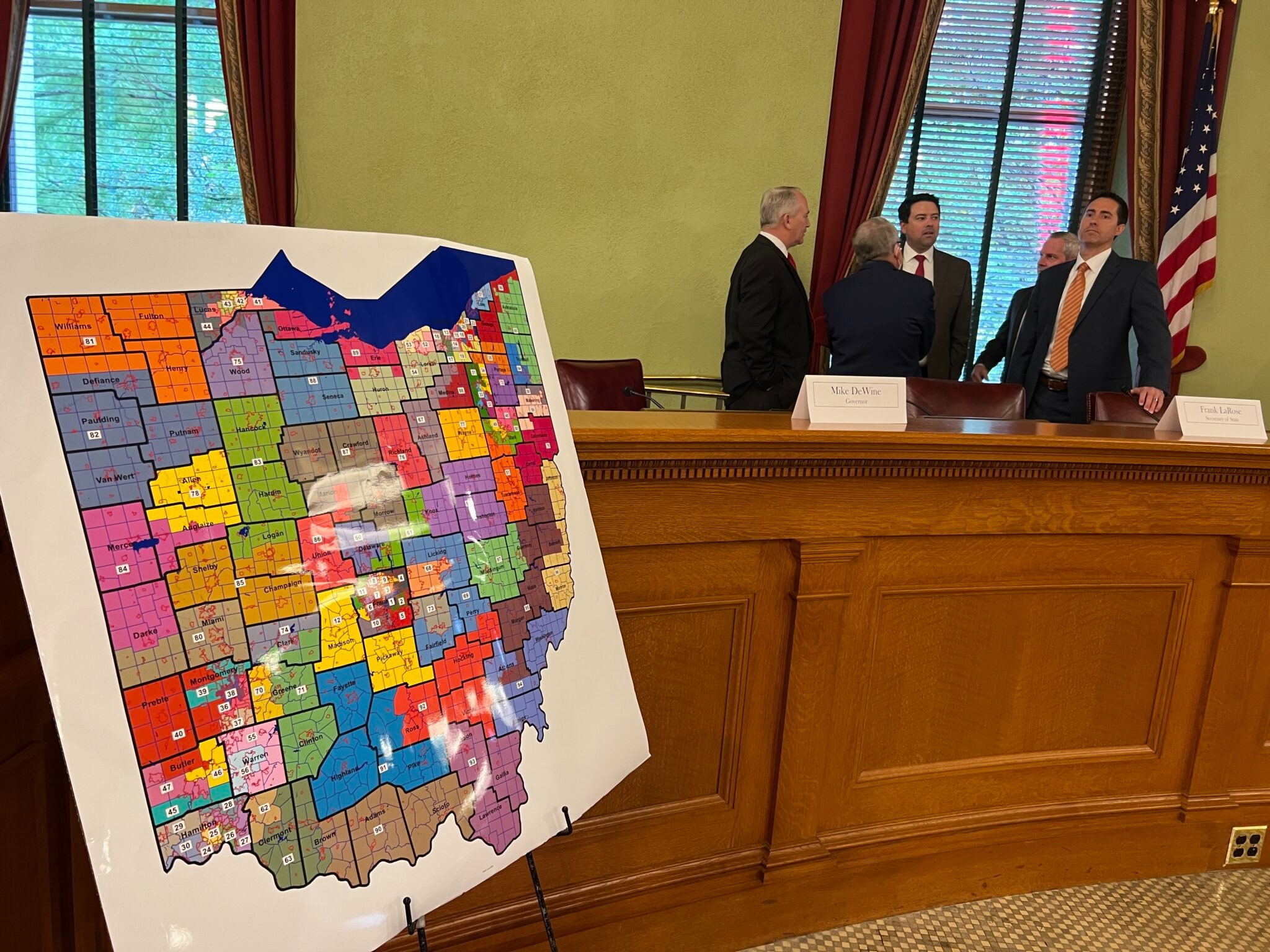
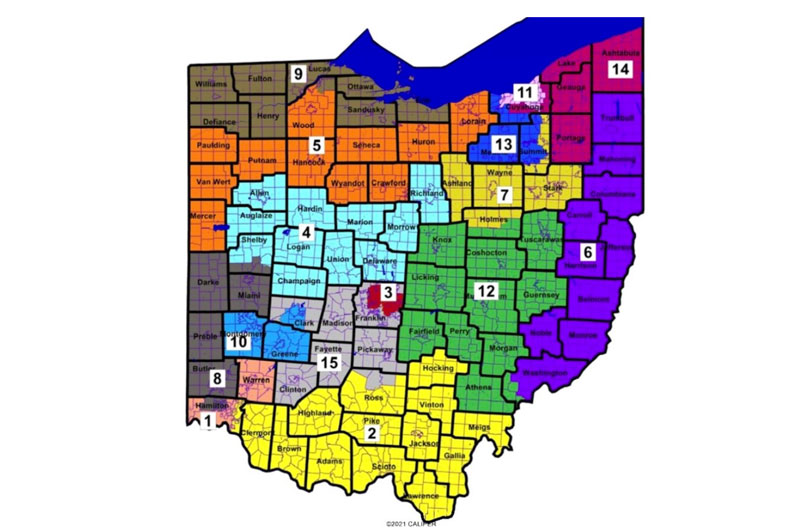
The GOP congressional map signed by Gov. Mike DeWine. (Right-Click to enlarge map)
Without bipartisan support, the map is slated to only be in place for four years. With DeWine’s signature, legal challenges are expected to be forthcoming. Statehouse legislative maps approved by the Ohio Redistricting Commission with only Republican support in September are facing legal challenges currently before the Ohio Supreme Court.
DeWine’s son, Justice Pat DeWine, has refused to recuse himself from the case, making Chief Justice Maureen O’Connor the potential swing vote on the constitutionality of the Republican plans that continue Republican supermajorities in the Ohio House and Senate and now an 11-2 advantage in congressional maps with two potential toss-up districts.
Ohio voters passed redistricting reform for state legislative maps in 2015, with more than 70% support, and congressional redistricting reform in 2018 with nearly 75% support. Those reforms called for maps that do not “unduly favor or disfavor” one political party or another.
The map approved Thursday in the House was introduced just Monday night as an amendment replacing the maps previously discussed in committee hearings. After the map was unveiled, it had one hearing in which a committee heard public comment. Every speaker was an opponent. The Princeton Gerrymandering gave the map a flunking grade.
An analysis of the map on Dave’s Redistricting App shows seven Republican districts, two Democratic districts and six districts listed as competitive for being within a 54-46 margin. Five in six of the “competitive” districts lean Republican, and the one that leans Democratic, Ohio’s 13th district, does so by 0.88%. It was passed along partisan lines in both the Ohio Senate and Ohio House this past week.
DeWine’s signing of the GOP congressional maps was criticized by anti-gerrymandering advocates.
“Once again, Gov. DeWine has failed to stand up to the extremists in his party. He could have rejected gerrymandered maps, but chose weakness instead,” said Desiree Tims, president and CEO of Innovation Ohio. “These rigged districts will lead to more extreme politicians who pass dangerous laws that devastate Ohio communities.”
The map will give Republicans 80% to 87% of Ohio’s congressional seats, the advocates noted, despite the fact that Republicans only win about 55% of Ohio’s statewide vote.
“Regardless of our skin color or zip code, everybody deserves to have a meaningful influence on our political process and choosing who gets to represent us,” said Jeniece Brock, Policy and Advocacy Director of the Ohio Organizing Collaborative. “By cracking and packing communities of color, this congressional map dilutes the power and voices of Black and brown Ohioans.”
The Ohio Senate Local Government and Elections Committee hears from the public on two redistricting proposals, one from Senate Dems and the other from the Senate GOP on November 4.
The last of the General Assembly’s congressional redistricting public hearings in individual committees are this week, just as a joint committee starts work.
In Senate Local Government and Elections Committee on Tuesday, the last scheduled hearings on GOP and Democratic bills to change the congressional district maps in the state occurred, with much of the same criticism for the GOP map that anti-gerrymandering groups and Ohioans in target areas say don’t focus on fairness.
The Ohio Senate GOP’s congressional redistricting map proposal.
On Tuesday, Bellbrook resident Wendy Dyer spoke through tears about the volunteering she did to promote the petition that would eventually change the state constitution and the redistricting process as a whole. She said at that time she felt a sense of achievement and change in the state, something that’s now changed with the map proposals from the GOP.
“I thought Ohio had really accomplished something,” Dyer said. “Now I really just feel stupid that I honestly believed that my government would do the right thing.”
Anne Light Hoke, of Columbus, said she disagrees with the Senate Republican map that moves her from District 3 to District 15, which is nestled in with three other districts in Franklin County, but then stretches due south into most of rural Southeastern Ohio.
Hoke said as a resident of Columbus, she said she has “urban concerns” like public transportation, traffic congestion and police brutality.
“Although I was born in a small town, I no longer have small town concerns like broadband access, access to sewer systems and water systems, burning trash regulations and fracking,” Hoke told the committee members on Tuesday.
The public input is set to continue Wednesday morning in the House Government Oversight Committee on House Bill 479, the House GOP’s map proposal. As of Wednesday, the committee agenda had not changed to include a new map proposal from the House Democrats, introduced on Monday.
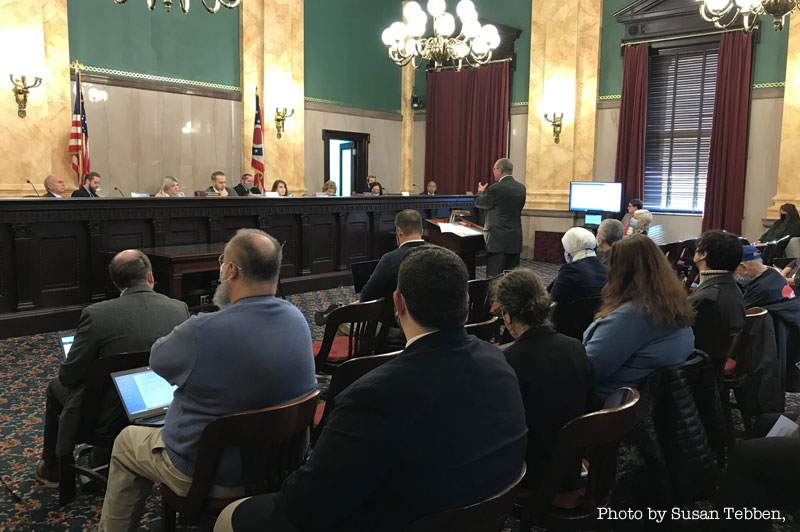
Also on Wednesday, the new joint committee on congressional redistricting is scheduled to meet for the first time at 2:30 p.m. in the Ohio Statehouse’s south hearing room. The two chairs of the House and Senate committees that have been hearing individual map proposals, state Rep. Shane Wilkin, R-Hillsboro and state Sen. Theresa Gavarone, R-Bowling Green, will be the co-chairs of the joint committee.
The joint committee is also scheduled to meet on Friday at 10:30 a.m., in the House Finance Room (Room 313).


![[WATCH] Ohio Secretary of State candidate Bryan Hambley](https://lovelandmagazine.com/wp-content/uploads/2025/06/Hambley-interview.jpg)