Tag: anti-trans legislation

  • Ohio governor, state agency lays out suicide prevention plan

    Ohio governor, state agency lays out suicide prevention plan

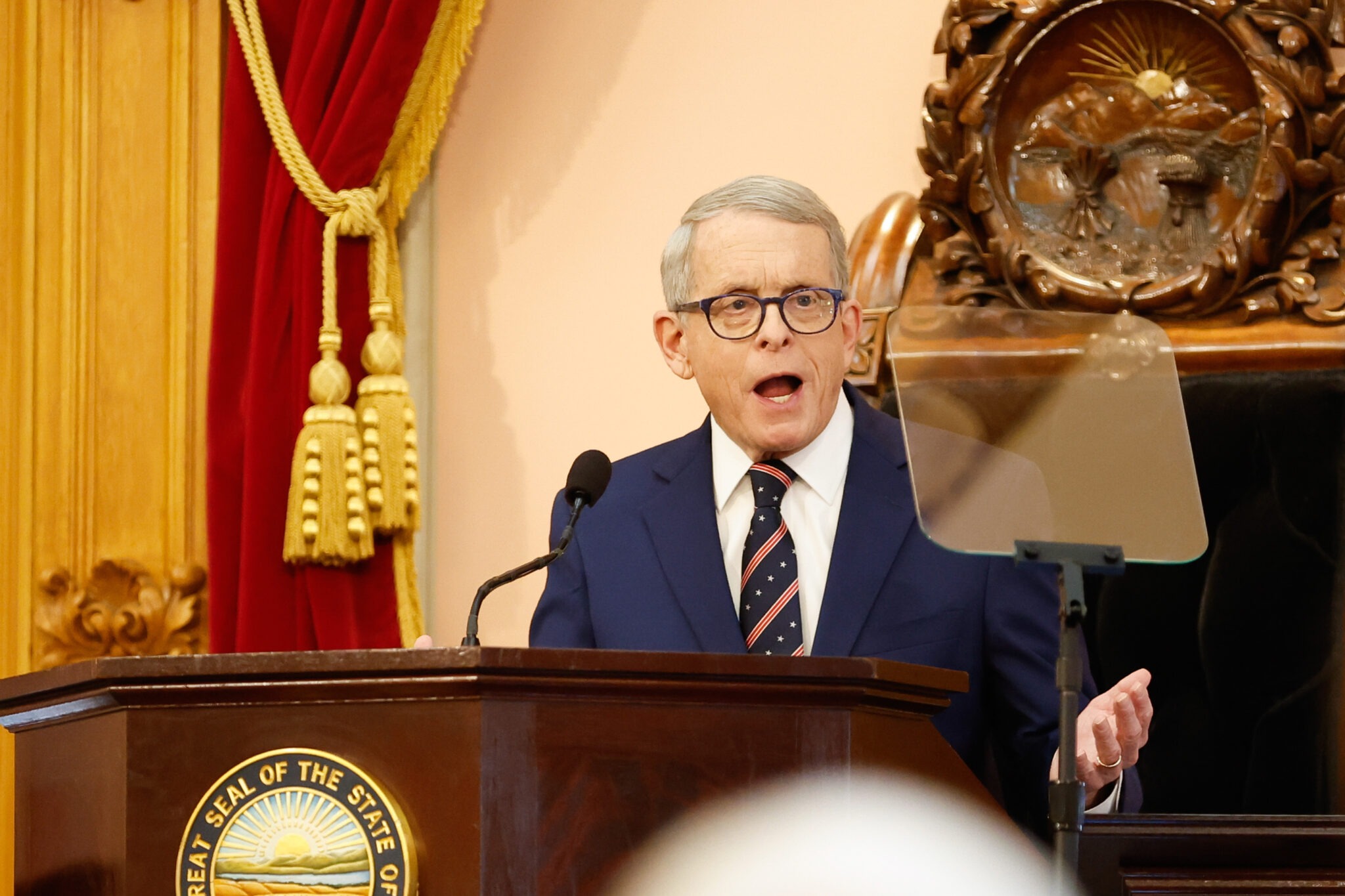
    JANUARY 31: Ohio Gov. Mike DeWine during the State of the State Address, Jan. 31, 2023, in the House Chamber at the Statehouse in Columbus, Ohio. (Photo by Graham Stokes for Ohio Capital Journal. Republish photo only with original story.)

    Plan mentions high risk to LGBTQ community impacted by gender-affirming care rules, HB 68

    BY:  Ohio Capital Journal

    Ohio Gov. Mike DeWine announced a two-year plan for suicide prevention, including with it statistics many advocates cited in opposing anti-trans legislation passed by lawmakers, and administrative rules the governor proposed.

    The 2024-2026 Suicide Prevention Plan “aims to promote life-saving strategies statewide,” according to an announcement by the governor’s office. The plan was developed in partnership between the RecoveryOhio initiative and the Ohio Suicide Prevention Foundation, “incorporating input from more than 30 private and public organizations,” according to the governor’s office statement.

    The plan’s main goals are centered around public awareness, data gathering, expansion of health care access and support for those with family members who have died by suicide.

    Tony Coder, executive director of the Ohio Suicide Prevention Foundation, wrote in an introduction to the prevention plan that suicide in the state “is at a crisis level, and it will take a statewide effort to reduce the rate of loss.”

    “We need policymakers to create common sense legislation that will improve our behavioral health care system,” Coder wrote. “…We need all hands on deck to end suicide.”

    The groups listed as most affected by suicide in Ohio include rural and Appalachian Ohioans, Ohioans with disabilities, veterans, males, young adults, and LGBTQ+ Ohioans.

    “Nationally, 1 in 5 transgender and nonbinary youth reported attempting suicide in the past year in 2022,” the report stated, also noting that lesbian, gay and bisexual youth are 4.8 times more likely “to consider suicide” and 4.3 times more likely to attempt it than their heterosexual peers.

    The report comes as transgender rights advocates and parents alike say new legislation by the Ohio General Assembly and administrative rules proposed by the governor could cause even more suicide risk to transgender youth, a group already at major risk of suicide, according to studies and medical data.

    One 2023 national study from The Trevor Project found 41% of LGBTQ+ youth surveyed have “seriously considered attempting suicide in the past year,” and that “anti-LGBTQ victimization” contributes to raise rates of suicide risk.

    House Bill 68 bans gender-affirming care for minors in Ohio, a measure that was supported by the Republican supermajority in the Ohio House and Senate, but was vetoed by DeWine.

    The support from the legislature came despite hours of testimony, hundreds of submissions opposing the bill, public protests at chamber votes, and support for gender-affirming care from major medical organizations across the country.

    DeWine’s veto was overridden by the House earlier this month, and by the Senate just last week, allowing the measure to go through, though it may face legal challenges in the near future.

    Even as DeWine vetoed HB 68, he introduced an emergency rule on Jan. 5 prohibiting health care facilities and other medical facilities from “performing gender surgeries on minors,” despite the fact that Ohio children’s hospitals say they haven’t been doing so, even before the rule or legislation was created.

    Two other rules have been proposed, one of which would establish a process through the Ohio Department of Mental Health and Addiction Services to diagnose and treat a “gender-related condition,” but only provide “gender transition services,” not surgical services, according to the draft language.

    A mental health evaluation and counseling would be required for at least six months before diagnosis or any treatment. That evaluation was criticized in public comment submitted regarding the draft language, in which Kathryn Poe, budget and health researcher for Policy Matters Ohio, said definitions in the draft rule “set a dangerous precedent for an organization concerned with the mental health of Ohioans, especially given th elevated risk for transgender Ohioans.”

    The second proposed rule would direct the Ohio Department of Health to report data on gender care to the General Assembly and the public every six months, while also creating “quality standards for those hospitals and ambulatory surgical facilities that wish to treat gender-related conditions.”

    In the new suicide prevention plan for 2024-2026, goals specifically targeted toward LGBTQ+ youth include offering “learning opportunities to grow knowledge skills for specific evidence-based practices, policies and services to impact high-risk populations, including Black and LGBTQ+ youth and young adults.”

    Included in proposed “action steps” to reduce suicide for LGBTQ+ is the creation of “workforce learning opportunities related to stress and risk factors of LGBTQ+ youth,” building “opportunities for affirming spaces and supportive relationships with trusted adults” and promoting anti-bullying policies in schools.

    The report also cites The Trevor Project as a resource for “evidence-informed strategies” to be used in the state for improved suicide prevention outcomes.

    The creator of HB 68, state Rep. Gary Click, called the Trevor Project an “advocacy group” in November as part of a committee meeting on the bill, claiming statistics on transgender mental health reported by the group were “a political statement” that was “designed to intimidate people like me from carrying legislation which would help protect young people.”

    “I totally reject that my bill causes people harm,” Click said at the time.

    Since passage of the bill and veto override, more than 100 families with transgender members have said they plan to leave the state as a result of the bill.


    Susan Tebben
    SUSAN TEBBEN

    Susan Tebben is an award-winning journalist with a decade of experience covering Ohio news, including courts and crime, Appalachian social issues, government, education, diversity and culture. She has worked for The Newark Advocate, The Glasgow (KY) Daily Times, The Athens Messenger, and WOUB Public Media. She has also had work featured on National Public Radio.

    MORE FROM AUTHOR

  • Ohio’s Republican U.S. Senate candidates spar in first televised debate

    Ohio’s Republican U.S. Senate candidates spar in first televised debate

     (From left) Sec. of State Frank LaRose, Bernie Moreno, and state Sen. Matt Dolan, R-Chagrin Falls, on the debate stage. (Photo courtesy of WCMH-TV.)

    BY:  –  Ohio Capital Journal

    The three Ohio Republican candidates competing for their party’s U.S. Senate nomination met Monday in the race’s first televised statewide debate.

    State Sen. Matt Dolan, R-Chagrin Falls, Ohio Sec. of State Frank LaRose, and Cleveland-area businessman Bernie Moreno tussled over issues like immigration, abortion and the economy. Each insists they should be the state’s Republican standard bearer, while their competitors would fall flat against Ohio Democratic U.S. Sen. Sherrod Brown.

    The debate sets the stage for what could be a consequential and highly competitive race. While presidential campaigns have largely moved away from Ohio to focus on other battlegrounds, the state could help determine who controls the closely divided Senate.

    Ohio’s primary election is March 19.

     Ohio’s first televised statewide U.S. Senate debate for 2024. (Photo courtesy of WCMH-TV.) 

    Immigration

    The debate kicked off with a discussion of immigration and the U.S.-Mexico border. It’s been a perennial issue for Republicans and one that all three candidates have made a centerpiece of their campaigns. But the rhetoric has grown sharper since Ohio’s last U.S. Senate campaign in 2022.

    During the last cycle, now-U.S. Sen. J.D. Vance, R-OH, argued cartels should be designated terrorist organizations. Now, all three Republican candidates embrace the idea.

    Does LaRose agree the U.S. should use drone strikes against them? “100%,” he said, adding, “we must define these cartels as foreign terrorist organizations and use the full force of the U.S. military and the U.S. federal government to kill them so that they can’t kill our fellow Americans.”

    LaRose has also proposed deploying three military divisions to the border.

    Moreno criticized that rhetoric as “irresponsible.”

    “We have to work with Mexico to give Mexico the option,” he argued, “They can be our largest legal trading partner or our largest illegal trading partner — they can’t be both.”

    Similarly, Dolan argued the administration should threaten to withhold aid and trade with Mexico to compel its participation in fighting cartels.

    But all three candidates readily staked out an even more radical position — ending birthright citizenship. “Birthright citizenship is a bad idea,” LaRose argued, adding people who came to the country illegally should not be able to “take advantage of that.”

    It’s an idea former President Donald Trump has dangled for years, but birthright citizenship is guaranteed by the Fourteenth Amendment.

     Sec. of State Frank LaRose, left, and Bernie Moreno. (Photo courtesy of WCMH-TV.) 

    Abortion

    The candidates also made their case for a national abortion ban — even if they quibbled with the terminology.

    “You’re using that word, I’m not,” Moreno argued before pitching “a 15-week floor where there’s common sense restrictions after 15 weeks.”

    Dolan signed on to 15 weeks, with “the three exceptions,” presumably rape, incest, and health of the mother.

    LaRose argued “it’s not enough to be pro-birth” and insisted “we need to make sure there are supports available” for prospective mothers.

    Still, like the others, LaRose argued, “the states can set their own standards, but there should be a bare minimum that we look at at the federal level.”

    But after the U.S. Supreme Court’s decision overturning Roe v. Wade sent abortion policy back to the states, the moderators pressed the candidates on why they believe federal lawmakers should be involved at all.

    “I don’t want it to be a federal issue,” Dolan insisted, “but I don’t want late term abortions to be the norm in the United States of America because that is out of touch.”

    A few minutes later, however, the moderators asked Dolan whether federal lawmakers should pursue anti-trans legislation and he offered a different argument.

    “No,” he said, “the Tenth Amendment makes it clear. The issues that are not expressly stated in the Constitution are left to the states and in Ohio.”

     OH Sec. of State Frank LaRose, speaking, and Bernie Moreno. (Photo courtesy of WCMH-TV.) 

    The economy and federal spending

    When it comes to backing stopgap continuing resolutions to keep the federal government funded, LaRose and Moreno both readily embraced shutting down the federal government as a negotiation tactic.

    “You would never run a business that way,” Moreno said, dismissing the approach as kicking the can down the road. “Republicans need to go into a negotiation with nothing off the table,” he added.

    LaRose insisted “if the Democrats are unwilling to join us on border security, if they’re unwilling to get the out-of-control spending under control, you bet I’m willing to shut down the government.”

    He added it’s not something to “relish” but “absolutely a tool we have to be willing to use.”

    Dolan stands out for his experience actually drafting budgets as the Ohio Senate’s Finance committee chair. And while he said he wouldn’t use continuing resolutions, he emphasized his ability to get agreement.

    “You have to be willing to make difficult choices and I have a career where I have made difficult choices,” Dolan argued, “They always haven’t been the best political choice for me, but they’ve always been the best for Ohio.”

     Bernie Moreno, left, and state Sen. Matt Dolan, R-Chagrin Falls. (Photo courtesy of WCMH-TV.) 

    The Trump factor

    Moreno got the former president’s endorsement late last month — a boon for the candidate after Trump’s backing helped propel Vance’s primary victory in 2022.

    LaRose had sought Trump’s endorsement as well, and after falling short, argued what matters is who will have the president’s back in the Senate. But Moreno pushed back.

    “The reality is he did endorse me,” Moreno insisted. “He knows who Frank LaRose is and doesn’t think that Frank will have his back and understands that dynamic.”

    In this campaign, and his unsuccessful run in 2022, Dolan has made a point of not seeking Trump’s approval. He insists “I’m about enacting Trump policies,” but that his chief focus is on Ohio voters.

    “They know that I will fight for Ohio,” Dolan argued, “and they also know the only thing you can trust about my two opponents is that when the political winds change, they will change with it.”

    It’s one of the few areas in which the candidates diverge, even if it’s more a matter of style than substance.

    A much more significant divergence is evident when it comes to funding for Ukraine. All three have vocally supported aid for Israel — LaRose quoting the Bible in doing so. But when it comes to Ukraine, LaRose contends “not another penny will go to Ukraine until we’ve secured the southern border.”

    “The world’s most exceptional nation can do things to make sure that our world is safer and more importantly, that America is more secure,” LaRose argued, “and that means that we need to create the circumstances where the fight in Ukraine can end very rapidly.”

    Moreno wants nothing to do with additional aid to Ukraine, arguing instead “what we need to do is drive towards peace and end the killing in Ukraine.”

    But Dolan, noting he represents a substantial Ukrainian population, said he views the issue differently. “This isn’t a balance sheet war for them,” he said, “this is real.”

    “If the United States does not continue to provide ammunition, weaponry, and aid to Ukraine, then Ohio boys and girls will be fighting Russia, in Poland, Western Europe or the Baltics,” Dolan argued.

    “That is a result of their policies,” he said of LaRose and Moreno.

    Democratic prebuttal

    Meanwhile, Democrats in Ohio are feeling a bit optimistic after recent victories for marijuana and abortion rights ballot measures. After voters approved Issue 1, enshrining abortion access in the state constitution, the Ohio Democratic Party began arguing abortion would be on the ballot again in 2024. All three Republican candidates, party chair Liz Walters argued, support a national abortion ban.

    Even as Republicans have tried to steer the race onto more favorable territory, former President Donald Trump has dragged it back — calling the repeal of Roe v. Wade during his administration “a miracle.

    In a call with reporters before Monday’s debate, the party aimed to keep the issue front and center. Dr. Catherine Romanos, a family doctor in Columbus, said her patients “breathed a sigh of relief” after the passage of Issue 1 last November.

    “They asked me less often if what they’re doing is breaking the law and they seem confident to come and get the care that they need,” she said.

    Echoing the warning that Republican candidates would support national abortion restrictions, Romanos argued “They think they know better than Ohioans. They’re wrong.”

    Follow OCJ Reporter Nick Evans on Twitter.


    Nick Evans
    NICK EVANS

    Nick Evans has spent the past seven years reporting for NPR member stations in Florida and Ohio. He got his start in Tallahassee, covering issues like redistricting, same sex marriage and medical marijuana. Since arriving in Columbus in 2018, he has covered everything from city council to football. His work on Ohio politics and local policing have been featured numerous times on NPR.

    MORE FROM AUTHOR