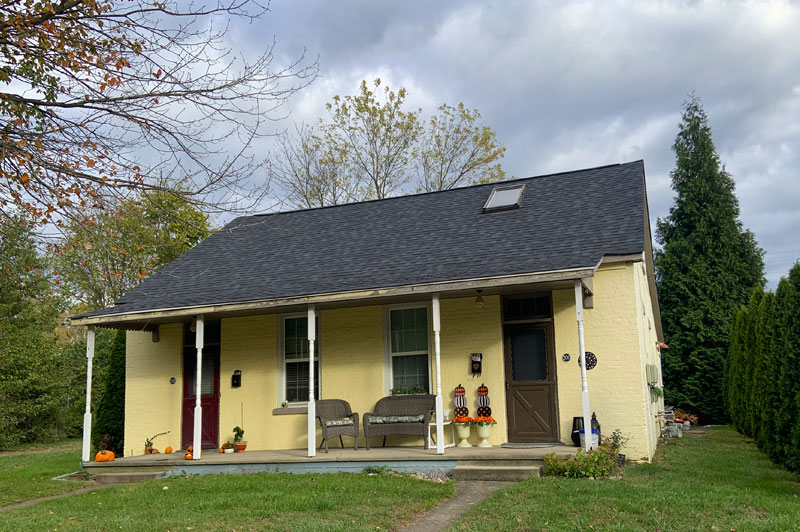
This story was updated on 10-17 and now includes the feasibility report of the house being restored that was submitted by John Hill.
Loveland, Ohio – The demolition of a historic home in Loveland’s Historic District is under appeal by resident Deidre Hazelbaker. The home is at 200 Railroad Avenue. The Historic Preservation and Planning Commission voted on October 2 to allow John Hill, through his Infuse Holdings LLC to demolish the building with a history dating to at least 1915. The demolition request comes as part of a six-unit, 3-story apartment development Hill has proposed facing Loveland, Nisbet park along the Loveland Bike Trail.
Hazelbaker filed her appeal on October 4 to the Loveland Board of Zoning Appeals. Her appeal will be heard at City Hall on October 30 at 5:30 PM.
The building at 200 Railroad Avenue, constructed on or before 1915, is designated a “Contributing” structure within Loveland’s historic district because it “holds significant historical value and is representative of the early 20th-century architecture typical of the area.” Any building constructed within the period of significance of the Historic Preservation and Planning District that contributes to its historic associations and architectural qualities qualifies for special consideration before a demolition permit can be considered.
One of the reasons Hazelbaker cited in her appeal is that the, “…decision to approve the demolition did not include a comprehensive feasibility study to explore alternatives such as rehabilitation or adaptive reuse. Without a detailed analysis of potential preservation options, the decision to demolish was made prematurely and without fully understanding the preservation potential of this historic structure.”
The appeal Hazelbaker filed continues by saying, “Granting this appeal and reversing the demolition decision would preserve the essential character of the neighborhood. The current structure, with its historical details and architectural elements, contributes to the visual appeal and heritage of Loveland. Its loss would alter the district’s character significantly and detract from the community’s identity.”
The governing document of the Preservation Commissions states in its preamble, “Unfortunately, Loveland has lost a number of downtown buildings over the years; consequently it is imperative every effort is taken to preserve the remaining historic buildings to allow future generations to experience the character of Loveland’s rich history.”
___________
BACKGROUND STORY
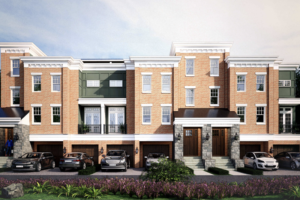 Six, three-story apartments proposed adjacent to Nisbet Park on Loveland Bike Trail
___________
Hazelbaker cites:
• The building at 200 Railroad Avenue is listed as a “contributing” building within Loveland’s historic district. Built on or before 1915, this multi-family home shows early 20th-century architectural styles and reflects Loveland’s development as a railroad town. As noted in the June 26, 2024, meeting, the building’s historical value is documented and adds to the character and heritage of the district. Demolishing this building would remove a piece of Loveland’s history and could set a bad precedent for other historically important structures.
• During the previous Commission meeting, many community members shared concerns that tearing down this building would disrupt the look and feel of Railroad Avenue. The proposed new construction does not fit in with the scale and style of the surrounding historic homes, which could hurt the overall feel of the district. Allowing this demolition would send the wrong message to future developers that upkeep and preservation don’t matter, leading to a slow loss of the district’s unique character.
• The Commission did not present a thorough study exploring ways to fix or restore 200 Railroad Avenue. A study by an independent group could have offered clear options for repairing and preserving the building instead of tearing it down. Without this information, the decision to approve demolition was made too soon and without understanding the potential to save this historic property.
___________
Below is the report John Hill submitted, intended to detail the condition of the structure and mechanical systems in relation to the feasibility of this house being restored to a habitable domicile that is current with modern building codes.
Hazelbaker believes the Commission should undertake an independent and impartial review and not rely on one prepared by the person who wants the demolition to proceed.
[pdf-embedder url=”https://lovelandmagazine.com/wp-content/uploads/2024/10/John-Hill-Report.pdf” title=”John Hill Report”]
______________
The purpose of the Loveland Historic Preservation Regulations is to preserve, protect and perpetuate places, buildings, structures and other objects having special historical, community or aesthetic interest or value, all for the following reasons:
- a) To safeguard the heritage of the City by preserving sites and structures which reflect elements of the City’s cultural, social, economic, political, archaeological history or architectural history;
- b) To stabilize and improve property values;
- c) To protect and enhance the City’s attractions to residents, tourists and visitors, and serve as a support and stimulus to business and industry;
- d) To enhance the visual, aesthetic, historic character, diversity and interest of the City;
- e) To foster civic pride in the beauty and notable accomplishments of the past;
- f) To promote the use and preservation of historic and archaeological sites and structures for the education and general welfare of the people of the City;
- g) To strengthen the economy of the City;
- h) To take whatever steps as may be necessary to safeguard the property rights of the owners whose
property is declared to be a Historic Structure or is located in the area designated as a Loveland Historic District, and act in an advisory role to city officials and departments of Loveland’s governmental system.
- i) Review all certificates of appropriateness application as defined by the Secretary of the Interior’s Standards’ for Rehabilitation
READ: HISTORIC PRESERVATION & PLANNING DISTRICT DESIGN REVIEW GUIDELINES
The Historic Preservation and Planning Commission approves the appropriateness of the demolition, construction, preservation, restoration, and rehabilitation of any home, commercial structure, or new construction within the designated historic district.