Tag: Arts

  • DeWine, state leaders announce $430M in coronavirus relief

    DeWine, state leaders announce $430M in coronavirus relief

    Marty Schladen

    Marty Schladen has been a reporter for decades, working in Indiana, Texas and other places before returning to his native Ohio to work at The Columbus Dispatch in 2017. He’s won state and national journalism awards for investigations into utility regulation, public corruption, the environment, prescription drug spending and other matters.

    Ohio Gov. Mike DeWine and the state’s legislative leaders on Friday announced how they’d allocate almost half of what the state has left in federal coronavirus-relief dollars.

    The state has about $1 billion unexpended from its share of the $2.2 trillion CARES Act that Congress passed in March. At least until the feds change the rules, the funds have to be spent by Dec. 31.

    Social-service groups that deal with issues of homelessness and hunger have been clamoring for months for a share of the money, as have business groups and others. So it’s been up to DeWine and the legislature to decide what to do with the money while Congress appears stymied over further coronavirus relief.

    “We tried to look at what the needs were and what had already been put out,” DeWine said during a remote press conference. “We don’t know whether Congress will pass another bill or not.”

    The state is holding about half of the funds for coronavirus testing and contact tracing and other needs while it awaits a possible second round of relief — which may or may not include assistance to state and local governments.

    The expenditures announced Friday include:

    • $50 million for mortgage and rental assistance to families making 200% or less of the federal poverty level 
    • $125 million for businesses with up to 25 employees
    • $37.5 million for restaurants and bars
    • $100 million for colleges and universities to do testing, contact tracing and provide mental-health services
    • $62 million for rural and critical-access hospitals
    • $25 million for non-profits providing services such a food banks, homeless shelters and other social services
    • $20 million for the arts

    A good deal more of the money was focused on businesses than on assisting individuals who are suffering most. But several in Friday’s press conference said they hope by helping small businesses keep their doors open, people will be able to get or keep jobs.

    “We know some businesses are barely making it,” Lt. Gov. Jon Husted said of that portion of the package. “This is focused on them.”

    For their part, some leaders of social-service organizations said they were grateful for the help they will receive.

    “We’re pleased that Gov. DeWine finally deployed federal coronavirus relief funds to help people avoid getting evicted during this pandemic,” Bill Faith, executive director of the Coalition on Housing and Homelessness in Ohio, said in a written statement. “And we appreciate (Ohio) Controlling Board members’ support, especially Sen. (Matt) Dolan (R-Chagrin Falls) and Sen. (Jay) Hottinger (R-Newark) who took a personal interest in keeping struggling Ohioans safely in their homes. We look forward to seeing details on how the program will be implemented. Given the Dec. 31 deadline to use these funds, we would welcome the governor’s assistance in advocating for Congress to provide additional rental assistance into 2021.”

    The Ohio Poverty Law Center also released a statement praising state leaders for their action. But it warned that it won’t be enough.

    “As Ohioans continue to experience job and income loss due to the pandemic, additional federal and state resources will be needed to prevent evictions and keep Ohioans safe, especially as we get closer to the expiration of the Centers for Disease Control and Prevention’s eviction moratorium,” it said. “We hope housing assistance will be among the highest priorities for resources in the coming weeks and months.”
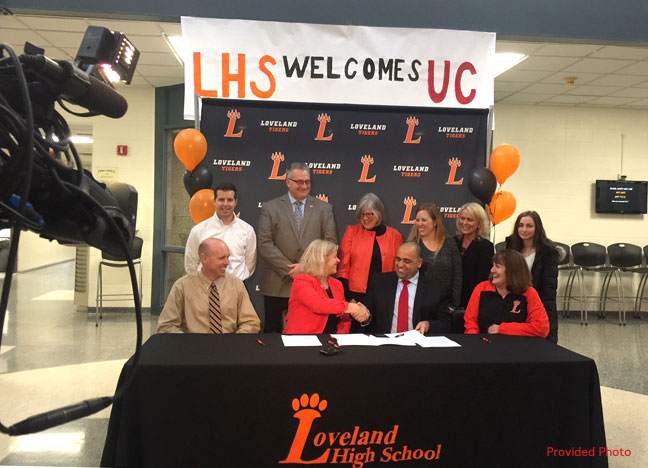

  • Loveland schools, University of Cincinnati partnership announced with formal signing ceremony

    Loveland schools, University of Cincinnati partnership announced with formal signing ceremony

    (First row, L to R:) Loveland High School (LHS) Teacher Phil Marchal, Loveland Interim Superintendent Dr. Amy Crouse, University of Cincinnati (UC) Director of School of Information Technology (IT) Dr. Hazem Said, LHS Principal Peggy Johnson; (Second row, L to R:) Patrick Keyser, Sogeti USA, Loveland Board of Education President Art Jarvis, Loveland Board of Education Vice President Dr. Kathryn Lorenz, Loveland Board of Education Member Eileen Washburn, Loveland Director of Secondary Programs Andrea Conner, UC Graduate Coordinator and Project Manager School of IT Lauren Kirgis

    Pathway program will be ready for fall 2018

    Loveland, Ohio – With cameras rolling to capture the significant moment, Loveland Interim Superintendent Dr. Amy Crouse and University of Cincinnati (UC) Director of School of Information Technology Dr. Hazem Said made formal the new partnership between the educational institutions that will equip the Loveland City School District to offer college-level Information Technology (IT) course work to high school students. The formal signing ceremony took place just before the State of Schools Open House Thursday, Feb. 22, at Loveland High School.

    “This partnership places Loveland students in a unique position for advanced learning opportunities that will qualify for college credit – a win for our families both academically and financially with the ever increasing student-loan debt that UC is sensitive to,” said Dr. Crouse. “We are simply thrilled to sit at the table with a school as premier as UC.”

    “The UC Information Technology Early College program is a unique and innovative program that will enable Loveland students to complete the first year of the UC BSIT program in high school,” said Dr. Said. “Those who receive a C or above will receive automatic admission to the BSIT program to study Software Development, Cybersecurity, Networking/Systems and Game Development & Simulation. We are excited to work with the leaders at Loveland City Schools to make this program available to Loveland parents and students.”  

    The partnership with UC creates an Information Technology (IT) Academic Pathway for Loveland High School (LHS) students, and is part of the district’s strategic plan to bring Academic Pathways to Loveland students beginning in middle school. LHS students will have access to post-secondary IT coursework starting in ninth grade. LHS students will have the ability to earn college credit through the College Credit Plus (CCP) program, and Advanced Placement (AP) courses.

    “Ultimately this partnership enables LHS students taking these courses to earn a masters degree through UC with only four years of college; it includes the courses they take through their senior year of high school plus four years of college,” explained Loveland Director of Secondary Programs Andrea Conner. “It also provides our Tiger students with the opportunity to apply for paid co-ops related to their course work the summer following their senior year.”

    Along with having the IT Pathway ready for fall of 2018, the district has clearly defined Academic Pathways for careers in: Arts, Audio/Video Technology and Communication; Business Management and Administration; Health Science; and Science, Technology, Engineering and Mathematics – with the phase-in of additional pathways in the 2018-2019 school year.


    Start the New Year Right

    Welcome to All About Kids We invite you to come visit one of our convenient locations, talk to our staff and teachers and learn why.