Tag: Athens County

  • After more than a decade of advocacy, a majority of injection wells in Athens County are suspended

    After more than a decade of advocacy, a majority of injection wells in Athens County are suspended

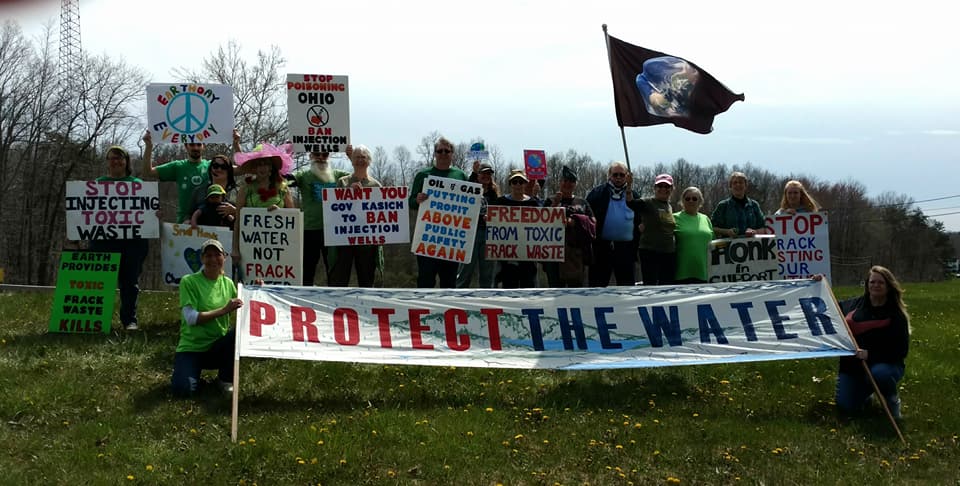
    Activists in Athens County rallied against the injection wells. (Photo provided by Roxanne Groff.)

    By:  Ohio Capital Journal

    After sounding the alarm on fracking waste injection wells for more than a decade, Roxanne Groff from Athens County is now finally starting to see some of the fruits of her and her friends’ labor.

    A handful of Athens County injection wells were suspended after Ohio Department of Natural Resources determined they pose an “imminent danger to the health and safety of the public and is likely to result in immediate substantial damage to the natural resources of the state,” according to letters from Chief of the Division of Oil and Gas Resources Management Eric Vendel.

    “I cried,” the 75-year-old activist said when she heard the news.

    Groff’s advocacy against injection wells started back in 2012 with the Hazel–Ginsburg well. It has since grown to include many Southeast Ohio residents who are also sounding the alarm — something Groff believes helped led to the wells being suspended.

    “All of us together, all of the community members stood up for themselves and pushed back,” Groff said. “We know that this is dangerous.”

    Injection wells in Athens

    There are seven class 2 injection wells in Athens County, but five are no longer in operation and the ODNR Division of Oil & Gas Resources Management expects those wells to be plugged, ODNR spokesperson Karina Cheung said in an email. Historically, three injection wells have been plugged in the county, she said.

    Class 2 wells are used to inject fluids — primarily brines — associated with oil and natural gas production, according to the EPA.

    Included in the five Athens wells that are out of operation are three K&H injection wells that were operational until a decision by the Oil and Gas Commission on April 19.

    The plugging permits for the three K&H wells will be issued soon and will be effective for two years once they are issued, Cheung said. She said the wells will be plugged this summer (according to the company Tallgrass Energy that owns the K&H wells).

    The Frost well was last used in 2021 and has been ordered to be plugged by the Chief of the Division of Oil & Gas Resources Management.

    “The company is in receivership and the Division has been in communication with the receiver about their obligation to plug the well,” Cheung said in an email.

    Plugging a well includes removing all uncemented casing and tubing from the well, and using cement to plug the well “ in a manner to isolate all oil, gas, and brine to formations that they originate in,” Cheung said.

    The exact cost of plugging a well is tough to determine.

    “Plugging costs vary due to differences in wells and the costs of abandonment and decommissioning of the surface storage facilities associated with the wells,” Cheung said in an email.

    But just because the wells will eventually be plugged doesn’t mean the environmental risks are gone, Athens County resident Susie Quinn said.

    “All the stuff that they’ve injected down there, it’s still down there,” she said. “This is not a cleanup. It’s just there stopping anymore from going in.”

    The Quinns got earthquake insurance for their house nearly a decade ago because “we’ve had so many little ones because of the fracking and injection wells.”

    Groff echoed Quinn’s sentiments about the plugged wells.

    “The threat remains … all that waste is there,” she said. “It’s down there. It’s under pressure. If it feels like going somewhere, it’s going to find a crack, and it’s going to keep going through that crack … until it gets to someplace where it either comes up to the surface or it just stops fracturing.”

    Advocacy against the wells

    The first Athens County injection well was the Hazel–Ginsburg well in 1984, Groff said. At the time Groff was an Athens County Commissioner, a role she served in from 1983 to 1995.

     Roxanne Groff (left) at the Mad Hatter’s Tea Party protest against the injection wells in Athens County. (Photo provided by Roxanne Groff.) 

    It wasn’t until 2012 when her advocacy related to fracking began, after Madeline ffitch was arrested for chaining herself to two barrels and blocking the driveway to the Ginsburg well.

    The Ginsburg well was last used in 2015, Cheung said.

    “The Division of Oil & Gas Resources Management granted a permit to plug the Ginsberg well, but the owner of the well did not plug it within the permit’s two-year expiration date,” Cheung said in an email. “The Division is conducting regulatory enforcement regarding the Ginsberg well.”

    Local environmental groups started popping up, like Athens County’s Future Action Network and Torch CAN DO, which stands for Torch Clean Air Now, Defend Ohio. These groups helped organize informational meetings with epidemiologists and geologists as well as protests to spread the word about fracking and raise awareness. One of their protests was a Mad Hatter’s Tea Party complete with a Queen of Hearts and little toxic tea bottles.

    Groff, along with the other activists who joined the fight, have been preaching for years about the environmental impact of injection wells.

    “You drill a hole into the ground and then you shove toxic radioactive waste under immense pressure,” Groff said. “Now what kind of fool do you think we are that you don’t think that that’s going to go somewhere?”

    There were more than 1,400 fracking incidents associated with oil and gas wells in Ohio between 2018 and September 2023, according to FracTracker Alliance — a nonprofit that collects data on fracking pipelines.

    There have been 26 incidents in Athens County during that same time period involving release, unintentional gas release and a fire, according to FracTracker.

    “Everybody knew that was going to happen,” Groff said. “We absolutely unequivocally knew that we were right. There was nothing that swayed anybody in this group from thinking that we were making stuff up.”

    The Athens County Commissioners also got involved and held meetings.

    “These wells are just terrible and what they’ve done and everything that was said that was going to happen, happened,” Athens County Commissioner Charlie Adkins said.

    Groff and the team of activists were overjoyed when ODNR ordered the injection wells to suspend operations.

    “The language they used is exactly what the people have been saying … they’re an imminent threat to the health and the welfare and well being of the environment and the people who live here,” Groff said.                            

    Quinn always believed they could make a difference.

    “We went from Torch CAN DO to Torch can done,” she said. “We’d like to pass our homesteads on to our children. We want to do this for our grandchildren.”

    Fight continues

    Even though some of the wells are no longer in use, Groff isn’t hanging up her activist hat just yet.

    For one, not all injection wells are suspended. The last two remaining wells in operation in Athens County are in Canaan Township and Lee Township, Cheung said.

    The long-term effects of the injection wells are not totally known at the moment and could not show up for years or decades, Groff said.

    Athens County Commissioner President Lenny Eliason said he would like to focus on long-term monitoring.

    “Appalachia has been extracted for years for a number of different materials and the pain of the short term gains sticks around a long time after,” he said. “So we have to get people that are more forward thinking about balancing what that short term gain is going to bring in the long term.”

    When asked if the drinking water had been affected by the injection wells, Groff and Quinn said they don’t know yet.

    Referring to the state, Groff said ““Your incompetence caused this to happen. If you want to assure people that this is not an imminent threat and danger, then prove it and the only way you can prove it is to continue to test the water.”

    Even though their advocacy is not quite done, they are relishing their victory.

    “It’s not only just a huge win for everybody here in Athens County, it’s a message to the rest of the people in the state that, with due diligence, you can be in control,” Groff said. “You just have to fight like hell to make yourself heard.”

    Follow OCJ Reporter Megan Henry on Twitter.


    Megan Henry
    Megan Henry

    Megan Henry is a reporter for the Ohio Capital Journal and has spent the past five years reporting in Ohio on various topics including education, healthcare, business and crime. She previously worked at The Columbus Dispatch, part of the USA Today Network.

    Ohio Capital Journal is part of States Newsroom, the nation’s largest state-focused nonprofit news organization.

    MORE FROM AUTHOR

  • GOP officials and a collegiate political scandal could nix Dem’s ballot slot in SE Ohio

    GOP officials and a collegiate political scandal could nix Dem’s ballot slot in SE Ohio

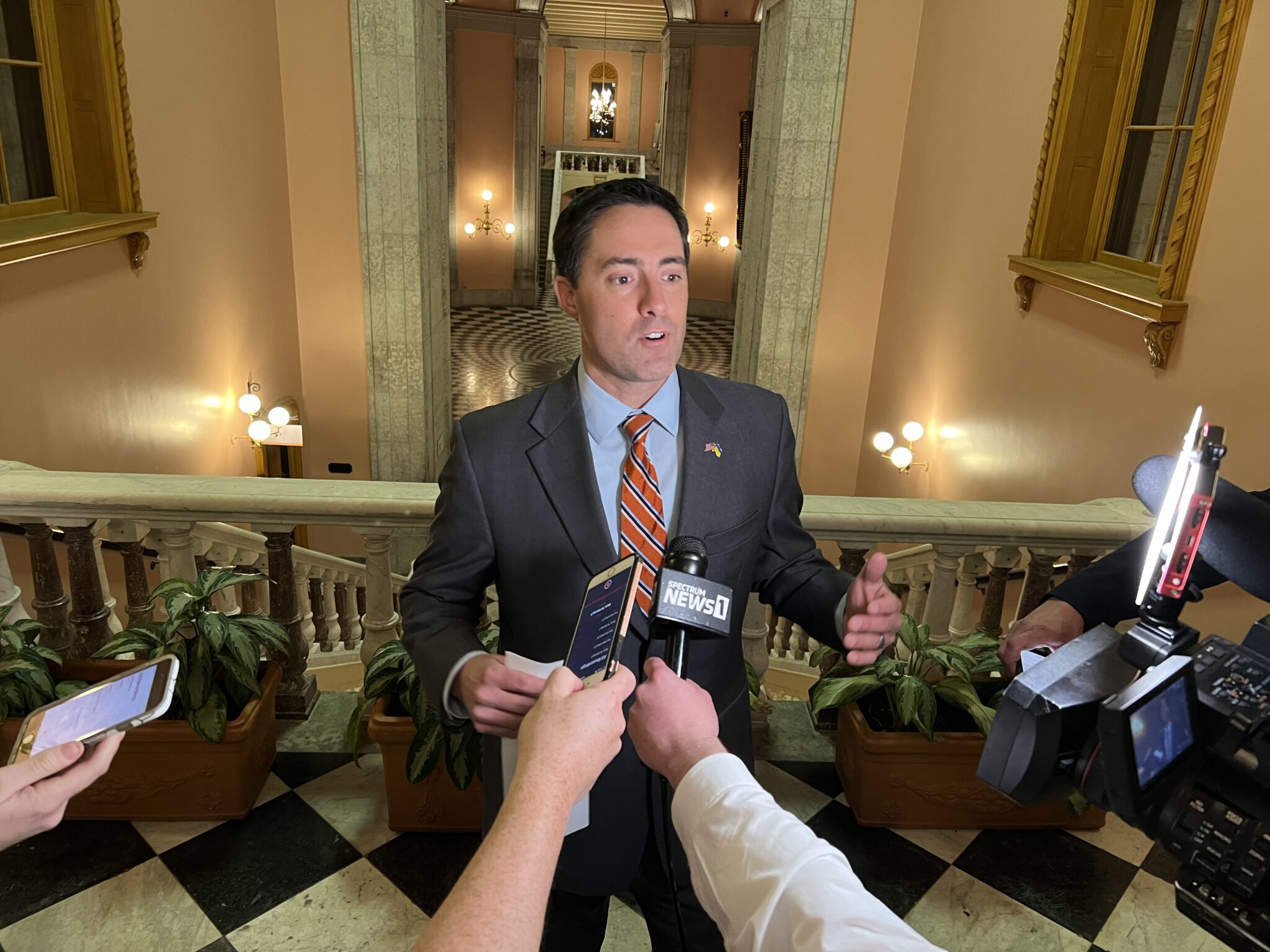
    Ohio Secretary of State Frank LaRose talks to reporters. (Photo by Susan Tebben, OCJ.)

    BY: JAKE ZUCKERMAN – Ohio Capital Journal

    The story of the ballot fight includes a scandal in Ohio University’s Student Senate, a primary election delayed by Ohio’s messy redistricting clash, a Democrat’s resignation after winning an uncontested race, and some of the finer points of election law.

    The result is Jay Edwards, a three-term Republican incumbent, currently running unopposed in one of the more competitive districts in the November General Election.

    Ohio law allows the two major political parties to replace candidates who withdraw after primaries. The Democratic Party chose Tanya Conrath — a southeast Ohio native, attorney and nonprofit leader — to fill a hole left by the victor who dropped out.

    Republicans on the Athens County Board of Elections, however, objected, leaving the matter tied 2-2. Ohio Secretary of State Frank LaRose, a Republican responsible for casting the deciding vote, voted against letting Conrath on the ballot.

    He said because Rhyan Goodman, the Democratic candidate who won an uncontested primary, resigned before officials formally counted the vote and certified his victory, then the law doesn’t guarantee the Democrats the right to replace a candidate.

    “They’re trying to cheat their way into not giving [incumbent GOP Rep. Jay Edwards] an opponent and not giving voters a choice,” Conrath said in an interview.

     Tanya Conrath. Courtesy photo.

    The issue traces back to February when Goodman, as a 19-year-old Ohio University student, filed to run in Ohio’s 94th House District using his dorm as his filing address. In a matter of weeks, however, Goodman met his first brush with political scandal — not via state politics but with the Ohio University Student Senate.

    Goodman faced impeachment for allegations that he lodged false accusations in an anonymous letter against the student treasurer and encouraged other student senators to accuse her of intimidation, according to student publication The New Political. He resigned just before his trial was set to start.

    In the fallout of some “mistakes that might have been made,” Goodman drifted away from the Ohio House race, according to Athens County Democratic Party Chairman Sean Parsons. In the runup to the primary, Goodman had no campaign website, no social media, and did not respond to phone calls from a reporter.

    He won 100% of the 1,174 votes cast in the Aug. 2 primary. Regardless, six days after he won the election but before county officials formally certified the vote, Goodman withdrew his name from contention for the November election. He did not respond to calls or emails.

    Rep. Allison Russo, the ranking House Democrat, defended the lack of failsafe candidates in the race. She said candidate recruitment is difficult in districts that weren’t finalized at the time, some of which were later found to be unconstitutional gerrymanders. What Democrat would step into that uncertainty knowing Republicans control the game?

    She said the party developed “some concerns” about Goodman in the spring, but there was little to be done without a certain election date or district lines to go off. Conrath, Russo said, followed the rules and the Republicans are just afraid of the competition.

    “Not surprisingly, Secretary LaRose once again put partisan interests over running fair elections and couldn’t even cite any case law to support his decision,” she said.

    Deadlines

    Ohio law allows a “party candidate” who withdraws after a primary but before a general election to be replaced by whomever party officials see fit. This must be done by 4 p.m. on the 86th day before a general election — Aug. 15.

    Primary elections are typically held in May. However, the Ohio Supreme Court repeatedly found Republicans’ proposed decennial redistricting maps to be unconstitutional partisan gerrymanders. The court’s majority demanded fairer maps. Republicans refused. The standoff ended with a second primary election in August after a federal court ordered the election to proceed with a map the state Supreme Court found unconstitutional.

    Although the election date changed, some of the relevant administrative deadlines did not. Conrath, who had been contacted by the party and urged to run, had until Aug. 15 to file. The board of elections didn’t certify Goodman’s victory until Aug. 17.

    However, Republicans on the Athens County Board of Elections argued that because Goodman wasn’t certified at the time of Conrath’s filing, the party therefore has no eligible candidate to replace. Larose agreed.

    “As such, Rhyan Goodman was not the official nominee and party candidate at the time of his withdrawal,” he said in casting his tie-breaking vote. “The Athens County Democratic Party … could not replace him prior to the official certification of the Aug. 2, 2022 primary results.”

    Conrath’s lawsuit in the Supreme Court disputes the idea that the lack of certification means Conrath can’t be chosen as a replacement. In court documents, she cites a similar case from 1992 in which a Republican candidate running for county recorder withdrew from the ballot after some primary votes were cast and his name was already printed on the ballot. The secretary of state at the time ordered against certifying the candidacy.

    The Ohio Supreme Court reversed, finding boards of election have a “clear duty” to count ballots cast for a candidate even despite an “untimely withdrawal” from consideration. The court also held that candidacies “retain vitality” for some purposes even after withdrawing.

    LaRose, through a spokesman, did not respond to inquiries. The Supreme Court ordered him to respond in court to Conrath’s lawsuit by Wednesday.

    Edwards, reached via text message, didn’t respond when asked if he thought the court should let Conrath run.

    Parsons tentatively acknowledged that the Democrats should have fielded another candidate for the race. However, he said the chronic uncertainty given redistricting and the mishmash of deadlines weakened the process. And Republicans’ reasoning, he said, doesn’t pass the smell test.

    “They’re not operating in good faith on this issue; It’s an attempt to keep somebody off the ballot,” he said. “It’s always better to have choice. That’s the way representative democracies work.”

    Conrath

    Conrath describes herself as a fifth generation Appalachian. She was born and raised in southeast Ohio and married a fellow native. After graduating Ohio University as an undergrad and Ohio State University for law school, she worked in a law practice in Athens.

    She owns a home appraisals business, works as associate director of the Ohio University Innovation Center, and works at an adult career center as well. She has served on nonprofit boards including My Sister’s Place and Planned Parenthood of Southeast Ohio.

    She said she was invited to run after Goodman’s resignation in August and made the decision and filing in a “whirlwind.” She had previously toyed around with the idea of running, but the U.S. Supreme Court’s decision to overturn its landmark ruling establishing women’s constitutional right to abortion access cemented her decision.

    “The Dobbs decision and watching Ohio put in a six-week abortion ban was the straw that broke the camel’s back,” she said.

    Besides the court’s findings of partisan gerrymandering, the vast majority of statehouse elections are unlikely to produce competitive general elections. Edwards’ district, however, is comparatively tight. Dave’s Redistricting App estimates it gives Republicans a 52%-45% edge. While President Donald Trump won the district in a landslide, Gov. Mike DeWine won it by a narrow 1.5%, according to analysis from the Ohio Manufacturers’ Association.

    Conrath expressed confidence she’d prevail in court. She said voters, not partisan officials, should pick their representatives.

    “This is a political play, and I think everyone knows it,” she said. “And I hope the Supreme Court sees this for what it is.”