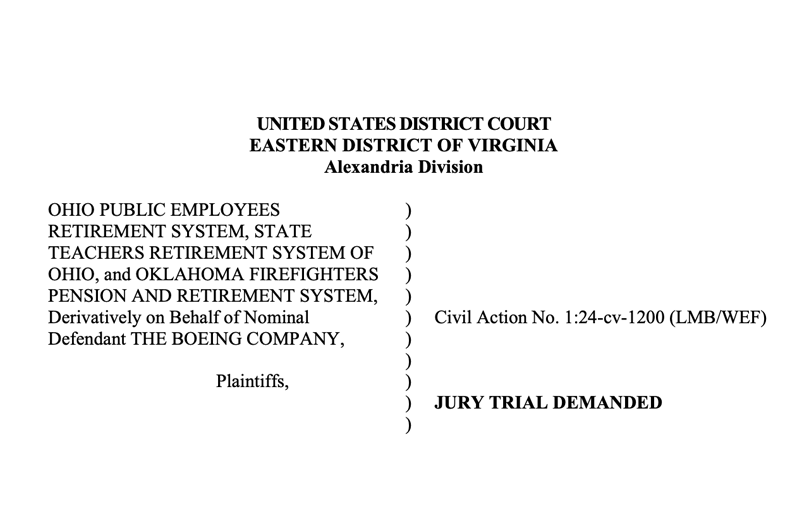
Attorney General Dave Yost is suing Boeing’s board of directors on behalf of two Ohio pension funds, seeking accountability for a pattern of safety and compliance failures that have harmed the company and its investors.
“The safety failures at Boeing are endangering lives and threatening the financial security of shareholders,” Yost said. “Running a safe, respectable company starts with the people at the top – and it’s time for them to be held accountable.”
Yost’s office – representing the Ohio Public Employees Retirement System and the State Teachers Retirement System of Ohio – accuses Boeing board members of breaching their fiduciary duties by failing to properly oversee the company.
The lawsuit asserts that board members and senior management, including former Boeing CEO Dave Calhoun, failed to implement adequate safety measures or to address whistleblower concerns about the company’s production processes.
Boeing’s safety and compliance failures culminated in a near catastrophe involving a Boeing 737 Max 9 aircraft earlier this year. An Alaska Airlines flight carrying 177 passengers was forced to make an emergency landing on Jan. 5 after a panel of the aircraft blew off shortly after takeoff.
The lawsuit contends that board members and senior management know about the ongoing unsafe practices but even today fail to address them, choosing instead to prioritize profits over safety and regulatory compliance.
“The failure of Boeing’s directors and officers to implement and oversee Boeing’s safety and compliance functions in good faith led to incalculable damage to Boeing’s relationships with its regulators, customers, lenders, potential employees, and the flying public,” the lawsuit says.
Yost is seeking to compel Boeing’s board of directors to improve safety and oversight of the company. The lawsuit is pending before the U.S. District Court for the Eastern District of Virginia.
Judges denied two delays in recent days that would have been key to a bribery and money laundering scandal that took place in Ohio between 2017 to 2020. Lawyers in one suit called it “one of the largest corruption and bribery schemes in U.S. history.”
Denial of a delay in one court case means that a player will still be sentenced late next month.
In denying the other, the judge in that case agreed with two former FirstEnergy executives who said federal law enforcement has them in its crosshairs. But she ordered that they be questioned under oath anyway.
One of those denied was former Ohio Republican Party Chairman Matt Borges, who on March 9 was convicted of racketeering along with former Ohio House Speaker Larry Householder, R-Glenford. Two others who were also charged in 2020 pleaded guilty and a third died by suicide.
Householder directed the effort in 2018 to elect friendly representatives who would make him speaker. He led the 2019 legislative fight to pass the bailout. And he engineered the nasty, dishonest battle to beat back an attempted repeal.
Borges’ role was much more limited. He acted as a go-between with statewide officials such as Attorney General Dave Yost and Secretary of State Frank LaRose — and he paid a worker on the repeal campaign $15,000 as the worker shared inside information about its likelihood of success.
Even though Householder’s role in the scandal was much bigger than that of Borges, each faces a sentence of up to 20 years in prison on the one count of racketeering of which he was convicted. Householder is scheduled to be sentenced in the Potter Stewart U.S. Courthouse in Cincinnati on June 29. Borges was scheduled for sentencing the next day.
But after his conviction, Borges asked the court for extra time to file post-trial motions asking that his conviction be thrown out. U.S. District Judge Timothy Black agreed, giving him until April 24.
Borges didn’t file anything by that deadline. But on May 15, Borges again asked permission to file post-trial motions. He argued that his conviction was on much shakier ground in light of two decisions handed down on May 11 by the U.S. Supreme Court: Ciminelli vs. United States and Percoco vs. United States.
Judge Black, however, on Monday agreed with Assistant U.S. Attorney Emily Glatfelter that the legal theories those decisions dealt with were “neither charged, nor argued, nor instructed” in Borges’ case. Black added that it’s important to keep the case moving.
“Finally, this case has been litigated, tried, and a verdict returned. Defendant Borges is now scheduled for sentencing on June 30, 2023. Disrupting the schedule would needlessly undermine the interests in judicial efficiency and finality,” the judge wrote.
Former FirstEnergy CEO Charles “Chuck” Jones. Source: FirstEnergy, via Flickr
Similarly, a separate federal judge declined to postpone sworn depositions of the two former FirstEnergy executives who directed more than $60 million in corporate cash to Householder-controlled dark money groups that fueled the scandal. She did so even as she acknowledged that former CEO Chuck Jones and former Vice President Michael Dowling “fear they are next in line for indictment” and don’t want to incriminate themselves in their depositions.
U.S. Magistrate Judge Kimberly Jolson is helping to manage the administration of a massive class-action suit against FirstEnergy, Jones and Dowling over the Householder scandal. Investors say the recklessness of the scheme cost them big — especially when it came to light and stock values plummeted.
Alleging federal securities fraud, lawyers for pension funds and other investors have said in court filings, “FirstEnergy and its most senior executives bankrolled one of the largest corruption and bribery schemes in U.S. history.”
Last Friday, Jolson also rejected attempts by Jones and Dowling — the former FirstEnergy executives — to delay sworn depositions to September or even later. The depositions had been scheduled for this week and next, but plaintiffs and defendants agreed to a short delay while Jolson considered the request.
In asking to hold off until Sept. 8, Jones and Dowling said that having to give a deposition under oath put them in a position in which they were damned if they did, and damned if they didn’t.
Answering questions could put them in criminal jeopardy, but if they took the Fifth, the jury in the class-action case is free to conclude they have something bad to hide, Jones and Dowling argued. They added that it’s certain that the feds are coming after them.
“Although the defendants in (the Householder trial) have been found guilty (but are yet to be sentenced) and charges have not yet been brought against Jones or Dowling, there can be no doubt that the government’s investigation into Jones and Dowling remains ongoing,” their motion said.
Judge Jolson replied that she had to weigh those concerns against those of FirstEnergy investors, who already have been fighting the case for nearly three years.
Jones and Dowling “say the stay is temporary, (but) their grounds supporting the stay could extend for months or even years,” Jolson wrote. “Presently, they request that the depositions be delayed until at least September 8, 2023. (Jones and Dowling) have chosen this date because it is the first date on which investigations and proceedings conducted by PUCO might resume—after a third six-month stay of those proceedings was recently granted at the request of” federal prosecutors.
The judge added it didn’t help the former executives’ argument that they haven’t been indicted yet because waiting until that question is resolved is a recipe for further delay.
Jolson said she understood the executives’ dilemma.
“In sum, there is substantial overlap between the issues in this case and the criminal investigation surrounding the Householder case,” she wrote. “And (Jones and Dowling) are faced with legitimate concerns regarding the invocation of their Fifth Amendment rights.”
Jolson added, however, that granting a delay would privilege the former executives who funded the corrupt bailout scheme over the aggrieved investors and the public.
“A stay of these key depositions at this moment — with no clear end in sight — would throw a wrench into the works of discovery and impede or even halt the litigation,” she wrote. “It would privilege the interests of (Jones and Dowling) above those of Plaintiffs, the public (whose interests are particularly implicated given that this is a class action), and the Court.”
MARTY SCHLADEN
Marty Schladen has been a reporter for decades, working in Indiana, Texas and other places before returning to his native Ohio to work at The Columbus Dispatch in 2017. He’s won state and national journalism awards for investigations into utility regulation, public corruption, the environment, prescription drug spending and other matters.
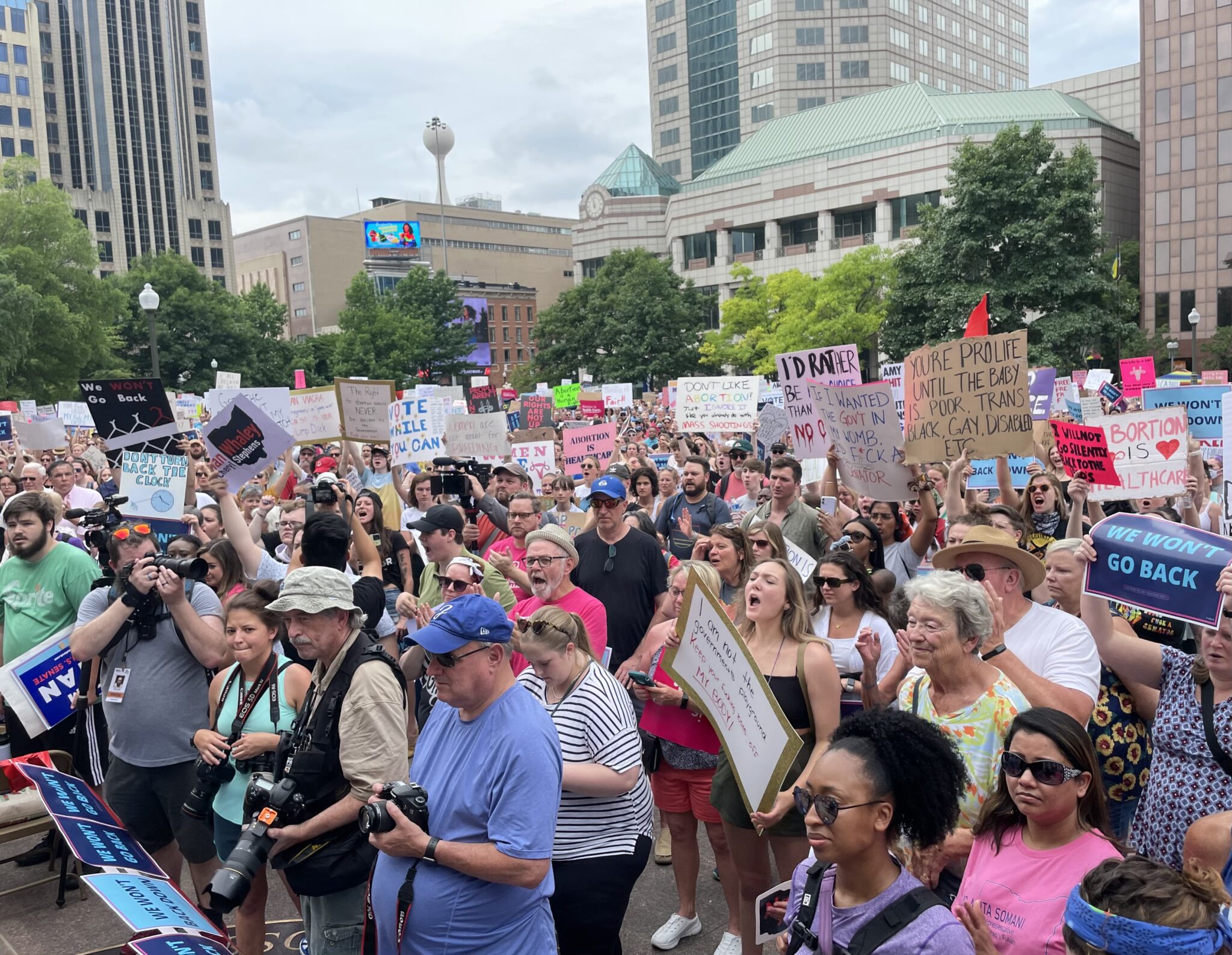
Over the weekend protesters rallied in demonstrations large and small voicing their opposition to the U.S. Supreme Court’s decision overturning Roe v. Wade.
The Attorney General
Saturday afternoon a couple dozen people gathered near the end of a sleepy street in Beechwold. Demonstrators brought bullhorns, pots and pans, even a vuvuzela, and organizers handed out pamphlets describing what areas are and aren’t public property. Then they marched up a narrow side street to Attorney General Dave Yost’s home.
Protesters demonstrating outside the home of Attorney General Dave Yost. (Photo by Nick Evans, OCJ.)
“After his workday, he comes home, kicks his feet up, has real nice evening,” organizer Mandy Shunnarah-Reed told the group before they set out. “Meanwhile, the rest of us have to live with the consequences of the decisions he’s made about our bodies and our livelihoods, 24-7, 365. We don’t get to just not worry about it, because it’s not business hours.”
“So that is why we are annoying him on a Saturday,” she said.
The group grew to about 50 and they made a racket of chants, whistles and smashing cookware at the foot of Yost’s driveway while a security agent from the AG’s office looked on. The cacophony was short lived though — after about twenty minutes they learned Yost wasn’t home.
Some Ohioans employed similar tactics to voice opposition to COVID-19 restrictions and to intimidate then-health director Amy Acton early in the pandemic. But Katie McKeel and her husband John were quick to draw a distinction.
Katie carried a sign that read “my body, my rights, my vote, my voice will be heard in 2022.” But the “22” was taped on. She first made the sign in 2018 for the women’s march in Washington D.C.
“If my right to my choice and my self-autonomy and what I do with my own body is not as important as the airspace of our elected officials, I find that to be completely out of whack,” Katie said.
“We haven’t threatened Dave Yost. Amy Acton got death threats,” John chimed in. “That’s a big difference.”
Christy Williams came to the protest with her daughter, and she argued that banning abortions won’t reduce the number that occur, it will just make them more dangerous. Like the McKeels, she believed their right to protest should take precedence.
“This is a civil right,” she said. “You can do this.”
The Statehouse
Sunday morning thousands of people turned up at the Statehouse for a rally put on by the Ohio Democratic Party. Notably, although not surprisingly, many of the groups spanned generations. Mothers with daughters and even granddaughters showed up together waving handmade signs. Picking up on that, U.S. Sen. Sherrod Brown noted up he was there with his wife, his daughters and grandkids. Brown told the crowd “we need a plan,” and argued for electing two new Democratic U.S. Senators and maintaining the Democratic majority in the House.
“If we can carry out this plan, by this time next year the Senate and the House of Representatives will have codified Roe v. Wade,” Brown argued.
The problem is, picking up Senate seats while keeping the House is a pretty tall order for a midterm election amid persistent inflation. The court’s decision to overturn Roe surely changes the political calculus, but it’s unclear how much.
The other issue, as people like Nina Turner have pointed out, is that Democrats already have control of all the levers of power they need to codify abortion protections — they simply haven’t acted because some Democratic senators oppose ending the filibuster.
Speaking afterward, Brown acknowledged some members of his caucus are “not in the right place” when it comes to the filibuster, but he insisted with two new members the party would act.
“If we have two more Democrats, we will change the filibuster rules, so that a majority can speak,” Brown said. “All we’re asking for is majority rule.”
One candidate looking to flip a Senate seat in Brown’s plan spoke to the crowd as well. Ohio Democratic U.S. Senate nominee Tim Ryan described the whiplash of marching to the Supreme Court building on Friday to protest with his 18-year-old daughter, in D.C. for an internship, alongside fellow congresswomen who were part of the fight that led to Roe in the first place.
“This is a struggle,” Ryan said. “This is a struggle for this election, and the next election, and the next election in the decades to come because we’re gonna turn this around, and we’re gonna make sure that this never happens again.”
Tim Ryan addressing the crowd outside the statehouse. (Photo by Nick Evans, OCJ.)
Ryan acknowledged afterward that some voters might feel pessimistic in light of Democrats’ unwillingness to roll back the filibuster and take action to protect abortion access at the federal level. But he urged them not to check out.
“So I would say you have a chance now,” Ryan said. “We are where we are. You have a chance to actually make that difference right here in Ohio.”
While Ryan and Brown made the case for federal action, Democratic gubernatorial nominee Nan Whaley made a more immediate, explicit argument.
“Ohio is ground zero for this fight,” Whaley insisted. “We are one of the largest states in the country where abortion is on the ballot.
Whaley called Gov. Mike DeWine the “most anti-choice governor in the country” and chastised him for urging people to be civil in the wake of the decision. What’s civil about taking away rights, forcing women to maintain a pregnancy or risk dying on an operating table she asked.
Like Brown and Ryan she drew a bright line from the court decision to the ballot box.
“This is not a drill. This is not a hypothetical,” Whaley told the crowd. “Our lives and our children’s lives are on the line. I refuse to go back and I know I am not alone.”
Columbus, Ohio – The ranking Democrat in the Ohio House said Attorney General Dave Yost has blocked her from legal representation as the Ohio Supreme Court reviews the latest redistricting proposal from state lawmakers.
The Ohio Redistricting Commission voted 5-2 along party lines Saturday to send over a revised map after the court overturned its first effort, determining it to be an unconstitutional gerrymander.
Democrats on the commission have previously been represented by their own counsel and submitted their own arguments — distinct from Republicans on the committee. House Minority Leader Allison Russo, D-Columbus, said in a statement Wednesday however that Yost has since blocked them from their legal representation. This comes as a deadline looms for the state officials to respond to objections to the GOP-approved map submitted for the court’s review.
Through spokeswoman Maya Majikas, Russo said Yost is “denying” her “the ability to consult with her legal counsel,” two attorneys with the Ice Miller law firm in Columbus retained through the attorney general’s office.
“Leader Russo is being denied her outside counsel representation at this stage of the litigation period,” Majikas said. “Ice Miller is not permitted by the AG to provide Democrats counsel/bills for any service to us.”
Yost seemed to confirm Russo’s central claim through spokeswoman Bethany McCorkle on Wednesday evening.
“The Ohio Supreme Court ordered the Commission to draw a new map, which is why one counsel will respond to the court on behalf of the entire commission,” McCorkle said. “None of the individual members will respond separately.”
Democratic members of the commission are technically named as defendants in the lawsuit. However, their interests largely align with the plaintiffs — a spread of special interest and voting rights organizations — and against Republicans on the commission who defended the maps.
“The Republican Legislative Commissioners prepared maps so lopsided that Republicans are essentially guaranteed veto-proof majorities in the General Assembly no matter how many votes Democrats earn,” the Democrats’ lawyers wrote in court filings.
The Supreme Court, overturning the legislative maps, found they likely guaranteed Republicans a supermajority in defiance of voter’s preferences, as required by the constitution. They ordered the commission to draw a map as close as possible to the state’s 54% Republican to 46% Democratic partisan tilt.
The newest proposal would create a projected 57-42 split in the House and 20-13 split in the Senate, far more advantageous for Democrats than the original. However, the Democrats’ margins are much tighter. For instance, in the House, 12 of the “Democratic leaning” seats in the latest map could also be considered tossups, with a Democratic edge of only 50-51%. All of the GOP-leaning seats favor Republicans by more than 52%.
The Ohio Redistricting Commission — comprised of four, bipartisan legislative appointees along with the governor, state auditor and secretary of state — was ordered to respond to the objections by Friday.
The commission itself is represented by two lawyers. The statewide officeholders and Republicans on the commission have their own lawyers as well. Even if, as Yost said, the commission’s members don’t respond individually, it’s likely that Republicans who control it will likely shape its arguments.
Sen. Vernon Sykes, D-Akron, the other Democrat on the committee, did not respond to an inquiry to his office.
A group representing small pharmacists says large chains, especially CVS, are moving patients’ prescriptions to their own stores without consent. CVS adamantly denies that. Photo by Marty Schladen, Ohio Capital Journal.
It’s unclear if she disclosed potential conflict during massive procurement
Since she became director of the Ohio Department of Medicaid in January 2019, Maureen Corcoran has owned stock in some of the department’s biggest contractors. Given the size of those contracts, they could have increased the value of the stock Corcoran owned.
Ohio Medicaid Director Maureen Corcoran. Official photo.
But while she complied with one set of state disclosure requirements, Corcoran won’t say just how much stock she owns in such companies as CVS Health, UnitedHealth Group and Express Scripts — each of which has done billions of dollars worth of business with the Medicaid department since Corcoran started running it.
In addition, Corcoran won’t say if she filed legally required affidavits disclosing that she had an ownership stake in corporations the department hired earlier this year as part of its $20 billion managed-care re-procurement or the company the state hired to run its $1 billion OhioRISE program. Should they be found, violations of the law could carry criminal penalties and invalidate contracts signed without proper disclosures.
Big money
When Corcoran took the reins of the Medicaid department, she held a stake in some companies that were getting a lot of scrutiny over their business with the state. Two were CVS Caremark and OptumRX, pharmacy middlemen that together were handling more than $2 billion a year in prescription-drug transactions for the department.
Ohio’s independent pharmacists and others accused the companies of several questionable practices — including charging a lot more for drugs than they were paying pharmacists. A state-commissioned analysis showed that in 2017, CVS and Optum charged almost a quarter-billion dollars more for drugs than they reimbursed the pharmacies that had bought and dispensed them.
The findings were still big news — and the companies were suing the Medicaid department — when Corcoran took control just after Gov. Mike DeWine took office at the start of 2019. Even so, Corcoran held onto stocks in CVS Caremark owner CVS Health and in OptumRX owner UnitedHealth.
According to disclosures filed with the Ohio Ethics Commission, Corcoran owned at least $1,000 worth of those companies’ stock.
Given that they were among 180 stocks and mutual funds she disclosed owning as of Jan. 31, 2019, it’s possible that Corcoran wasn’t even aware that she held stakes in companies that did such high-profile business with her agency. Whatever the case, Corcoran held onto shares in the companies through 2019 and 2020, her ethics filings show.
Under Ohio’s aging ethics laws, agency bigwigs like Corcoran are allowed to own stock in companies with which their departments do business so long as their holdings don’t exceed 5% of the company’s outstanding stock. In the case of Medicaid’s big contractors, that would mean the director would have to be one of the wealthiest people in Ohio to violate the provision.
CVS and UnitedHealth are the fourth and fifth-largest corporations in the country by revenue. In order to violate the ethics provision, Corcoran would have to have owned a combined $18 billion worth of the companies’ stock in 2019.
Potential for conflict
That’s a clear sign that the state’s ethics laws need to be updated, said Catherine Turcer, executive director of Common Cause Ohio, a watchdog group.
“Five percent of a company’s stock in the 70s, 80s or even the 90s wasn’t anywhere near what it is now,” Turcer said.
In addition, knowing just how much Corcoran’s investments with Medicaid contractors were worth would go a long way toward showing how big a conflict of interest she has. If it’s just over $1,000, the conflict might seem nominal, but if it’s much more, it would be a lot more serious, Turcer said.
“There are two things Maureen Corcoran could do,” Turcer said. “One would be to publicly identify how much over the $1,000 she owns and allow the public to weigh in. The other thing she could do so the public didn’t worry about the conflict of interest is actually divest herself of these stocks.”
Last Friday, the Medicaid department was asked the value of Corcoran’s investments in CVS, UnitedHealth and Express Scripts, a third pharmacy middleman with which the department has done business.
A spokeswoman for the department said it would respond to those and other questions, but as of Tuesday afternoon, it hadn’t. The spokeswoman also didn’t answer questions about when responses would be forthcoming.
Bigger problem?
Potentially more ominous for Corcoran and her department is another question they haven’t responded to: Whether Corcoran filed affidavits disclosing her interest in companies with whom the department recently entered into huge contracts.
This year, the Medicaid department implemented a big redesign of its managed care program.
To gain more insight into drug transactions, the department will work next year with a single drug middleman contracted directly with the department — instead of being hired by managed-care providers as they have in the past.
But while UnitedHealthcare’s OptumRx might be losing that business, the Medicaid department is hiring UnitedHealthcare Community Plan of Ohio to be one of six companies administering the state’s $20 billion-a-year managed-care program.
The re-procurement has raised other questions. Also hired was a plan owned by managed-care giant Centene, which agreed earlier this year to pay out more than $1 billion to Ohio and 21 other states after being accused by Attorney General Dave Yost of fleecing taxpayers. Corcoran has struggled to explain why her department would keep doing business with the company.
The state also is creating OhioRISE, an ambitious program intended to help 60,000 Ohio children with the most complex behavioral health and other needs. Aetna Better Health of Ohio was selected in April to administer the $1 billion program.
It’s unclear whether Corcoran continues to own stock in UnitedHealth or CVS, or whether she disclosed any ownership when contracts were let this year.
But the state law governing such disclosures spells out potential criminal penalties for violations and it says any contract so made “is void and unenforceable.”
Loveland, Ohio – Ohio Attorney General Dave Yost has filed a consumer protection lawsuit against a former Loveland used car dealership after receiving about 80 complaints from Ohioans that the owners of the dealership failed to deliver vehicle titles to its customers.
Consumers who wish to file complaints for deceptive business practices can do so here or by calling 800-282-0515.
“Innocent people were taken for a ride of lies and deception,” Yost said. “People who do business like that better buckle up, because the next stop is justice.”
The lawsuit was filed this week by Yost’s Consumer Protection section in Hamilton County Common Pleas Court against Worldwide Auto Sales, doing business as Cincinnati Auto Wholesale and its owners Anthony W. Blevins and Charles W. Reynolds.
The dealership, which is no longer in operation, was located at 421 Loveland-Madeira Road in Loveland.
The complaint alleges that dealership owned by Blevins and Reynolds sold vehicles, some of which did not have clear titles to complete ownership. The suit also accuses the defendants of failing to deliver vehicle warranties and misrepresenting details of the sale.
Yost’s Consumer Protection Section administers the Title Defect Recision (TDR) fund which helps used car buyers resolve title problems. This fund provides remedies to consumers who were not given proper title within 40 days after a vehicle purchase.
Yost’s office has made payments totaling $226,823.82 to date from the TDR fund to help those with issues who bought used cars from the defendants.
The lawsuit alleges failure to deliver title, in violation of ORC 4505.181, and engaging in unfair and deceptive acts by failing to deliver titles and auto warranties, in violation of ORC 1345.02.
The lawsuit seeks to recover the TDR funds paid out to consumers in addition to declaratory relief, injunctive relief and civil penalties.
Yost is also seeking to prevent the owners from maintaining or obtaining a dealer or sales license until they comply with the Consumer Sales Practices Act and Certificate of Motor Vehicle Title Act and have reimbursed the TDR fund.
By Marty Schladen – November 9, 2020 (Ohio Capital Journal)
Some, but not all, Ohio Republican officials on Monday appeared to be distancing themselves from Donald Trump’s unsubstantiated claims that the Nov. 3 election is being stolen from him.
Trump racked up early leads — particularly in some battleground states where Republican lawmakers refused to allow early processing of mail-in votes. A massive portion of the electorate was expected to take advantage of mail-in voting because of the coronavirus pandemic and some states, such as Ohio, were ready to start processing them weeks before Election Day.
Also, Trump for months has been discouraging his supporters from voting by mail. So it was widely expected in states like Pennsylvania, Michigan and Wisconsin that most of the early results to come in would be from Election Day voting and would heavily favor Trump. Those would be followed by mail-in ballots heavily favoring former Vice President Joe Biden and would take days to count.
That’s just what happened, and by late Saturday morning all major U.S. news organizations judged that Biden had built an insurmountable lead in Pennsylvania and projected him to be the winner of the election.
By Monday afternoon Trump’s allies were talking about legal challenges to the vote in several states, but the Washington Post reported that there appeared to be no central strategy. Meanwhile, many others called on Trump to stop undermining the public faith in the electoral process and concede.
“We all knew the counting process was going to take longer than usual this year because of the once-in-a-lifetime pandemic and higher voter turnout,” U.S. Sen Sherrod Brown, a Democrat, said over the weekend. “Counting votes and making sure every voice is heard is not fraud — it’s democracy at work. The President’s attacks on our democratic process are dangerous, but we will count every single vote.”
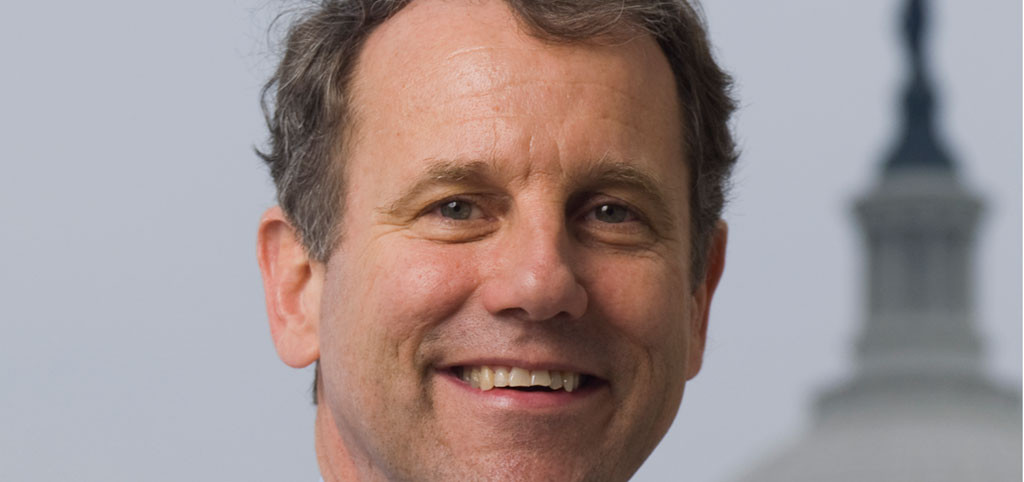
U.S. Sen Sherrod Brown
On Sunday, former President George W. Bush became the most prominent Republican to essentially declare the election over when he congratulated Biden.
Early Monday afternoon, Ohio Gov. Mike DeWine, also a Republican, congratulated Biden, although he said Trump has every right to go to court if he wishes.
“I congratulate Vice-President Biden,” DeWine said in a statement. “It would appear that President Trump’s legal team will be filing legal actions. The President’s lawyers have every right to present evidence in court on any legal issues or irregularities involving the election, and the courts are the proper place to hear evidence on these issues. When lawsuits have concluded and election results are certified, it is important for all Americans to honor the outcome.”
The office of Ohio’s top elections official, Secretary of State Frank LaRose, was more direct when asked if LaRose believed Biden had won.
“Yes, he does,” his spokeswoman, Maggie Sheehan, said in an email.
She pointed to an Oct. 6 statement LaRose had made on Fox News.
“When the results on election night say one thing and then when the results change over the ensuing several weeks, that’s not a sign that something nefarious is happening,” he said. “In fact, quite the contrary. It’s a sign that the legal process is being allowed to play itself out so that every legally cast vote can be tabulated. That’s exactly what we need to do.”
Meanwhile another Ohio Republican, Attorney General Dave Yost, is following Trump into court. Politico reported Monday that Yost’s office had filed a friend-of-the-court brief with the U.S. Supreme Court challenging a three-day extension for ballots to be received in Pennsylvania. That is one of the matters Trump and his allies are litigating.
Attorney General Dave Yost
Yost’s office didn’t respond when asked if the attorney general believed Biden had won the election. But Georgetown University Law Professor Josh Chafetz tweeted that the Supreme Court effort was pointless.
Yost released a statement saying that the legal action transcends pollitics.
“This constitutional question will come up again in future elections,” it quoted him as saying. “It is in the best interest of all Ohioans — all of America — to gain a definitive answer, regardless of politics.”
The office of U.S. Sen. Rob Portman didn’t immediately respond when asked if he believed that Biden had won the election. But over the weekend, Portman refused to criticize Trump for appearing in the White House East Room early Wednesday morning to declare himself the winner.
U.S. Sen. Rob Portman
His office referenced a series of tweets posted on Friday that didn’t address whether it was right for a president to call himself the winner of an election in which vast numbers of votes hadn’t been counted.
The office of Ohio Auditor Keith Faber, an ardent Trump supporter, didn’t respond when asked if he believed Biden had won the election.
Ohio Treasurer Robert Sprague didn’t answer whether he thought Biden had won, but he urged patience.
“While news organizations make projections, they do not determine the winner of the Presidential election — the people do,” he said in a statement issued by his office. “That’s why it’s important to allow the elections departments of all 50 states to continue completing their certification processes so the 2020 election can be finalized properly and in accordance with the states’ laws. This process takes time, and it’s in the best interest of our republic to ensure it’s done right, rather than done fast.”
Marty Schladen has been a reporter for decades, working in Indiana, Texas and other places before returning to his native Ohio to work at The Columbus Dispatch in 2017. He’s won state and national journalism awards for investigations into utility regulation, public corruption, the environment, prescription drug spending and other matters.
Columbus, Ohio – Ohio Attorney General Dave Yost today announced a more than $85 million multistate settlement with American Honda Motor Co., Inc. and Honda of America Mfg., Inc. over allegations the automaker concealed safety issues related to defective airbag systems in certain Honda and Acura vehicles. The systems were designed and manufactured by Takata Corp., a longtime Honda supplier, and were first installed in vehicles sold in the United States in the 2001 model year.
The frontal airbags posed a significant risk of rupture, which could cause metal fragments to fly into the passenger compartments of vehicles.
The settlement, reached between Honda and the attorneys general of 48 states, territories and the District of Columbia, concludes a multistate investigation into Honda’s failure to inform regulators and consumers that the frontal airbags posed a significant risk of rupture, which could cause metal fragments to fly into the passenger compartments of vehicles. The ruptures resulted in at least 14 deaths and 200 injuries in the U.S. alone.
“I’d never buy a car if I knew systems meant to save me and my family could actually hurt us,” Yost said. “That is what Honda denied Ohio consumers – the chance to make the best decisions for their families. This agreement will ensure that doesn’t happen again.”
“I’d never buy a car if I knew systems meant to save me and my family could actually hurt us,” Yost said.
The states made the case that Honda engineers suspected that the airbags’ propellant, ammonium nitrate, could burn aggressively and cause the inflator to burst. Despite these concerns, Honda delayed warning consumers and safety officials, even as it began partial recalls in 2008 and 2009. Further, Honda continued to represent to consumers that its vehicles, including its airbags, were safe. Since 2008, Honda has recalled approximately 12.9 million Honda and Acura vehicles equipped with the suspect inflators.
Ohio Attorney General Dave Yost
The states alleged that Honda’s actions, or perhaps more accurately its failures to act, as well as its misrepresentations about the safety of its vehicles, were unfair and deceptive, and that Honda’s conduct violated state consumer protection laws, including Ohio’s Consumer Sales Practices Act, O.R.C 1345.01 et seq.
Under the terms of the consent judgment, which will be filed with the Franklin County Court of Common Pleas, Honda has agreed to strong injunctive relief which, among other things, requires it to:
Take steps to ensure that future airbag designs include “fail-safe” features to protect passengers in the event the inflator ruptures.
Adopt changes to its procurement process for frontal airbags, ensure that its suppliers have the appropriate industry certifications and satisfy key industry performance standards, as well as improve record-keeping and parts tracking.
Implement recurrence prevention procedures designed to prevent a tragedy like this from happening again, such as requiring that Honda approve all new frontal airbag designs before the company will consider them for use in new vehicles.
Abide by prohibitions on misleading advertisements and point of sale representations regarding the safety of Honda’s vehicles, including the airbags.
Make improvements in critical areas such as risk management, quality control, supplier oversight, training and certifications, and implement mandatory whistleblower protections.
Honda also agreed to pay the participating attorneys general a total of $85,151,210.15, of which Ohio’s share is $2,367,714.89.
In addition to Ohio, the multistate group includes Alabama, Alaska, Arkansas, Colorado, Connecticut, Delaware, the District of Columbia, Florida, Georgia, Guam, Idaho, Illinois, Indiana, Iowa, Kansas, Kentucky, Louisiana, Maine, Maryland, Massachusetts, Michigan, Minnesota, Mississippi, Missouri, Montana, Nebraska, Nevada, New Hampshire, New Jersey, New York, North Carolina, North Dakota, Northern Mariana Islands, Oregon, Pennsylvania, Rhode Island, South Carolina, South Dakota, Tennessee, Texas, Utah, Vermont, Virginia, Washington, West Virginia, Wisconsin, and Wyoming.
Consumers who own a Honda or Acura vehicle are strongly encouraged to visit Honda’s airbag recall website at Hondaairbaginfo.com, or call its customer service toll-free number at 1-888-234-2138, to see if the vehicle is subject to a recall. Consumers may also check for open recalls by going to Safercar.gov. All safety recall repairs are free at authorized Honda dealers.
Columbus, Ohio – Attorney General Dave Yost is encouraging Ohioans affected by Equifax’s massive 2017 data breach to sign up for free credit monitoring before the offer expires next week.
Consumers can check their eligibility on EquifaxBreachSettlement.com and file claims on the website by Wednesday, Jan. 22, to receive up to 10 years of free credit monitoring.
“These credit monitoring services will go a long way in shielding data breach victims from the perils of identity theft,” Yost said. “This sort of protection normally costs hundreds of dollars per year, but there’s still time to get it for free.”
The services are available at no cost to victims of the breach as part of a $600 million settlement with Equifax obtained last year by a 47-state coalition of attorneys general, led in part by Ohio.
On Sept. 7, 2017, Equifax, one of the largest consumer reporting agencies in the world, announced a breach affecting nearly half of the U.S. population. Breached information included Social Security numbers, names, dates of birth, addresses, and, in some cases, credit card and driver’s license numbers.
An investigation by the coalition of states found the breach occurred because Equifax failed to implement an adequate security program to protect consumers’ sensitive personal information. Despite knowing about a critical vulnerability in its software, Equifax failed to patch its systems, allowing outside actors to access the personal information.
Additionally, Equifax failed to replace software that monitored the breached network for suspicious activity. As a result, the attack went unnoticed for 76 days. The settlement requires Equifax to strengthen its security practices to better protect consumer information moving forward.
Columbus, Ohio – Ohio’s schools can now apply for their share of $10 million in school safety grants awarded by Attorney General Dave Yost’s office for the 2019-20 school year.
All public schools, chartered nonpublic school and schools operated by county boards of developmental disabilities are eligible to receive either $2,500 or $4.49 per student, whichever amount is greater.
“Our kids learn and grow best in an environment free from fear and violence,” Yost said. “These grants will help bring that goal closer to reality.”
Funding for the grants comes from dollars that legislators set aside for school safety in House Bill 166. The law gives school leaders flexibility to decide how the grant funds can best benefit school safety and security efforts. These efforts may include:
The support of school resource officer certification training;
Any type of active shooter and school safety training or equipment;
All grade level type educational resources;
Training to identify and assist students with mental health issues;
School supplies or equipment related to school safety or for implementing the school’s safety plan;
Any other training related to school safety.
The attorney general’s office notified superintendents today of their eligibility and provided instructions for accessing the funds. All applications are due by Dec. 13.