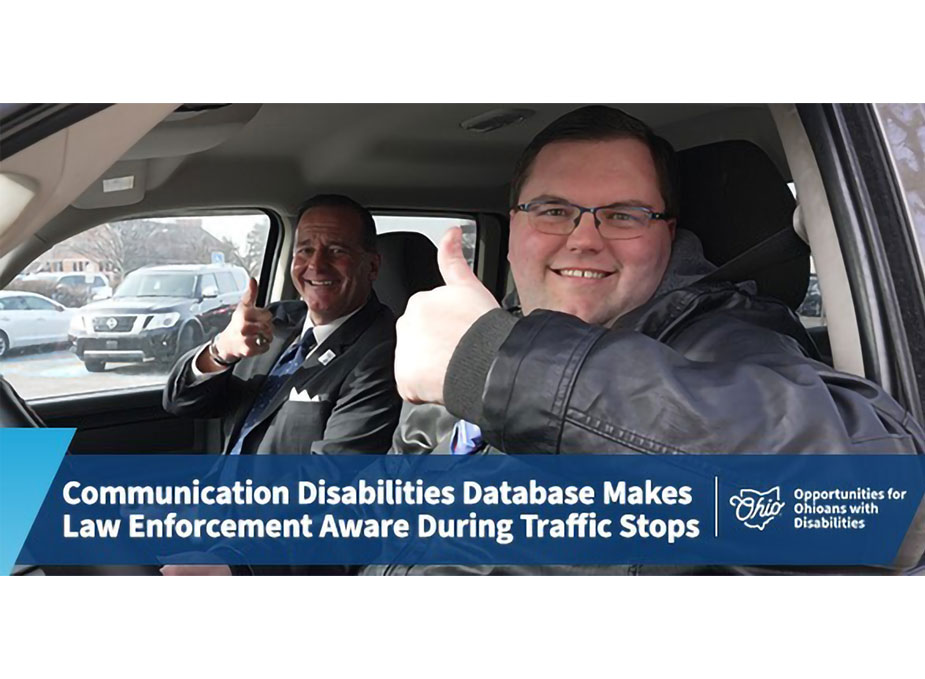
This April, we invite you to join us in celebrating Autism Acceptance Month with a meaningful video featuring Connor Miller and Kevin L. Miller, the Director of Opportunities for Ohioans with Disabilities (OOD) and Connor’s dad.
In this video, Connor shares his journey with autism and how it has shaped his life. As we celebrate this special month, discover the importance of understanding, supporting, and embracing differences.
They also discuss the Communication Disability Law, which provides a way for individuals with communication disabilities to voluntarily enroll in a database that alerts law enforcement during traffic stops. They explain how this option fosters safety, promotes understanding, and empowers individuals like Connor to navigate the world with greater confidence.
Tune in to learn how this law is making a real difference in Ohio…
Americans with autism, ADHD and other conditions deserve recognition and support, not to be treated as a ‘health crisis’
by Carolyn McCoy
President Donald Trump’s recent executive order on chronic disease and mental health is dangerous: It groups autism and ADHD — natural, genetic neurotypes — alongside chronic diseases. This is not just inaccurate, it is harmful to millions of neurodivergent Americans fighting for acceptance and equal rights.
Autism and ADHD are not diseases. They are not illnesses. They are not a “health crisis.” They are neurodevelopmental variations, passed down through families — just like eye color.
I am neurodivergent. So is my child, my mother, my sister and my nephew. We are not sick. We do not need curing. What we need is recognition, support, and a society that doesn’t try to erase us.
This harmful framing isn’t just offensive — it’s a strategic attack on disabled people, targeting our children first.
Stripping away protections
For years, I have fought to get my daughter the support she needs in school. She is too smart to be recognized for her disabilities, yet too disabled to fit into the school environment. The system refuses to acknowledge that neurodivergent children struggle in ways that aren’t immediately visible — and now, they are making it even harder.
While Trump calls neurodivergence a “health crisis,” Republican-led states are suing to strip away protections for disabled children. Multiple states want to eliminate Section 504 protections, which ensure that kids with disabilities have rights to accommodations in school
And it doesn’t stop there. Trump’s hand-picked Secretary of Health and Human Services, Robert F. Kennedy Jr., has a long history of spreading misinformation about autism and ADHD. He falsely claimed vaccines cause autism — a claim that’s been widely debunked for many years — and referred to the rise in autism diagnoses as a “holocaust.”
Now, this same man is leading federal health policy.
Follow the money
Let’s be honest: They simply don’t want to spend money on kids like mine.
Those 504 plans and disability protections cost money, and rather than ensuring public schools provide equitable access, states are diverting those funds elsewhere.
In Ohio, the expansion to near-universal private school vouchers has almost entirely benefited wealthy families that were already sending their kids to private schools.
This is about funding education for the privileged while gutting public schools.
YOU MAKE OUR WORK POSSIBLE.
Mask, hide or be punished
I was diagnosed young. Instead of being encouraged to embrace who I was, I learned to suppress my natural instincts, reactions and behaviors.
For years, I played the part. The world received me more kindly when I wasn’t being myself.
It wasn’t until recently that I started to undo the years of conditioning that told me my natural way of existing wasn’t acceptable. For the first time in my life, I feel authentically me.
I am happier now, even though the world doesn’t always accept me the way it did before. And I refuse to let my daughter grow up believing she has to do the same.
But this executive order? The lawsuits against 504 plans? The diversion of public funds to private schools?
They are telling our children exactly that: Mask. Hide. Fit in. Or be punished.
What we actually need
If the administration truly wants to address health disparities, it should support neurodivergent individuals, not pathologize us. That means:
Protecting 504 plans and disability rights
Reforming education to stop punishing neurodivergent kids for being themselves
Increasing access to neuro-affirming healthcare
Acknowledging that neurodivergence is not a crisis
The government can cling to outdated, ableist narratives or listen to the millions of neurodivergent individuals saying:
We are not a disease. We are not a crisis. We have always been here, and we are not going anywhere.
We demand a retraction of this harmful framing, recognition that neurodivergence is part of human diversity, and real action — not to “fix” us, but to create an environment where we can thrive.
We will not stand by while our rights — and our children’s rights — are taken away. It’s time to push back.
Loudly. Relentlessly. Neurodivergent voices will not be silenced.
____________
Carolyn McCoy
Carolyn McCoy is a mother to a neurodivergent 11-year-old and two stepchildren, ages 13 and 15. She is a marketing strategist, mentor, writer and advocate for neurodivergent and human rights, and she is passionate about fostering a more inclusive world. In addition, Carolyn serves on the committee for Cancer Gateway Research’s Celeb Fight Night, supporting critical cancer research initiatives.
The Autism Collaboration, Accountability, Research, Education and Support (Autism CARES) Act has been extended for five years.
What It Means
The five-year extension of this federal law creates a pathway for $1.95 billion to be spent with the funds will going toward:
Research
Early detection
Prevalence tracking
Screening
Professional training
Intervention services
Other related government activities
The bill, sponsored by Rep. Chris Smith (R-NJ), received “overwhelming bipartisan support.”
Under the law’s extension, the Autism CARES Act will:
“Encourage research focused on the daily life challenges of autistic people across the lifespan with a new emphasis on autism and aging.
Further efforts for greater inclusivity in research activities, so that studies reflect the full range of needs of support and services to ensure the physical safety and well-being of all autistic people.
Require a report to identify and develop a strategy for expanding the developmental-behavioral pediatrician workforce.
Create an Autism Intervention Research Network for Communication Needs (AIR-C) to address how to best support autistic people who are non-speaking or may need additional communication support.
Create a technical assistance program to provide training and assistance in providing individuals with autism and other developmental disabilities with access to evidence-based services, tools and technologies that support communication needs to states, Indian Tribes or Tribal organizations, localities, or territories.
Require HHS to develop a Report to Congress on the mental health of autistic people.
Increase the minimum number of NIH Autism Centers of Excellence – research networks that have provided us with a much clearer picture of the significant disparities that autistic people experience in terms of access to quality health care, daily life supports and services.
Require a professional judgment budget that will provide the autism community and Congress with a transparent plan that outlines a strategic direction and resource needs for autism research for years to come.” autismspeaks.org.
Columbus, Ohio – The countdown is on for the highly anticipated 2024 Ohio State Fair, running from July 24 through August 4, 2024. As excitement builds, Opportunities for Ohioans with Disabilities (OOD) and the Ohio State Fair are proud to announce their continued commitment to accessibility.
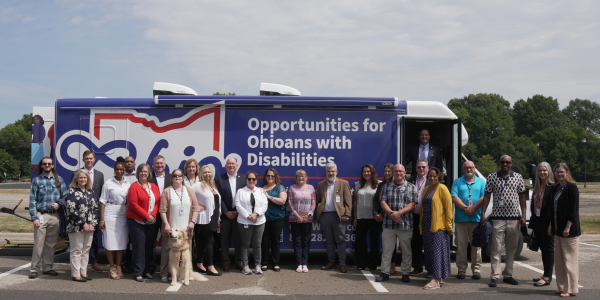
Visitors can look forward to a wealth of resources designed to ensure everyone can fully enjoy the fair. Guest information services booths are strategically placed throughout the fairgrounds, offering daily schedules, maps, accessibility guides, and directions. For those seeking additional support, the OOD mobile unit is stationed near the Lausche Youth Exploration Space, providing comprehensive accessibility information.
OOD staff and the new mobile unit.
Fairgoers can enjoy free wheelchair/mobility device charging stations, technology to connect people who are blind or have low vision with an agent who can help with navigation, American Sign Language interpretation, audio descriptions, a dedicated sensory-friendly morning, and two universal changing tables.
“Ohio is the heart of it all, and we want people of all abilities to be able to enjoy everything our great State Fair has to offer,” said Ohio Governor Mike DeWine. “The Ohio State Fair provides a wealth of supports for individuals with disabilities, and this year our goal is to make it the most enjoyable yet for every person who comes through the gates.”
OOD partnered with the Fair to make complimentary wheelchair/mobility device charging stations available throughout the grounds. The stations are in marked areas in the Bricker MarketPlace Building, Kasich Hall, the Lausche Youth Exploration Space, Natural Resources Park pavilion, Voinovich Livestock and Trade Center, and WCOL Celeste Center.
“The Ohio State Fair offers a rejuvenating break from work and our daily routine,” said OOD Director Kevin L. Miller. “Since fairgoers usually spend the entire day on the grounds, it’s important that charging stations are available to sustain wheelchairs, scooters, and other mobility devices.”
Also made available with support from OOD and the National Federation of the Blind of Ohio, fairgoers who are blind or have low vision can use Aira – which stands for Access to Information Remote Assistance – to connect, for free, to a remote agent via a cell phone or through specially-fashioned glasses. Both the application and the glasses allow the agent to access visual information, which is especially helpful for navigating a large, unfamiliar area. The agent can also locate users through GPS and direct them to places of interest.
For fairgoers whose preferred method of communication is American Sign Language (ASL), interpretation will be offered at these events, with no reservations required: the Fair’s opening ceremony on July 24, the Sale of Champions Livestock Auction on August 4, daily at the Natural Resources Park Great Lakes Timber (lumberjack) shows and the Marvelous Mutts shows at The Dog House, and for all ticketed concerts in the WCOL Celeste Center. The Fair’s daily schedule will feature additional events available in ASL. For Ohioans who are Deaf or hard of hearing and use ASL, please watch a video about the Ohio State Fair ASL interpretation.
In collaboration with the Ohio Center for Autism and Low Incidence (OCALI), the Autism Society of Central Ohio, and the Ohio Department of Developmental Disabilities, the Ohio State Fair is turning down the lights and volume to host a sensory-friendly morning on Thursday, July 25 from 10 a.m. to 1 p.m. Fairgoers will have an opportunity to ride the rides with no flashing lights or music, visit the Fair’s educational activities, and explore many activities in the shade of the Natural Resources Park. “On sensory-friendly morning, the sights, sounds, and stimuli are reduced to allow individuals to experience our incredible State Fair in a way that helps them feel more comfortable and engaged,” said Shawn Henry, OCALI Executive Director. Find more information and resources on OCALI’s sensory-friendly morning webpage.
This year’s Fair will offer two universal adjustable height changing stations. While one station returns to its previous location in the Ag Pro Taft Coliseum family restroom, a new station has been added to the newly renovated First Aid Center, north of Kasich Hall. These spacious and private facilities cater to fairgoers’ accessibility needs, strategically placed at opposite ends of the grounds to ensure convenience for all attendees.
“At the Ohio State Fair, we believe that accessibility is not just a checkbox; it’s a continuous journey of improvement and inclusivity,” said Adam Heffron, Ohio Expo Center & State Fairgrounds Executive Director. “We’re dedicated to building upon our existing accessibility efforts, working diligently to create an environment that is welcoming and accessible to all.”
Additional accessibility efforts at the Ohio State Fair include the following:
Ample accessible parking spaces
Buildings and many restrooms are accessible
Motorized scooter and non-motorized wheelchair rentals
A Quiet Room situated just east of Central Park, equipped to provide sensory relief
Communication boards for fairgoers who are nonverbal, available at all guest information services booths and on the Ohio State Fair accessibility webpage, featuring Fair-specific symbols to facilitate navigation and encourage exploration of Fair offerings
Accessible seats for concerts in the WCOL Celeste Center can be purchased at the same cost directly from Ticketmaster (to view accessible seats, click the “filters” button, then toggle on the “accessibility” button to see)
Free assisted listening devices for use at the WCOL Celeste Center, Main Street Stage presented by Ohio Lottery, and Wellcare Gazebo Stage
Audio descriptions for select exhibits and attractions, available within the Ohio State Fair app
Art Possible Ohio exhibit in Kasich Hall C, featuring artwork by Ohio artists with disabilities
Service animal relief areas with pick-up bags and waste receptacles at the Rhodes Center Lawn, Central Park, and Natural Resources Park
Designated accessible seating at additional stages
Accessible play area at the Ohio Department of Natural Resources Park
David Miller is the Managing Editor of Loveland Magazine
by David Miller
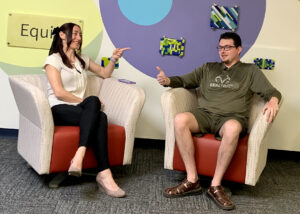
Loveland, Ohio – In celebration of Autism Acceptance Month, Cassie Mattia invited a very special guest to share his story with the community. Tim Livelsburger is not only advocating for those with Autism within the community, but he is also using his experiences as a learning tool to help those that may be encountering obstacles due to their disability.
Tim is thriving and wants nothing more than to use his voice to help others with developmental disabilities achieve their goals! He told Cassie what obstacles he overcame, and how he is now exceeding his ultimate goals.
Cassie, besides being the President and Publisher of Loveland Magazine is the Public Relations Coordinator for the Butler County Board of Developmental Disabilities. She asked LOVELAND MAGAZINE TV and myself to travel to the BCBDD’s office in Hamilton with our video equipment to help produce the interview and wanted us to share it with you, our faithful Loveland Magazine readers.
I couldn’t be more thankful to have a business partner with the values of Cassie and that she seeks out someone like Tim to interview, someone who is doing wonderful things within his Autism family and the broader family we all hope to have an impact on. Thank you Tim, Cassie, and the Butler County Board of Developmental Disabilities for what you are dedicating your life’s work toward; inclusion, understanding, and acceptance of each individual.
Happy Autism Acceptance Month to each of you and to our readers.
President and Publisher of Loveland Magazine, Cassie Mattia is a resident of Historic Downtown Loveland and the Public Relations Coordinator at Butler County Board of DD. Cassie was awarded the Little Miami River Chamber Alliance 2021 Young Business Professional of the Year.
“Livelsburger is not only advocating for those with Autism within the community, but he is also using his experiences as a learning tool to help those that are encountering their own obstacles due to their disability! Tim sat down with BCBDD PR Coordinator Cassie Mattia to talk about his disability and how he has overcome so many obstacles along the way. Tim is thriving and wants nothing more than to use his voice to help others with developmental disabilities achieve their goals!”
Stay tuned to see the full-length interview coming soon!
Let’s change the world for people with intellectual and developmental disabilities (IDD)
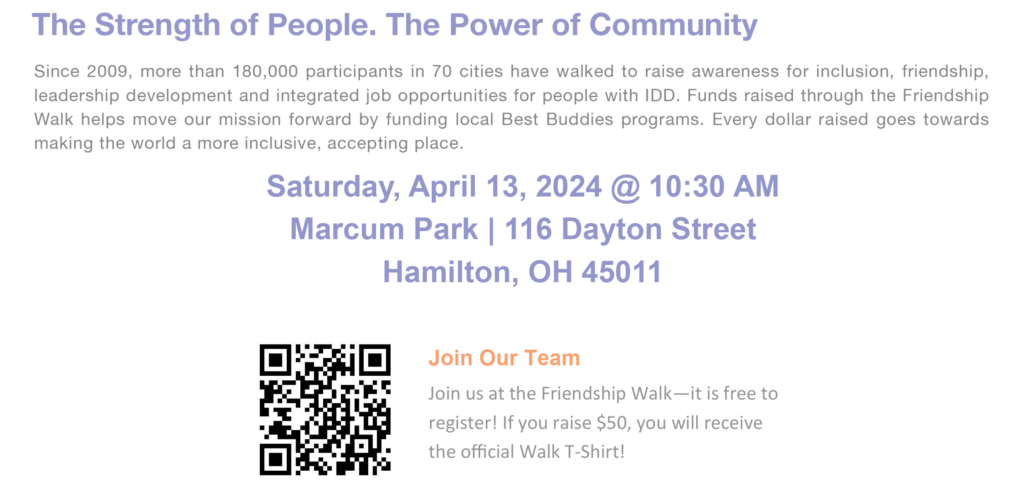
April 13, 2024
10:30 AM | Hamilton, OH
The Best Buddies Friendship Walk is the leading event in the country supporting inclusion for people with intellectual and developmental disabilities (IDD) and you can join us in HAMILTON on April 13that Marcum Park!
Join 50,000 participants at 70+ Walks across the globe to support the Best Buddies programs in schools, workplaces, and communities. You’ll be making the world more welcoming to people with IDD — one friendship, one job, and one life-changing connection at a time.
Best Buddies International is a nonprofit 501(c)(3) organization dedicated to establishing a global volunteer movement that creates opportunities for one-to-one friendships, integrated employment, leadership development, inclusive living and family support for people with intellectual and developmental disabilities (IDD).
Who We Serve
The IDD community that Best Buddies serves includes, but is not limited to, people and families with Down syndrome, autism, Fragile X, Williams syndrome, cerebral palsy, traumatic brain injury and other undiagnosed disabilities.
Programs
Best Buddies is the world’s largest organization dedicated to ending the social, physical and economic isolation of the 200 million people with intellectual and developmental disabilities (IDD). Our programs empower the special abilities of people and families with IDD by helping them form meaningful friendships with their peers, secure successful jobs, live independently, improve public speaking, self-advocacy and communication skills, and feel valued by society.
Erlanger, Ky. – The Cincinnati/Northern Kentucky International Airport (CVG) is making travel more accessible for passengers with hidden disabilities or conditions. The airport is participating in the Sunflower Lanyard Program, a worldwide initiative which aims to raise awareness and support those who have autism, hearing loss, dementia, PTSD, anxiety, or other conditions which may not be readily visible.
Employees and volunteers at many airports, and other public places, identify the sunflower as a symbol that a person may need additional assistance and patience. At CVG, all airlines, concessions, and TSA personnel have received and will continue to receive information about the program and how they can best offer assistance. Wearing a lanyard does not expedite security or other airport processes. Rather, it allows an individual to voluntarily share that they may need a helping hand, more understanding, or more time.
CVG travelers can request a free sunflower lanyard to be mailed to their residence by emailing info@cvgairport.com or by stopping by the information desk on the Baggage Claim level at the airport. CVG is experiencing high passenger volumes this summer and wants to spread awareness and increase utilization of this program.
More than 215 airports across the world participate in the Sunflower Lanyard program, including many CVG has nonstop service to including:
Seattle, WA (SEA)
Tampa, FL (TPA)
Boston (BOS)
Dallas (DFW)
Toronto, Canada (YYZ)
For a list of airports which participate in the program and more information, visit the Hidden Disabilities Sunflower website at hdsunflower.com.
Part of Loveland Magazine’s coverage of Developmental Disabilities Awareness Month
[/vc_column_text][vc_column_text]
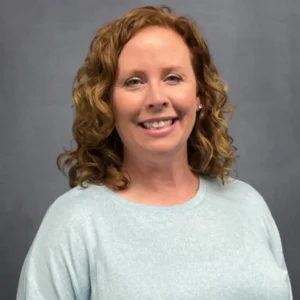
Cassie Mattia
by Cassie Mattia
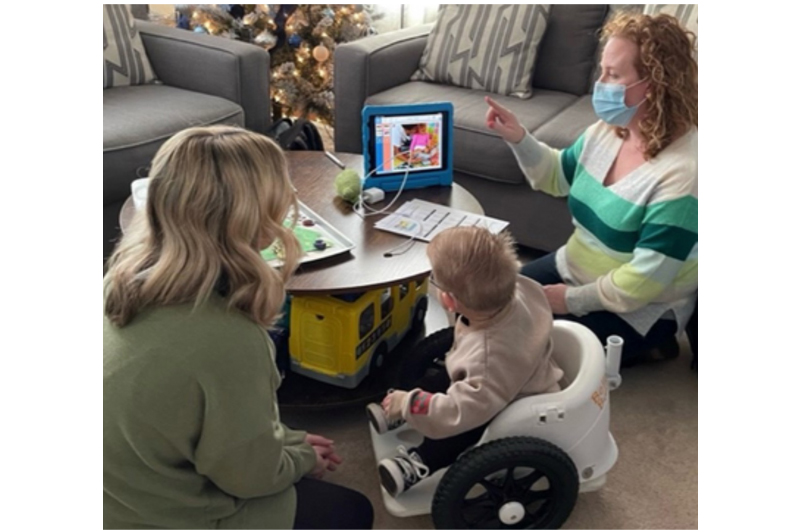
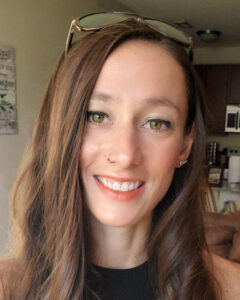
Since the inception of Ohio’s Technology First Initiative, new and improved devices that help with two-way communication or provide step-by step assistance has helped many families and individuals with developmental disabilities overcome daily obstacles. For children with developmental disabilities, communication devices are often one of the most important parts of their growth and development. Butler County Board of Developmental Disabilities (BCBDD) Early Intervention Speech-Language Pathologist, Bree Lanham, began learning about Augmentative and Alternative Communication devices in college and knew that with her expertise she could implement what she had learned into the BCBDD Early Intervention program and immediately impact the children and families a part of the program.
Bree Lanham
“Since joining the board, I saw an opportunity for increasing awareness of Augmentative and Alternative Communication (AAC) to be used in Early Intervention. There are many myths associated with using AAC in young populations and I really wanted to make it my mission to reveal the truth about AAC and how it can benefit birth to 3,” Bree said.
Bree, who has been a Speech-Language Pathologist (SLP) for 14 years, began learning about low-tech and high-tech AAC devices at Arizona State University where she gained her degree in Communication Disorders (Speech Pathology). Bree’s undergraduate degree in Special Education allowed her to explore the world of AAC devices and use various forms of the devices to give the children she worked with access to language surrounding curriculum in the classroom. “I’ve lived all over the US and had experience working with families and children not only in Early Intervention (EI), but schools and clinics as well. I have found that the earlier a child has access to a robust system of communication, the earlier they can begin integrating their skills with family and friends across environments and building lifelong relationships,” Bree said.
What is an AAC device?
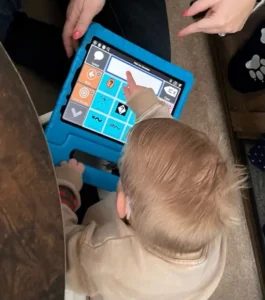
Augmentative and alternative communication encompasses the communication methods used to supplement or replace speech or writing for those with impairments in the production or comprehension of spoken or written language. In simpler terms, AAC means ALL of the ways that someone communicates besides talking. Anyone at any age can use AAC to help with speech and language skills. AAC devices fall into two categories, no or low-tech, meaning a physical aid or tool is not required, and high-tech, which utilizes technology. No or low-tech includes gestures and facial expressions, writing, sign language, drawing, spelling words by pointing to letters, and pointing to photos, pictures, or written words. High-tech most often uses an app on an iPad or tablet to communicate. High-tech may also include using a computer with a speech-generating device.
Who should use AAC devices?
AAC devices work well for children who are pre-verbal, those with developmental delays such as Autism or Down Syndrome as well as children who are difficult to understand such as those with severe phonological impairments or Childhood Apraxia of Speech. High-tech AAC devices allow children to build on their language skills; quickly going from single words to short sentences in a matter of months. High-tech AAC devices gives children a voice to request their favorite food, favorite toy or to tell their parents and caregivers about an important need or want. AAC devices can be a huge help to kids who are learning verbal speech alongside their device and promotes speech and language development.
Bree quickly recognized the need for AAC devices in the BCBDD EI program and as a result of her efforts, the EI department procured several iPads with five apps (Proloquo2Go, TouchChat, TD Snap, Snap Scene and Cough Drop) to use for expressive communication. The iPads are available through a budding lending library for EI families to now learn the possibilities of what is out there and how AAC devices can help their child develop and grow to the best of their potential. Since the introduction of AAC devices to the EI program, the Butler County Educational Service Center has provided an additional 8 iPads to help grow the lending library.
“It’s great to work for an organization where employees feel empowered to reach out when they see a need. Bree approached us with an opportunity to enhance our services to the children we serve. Of course, we quickly made that opportunity a reality for our families and can now add AAC as another option for our families,” said Sherry Dillon, BDBDD Community Services Director.
2-year-old Leo Davis using an AAC device
BCBDD EI Therapists are trialing the AAC apps with several kids in the EI program to use across daily routines such as playtime and mealtime. “Our plan is to figure out which app best fits their needs and work to complete an AAC Evaluation to provide these children with permanent devices to supplement expressive language. I feel that all children should have access to robust language from an early age to promote developmentally and/or age-appropriate communication skills,” Bree explained.
The use of AAC devices in the BCBDD EI program has already begun to make a huge difference in Kasey Davis’ life, whose 3-year-old son Connor is using an AAC device to model language.
“Having access to the device has been amazing for our family,” said Kasey. “It’s allowed our son to explore expressive communication in new ways we didn’t think was possible. Although we are still learning the different apps, he’s picking it up quickly and is engaged when using it. Having a ‘tailor made’ device that we can customize to our needs has made the experience even better. We’re so grateful for the opportunity to work with the program and use the device as a tool for our son.”
The benefits of AAC can be endless when introduced early on, according to Bree.
“Our Early Intervention program is unique. We have access to low and high-tech AAC for all children. Families will need to work with their therapists to obtain the right fit and explore all options. Typically, a child will be working with a therapist for a period of time to determine the best fit for AAC. High-tech AAC devices can and should be implemented early but are often not the first strategy or system that we use. This may be due to various factors including need or fit for the family and child. Essentially, it’s a complex process of determining what is the best fit for a child and family long-term. This is why a family’s Speech Language Pathologist should work together with the family to determine the most appropriate fit that meets the current need and also allows the child to push to the next level of development,” Bree said.
Bree says that when working with a SLP or therapist it is critical in determining the need for high-tech devices as not all children and families will need them. “Asking your SLP or therapist questions is the best way to learn more about what we have to offer and which program on the device will fit their needs. It’s also critical to work with your therapist to learn the device and how to implement it in daily routines to reduce device abandonment long-term,” Bree added.
AAC devices can lead to other benefits in a child’s future!
According to AssistiveWare.com, AAC devices can offer a child many social, physical, and emotional benefits including:
stronger friendships and deeper relationships
richer, more frequent social interactions
deeper social roles
increased autonomy and decision-making power over their own life
increased independence
more respect from others
greater participation in their family lives and communities
improved information sharing with physicians
improved personal safety in a variety of care settings, such as hospitals or long-term facilities
more employment and volunteer opportunities
improved physical and mental health
With the implementation of AAC devices in the BCBDD EI program and the proven success rate with families currently trialing the devices, BCBDD Superintendent, Lisa Guliano couldn’t be happier about offering more assistive technology options to children and families.
“I appreciate Bree’s initiative in pursuing use of Augmentative and Alternative Communication as an option for children and families being served through Early Intervention,” Lisa said. “These efforts align with our statewide Technology First plan and our agency’s goal to increase the number of people using assistive technology across the lifespan. I’m excited to see the outcomes for children and families as they explore the options available.”
The new BCBDD AAC system in the EI program is something Bree believes all organizations that serve children with communication delays and disorders would benefit from. “All children should be provided a system of communication as early as possible, and this can range from pictures and signs to a high-tech device,” said Bree. “I’ve always felt that my job as an SLP is not to ‘make a child talk’ but to teach a child to communicate and AAC is another tool in my toolbelt that can support a child in their development of communication skills.”
AAC Myths vs. Facts
Myth: Using AAC or high-tech device will prevent a child from talking. Fact: Using AAC or a high-tech device can help to promote verbal speech.
Myth: AAC is a “last resort” in speech-language intervention. Fact: There are no pre-requisites for providing AAC and it can be used in tandem with traditional speech-language intervention.
Myth: Only children with certain cognitive abilities will benefit from AAC or high-tech devices. Fact: No, the opposite is true. Emerging research is showing that devices can actually promote communication and cognitive development including increasing social skills, facilitating communicative intent and aiding in learning symbolic representation.
Myth: Children need to trial low-tech devices before high-tech devices such as PECS. Fact: There are no pre-requisites for providing a robust system of communication. Each child should be evaluated independently and provided access to the system of communication that will grow with them. Speech-Language Pathologists specialize in assisting families with making these decisions.
To find out more about access to BCBDD AAC devices through the EI program contact your Developmental Specialist or email info@butlerdd.org.[/vc_column_text][vc_separator border_width=”10″][vc_message]
Columnist Cassie Mattia is a resident of Historic Downtown Loveland and the Public Relations Coordinator at the Butler County Board of Developmental Disabilities. Cassie was awarded the Little Miami River Chamber Alliance 2021 Young Business Professional of the Year. Cassie is very active in the Loveland community and will often be seen helping plan and volunteering at the Little Miami Chamber Alliance and City of Loveland events. Cassie also enjoys supporting the local restaurants and businesses in Loveland as well as making guest barista appearances at Mile42 Coffee. To see what Cassie is up to follow her on Facebook and Instagram!
You can reach Cassie at cmattia12@gmail.com[/vc_message][/vc_column][/vc_row]
Everyone experiences challenges in their lives whether it’s having a not-so-great work week, overcoming an illness, or getting into an argument with someone you care about. In the grand scheme of things, those challenges are often ones you can quickly overcome and grow from! Some obstacles in life can be so challenging that when one overcomes them it is not only inspirational to see but also serves as a beautiful example for those experiencing the same obstacles. Meet Kathryn (Kat) Feldmann, a 21-year-old who has not only never backed down from a challenge but has also been a source of motivation for others in the developmental disability community to pursue their dreams.
Kat, who lives with her mom, Kristen, her dad, Kurt, and her brother, Konrad in Liberty Township has overcome a lot of medical challenges in her life. As a baby, Kat was diagnosed with an Atrial Septal Defect that was eventually corrected through surgery. Kat was also diagnosed with autism, Pierre Robin Sequence, anxiety, Craniofacial Anomalies, and a speech delay. Though Kat deals with challenges daily due to her disabilities, she has successfully managed to not only exceed her goals, but also receive many awards/honors along the way for her outstanding achievements.
Kat, as a very young girl, loved being involved in the community and supporting organizations that she truly believed in.
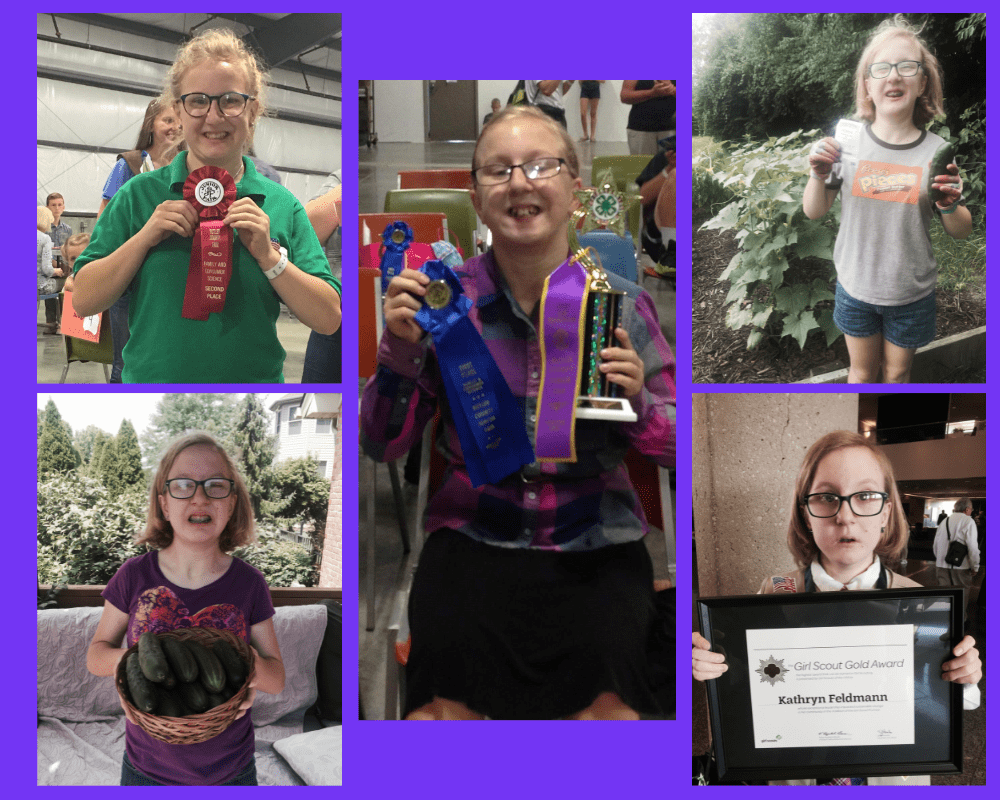
“Throughout her school age years, she participated in Butler County 4H doing mostly food and nutrition projects and even competed at the state fair twice,” Kat’s mother Kristen said. “Kat was also involved in Girl Scouts since first grade and earned the Girl Scout Gold award. For this, she earned a multiyear grant from Katie’s Krops and grew a garden from which she donated her entire harvest to a local food pantry. She also identified and printed recipes to donate alongside the produce so that the recipients would have a better idea of how to cook it.”
Kat and her many accomplishments, awards, and honors!
Kat’s determination and dedication to the environment, her community, and cooking delicious, healthy, fresh food earned her multiple 4H awards and a trip to Washington DC where she served as the “Citizens Focus” Club’s Treasurer. Little did Kat realize she was becoming one of the biggest local advocates for those with developmental disabilities!
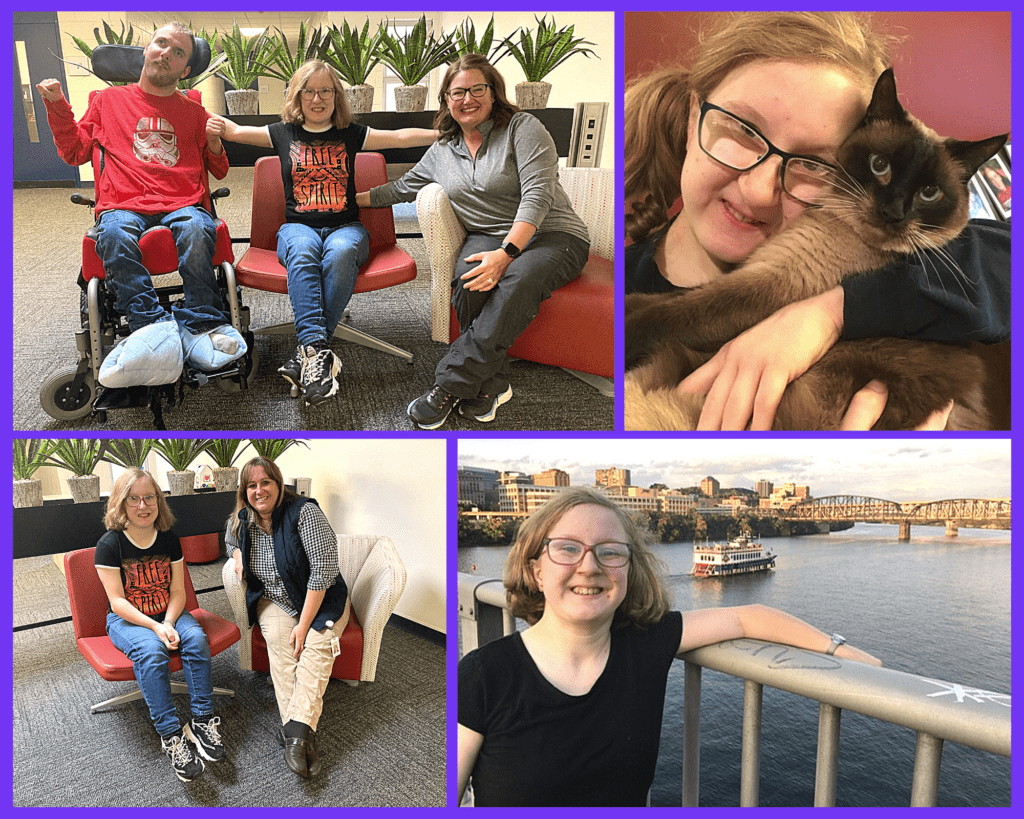
As time went on, Kat began to really enjoy researching things that interested her, often watching YouTube videos to learn as much as she could about topics that she was passionate about. This led to Kat diving into many hobbies such as collecting American Girl Dolls, reading books, cooking, music, dancing, spending time with her Siamese cats, and art.
Kat, her brother Konrad, and her mother Kristen (Photo top left), Kat and 1 of her 3 Siamese cats (Photo top right), Kat and her SSA, Teresa Rouff (Photo bottom left), Kat in Pittsburgh (Photo bottom right).
Kat successfully graduated from Lakota East and shortly after became a part of Butler Tech’s Project Life, a comprehensive, multi-year transition program where students develop, practice, and strengthen skills that increase adult independence and successful integrated employment in the community, and Butler Tech’s Project Search, a school-to-work program for students with disabilities who are serious about working hard and getting a job.
“Kat completed both Project Life and Project Search in May of 2022. For Project Search she completed rotations in the emergency department and the lab at West Chester Hospital,” Kristen explained. “She is now working with Opportunities for Ohioans with Disabilities (OOD) to secure employment in the future.”
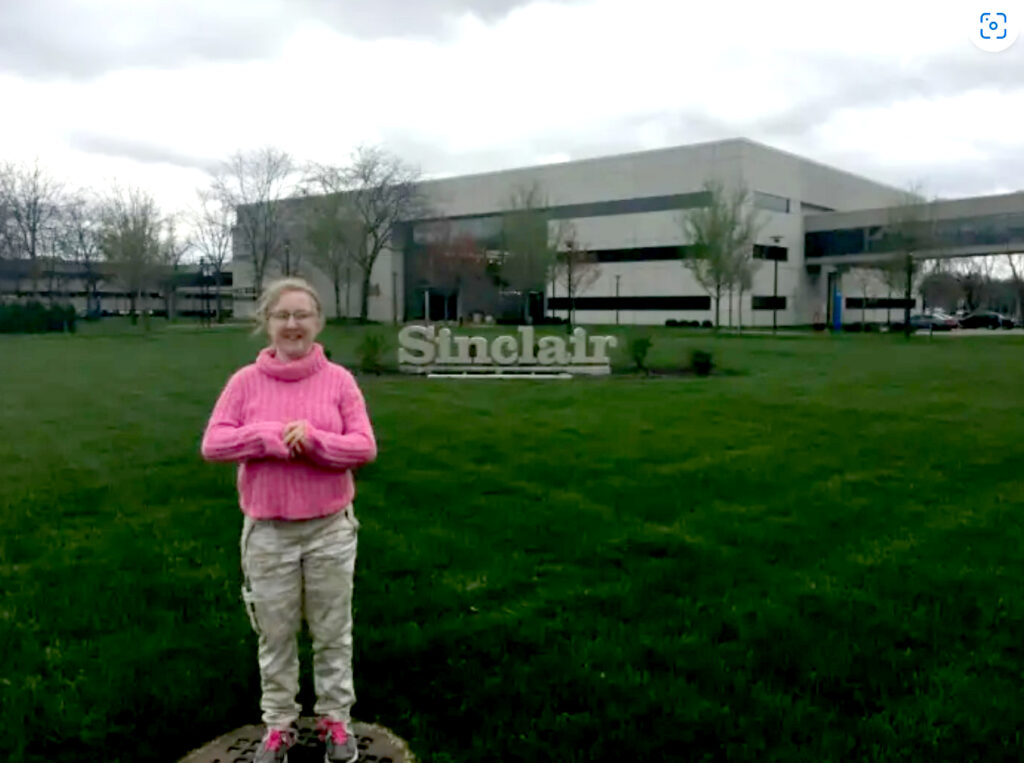
Once Kat finished Project Search she realized she had an interest in Hospitality which led her to enrolling in the Tartan TOPS program at Sinclair College, an educational/career pathway program for part-time students who have an intellectual disability.
Kat in front of Sinclair College, where she currently takes classes in the Tartan TOPS program.
BCBDD Service and Support Administrator (SSA), Teresa Rouff, began working with Kat in April and couldn’t be more impressed with Kat’s progress!
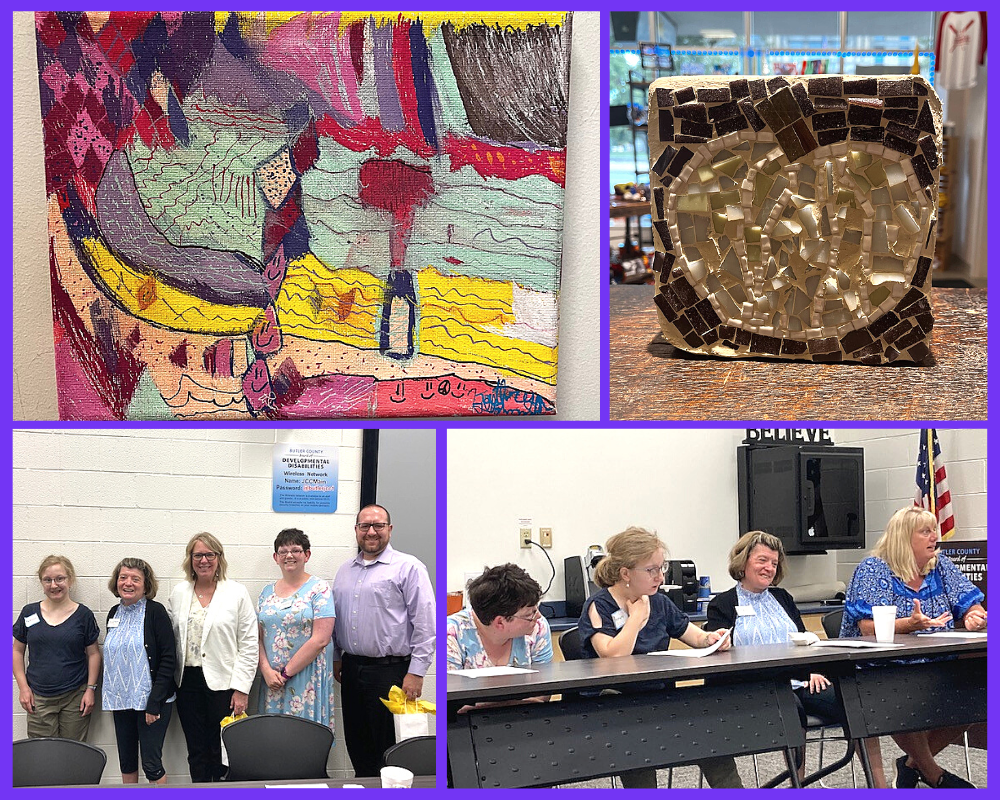
“On top of all the amazing things Kat is doing, she recently began a vocational habilitation program at InsideOut Studio where she creates various art pieces,” Teresa said. “She loves art and is VERY talented. She has a few pieces for sale on the InsideOut Studio website that show how gifted she is at art!”
Kat enjoys all aspects of art and is currently working with fiber and crocheting knits at InsideOut Studio. Kat said she hopes to sell some of her creations through the online store.
“Kat is also involved in SpeakUp and was recently matched with a buddy through Best Buddies and looks forward to fun times ahead with her new friend,” Kristen said. SpeakUp is a BCBDD self-advocacy group and Best Buddies is a non-profit organization that offers one-on-one friendship and leadership development programs for individuals with intellectual and developmental disabilities.
Kat’s “Happiness” acrylic on canvas that she created at InsideOut Studio (Photo top left), Kat’s white pumpkin garden stone that she created at InsideOut Studio (Photo top right), Kat with advocate Jodi Mann, Director Kimberly Hauck from the Ohio Department of Developmental Disabilities (DODD), advocate Cassie Sullivan, and Steve Beha, the Chief Policy Officer for the DODD, Kat was on an advocate panel when DODD’s Director Hauck visited the BCBDD (Bottom right photo).
Kat says her main hope and dream is to become as independent as possible and to live with roommates and friends for socialization. She says she would like to get a job that allows her to make a difference in the world and continue doing what she’s passionate about!
Watch the on-camera interview with Kat Feldmann, BCBDD SSA Teresa Rouff, and Kat’s mother Kristen Feldmann below!





![[Video Interview] Cassie Mattia Talks With Autism Awareness Advocate Tim Livelsburger](https://lovelandmagazine.com/wp-content/uploads/2024/04/cassie-tim.jpg)
 President and Publisher of Loveland Magazine, Cassie Mattia is a resident of Historic Downtown Loveland and the Public Relations Coordinator at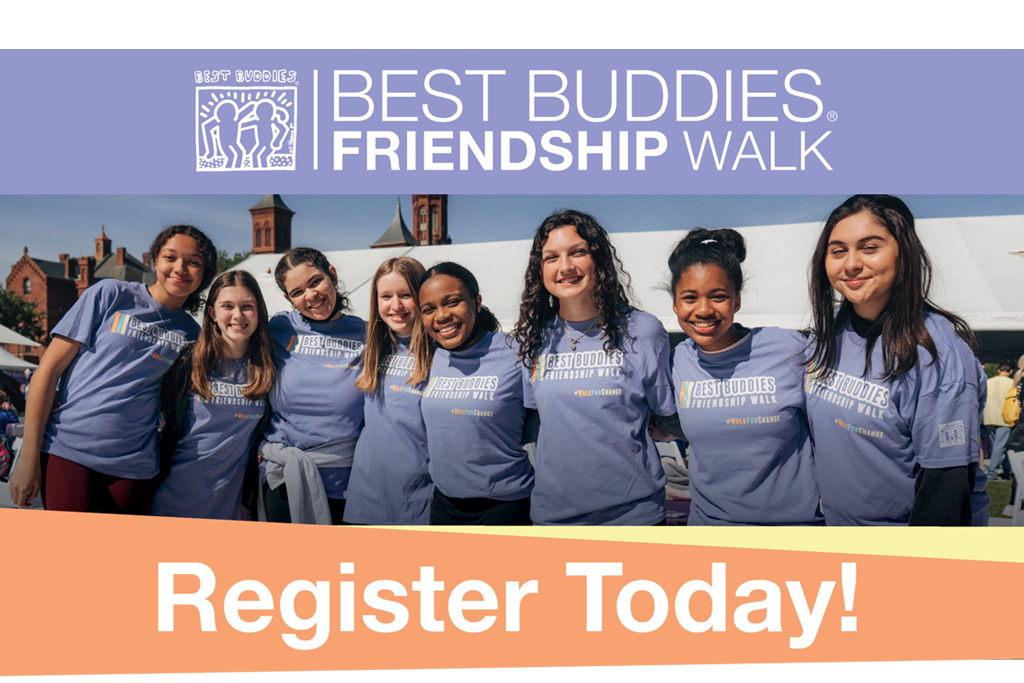
 April 13, 2024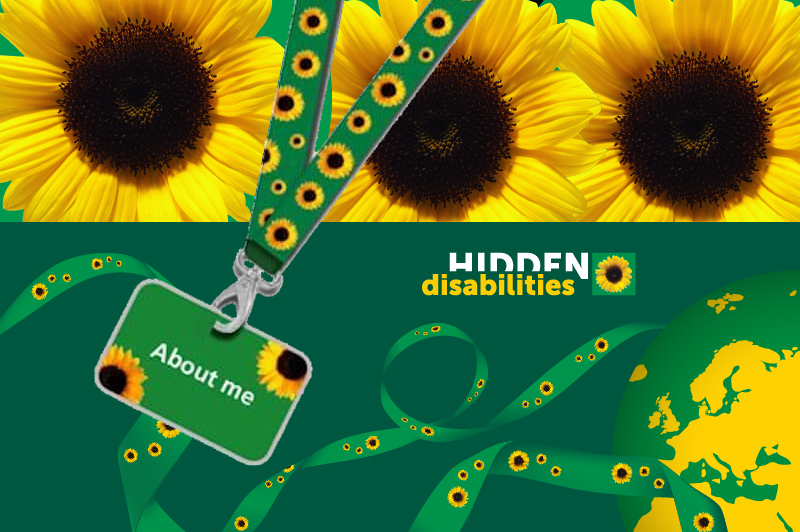
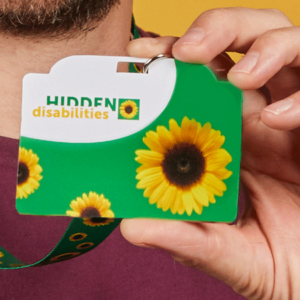 for passengers with hidden disabilities or conditions. The airport is participating in the Sunflower Lanyard Program, a worldwide initiative which aims to raise awareness and support those who have autism, hearing loss, dementia, PTSD, anxiety, or other conditions which may not be readily visible.