Loveland, Ohio – Did you know that the LIFE Food Pantry prepares weekend bags for over one-hundred students each week of the school year? Your support will ensure these children have nutritious and comforting food during their weekends away from their school’s cafeteria.
Currently, the biggest needs are “Ramen” and Mac & Cheese, however if you read their recommended shopping list your donations can really make a difference in a young student’s life.
You can drop off your donations at the pantry at any time or shop from home with the “Weekend Bags” wishlist! There is a outside dropbox at the Pantry for after hours donations.
If you choose to not shop on Amazon, taking at look at the Amazon list will help you shop at your local grocery store to buy what is needed for the Life volunteers who prepare the bage children can take home on Fridays.
The pantry is located at 541 Loveland-Madeira Road, Loveland, Ohio 45140.
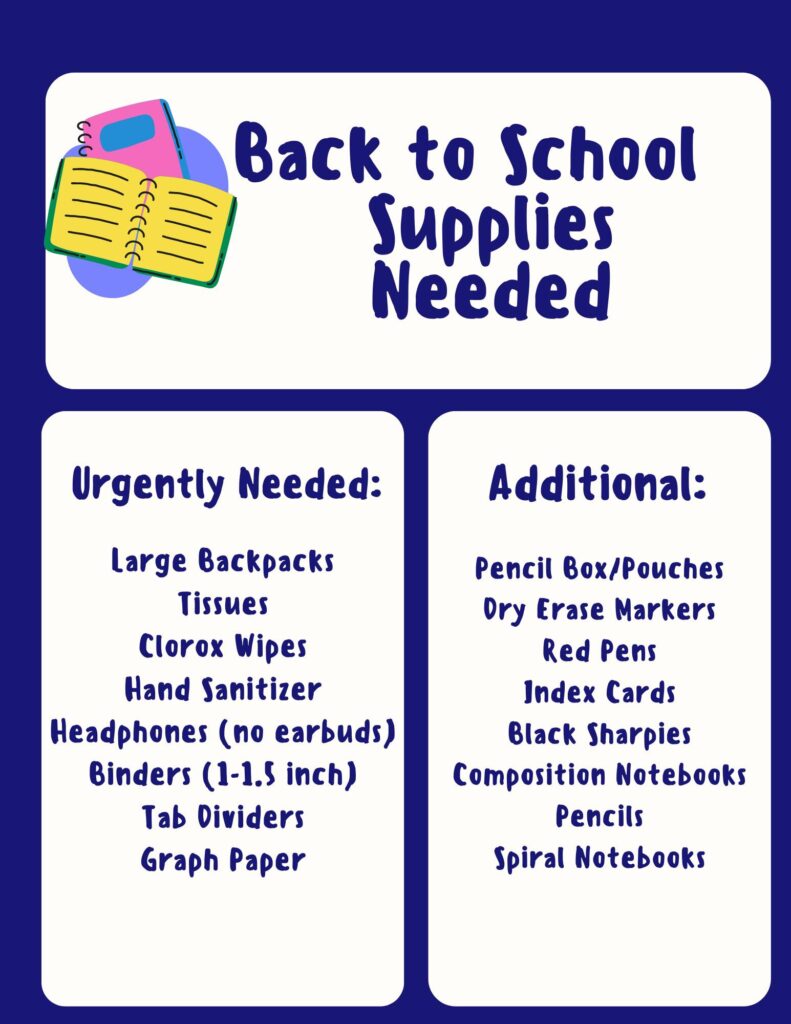
Loveland, Ohio – The LIFE Food Pantry is gearing up for a Back to School event to ensure every child in our neighborhood starts the year with confidence and supplies they need to succeed.
But they can’t do it alone! Your support can make a huge difference.
Here’s how you can help:
1. Visit their wishlist to shop for specific items:
2. Prefer to shop in person for your donation? Feel free to drop off any of the items below at the pantry. Non-perishable items can be dropped off during normal hours or in the collection bin located in front of the pantry.
541 Loveland-Madeira Road
Loveland, Ohio 45140
(513) 583-8222
Your generosity will make a world of difference for local students. Let’s make this school year the best one yet!
Tiger LIFE Shop (Back To School)
In August, students returning to school can receive a backpack filled with age/grade appropriate supplies; personal care items; socks and underwear; a spirit wear shirt (Loveland schools only).
On Tuesday, the state reported 744 new positive cases within the previous 24 hours, a daily total that hadn’t been seen since May.
Dr. Bruce Vanderhoff acknowledges that as the public face of the Ohio Department of Health he is repeating himself a lot these days.
Dr. Bruce Vanderhoff
But the message is important enough to continue repeating in simple terms, ODH’s chief medical officer said Wednesday.
“It really comes down to, are you vaccinated and safe or are you unvaccinated and vulnerable?”
Ohio once again finds itself at a crossroads. After months of declining rates of new cases, hospitalizations and deaths, Ohio is now seeing increases thanks mostly to a new “Delta variant” that officials say is even more contagious.
I think it is absolutely the case that we are now looking at a pandemic of the unvaccinated.
– Dr. Bruce Vanderhoff, Ohio Department of Health
Vaccination rates here have all but stalled, concerning those like Vanderhoff who fear the state will slip back into a public health crisis as schools look to return to class next month.
“I think it is absolutely the case that we are now looking at a pandemic of the unvaccinated,” he told reporters .
Vanderhoff was joined by two pediatricians, including Dr. Patty Manning-Courtney, the chief of staff at Cincinnati Children’s Hospital. The recent rise in cases has them worried not just of the Delta variant, but what else could be on the horizon.
Patricia Manning-Courtney, MD
Manning-Courtney said her hope is Ohioans will get vaccinated before the state experiences an even worse variant that could significantly impact the youth population. She fears a scenario of Ohio learning “the hard way” that vaccines are necessary for public health.
The latest surge
The state’s COVID-19 numbers declined throughout the spring, leading Gov. Mike DeWine and ODH to rescind the swath of public health mandates.
There was reason for optimism: The two-week average was down to just 17.6 cases per 100,000 residents as of July 7.
But since then, that average has more than doubled to 37.8.
On Tuesday, the state reported 744 new positive cases within the previous 24 hours, a daily total that hadn’t been seen since May. The state is recording a greater proportion of cases and hospitalizations among younger people, according to ODH data.
“It appears that this surge is being driven by yet another variant, the Delta variant,” Vanderhoff said, “which is, as I’ve shared before, even more contagious than the (alpha) variant that preceded it.”
The Delta variant is now present in more than one-third of all new cases in Ohio and is on its way to being the dominant variant of COVID-19, Vanderhoff said.
‘Captains of the ship of their own health’
President Biden recently said COVID-19 vaccine misinformation is costing Americans lives. (Photo by Alex Wong/Getty Images)
Unlike a year ago, when mitigation tactics like distancing and face masks were seen as the most effective ways to protect oneself from the virus, a proven vaccine is now available for Ohioans.
But it remains difficult to convince a majority of residents here to get vaccinated.
A vast number of Ohioans received shots when they were first made available, with a boost in vaccinations this spring with the widening of eligibility and the announcement of a Vax-A-Million sweepstakes. (Franklin County is among the places still experimenting with vaccine incentives; those who get their first dose at Columbus-area clinics receive a $100 Visa gift card.)
On the whole, the statewide vaccination rate has stagnated. More than 5.3 million Ohioans have completed their vaccination doses, but that still reflects just 45.5% of the total population.
DeWine had said his lottery idea was meant to target those who were not anti-vaccine, but needed some kind of boost to schedule their appointment.
Now, after months of availability, Vanderhoff and others believe there is still a large segment of the population who can be convinced. These are well-intentioned people with understandable concerns that can eventually be swayed to change their minds, the officials hope.
Misinformation spread online and in public spaces isn’t helping matters. Vanderhoff agreed with a recent statement by President Joe Biden that vaccine misinformation shared around on social media platforms is contributing to ongoing hesitancy and COVID-19 deaths.
“I think there have been people who are sharing information in a very authoritative way that is not scientifically accurate,” Vanderhoff said. “As a physician, that’s very distressing, because we want people to make their own decisions of course. We want people to be the captains of the ship of their own health, but we want them to make their decisions on the basis of good, well-founded, scientific information.
Dr. Amy Edwards
“Frankly, it’s heartbreaking when we see people who are cascading information that is not scientifically based,” he added.
Dr. Amy Edwards, the associate medical director of pediatric infection control at UH Rainbow Babies & Children’s Hospital, said vaccine misinformation has been around long before the coronavirus. She noted an example of seeing a child die of the whooping cough.
“That’s unacceptable to me,” she said. “It should just never happen.”
Vanderhoff and the pediatricians tried to dispel fears about the vaccine harming children. They noted rare cases of myocarditis, an inflammation of the heart muscle that has been reported in a small number of children this year.
But Edwards called this a “rare side effect” that impacts as few as one in every 100,000 or more that receive the vaccine.
“The risk is much higher from the virus itself,” she said.
While there continue to be some examples of vaccinated people getting COVID-19, most are protected against serious outcomes like hospitalizations and deaths.
All of the 130 people in Maryland who died of the virus in June were unvaccinated. Other states have reported similar statistics, including Alabama, where 96% of the COVID-19 deaths between April and mid-July were unvaccinated.
“The issue of breakthrough with this kind of a vaccine against this kind of virus,” Vanderhoff said, “is really the issue of: Are you seeing people get severely ill? Are they ending up in the hospital? Are they dying? We’re just not seeing that in appreciable numbers with this vaccine.”
Asked about future health orders with school returning in the fall, Vanderhoff said he could not disclose ongoing policy discussions within the state health department. He said ODH will be providing guidance and recommendations “in the near future.”
If your daughter’s reaching (or has reached) the age when you feel it’s time she had a phone, you know you’re entering into a challenge.
by Fran Hendrick, PCC
Getting a cell phone warrants a celebration, right? Of course! But like any rite of passage, there is both responsibility and risk attached to it. Having a phone in her possession raises a number of very real health and safety issues because cell phone use is implicated in anxiety, stress, depression, cyberbullying, addiction, and emotional dependency (that’s right, cell phones can erode confidence!) — for starters. Like driving later on, handing your daughter her first phone merits some planning.
Join me Friday for a Facebook Livestream on this this topic!
Got questions?
I’ve been looking at a different back-to-school concerns each week for the past three weeks. Please join me at www.facebook.com/franhendrick for a Facebook Live Stream on Fridays (8/3-8/24) at 11:00 AM Eastern Time.
Post your questions about that week’s back-to-school issue in the comment section of the live stream post — or private message me on Facebook. I love helping you work out these answers.
See you there!
I’ve got three things for you on this topic:
1. The Cell Phone Safe Use Resource Sheet
I’ve put this together to help you create an informed plan — and yes, I really do think it’s that important. The research is coming in and it’s disturbing. But along with the research, we’ve now got more strategies and guidelines to help having a phone be a constructive experience for kids.
In this Resource Sheet, I cover:
Links to information you need to educate yourself in order to plan for your daughter.
Links to information on Parental Controls — super important.
How your own fears can get in the way of taking steps to protect your daughter.
How to structure a conversation with your daughter on this delicate topic.
How to respond to her feelings about implementing some structure around cell phone use.
2. From the Blog Archives
This issue of emotional dependency cuts right to the heart of what so many moms want for their daughters — and that’s confidence. In the post below, I’ve explained how cell phones can erode confidence. It’s not a small thing.
I’ll be talking about this topic and other questions, as well, Friday August 24 at 11:00 AM Eastern Time in a Facebook Live. You can join this event on my Facebook Page. (By the way — previous topics are also there for you to view. Just click the Video tab and you’ll see them.)
Professional clinical counselor, parenting columnist, and teacher Fran Hendrick has provided coaching and counseling for hundreds of women and girls for twenty-five years. She is a member of the International Association for Psychoanalytic Self Psychology. In addition to her therapy practice, Fran provides consultation online and by phone for moms participating in her Helping Confidence Bloom classes and upcoming ecourse.
Fran divides her time among working with clients, kayaking with her husband, and scampering up jungle gyms with her granddaughters. Clients appreciate Fran’s calm, empathic style, her practical strategies and solid advice, and her playful spirit. Wildflower House, Fran’s cozy personal development studio in charming, historic Loveland, Ohio provides a space for women and girls to grow the confidence to become exactly who they’re meant to be.
Crisis Alert! It’s pretty scary for girls to find out that their BFF isn’t in their class this year. Handling that crisis is the topic of the second of four Back to School posts. If that’s what’s happening in your house right now, this post is for you.
This Back-to-School topic is empowering girls to develop new friendships. I’ll be showing you things you can do to help your daughter gain confidence as she starts school.
Starting school can be hard on kids — and moms, too. This post is for you if your child is struggling with separation anxiety. Make sure to download the free planning tool!
Separation Anxiety
2 Girls, 2 Stories, 2 Plans
Sending your little girl off for the first day of preschool or kindergarten is not for the meek at heart! You’re not alone if you’ve been thinking about it for weeks and worrying about it when you’re meant to be sleeping. Even if your little one is feeling excited and confident, there’s still the issue of how you’re feeling!
Ohio Attorney General Mike DeWine today offered consumer protection tips ahead of Ohio’s sales tax holiday, which runs this Friday through Sunday.
“As people take advantage of the sales tax holiday and complete their back-to-school shopping, we want them to be prepared,” Attorney General DeWine said. “We’ve helped thousands of people resolve consumer complaints, and we know that many disputes are the result of a misunderstanding. We put an emphasis on prevention to help people avoid problems and make the most of their money.”
During the sales tax holiday, the following items are exempt from sales and use tax:
Clothing priced at $75 per item or less;
School supplies priced at $20 per item or less; and
School instructional materials priced at $20 per item or less.
The Ohio Department of Taxation provides detailed information about the sales tax holiday on its website, including FAQs about what is and what is not exempt from sales tax during the holiday.
Tips for consumers include:
Plan ahead. The sales tax holiday runs from Friday, Aug. 4, through Sunday, Aug. 6, 2017. Determine in advance the purchases you want to make, and review the Department of Taxation’s FAQs to understand what is and what is not exempt from sales and use tax during the sales tax holiday. Also research sellers’ reputations by reading customer reviews and checking for complaints on file with the Ohio Attorney General’s Office and Better Business Bureau.
Understand return policies before you buy. In Ohio, sellers can choose to set their own return policies, including policies of “no returns,” but they should clearly tell you what their return policy is before you check out or complete the transaction. For example, the return policy shouldn’t be posted only on the back of a receipt.
Stay safe online. Research websites you plan to use, and make sure a website is secure before you enter any personal information or payment details. In the web address, look for the “s” in “https” and/or a lock symbol to help ensure a website has security features. Also consider paying with a credit card, which generally gives you stronger protections to dispute unauthorized charges.
Check the exclusions and limitations of an offer. Exclusions and limitations must be clearly disclosed in advertisements, including online, so review terms and conditions carefully before you go to the store or make a purchase.
Keep your receipts. Maintaining a complete record of a sale will help you handle problems that may arise after the purchase. Keep receipts, copies of advertisements, photos of products, and other documentation until the transaction and billing process are complete.
Monitor your accounts. Regularly check your credit card and bank accounts for unauthorized charges or unexpected activity. If you find problems, immediately notify your credit card provider or bank. The sooner you identify a problem, the sooner you can work to correct it.
Protect your personal information. Don’t carry around extra, unneeded credit cards, debit cards, or other sensitive information in your wallet or purse. Also limit giving out your personal information. Check privacy policies to see how sellers will use your information.
Watch for scams and identity theft. Con artists operate year round. If you receive a message saying you’ve won the lottery, the IRS is coming to arrest you, or a family member is out of the country and in need of money immediately, it’s likely a scam. Also, help watch for signs of potential identity theft by checking your credit report using www.AnnualCreditReport.com.
Consumers who need help addressing a consumer problem or question should contact the Ohio Attorney General’s Office at www.OhioProtects.org or 800-282-0515.












 by Fran Hendrick, PCC
 Located in downtown Loveland Ohio at 111 N. Wall Street, Wildflower House is a place to bloom.