Tag: background check

  • DeWine signs law removing training, background check, permitting requirement to conceal carry

    DeWine signs law removing training, background check, permitting requirement to conceal carry

    BY: JAKE ZUCKERMAN – Ohio Capital Journal

    Gov. Mike DeWine signed a bill into law Monday removing training, background check and permitting requirements to carry a concealed weapon in Ohio.

    When the law takes effect in 90 days, all Ohioans aged 21 and older who are lawfully allowed to possess a weapon will be able to carry it concealed on their persons. Prior law required them to undergo eight hours of training, a background check, and an application through their local sheriff.

    The enactment of “constitutional carry” or “permitless carry” marks a long-coveted win for the gun rights movement and firearms lobby, and a major loss for Democrats, anti-gun violence activists, police organizations and public health researchers who opposed it.

    Ohio is now the 23nd state in the U.S. with a permitless carry law, according to a count from the U.S. Concealed Carry Association. Several states including Iowa, Tennessee, Texas, and Wyoming passed versions of the law in 2021. Alabama signed the legislation into law just last week.“This is a day that will go down in history,” said Dean Rieck, Executive Director of Buckeye Firearms Association. “The brass ring has always been to eliminate the licensing mandate … and now, finally, that day is here. This is a great moment for Ohio and for those who wish to more fully exercise their Constitutional right to keep and bear arms.”

    The bill passed the House 58-36, with only Republicans in support. Two Republicans voted in opposition with Democrats, though at least one said he did so only because the bill does not go far enough.

    It passed in the Senate 24-9. All Democrats voted against the bill. Sen. Jerry Cirino, R-Kirtland, voted against the bill when the Senate first passed it in December. However, he reversed on the final Senate vote.

    Supporters of the legislation say it’s a logical extension of the Second Amendment to the U.S. Constitution, which states: “A well regulated Militia, being necessary to the security of a free State, the right of the people to keep and bear Arms, shall not be infringed.”

    Sen. Terry Johnson, R-McDermott, the bill’s lead sponsor, said in a floor speech the bill is also in some ways a response to protesters “burning down their own cities” — a reference to racial justice protests that formed in the wake of a police officer murdering George Floyd during a stop in the summer of 2020.

    Critics say the policy will enable undertrained and possibly dangerous or unstable people to carry a concealed weapon. Public health research has linked concealed carry policies to increases in violent crimes.

    For instance, the American Journal of Public Health found that states with looser concealed carry regulations were associated with an 11% increase in handgun homicide rates than states with stricter policies. Modeling from the National Bureau of Economic Research found states that adopt concealed carry laws experience between a 13% and 15% increase in violent crime in the 10 years after implementation.
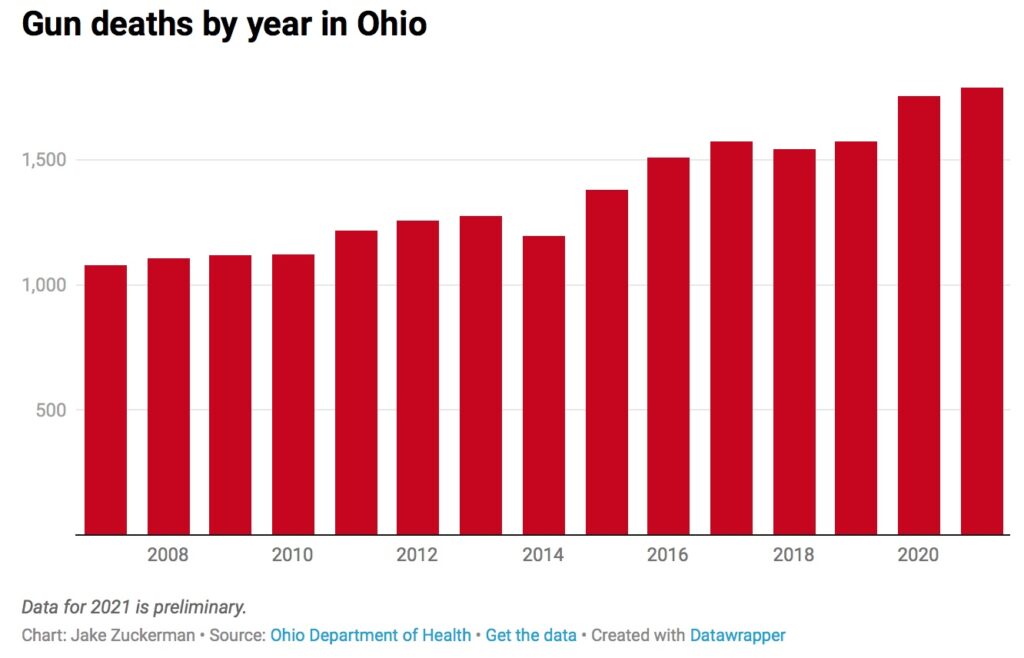
    According to the Health Policy Institute of Ohio, between 1999 and 2020 there have been large increases in annual rates of homicides (123%) and suicides (49%) in the state. While the prevalence of guns in suicides is steady, they’re becoming increasingly prevalent in homicides.

    However, gun supporters often point to a study published in the American College of Surgeons that didn’t identify any significant association after states adopted looser gun policies.

    In a statement, House Minority Leader Allison Russo criticized DeWine, emphasizing the thousands of concealed carry permits that are denied, revoked or suspended every year under the current system. While permitless carry doesn’t change who can possess a gun, it removes an additional layer of scrutiny within the current system.

    “Removing these responsible and reasonable precautions compromises the safety and security of our communities and law enforcement,” Russo said. “SB 215 completely betrays Ohioans who have called time after time for commonsense gun safety legislation, not extreme bills that endanger the lives of our children and families. Republicans have made it crystal clear that they value the approval of the gun lobby more than the lives of Ohioans and the police officers who protect our communities every day.”

    Gary Wolske, president of the Fraternal Order of Police of Ohio, spoke out against the law in a Columbus Dispatch column. He argued the requirement to seek a permit is a reasonable one that strikes a balance between constitutional rights, officer safety, and public safety. The new law also removes a requirement under current law that those carrying a weapon “promptly” notify an officer that they’re armed. Instead, people who are carrying need only inform an officer they’re armed if the officer asks.

    Photo by Matthew Hatcher/Getty Images

    The Ohio Supreme Court has held since 2003 that “there is no constitutional right to bear concealed weapons.” While the right to bear arms, the court said, is fundamental, it is not without limitations.

    Since then, Ohio has steadily loosened its gun laws.

    Ohio first enacted a concealed program shortly thereafter in 2004. Several of its sponsors at the time remain in office including (by their current offices) Auditor Keith Faber, Lt. Gov. Jon Husted; congressmen Bob Gibbs, Jim Jordan and Bob Latta; state Sens. Bob Peterson, Tim Schaffer and Kirk Schuring; and state Reps. Jamie Callender, Bill Seitz, Scott Oelslager, Tom Patton and Jean Schmidt.

    Two years later, the legislature passed a law preemptively blocking Ohio cities from passing any gun restrictions stricter than those established by the state. The law was used to squash lawsuits from Ohio cities including Clyde, Cleveland and Cincinnati seeking to regulate guns within their borders.

    In March 2015, a new law reduced the required training hours to receive a concealed carry permit to eight from 12. Early last year, Gov. Mike DeWine signed a “stand your ground” bill into law, which removes the legal requirement that a person try to retreat from a perceived attack before responding with lethal force.

    The governor announced passage of the permitless carry bill in a news release comingled with several other bills. He didn’t offer any comment.

  • Attorney General DeWine Offers Consumer Tips Following Marriott Starwood Hotels Breach

    Attorney General DeWine Offers Consumer Tips Following Marriott Starwood Hotels Breach

    Affecting as many as 500 million guests

    Columbus, Ohio – Ohio Attorney General Mike DeWine today offered tips for consumers following Marriott’s recent announcement of a data breach affecting as many as 500 million guests who made a reservation at a Starwood brand hotel, which includes Sheraton Hotels & Resorts and Westin Hotels & Resorts, among others.

    Marriott has reported it believes hackers gained unauthorized access to the Starwood guest reservation database in 2014 and that people who made a reservation on or before Sept. 10, 2018, at a Starwood property may have been affected.

    The company has reported that for approximately 327 million guests, the information breached included some combination of name, mailing address, phone number, email address, passport number, Starwood Preferred Guest account information, date of birth, gender, arrival and departure information, reservation date, and communication preference. It also said some payment card numbers and expiration dates may have been affected.

    “Any time there is a breach that has gone undetected for this long and affected this many people, it’s very concerning,” Attorney General DeWine said. “We’re hoping Marriott will step up to help those affected. We’re also encouraging individuals to take steps to protect themselves.”

    Tips for consumers include:

    • Monitor your accounts. Look for suspicious activity. If you find errors, immediately notify your bank or credit card provider.
    • Beware of scams related to the breach. Con artists may pretend to have information about the breach or they may falsely claim to want to help you. Some calls or messages may be scams designed to steal your money or personal information. Don’t give out personal information to those who contact you unexpectedly (even if they say they want to help you) and be wary about clicking on links or downloading attachments in messages.
    • Check your credit report. Monitoring your credit report can help you identify signs of potential identity theft. You are entitled to one free credit report per year from each of the three major credit reporting agencies. Visit www.AnnualCreditReport.com to access those reports. You can pull all three at once, or you can stagger pulling your reports throughout the year.
    • Place an initial fraud alert on your credit report. Contact one of the three major credit reporting agencies — Experian, Equifax, or TransUnion — to place an initial fraud alert, which will stay on your credit report for one year. The alert is free of charge and will make it more difficult for someone to open credit in your name.
    • Consider placing a security freeze on your credit report. A security freeze (or credit freeze) essentially puts a lock on your credit so that most third parties can’t access your report. This helps protect you from unauthorized accounts being opened in your name. Security freezes are permanent until you lift them, and they are now free to place or to remove. Contact each credit reporting agency separately to place a freeze.

    Consumers should keep in mind that even if their information is compromised in a data breach, it doesn’t necessarily mean it will be used by an identity thief to open accounts or commit other fraud. However, consumers should watch for warning signs that their information may have been used fraudulently.

    Signs of possible identity theft may include:

    • Unexpected mail about accounts you did not open.
    • Unexpected collection calls or letters.
    • Another person’s name showing up in your background check or credit report.
    • Credit reporting errors or a lower-than-expected credit score.

    Consumers who want help correcting the effects of identity theft should contact the Ohio Attorney General’s Office at 800-282-0515 or www.OhioProtects.org. Attorney General DeWine created an Identity Theft Unit in 2012 to help victims repair the damage caused by identity theft, such as by clearing fraudulent debt in a victim’s name. The unit has eliminated over $2 million in fraudulent charges since its creation.


      Accounting Plus–Bingaman Accounting and Tax Service, LLC is a tax preparation, payroll and bookkeeping company locally based in Loveland, OH.


  • Governor Kasich issues common sense gun order

    Governor Kasich issues common sense gun order

    The database includes criminal conviction sentences, protection orders, and mental health records that, in Ohio, should be inputted.

    Columbus, Ohio – On Monday, Governor John R. Kasich took action to begin implementing recommendations of a working group he reconvened in April to improve the background check system that helps make sure guns stay out of the hands of people prohibited by law from having them.

    The group reached unanimous agreement on a proposal that has been introduced as legislation in the General Assembly HB 585/SB 288. Those bills include closing gaps in the background check system.

    The working group developed a 39-page report that assessed the current level of compliance in Ohio and identified barriers that exist to achieving comprehensive, up-to-date reporting. Those recommendations include ways to expand training and training to those responsible for submitting data into the system, reforms to reduce duplicative or unclear reporting responsibilities and ensure greater coordination among entities.

    In addition, the working group published a reporting compliance manual for local governments and elected officials who have responsibility for inputting data into the background check system and ways they can overcome compliance barriers.

    By signing Executive Order 2018-10K, Kasich permanently established the National Instant Criminal Background Check System (NICS) Compliance Working Group to continue working to ensure that gaps in the system are closed. Kasich also signed Executive Order 2018-11K to adopt emergency rules to require law enforcement agencies to upload protection order and warrants into theLaw Enforcement Automated Data System (LEADS) to close an existing reporting gap identified by the working group.

    “By closing gaps in the gun-buyer background check system, we can make it less likely that dangerous people are able to purchase firearms,” said Kasich.

    “By closing gaps in the gun-buyer background check system, we can make it less likely that dangerous people are able to purchase firearms,” said Kasich.  “I’m grateful to the working group for putting together such a thorough report and Ohioans will be safer as result of their continued work.”

    Anyone buying a firearm must undergo a background check to make sure they are not prohibited by federal or state law from possessing a firearm.  Those background checks only protect the public if the information in the National Instant Criminal Background Check System is complete, accurate, and up to date.  The database includes criminal conviction sentences, protection orders, and mental health records that, in Ohio, should be inputted.

    Earlier this year, Gov. Kasich brought together leaders with a variety of backgrounds to search for common ground on new policies that can protect Ohioans’ lives and respect their constitutional rights. The group reached unanimous agreement on a proposal that has been introduced as legislation in the General Assembly HB 585/SB 288. Those bills include closing gaps in the background check system.

    The two executive orders can be viewed here and the full report from the working group is available here.


      Take Home Tano is about fresh, wholesome food for the frenzied family   Our goal is to meet the needs of busy families.