Tag: ballot issue

  • Maybe end to dueling Issue 1’s on ballots

    Maybe end to dueling Issue 1’s on ballots

    Columbus, Ohio – State Rep. Adam Mathews (R-Lebanon) and Rep. Bob Peterson (R-Sabina) presented sponsor testimony on legislation that will bring more clarity and transparency to statewide ballot initiatives in Ohio.

    “While drafting this bill, we heard from many voters and civically engaged Ohioans who wished for more clarity at the ballot box,” Mathews said. “Our aim in introducing this legislation is to ensure that each ballot issue put before the voters receives the unique and thoughtful debate it deserves.”

    The legislation clarifies that for elections occurring after November 2024, statewide ballot issues will be designated by the Arabic numeral consecutive to that of the last statewide ballot issue in the immediately preceding election. Essentially, if a bill moves forward into law, no statewide issue number would be repeated. For example, Issues 1 and 2 would be one election, and the subsequent elections would start with statewide Issues 3 and 4.

    “House Bill 271 represents a significant step towards eliminating voter confusion as they research ballot issues,” Peterson said. “While we may not agree on specific ballot initiatives, I believe this will be a bipartisan solution to assisting voters in acquiring the information they need to make informed votes.”

    The legislation will continue to have hearings in the House State and Local Government Committee.

  • Gathering the facts to make an informed decision

    Gathering the facts to make an informed decision

    by Dr. Amy Crouse

    As the superintendent of the Loveland City School District, it is my responsibility to ensure that every child in our district has access to quality education while managing our tax dollars wisely and providing a good value to residents. I take this responsibility seriously.

    Dr. Amy Crouse is Superintendent, Loveland City School District

    Another responsibility I take very seriously is the dissemination of facts. This is why we have been hosting community chats and forums, such as the event held on September 12; it’s why we are constantly updating our website and addressing frequently asked questions; and it’s why we are so intent on engaging with our community. It is imperative that our residents have the facts in order to make an informed decision at the ballot on November 5. And some of what we’re seeing out there, well, it’s simply not accurate.

    What is accurate is that Loveland City Schools have reached a critical juncture: We have overcrowding, with some classes being held in hallways and in trailers, we have three old buildings for which repair costs have reached the threshold where industry standards recommend replacement over renovation, and we have a need to secure additional operating dollars. The needs facing our schools are very real and immediate.

    Over these last several years, we have spent time working with the community on a plan that is cost-efficient and meets the school district’s needs. This is the ballot issue facing voters with the Tuesday, November 5 election.

    We realize that this ballot issue is no small ask. We also realize, like the community members who helped identify and prioritize the needs, that it is more cost effective to do the work all at once and that the longer we wait, the more expensive it will be to remedy the needs facing our schools.

    Large amounts of money would have to be spent on other temporary solutions, like trailers, instead of putting the dollars toward real solutions for the long term.

    When considering this ballot issue, it is important to note that there is no zero-cost option with our facilities and the needs do not go away over time if we continue with the status quo. In fact, continuing to do so with our facilities comes at a substantial cost – we would need to divert funds from the classroom to pay for critical repairs, which are still only temporary fixes to problems that don’t go away. We would need to put off important safety and security updates in the buildings and continue to make do with antiquated science and technology laboratories and learning spaces. Large amounts of money would have to be spent on other temporary solutions, like trailers, instead of putting the dollars toward real solutions for the long term.

    I encourage you to visit the “Frequently Asked Questions” section on our website.

    These are important considerations for our community – it comes down to how we want our schools to operate. So that you can be informed about the facts regarding the district work, planning and needs, I encourage you to visit the “Frequently Asked Questions” section on our website. Among other facts on this page, we have also included the updated cost information that shows the board’s intent to structure the financing so that the overall impact of the tax is phased in for residents over three years. This helps residents and it helps meet the school district’s needs.

    In service to our Tigers.


  • Building Tiger Nation facilities master planning moves on to phase two

    Building Tiger Nation facilities master planning moves on to phase two

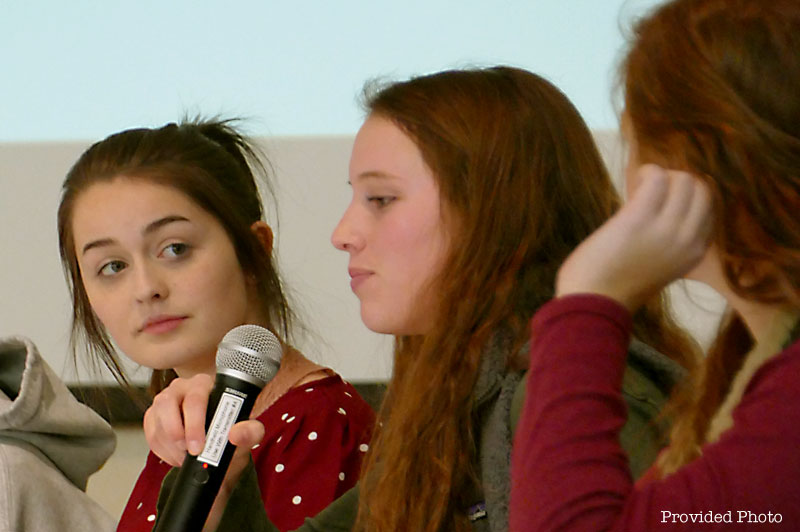
    At Community Meeting #2 on November 28, students shared their needs as they relate to the Loveland Schools facilities.

    A ballot issue is expected in November 2019.

    Community Meeting #3 is on January 23

    A news release from the Loveland School District

    On November 28, the Loveland City School District held the second Building Tiger Nation Community Meeting, with over 100 members of the Tiger Family and greater Loveland community in attendance. In a presentation of the results of the educational facility evaluation conducted over the past six months, a panel of students and teachers shared their personal experiences regarding the implications of the current school facilities on teaching and learning at Loveland.

    “It was very powerful to hear directly from the ‘experts’ on their impressions and experiences, and see the correlation to the hard data collected during the evaluation process,” said Superintendent Dr. Amy Crouse. “Some of the needs we heard about are recurring themes throughout the district, while others are specific to certain building and campuses. Taking into account enrollment projections and the fact that we can’t provide all the programming we wish to due to space limitations today, our buildings compromise our students’ educational needs.”

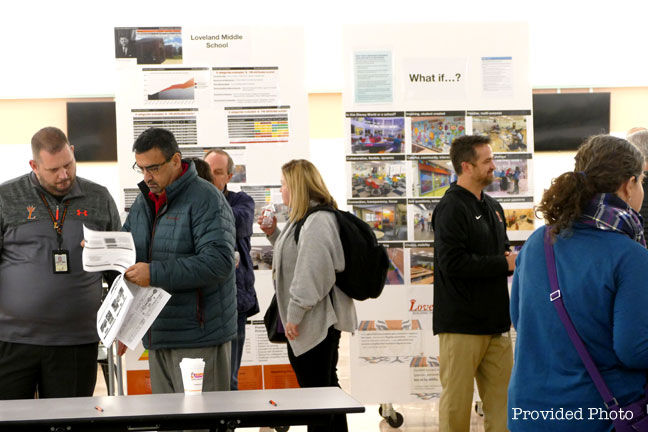
    Community members toured the “gallery” and learned about specific needs in the various school buildings.

    The educational facility evaluation, which has been part of the assessment phase in the master planning process, focused on five main areas and how the school facilities currently perform in each: whether there is adequate academic square footage; building navigation (taking into account hallways, circulation spaces within the buildings, as well as parking and traffic patterns); the potential for expansion of buildings at the various campuses; how the buildings serve students and staff in terms of health and wellness; and whether the buildings and learning spaces are inspirational and relevant for today’s students.

    “It’s like a square peg trying to fit in a round hole,” said Cincy Rack, third grade teacher at Loveland Elementary School. “The biggest, single challenge every year is ‘how am I going to make my space work?’”

    Loveland High School Sophomore Anna Colletto spoke of navigation issues and a particularly difficult area in the overcrowded hallways: “Students trying to get upstairs are struggling, students trying to get to their classes are struggling, and students trying to get into their lockers are struggling. It takes two to three minutes just to get through that portion of the hallway, which takes up our five-minute break to get to the next class.”

    The meeting was the second in a series to inform the Loveland community about the facilities master planning process since the start of the 2018-19 school year. Finance Committee meetings, open to the public, continue to be held monthly. The master planning process now moves from the assessment phase on to the translation phase, and the first options for a master plan will be developed over the coming weeks. They will be presented to all Loveland stakeholders at Community Meeting #3 on January 23, and will then be evaluated, prioritized, and finalized. The master plan, along with financing suggestions, will be presented to the Loveland Board of Education in spring, likely April or May. A ballot issue is expected in November 2019.

    For more information, please visit www.buildingtigernation.org.


    Welcome to All About Kids We invite you to come visit one of our convenient locations, talk to our staff and teachers and learn why.