[vc_row][vc_column][vc_column_text]
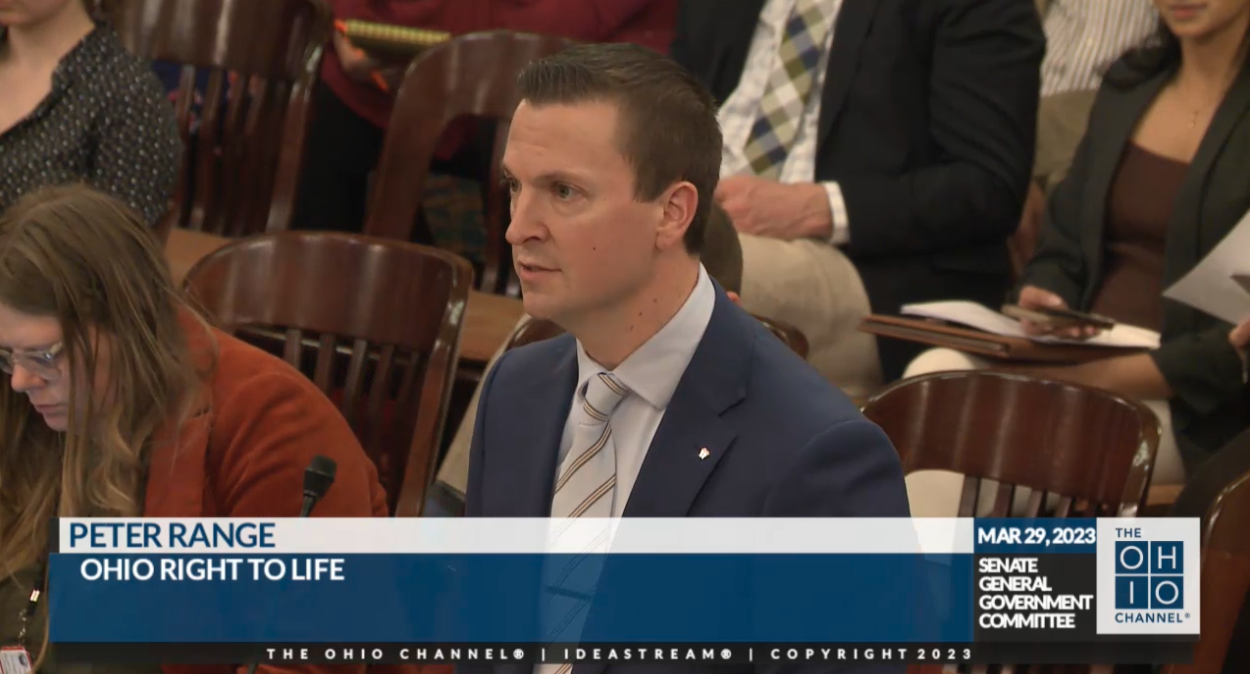
Ohio Right to Life CEO Peter Range speaking before the Senate General Government committee in favor of SJR 2. (Screen grab from the Ohio Channel)
[/vc_column_text][vc_column_text]
Right to Life officials claim a reproductive rights amendment would allow youth to receive gender affirming care without parental notification
BY: NICK EVANS – Ohio Capital Journal
Late last year, Rep. Brian Stewart, R-Ashville, and Secretary of State Frank LaRose introduced their plan requiring supermajority for constitutional amendments. It didn’t take long for opponents to check the calendar and argue the resolution was advancing — and advancing now — to block an abortion rights amendment on the horizon.
Despite Stewart and LaRose’s contentions to the contrary, Republican leaders have given up the charade that the two ballot measures are unconnected. On Wednesday in a Senate committee hearing for SJR 2, outside conservative organizations doubled down. A 60% threshold for future constitutional amendments is necessary, they argued, to head off the reproductive rights amendment before November.
But they went a step further, too.
Speakers from Ohio Right to Life argued — without evidence — that the reproductive rights amendment would open the door to minors receiving gender affirming care without parental notification.
It’s a specious argument that presages an exceptionally bitter march to November, marked by disinformation and fear-mongering, with critics of the argument noting that nothing in the proposed amendment mentions or supersedes Ohio’s parental consent laws.
A “healthy tension”
Unlike the last year’s attempt to establish a supermajority threshold, numerous proponents showed up to speak in favor of the idea.
Some, like University of Toledo professor Lee Strang, stuck to the policy,
“Ohio adopted this initiative mechanism for a variety of reasons,” he explained. “The most common reason was the belief that the state legislature was not sufficiently responsive to average Ohioans and was instead subject to control of large nationwide trusts.”
Of course, that might sound familiar. Ohio’s last redistricting became a debacle in which Republican leaders repeatedly defied the state supreme court. It’s been less than a month since a jury convicted former House speaker Larry Householder in a multimillion-dollar bribery scheme funded by two major utilities.
Strang contends the amendment process needs to maintain a “healthy tension” between two ideals: stability and flexibility. The higher threshold would insulate the constitution from provisions that belong in statutes, he said.
Other speakers, however, wandered farther afield.
Right to Life
Ohio Right to Life CEO Peter Range argued passing SJR 2 is about “building a culture of life.” His testimony made no bones about wanting the higher threshold to undermine the reproductive rights amendment. But he also injected one of the latest rallying cries of the culture war.
“This amendment that’s coming up in November will wipe away parental rights to be engaged in their teenagers decision to get an abortion or not, in their teenagers decision to get sex change operation or not.”
He wasn’t the only right to life official to make a “parental rights” argument tied to trans youth. Kate Batra insisted, “I’m not being hyperbolic at all, when I say lives are stake.”
“If this extreme amendment is passed, parents will have their rights obliterated,” Batra argued. “So moms and dads won’t be notified, let alone be able to consent, to their underage daughters undergoing abortion procedures. This also opens the door for adolescents to pursue controversial sex change operations, puberty blockers, sterilization procedures and the like—all without the parents’ knowledge or consent.”
The amendment itself, however, makes no mention of gender affirming care. It’s first section reads, in full:
“Every individual has a right to make and carry out one’s own reproductive decisions, including but not limited to decisions on contraception; fertility treatment; continuing ones own pregnancy; miscarriage care; and abortion.”
It goes on to prohibit state interference except that abortion “may be prohibited after fetal viability.” The amendment carries an exception for the life or health of the mother.
After the committee hearing, Sen. Rob McColley, R-Napoleon, who is one of the resolution’s sponsors, offered a tepid response to the parental rights argument.
“There’s been an argument proffered by some that says they’re concerned with the language that says ‘but not limited to,’” he explained. “I’m not 100% well versed on that argument, so I can’t really opine on it.”
“Demonstrably and totally false”
Organizers leading the push for the reproductive rights amendment didn’t seem surprised by the line of argument.
Television ads from the dark money organization Protect Women Ohio make the same spurious allegations about parental rights. The ad’s script actually leads with trans fear-mongering.
“Your daughter is young, vulnerable, online,” the narrartor says. “You fear the worst: pushed to change her sex or to get an abortion.”
Executive director of Ohio Physicians for Reproductive Rights, Dr. Lauren Beene, pushed back forcefully on the ad’s claims.
“The ad is demonstrably and totally false. There is absolutely nothing in the amendment that mentions or supersedes Ohio’s parental consent laws,” she said.
In a recent NBC4 factcheck, a Capital University law school professor rated Protect Women Ohio’s claims as four out of four Pinocchios.
“Their intentionally deceptive ad is the beginning of a multi-million-dollar disinformation campaign,” she added, “designed to raise unsubstantiated fears and distract from the fact that the amendment will ensure Ohioans have access to comprehensive reproductive health care, including abortion, and preserve the sanctity of the doctor-patient relationship.”
Equality Ohio executive director Alana Jochum criticized the ad as well for making “false claims” and “ignoring the facts.”
“Not only does the proposed amendment have nothing to do with gender affirming healthcare, those arguing that it does are implying that life-saving healthcare is something nefarious,” she said. “The ballot initiative being referenced specifically protects the right to abortion, another form of lifesaving medical care that Ohioans deserve to have access to.”
“False claims about what the proposed abortion amendment would do attempt to mislead voters by spreading lies that have been debunked by legal experts,” she added. “They are once again dragging precious children, their families, and their health care providers into a conversation that has nothing to do with them — especially when we should actually be talking about protecting democracy.”
Cincinnati attorney David Langdon registered Protect Women Ohio as an Ohio non-profit a little over a month ago. Langdon helped draft the 2004 Ohio constitutional amendment defining marriage as between one man and one woman. He has also represented the Center for Christian Virtue — another organization pushing for the supermajority threshold.
Follow OCJ Reporter Nick Evans on Twitter.[/vc_column_text][vc_separator border_width=”10″][vc_column_text]
 Nick Evans has spent the past seven years reporting for NPR member stations in Florida and Ohio. He got his start in Tallahassee, covering issues like redistricting, same sex marriage and medical marijuana. Since arriving in Columbus in 2018, he has covered everything from city council to football. His work on Ohio politics and local policing have been featured numerous times on NPR.
MORE FROM AUTHOR[/vc_column_text][/vc_column][/vc_row]