Tag: bars

  • Ohio House passes state budget; here’s what to know

    Ohio House passes state budget; here’s what to know

    Step closer toward a constitutional school funding model

    By Tyler Buchanan and Ohio Capital Journal

    Loveland, Ohio – Ohio took a step closer toward a constitutional school funding model with the passage Wednesday of a two-year operating budget in the Ohio House of Representatives, a sweeping bill that also proposes an across-the-board income tax cut, a broadband internet expansion plan and more spending to aid businesses struggling from the pandemic.

    The House passed a two-year, $74.4 billion budget for Fiscal Years 2022 and 2023 by a vote of 70 to 27. 

    Democrats took issue with certain portions of the budget, but its education funding reforms helped lead a dozen of them to ultimately join the Republican majority in approving the bill.

    The budget now heads to the Ohio Senate, which will negotiate its own version over the coming months. Members of both legislative chambers will eventually hash out disagreements before a final version is sent to Gov. Mike DeWine for approval this summer.

    “We are investing in Ohio’s priorities and Ohio’s future,” said Rep. Scott Oeslager, R-North Canton, who serves as the House budget chairman as he has for several previous budget cycles.

    Oeslager said the ongoing pandemic has presented a wide array of challenges for Ohio, and the ongoing needs associated with the crisis are evident. He complimented House members for crafting a “balanced, responsible and truly meaningful” budget.

    This budget does not include any federal spending from the American Rescue Plan. Speaker Bob Cupp, R-Lima, said Ohio has not yet received this relief funding and a forthcoming committee would determine how best to spend it. 

    Here are budget highlights as approved by the Ohio House of Representatives.

    Education funding model overhaul

    Amesville Elementary in the Federal Hocking School District. Photo from district website. Lawmakers approved a new education funding model in the House budget passed on Wednesday.

    It has been more than 24 years since the DeRolph v. State decision was handed down by the Ohio Supreme Court, which ruled Ohio’s state funding model does not provide an equal opportunity for all students to learn and is therefore unconstitutional.

    Lawmakers were tasked with determining a more equitable, constitutional funding model — something they have failed to accomplish in the decades since.

    Cupp has led a renewed push to reform the funding system in recent years and said after Wednesday’s vote he was glad this budget achieves that goal.

    The House-approved budget includes a nearly $2 billion increase in school funding, with most districts expected to receive more funding over the next six years. (A spreadsheet showing the funding estimates for each individual district in Ohio was published by The Columbus Dispatch.)

    The Loveland City School District may receive $941,996 additional State tax dollars according to the Columbus Dispatch.
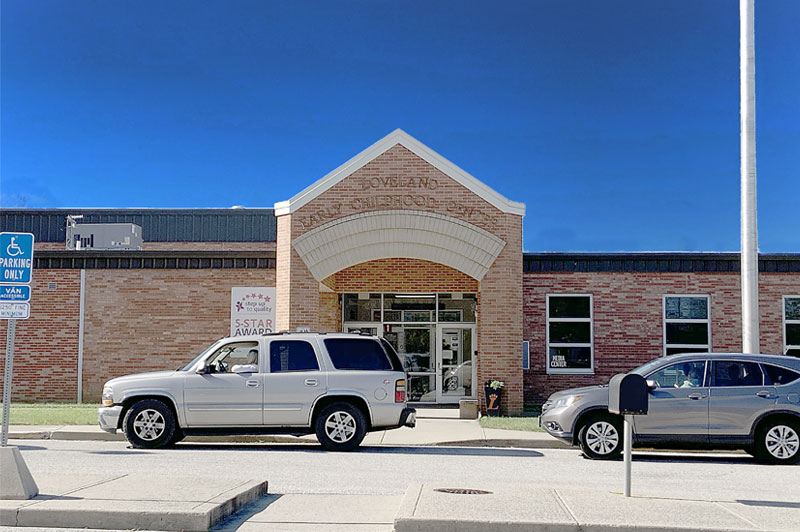
    The Loveland Early Childhood Center in Loveland, Ohio (Photo by David Miller/Loveland Magazine © 2020)

    Cupp said he did not want to speculate on potential disagreements the Senate may have with this funding plan, but hoped there would be more productive conversations between members of the two chambers on this subject.

    “We think they will agree that it is a very good plan going forward,” he said.

    Detailed Ohio Capital Journal reporting on the education reforms included in this budget is forthcoming.

    More spending for COVID-19 relief, and vacating penalties for public health violations

    The budget includes relief spending to benefit a variety of Ohio businesses.

    Millions of dollars would go toward helping entertainment venues, bars, restaurants and hotels. Additionally, there is a “New Business Relief Grant” program to specifically help those businesses that opened after Jan. 1, 2020.

    Republicans also inserted a budget provision that would vacate all public health violations incurred by Ohio businesses since March 2020. 

    A number of Ohio bars, including several on the island village of Put-In-Bay, were cited in 2020 for violating COVID-19 health orders. The House budget would expunge these violations and repay any fines levied against businesses. Photo from the Ohio Investigative Unit.

    Businesses that have faced penalties for violating public health orders, such as not enforcing mask and distancing mandates, would have their violation records expunged. Any disciplinary actions currently in progress would be halted. 

    The state would be forced to repay any fines levied and reinstate licenses revoked. The Legislative Service Commission (LSC) estimates this would amount to $100,000 in fines repaid to health order offenders.

    This provision mirrors a separate bill introduced by Republicans earlier this year

    Cupp defended this provision by saying Ohio businesses failed to abide by public health orders because the virus was an “unknown” phenomenon in 2020.

    “The restrictions were new, they were different, and a lot of businesses sort of got caught up in this administrative web. As we work our way out of the pandemic, we think it’s important to take another look at (the violations) and to give them some sort of the benefit of the doubt…,” Cupp said.

    Tax cuts

    Another main portion of the bill involves income tax cuts and deductions.

    There is a 2% personal income tax cut for all earners, which LSC estimates would save taxpayers around $380 million in the coming two years. 

    “Once more, the wealthy and big businesses will fare far better than working families under this budget,” said Rep. Michael Skindell, D-Lakewood, who unsuccessfully proposed taking out the tax cut and diverting it to other priorities.

    He cited data from the Institute on Taxation & Economic Policy, which was promoted by the think tank Policy Matters Ohio, which shows the tax cut would primarily benefit the richest Ohioans.

    Those earning under $40,000 per year would receive virtually no benefit from this tax cut, the study found. Ohioans earning between $40,000-61,000 per year would see their taxes cut by an average of $7 over the course of an entire year.

    The top 1% of Ohio earners, those making more than $490,000 per year, would comparatively see their taxes cut by an average of $612 each year.

    Skindell said the tax cut shows a “huge disparity and continues the tax shift in this state.”

    Separately, the House budget institutes an income tax deduction on capital gains earnings for Ohio-based “venture capital operating companies.” Such investors could deduct all of their earnings from investments in Ohio businesses and 50% of earnings from investments in businesses elsewhere.

    LSC estimated this provision may cost the state tens of millions of dollars per year in income tax revenue lost.

    Broadband internet expansion

    The House budget includes $190 million in funding toward new broadband internet expansion projects. (Photo by Leonardo Fernandez Viloria/Getty Images).

    Ohio lawmakers have worked toward a bipartisan effort this year of expanding broadband internet access in the state.

    With several bills already progressing toward that end, lawmakers opted to include the proposed “Ohio Residential Broadband Expansion Grant Program” in this budget.

    The budget allocates $190 million over the next two years toward grants to pay for new broadband expansion infrastructure projects.

    Other pieces of the budget

    Here are some other noteworthy provisions from the budget bill:

    • The governor had proposed changing antiquated language in Ohio law to clearly state all couples can adopt children (LGBTQ couples are legally allowed to in Ohio). The governor suggested changing the phrase “husband and wife” to read “legally married couple,” but Republican lawmakers took out this change to leave the original language in place.
    • The budget allocates millions of dollars for firefighting equipment and training, along with millions more for a law enforcement training program.
    • The budget provides $25,000 to Ohio domestic violence groups to give clients travel vouchers, gas cards and ridesharing credits.
    • Millions of dollars will go toward the Foundation for Appalachian Ohio, as well as money for workforce development around the state and in Appalachian communities.
    • The budget includes greater investments for maternal/infant health programs.

    The budget does not include several major proposals from the governor, including gun safety reforms and a $50 million public relations campaign for Ohio.

  • Hamilton County Sheriff will enforce statewide curfew

    Hamilton County Sheriff will enforce statewide curfew

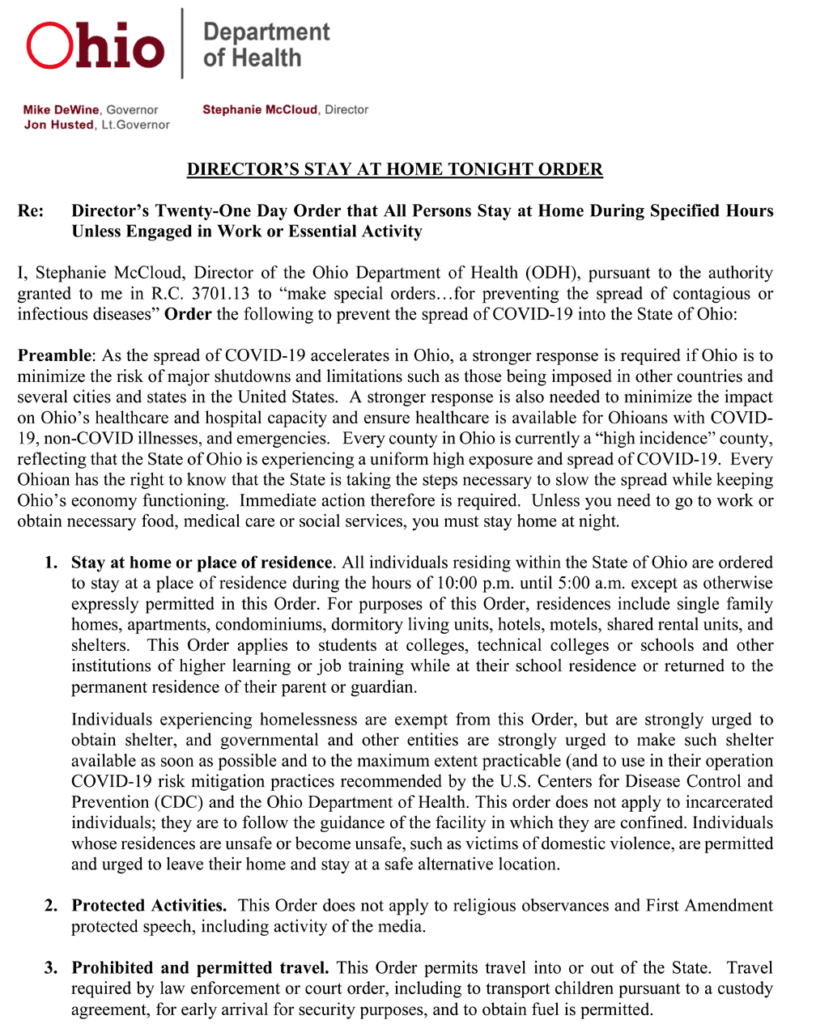
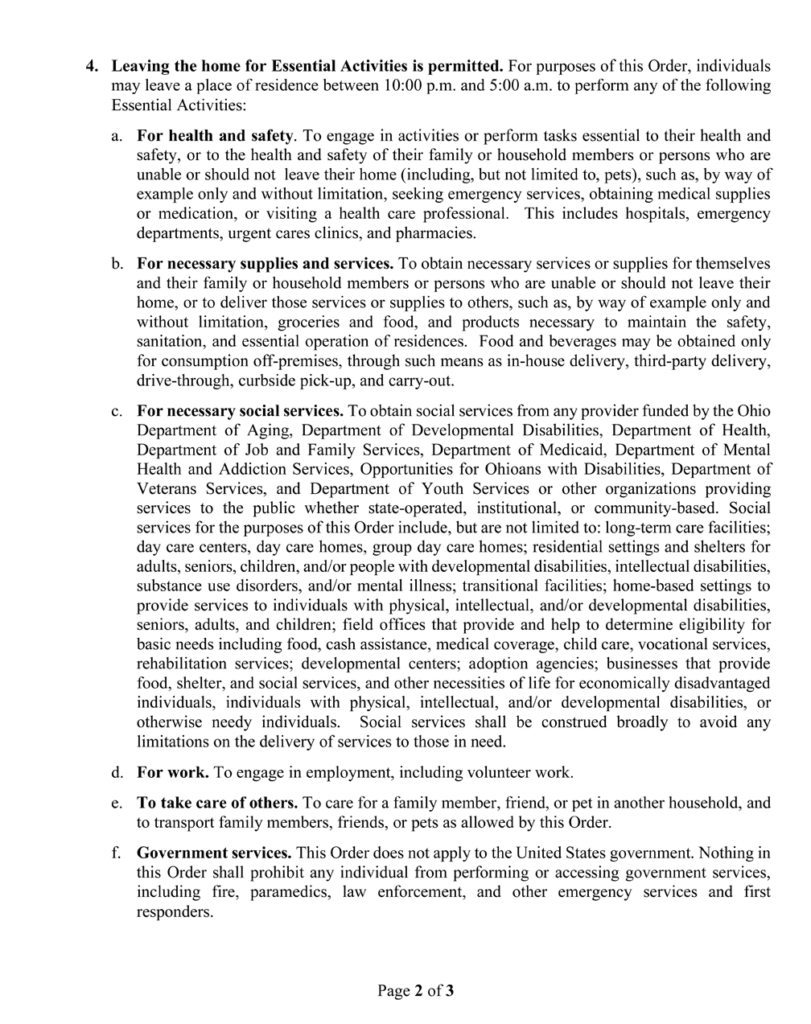
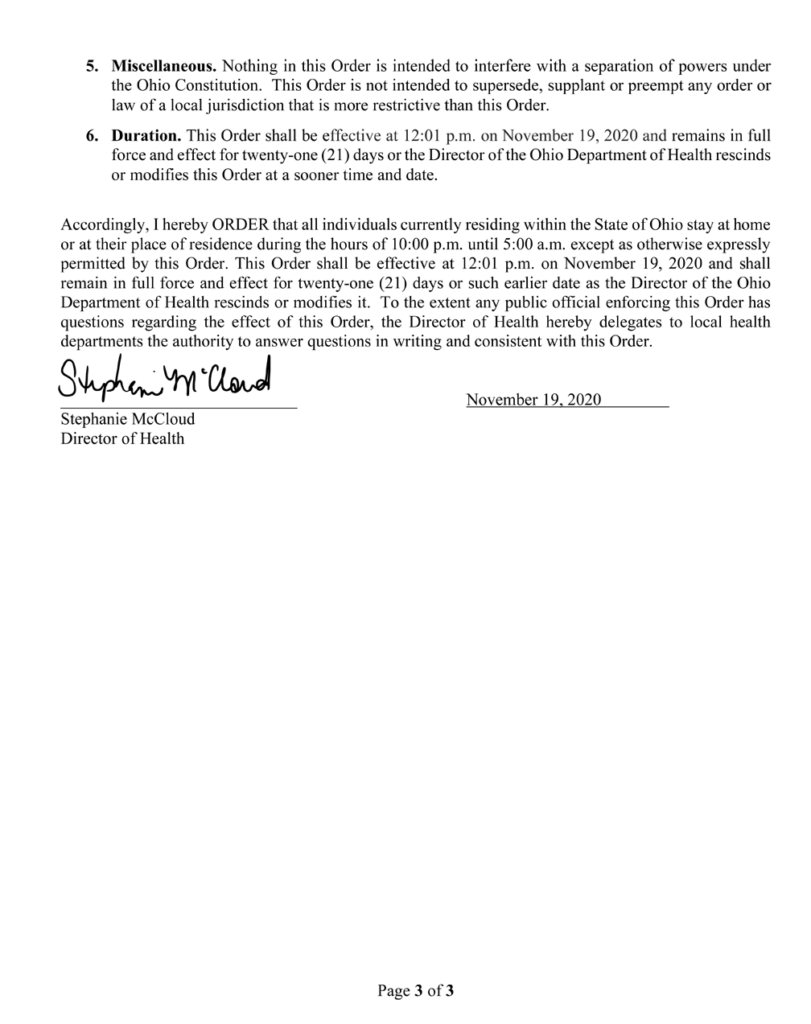
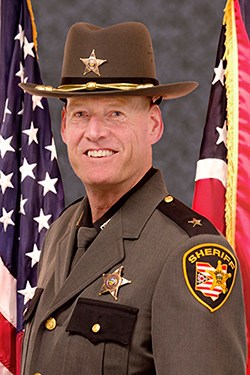
    Hamilton County, Ohio – Sheriff Jim Neil reports that beginning Thursday at 10 PM, the Hamilton County Sheriff’s Office has begun enforcement of the “Statewide Curfew” issued by the Ohio Department of Health. (Read the Health Order below)

    Neil said in a press release, “We’re asking all citizens and businesses to comply with the order. Restaurants and bars must stop serving in person customers at 10 PM during the curfew period. Takeout, however, can remain open beyond 10 PM. Violators will receive a verbal warning to comply with the order. After being verbally warned, the violator(s) will be cited under 3701.352, Ohio Revised Code, Misdemeanor of the 2nd degree.”

    Sheriff Jim Neil

    The Neil noted that the curfew does not include the following:

    •   Individuals going to and from work
    •   Those who have an emergency
    •   Those who need medical care
    •   Grocery shopping
    •   Going to the pharmacy
    •   Picking up carryout or a drive-thru meal. Delivery is also permitted
    •   Yes, you can still take your dog outside or go for a walk My goal as Sheriff of Hamilton County is to keep my deputies and the general public safe

    Health Order Signed Encouraging Ohioans to Stay Home

    (COLUMBUS, Ohio)—Ohio Governor Mike DeWine on Thursday announced that Ohio Department of Health Director Stephanie McCloud signed a health order encouraging people to stay at home during specified hours unless they are working or engaged in an essential activity.

    “As COVID-19 continues to spread in Ohio, we need a stronger response to minimize the impact on Ohio’s healthcare and hospital capacity and ensure healthcare is available to those that need it,” said Governor DeWine. “With this order we are discouraging get-togethers and gatherings to minimize the spread of the virus while minimizing the economic impact of a complete shutdown.”

    According to DeWine the specifications in this order include:

    • Individuals within the state must stay at a place of residence during the hours of 10 PM and 5 AM except for obtaining necessary food, medical care, or social services or providing care for others.
      • This order doesn’t apply to those that are homeless. Individuals whose residences are unsafe or become unsafe, such as victims of domestic violence, are encouraged to leave their homes and stay at a safe, alternative location.
      • The order does not apply to religious observances and First Amendment protected speech including activity by the media.
    • The order permits travel into or out of the state and permits travel required by law enforcement or court order, including to transport children according to a custody agreement, or to obtain fuel.

    Individuals are permitted to leave a place of residence during the hours of 10 PM and 5 AM for the following essential activities:

    • Engaging in activities essential to their health and safety or the health and safety of those in their households or people who are unable to or should not leave their homes, including pets. Activities can include but are not limited to seeking emergency services, obtaining medical supplies or medication, or visiting a health care professional including hospitals, emergency departments, urgent care clinics, and pharmacies.
    • To obtain necessary services or supplies for themselves and their family or members of their household who are unable or should not leave their home, to deliver those services or supplies to others. Examples of those include but are not limited to, obtaining groceries and food. Food and beverages may be obtained only for consumption off-premises, through such means as delivery, drive-through, curbside pickup and carryout.
    • To obtain necessary social services.
    • To go to work, including volunteer work.
    • To take care of or transport a family member, friend, or pet in their household or another household.
    • To perform or obtain government services.

    The order will apply for the next 21-days.


  • DeWine announces new curfew to try to slow covid spread

    DeWine announces new curfew to try to slow covid spread

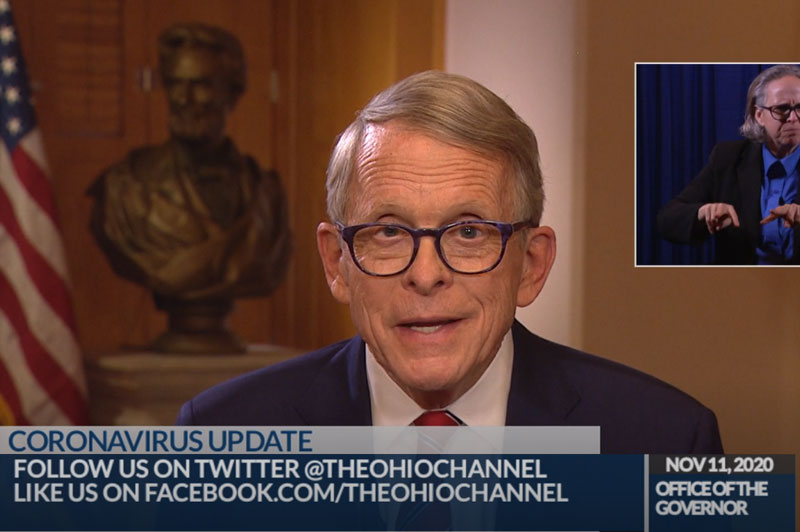
    Gov. Mike DeWine is pictured during his statewide address on Wednesday, Nov. 11. Photo courtesy Ohio Channel.


    By Marty Schladen and the Ohio Capital Journal


    Desperate to slow the spread of coronavirus, Ohio Gov. Mike DeWine on Tuesday announced a new curfew intended to decrease person-to-person contacts and new infections.

    The move was greeted with skepticism in some quarters.

    DeWine said that starting at 10 p.m. on Thursday, there will be a 21-day statewide curfew from 10 p.m. to 5 a.m. Bars, restaurants and retail stores will have to close. But there will be exceptions for pharmacies, grocery stores, food delivery, drive-through and pickup service.

    Technically, people who violate the curfew could be charged with a second-degree misdemeanor, punishable by 90 days in jail and a $750 fine. But as he has with other covid-related health orders, DeWine said he he’s not eager to see people charged.

    “We do not expect law enforcement to go pull people over because they’re out beyond 10 o’clock,” he said. “But if they’re seeing something going on, this is a way they can walk up and say, ‘Hey guys, you’re here… there’s a curfew. Why don’t you just go home?’”

    The governor added, “No one’s been charged under these health orders,” he said. “That doesn’t mean they couldn’t be, but they haven’t so far.”

    The curfew comes as Ohio experiences its most alarming spike in coronavirus infections and hospitalizations since the start of the pandemic early this year.

    On Tuesday, state health authorities reported 7,079 new cases over the past 24 hours, a 36% increase over the 21-day average. They also reported 368 new coronavirus hospitalizations, only a little less than the state record of 386 set on Nov. 10.

    The swelling numbers have placed Ohio hospital staffs in a “precarious situation,” said Bruce Vanderhoff, chief medical officer for the Ohio Department of Health. He said medical workers are fatigued from fighting the disease since March and they have to balance that work with living in communities and with families where the virus is increasingly prevalent.

    DeWine said his goal was to reduce the number of person-to-person contacts and thereby stop the virus from spreading. He asked Ohioans to voluntarily do that through such measures as condensing the number of trips they make to the grocery and buying more when they do. At the same time, he urged people to do what they can to remotely maintain emotional connections.

    However, critics noted that the curfew doesn’t go as far as one imposed in the spring. For example, the earlier order imposed limits on how many people can be in stores when they’re open.

    Asked what scientific basis he used in issuing the order, DeWine said, “We know the basic science. The basic science is fewer contacts, less spread.”

    The likely effectiveness of the curfew was disputed by at least one scientist in the field. Kent State epidemiologist Tara C. Smith tweeted that she didn’t know any professionals who thought it would work.

    DeWine, however, might have felt the curfew was as far as he could go. It had the support of the Ohio Restaurant Association, likely meaning that there was some negotiation behind it.

    Also, DeWine is a member of a party led by president who in October visited Circleville and said the media were hyping the virus to hurt his reelection chances. The president predicted the media would stop covering coronavirus on Nov. 4 — the day after the election.

    Covid skepticism runs so deep in elements of the Republican Party that at the same time that DeWine was announcing the curfew, Ohio Senate President Larry Obhof, R-Medina, was testifying in favor of his bill to repeal an earlier health order requiring bars to stop serving at 10 p.m.

    For his part, DeWine said he hopes the curfew will “push more people toward home.”

    “I think if we do these things it gives us a shot at slowing (the coronavirus) down,” the governor said. “Most of what we’re doing and the decisions I’m making are between two bad choices.”


    Marty Schladen

    Marty Schladen has been a reporter for decades, working in Indiana, Texas and other places before returning to his native Ohio to work at The Columbus Dispatch in 2017. He’s won state and national journalism awards for investigations into utility regulation, public corruption, the environment, prescription drug spending and other matters.

  • DeWine announces revised mask and social gathering orders

    DeWine announces revised mask and social gathering orders

    At the end of September, Ohio averaged under 1,000 new cases per day; this week, Ohio hit a record high of more than 6,500 new cases reported in a single 24-hour period.

    At the end of September, Ohio averaged under 1,000 new cases per day; this week, Ohio hit a record high of more than 6,500 new cases reported in a single 24-hour period.

    In a statewide address to Ohioans Wednesday evening, Ohio Governor Mike DeWine called on citizens to recommit to their individual efforts to prevent coronavirus spread as Ohio moves through its most intense, widespread, and dangerous surge of cases to date.

    Ohio is currently facing a record number of coronavirus-related hospitalizations and intensive care admissions, with nearly 3,000 people in the hospital, including more than 700 people in the ICU.

    During the first week of November alone, 104 Ohioans infected with the coronavirus died.

    To reinforce the necessity of wearing masks and slowing virus spread, Governor DeWine announced two forthcoming orders:

    Revised Mask Order

    DeWine said, “To protect frontline workers and customers, the Ohio Department of Health will reissue Ohio’s mask order and add the following provisions:

    • Each store will be required to post a sign outlining face-covering requirements at all public entrances to the store;
    • Each store will be responsible for ensuring that customers and employees are wearing masks; and
    • A new Retail Compliance Unit, comprised of agents led by the Ohio Bureau of Workers’ Compensation, will inspect to ensure compliance. 
    • A first violation will result in a written warning and a second violation will result in closure of the store for up to 24 hours.

    New Social Gathering Order

    Ohio’s April order that limits public events and private gatherings of more than 10 people is still in effect, however, there has been rampant spread of the virus as a result of banquets, wedding receptions, and social gatherings following funerals according to DeWine.

    “To address the tragedies that have resulted from such events, the Ohio Department of Health will issue an order that will place significant new restrictions on these social activities,” DeWine said.

    Specifically, open congregate areas will no longer be permitted to open, and everyone will be required to be seated and masked unless they are actively consuming food or drinks.

    Bars, restaurants, and fitness centers may remain open, but this will be reassessed one week from tomorrow for potential closure. 

    “If the current trend continues and cases keep increasing, we will be forced to make these closures,” said DeWine. “I am very well aware of the burden this will place on employees and owners, but these are places where it is difficult or impossible to maintain mask-wearing, which we know now is the chief way of slowing this virus.”

    Concern for healthcare workers

    “With this new wave of COVID-19, the onset of flu season, and an already-exhausted group of healthcare workers, there are serious concerns that there won’t be enough people to fully staff our healthcare facilities in the next few weeks,” said DeWine. “If we don’t change this, Ohio won’t be able to provide appropriate care for COVID patients or for Ohioans who require other emergency care for things like accidents, strokes, and heart attacks. Hospitals will again be forced to postpone important, but less urgent, care.”

    Although testing capacity in Ohio has nearly doubled, the number of people testing positive for the coronavirus has increased almost four times. At the end of September, Ohio averaged under 1,000 new cases per day; this week, Ohio hit a record high of more than 6,500 new cases reported in a single 24-hour period.

    “As we wait for the vaccine, which could come as soon as December, we have so much to protect,” said DeWine. “What each Ohioan does in his or her own life impacts every citizen and every place we desperately want and need to keep open– our schools, nursing homes, hospitals, and businesses.”

    For Governor DeWine’s entire address, visit ohiochannel.org or read his prepared remarks at coronavirus.ohio.gov.

  • Continuing business closures in Ohio

    Continuing business closures in Ohio

    The following businesses and operations remain closed as of May 15, 2020, as part of Ohio’s plan to prevent the spread of COVID-19:

    • K-12 schools.
    • Childcare services (permitted to reopen May 31).
    • Restaurants and bars dine-in service.
      • Carry-out and delivery services are permitted.
      • Outdoor dining is permitted.
      • Dine-in service permitted May 21.
    • Older adult day care services and senior centers.
    • Adult day support or vocational habilitation services in congregate settings.
    • Rooming and boarding houses, and workers’ camps.
    • Entertainment/recreation/gymnasium sites.
      • Includes, but is not limited to:
        • All places of public amusement, whether indoors or outdoors, such as:
          • Laser tag facilities, roller skating rinks, ice skating rinks, arcades, indoor miniature golf facilities, bowling alleys, indoor trampoline parks, indoor water parks, arcades, and adult and child skill or chance game facilities remain closed.
          • Gambling industries. (Horse racing is permitted without spectators May 22.)
          • Auditoriums, stadiums, arenas.
          • Movie theatres, performance theatres, and concert and music halls.
          • Public recreation centers and indoor sports facilities.
          • Parades, fairs, festivals, and carnivals.
          • Amusement parks, theme parks, outdoor water parks, children’s play centers, playgrounds, and funplexes.
          • Aquariums, zoos, museums, historical sites, and similar institutions.
          • Country clubs and social clubs.
    • Spectator sports, recreational sports tournaments and organized recreational sports leagues. (Non-contact and limited-contact sports leagues are permitted to reopen May 26.)
    • Health clubs, fitness centers, workout facilities, gyms, and yoga studios (permitted to reopen May 26).
    • Swimming pools, whether public or private, except swimming pools for single households. (Public pools and club pools regulated by local health departments are permitted to reopen May 26.)
    • Residential and day camps.
    • Campgrounds, including recreational camps and recreational vehicle (RV) parks (permitted to reopen May 21).
      • Excludes people living in campground RVs with no other viable place of residence.
      • Excludes people living in cabins, mobile homes, or other fixed structures that are meant for single families and where preexisting residential activity already has been established. (E.g., for people who have part-time preestablished residences at campgrounds for the summer months.)

    For answers to your COVID-19 questions, call 1-833-4-ASK-ODH (1-833-427-5634).


    Your mental health is just as important as your physical health. If you or a loved one are experiencing anxiety related to the coronavirus pandemic, help is available 24 hours a day, seven days a week. Call the COVID-19 CareLine at 1-800-720-9616.