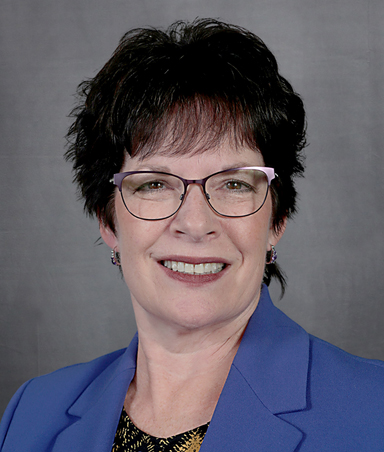
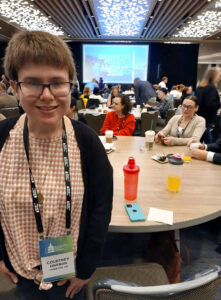
Butler County Board of Developmental Disabilities (BCBDD ) says, “Community Outreach Advocate Courtney Hineman has made it her professional and personal mission to advocate for inclusion in the developmental disability community.”
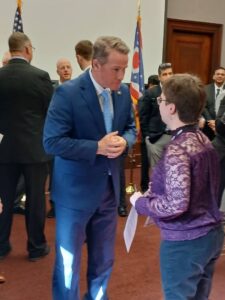
Courtney speaking with United States Senator Jon Husted.
This interview highlights Courtney’s recent advocacy work in D.C. with the U.S. Congress and at the Ohio Statehouse.
In April, Courtney took her advocacy on the road to Washington, D.C., to attend the Disability Policy Seminar and Advocacy Day. “While in D.C., Courtney met many fellow advocates, shared her story, and explained why disability policies are vital to the developmental disability community with several U.S. legislators.” The purpose of the “Hill Visits” is to speak directly with state congressional delegations about the high-priority issues affecting people with intellectual and developmental disabilities.
Watch as Courtney and the BCBDD‘s public relations coordinator, Cassie Mattia sit down for an interview where Courtney dives into her Washington, D.C., trip and her latest Ohio Developmental Disability Council meeting in Columbus.
The Butler County Board of Developmental Disabilities supports 4,207 Butler County Residents. Supports and services are available life-long through contracts with partner agencies or directly provided by our Board.
We believe in…
Diversity – Valuing our differences and celebrating our likenesses
Excellence – Setting high standards for ourselves and our organization
Equity – Supporting each other in our unique needs and strengths
Opportunity – Inspiring each other to grow and learn
Butler County, Ohio – Butler County Board of Developmental Disabilities Employment Navigator, Elizabeth Grove, couldn’t wait to share a success story that has been several years in the making. Greg Nelson, a Wright State University graduate, a homeowner, and a Cincinnati sports team enthusiast received news this week, that Elizabeth says, will not only change Greg’s life, but will also give him the opportunity to thrive in the workforce!
“Greg has a great sense of humor, an infectious smile, a tremendous amount of patience, and the best natural support system anyone could ever dream to have,” Elizabeth said. “The biggest challenge in life Greg must endure is having quadriplegic cerebral palsy. He is non-verbal and must have 24/7 staffing to care for his physical needs. Greg articulately communicates through assistive technology in which he uses his chin to type out sentences on his iPad. It can take up to 5 minutes for him to answer a simple question. His bright intellect is often stifled by the vast majority because they see his disability first and fail to practice person-first thinking.”
For 4 years, Greg worked for Ken Anderson Alliance managing their social medial platforms, but due to budget cuts, Greg lost his job in February of 2024. In hopes that he could find some help looking for employment, Greg reached out to SSA Lead, Kent Price.
“As a team Kent and I connected Greg to a rehabilitation engineering technologist to learn if there was any equipment available for Greg to enhance his typing skills,” Elizabeth said. “Greg tested adaptive computer hardware and software, worked with Control Bionics to test out the Neuronode 3.0 switch and controller, and a sip/puff pneumatic switch from Origin Instruments. After many attempts and months, it was determined technology was not yet advanced enough to meet Greg’s needs. At that point, his case was closed with the rehabilitation engineering technologist in January of 2025. Although Greg did not share his thoughts to the team at the closure meeting, his facial expression spoke a thousand words.”
Elizabeth, Kent, and Greg did not give up despite receiving the news his case was closed. Instead, Elizabeth and Kent assured Greg they were not going anywhere and were going to help him find something of value to stimulate his mind and highlight his skills.
“Kent and I shared many conversations behind the scenes brainstorming volunteering opportunities and jobs,” Elizabeth said. “We reached out to the different chambers of commerce in Butler County, the Lakota East school district where Greg was a student, and Wright State’s office of disability services. The possibilities were endless we just needed to find someone with person-first thinking.”
Things finally seemed to align for Greg when Kent took a tour of The Lodge Activity Center with another client and while there Celena Parker, The Lodge Activity Center’s owner, causally mentioned her need to hire someone to manage their Facebook account. Without missing a beat, Kent told Celena he knew just the guy.
“Fast forward to now, Greg has officially accepted the position of Social Media Content Manager for the Lodge Activity Center and this week he met his new boss and co-workers,” Elizabeth said. “Kent and I are over the moon excited for Greg’s new adventure and will be frequently visiting the Lodge’s Facebook page. I have thoroughly enjoyed my time working with Greg and applaud Kent for always keeping his clients on the forefront of his mind. Without his light bulb moment, Greg would have missed out on this incredible job opportunity!”
About the Butler County Board of Developmental Disabilities
The Butler County Board of Developmental Disabilities supports 4,207 Butler County Residents. Supports and services are available life-long through contracts with partner agencies or directly provided by our Board.
Founded in 1967, the Butler County Board of Developmental Disabilities supports 4,207 people. Supports and services are available life-long through partner agencies or directly provided by our Board.
Much of our services go beyond the walls of our facilities and take place in the community. The Board’s supports are geared toward the philosophy of person-centered thinking, which places the individual at the center of decisions made about the services they receive. We are committed to helping people determine their dreams and helping to make those dreams come true.
_____________
BECOME A LOVELAND MAGAZINE SUPERFAN BY DONATING NOW!
Editor’s note: Open and free local reporting is critical to having well-informed community. Loveland Magazine has published a free newspaper and website for the last 20 years for our community. If you would like us to continue, kindly contribute to this service. It would be greatly appreciated. Donations may be made to: Loveland Magazine, 243 Wall Street, Loveland, Ohio 45140. Or, donations can be made through PayPal using a credit card. (https://bit.ly/4j1ju3k)
FOX19 Now morning anchor Julie O’Neill, Cassie Mattia, and Butler County Department of Developmental Disabilities Superintendent, Lee Ann Emmons
(Screen Grab from Fox 10)
David Miller is the Managing Editor of Loveland Magazine
by David Miller
Loveland, Ohio – On Tuesday, Loveland Magazine President Cassie Mattia and the new Butler County Department of Developmental Disabilities (BCBDD) Superintendent, Lee Ann Emmons got the opportunity on FOX19 Now News to share with the community all the fun and exciting things they have going on at the agency.
Julie O’Neill interviewed Superintendent Lee Ann Emmons and BCBDD’s Public Relations Coordinator Cassie Mattia about their new mission statement, gaining their 3-year accreditation, being named one of the top workplaces in Enquirer – Cincinnati and Kentucky for 2024, and what it’s been like for Lee Ann thus far as a new Superintendent for the BCBDD.
If you would like to meet Lee Ann attend the meet and greet on Tuesday, June 25 from 4:30 until – 5:30 PM at the Janet Clemmons Center located at 282 N Fair Ave. in Hamilton.
President and Publisher of Loveland Magazine, Cassie Mattia is a resident of Historic Downtown Loveland and the Public Relations Coordinator at Butler County Board of DD. Cassie was awarded the Little Miami River Chamber Alliance 2021 Young Business Professional of the Year.
“Interviewing Josh on the red carpet was a fantastic opportunity for our community to see via Facebook Live – what kind of a person Josh is. I think what he had to say was important for everyone to hear and quite frankly was inspirational,” Cassie told me after the interview.
Joshua Felder was one of the leading actors in the recently released movie Champions, starring Woody Harrelson, and was the keynote speaker at the 2023 Community Recognition Awards gala put on by the Butler County Board of Developmental Disabilities (BCBDD) on September 28.
Champions is the story about a Des Moines, Iowa young adult basketball team whose players all have developmental disabilities. Joshua played the role of Darius. The film stars Woody Harrelson as an unpredictable, minor-league basketball coach who after an arrest for drinking while driving and hitting a police car was ordered to coach a team of players with intellectual disabilities as community service. By the way, Harrelson is a 1979 graduate of Lebanon High School.
Cassie also told me that having Josh as their keynote speaker for the awards ceremony and getting the chance to spend time with him while he was in Hamilton was something she will always treasure. Besides the on-air interview, Cassie was also able to spend the day with him and her cohorts as he toured the city and learned about the things BCBDD does. “Josh is definitely going to achieve big things in his life. What a great role model for many many individuals out there,” she said.
In the movie, Joshua plays Darius, the teammate who had a promising basketball career before he was involved in a terrible car accident caused by a drunk driver and ended up with brain damage. He refuses to play for Harrelson’s team. However after getting to know the new coach, Darius realized he needed to be able to forgive the woman who hit him and the character played by Harrelson and decided to join the team that went to the Special Olympics finals in Winnipeg.
In real life, Joshua is a Global Ambassador and is on the International Board of Directors for Best Buddies International. He was the first person with a disability to be a dancer in a Super Bowl halftime show. He appeared with The Weeknd and was featured in a Showtime Original, which outlined the making of the Super Bowl LV Halftime Show. Additionally, Joshua was featured on CBS This Morning with Gayle King. Joshua has “high-functioning” autism.
Cassie, besides being the president and co-owner of Loveland Magazine is the Public Relations Coordinator for the Butler County Board of Developmental Disabilities and was given the responsibility to do interviews on the red carpet as guest celebrities arrived for the the Hollywood-themed annual awards celebration.
Cassie continued, “Planning and putting on an annual event like the Community Recognition Awards can be tough, but after you see the results of the awards and how the event brings the community together is truly the icing on the cake.”
I attended the event to be inspired by the award winners, meet a star in what is now one of my all-time favorite movies, and volunteer to record videos and take still photos for Cassie and the BCBDD.
Cassie Mattia interviewing movie star Joshua Felder.
Josh said that while he toured Hamilton he was glad he finally got to stand under the famous Alexander Hamilton statue. He picked up a Joe Burrow jersey even while proclaiming he a “forever” Tampa Bay Buccaneers fan and enjoyed Skyline Chili.
According to Cassie, “Josh is an incredible advocate for the DD community and is living proof of what someone with a developmental disability can achieve.”
Thank you Josh and Cassie for the lessons you teach me and your exciting inspiration.
Savannah Guthrie, Woody Harrelson, and members of the cast of “Champions” talk about the bond they made during the production of the movie Champions.
The Butler County Board of Developmental Disabilities supports over 3,700 people to live, work, and learn successfully in their community. Supports and services are available life-long through contracts with partner agencies or directly provided by the Board.
If you believe that you, someone in your family, or someone you know might benefit from a local DD Board, here are some links:
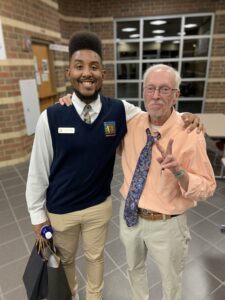
Clermont County Board of Developmental DisabilitiesBest Buddies International is a dynamic and growing organization, thanks to the people who help advance its mission every day. From the Board of Directors to the summer interns, everyone on the Best Buddies team shares their energy and enthusiasm as they work to enhance the lives of people with intellectual and developmental disabilities.
Part of Loveland Magazine’s coverage of Developmental Disabilities Awareness Month
[/vc_column_text][vc_column_text]
Cassie Mattia
by Cassie Mattia
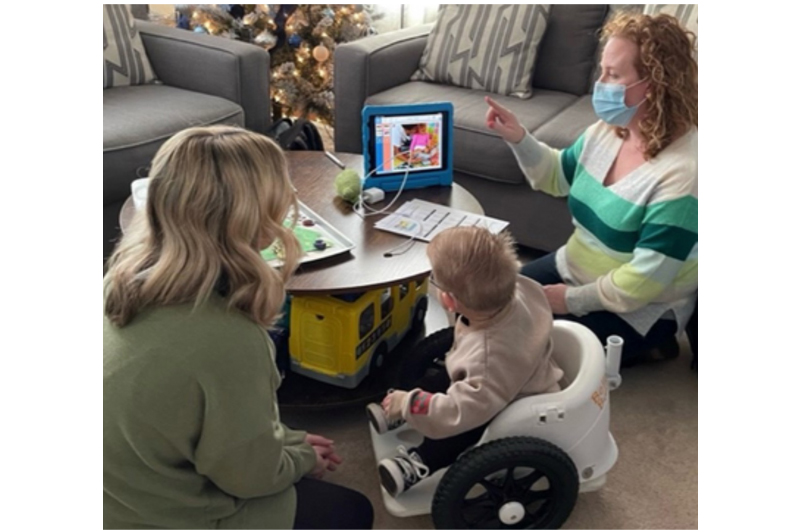
Since the inception of Ohio’s Technology First Initiative, new and improved devices that help with two-way communication or provide step-by step assistance has helped many families and individuals with developmental disabilities overcome daily obstacles. For children with developmental disabilities, communication devices are often one of the most important parts of their growth and development. Butler County Board of Developmental Disabilities (BCBDD) Early Intervention Speech-Language Pathologist, Bree Lanham, began learning about Augmentative and Alternative Communication devices in college and knew that with her expertise she could implement what she had learned into the BCBDD Early Intervention program and immediately impact the children and families a part of the program.
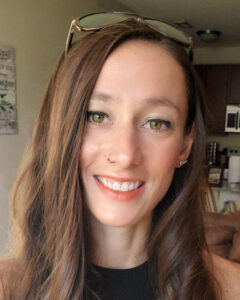
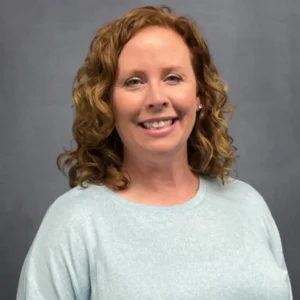
Bree Lanham
“Since joining the board, I saw an opportunity for increasing awareness of Augmentative and Alternative Communication (AAC) to be used in Early Intervention. There are many myths associated with using AAC in young populations and I really wanted to make it my mission to reveal the truth about AAC and how it can benefit birth to 3,” Bree said.
Bree, who has been a Speech-Language Pathologist (SLP) for 14 years, began learning about low-tech and high-tech AAC devices at Arizona State University where she gained her degree in Communication Disorders (Speech Pathology). Bree’s undergraduate degree in Special Education allowed her to explore the world of AAC devices and use various forms of the devices to give the children she worked with access to language surrounding curriculum in the classroom. “I’ve lived all over the US and had experience working with families and children not only in Early Intervention (EI), but schools and clinics as well. I have found that the earlier a child has access to a robust system of communication, the earlier they can begin integrating their skills with family and friends across environments and building lifelong relationships,” Bree said.
What is an AAC device?
Augmentative and alternative communication encompasses the communication methods used to supplement or replace speech or writing for those with impairments in the production or comprehension of spoken or written language. In simpler terms, AAC means ALL of the ways that someone communicates besides talking. Anyone at any age can use AAC to help with speech and language skills. AAC devices fall into two categories, no or low-tech, meaning a physical aid or tool is not required, and high-tech, which utilizes technology. No or low-tech includes gestures and facial expressions, writing, sign language, drawing, spelling words by pointing to letters, and pointing to photos, pictures, or written words. High-tech most often uses an app on an iPad or tablet to communicate. High-tech may also include using a computer with a speech-generating device.
Who should use AAC devices?
AAC devices work well for children who are pre-verbal, those with developmental delays such as Autism or Down Syndrome as well as children who are difficult to understand such as those with severe phonological impairments or Childhood Apraxia of Speech. High-tech AAC devices allow children to build on their language skills; quickly going from single words to short sentences in a matter of months. High-tech AAC devices gives children a voice to request their favorite food, favorite toy or to tell their parents and caregivers about an important need or want. AAC devices can be a huge help to kids who are learning verbal speech alongside their device and promotes speech and language development.
Bree quickly recognized the need for AAC devices in the BCBDD EI program and as a result of her efforts, the EI department procured several iPads with five apps (Proloquo2Go, TouchChat, TD Snap, Snap Scene and Cough Drop) to use for expressive communication. The iPads are available through a budding lending library for EI families to now learn the possibilities of what is out there and how AAC devices can help their child develop and grow to the best of their potential. Since the introduction of AAC devices to the EI program, the Butler County Educational Service Center has provided an additional 8 iPads to help grow the lending library.
“It’s great to work for an organization where employees feel empowered to reach out when they see a need. Bree approached us with an opportunity to enhance our services to the children we serve. Of course, we quickly made that opportunity a reality for our families and can now add AAC as another option for our families,” said Sherry Dillon, BDBDD Community Services Director.
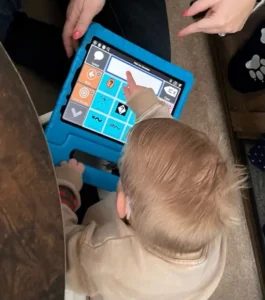
2-year-old Leo Davis using an AAC device
BCBDD EI Therapists are trialing the AAC apps with several kids in the EI program to use across daily routines such as playtime and mealtime. “Our plan is to figure out which app best fits their needs and work to complete an AAC Evaluation to provide these children with permanent devices to supplement expressive language. I feel that all children should have access to robust language from an early age to promote developmentally and/or age-appropriate communication skills,” Bree explained.
The use of AAC devices in the BCBDD EI program has already begun to make a huge difference in Kasey Davis’ life, whose 3-year-old son Connor is using an AAC device to model language.
“Having access to the device has been amazing for our family,” said Kasey. “It’s allowed our son to explore expressive communication in new ways we didn’t think was possible. Although we are still learning the different apps, he’s picking it up quickly and is engaged when using it. Having a ‘tailor made’ device that we can customize to our needs has made the experience even better. We’re so grateful for the opportunity to work with the program and use the device as a tool for our son.”
The benefits of AAC can be endless when introduced early on, according to Bree.
“Our Early Intervention program is unique. We have access to low and high-tech AAC for all children. Families will need to work with their therapists to obtain the right fit and explore all options. Typically, a child will be working with a therapist for a period of time to determine the best fit for AAC. High-tech AAC devices can and should be implemented early but are often not the first strategy or system that we use. This may be due to various factors including need or fit for the family and child. Essentially, it’s a complex process of determining what is the best fit for a child and family long-term. This is why a family’s Speech Language Pathologist should work together with the family to determine the most appropriate fit that meets the current need and also allows the child to push to the next level of development,” Bree said.
Bree says that when working with a SLP or therapist it is critical in determining the need for high-tech devices as not all children and families will need them. “Asking your SLP or therapist questions is the best way to learn more about what we have to offer and which program on the device will fit their needs. It’s also critical to work with your therapist to learn the device and how to implement it in daily routines to reduce device abandonment long-term,” Bree added.
AAC devices can lead to other benefits in a child’s future!
According to AssistiveWare.com, AAC devices can offer a child many social, physical, and emotional benefits including:
stronger friendships and deeper relationships
richer, more frequent social interactions
deeper social roles
increased autonomy and decision-making power over their own life
increased independence
more respect from others
greater participation in their family lives and communities
improved information sharing with physicians
improved personal safety in a variety of care settings, such as hospitals or long-term facilities
more employment and volunteer opportunities
improved physical and mental health
With the implementation of AAC devices in the BCBDD EI program and the proven success rate with families currently trialing the devices, BCBDD Superintendent, Lisa Guliano couldn’t be happier about offering more assistive technology options to children and families.
“I appreciate Bree’s initiative in pursuing use of Augmentative and Alternative Communication as an option for children and families being served through Early Intervention,” Lisa said. “These efforts align with our statewide Technology First plan and our agency’s goal to increase the number of people using assistive technology across the lifespan. I’m excited to see the outcomes for children and families as they explore the options available.”
The new BCBDD AAC system in the EI program is something Bree believes all organizations that serve children with communication delays and disorders would benefit from. “All children should be provided a system of communication as early as possible, and this can range from pictures and signs to a high-tech device,” said Bree. “I’ve always felt that my job as an SLP is not to ‘make a child talk’ but to teach a child to communicate and AAC is another tool in my toolbelt that can support a child in their development of communication skills.”
AAC Myths vs. Facts
Myth: Using AAC or high-tech device will prevent a child from talking. Fact: Using AAC or a high-tech device can help to promote verbal speech.
Myth: AAC is a “last resort” in speech-language intervention. Fact: There are no pre-requisites for providing AAC and it can be used in tandem with traditional speech-language intervention.
Myth: Only children with certain cognitive abilities will benefit from AAC or high-tech devices. Fact: No, the opposite is true. Emerging research is showing that devices can actually promote communication and cognitive development including increasing social skills, facilitating communicative intent and aiding in learning symbolic representation.
Myth: Children need to trial low-tech devices before high-tech devices such as PECS. Fact: There are no pre-requisites for providing a robust system of communication. Each child should be evaluated independently and provided access to the system of communication that will grow with them. Speech-Language Pathologists specialize in assisting families with making these decisions.
To find out more about access to BCBDD AAC devices through the EI program contact your Developmental Specialist or email info@butlerdd.org.[/vc_column_text][vc_separator border_width=”10″][vc_message]
Columnist Cassie Mattia is a resident of Historic Downtown Loveland and the Public Relations Coordinator at the Butler County Board of Developmental Disabilities. Cassie was awarded the Little Miami River Chamber Alliance 2021 Young Business Professional of the Year. Cassie is very active in the Loveland community and will often be seen helping plan and volunteering at the Little Miami Chamber Alliance and City of Loveland events. Cassie also enjoys supporting the local restaurants and businesses in Loveland as well as making guest barista appearances at Mile42 Coffee. To see what Cassie is up to follow her on Facebook and Instagram!
You can reach Cassie at cmattia12@gmail.com[/vc_message][/vc_column][/vc_row]
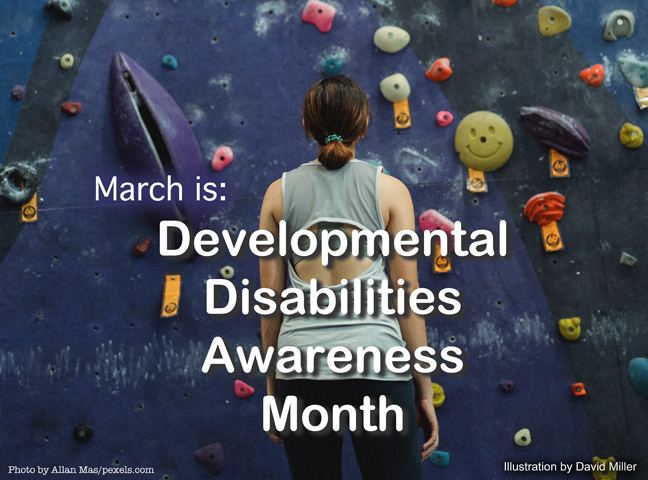
Developmental Disabilities Awareness Month is the right time to talk about it
by Lisa Guliano
Before the 1950s, Ohio residents with developmental disabilities were often sent to institutions or kept at home, isolated and hidden from the public. Thanks to the advocacy efforts of parents who wanted better for their children, change was brought about. In 1952, parents in Butler County formed what would later become the Butler County Board of Developmental Disabilities (BCBDD).
With such a start, BCBDD has always had a hand in advocating for people with developmental disabilities and despite progress, there are many ways that advocacy is still needed to this day.
In 1986, the Ohio Legislature signed into law a Bill of Rights for people with developmental disabilities. The statute includes 24 rights to legally reinforce the freedom to choose and experience life. These are basic rights such as: the right to participate in decisions that affect their lives; the right to social interaction with members of either sex; the right to food adequate to meet accepted standards of nutrition; and the right to privacy, including periods of privacy and places of privacy to name some examples.
It has always been difficult for me to accept that people with disabilities needed additional protection under the law to simply be treated equally as all citizens.
Given that reality, our Board’s mission focuses on supporting people to live, work and learn in their community. What that looks like is different for every person depending on their goals and dreams for their future – just like you and me. Our role as advocates is an honorable one — it is vitally important given the history of people with disabilities living in institutions and being hidden from the community for being different.
Supporting people with disabilities to access opportunities to develop their full human potential – language also included in the Bill of Rights – incredibly increases our value as a society. Each person realizing their goals and dreams has an exponential effect on all of us.
If you’re trying to think of examples of what our mission looks like in the community, I’d encourage you to look at yourself, possibly your family members and even your friends. Haven’t we all worked on a plan for our lives and accessed support from others along the way? Are there times when you or someone you know faced challenges, or even barriers because of being different or not fitting a “typical profile?” As you’ve walked your path in life, recall the times where your opportunities led you to reaching goals, getting closer to your full potential, contributing to your sense of worth, your family and your community.
Diversity doesn’t look all that different for people with disabilities as they focus on living their best lives – not defined by us – but supported by us. We celebrate Developmental Disabilities awareness month in March and I’m challenging you to focus on the abilities, not the disabilities of people in our community, recognizing the unique ways all of us contribute to society.
March is Developmental Disabilities (DD) Awareness Month which makes it the perfect time to share how my community created opportunities for me and partly because of that, I’ve been able to flourish. As someone who lives with a developmental disability, I want others with disabilities to have similar opportunities for employment, leadership, and friendship.
When I was younger, I got to be a part of a summer work program through the Butler County Board of Developmental Disabilities (BCBDD). My first job was cleaning toilets and tables at Barn N Bunk, and I cleaned at Camp Campbell Gard as well. Later, I worked at the East Butler YMCA at the customer service desk.
I really enjoyed getting to interact with people and learn new things. For many people with disabilities, building friendships or gaining leadership skills can be difficult. For me, these work experiences helped create opportunities for both leadership and friendship. I feel my past work experiences lead me to the job I have now because I was able to learn how to interact with customers and show others that I’m a hard worker.
Sometimes, it can be hard for people with disabilities to develop friendships. For me, Best Buddies helped bridge that gap. Best Buddies is an international organization that matches people with and without disabilities for friendship. Through Best Buddies I have learned how to grow in a relationship with a friend, I’ve been able to try new things, and I’ve learned leadership skills. One of my favorite experiences through Best Buddies was painting pumpkins with my new friend.
Through Best Buddies, I have attended leadership trainings which helped me in my role as Community Outreach Advocate at BCBDD. At those leadership trainings we learned how to share our story. We learned how to write a speech and how to present in front of others. This has given me confidence not only at work but also in my personal life. I now know that I can speak up for myself and that sharing my experience can help others with disabilities and their families.
These opportunities helped me tremendously. You can create that for someone in your community. I hope that you take the time this month and every month to give someone with a disability an opportunity to grow in their skills and help them live the best life they can live.
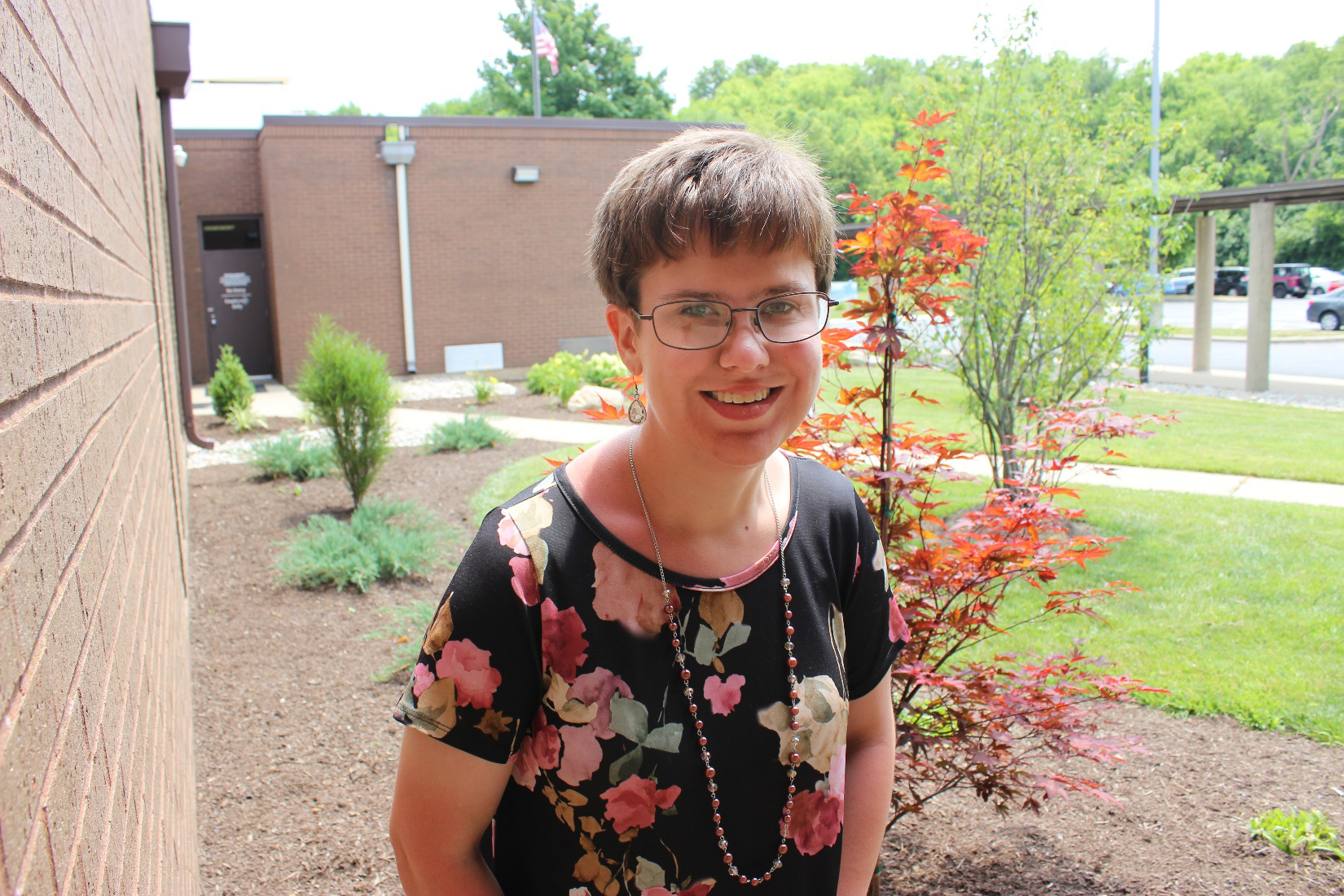
Everyone experiences challenges in their lives whether it’s having a not-so-great work week, overcoming an illness, or getting into an argument with someone you care about. In the grand scheme of things, those challenges are often ones you can quickly overcome and grow from! Some obstacles in life can be so challenging that when one overcomes them it is not only inspirational to see but also serves as a beautiful example for those experiencing the same obstacles. Meet Kathryn (Kat) Feldmann, a 21-year-old who has not only never backed down from a challenge but has also been a source of motivation for others in the developmental disability community to pursue their dreams.
Kat, who lives with her mom, Kristen, her dad, Kurt, and her brother, Konrad in Liberty Township has overcome a lot of medical challenges in her life. As a baby, Kat was diagnosed with an Atrial Septal Defect that was eventually corrected through surgery. Kat was also diagnosed with autism, Pierre Robin Sequence, anxiety, Craniofacial Anomalies, and a speech delay. Though Kat deals with challenges daily due to her disabilities, she has successfully managed to not only exceed her goals, but also receive many awards/honors along the way for her outstanding achievements.
Kat, as a very young girl, loved being involved in the community and supporting organizations that she truly believed in.
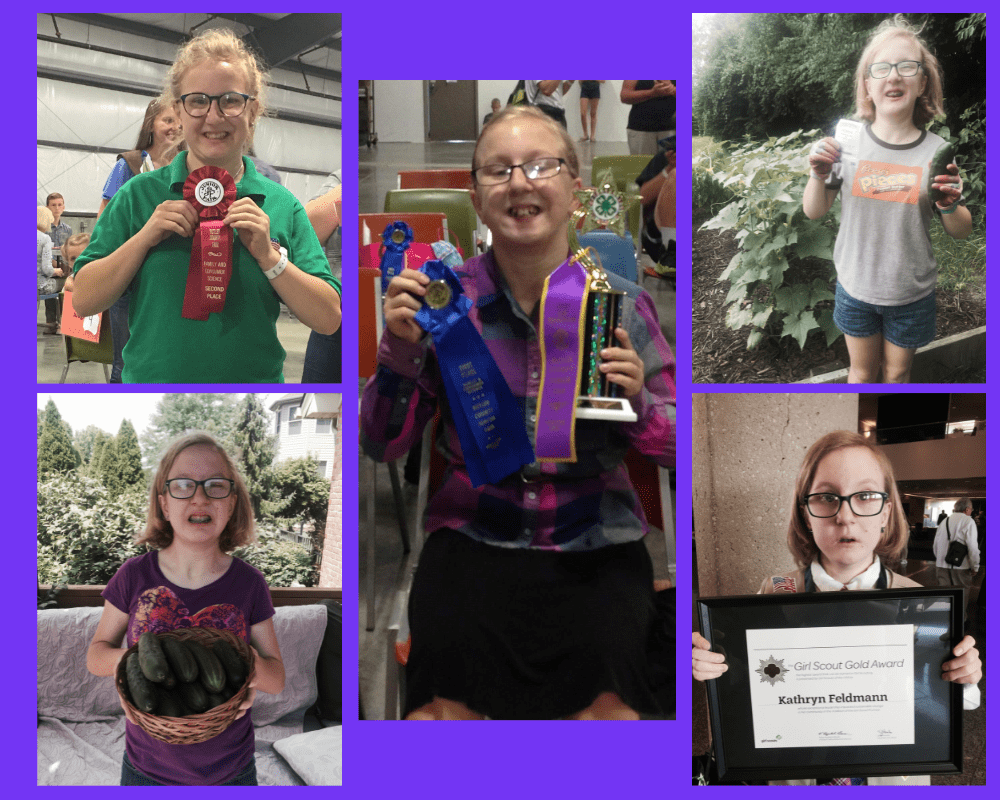
“Throughout her school age years, she participated in Butler County 4H doing mostly food and nutrition projects and even competed at the state fair twice,” Kat’s mother Kristen said. “Kat was also involved in Girl Scouts since first grade and earned the Girl Scout Gold award. For this, she earned a multiyear grant from Katie’s Krops and grew a garden from which she donated her entire harvest to a local food pantry. She also identified and printed recipes to donate alongside the produce so that the recipients would have a better idea of how to cook it.”
Kat and her many accomplishments, awards, and honors!
Kat’s determination and dedication to the environment, her community, and cooking delicious, healthy, fresh food earned her multiple 4H awards and a trip to Washington DC where she served as the “Citizens Focus” Club’s Treasurer. Little did Kat realize she was becoming one of the biggest local advocates for those with developmental disabilities!
As time went on, Kat began to really enjoy researching things that interested her, often watching YouTube videos to learn as much as she could about topics that she was passionate about. This led to Kat diving into many hobbies such as collecting American Girl Dolls, reading books, cooking, music, dancing, spending time with her Siamese cats, and art.
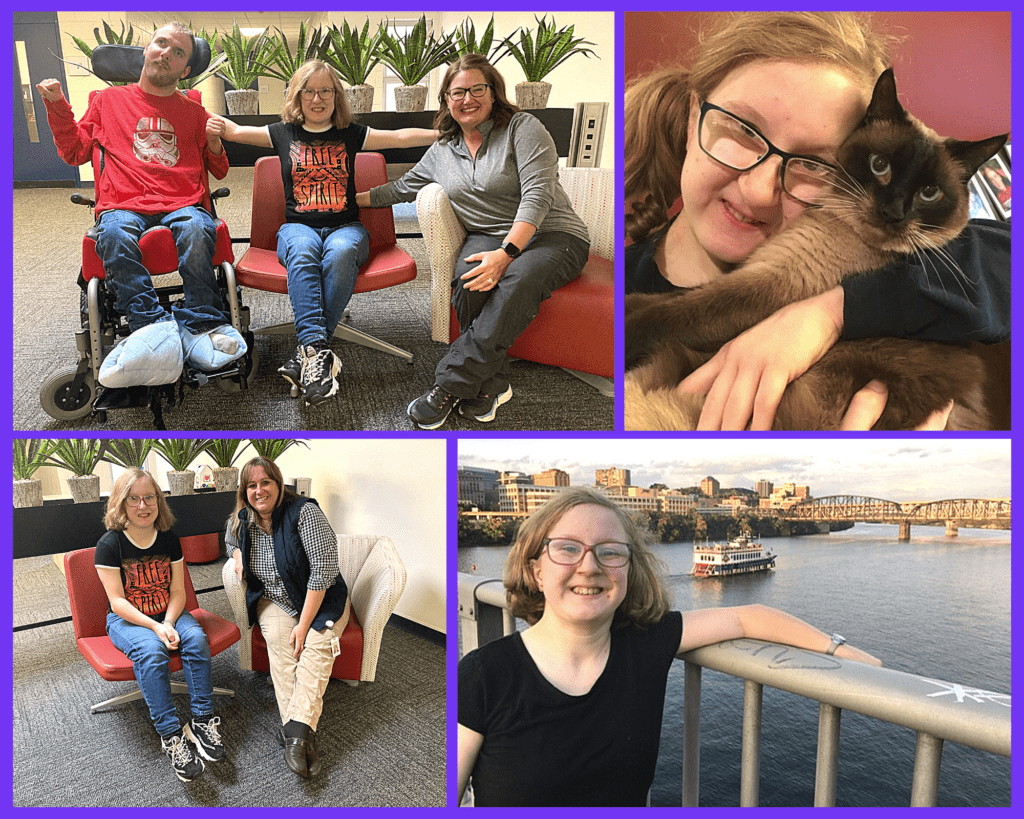
Kat, her brother Konrad, and her mother Kristen (Photo top left), Kat and 1 of her 3 Siamese cats (Photo top right), Kat and her SSA, Teresa Rouff (Photo bottom left), Kat in Pittsburgh (Photo bottom right).
Kat successfully graduated from Lakota East and shortly after became a part of Butler Tech’s Project Life, a comprehensive, multi-year transition program where students develop, practice, and strengthen skills that increase adult independence and successful integrated employment in the community, and Butler Tech’s Project Search, a school-to-work program for students with disabilities who are serious about working hard and getting a job.
“Kat completed both Project Life and Project Search in May of 2022. For Project Search she completed rotations in the emergency department and the lab at West Chester Hospital,” Kristen explained. “She is now working with Opportunities for Ohioans with Disabilities (OOD) to secure employment in the future.”
Once Kat finished Project Search she realized she had an interest in Hospitality which led her to enrolling in the Tartan TOPS program at Sinclair College, an educational/career pathway program for part-time students who have an intellectual disability.
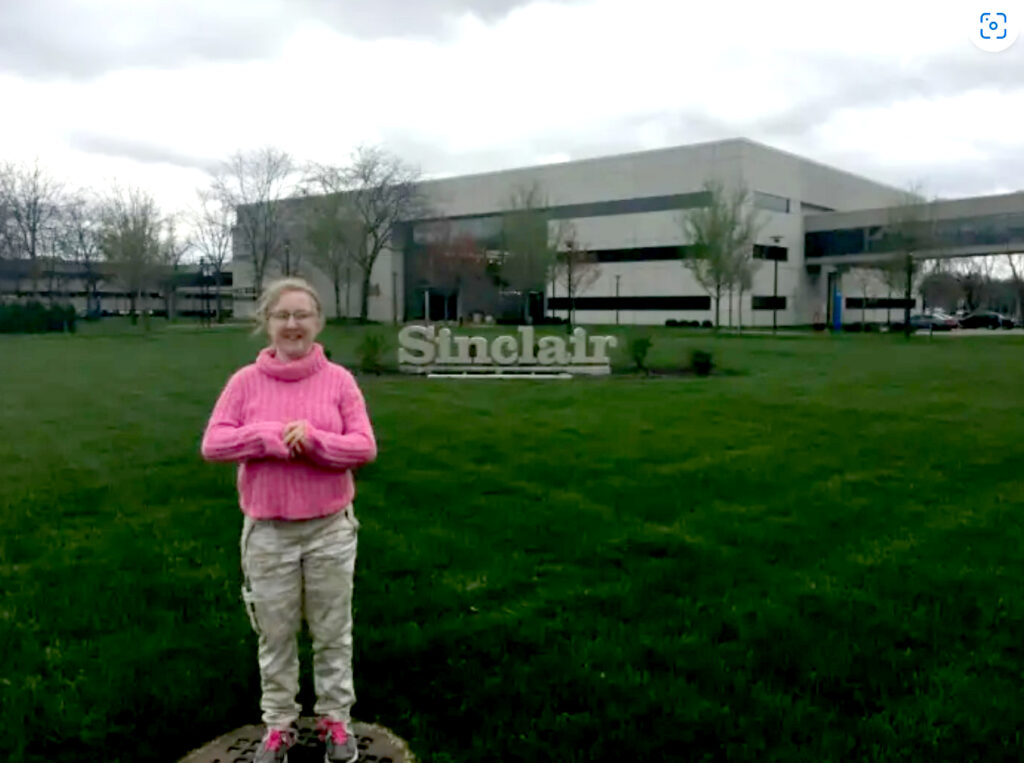
Kat in front of Sinclair College, where she currently takes classes in the Tartan TOPS program.
BCBDD Service and Support Administrator (SSA), Teresa Rouff, began working with Kat in April and couldn’t be more impressed with Kat’s progress!
“On top of all the amazing things Kat is doing, she recently began a vocational habilitation program at InsideOut Studio where she creates various art pieces,” Teresa said. “She loves art and is VERY talented. She has a few pieces for sale on the InsideOut Studio website that show how gifted she is at art!”
Kat enjoys all aspects of art and is currently working with fiber and crocheting knits at InsideOut Studio. Kat said she hopes to sell some of her creations through the online store.
“Kat is also involved in SpeakUp and was recently matched with a buddy through Best Buddies and looks forward to fun times ahead with her new friend,” Kristen said. SpeakUp is a BCBDD self-advocacy group and Best Buddies is a non-profit organization that offers one-on-one friendship and leadership development programs for individuals with intellectual and developmental disabilities.
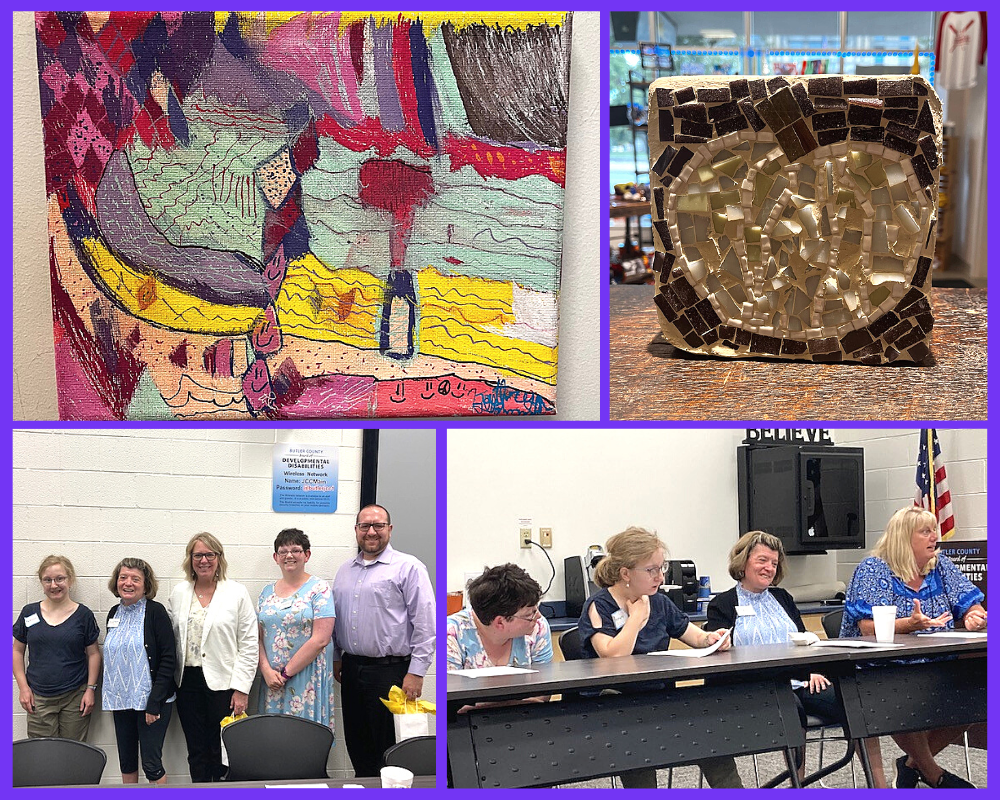
Kat’s “Happiness” acrylic on canvas that she created at InsideOut Studio (Photo top left), Kat’s white pumpkin garden stone that she created at InsideOut Studio (Photo top right), Kat with advocate Jodi Mann, Director Kimberly Hauck from the Ohio Department of Developmental Disabilities (DODD), advocate Cassie Sullivan, and Steve Beha, the Chief Policy Officer for the DODD, Kat was on an advocate panel when DODD’s Director Hauck visited the BCBDD (Bottom right photo).
Kat says her main hope and dream is to become as independent as possible and to live with roommates and friends for socialization. She says she would like to get a job that allows her to make a difference in the world and continue doing what she’s passionate about!
Watch the on-camera interview with Kat Feldmann, BCBDD SSA Teresa Rouff, and Kat’s mother Kristen Feldmann below!


![[WATCH INTERVIEW] Courtney Hineman took her advocacy on the road to D.C.](https://lovelandmagazine.com/wp-content/uploads/2025/05/courtney-cassie-interview-feature.jpg)
 Watch as Courtney and the BCBDD‘s public relations coordinator, Cassie Mattia sit down for an interview where Courtney dives into her Washington, D.C., trip and her latest Ohio Developmental Disability Council meeting in Columbus.
 The Butler County Board of Developmental Disabilities supports 4,207 Butler County Residents. Supports and services are available life-long through contracts with partner agencies or directly provided by our Board.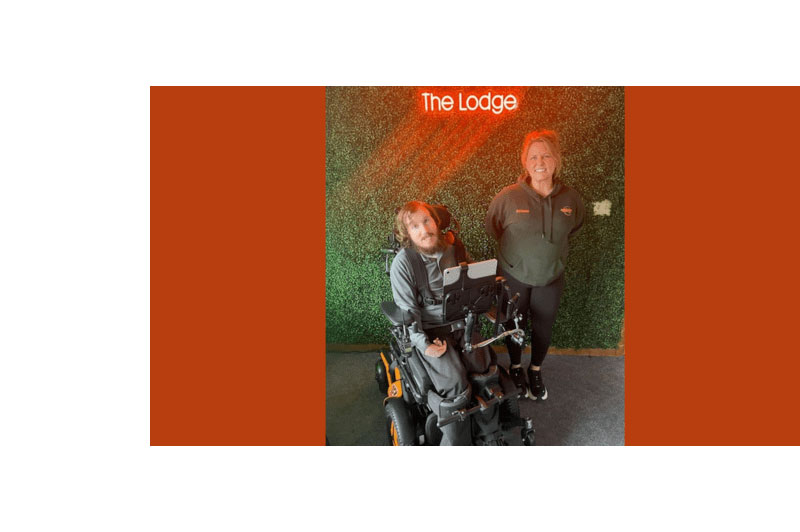
 About the
  About the Butler County Board of Developmental Disabilities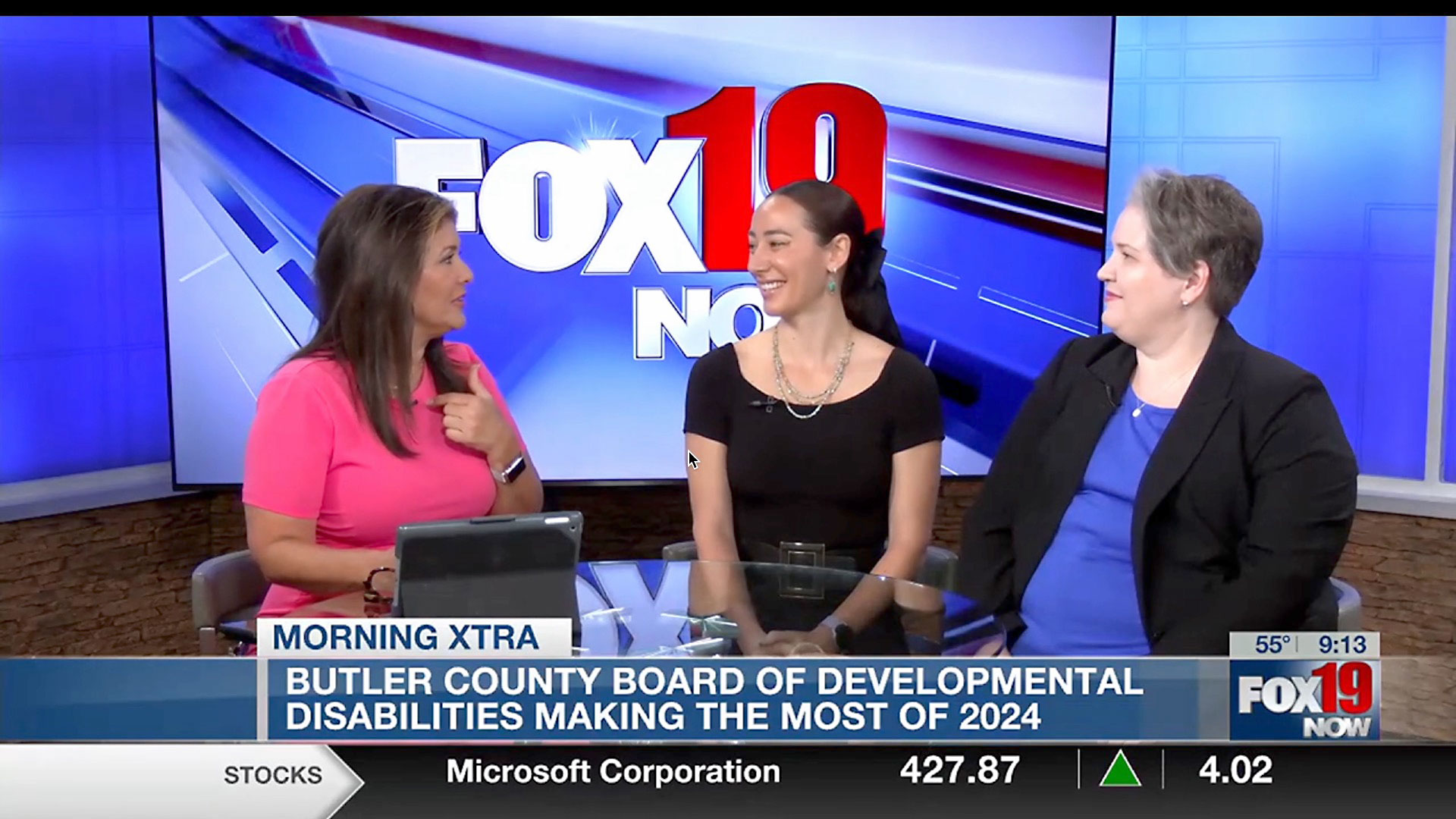
 President and Publisher of Loveland Magazine, Cassie Mattia is a resident of Historic Downtown Loveland and the Public Relations Coordinator at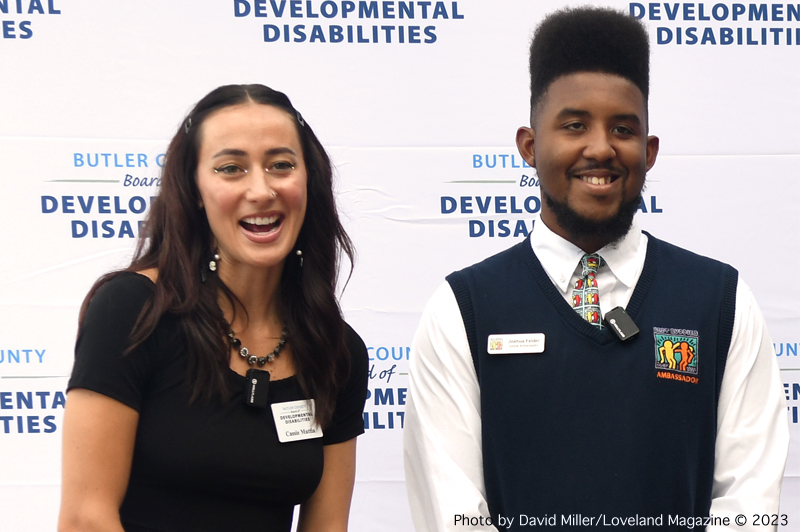
 Best Buddies International