

Tag: bipartisan support

  • What’s next for congressional redistricting

    What’s next for congressional redistricting

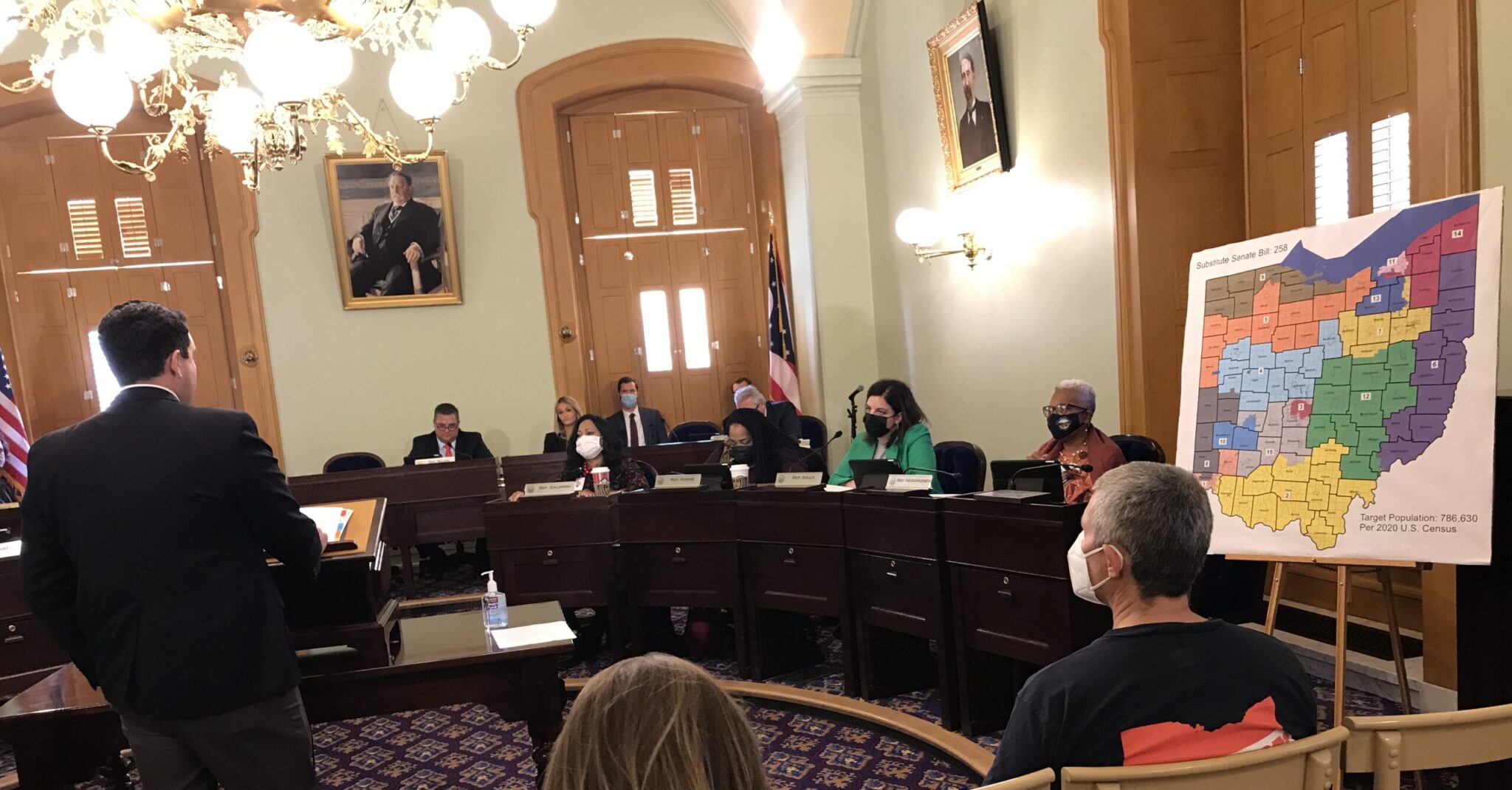
    State Sen. Rob McColley, R-Napoleon, presents congressional redistricting maps to the House Government Oversight Committee on November 17. (Photo: Susan Tebben, OCJ)

    BY: SUSAN TEBBEN –  Ohio Capital Journal

    This week the process begins again of trying to draw congressional districting lines in Ohio.

    The Ohio Supreme Court started its year sending the state legislature back to the drawing board on congressional redistricting, after rejecting the map passed in November by the GOP supermajority.

    With a one-week timeline for the legislature to come up with a plan, committees are convening with that specific purpose.

    Starting Tuesday morning in the Ohio House’s Government Oversight Committee, representatives will hear about House Bill 479, a bill led by state Rep. Scott Oelslager, R-North Canton, which is up for a possible substitution, meaning it could include the new House proposal for congressional districts.

    That bill was the vehicle for the House’s proposal last time around, but it was overtaken by the GOP’s Senate Bill 258, which was quickly adopted by the legislature as the official redistricting plan.

    The same day the House considers its own redistricting effort, the Senate General Government Budget Committee will be looking at Senate Bill 286, state Sen. Rob McColley’s bill for congressional redistricting.

    McColley, R-Napoleon, was the lead on SB 258, the map that would eventually be rejected as unconstitutional by the state’s high court.

    The senate committee accepted testimony on the bill for its first hearing on Tuesday, and a possible vote is indicated for Wednesday’s meeting of the General Government Committee. No testimony or vote is indicated for the House Bill, and the committee is not set to meet again this week.

    If either of the bills pass through committee, it would move on for a full House and/or Senate vote. Both chambers are scheduled to have sessions on Wednesday, with the House set to meet at 1 p.m. and the Senate to meet at 1:30 p.m.

    The House has an “if-needed” session on the calendar for 1 p.m. on Thursday, which could mean the Senate will pass a redistricting plan on Wednesday and send it to the House for agreement on Thursday.

    The legislature has until Feb. 13 to pass a plan. In order for the plan to take effect for 10 years, bipartisan support is needed, which would have to include 33% of Democrats in both the House and Senate. If the legislature can’t get bipartisan support, the map would be in place for four years, pending supreme court approval.

    A new plan from the legislature would have to have an emergency clause attached to it in order to take effect before the May 30 primary. Typically, without an emergency clause, a bill passed by the General Assembly goes into effect 90 days after the governor signs it.

    If the legislature doesn’t bring a plan to a vote by the deadline, the process heads back to the Ohio Redistricting Commission, who would have another 30 days to come up with a plan.

    The ORC just finished revising legislative maps, which were once again invalidated in a Monday ruling by the supreme court.

    The 4-3 decision by the court found the revised maps had similar violations as the original maps, with the court still finding issues with the revised maps in terms of partisan favoritism.

    The ORC now has until February 17 to revise the legislative maps for a third time.

  • Chances for Ohio death penalty repeal appear to be growing

    Chances for Ohio death penalty repeal appear to be growing

    By Marty Schladen and Ohio Capital Journal

    The biggest-ever bipartisan coalition on Thursday announced a renewed effort to repeal the death penalty in Ohio.

    State Sen. Nickie Antonio, D-Lakewood, and Sen. Steve Huffman, R-Tipp City, hosted a virtual press conference to announce that they and three other Republican and four Democratic senators so far have said they will co-sponsor the repeal legislation. The measure also has bipartisan support in the House.

    Antonio has long advocated to end Ohio’s troubled death penalty. But Huffman, a physician, is new to the cause. He explained that he still believed in stiff penalties for “the worst of the worst,” but replacing death sentences with life in prison without the possibility of parole would fulfill that goal.

    “Like so many in Ohio, I once supported capital punishment,” he said. “But through prayer and reflection I’ve come to believe that it is the wrong policy for the state of Ohio. I’ve been heading in this direction for decades. Life is precious.”

    Public opinion has been shifting as well. In 2014, 68% of Ohioans supported the death penalty, but a poll conducted late last year indicated that the number had almost flipped. Now, 60% of Ohioans support a repeal.

    Traditionally a state with a relatively large number of executions, there haven’t been any in Ohio since July 2018. Since he took office in early 2019, Gov. Mike DeWine has stayed all scheduled deaths, first because a federal judge likened the state’s execution method to torture, and then because the makers of the intravenous drugs have refused to supply them.

    More recently, DeWine said lethal injection in Ohio appears to be “impossible from a practical point of view today.”

    Antonio said the practical difficulties, and changing public opinion, make this an opportune time to repeal the death penalty.

    “I think that there’s a shift in the country that we’re also seeing reflected in the state,” she said. “We also have a governor who has put a moratorium on executions right now. There’s more difficulty to — I think it’s an oxymoron — ‘humanely’ execute someone… so there’s all these things.”

    In addition to Antonio and Huffman, Sens. Niraj Antani, R-Miamisburg, and Sandra Williams, D-Cleveland, joined the press conference. Also joining were Reps. Jean Schmidt, R-Loveland, Bride Rose Sweeney, D-Cleveland, Adam Miller, D-Columbus and Kristina Roegner, R-Hudson.

    In the face of the growing momentum, DeWine, a Republican, was asked later in the day if he’d sign a repeal bill in the event that one made it to his desk. He didn’t commit himself, but he seemed open to it.

    “My thinking on the death penalty has certainly evolved,” DeWine said. “But it is the law and as long as the law stays on the books it is something I would expect the General Assembly at some point to take up and I’ll certainly weigh in as they move a bill forward.”

    Antani described how he was a Republican outlier when he signed onto the anti-death penalty cause six years ago, but he was confident more GOP colleagues would join up as they came to see that it was consistent with conservative principles. He said he predicted, “Our party will see that this is a pro-life issue. Our party will see this as (an anti-) big-government issue.”

    Addressing the latter issue, Antani and many others cited the growing number of people who have been sent to death row only to be exonerated.

    Also on Thursday, the Death Penalty Information Center added 11 people to its list of people who have been exonerated after being sent to death row. 

    “The data now show that for every eight people who have been put to death in the U.S. since executions resumed in the 1970s, one person who had been wrongfully convicted and sentenced to death has been exonerated,” the group said in a statement.

    Hannah Kubbins, executive director of Ohioans to Stop Executions, said that in the Buckeye State, the ratio is one exoneration for every five executions.

    Williams noted that in addition to wrongful convictions, the death penalty is disproportionately applied to people of color. Ohio has prohibited using the penalty against people with mental disabilities, but that’s not enough, she said.

    “Instead of piecemealing the state’s policy on the death penalty, we should really end it all,” she said.

    Schmidt said meeting people who were wrongfully sent to death row is what reshaped her thinking.

    “This has been a long journey for me,” she said. “Twenty years ago I served in this very Statehouse as a state legislator and I fought to keep the death penalty, but I evolved.”

    That thinking could be widespread. Antonio said that as she talks about repeal with colleagues of both parties, she’s “gotten very little pushback” and expects to sign up many more sponsors.

    Huffman said it might take time for some of his colleagues, but he expects they’ll get there.

    “I think there’s a lot of people that are continuing to think about it and, especially in the Senate, they know that it’s out there and they know that public opinion is to get rid of it,” he said. “I think that they’re continuing to form their thoughts, but I believe that the majority are leaning toward getting rid of the death penalty.”