Tag: BMV

  • Ohio begins offering mobile ID with Apple, but it can’t be used to vote or during traffic stops

    Ohio begins offering mobile ID with Apple, but it can’t be used to vote or during traffic stops

    (Getty Images)

    Don’t get rid of your physical ID

    By:  Ohio Capital Journal

    Last month, Ohio joined a handful of other states allowing residents to load their Driver’s License or ID card onto an Apple iPhone. It’s a nifty little feature not unlike the phone’s tap-to-pay service, but while the virtual card is handy for getting through TSA checkpoints, in many other circumstances — like voting or a traffic stop — it just won’t cut it.

    Where it does (and doesn’t) work

    In a press release announcing the program, Gov. Mike DeWine bragged “Ohio has always been a leader in innovation, and now we are the fifth state in the country that gives residents the option to securely add their driver’s license to Apple Wallet.”

    “This is another example of how Ohio is using technology to better serve its customers and residents,” he added.

    The Apple wallet version of your ID may have all your information, but it’s not like a photocopy of the card. Instead, the phone shares your information digitally, which means whoever is reading that information will need a specific card reader.

    In an emailed statement, DeWine’s spokesman Dan Tierney explained that’s part of the reason the TSA can move quickly to accept mobile ID while local law enforcement or boards of elections simply can’t.

    “The reason that you are seeing TSA checkpoints announced before other transaction points is the sheer number of terminals involved,” he explained. “An airport will only need a dozen or so, while implementation with polling locations and law enforcement patrols will require the purchase of tens of thousands of terminals or other devices that contain the required hardware and software.”

    In Ohio, TSA checkpoints at Columbus’ John Glenn International Airport and Cincinnati/Northern Kentucky International Airport are ready to accept mobile ID. So far four other states, Arizona, Colorado, Georgia and Maryland, have joined the program. Major airports in Phoenix, Denver, Atlanta and Baltimore are equipped for mobile ID.

    But for the time being, using your mobile ID for something as mundane as picking up a six pack will depend on whether the store you’re visiting has the required reader. To help facilitate that process, Ohio has launched an app that businesses can use to read mobile IDs.

    “I expect that with any technology,” Tierney said, “we will see these tap terminals and reading devices become much less expensive over time, which would allow for wider implementation in much larger systems.”

    Potential confusion?

    In several places on the BMV website the agency warns a mobile ID does not replace your physical card. In a frequently asked questions menu, the BMV insists “you must continue to carry your physical card,” and describes the mobile ID as “a convenient, secure companion” to your traditional card.

    On the other hand, “the fine print” is an expression because people so often don’t read it.

    And that’s a bit concerning for Mia Lewis of Common Cause Ohio.

    “So, I’m just envisioning people uploading it onto their phone and then saying great and leaving their ID at home and then going to vote and finding out that actually that isn’t good enough for voting,” she described.

    She argued just a few years ago Ohioans could vote with a bank statement or a utility bill. Since then, the requirements have tightened substantially, restricting voter identification to an unexpired photo ID. In response, Ohio election officials have seen a sharp uptick in the number of provisional ballots.

    “(Mobile ID) is good enough for the TSA, you can get on a flight, good enough for getting into a bar, but for some reason it’s not good enough for voting,” Lewis said. “But that hasn’t been clearly articulated to people, and I’m just envisioning more and more provisional ballots where people have gone to vote, and they haven’t been able to.”

    The promotional materials from Apple are careful not to overstate its utility. The webpage says “presenting your ID just got much easier” because “there’s no need to reach for your your physical ID.” And while the company emphasizes the convenience of the feature, there’s no bald-faced ‘leave your card at home’ messaging.

    Still, there’s no warning to keep your card handy.

    “You know, it’s promoted as like so convenient,” Lewis said. “Well, if it doesn’t work in all instances, I don’t really see how that’s convenient, because you still have to carry your license for the times that it doesn’t work, and I feel like voting is such an important one.”

    Follow OCJ Reporter Nick Evans on Twitter.


    Nick Evans
    Nick Evans

    Nick Evans has spent the past seven years reporting for NPR member stations in Florida and Ohio. He got his start in Tallahassee, covering issues like redistricting, same sex marriage and medical marijuana. Since arriving in Columbus in 2018, he has covered everything from city council to football. His work on Ohio politics and local policing have been featured numerous times on NPR.

    Ohio Capital Journal is part of States Newsroom, the nation’s largest state-focused nonprofit news organization.

    MORE FROM AUTHOR

  • El Departamento de Seguridad Pública de Ohio anuncia un nuevo programa educativo sobre seguridad vial dirigido a personas que no hablan inglés en Ohio

    El Departamento de Seguridad Pública de Ohio anuncia un nuevo programa educativo sobre seguridad vial dirigido a personas que no hablan inglés en Ohio

    La Oficina de Seguridad Vial de Ohio (OTSO), una división del Departamento de Seguridad Pública de Ohio, anunció hoy que ahora hay nuevos recursos educativos disponibles para diversas comunidades de Ohio para ayudar a los estudiantes del idioma inglés a convertirse en conductores con licencia.

    El plan de estudios y el programa de capacitación de capacitadores tienen como objetivo ayudar a las personas que no hablan inglés a aprender prácticas de conducción segura y prepararse para los exámenes escritos y de conducción en la Oficina de Vehículos Motorizados de Ohio (BMV). Incluye información sobre los requisitos para obtener una licencia de conducir en Ohio, el significado de las señales de tránsito y otras leyes básicas de seguridad vial.

    “Es posible que las personas que no hablan inglés y son nuevas en Ohio no comprendan completamente las reglas de tránsito, lo que aumenta el riesgo de verse involucrados en un accidente”, dijo el director del Departamento de Seguridad Pública de Ohio, Andy Wilson. “Incluso la educación vial más básica ayuda a promover comportamientos seguros en nuestras carreteras, lo que beneficia a todos los conductores de Ohio”.

    ¿Tienes preguntas?
    drivertraining@dps.ohio.gov
    614-466-3524

    Un programa piloto se presentó por primera vez en la Cumbre de Seguridad Vial de Ohio de 2024 de OTSO en Columbus y ahora está listo para lanzarse en todo el estado. La capacitación proporciona información para que los participantes la compartan con estudiantes que aprenden inglés o con adultos que no hablan inglés y que quieran aprender a conducir en Ohio. Las capacitaciones se llevan a cabo en inglés y los participantes traducen el material para compartirlo en sus comunidades.

    “Brindar educación sobre seguridad vial en varios idiomas ayuda a eliminar algunas barreras para los estudiantes de inglés de Ohio e integrarlos a la comunidad”, dijo Emily Davidson, directora ejecutiva de OTSO. “Esperamos que este nuevo programa educativo pueda ayudar a crear un entorno más seguro e inclusivo para todos los residentes”.

    Es importante tener en cuenta que este plan de estudios no reemplaza la educación vial y que quienes lo presentan en comunidades lingüísticas diversas no se consideran instructores de capacitación vial con licencia en el estado de Ohio. Los conductores adolescentes todavía deben completar 24 horas de instrucción en el aula y 8 horas de capacitación al volante en una escuela de capacitación para conductores autorizada. Los conductores adultos que no aprueban el primer intento en el examen de manejo en la BMV deben completar el programa abreviado para adultos, que consta de 4 horas de instrucción en el aula y 4 horas de capacitación detrás del volante con un instructor autorizado o 24 horas de práctica de manejo con un conductor con licencia mayor de 21 años.

    Hay recursos disponibles en el sitio web de OTSO para aquellos interesados ​​en llevar este plan de estudios a su comunidad. El esquema del plan de estudios, las diapositivas de PowerPoint, la guía de recursos y otras ayudas de capacitación están disponibles de forma gratuita para cualquiera que los solicite.

    Este anuncio sigue una serie de iniciativas de OTSO para fortalecer la educación vial, que incluyen casi $2,5 millones en subvenciones para financiar becas de capacitación vial para adolescentes elegibles en 42 condados. A principios de este año, se otorgaron $4.5 millones en financiamiento a través del nuevo  programa de subvenciones Creación de Oportunidades para la Educación Vial (CODE) que apoya la expansión de las opciones de capacitación vial en áreas desatendidas.

  • Ohio Department of Public Safety Announces New Traffic Safety Education Program Aimed at Non-English Speakers in Ohio

    Ohio Department of Public Safety Announces New Traffic Safety Education Program Aimed at Non-English Speakers in Ohio

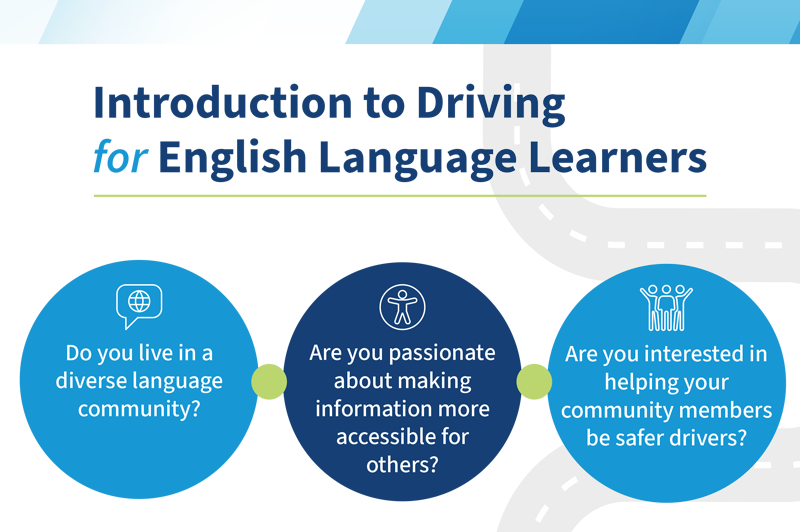
    The Ohio Traffic Safety Office (OTSO), a division of The Ohio Department of Public Safety, announced today new educational resources are now available for diverse communities in Ohio to help English Language Learners become licensed drivers.

    The curriculum and train-the-trainer program is intended to help non-English speakers learn safe driving practices and prepare for the written and driving tests at the Ohio Bureau of Motor Vehicles (BMV). It includes information on the requirements for obtaining a driver license in Ohio, the meanings of traffic signs and signals, and other basic traffic safety laws.

    “Non-English speakers who are new to Ohio may not fully understand the rules of the road, increasing their risk of being involved in a crash,” said Ohio Department of Public Safety Director Andy Wilson. “Even the most basic driver education helps promote safe behaviors on our roads, benefitting all drivers in Ohio.”

    Do you have questions?
    drivertraining@dps.ohio.gov
    614-466-3524

    A pilot program was first introduced at OTSO’s 2024 Ohio Traffic Safety Summit in Columbus and is now ready to be launched statewide. The training provides information for participants to share with English Language Learners or non-English speaking adults that want to learn to drive in Ohio. Trainings are conducted in English, and participants translate the material to share in their communities.

    “Providing traffic safety education in multiple languages helps to remove some barriers for Ohio’s English Language Learners and integrate them into the community,” said Emily Davidson, OTSO executive director. “We hope this new education program can help create a safer and more inclusive environment for all residents.”

    It’s important to note that this curriculum does not replace driver education, and that those who present it in diverse language communities are not considered licensed driver training instructors in the state of Ohio. Teen drivers are still required to complete 24 hours of classroom instruction and 8 hours of behind-the-wheel training at a licensed driver training school. Adult drivers who fail the first attempt at the driving test at the BMV are required to complete the abbreviated adult program – which is 4 hours of classroom instruction and either 4 hours of behind the wheel training with a licensed instructor or 24 hours of driving practice with a licensed driver over the age of 21.

    Resources are available on OTSO’s website for those interested in bringing this curriculum to their community. The curriculum outline, PowerPoint slides, resource guide, and other training aids are available free of charge to anyone that requests them.

    This announcement follows a number of initiatives by OTSO to strengthen driver education, including nearly $2.5 million in grants to fund driver training scholarships to eligible teens in 42 counties. Earlier this year, $4.5 million in funding was awarded through the new Creating Opportunities for Driver Education (CODE) Grant program that supports the expansion of driver training options in underserved areas.

  • ID R Kids for Safety

    ID R Kids for Safety

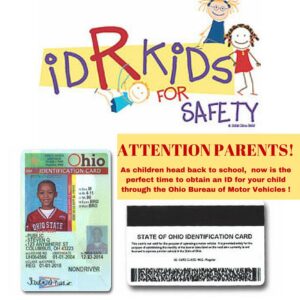
    There is no minimum age for an Ohio ID card. According to the Ohio Bureau of Motor Vehicles, obtaining an ID card for your child has many advantages, including that it may assist police if a child is reported missing. You may apply for an Ohio ID card for your child through the Ohio Bureau of Motor Vehicles.

    You may also apply for an Ohio ID card for your child at any deputy registrar location.

    • Ohio ID cards are used for identification purposes only.
    • Ohio photo ID cards for children may assist police if a child is reported missing.

    What do you need to bring?

    You must provide proof of your child’s:

    • Full legal name
    • Date of birth
    • Social Security number (if ever assigned)
    • Legal presence
    • Ohio residency

    Any child under age 18 must be accompanied by a parent or guardian with an Ohio driver license or ID card. If the parent or guardian does not have an Ohio driver license or ID card, then they must also provide proof of:

    • Full legal name
    • Date of birth
    • Social Security number (if assigned)
    • Legal presence
    • Ohio residency

    Go to our Acceptable Documents page for a full list of identity documents and links to use our interactive process to assist you with what to bring to a deputy registrar agency.

    How much does an Ohio ID cost?

    $10.00

    The bureau says, “Don’t forget to include a listing for your child’s Next of Kin in connection with his or her state ID. It will help police get in touch with parents or guardians.”
  • Ohio BMV will refund disabled veterans after incorrectly charging for license plates

    Ohio BMV will refund disabled veterans after incorrectly charging for license plates

    [vc_row][vc_column][vc_column_text]

    Photo from Wikimedia Commons by “Mister Upstate.”

    BY: Ohio Capital Journal

    The Ohio Bureau of Motor Vehicles will issue refunds to nearly 2,000 disabled veterans who were wrongly charged for specialty license plates.

    The BMV recently realized it did not implement a change in Ohio law that went into effect in October 2019 that allows certain disabled veterans to receive up to two free disabled veteran license plates/military license plates, the BMV said in a release Thursday.

    The average refund will be $60, although the exact amount of each refund will vary based on local fees and taxes.

    “The BMV deeply regrets this error,” Charlie Norman, Ohio BMV Registrar, said in a news release. “We are undertaking an internal review to determine why the legislative change wasn’t adopted in a timely manner to ensure that this will not happen in the future.”

    The BMV will be contacting all veterans who were improperly charged and refunds will be processed within the next month. The BMV is implementing a “processing change” so veterans who qualify for free disabled and military license plates are not charged in the future.

    The law applied to veterans with a service-connected disability who are declared 100% disabled by the U.S. Department of Veterans Affairs, and does not apply to personalized specialty disabled/military license plates.

    Follow OCJ Reporter Megan Henry on Twitter.

    Megan Henry
    MEGAN HENRY

    Megan is a reporter for the Ohio Capital Journal.

    MORE FROM AUTHOR

    [/vc_column_text][/vc_column][/vc_row]

  • Expiration date for driver licenses, identification cards, and vehicle registrations extended until July 1

    Expiration date for driver licenses, identification cards, and vehicle registrations extended until July 1

    Loveland, Ohio – Due to the ongoing pandemic, Ohio Governor Mike DeWine has signed Ohio House Bill 404, which extends the expiration date of driver licenses (DL), identification cards (ID), and vehicle registrations beyond December 1, 2020.

    Now, if a customer’s expiration date on their DL, ID, or vehicle registration is March 9, 2020, to April 1, 2021, the expiration date has been automatically extended and will remain valid until July 1, 2021.

    Many of the services Lovelanders rely on at the Ohio Bureau of Motor Vehicles (BMV) can be accomplished online at www.OPlates.com. If customers need to purchase a temporary tag for their car, renew their vehicle registration, order new license plates, check their driving record, or another service, they can take care of it online from the comfort and safety of their home.

    If a customer must visit a location, they are strongly encouraged to use the “Get in Line, Online” virtual queuing system. This system allows customers to virtually get in line before arriving at the BMV, thereby minimizing the amount of time physically spent at the agency and keeping customers safe.

    Note: 

    “You may be required to wear a face covering in accordance with local and/or state mandates when visiting a deputy registrar or driver examination location. Please bring a face covering with you to ensure you can obtain the services you need.”

    DRIVER EXAMINATION STATION SKILLS TESTING RESUMES

    To schedule your driving skills test, call 877-439-8378 or schedule via the Live Chat feature. Be advised BMV anticipates heavy call volume for scheduling.

    ALL DX locations still offer the maneuverability test, with only some of those locations offering both maneuverability and the modified in-car testing. Be advised that the person taking the skills test must be accompanied by an adult licensed driver in the passenger seat for the entirety of the skills test, but that no additional passengers may be in the vehicle during the test. The following driver examination stations have resumed skills testing by appointment only:

  • Driver examination station skills testing will resume June 12

    Driver examination station skills testing will resume June 12

    COLUMBUS Ohio -The Ohio Bureau of Motor Vehicles (BMV) announced yesterday that driver examination station skills testing will resume June 12 at the following locations, by appointment only:

    • 8210 County Rd. 140, Suite C, Findlay, Ohio 45840 (Hancock County)
    • 22133 Rockside Road, Bedford, Ohio 44146 (Cuyahoga County)
    • 990 Morse Road, Suite B, Columbus, Ohio 43229 (Franklin County)
    • 873 East Main Street, Newark, Ohio  43055 (Licking County)
    • 502 McCarty Lane, Suite 3, Jackson, Ohio 45640 (Jackson County)
    • 10940 Hamilton Ave, Cincinnati, OH 45231 (Hamilton County)

    Additional driver examination stations will resume skills testing starting on June 16 by appointment. The BMV is making efforts to contact those individuals who may have had their test canceled during COVID19 to reschedule on a priority basis. Once those tests are rescheduled, then appointments will be available for all other customers. Customers should call to ensure their location is open.  Appointments will be able to be made online.

    Class D skills testing will use a modified process that allows the driver examiner to score the prospective licensee from outside the car in accordance with the Ohio Department of Health and Center for Disease Control recommended health and safety guidelines.

    The BMV will reach out to individuals who had a test cancelled due to COVID-19 to provide an opportunity for priority-based scheduling.


    As a reminder

    If a customer’s license, identification card, vehicle registration, or temporary permit expired on or after the state of emergency’s effective date of March 9, 2020, its expiration date has been automatically extended and will remain valid until 90 days after the state of emergency ends, or December 1, 2020, whichever date comes first.

    Many of the services Ohioans rely on at the BMV can be accomplished online at www.OPlates.com. If customers need to purchase a temporary tag for their car, renew their vehicle registration, order new license plates, check their driving record, and many other services, they can complete the transaction online.

    Since reopening on May 26, 2020 BMV transactions are up approximately 8% from 2019 during that same time frame.   The BMV encourages customers who absolutely must visit a deputy registrar to take advantage of “Get In Line, Online,” which allows customers to virtually get in line before arriving.

    Visit www.bmv.ohio.gov for more information.


  • BMV locations in Ohio will be permitted to reopen May 26

    BMV locations in Ohio will be permitted to reopen May 26

    Loveland, Ohio – Beginning Tuesday, May 26, Ohio Bureau of Motor Vehicles (BMV) locations in Ohio will be permitted to reopen for certain services if these facilities can meet required safety protocols.

    BMV says that services that can be accomplished online should still be done online. More details on online BMV services can be found at oplates.com.

    The BMV is currently experiencing a high volume of orders and processing times are longer than usual according to a disclaimer on their web portal. “Temporary tag processing times may be longer than 10 business days.”

    Due to HB 197, all temporary tags that are about to expire or are expired are still valid for 90 days after the expiration. It is not necessary to purchase a new temporary tag.

    The BMV is creating a detailed list of guidelines and best practices for deputy registrars to follow.  A full list of mandatory and recommended best practices will be available soon at coronavirus.ohio.gov.


  • [Fee Amnesty] Driver license reinstatement fee reduction

    [Fee Amnesty] Driver license reinstatement fee reduction

    Columbus, Ohio —House Bill 336, the Reinstatement Fee Amnesty Initiative, creates a six-month program for driver license reinstatement fee reduction and waiver for offenders whose driver licenses have been suspended for specific violations. The initiative only applies to a driver license or permit suspension; it does not apply to a commercial driver license or commercial permit suspension.

    The Ohio Bureau of Motor Vehicles (BMV) will determine an applicant’s eligibility based on the defined permissible qualifying offenses contained in Ohio Revised Code.

    In order to be eligible for reinstatement fee reduction:

    • Applicants must have completed all court-ordered sanctions related to the eligible offense other than the payment of reinstatement fees.
    • At least 18 months must have passed since the end of the period of the suspension ordered by the court. Those able to provide proof of indigence will qualify for a complete amnesty of reinstatement fees.
    • Effective January 31, 2019, to apply, complete BMV form 2829, a BMV Reinstatement Fee Amnesty Application. You may obtain the form at your local Deputy Registrar, online at www.bmv.ohio.govor it can be mailed to you by calling 614-752-7500.
    • As stated in HB336, “indigent” means a person who is a participant in the supplemental nutrition assistance program administered by the department of job and family services pursuant to section 5101.54 of the Revised Code.

      Welcome to All About Kids We invite you to come visit one of our convenient locations, talk to our staff and teachers and learn why…