Tag: board of education

  • Ellen Mershon addressed the Board regarding the failed levy

    Ellen Mershon addressed the Board regarding the failed levy

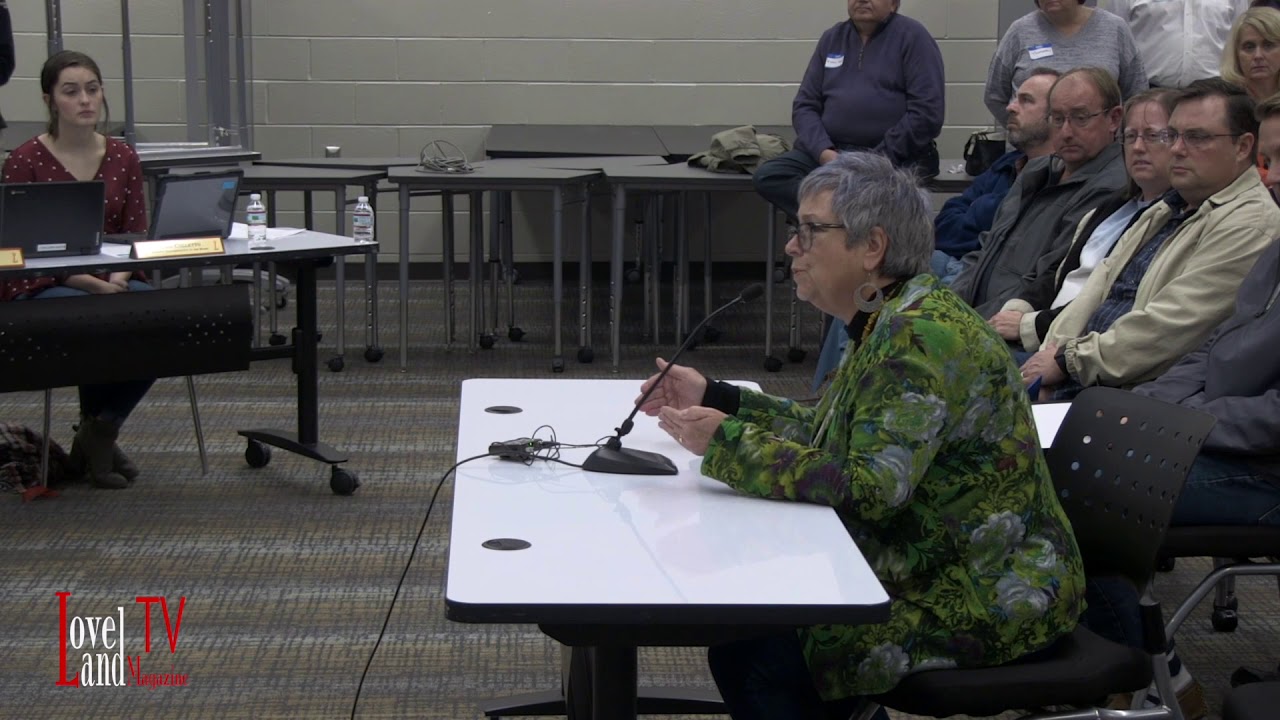
    Loveland, Ohio – On November 19, before a packed, stand on the furniture in the back for a better view, house, Ellen Mershon took to the open forum microphone to express views on the recently failed levy that was on the November 5 ballot. The Board asked voters to approve issuing bonds for $118,515,000 and a combined operating and bond levy of 16.78-mill. The levy was rejected by voters 78-22 per-cent.

    The Board is currently considering placing another levy on the ballot in March of 2020. They say they will need to submit ballot language for a potential operating levy on the March ballot no later than December 18, requiring a first resolution to be passed at the December 10 board meeting.

    Mershon’s comments were during the regular business meeting of the Board where residents are allowed to sit in front of a microphone for 3 minutes to talk to the Board, the Administration, and the other audience members about anything relating to the operation of the District.

    There was another meeting that night following the business meeting. It was facilitated by Jeffrey Stec, the Director of Citizens for Civic Renewal. The District hired Citizens for Civic Renewal to conduct this public meeting.

    The District has published a PowerPoint presentation, notes by the facilitator, and comments received in writing from community members at the 2nd meeting. An unedited Board video from the input session can be found here.

    Te next meeting of the Board will be on November 26 at 6 PM in the LMS/LIS Media Center. (View the Agenda) Among agenda items is a “Recommended Action” by the Superintendent to cancel the contract with Allerton Hill Consulting. Another item is a resolution put forth by the Treasurer to participate in Ohio Open Checkbook. The Board is also expected to appoint an Ad Hoc, Short Term Advisory Committee. You can read the proposal below.*
    Other Meetings:
    • Tuesday, December 3, 6 PM (special meeting)
    • Tuesday, December 10, 6 PM (work session)
    • Tuesday, December 17, 6 PM (special meeting)


    *Ad Hoc, Short Term Advisory Committee

    This ad hoc advisory committee has been established for the purpose of helping the Board of Education to determine whether a March ballot issue is feasible or not.  The committee will work with the Board while the meeting is in session which will allow for interaction between committee members and board members.

    On 11/26, the committee will be invited to join the meeting after the board has concluded regular business outlined on the agenda.   On 12/3, the full board meeting time will likely be given to the work of the committee.

    Should the work result in a determination that a March ballot language is feasible, we must meet election timelines.  The determination of millage for a ballot issue in March 2020 must be approved in a formal resolution of necessity by the Board of Education on 12/10/19. Seven days later (12/17) the Board must approve a resolution to proceed.  The resolutions must be given to the Board of Elections by 12/18/19.

    Should the work result in a determination that March is not feasible, the Board and community will focus on a November 2020 operating levy.

    Following the 12/3/19 meeting, this committee will be dissolved having served its intended objective.  However, should the format be successful we will develop a system to continue the work and identify a way to give more people an opportunity to participate if they wish.

    ————————————–
  • Janet Lane addressed the Board regarding the failed levy

    Janet Lane addressed the Board regarding the failed levy

    Loveland, Ohio – On November 19, before a packed, stand on the furniture in the back for a better view, house, Janet Lane took to the open forum microphone to express views on the recently failed levy that was on the November 5 ballot. The Board asked voters to approve issuing bonds for $118,515,000 and a combined operating and bond levy of 16.78-mill. The levy was rejected by voters 78-22 per-cent.

    The Board is currently considering placing another levy on the ballot in March of 2020. They say they will need to submit ballot language for a potential operating levy on the March ballot no later than December 18, requiring a first resolution to be passed at the December 10 board meeting.

    Lane’s comments were during the regular business meeting of the Board where residents are allowed to sit in front of a microphone for 3 minutes to talk to the Board, the Administration, and the other audience members about anything relating to the operation of the District.

    There was another meeting that night following the business meeting. It was facilitated by Jeffrey Stec, the Director of Citizens for Civic Renewal. The District hired Citizens for Civic Renewal to conduct this public meeting.

    The District has published a PowerPoint presentation, notes by the facilitator, and comments received in writing from community members at the 2nd meeting. An unedited Board video from the input session can be found here.

    Te next meeting of the Board will be on November 26 at 6 PM in the LMS/LIS Media Center. (View the Agenda) Among agenda items is a “Recommended Action” by the Superintendent to cancel the contract with Allerton Hill Consulting. Another item is a resolution put forth by the Treasurer to participate in Ohio Open Checkbook. The Board is also expected to appoint an Ad Hoc, Short Term Advisory Committee. You can read the proposal below.*
    Other Meetings:
    • Tuesday, December 3, 6 PM (special meeting)
    • Tuesday, December 10, 6 PM (work session)
    • Tuesday, December 17, 6 PM (special meeting)


    *Ad Hoc, Short Term Advisory Committee

    This ad hoc advisory committee has been established for the purpose of helping the Board of Education to determine whether a March ballot issue is feasible or not.  The committee will work with the Board while the meeting is in session which will allow for interaction between committee members and board members.

    On 11/26, the committee will be invited to join the meeting after the board has concluded regular business outlined on the agenda.   On 12/3, the full board meeting time will likely be given to the work of the committee.

    Should the work result in a determination that a March ballot language is feasible, we must meet election timelines.  The determination of millage for a ballot issue in March 2020 must be approved in a formal resolution of necessity by the Board of Education on 12/10/19. Seven days later (12/17) the Board must approve a resolution to proceed.  The resolutions must be given to the Board of Elections by 12/18/19.

    Should the work result in a determination that March is not feasible, the Board and community will focus on a November 2020 operating levy.

    Following the 12/3/19 meeting, this committee will be dissolved having served its intended objective.  However, should the format be successful we will develop a system to continue the work and identify a way to give more people an opportunity to participate if they wish.

    ————————————–

  • Dale Friemoth addresses Board of Education about failed levy

    Dale Friemoth addresses Board of Education about failed levy

    Loveland, Ohio – On November 19, before a packed, stand on the furniture in the back for a better view, house, Dale Friemoth took to the open forum microphone to express views on the recently failed levy that was on the November 5 ballot. The Board asked voters to approve issuing bonds for $118,515,000 and a combined operating and bond levy of 16.78-mill. The levy was rejected by voters 78-22 per-cent.

    The Board is currently considering placing another levy on the ballot in March of 2020. They say they will need to submit ballot language for a potential operating levy on the March ballot no later than December 18, requiring a first resolution to be passed at the December 10 board meeting.

    Friemoth’s comments were during the regular business meeting of the Board where residents are allowed to sit in front of a microphone for 3 minutes to talk to the Board, the Administration, and the other audience members about anything relating to the operation of the District.

    There was another meeting that night following the business meeting. It was facilitated by Jeffrey Stec, the Director of Citizens for Civic Renewal. The District hired Citizens for Civic Renewal to conduct this public meeting.

    The District has published a PowerPoint presentation, notes by the facilitator, and comments received in writing from community members at the 2nd meeting. An unedited Board video from the input session can be found here.

    Te next meeting of the Board will be on November 26 at 6 PM in the LMS/LIS Media Center. (View the Agenda) Among agenda items is a “Recommended Action” by the Superintendent to cancel the contract with Allerton Hill Consulting. Another item is a resolution put forth by the Treasurer to participate in Ohio Open Checkbook. The Board is also expected to appoint an Ad Hoc, Short Term Advisory Committee. You can read the proposal below.*
    Other Meetings:
    • Tuesday, December 3, 6 PM (special meeting)
    • Tuesday, December 10, 6 PM (work session)
    • Tuesday, December 17, 6 PM (special meeting)


    *Ad Hoc, Short Term Advisory Committee

    This ad hoc advisory committee has been established for the purpose of helping the Board of Education to determine whether a March ballot issue is feasible or not.  The committee will work with the Board while the meeting is in session which will allow for interaction between committee members and board members.

    On 11/26, the committee will be invited to join the meeting after the board has concluded regular business outlined on the agenda.   On 12/3, the full board meeting time will likely be given to the work of the committee.

    Should the work result in a determination that a March ballot language is feasible, we must meet election timelines.  The determination of millage for a ballot issue in March 2020 must be approved in a formal resolution of necessity by the Board of Education on 12/10/19. Seven days later (12/17) the Board must approve a resolution to proceed.  The resolutions must be given to the Board of Elections by 12/18/19.

    Should the work result in a determination that March is not feasible, the Board and community will focus on a November 2020 operating levy.

    Following the 12/3/19 meeting, this committee will be dissolved having served its intended objective.  However, should the format be successful we will develop a system to continue the work and identify a way to give more people an opportunity to participate if they wish.

    ————————————–

  • Telling us that our children are not safe was the straw that broke the camel’s back for me

    Telling us that our children are not safe was the straw that broke the camel’s back for me

    Not only did Allerton Hill’s tactics divide this community with the “stick to the message at all costs” and scare tactics, but telling us that our children are not safe was the straw that broke the camel’s back for me.

    by Anna Bunker

    You have awakened our sleepy little community to the fact that we can no longer trust the judgment of the Loveland Board of Education to represent our community in matters relating to the Loveland City School District. When you were elected, we gave you our trust to act in the best interest of our community and a few weeks ago the polls stated you have have not.

    This is the outline of Anna Bunker’s speech to the Board of Education during the Hearing of the Public portion of the meeting on November 19

    As a group, you have lost my trust in your ability to recognize what the community needs. We shouldn’t need to be sold the idea of 3 new buildings, 110 acres of land, security upgrades, etc… If the Superintendent and Board of Education spent the same amount of time educating the community before they voted on adopting the plan as they did to promote it during the election, I think we would be having a much different conversation today.

    The fact is you knew this was a big ask and tried to hide the overall costs in the fine print. You conducted a survey before you voted on putting this on the ballot and the survey told you that 90% of the people surveyed had no or little idea about the Building Tiger Nation plan. In that same survey, you were told that 50% of the people believed Loveland already had high taxes.

    And even with this information, you approved the plan and put it on the ballot anyway.

    Speaking of communications, the fact that you felt the need to hire Allerton Hill with a price tag of $133,000 to sell this levy to the community has to be one of the biggest mistakes you made. This is not Washington DC or New York City, this is Loveland, Ohio, a caring and trusting community that takes care of one another.

    Not only did Allerton Hill’s tactics divide this community with the “stick to the message at all costs” and scare tactics, but telling us that our children are not safe was the straw that broke the camel’s back for me.

    This was just a scare tactic because the truth is our Tiger community is safe.

    How dare you tell our community and surrounding communities that our schools are not safe!

    Are there improvements that can be made, of course.

    Are there changes you would like to implement, of course.

    But our schools are safe.

    This was just a scare tactic because the truth is our Tiger community is safe. We have amazing administrators, teachers, staff, and safety officers that in an emergency will do their best to keep our children safe. There will always be some new theory or strategy on school safety, but it doesn’t mean our kids are not safe.

    I believe you are all good people acting with good intentions. But I also believe somewhere along the road things went sideways and you may have forgotten why you initially ran for this position.

    Fool me once, shame you, Fool me twice, shame on me.

    What am I going to do? I am going to keep our Political Action Committee up and running to ensure two things:

    1) A seat on the Board of Education will never be unopposed again.

    2) I will do my best to keep myself informed and continue to keep the Loveland community informed, so they are never blindsided again.

    You have not only lost my trust in your ability to represent our community’s needs, but you have also lost my vote.


  • Superintendent asks for more frequent, direct feedback

    Superintendent asks for more frequent, direct feedback

    by Dr. Amy Crouse

    After reflecting on the election results of last week, it is clear that the district needs more frequent, direct feedback and engagement from the Loveland Schools community, including parents, residents, and staff. Our Board of Education, along with the school administration, is taking the results of the failed combined levy very seriously and is asking for your guidance in determining the next steps to ensure we continue to support our goal of providing the best education for Loveland children.

    On Tuesday, November 19, we invite you to join us for a brief Board of Education business meeting and a community input/listening session that will follow. We want to hear from you, and need your honest and direct feedback.

    It is my sincere hope that we – together – will find ways to move forward for the benefit of our community as a whole.

    Dr. Amy Crouse is the Superintendent of the Loveland City School District


  • Restoring Trust: Recommendations for the Loveland Board of Education

    Restoring Trust: Recommendations for the Loveland Board of Education

    By Kim and Rick Donaldson

    A large portion of the Loveland community has lost faith in the Loveland board of education and school administration. This is clear from the decisive 78% to 22% defeat of the school levy and bond issue on November 5th. Further evidence is provided by the fact that the two board members running for reelection each garnered only around 50% of the vote while running unopposed, meaning that half of those who voted chose to vote for neither of them. Before putting another levy on the ballot, the board needs to take substantive actions to regain the community’s trust.

    Before putting another levy on the ballot, the board needs to take substantive actions to regain the community’s trust.

    Others in the community have recommended three actions: terminate the land purchase contract with the Grail, terminate the Allerton Hill consulting contract and implement Ohio’s open checkbook. All three are excellent ideas and we support them wholeheartedly. These three actions would demonstrate that the board is responding to the electorate and that they are committed to communicating openly, honestly and with full financial transparency. In addition, the board needs to demonstrate a commitment to providing strong, fiscally responsible governance in the future.

    We, therefore, recommend two additional actions

    The first is to implement an annual budgeting process that starts with a strict cost cap tied to taxpayers’ ability to pay. A relatively simple way to do this would be to limit the total expenditure per student, including both operating and non-operating expenditures, to a fixed percentage of the median income in the district. We recommend a limit of 20%, which according to the Ohio Department of Education data corresponds to 2013 levels, before the ramp-up that occurred over subsequent years. This would serve to ensure that school taxes do not continue to consume an ever-increasing portion of household income and restrict tax levies to levels more acceptable to voters.

    Because of its focus on cost versus benefit, this method forces much better prioritization and decision making than the typical method.

    The second action is to use a zero-based budgeting approach to allocate money within the budget cap. This is a standard budgeting method in which the budget allotted to each expense category starts at a base level of zero and moves up from that level only to the extent that is justified by its benefit. Because of its focus on cost versus benefit, this method forces much better prioritization and decision making than the typical method wherein each expense is assumed to start at the prior year’s level plus a standard annual increase. In this context, benefits would need to be defined as proven, quantifiable impacts on academic performance in order to ensure we deliver the best education our community can afford for our children.

    Taking these actions now would go a long way toward convincing the community that the Loveland board of education is actively supervising school administrators, ensuring sound management of the school system and advancing the interests of the entire community.

    After all, that is what we elected them for?

    Kim and Rick Donaldson live in the Grailville neighborhood of Miami Township


  • Residents invited to attend  input session at the November 19 Board of Education meeting

    Residents invited to attend input session at the November 19 Board of Education meeting

    Loveland, Ohio – The Loveland Board of Education will meet for a regularly scheduled business meeting on Tuesday, November 19 at 6 PM, which will include a hearing of the public. Immediately following the meeting, the board will host an opportunity for dialogue between the community, the board, and the administration.

    The board will need to submit ballot language for a potential operating levy on the March ballot no later than December 18, requiring a first resolution to be passed at the December 10 board meeting.

    “We welcome input from our residents on how to gain community support for the school district to meet its financial needs going forward,” said Art Jarvis, board president. “Based on the results of the recent election, we are not able to pursue a comprehensive approach to the facilities issues as proposed in our master plan at this time. We must, however, continue to serve our Loveland students with a quality education. An analysis of the district expenses will be made over the coming weeks and we are asking our residents to provide input on what they are willing to support in terms of educational programs and services.”

    The board will need to submit ballot language for a potential operating levy on the March ballot no later than December 18, requiring a first resolution to be passed at the December 10 board meeting. In order to prepare, the board has added three meetings to its regular meeting schedule and may supplement with additional opportunities for the community to provide input in the process.


    Loveland Board of Education adds several meetings to schedule

    Read on…


    The Board of Education’s full meeting schedule can be found here. Meetings start at 6 PM and are held in the LMS/LIS Media Center on 757 South Lebanon Road.


  • Polling locations, voting hours, Election Guide

    Polling locations, voting hours, Election Guide

    VOTE TOMORROW, NOVEMBER 5!

    VOTING HOURS:
    6:30 AM – 7:30 PM
    FIND YOUR POLLING LOCATION:
    In Hamilton County enter your address HERE
    In Clermont County follow this LINK
    In Warren County follow this LINK

    Read our guide to candidates and issues


  • Kim and Rick Donaldson suggest: “Quality Schools Loveland can Afford”

    Kim and Rick Donaldson suggest: “Quality Schools Loveland can Afford”

    Kim and Rick Donaldson live on Paxton Road in Miami Township

    By Kim and Rick Donaldson

    As a community, we support the goal of providing high-quality education for our children. But we also need to consider affordability.  Loveland is largely a residential community whose local tax burden falls primarily on individual homeowners who are somewhat less affluent than those in surrounding districts. Whereas a one mil property tax raises about $228 per student in Mariemont, $249 in Madeira, $339 in Sycamore and $607 in Indian Hill, it raises only about $191 per student in Loveland. Consequently, we need to recognize that our school budgets are necessarily more limited, and just as a family with a limited budget must prioritize needs and manage money wisely, so must the school district. The proposed building master plan does not, in our opinion, adequately address these budget constraints.

    We wonder what other cost reduction opportunities we might find were we provided with a more detailed plan.

    In the board of education’s January 23rdcommunity meeting presentation, there is a single slide showing a $65M baseline plan for repairs at all existing building sites, which was rejected because it “does NOT address any of the core identified needs that were discovered during the assessment process.” After evaluating multiple options for addressing these “needs”, the board settled on a $165M plan and a $7.7M land purchase, i.e. $108M more than the baseline plan. From the very high-level cost breakdown subsequently provided by the administration, we can see that the plan includes $10M for athletic facility upgrades and $22.6M for a new fine arts building. That’s 30% of the incremental cost over the baseline plan going toward enrichment programs affecting a subset of the students, not to fundamental academic programs affecting the entire student body. We wonder what other cost reduction opportunities we might find were we provided with a more detailed plan.

    To arrive at a more cost-effective solution, we need to start again from the beginning with clear priorities regarding what is needed, as opposed to what is wanted.

    To arrive at a more cost-effective solution, we need to start again from the beginning with clear priorities regarding what is needed, as opposed to what is wanted. Building safety and security come first, followed by those facility improvements that have a proven impact on academic achievement. Increasing classroom space to enable reducing the student to teacher ratio might fall into the latter category. We then need to develop facility concepts that satisfy these needs in a manner that minimizes both construction and future operational costs. For example, the current facility master plan envisions three separate buildings for pre-K through 5thgrade. Combining these into a single building would reduce construction costs, reduce heating and cooling costs and maximize the opportunity for sharing resources and occasional use spaces like cafeterias, gymnasiums, and auditoriums. A two- or three-story building would also provide the opportunity to use an existing site, eliminating the cost of land purchase and development.

    These are just a few ideas meant to illustrate the point. Given the right set of objectives and constraints, the district’s architectural consultants would undoubtedly come up with more and better ideas. But the first step toward developing a school facility plan that strikes a reasonable balance between the educational needs of our children and the financial limitations of the community is to vote against the Loveland school levy and bond issue on November 5th.

    Reference

    January 23, 2019 Community Meeting Presentation:  https://secureservercdn.net/50.62.175.49/f0o.a87.myftpupload.com/wp-content/uploads/2019/01/CM3-01.23.19-Slide-Deck.pdf


  • Tigers Helping Tigers Launches

    Tigers Helping Tigers Launches

    by Cati O’Keefe

    The prospect of higher property taxes brought on by the proposed Loveland school levy has spawned Tigers Helping Tigers, a charitable foundation formed to help those with limited resources pay their tax bills.

    Cati O’Keefe is a resident of Downtown Loveland

    The foundation was conceived by Art and Kim Jarvis. Art Jarvis is the president of the School Board, which proposed the ambitious new building master plan for the school system. “My job on the Board of Education is to make sure kids get the education they need to excel in the future. And that’s the purpose of the levy,” he says.

    That’s his board member perspective. At home with his wife, however, he found their conversations frequently turning to the impact the financial ask could have on those with limited resources. “The community member Art Jarvis was bothered with the thought that the levy could cause fixed-income neighbors to suffer,” he says.

    The Jarvises reached out to friends in the community, started sharing ideas, and Tigers Helping Tigers was born. Jarvis and the fledgling board (currently Kim Jarvis and Loveland residents Deb Ricci and Katherine Dannemiller) sat down with Greg Knake, executive director of The Care Center, and detailed their plan to raise $80,000-$100,000 to launch the new foundation.

    Knake was on board immediately, framing the issue as a problem that needed to be addressed long before the current levy. “We’ve seen poverty grow 100% locally from 2005-2015 in Loveland,” he says. “Approximately 15% of kids in Loveland are on free and reduced lunch. This is an eight times faster increase than in urban areas.”

    W​e’ve seen poverty grow 100% locally from 2005-2015 in Loveland. Approximately 15% of kids in Loveland are on free and reduced lunch.

    Knake believes the proposed tax relief adds another spoke in The Care Center’s service wheel. “We are trying to bring help and resources to families teetering on the edge, and do it in a targeted way by getting people back to work or into a better job, giving them life skills, and breaking the cycle of poverty with one-on-one coaching and mentoring,” he explains.

    The Care Center, which Knake describes as a faith-based organization, is collocated with the non-denominational North Star Church on Lebanon Road. The center is in the midst of a fund-raising endeavor itself, with a new facility slated for completion October 2020. “Our strategy employs best-practice research that has started organizations locally, like CityLink and the Healing Center, and is focused on bringing resources together under one roof,” he says.

    Knake highlights the synergy between Tigers Helping Tigers and The Care Center: “ We already have relationships with many of the families who would qualify for assistance from the foundation,” he says. “We have the forms and processes in place needed to prequalify families–plus financial coaches and mentors–because hopefully this isn’t just a little bit of help on taxes but is also integrated with financial coaching to get them to an even better place in all parts of their lives.” (While The Care Center encourages people to discover and use its services, participation in the program is not a prerequisite for assistance through Tigers Helping Tigers.)

    Tigers Helping Tigers board members are equally pleased with how the two organizations dovetail.

    While The Care Center encourages people to discover and use its services, participation in the program is not a prerequisite for assistance through Tigers Helping Tigers.

    “I am passionate about The Care Center’s impact on our community, and Tigers Helping Tigers is just another piece in assisting the marginalized, says Ricci. “The Care Center embodies the culture of our community, which generously gives back to those in need. The work of the Care Center team has helped so many cross the bridge of poverty to thriving in life. Having a strong education system is vital to our youth in reaching their greatest potential. This paired with the resources of The Care Center represents a community I am proud to be a part of.”

    Dannemiller, who also serves on the fund-raising executive team for Nest Community Learning Center, believes the partnership will pay dividends for the Loveland community. “We have put six kids through the Loveland school system and stayed for the quality of the schools,” she says. “The levy is a hardship, but bridging the gap for people on limited incomes through the Care Center is a natural fit. The organization takes care of people who need help and creates a continuous path for them to get on their feet. Combining our program with theirs will extend help to people in a way that is impactful.”

    At the end of the day, it is immaterial whether the current levy passes, fails, or gets kicked down the road to return in another iteration. Real need exists now.

    The process of pondering cost versus value on the levy has, for many citizens, served as a reminder that levies–even modest ones–threaten the fragile existence of some community members and families. At the end of the day, it is immaterial whether the current levy passes, fails, or gets kicked down the road to return in another iteration. Real need exists now. Please consider donating to Tigers Helping Tigers and The Care Center. Inquiries regarding donations, receiving services, or volunteering can be made through Greg Knake at greg@carecenter.com or Art Jarvis at jarvisa@fuse.net .