This balancing act is further compounded by the fact that Greeson is a breastfeeding mother assigned to an Army Reserve Ready Force X unit.
Story by Sgt. 1st Class Debra Richardson
319th Mobile Public Affairs Detachment
 FORT McCOY, Wis.—As the sun sets, darkness engulfs the twelve rows of Army green tents until they are no longer visible. A group of female Soldiers meander from afar, their steps confident but slow until they make a sharp right to enter tent 71, their home for the past three weeks. As bulky Kevlar helmets are removed and dirty boots are tossed aside, the Soldiers reach for their cellphones, calling to one another to sit on their bunks and admire photos of their young children blowing kisses, leaving for school, and playing with their toys.
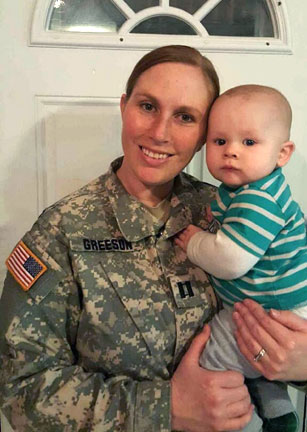
For Capt. Korinn Greeson, a Goshen, Ohio native and medical service officer assigned to the 256th Combat Support Hospital, this camaraderie, although helpful, hammers home the reality that she and her comrades are preparing to deploy.
“This is the call of duty,” Greeson explains, grimacing as she reminisces about her first time in the field as a breastfeeding mom.”
“This is the call of duty,” Greeson explains, grimacing as she reminisces about her first time in the field as a breastfeeding mom. Greeson is a mom of four, including a five-month-old son, and with ten years of service, separation from her children has become an expected, but challenging obstacle to motherhood.
“Rarely is being in the military convenient,” Greeson said, “but I chose to serve in the Army Reserve and I do the best I can to balance being a good Soldier and a good mom.”
This balancing act is further compounded by the fact that Greeson is a breastfeeding mother assigned to an Army Reserve Ready Force X unit. Those units designated by the Army Reserve as Ready Force X are expected to maintain a higher readiness level in order to deploy within days of notification.
Fran Hendrick says moms can become pros at growing girls’ resilience, strength, and happiness
“My goal is to be able to sustain a milk supply so I can feed my baby when I get home,” Greeson said. In preparation for this field training, Greeson transitioned to pumping twice a day, introduced her baby to the bottle, and began supplementing some of her son’s daily feedings with formula.
“I stopped breastfeeding all three of my other children due to various forms of Army field training,” Greeson said. “This time around, though, my son is five months old and I’m not ready to stop breastfeeding him. From the beginning, I knew I would have to leave him at some point for at least two weeks and this was always part of my parent planning.”
According to the Army Breastfeeding and Lactation Support Policy…
According to the Army Breastfeeding and Lactation Support Policy, Soldiers who are breastfeeding or expressing milk remain eligible for field training, mobility exercises, and deployments. Commanders are expected to designate a private space with locking capabilities, an electrical outlet, and access to a safe water source for Soldiers to express milk.
Greeson is one of four women participating in Combat Support Training Exercise 18-03 at Fort McCoy, Wisconsin. The unit commander, Col. Laconnia Dandy, ensured the Soldiers would have the ability to store and ship their expressed milk during the exercise.
“Being a reserve soldier typically requires you to be responsible for one weekend a month and two weeks a year, but you also know there is a chance that you will be called up at any time and expected to serve,” Greeson said. “I couldn’t do any of this if I didn’t have a supportive husband at home, though. We’ve been married for ten years and we often talk and make plans for a situation in which I’m deployed.”
With only four days of training remaining, Greeson says she’s enjoyed this experience but she’s excited to return home and see her family.
“I’m ready to deploy,” Greeson continued. “I’m okay with it but it doesn’t mean it’s going to be easy.”


 According to the announcement, “Breastfeeding has many known health benefits for mother and baby and is recognized as the optimal source of nutrition for infants. Breastfeeding is widely accepted as an effective strategy to promote positive health outcomes for both mothers and their babies. A woman’s early experience with breastfeeding can affect whether and how long she continues to breastfeed. Lack of support from professionals is an identified barrier to breastfeeding.”
 The Appalachian Breastfeeding Network (ABN) operates the toll-free 24/7 hotline with live, trained lactation professionals. Services are available free of charge to all callers, including mothers, their families and partners, expectant parents, and health care providers.