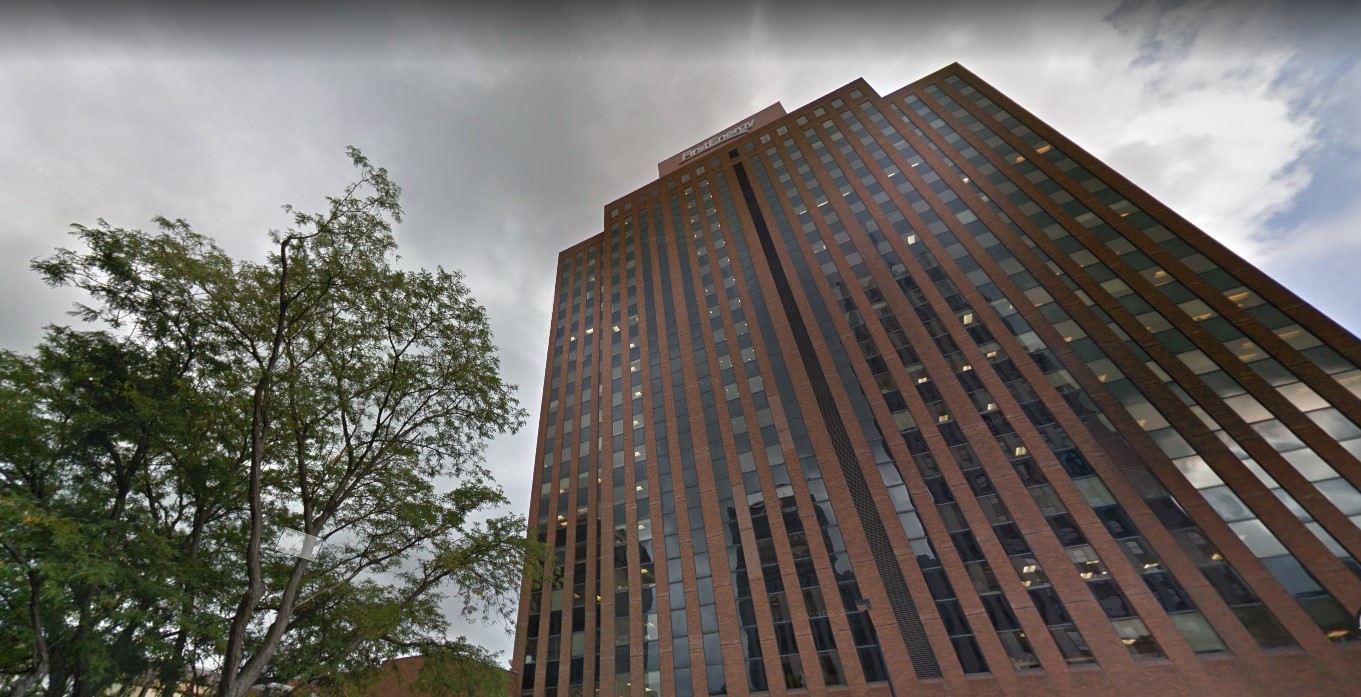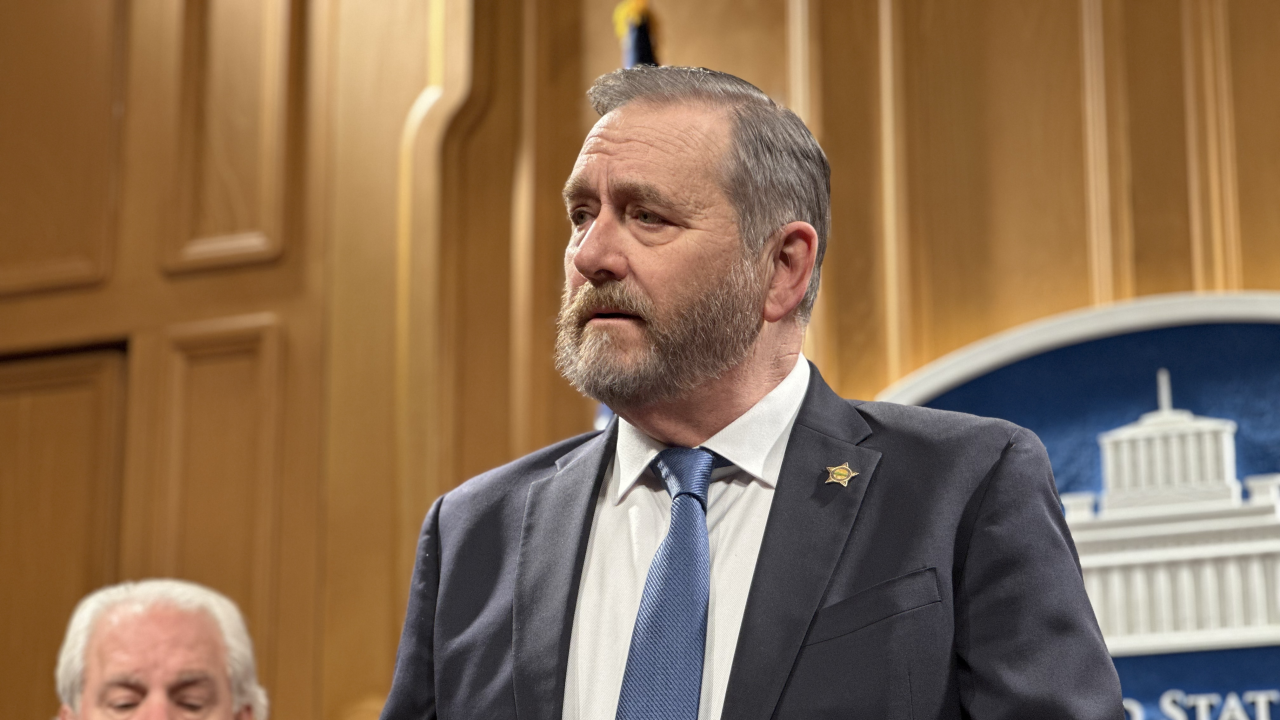
Ohio Attorney General Dave Yost. (Photo by Morgan Trau, WEWS.)
Ohio Attorney General Dave Yost this year brought criminal charges against four figures who were involved in the biggest bribery scandal in state history.
Many thought they were long overdue. That’s especially true of cases filed against men accused of funding the conspiracy, but who still hadn’t been charged by federal prosecutors four years after the last of the alleged wrongdoing took place — and almost a year after two others began lengthy prison sentences.
But Yost’s own name came up several times in the federal trial and his office last week again ignored detailed questions about the matter.
The attorney general played an important role in the defeat of an attempted repeal of the corrupt bailout. And there were claims that he believed that the bailout was a bad law, but kept his mouth shut out of loyalty to one of the conspirators — and to the law’s major beneficiary.
The issue is politically fraught for Yost because the state charges he filed this year have raised new questions about Lt. Gov. Jon Husted’s involvement in the scandal. Yost and Husted are widely expected to face each other in the 2026 race to be Ohio’s Republican nominee for governor.
New charges
Former House Speaker Larry Householder, R-Glenford, was sentenced to 20 years in federal prison last June for his role in a scheme in which Akron-based FirstEnergy paid more than $60 million to make him speaker in 2018 and to pass and protect a $1.3 billion ratepayer bailout the following year. It’s one of the biggest scandals in Ohio history, and so far it has also sent former GOP Chairman Matt Borges to prison for five years, resulted in two more guilty pleas — and seen two defendants die by suicide.
But U.S. Attorney Kenneth Parker sidestepped a pretty important question last June when he stood in front of the federal courthouse in Cincinnati and boasted to the press about the convictions and sentences his assistants had just won. He was asked, what about the people who paid the bribes? Would they be charged? If so, when?
All Parker would say was that the investigation was ongoing.
In December, his team indicted Sam Randazzo, Gov. Mike DeWine’s nominee to be Ohio’s top utility regulator. In a deferred prosecution agreement, FirstEnergy said it paid Randazzo a $4.3 million bribe just before he became regulator. From that post, he did a number of lucrative favors for the company related to the bailout and he improperly helped with other matters as well, according to the indictment.
But still uncharged by the feds are former FirstEnergy CEO Chuck Jones and Vice President Michael Dowling, the executives alleged to have directed truckloads of company money into 501(c)(4) dark money groups that financed the scandal.
In February, a team of state prosecutors led by Yost stepped into the void by securing a grand jury indictment against Jones, Dowling and Randazzo. The charges relate to the bailout scandal, and also to a decade’s worth of shady dealings that allegedly paid Randazzo more than $10 million and ripped off industrial energy users and residential customers alike.
In April, Randazzo died by suicide.
Other questions
The state indictment also raised new questions about the cozy relationships between the DeWine/Husted administration, FirstEnergy and Randazzo.
Weeks before they were inaugurated, DeWine and Husted had dinner in downtown Columbus with Jones and Dowling — FirstEnergy’s top leadership — and discussed whether Randazzo would be acceptable to regulate the company. Jones and Dowling then drove about a mile to Randazzo’s German Village residence and negotiated the $4.3 million payoff, according to text messages that are being used in multiple court proceedings.
The state indictment alleges that DeWine’s chief of staff, Laurel Dawson, knew about the payoff before the governor appointed Randazzo to chair the Public Utilities Commission of Ohio. But Dawson — whose husband was a FirstEnergy lobbyist who allegedly received a $10,000 loan from Randazzo — isn’t talking publicly about what she knew or what she told her boss.
DeWine also continues to stand behind his former governmental affairs director, Dan McCarthy, who lobbied the legislature on DeWine’s behalf to pass the bailout law.
Just before taking that job, McCarthy, too, was a FirstEnergy lobbyist — a job in which he set up a dark-money group that became a conduit for tens of millions in funding for the scandal. In last year’s trial, the prosecution presented evidence that FirstEnergy VP Dowling in 2019 ordered a subordinate to keep the then-DeWine aide’s name off of a $10 million infusion into the corrupt bailout even after being told that it would violate IRS rules to do so.
DeWine and his staff haven’t explained what McCarthy and Dawson knew about the corrupt machinations as the bailout law was in the works — or when DeWine signed it mere hours after its passage.
DeWine, Husted and their administration also haven’t explained what they knew about the long, shady relationship between Randazzo and FirstEnergy described in the state indictment. The governor’s spokesman has tried to suggest that it was common knowledge, but extensive evidence shows that Randazzo and FirstEnergy went to great lengths to conceal it.
DeWine also has said he didn’t know about millions in dark money contributions FirstEnergy made in 2018 to support his gubernatorial bid. But a University of Cincinnati political scientist said it’s simply not believable that a company would make that kind of an expenditure and not make sure the beneficiary knew about it. That seems especially true for a company that subsequently admitted that it paid millions more in outright bribes.
For his part, Husted won’t comment on the $1 million in dark money FirstEnergy spent supporting his 2018 bid for governor, or whether he promoted Randazzo for the regulatory job when he dropped his bid and joined DeWine’s ticket.
The two had history. As House speaker in 2007, Husted appointed Randazzo to the PUCO Nominating Council — a position he held until DeWine nominated him to chair the agency.
Questions for the Attorney General
Husted and Yost, the attorney general, are widely regarded as the frontrunners for the 2026 GOP gubernatorial nomination in a state that hasn’t elected a Democrat to that job since 2006.
There hasn’t been any suggestion that Yost brought charges in the bailout scandal as a way of embarrassing his likely opponent. But at the same time, Yost’s office has avoided questions about his own involvement in the bailout controversy.
According to text messages presented at last year’s federal court trial, Yost was drawn into the fight at a critical time. The bailout passed the Householder-run House at the end of May 2019, but a month later, opposition was growing in the state Senate.
Borges, the former GOP chair who had run some of Yost’s political campaigns, had a June 26, 2019 text conversation with Juan Cespedes, who was also being paid to push the corrupt bailout law. Borges intimated that Yost believed that the law was a bad one.
The AG “‘would be out front (in opposition) if not for (FirstEnergy) support and your involvement,’” Borges quoted Yost as saying.
A spokesperson for Yost declined to comment at the time, citing the fact that he’d been subpoenaed in the case.
Regardless of the AG’s view, so many people agreed that the bailout was a horrible law that an effort to undertake the cumbersome repeal process was getting underway even before it passed. Borges noted to Cespedes that Yost would have to give his approval before a repeal could get on the ballot. The AG would try to help them there, too, Borges said.
“If there’s any way the law will allow him to reject the language, he will do it,” Borges texted.
Regardless of why, Yost ended up doing just that.
Crucial lost time
DeWine signed the bailout, House Bill 6, the day the Senate passed it — July 23, 2019. Six days later, repeal advocates had gathered 1,000 signatures from registered voters and submitted a summary of the repeal to Yost for his approval.
Time was of the essence because under Ohio law, repeal advocates had to gather another 265,000 voters’ signatures within 90 days of the law’s passage to get it on the ballot. But first they had to wait for Yost to approve the ballot summary.
The attorney general waited the full 10 days allotted him and then issued a rejection letter that seems at odds with any concept of “summary.”
It was a six-page, 1,535-word document that picked apart the summary in excruciating detail.
“He listed a lot of different things,” said Rachael Belz, CEO of Ohio Citizen Action, which was strongly opposed to the bailout. “It seemed like a lot to overcome. It didn’t seem very neutral.”
The repeal was a referendum — the only one for which Yost has considered summary language since he’s been attorney general. Of the 26 other summaries he’s rejected, the vast majority were for proposed constitutional amendments and the rest were for initiated statutes.
His rejection of the summary for the bailout repeal stands out for its length. It’s more than twice as long as his other rejections are on average, according to information available on the attorney general’s website.
In the event, Yost’s initial rejection did heavy damage to the repeal effort.
Proponents on Aug. 16, 2019 submitted a new summary, which Yost certified on Aug. 29, 2019. But by that time, the repeal team had only 54 days left of the original 90 to gather and submit more than a quarter-million valid signatures. Their time to complete the gargantuan task was cut almost in half, in other words.
What followed was a lying, xenophobic and sometimes-violent campaign to defeat the repeal into which FirstEnergy plowed $36 million in dark money. Perhaps unsurprisingly, the repeal couldn’t get enough signatures and parts of the corrupt bailout law are still on the books.
Yost’s office didn’t respond to questions about his role in the repeal — or Borge’s statements that were presented at the former political boss’s criminal trial. But for Belz of Citizen Action, there’s plenty of blame to spread among Ohio’s statewide leaders.
“I don’t think Yost’s hands are clean,” she said. “I don’t think Husted’s hands are clean. I don’t think DeWine’s hands are clean. I don’t know whose hands are clean. Frankly, that’d be a shorter list.”