Tag: browns stadium

  • Gov. DeWine signs off on using unclaimed funds for Browns stadium, future Ohio projects

    Gov. DeWine signs off on using unclaimed funds for Browns stadium, future Ohio projects

    By:  Ohio Capital Journal

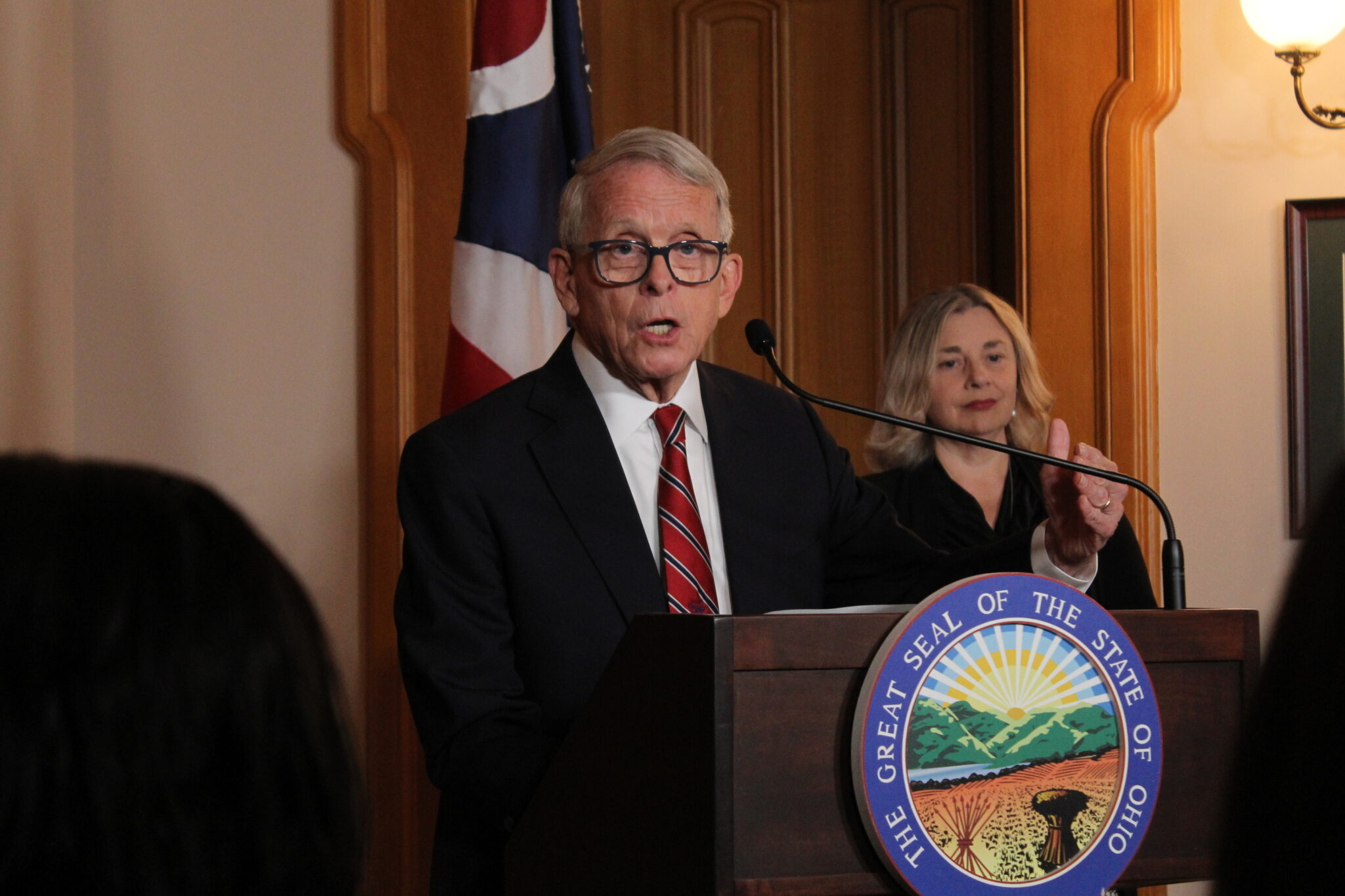
    With his signature late Monday night, Ohio Gov. Mike DeWine has allowed a controversial funding plan for a new Cleveland Browns stadium to go forward. The state will tap its multi-billion-dollar pool of unclaimed funds — money which belongs to ordinary Ohioans — to pay for the Browns’ stadium and other sports and cultural facilities in the future.

    Shortly before DeWine signed the budget, Attorney General Dave Yost urged him to veto the provision. Yost argued taking money from Ohioans to fund a privately owned stadium is “poor policy.” Two former Democratic lawmakers who threatened a class action lawsuit last week, said they’re going forward.

    GET THE MORNING HEADLINES.


    DeWine did, however, make one minor tweak to the funding mechanism. The initial program set a $500 million threshold. Projects beyond that amount were eligible for up to 25% of the cost in state funds, but those costing less were only eligible for 15% in state funds.

    The governor argued that cost floor “would have the perverse incentive of encouraging projects to become unnecessarily more expensive simply to meet a threshold for state funding.” Instead, all projects will be capped at a 25% state share.

    Why let it go forward?

    Although the governor declined to veto the use of unclaimed funds, he didn’t completely embrace the approach.

    “Well, as you know, that was not my first choice, I had another way of doing it,” DeWine told reporters Tuesday. The governor’s opening bid would’ve increased taxes on sports betting to fund new facilities. “But, you know, governors don’t get everything they want. Nobody gets everything they want.”

    He explained that even if “we’re all invested in our own ideas,” he took a step back and focused on his priorities.

    “To me, the biggest objectives were no taxpayers’ dollars used for this, in the sense of nothing coming out of general fund — nothing competing against education,” DeWine explained, “and it couldn’t just be about the Browns, it had to be universal.”

    “When you get the two prime objectives,” DeWine added, “it seems to me it’s time to say, ‘Yeah, I’m achieving what I wanted to achieve.’”

    In a social media post, Browns team owners Jimmy and Dee Haslam praised DeWine for approving the plan and promised to deliver a “transformative project” that will create a “generational impact.”

    Still, DeWine’s own comments underscore how fine a line he’s walking. The new fund will be built exclusively on taxpayers’ dollars in the form of old deposits or reimbursements that state officials are holding until claimed. The governor stresses that “stadiums should not compete with mental health. Stadiums should not compete with education.” By sidestepping the general fund, the budget avoids those tradeoffs.

    But it’s a distinction that might not make a difference to average Ohioans.

    The National Association of State Treasurers — officials typically tasked with unclaimed funds oversight — is explicit in its stance that a state’s role is merely custodial, and citizens’ right to recover property should be maintained in perpetuity.

    Ohio’s new budget gives claimants a 10-year grace period, but following that, all assets left in the unclaimed funds trust for more than 10 years will get transferred to the stadium and cultural facilities fund.


    The criticism

    Ohio’s unclaimed funds trust is worth close to $5 billion, and much of that money has been parked there for well over a decade. But simply taking those dollars, particularly to benefit a billionaire professional team owner, didn’t sit well with lawmakers on both sides of the aisle.

    In his letter to DeWine, Yost acknowledged some states have instituted similar transfers, but he expressed discomfort unclaimed dollars becoming state dollars in just 10 years.

    “This timeline makes Ohio an outlier nationally,” Yost wrote, “and risks inadvertently harming taxpayers unaware they have money in the state’s unclaimed funds.”

    In a reference to the Ohio constitution’s eminent domain provisions, he argued “the statutory taking of public funds without clear public benefit is poor policy.” State Supreme Court precedent in cases like Norwood v. Horney holds that governments must demonstrate a public benefit to take private property.

    “Billionaires should finance their own stadiums—full stop,” Yost added. “The $600 million handout for a single professional sports facility raises serious concerns about fiscal sustainability and fairness.”

    Ohio’s former Attorney General Marc Dann, and former state Rep. Jeff Crossman, both Democrats, visited the statehouse as lawmakers were getting ready to vote on the budget. They warned that if lawmakers went forward, they would file a class action lawsuit.

    Tuesday morning, Crossman said, “If Governor DeWine and the legislative majority think they can betray Ohioans’ constitutional property rights without a fight — they’re dead wrong.”

    “They’re getting the lawsuit they clearly invited,” he added, “and just like the case decided yesterday on (Pandemic Unemployment Assistance) benefits, we intend to win. Because when the state breaks the law, someone has to stand up for the people of Ohio”.

    The governor himself appeared resigned to a fight in court. In bit of homespun storytelling, DeWine recalled being a young lawyer arguing with an older judge in Green County.

    “He looked at me and said, Mister DeWine, that’s why God made the Court of Appeals,” DeWine said. “And so, you know, when don’t people don’t like things, they can go to court, and that’s what we have in our system.”

    Follow Ohio Capital Journal Reporter Nick Evans on X or on Bluesky.


    Nick Evans
    Nick Evans

    Nick Evans has spent the past seven years reporting for NPR member stations in Florida and Ohio. He got his start in Tallahassee, covering issues like redistricting, same sex marriage and medical marijuana. Since arriving in Columbus in 2018, he has covered everything from city council to football. His work on Ohio politics and local policing have been featured numerous times on NPR.

    Ohio Capital Journal is part of States Newsroom, the nation’s largest state-focused nonprofit news organization.

    MORE FROM AUTHOR


  • Ohio Senate Democrats hope to fully fund public schools, not fund Browns stadium in state budget

    Ohio Senate Democrats hope to fully fund public schools, not fund Browns stadium in state budget

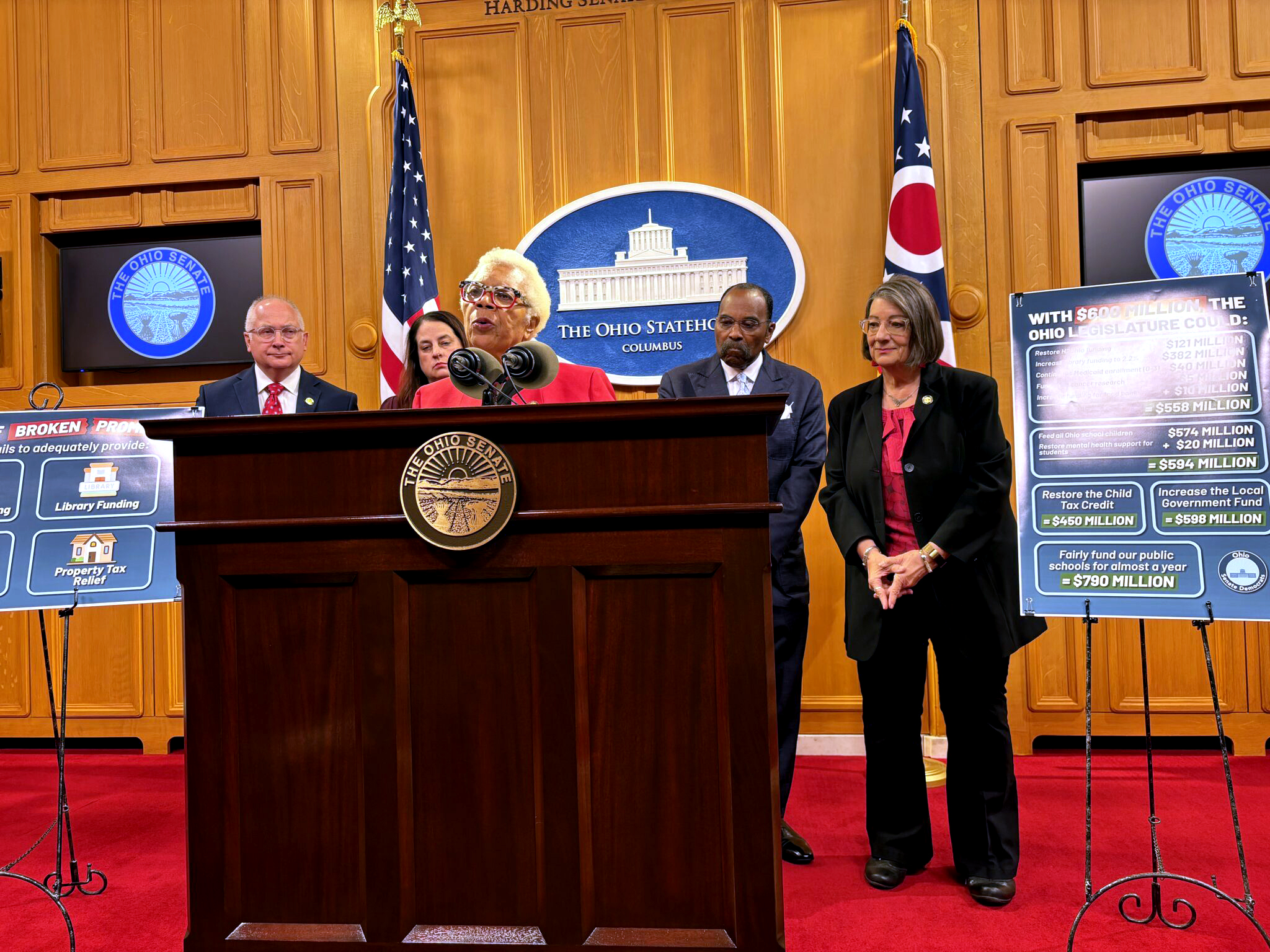
    Ohio state Sen. Paula Hicks-Hudson, D-Toledo, and other members of the Senate Democratic Caucus discuss the amendments they submitted to the state’s two-year operating budget. (Photo by Megan Henry, Ohio Capital Journal).

    By: Ohio Capital Journal

    Ohio Senate Democrats have submitted 423 amendments to the two-year state operating budget — including one removing the $600 million bond package for a new Cleveland Browns stadium in Brook Park, and one to fully fund public schools.

    The Ohio House passed their version of the budget last month and the Senate is currently working on the budget, which Ohio Gov. Mike DeWine must sign into law by June 30.

    GET THE MORNING HEADLINES.


    “This budget steals from our children by defunding public schools, transfers money for health care and libraries to rich benefactors, all the while failing to address the needs of hard working everyday Ohioans,” Senate Minority Leader Nickie J. Antonio, D-Lakewood, said Tuesday during a press conference.

    “This Republican budget prioritizes partisan agendas and handouts to the wealthy and well-connected, also through vouchers, tax breaks, and a stadium giveaway to the tune of more than half a billion dollars, all paid for by the working class,” she said.

    The Senate Democrats had a few different ideas for how $600 million can be spent — a direct shot at how the Ohio House Republicans added a bond package for a new Cleveland Browns stadium for that same amount in their version of the budget.

    Republicans hold a 24-9 supermajority in the Ohio Senate, giving Democrats very little power to enact any of their priorities. Nevertheless, Democratic lawmakers laid out their vision of what the state could be doing differently.

    The Ohio legislature could restore H2Ohio funding for $121 million, increase library funding to 2.2% for $382 million, offer continuous Medicaid expansion enrollment for $40 million, fund child cancer research for $5 million, and increase funding for food banks for $10 million (which totals to $558 million), Antonio said.

    Or lawmakers could feed all Ohio school children for $574 million and restore mental health support for students for $20 million, Antonio said.

    The legislature could restore the Child Tax Credit for $450 million, increase the Local Government Fund by $598 million, and fairly fund public schools for almost a year for $790 million, Antonio said.

    “If I were queen of the world, all these things would be part of our general fund budget,” she said.

    If $600 million is bonded out for a sports franchise, “Ohioans are still on the hook for that money in the long run,” Antonio said.

    DeWine originally proposed doubling the tax on sports betting from 20% to 40% with proceeds going to fund professional sports stadiums and Ohio youth sports.

    “I thought what the governor proposed originally was actually a better way to go because the funds were coming from outside entities,” Antonio said. “It has the whole state in mind, not just one group in one part of the state.”

    She said she would “be much more supportive” of an amendment along those lines.

    School funding

    To fully fund public schools based on statistics from the Fair School Funding Plan from 2021, schools would need an additional $666 million in funding (more now with inflation), but the proposed budget only gives them about $226 million.

    “It breaks the promise we’ve made for our children in public schools by abandoning fully funding the Fair School Funding Plan,” Antonio said.

    The Cupp-Paterson Fair School Funding Plan from 2021 was supposed to take six years and was meant to change how public dollars are provided to K-12 schools by giving additional support to local districts so they can rely less on property taxes.

    The first two years were partially fully funded and the second two years were fully funded. There are two more years left.

    “Our caucus has submitted amendments that would fully fund the fair school funding plan,”  Antonio said.

    The Senate Democratic amendments would also increase the state minimum teacher salary from $35,000 to $50,000, she said.

    Additional amendments

    Ohio Senate Democrats added an amendment to restore DeWine’s proposed $1,000 child care tax credit and another that would remove the language the Ohio House added to the budget that would make changes to the Ohio Housing Trust Fund.

    The Housing Trust is funded by a portion of the fees collected by county recorders, with half of the fees staying with the county and the other half going back to the fund — which requires at least 50% of the funds be spent in non-urban areas.

    The House budget proposal would remove the requirement for county recorders to send the state Department of Development money to reallocate the funds — something housing advocates say make it less effective across the state.

    “Rural areas would also be most impacted by the potential blocks of housing services as well, but all Ohio communities will see service disruption and increases in homelessness and decrease in access to affordable housing,” said Ohio state Sen. Paula Hicks-Hudson, D-Toledo.

    Ohioans deserve better from the state budget, Antonio said.

    “I think a whole lot of everyday Ohioans are going to be very surprised and have a whole lot of buyer’s remorse when they find out what it is that these people are doing on their behalf,”  Antonio said when asked about the Republican supermajority in the Statehouse.

    Follow Capital Journal Reporter Megan Henry on Bluesky.

    Megan Henry
    Megan Henry

    Megan Henry is a reporter for the Ohio Capital Journal and has spent the past five years reporting in Ohio on various topics including education, healthcare, business and crime. She previously worked at The Columbus Dispatch, part of the USA Today Network.

    Ohio Capital Journal is part of States Newsroom, the nation’s largest state-focused nonprofit news organization.

    MORE FROM AUTHOR

  • Analysis shows universal pre-K in Ohio would repay its costs almost fourfold

    Analysis shows universal pre-K in Ohio would repay its costs almost fourfold

    Getty Image

    By:  Ohio Capital Journal

    A paper issued last month by Scioto Analysis concluded that every dollar spent on universal pre-K in Ohio would produce $3.80 in benefits.

    Unsurprisingly, most of that benefit comes in the form of greater future earnings of kids who attend pre-K and then show up to kindergarten prepared to learn, the analysis said.

    “Seven dollars of every $10 of benefits generated by a universal prekindergarten program come from future labor market earnings of children,” Scioto Analysis Principal Rob Moore said in a written statement accompanying the report. “According to the evidence we have, universal prekindergarten could be a strong long-term economic development investment for Ohio.”

    The Ohio state government doesn’t fund universal pre-K. Some cities, including Cincinnati, Cleveland, Dayton, and Toledo, have funded pre-K programs that are less than universal.

    Head Start is a federal pre-K program, but in Ohio and most other states, eligibility is generally restricted to families living at or below federal poverty guidelines. For a family of four, that’s less than $42,000 a year.

    The Scioto Analysis report cited research showing that universal pre-K can benefit kids from middle-income families almost as much as it does those from poor ones.

    In Ohio, 57% of three and four-year-olds were enrolled in pre-K in 2022. Using the Washington State Institute for Public Policy’s benefit-cost analysis of universal prekindergarten, the Scioto Analysis report modeled the impact on the economy if 71% of Ohio’s preschoolers went to prekindergarten.

    It found that adding 29,000 Ohio kids to the program would benefit the economy by cutting the time kids would later spend repeating grades, in prison, or needing special education. But by far and away, the biggest benefit was in kids’ future earnings.

    “This benefit occurs because children develop essential cognitive and social skills during prekindergarten which lead to higher academic achievement and better job prospects,” the report said.

    In its draft of the biennial budget, the Republican leadership of the Ohio House has been generous to the state’s wealthiest interests.


    GET THE MORNING HEADLINES.


    The billionaire Haslam family wants $600 million to move the Browns out of downtown Cleveland and into a new stadium in Brook Park. House Finance Committee Chairman Brian Stewart, R-Ashville, built that funding into the budget, calling it “a once-in-a-lifetime project.” He added that new stadiums are “huge economic drivers.”

    However, most economists who have studied them would disagree.

    They say stadiums by and large don’t create new spending. Instead, they shift existing discretionary spending from one part of a regional economy to another, experts say

    “The empirical evidence shows repeatedly that stadium subsidies fail to generate new tax revenue and new jobs or attract new businesses,” the Tax Foundation said in an October report. “While attending a sporting event or a concert in a new, publicly subsidized venue might benefit fans of the team or those who attend the event, those subsidies shift spending that would have occurred in other parts of the city or state in the absence of a new sports stadium or arena.”

    Meanwhile, by developing intellectual capital, public education provides multifaceted benefits to the economy, experts say.

    “Research shows that individuals who graduate and have access to quality education throughout primary and secondary school are more likely to find gainful employment, have stable families, and be active and productive citizens,” Dana Mitra of Pennsylvania State University said in a research report. “They are also less likely to commit serious crimes, less likely to place high demands on the public health care system, and less likely to be enrolled in welfare assistance programs.”

    However that may be, the Ohio House budget would slash funding for public education far below what’s called for under a 2021 plan to make it sufficient to meet the requirements of the Ohio Constitution.

    The Fair School Funding Plan calls for $666 million in new spending on public education. The Republican House budget would provide only $226 million.


    Marty Schladen
    Marty Schladen

    Marty Schladen has been a reporter for decades, working in Indiana, Texas and other places before returning to his native Ohio to work at The Columbus Dispatch in 2017. He’s won state and national journalism awards for investigations into utility regulation, public corruption, the environment, prescription drug spending and other matters.

    Ohio Capital Journal is part of States Newsroom, the nation’s largest state-focused nonprofit news organization.

    MORE FROM AUTHOR