Tag: Bruce Vanderhoff

  • COVID-19 Update – Watch ODH Press Conference

    COVID-19 Update – Watch ODH Press Conference

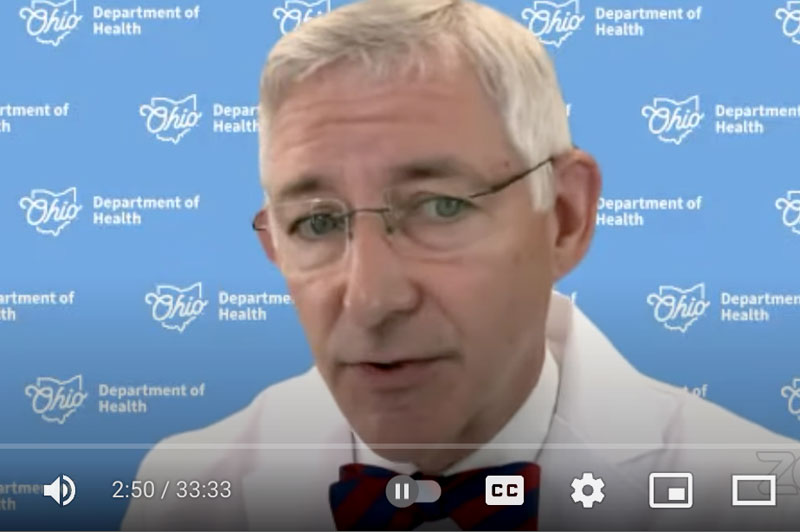
    Ohio Department of Health Director Bruce Vanderhoff hosted a press conference on COVID-19 and the updated COVID vaccine.

    Featuring Joe Gastaldo, M.D., infectious disease specialist and Vice President of Clinical Affairs for OhioHealth Dublin Methodist Hospital and OhioHealth Grady Memorial Hospital, and Vanessa Maier, M.D., MPH, Medical Director, MetroHealth Medical Center’s School Health Program.

  • Vaccine floods into Ohio but drop in new covid cases stalls

    Vaccine floods into Ohio but drop in new covid cases stalls

    By Marty Schladen and Ohio Capital Journal

    March 26, 2021

    Ohio got even more good news on the coronavirus vaccine Thursday. But even as doses are flooding into the state, what had been a steady drop in infections has turned into a plateau.

    Gov. Mike DeWine announced that next week — when all Ohio adults will be eligible to be vaccinated — the state will receive 571,000 doses, which he said was “by far and away the highest amount of doses we’ve received.” In fact, it more than quintuples the 100,000 doses a week that the state was receiving in early February.

    The surge has allowed the state to throw open vaccine eligibility to every Ohioan 16 and over starting Monday and it allowed DeWine on Thursday to announce 11 new mass vaccination sites:

    • Knights of Columbus, Lima, 2,500 doses a week
    • Lucas County Recreation Center, 5,000 doses a week
    • Dayton-Montgomery County Convention Center, 5,000 doses a week
    • Celeste Center, Columbus, 5,000 doses a week
    • Summit County Fairgrounds, 5,000 doses a week
    • Southern Park Mall, Mahoning County, 2,500 doses a week
    • Cintas Center, Cincinnati, 5,000 doses a week
    • Wilmington Airpark, 5,000 doses a week
    • Adena Medical Education Center, Ross County, 2,500 doses a week
    • Wayne Street Medical Campus, Marietta, 1,500 doses a week
    • Colony Square Mall, Muskingum County, 1,500 doses a week

    The state also is starting up two mobile vaccination clinics that will visit rural counties in April.

    In all, about a quarter of Ohio adults have now received at least a first dose of the vaccine. Yet progress toward DeWine’s benchmark to remove all remaining health orders has stalled and even gone backward a little since last week.

    DeWine has said once the state drops to 50 new cases a week per 100,000 Ohioans, all the orders come off. But after a long decline, the rate of cases went up from 144 last week to 147 this week.

    While the increase is slight, making it more concerning is that some neighboring states — such as Michigan — are now seeing rapid growth in the number of cases per 100,000.

    Part of that might be because people are tired of pandemic precautions, the weather’s getting nicer and vaccines are more widely available, so some people are abandoning caution. Another reason is that the faster-spreading UK variant of the virus is becoming more predominant.

    “That’s (the variant) we’re seeing the most of,” said Bruce Vanderhoff, chief medical officer for the Ohio Department of Health. “We’ve been expecting a growing presence of these variants.”

    Vaccine reluctance is surely also playing a role. 

    Even though they’ve been eligible to get a shot since January, the portion of Ohioans 80 and over getting at least a first dose only crossed 70% this week.

    “We’re hopeful that these numbers will continue to creep up, move up,” DeWine said of percentages for all age groups.

    Also, some institutions in Ohio haven’t responded to months of repeated offers of vaccines from the state. A frustrated DeWine said he was going to publish the names of 56 nursing homes and 168 assisted-living facilities that have failed to communicate with state officials about the vaccine.

    “I don’t know what else to do,” DeWine said. “I’m worried about the people in these nursing homes” and assisted care facilities.

    So despite the temptation to party like it’s March 2019, state officials are pleading for Ohioans to understand that the pandemic’s still here and still dangerous.

    “We’re in the final stages of this marathon,” Vanderhoff said. “So let’s keep masking and distancing even if you’ve had the chance to roll up your sleeve and get vaccinated.”

  • Ohio announces initial vaccine plan

    Ohio announces initial vaccine plan

    By Marty Schladen and Ohio Capital Journal

    If approvals go according to plan, Ohio will get more than a half-million doses of coronavirus vaccine between Dec. 15 and the end of the month, Gov. Mike DeWine said on Friday.

    While more than expected, the amount is far from adequate in a state with a population approaching 12 million.

    “The race has started and it’s started in a very robust way,” said Bruce Vanderhoff, medical director for the Ohio Department of Health.

    Even so, officials had to make some painful choices about who would be first in line for a first dose, to be followed by a booster either three or four weeks later, depending on the vaccine, DeWine said. 

    That means prisons and jails, where inmates and staff have been dying of covid since the start of the pandemic, will not be among the first to be vaccinated. Nor will service workers such as grocery store clerks, who potentially are exposed to the virus every day.

    “We have not gotten beyond (determining who will be in the first group) but the goal will be to save the most lives,” DeWine said on a day when more than 10,000 new coronavirus cases and 129 more deaths were reported.

    Among those in the first group will be:

    • Health care workers and staff caring for covid patients
    • Emergency medical responders
    • People with underlying health conditions living close to each other and their caregivers. They include people and workers in nursing homes, assisted living centers, veterans homes and the like.

    DeWine stressed that the exact number of doses won’t be known until the week they’re due to arrive. He added that as initial rounds are doled out, they’ll be paired with boosters to be sent later.

    Joseph Gastaldo, director of infectious diseases at OhioHealth, said the vaccines awaited in Ohio are being made by Pfizer and Moderna. They still are awaiting final approval by independent panels of experts working under the auspices of the U.S. Food and Drug Administration and the Centers for Disease Control and Prevention. That approval is expected in the next two weeks.

    Approvals of other vaccines are hoped for, but there are a few factors that make it hard to predict when a big enough portion of the Ohio population will have been vaccinated to it difficult for the virus to spread.

    One is that about half of Ohioans are reluctant to get it, DeWine said. He said he hopes public information campaigns and news of the vaccines’ safety and efficacy will counteract the skepticism.

    Also, it’s unclear what other vaccines might be coming online, how quickly, or how fast production and distribution can be scaled up. Add those together and it’s uncertain when average folks can line up for a shot in the arm.

    “I don’t think anyone knows that,” DeWine said.

  • DeWine announces new curfew to try to slow covid spread

    DeWine announces new curfew to try to slow covid spread

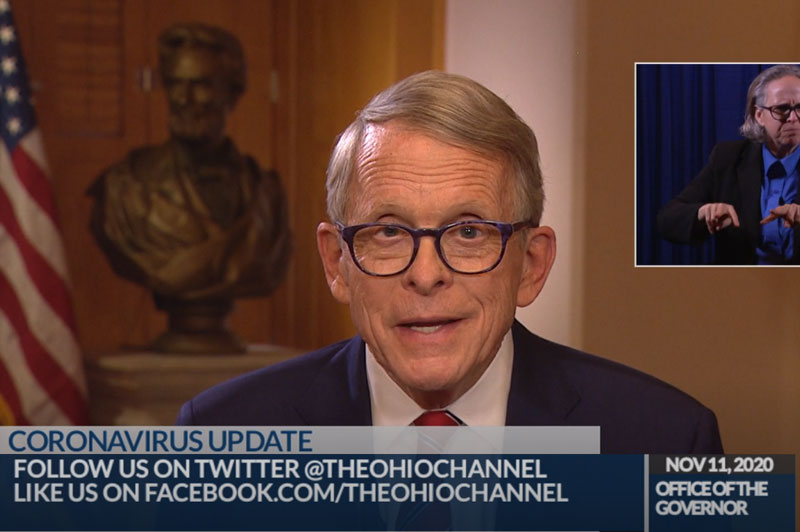
    Gov. Mike DeWine is pictured during his statewide address on Wednesday, Nov. 11. Photo courtesy Ohio Channel.


    By Marty Schladen and the Ohio Capital Journal


    Desperate to slow the spread of coronavirus, Ohio Gov. Mike DeWine on Tuesday announced a new curfew intended to decrease person-to-person contacts and new infections.

    The move was greeted with skepticism in some quarters.

    DeWine said that starting at 10 p.m. on Thursday, there will be a 21-day statewide curfew from 10 p.m. to 5 a.m. Bars, restaurants and retail stores will have to close. But there will be exceptions for pharmacies, grocery stores, food delivery, drive-through and pickup service.

    Technically, people who violate the curfew could be charged with a second-degree misdemeanor, punishable by 90 days in jail and a $750 fine. But as he has with other covid-related health orders, DeWine said he he’s not eager to see people charged.

    “We do not expect law enforcement to go pull people over because they’re out beyond 10 o’clock,” he said. “But if they’re seeing something going on, this is a way they can walk up and say, ‘Hey guys, you’re here… there’s a curfew. Why don’t you just go home?’”

    The governor added, “No one’s been charged under these health orders,” he said. “That doesn’t mean they couldn’t be, but they haven’t so far.”

    The curfew comes as Ohio experiences its most alarming spike in coronavirus infections and hospitalizations since the start of the pandemic early this year.

    On Tuesday, state health authorities reported 7,079 new cases over the past 24 hours, a 36% increase over the 21-day average. They also reported 368 new coronavirus hospitalizations, only a little less than the state record of 386 set on Nov. 10.

    The swelling numbers have placed Ohio hospital staffs in a “precarious situation,” said Bruce Vanderhoff, chief medical officer for the Ohio Department of Health. He said medical workers are fatigued from fighting the disease since March and they have to balance that work with living in communities and with families where the virus is increasingly prevalent.

    DeWine said his goal was to reduce the number of person-to-person contacts and thereby stop the virus from spreading. He asked Ohioans to voluntarily do that through such measures as condensing the number of trips they make to the grocery and buying more when they do. At the same time, he urged people to do what they can to remotely maintain emotional connections.

    However, critics noted that the curfew doesn’t go as far as one imposed in the spring. For example, the earlier order imposed limits on how many people can be in stores when they’re open.

    Asked what scientific basis he used in issuing the order, DeWine said, “We know the basic science. The basic science is fewer contacts, less spread.”

    The likely effectiveness of the curfew was disputed by at least one scientist in the field. Kent State epidemiologist Tara C. Smith tweeted that she didn’t know any professionals who thought it would work.

    DeWine, however, might have felt the curfew was as far as he could go. It had the support of the Ohio Restaurant Association, likely meaning that there was some negotiation behind it.

    Also, DeWine is a member of a party led by president who in October visited Circleville and said the media were hyping the virus to hurt his reelection chances. The president predicted the media would stop covering coronavirus on Nov. 4 — the day after the election.

    Covid skepticism runs so deep in elements of the Republican Party that at the same time that DeWine was announcing the curfew, Ohio Senate President Larry Obhof, R-Medina, was testifying in favor of his bill to repeal an earlier health order requiring bars to stop serving at 10 p.m.

    For his part, DeWine said he hopes the curfew will “push more people toward home.”

    “I think if we do these things it gives us a shot at slowing (the coronavirus) down,” the governor said. “Most of what we’re doing and the decisions I’m making are between two bad choices.”


    Marty Schladen

    Marty Schladen has been a reporter for decades, working in Indiana, Texas and other places before returning to his native Ohio to work at The Columbus Dispatch in 2017. He’s won state and national journalism awards for investigations into utility regulation, public corruption, the environment, prescription drug spending and other matters.


  • Record-Breaking Cases & Hospitalizations, Statewide High Incidence

    Record-Breaking Cases & Hospitalizations, Statewide High Incidence

    CURRENT COVID-19 DATA
    There are 235,170 confirmed and probable cases of COVID-19 in Ohio and 5,461 confirmed and probable COVID-19 deaths. A total of 20,015 people have been hospitalized, including 3,969 admissions to intensive care units. In-depth data can be accessed by visiting coronavirus.ohio.gov.  Video of today’s full update, including versions with foreign language translation, can be viewed on the Ohio Channel’s YouTube page.  For more information on Ohio’s response to COVID-19, visit coronavirus.ohio.gov or call 1-833-4-ASK-ODH.

    Columbus, Ohio – Ohio Governor Mike DeWine and Lt. Governor Jon Husted today provided the following updates on Ohio’s response to the COVID-19 pandemic. 

    RECORD-BREAKING CASES & HOSPITALIZATIONS
    DeWine announced today that Ohio is once again breaking records in regard to COVID-19 cases and hospitalizations.

    • Between yesterday and today, health officials have reported a total of 4,961 new positive coronavirus cases in Ohio, the highest number of new cases in a 24-hour period to date.

    • There are currently 2,075 patients hospitalized with COVID-19 which is a 55 percent increase in hospitalized patients compared to two weeks ago. 

    • Of the hospitalized patients, 541 people are in intensive care. The previous record for intensive care admissions was 533 in April. 


    “This virus is flaring up, and we have to push it down – the economy depends on it,” said Governor DeWine. “If the virus continues to aggressively spread, people will lose confidence in their ability to safely go to stores, restaurants, and other businesses. If we want to keep our economy moving, we must all live with this virus and we must all be more careful.”

    Governor DeWine stressed that the new record number of cases is not due to increased testing capacity in the state. Since September 24, the total number of tests in Ohio has increased by approximately 44 percent, but positive cases have increased 280 percent in the same time period. If a person is tested multiple times, they are only counted once.

    STATEWIDE HIGH INCIDENCE 

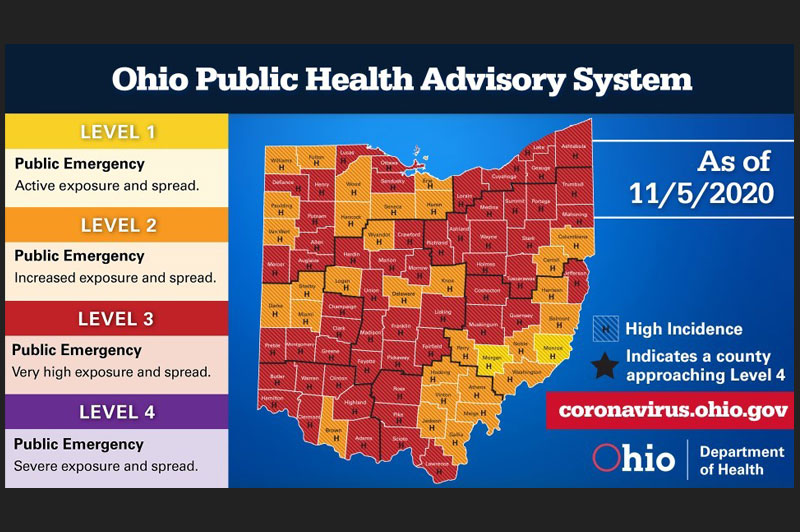
    New health data compiled by the Ohio Department of Health revealed today that all 88 counties in Ohio are now considered “high incidence” as defined by the Centers for Disease Control and Prevention. 

    “There have been so many cases in the past two weeks that the risk of catching this virus in every county of this state is very real and very concerning,” said Governor DeWine. “Again, I ask everyone to recognize their personal responsibility in slowing the spread of this deadly disease. It’s up to every citizen in Ohio to choose to slow the spread by wearing masks, distancing, and making overall smart decisions.”

    According to today’s updated Ohio Public Health Advisory System map, 56 counties are currently rated as having a very high risk of exposure and spread (Red Level 3), up from 43 counties last week. This represents the highest number of Red Level 3 counties since the launch of the advisory system in July. As of today, 86 percent of Ohioans are living in a Red Level 3 county. 

    A county-by-county breakdown outlining the presence of COVID-19 in all of Ohio’s 88 counties can be found on the Ohio Public Health Advisory System’s website.


    NEW OHIO DEPARTMENT OF HEALTH STRUCTURE

    Governor DeWine announced multiple key additions to the existing administration at the Ohio Department of Health (ODH). 


    Chief Medical Officer Dr. Bruce Vanderhoff: 
    Dr. Vanderhoff previously served for more than a decade as a Senior Vice President and as the Chief Medical Officer at OhioHealth. He has years of experience leading large teams in successfully dealing with important healthcare issues in Ohio and prepared OhioHealth to deal with the threat of Ebola and the H1N1 flu pandemic.  

    Director Stephanie McCloud: 
    Director McCloud previously served as Governor DeWine’s administrator of the Ohio Bureau of Workers’ Compensation, managing an agency of 1,800 colleagues and over $28 billion in assets. She has considerable experience in the area of mental health and addiction treatment which is a priority in Ohio’s health improvement plan. 

    Senior Deputy Lance Himes: 
    Himes had previously served as the interim director of ODH where he has played an integral role in running and managing many aspects of the pandemic response operation. He will lead the coordination of the state’s vaccine distribution plan and will continue to work directly with Ohio’s local health commissioners.

    Chief of Staff Kathleen Madden: 
    Madden had previously served as Assistant Director at the Ohio Office of Budget and Management and will now play a key role in keeping ODH’s pandemic and non-pandemic programs and operations on track. She will work to prioritize and resolve critical issues, provide oversight and guidance to ODH staff, and ensure that ODH funds are spent responsibly and strategically. Other key members of the ongoing COVID-19 response who will continue their roles in assisting ODH are: 

    Adjutant General Maj. Gen. John Harris, Ohio National Guard: 
    Maj. Gen. Harris will continue work to ensure complex operations, such as COVID testing and contact tracing, are well-coordinated, monitored, and improved when necessary.  He will also work directly with Senior Deputy Himes on the planning and logistics of the forthcoming vaccine distribution program.  

    Director Ursel McElroy, Ohio Department of Aging: 
    Director McElroy will continue to direct virus prevention efforts for older adults in the community and in long-term settings, including nursing homes and assisted living facilities.  

    Director Lori Criss, Ohio Department of Mental Health and Addiction Services: 
    Director Criss will continue to lead efforts to address the increasing mental health needs of citizens during the pandemic.

    NEW OHIO BWC ADMINISTRATOR
    Governor DeWine announced that John Logue, the Ohio Bureau of Workers’ Compensation’s (BWC) Chief of Strategic Direction, will become the new administrator of Ohio BWC effective on November 16. Logue has worked for 26 years in the industry. Before returning to BWC in 2019, he most recently served as the vice president of client services for International Absence Management Company where he focused on Ohio workers’ compensation.