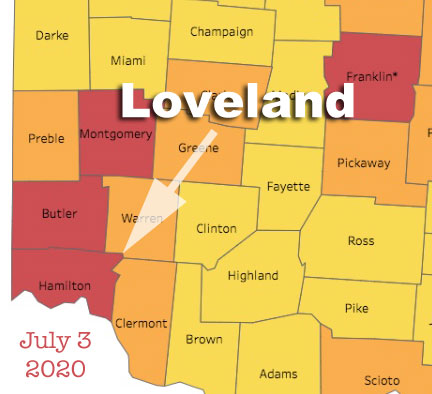
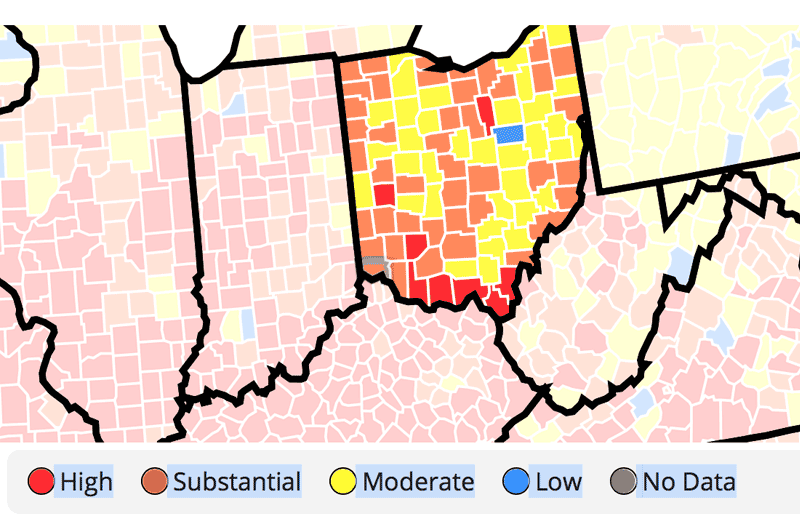
All counties surrounding Loveland are an area of Substantial Transmission
Loveland, Ohio – As the Washington Post reports that a new coronavirus variant discovered in Colombia is showing up among patients in South Florida and that the delta variant of the coronavirus appears to cause more severe illness than earlier variants and spreads as easily as chickenpox, according to an internal federal health document that argues officials must “acknowledge the war has changed”, Hamilton County Public Health says we are now in an area of “substantial spread”.
All of Hamilton County has been identified as an area of “substantial spread” of COVID-19 by the Centers for Disease Control and Prevention (CDC). Substantial spread occurs when an area sees more than 50 cases per 100,000 population in the past seven days. Butler, Clermont, and Warren are also an area of “substantial spread”.
Hamilton County is at 54.07 cases per 100,000.
In updated guidance for substantial spread areas, which now includes all of the Loveland area, the CDC recommends:
Everyone, including those fully-vaccinated, wear a mask in public indoor settings.
Fully-vaccinated people might choose to wear a mask regardless of the level of transmission, particularly if they are immunocompromised or at increased risk for severe disease from COVID-19, or if they have someone in their household who is immunocompromised, at increased risk of severe disease or not fully vaccinated.
Fully-vaccinated people who have a known exposure to someone with suspected or confirmed COVID-19 should be tested 3-5 days after exposure, and wear a mask in public indoor settings for 14 days or until they receive a negative test result.
Universal indoor masking for all teachers, staff, students, and visitors to schools, regardless of vaccination status.
“The Delta variant has altered the game plan for COVID-19,” says Hamilton County Health Commissioner Greg Kesterman. “We know masking works and is yet another layer, in addition to vaccination, to protect all of us from another surge of the virus.”
Vaccination remains the best way to avoid COVID-19 infection.“The vaccines are safe, effective and readily available,” according to Kesterman. “This is now a pandemic of the unvaccinated. If you have questions or concerns about the vaccine, please talk to a trusted health professional for the best information.”
Jake Zuckerman is a statehouse reporter. He spent three years chronicling the West Virginia Legislature for The Charleston Gazette-Mail after covering cops and courts for The Northern Virginia Daily.
This story was written by Jake Zuckerman with local news added by Loveland Magazine staff.
–
Thursday was Ohio’s worst day of the pandemic and all evidence suggests things are likely to worsen, according to interviews and new state data.
Nearly 2,200 new COVID-19 infections were reported Thursday, the state’s third record breaking day last week.
There were 1,041 Ohioans in the hospital with COVID-19 — about 100 shy of the all-time high set in late July. The COVID-19-hospitalized population has nearly doubled since mid-September.
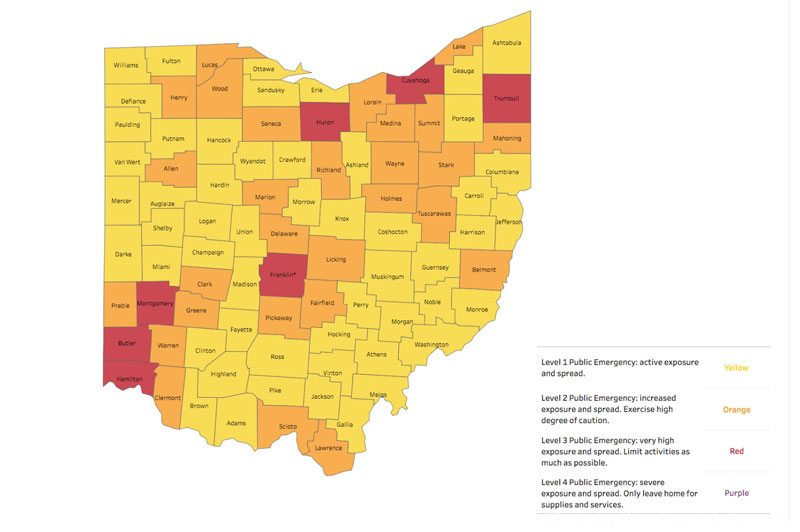
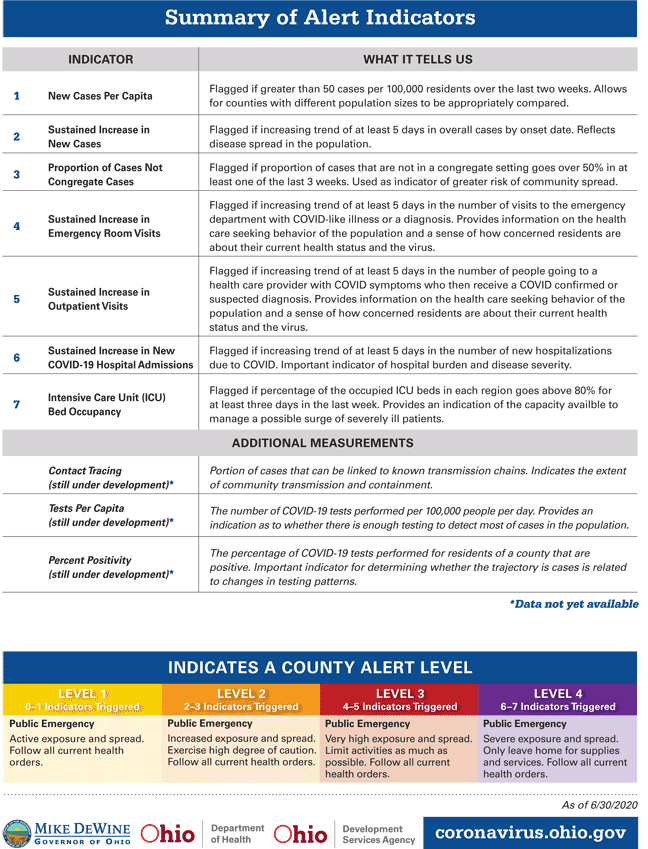
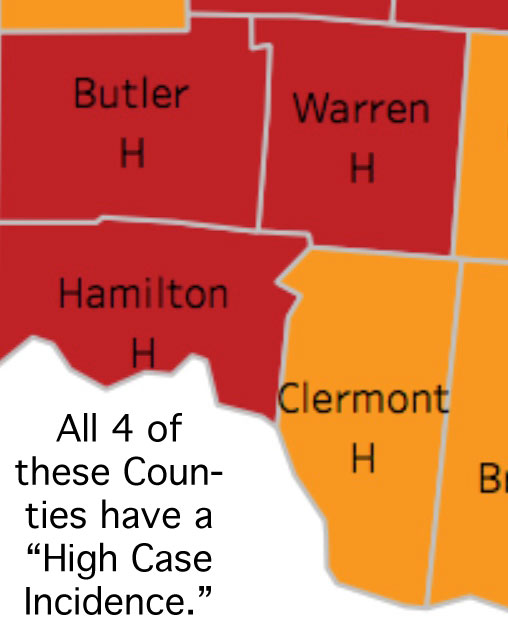
A “Public Emergency” has been declared in RED counties – with very high exposure and spread.
On Thursday, Governor DeWine released Ohio’s updated Public Health Advisory System map. New health data compiled by the Ohio Department of Health found that 29 counties currently have a very high risk of exposure and spread (Level 3): Hamilton, Butler, and Warren are among the “RED” counties.
“We’ve gone up dramatically in a relatively short period of time,” Gov. Mike DeWine said to reporters Thursday.
“What you’re seeing in today’s numbers should get our attention,” DeWine said. “There’s a red tide flowing all over the state of Ohio.”
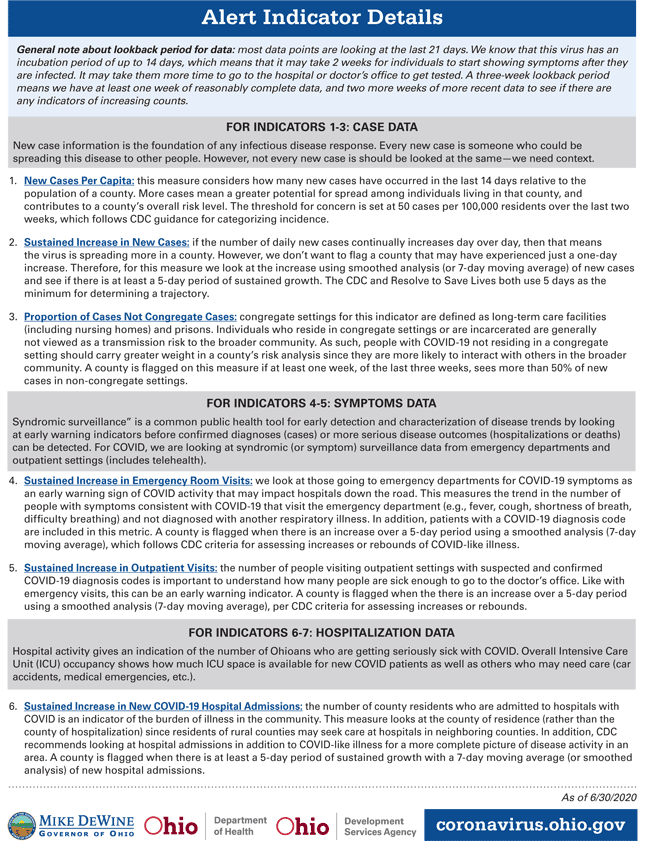
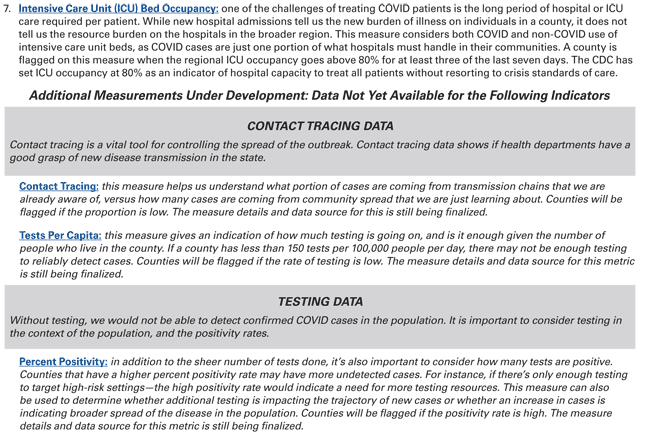
Thirteen new counties turned red this week indicating “very high exposure and spread” on the Ohio Public Health Advisory System — a product of seven inputs like hospital visits, outpatient care visits in a county, population-adjusted infection rates and others. Twenty-nine counties are red, spanning about two-thirds of the state’s population.
“What you’re seeing in today’s numbers should get our attention,” DeWine said. “There’s a red tide flowing all over the state of Ohio.”
DeWine said some of the newly-turned red counties are slated to host community events like political rallies, pub crawls and social gatherings and that “now is really the time to rethink whether these are in the best interest of the community.”
He did not address his own administration’s decision to exempt recent rallies for President Donald Trump from the statewide mask requirement.
While DeWine said there are no plans in store for any kind of statewide stay-at-home order, he declined to promise against instituting the policy down the line.
All told, nearly 176,000 Ohioans have contracted COVID-19. Nearly 17,000 have been hospitalized, and 5,038 have died since March.
In red counties, health department staff said they continue to see spread at family gatherings like bonfires, birthday parties and barbeques.
Jennifer Hiestand, a public information officer at the Zanesville-Muskingum County Health Department, estimated 60% of people in public are wearing masks. Contact tracers have found “mini outbreaks” that are seemingly the result of people letting their guards down.
In red counties, health department staff said they continue to see spread at family gatherings like bonfires, birthday parties and barbeques.
“People just made the decisions not to social distance or not to wear a mask, those things that they probably should have,” she said.
Mahoning County Health Commissioner Ryan Tekac said he is seeing a lot of the county’s progress this summer start to erode as cold weather drives people inside.
“I think there are some concerns right now that individuals are putting their guards down,” he said.
Ohio’s recent case surge fits in with a national trend. The New York Times reports cases are trending upward in 41 states, especially in the Midwest.
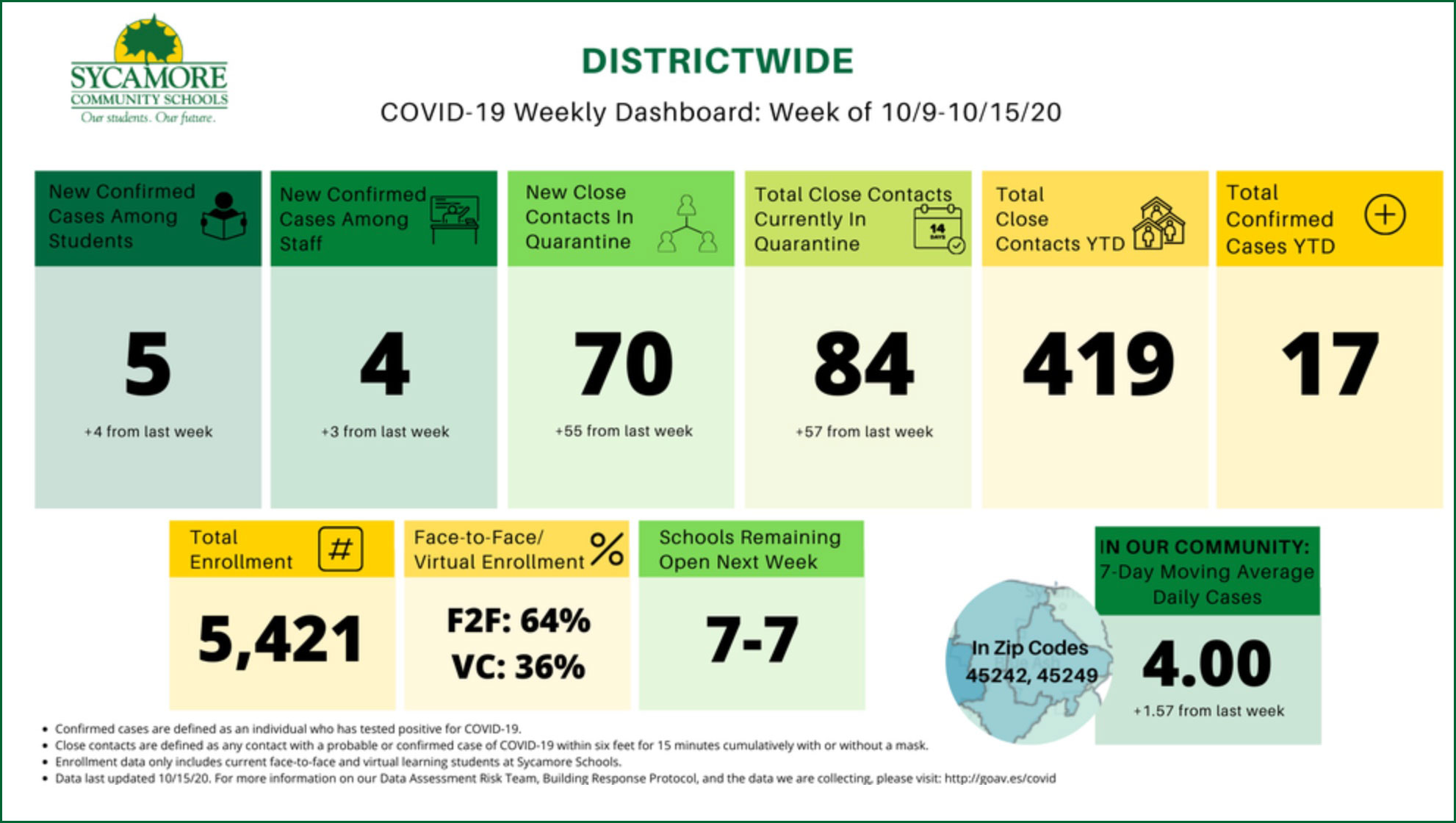
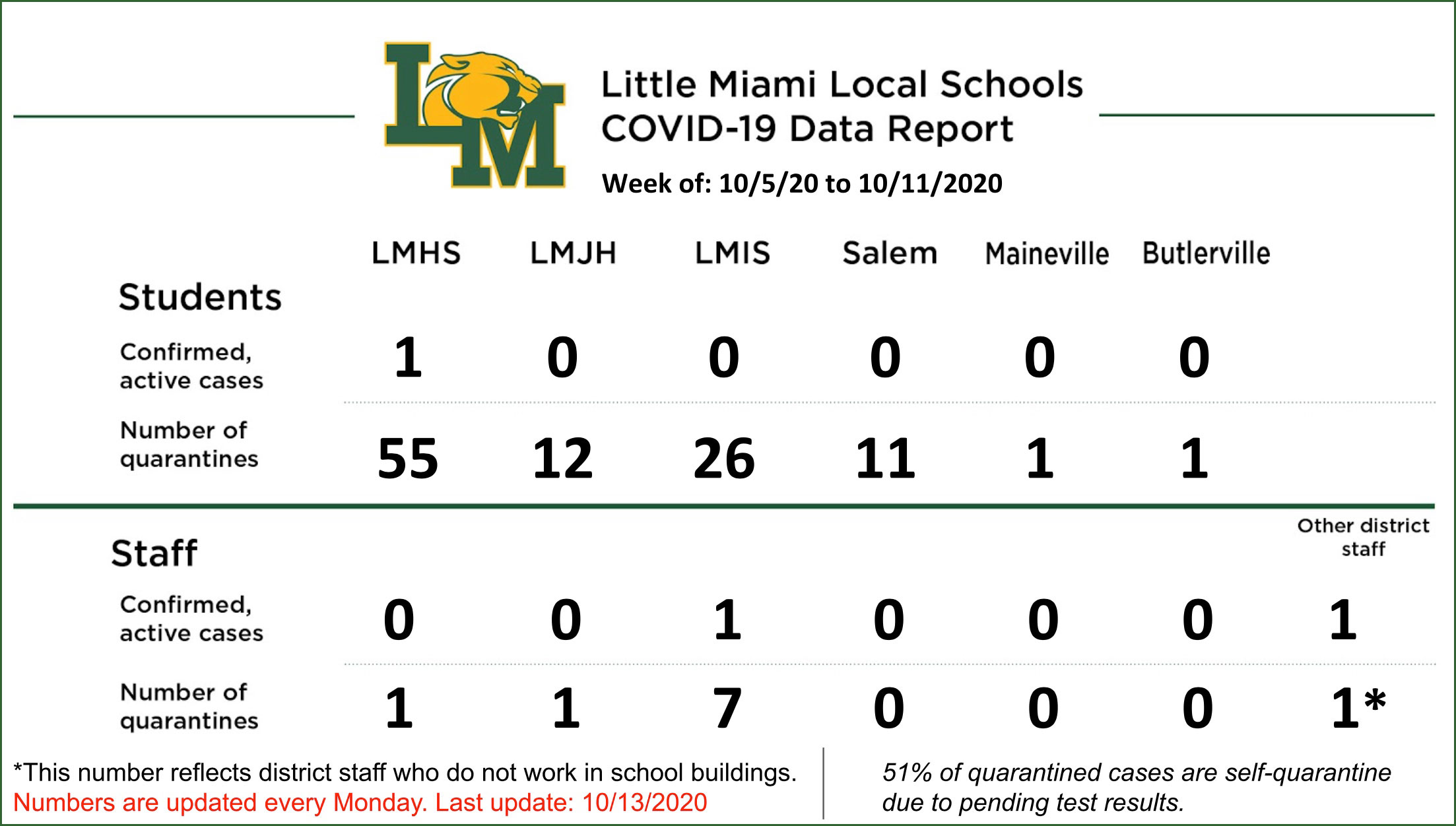
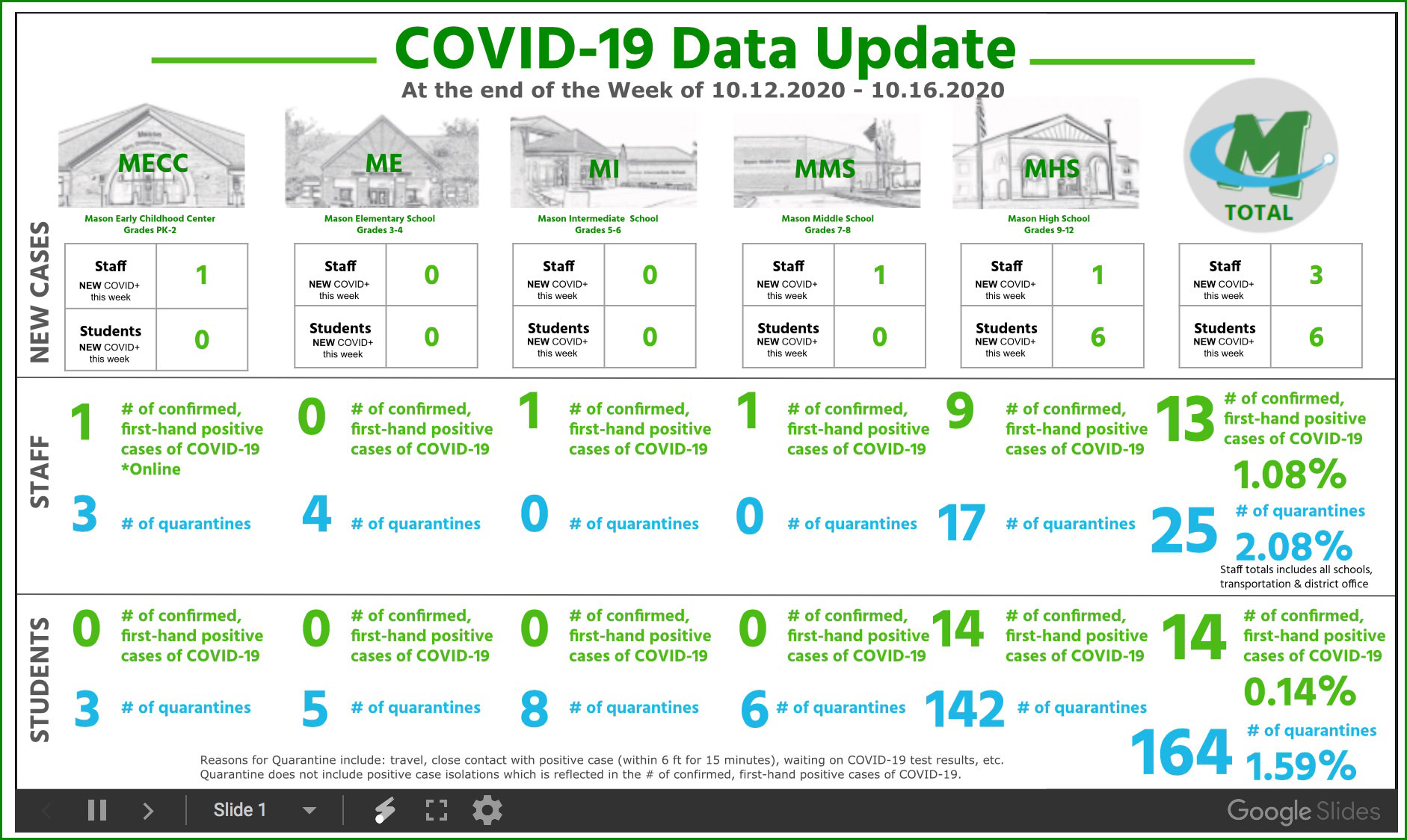
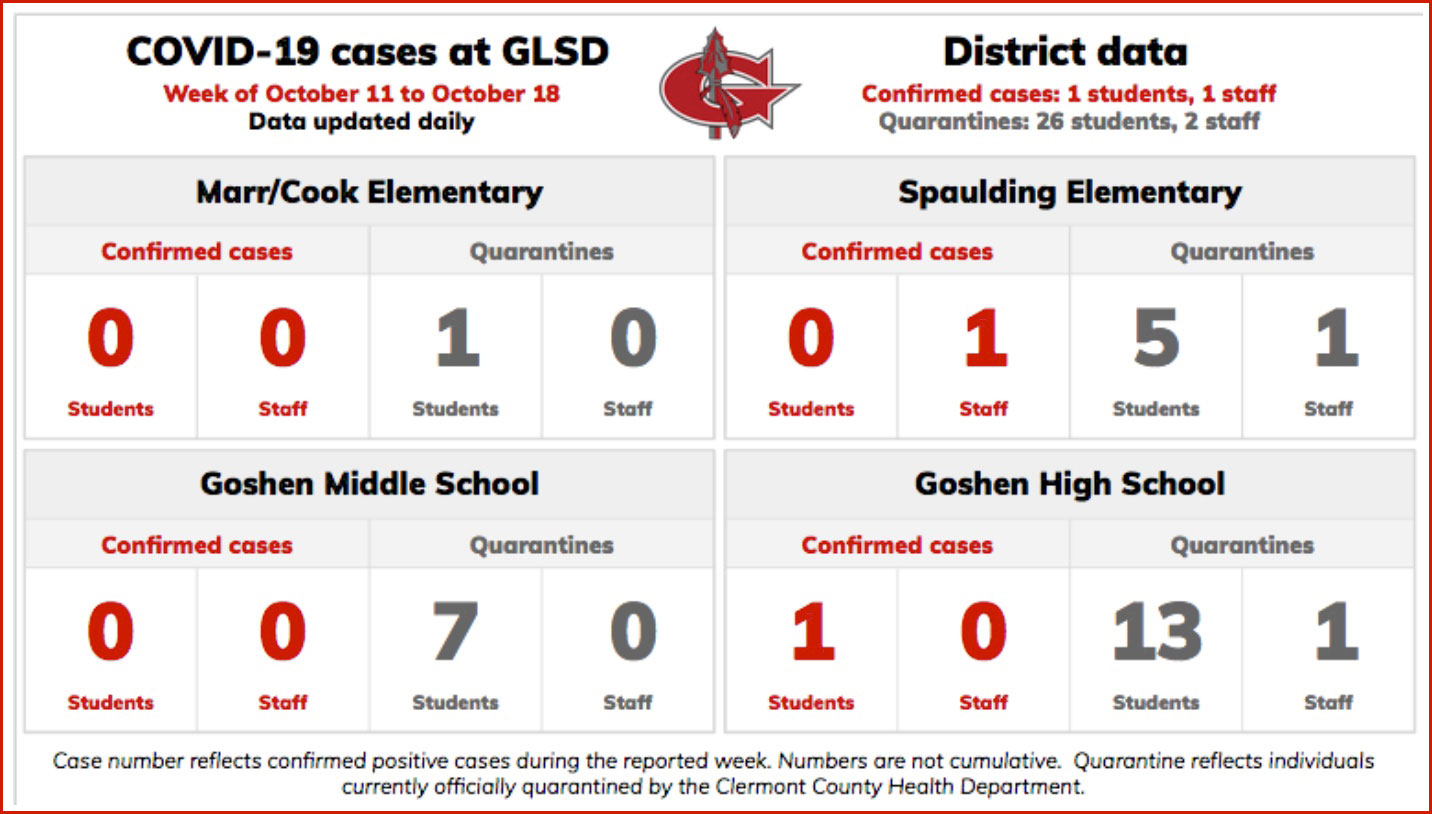
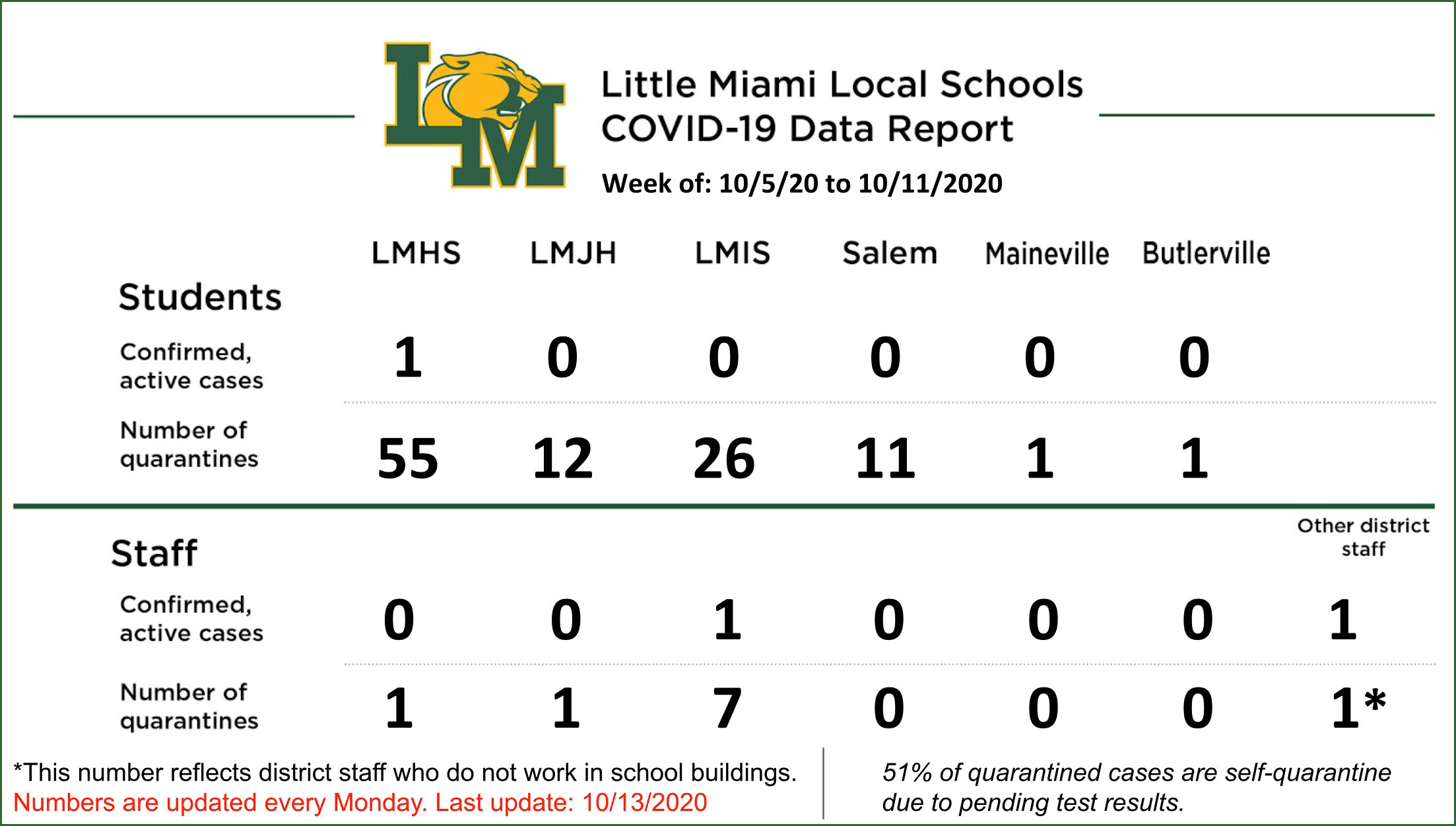
Sycamore Aves mom reminds us of the importance to stay home if you’re experiencing COVID-19 symptoms. These next few weeks will be crucial. Please do your part so we can stay in school!
Two holidays are coming up that will test Ohio’s public health discipline — Halloween and Thanksgiving.
Tekac said there’s a lot of concern, especially with Thanksgiving, about the potential for outbreaks. However, he said people know the guidance; wear masks, keep your distance, wash your hands, outside is better than inside.
He said at a certain point it comes to individuals making their own good decisions.
Dr. Anthony Fauci, the top infectious disease expert at the National Institute of Health, told CBS News it’s an “unfortunate fact” that Thanksgiving will cause a lot of spread and suggested skipping out on the tradition this year.
“I think given the fluid and dynamic nature of what’s going on right now and the spread and uptick of infections, I think people should be very careful and prudent about social gatherings,” he said.
Active children and adults, people with heart and lung disease, including asthma, and older adults should reduce prolonged or heavy outdoor exertion.
Air Quality Forecast is 105 AQI for Thursday, July 17
The Southwest Ohio Air Quality Agency has issued an Air Quality Alert for Friday, July 17 for Butler, Clermont, Hamilton, and Warren counties in Ohio; Boone, Campbell, and Kenton counties in Kentucky; and Dearborn County in Indiana.
You can help protect those most vulnerable
• Take the bus, carpool, bike or walk instead of driving
• Refuel your vehicle after 8 p.m.; do not top off when refueling and tighten the gas cap
• Avoid idling your vehicle
• Combine trips or eliminate unnecessary vehicle trips
• Keep your vehicle maintained with properly inflated tires and timely oil changes
• Avoid use of gasoline-powered lawn equipment on Air Quality Advisory days
• Avoid use of oil-based paints and stains on Air Quality Advisory days
• Never burn leaves or other yard trimmings
• Always burn clean, seasoned wood in outdoor fire pits, fireplaces and wood stoves
• Do not use fire pits or fireplaces for non-essential home heating on Air Quality Advisory days
• Conserve electricity
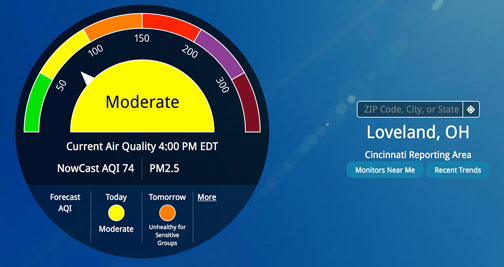
You can check the current air quality by clicking on this image and entering a ZIP Code.
If you find that having this type of local news adds value to your quality of life, kindly consider contributing to the cost of producing it.
Active children and adults, people with heart and lung disease, including asthma, and older adults should reduce prolonged or heavy outdoor exertion.
Air Quality Forecast is 105 AQI for Wednesday, July 15
The Southwest Ohio Air Quality Agency has issued an Air Quality Alert for Tuesday, July 15 for Butler, Clermont, Hamilton, and Warren counties in Ohio; Boone, Campbell, and Kenton counties in Kentucky; and Dearborn County in Indiana.
You can help protect those most vulnerable
• Take the bus, carpool, bike or walk instead of driving
• Refuel your vehicle after 8 p.m.; do not top off when refueling and tighten the gas cap
• Avoid idling your vehicle
• Combine trips or eliminate unnecessary vehicle trips
• Keep your vehicle maintained with properly inflated tires and timely oil changes
• Avoid use of gasoline-powered lawn equipment on Air Quality Advisory days
• Avoid use of oil-based paints and stains on Air Quality Advisory days
• Never burn leaves or other yard trimmings
• Always burn clean, seasoned wood in outdoor fire pits, fireplaces and wood stoves
• Do not use fire pits or fireplaces for non-essential home heating on Air Quality Advisory days
• Conserve electricityYou can check the current air quality by clicking on this image and entering a ZIP Code.
If you find that having this type of local news adds value to your quality of life, kindly consider contributing to the cost of producing it.
Active children and adults, people with heart and lung disease, including asthma, and older adults should reduce prolonged or heavy outdoor exertion.
Air Quality Forecast is 101 AQI for Tuesday, July 14
The Southwest Ohio Air Quality Agency has issued an Air Quality Alert for Tuesday, July 14 for Butler, Clermont, Hamilton, and Warren counties in Ohio; Boone, Campbell, and Kenton counties in Kentucky; and Dearborn County in Indiana.
You can help protect those most vulnerable
You can help the situation locally by not using fire pits, lighting campfires, charcoal grills, or setting off fireworks.
If you conserve electricity by turning out lights and unplugging unused appliances and electronics during the alert it will reduce the demand for coal-burning power plants in our region.
Take the bus, carpool, bike, or walk instead of drive.
Refuel your vehicle after 8 p.m.; do not top off when refueling and tighten the gas cap.
Do not idle your vehicle; exhaust contributes considerably to ozone formation.
Combine trips or eliminating unnecessary vehicle trips.
Keep your vehicle maintained with properly inflated tires and timely oil changes.
Avoid use of gasoline-powered lawn equipment on Air Quality Alert days.
Avoid use of oil-based paints and stains on Air Quality Alert days.
Never burn leaves or other yard trimmings.
Suspend use of fire pits, campfires and charcoal grills on Air Quality Alert days.
Conserve electricity by turning out lights and unplugging unused appliances and electronics.
You can check the current air quality by clicking on this image and entering a ZIP Code.
If you find that having this type of local news adds value to your quality of life, kindly consider contributing to the cost of producing it.
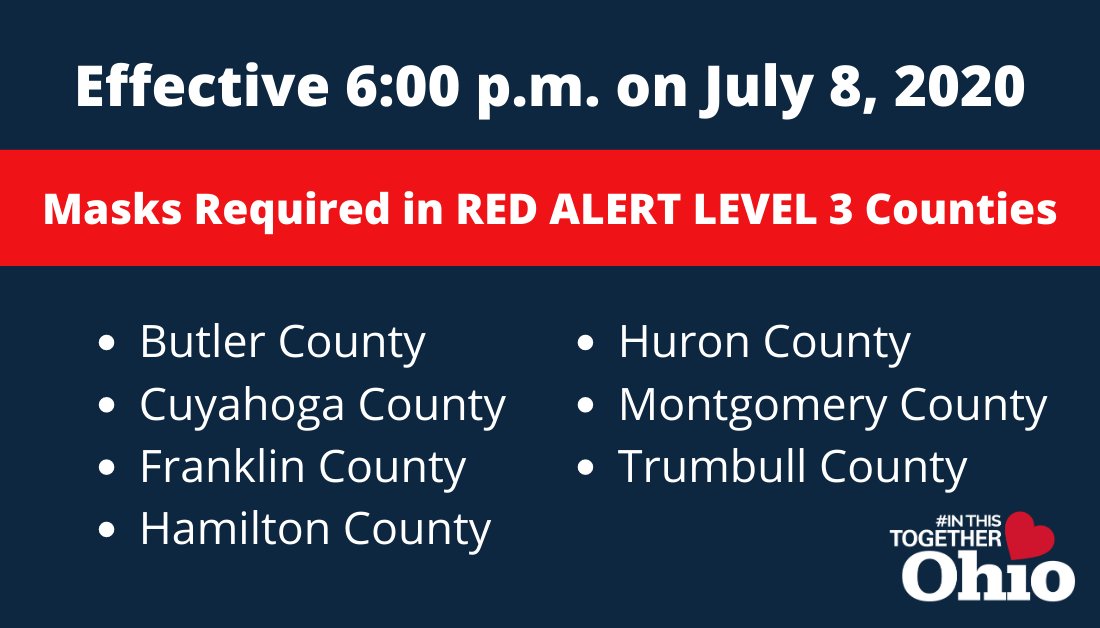
Loveland, Ohio – Today beginning at 6 PM all of Hamilton County is under an order of the Ohio Department of Health that mandates the wearing of face coverings in public.
The Public Health Advisory Alert System is a color-coded system designed to supplement existing statewide orders through a data-driven framework to assess the degree of the virus’ spread and to engage and empower individuals, businesses, communities, local governments, and others in their response and actions.
The system consists of four levels that provide Ohioans with guidance as to the severity of the problem in the counties in which they live. The levels are determined by seven data indicators that identify the risk level for each county and a corresponding color code to represent that risk level.





 You can help protect those most vulnerable