

Tag: By: Marty Schladen –

  • Economists: Ohio school funding cuts would hurt economy, increase inequality

    Economists: Ohio school funding cuts would hurt economy, increase inequality

    By:  – Ohio Capital Journal

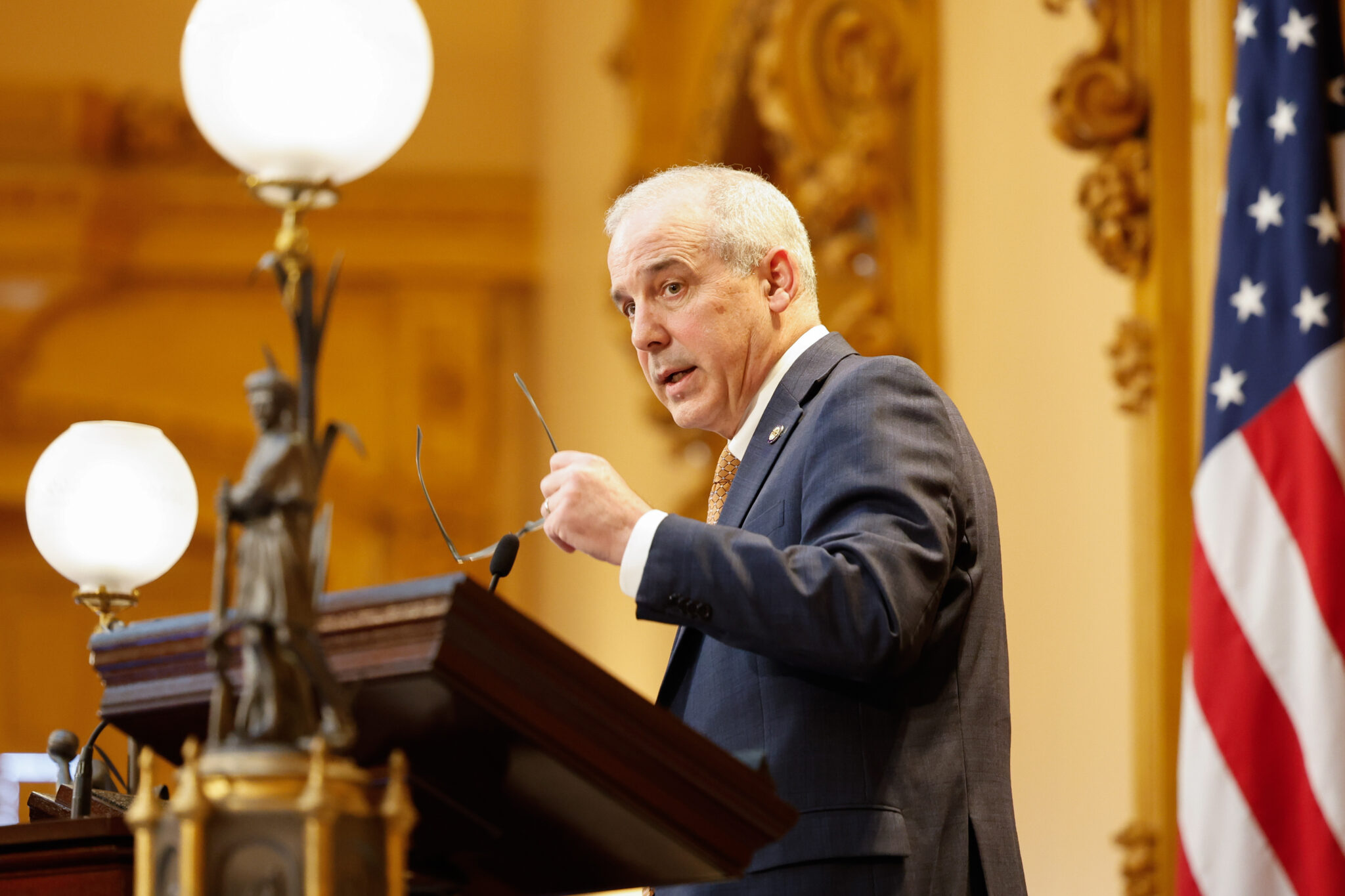
    In a survey released Monday, the overwhelming majority of economists said cuts to public education funding proposed by Republican Ohio House Speaker Matt Huffman would dampen the state’s future economic output at the same time that they would increase inequality in an already unequal state.

    According to the Ohio Supreme Court, the state’s public schools have been chronically underfunded. Over the past several years, the Ohio General Assembly has attempted to address the problem through the Cupp-Patterson plan passed as part of the state budget. Because it was included in the state budget, it wasn’t fully funded, so full implementation will only come if lawmakers approve the third and final phase of funding in the two-year state budget due July 1.

    But fresh off championing nearly $1 billion in new money for families sending their kids to private and religious schools last year as Senate president, Huffman last month said Ohio’s public school funding was “unsustainable.”

    A panel of Ohio economists said Huffman’s proposed $325 million-a-year cut to the state’s public school funding would be a huge mistake. Not only would that put poor families even further behind, it would sap the state’s economic output in the long run, the economists agreed by large margins.

    Scioto Analysis surveyed 17 Ohio economists and asked if they agreed that “cutting school spending by $650 million (over two years) would significantly reduce the state’s future economic output.” Fourteen, or 82%, agreed, while two were uncertain. Just one disagreed.

    In the comment section of the survey, Bill LaFayette of Regionomics said it all goes back to why we spend money on public schools in the first place.

    “School spending is not an expenditure, it is an investment in our future workforce,” he wrote. “If we don’t have the revenue to support our schools, colleges, and universities adequately, perhaps we should rethink some of those tax cuts.”

    GET THE MORNING HEADLINES.


    Kathryn Wilson of Kent State University said the costs from cutting education would be multiple.

    “There are two effects I foresee,” she wrote. “One is that there will be less productivity because there will be less human capital (fewer high school graduates, lower test scores and skills). A second effect is that there will be more reliance on government assistance programs and criminal justice costs due to the lower graduation rates and earnings potential of Ohio’s students.“

    The economist who disagreed that cutting spending on public education would harm economic output, Michael Jones of the University of Cincinnati, didn’t explain his thinking.

    A similarly large majority of economists agreed that “cutting school spending by $650 million would significantly increase inequality in Ohio.” Again, 14 agreed, two were uncertain and one disagreed.

    Such inequality is already a big issue in the Buckeye State. A 2024 analysis said that the lowest-paid 20% of Ohioans paid twice as much of their incomes in taxes as the highest-paid 1% did. Also, more than a quarter of Ohioans are poor enough to qualify for Medicaid, meaning that for an individual woman who isn’t pregnant, she makes less than $21,600 a year.

    Helping drive inequality might be such mechanisms as Ohio’s $1 billion-a-year LLC tax break. Sold on promises that it would supercharge the state economy, its boosters haven’t been able to show it’s had any effect. Most of its benefit, however, accrues to the wealthiest Ohioans.

    There’s also more than $1 billion the state has forgone in liquor franchise taxes to fund JobsOhio, which according to its own metrics, has shown middling performance. And Gov. Mike DeWine continues to give tech giants massive tax cuts to build data centers that would create relatively few jobs, and that the companies may well have built without the tax breaks.

    In the Scioto Analysis survey, the economists said Huffman’s school funding cuts would only exacerbate inequality.

    “Public education funding has always been America’s biggest spending program for reducing inequality,” wrote Jonathan Andreas of Bluffton University. “In places without any public education funding, there is huge inequality in education which causes huge inequality in income.”

    Wilson of Kent State said that less state funding for public schools meant more reliance on local property taxes. Therefore, poorer districts would have poorer schools.

    “The purpose of the funding (Huffman proposes to cut) was to have less reliance on local property taxes,” she wrote. “There are large differences in per-student-spending across districts within Ohio. Reducing this funding will increase those gaps and increase inequality.”

    Jones of the University of Cincinnati was the sole economist to disagree that slashing public school funding would increase inequality, but again he didn’t offer an explanation for that stance.

    YOU MAKE OUR WORK POSSIBLE.

    _____________
    Marty Schladen
    Marty Schladen

    Marty Schladen has been a reporter for decades, working in Indiana, Texas and other places before returning to his native Ohio to work at The Columbus Dispatch in 2017. He’s won state and national journalism awards for investigations into utility regulation, public corruption, the environment, prescription drug spending and other matters.

    Ohio Capital Journal is part of States Newsroom, the nation’s largest state-focused nonprofit news organization.

    MORE FROM AUTHOR

  • Ohio coal plant said to be nation’s most deadly. New owners seem likely to keep it open

    Ohio coal plant said to be nation’s most deadly. New owners seem likely to keep it open

    By:  Ohio Capital Journal

    Environmental activists have been pressing the company buying an Ohio coal plant said to be the nation’s deadliest to retire the facility. But that seems unlikely, given statements it made in a regulatory filing that it provided to the Ohio Capital Journal.

    The buyer, Energy Capital Partners, has boasted of helping plants make the transition away from coal. It hasn’t answered questions about its plans for Gavin, but in a Dec. 11 filing before the Federal Energy Regulatory Commission, it expressed no such plans for the Gavin Plant.

    “As with any electric generation facility, (Energy Capital Partners) and Javelin expect that the Gavin facility… will continue to operate for so long as they are legally able to do so on an economic basis,” it said.

    Energy Capital Partners, or ECP, and Javelin are private-equity firms that are in the process of buying the 50-year-old plant from another private-equity firm, Blackstone. The 2,600 megawatt plant along the Ohio River near Cheshire has stirred controversy for years.

    To settle lawsuits in 2002, a former owner, American Electric Power, bought out residents around the plant for more than three times the value of their property.

    The generating facility had been dumping toxic coal ash into unlined pits, creating worries that it would contaminate groundwater. The U.S. Environmental Protection Agency in 2022 ordered it to stop, and now its owners face a $40 million cleanup liability.

    And a 2023 analysis by the Sierra Club looked at coal-plant emissions and weather patterns. It concluded that because it sends a plume of toxins over populous areas in the eastern United States, the Gavin plant is the deadliest in the country, killing an estimated 244 people a year.

    Many investors have been turning away from fossil fuels — and especially coal — as a method of powering electricity generation. But private-equity investors have been taking up some of the slack, with nearly 80% of their power plant investments being in those fueled by coal or gas.

    Private equity has been stigmatized over claims that it practices one of the harshest forms of capitalism. They often buy assets in deals that quickly recoup their investments, then frequently sell off the most valuable parts of an enterprise, and then walk away either by selling or declaring bankruptcy. Whether people needlessly lose jobs or consumers lose choices is not a consideration, critics say.

    That has left environmentalists and private-equity critics worried that Gavin’s owners will continue to operate it as a polluting coal plant, then close it, and find a way to stick taxpayers with any cleanup costs.

    However, Energy Capital Partners bills itself as a company that helps utilities convert from using coal.

    “Energy Capital Partners (ECP) is a leading credit and equity investor across energy transition infrastructure, with a focus on investing in electricity and sustainability infrastructure, providing reliable, affordable clean energy,” its website says.

    The company last week declined to respond to questions, other than to send the Dec. 11 filing it made in a FERC proceeding. In it, ECP made several statements that seem to indicate the company plans to keep the Gavin plant operating as it is.

    “Notably, the Gavin facility has an existing long-term contract for coal supply with a supplier unaffiliated with Javelin, and ECP and Javelin have no intention of altering those arrangements,” it says.

    The filing also said that it’s just speculation that the new owners plan to retire the plant.

    “… regarding a secondhand, unnamed source’s speculation regarding plans to retire the Gavin facility, ECP and Javelin confirm that there are no such plans,” it said. “Notably, even the post cited by the Joint Protesters for the proposition that Gavin may be retired ‘in the coming years’ simply states (again, based on an unnamed source) that the facility may close or be converted to run on a different fuel by 2031, which is well outside of the forward-looking view on which the Commission relies in reviewing Section 203 applications.”

    A group critical of the practices of private-equity investors asked what it would take to close the Gavin Plant

    “Whether owned by Blackstone or ECP, every day that private equity firms continue to operate the deadly Gavin coal plant is another day that private equity executives are choosing to put communities at greater health risk,” Alissa Jean Schafer, Climate Director of the Private Equity Stakeholder Project said in a statement. “Gavin is one of the worst polluting power plants in the nation, and as emission plumes travel downwind, these negative health impacts reach far beyond Ohio. How many more premature deaths will be linked to Gavin before this plant is shut down?”
    _______________
    Marty Schladen
    Marty Schladen

    Marty Schladen has been a reporter for decades, working in Indiana, Texas and other places before returning to his native Ohio to work at The Columbus Dispatch in 2017. He’s won state and national journalism awards for investigations into utility regulation, public corruption, the environment, prescription drug spending and other matters.

    Ohio Capital Journal is part of States Newsroom, the nation’s largest state-focused nonprofit news organization.

    MORE FROM AUTHOR