Tag: BY: SUSAN TEBBEN

  • Ohio’s pro-abortion rights groups plan fights against total abortion ban bill

    Ohio’s pro-abortion rights groups plan fights against total abortion ban bill

    By:  Ohio Capital Journal

    Pro-abortion rights advocates are taking a proposed total abortion ban in Ohio to heart. Noting the celebration of Juneteenth and Black emancipation, they say the use of the 14th Amendment to try to exert state control over individual freedom and bodily autonomy is vile.

    The new bill a pair of freshman Republican House lawmakers are planning to introduce would ban abortion and criminalize it, along with in-vitro fertilization and certain types of contraception. The measure’s filing was first reported by WEWS.

    The bill is meant as a direct challenge to the state reproductive rights amendment passed by 57% of Ohio voters in 2023.

    Bill supporters say the current constitutional amendment that enshrined reproductive rights into the Ohio Constitution “should be treated as null and void” because, they claim, it violates the equal protection clause of the 14th Amendment “by denying pre-born persons the right to life.”

    The 14th Amendment of the U.S. Constitution protects citizenship and due process, along with equal protection under the law.

    “In appealing to the 14th Amendment, the Ohio Prenatal Equal Protection Act appeals to a higher law; the U.S. Constitution,” the anti-abortion group End Abortion Ohio, who is leading the charge on the bill, said in a statement.

    Austin Biegel, a member of End Abortion Ohio, argued that yes, the bill would go against the majority public opinion of Ohioans, but he justified it by arguing that slavery was once also supported and legal in the U.S.

    Lexi Dotson-Dufault, executive director of the resource and referral service Abortion Fund Ohio, called the use of the 14th Amendment as part of an abortion ban bill “vile.”

    “A bill that bans abortion while citing the 14th Amendment misuses a civil rights protection to justify state control over our marginalized community members, especially Black people,” Dotson-Dufault said.

    A report from the National Partnership for Women & Families in May of last year found that state abortion bans “exacerbate the existing Black maternal mortality crisis,” and “threaten” 7 million Black women nationwide.

    The study found that mothers who can’t access abortion care see negative impacts to their “economic security and development of their existing children.”

    ‘Canary in the coal mine’

    Dotson-Dufault and Ohio Women’s Alliance Deputy Director Jordyn Close believe Republican legislators are emboldened to attempt anti-abortion measures in part because of a Missouri Supreme Court ruling that reinstated a “de facto abortion ban” in May, lifting an injunction that had blocked abortion restrictions.

     Lexi Dotson-Dufault, executive director of Abortion Fund Ohio. Photo courtesy of Lexi Doston-Dufault. 

    The decision came months after that state also approved an amendment to its constitution that protected reproductive rights.

    The pro-abortion rights advocates see no legal standing for the new abortion ban bill, but they also see abortion rights as “the canary in the coal mine when it comes to … rights being stripped away from people.”

    “I don’t think that this bill has any legs to stand on, but I do think that it’s very important to highlight just how gross it is that they would even try it,” Close said. “Because if it’s not this bill, it will be another one introduced in the next session … it just continues because they do not respect Ohioans.”

    Ohio’s constitutional amendment, passed in 2023, protects abortion and other types of reproductive health like fertility treatments and miscarriage care, but more than 30 other regulations still sit on the books in Ohio law.

    Those statutes would have to be undone one by one, even though state courts have blocked some of the laws, as well as a six-week abortion ban that was on the books before Roe v. Wade was overturned by the U.S. Supreme Court.

    But Republicans in the state legislature are also trying to double-down on such regulations.

    State Reps. Mike Odioso and Josh Williams have already filed House Bill 347, a bill which targets informed consent, requiring that 24 hours before an abortion doctors provide not only “medically accurate information that a reasonable patient would consider material to the decision of whether to undergo the elective abortion” — which abortion providers have said they are already required to do — but also “alternatives to abortion, including adoption and parenting.”

    H.B. 347 also puts into law medically controversial and unproven language that “it may be possible to reverse the effects of the abortion-inducing drug” if a medication abortion is taking place.

    This isn’t the first time Ohio lawmakers have attempted to include this language in state law.

    The bill also requires a physician to notify the pregnant person, except in the case of rape or incest, “that the unborn child’s father has a child support obligation, even if the father has offered to pay for the elective abortion.”

    According to a recent midyear analysis from the Guttmacher Institute, 13 states have total abortion bans on the books, with another 28 that have bans between six weeks of gestation and “viability.”

    Ohio’s constitutional amendment places abortion legality at viability, as determined by an individual’s physician.

    The institute’s report also said the first half of 2025 has given rise to anti-abortion state lawmakers who “have continued to push the envelope toward pregnancy criminalization, restrictions on bodily autonomy and laws that recognize fetal and embryonic personhood,” while also reducing funding for resources like sex education.

     Jordyn Close, deputy director of Ohio Women’s Alliance. (Photo by Graham Stokes for Ohio Capital Journal. Republish photo only with original article.) 

    The state-level action comes as the Trump administration spent its first few months in office revoking Biden-era executive orders on abortion, including patient privacy protections, and rolling back guidance on access to emergency abortion care under the federal Emergency Medical Treatment and Labor Act.

    President Donald Trump also pardoned nearly two dozen people convicted under a federal law that bans threats, physical obstruction or force at the entrances to reproductive health clinics.

    The language of that federal law for which Trump issued pardons also bars interference, injury or intimidation for any exercise of First Amendment religious freedom, including at places of worship.

    Efforts to slash federal funding have also touched reproductive health, with cuts to Title X, which funds “family planning” grants and other reproductive health services for low-income individuals, including many services in Ohio.

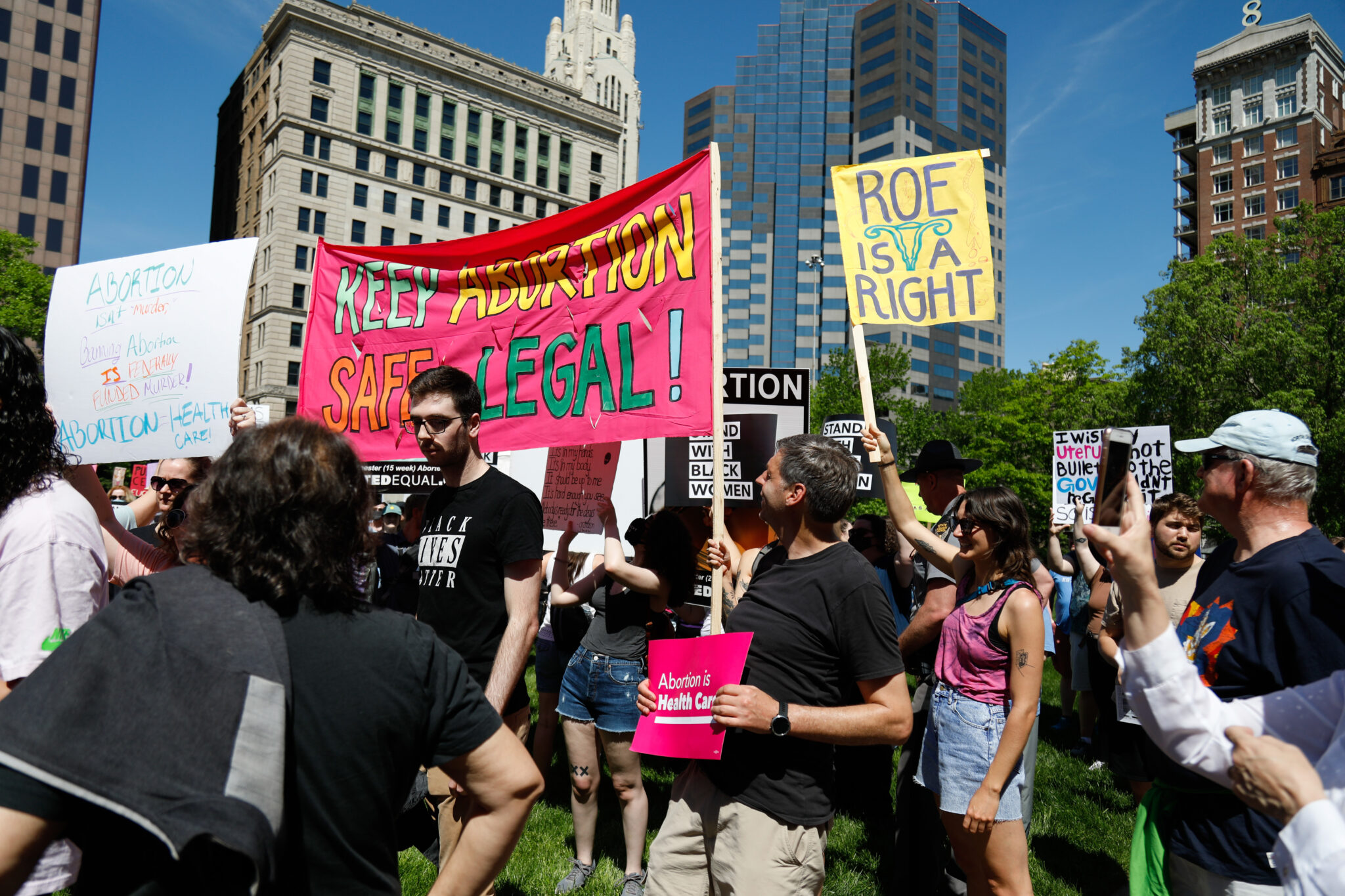
    Pro-abortion rights groups have already started their fight against the total abortion ban bill with a demonstration on Wednesday that interrupted an anti-abortion gathering in the Statehouse.

    They want to spend more time not only raising their voices in the halls of the legislature, but also educating the voters going into 2026 elections.

    “Even though we had a moment of victory in 2023, the fight is far from over,” Close said. “We have to look toward the next electoral (cycle) to protect our courts, because inevitably when we have these showdowns in the state legislature, the courts is where everything ends up.”

    A spokesperson for Oho House Speaker Matt Huffman said Huffman’s focus remains on the state operating budget until its July 1 deadline, and had no other information on the bill’s introduction or timeline.

    A request for comment from Senate President Rob McColley on whether he would consider such a bill went unanswered on Wednesday.

    Back in November 2024, just before he began his tenure as Senate president, McColley told the Capital Journal “the inaction on the issue kind of speaks for itself,” referring to any effort to undermine the constitutional amendment. He also said since the issue had passed the year before, “there really hasn’t been a lot of discussion about it.”

    “I think, by and large, people realize Ohioans spoke, and that’s the way it is right now,” McColley said then.

    The Ohio Democratic Party said they were staunchly against the abortion ban measure, questioning the priorities of state Republicans, and saying the party with the Statehouse supermajority is attempting to “drag our state into the past.”

    “Ohio women would die under this cruel, disastrous legislation,” said Ohio Democratic Party Chair Kathleen Clyde.



    Susan Tebben
    Susan Tebben

    Susan Tebben is an award-winning journalist with a decade of experience covering Ohio news, including courts and crime, Appalachian social issues, government, education, diversity and culture. She has worked for The Newark Advocate, The Glasgow (KY) Daily Times, The Athens Messenger, and WOUB Public Media. She has also had work featured on National Public Radio.

    Ohio Capital Journal is part of States Newsroom, the nation’s largest state-focused nonprofit news organization.

    MORE FROM AUTHOR

  • Child health programs including even pediatric cancer research see cuts in Ohio House budget draft

    Child health programs including even pediatric cancer research see cuts in Ohio House budget draft

    By:  Ohio Capital Journal

    From changes to Medicaid to cuts to pediatric cancer research, the Ohio House budget proposal concerns many who have championed child wellbeing and improvement on issues where Ohio struggles — like infant mortality — as important budget priorities.

    “It just felt like they had taken a hacksaw to some of these line-items without real consideration to what they did,” said Kathryn Poe, budget and health researcher for the think tank Policy Matters Ohio.

    Poe said it seems as though state legislators are taking cues from the federal government are trying to drastically cut spending, but that don’t improve the state in the process.

    “These cuts at the federal level also feel really haphazard,” Poe said. “But the state doesn’t have the amount of money or time or influence to make these sort of haphazard cuts.”

    Specifically, Poe sees the elimination of Ohio’s Medicaid expansion as a significant change that will create struggles for low-wage workers who count on Medicaid for their health insurance, and who will be prevented from planning for the future without the ability to count on proper health insurance.

    As Poe put it, “what do you do when 700,000 people lose their insurance overnight?”

    The House’s version of the budget absorbed a proposal by Gov. Mike DeWine in his executive budget that creates a trigger effect, eliminating Group VIII, or the Medicaid expansion eligibility group, “if the federal government sets the federal medical assistance percentage below (its current level of) 90%,” according to budget documents.

    The federal medical assistance percentage (or FMAP) refers to the amount of federal funding the state receives for Medicaid, based on a state’s per capita income.

    GET THE MORNING HEADLINES.


    The expansion group is made up of Ohioans ages 19 to 64 who have household incomes of less than 138% of the federal poverty line and aren’t eligible in other Medicaid categories. According to the Health Policy Institute of Ohio, the Medicaid expansion “has been a major contributor to Ohio’s uninsured rate dropping by half from 14% in 2010 to 7% in 2022.”

    The group said the expansion has also improved access to care, with data showing a 31% decrease in Ohioans who went without care due to cost from 2013 to 2023.

    According to the state, the expansion population caseload is projected to be 779,000 Ohioans in fiscal year 2026, and 772,000 in 2027. That would account for more than $13.5 billion in expenditures over the two fiscal years.

    Without the expansion, workers under the program would be less likely to have insurance, partly because many workers earning less than 138% of the federal poverty line are working jobs where they aren’t given enough hours to receive medical benefits, such as entry-level retail jobs or customer service.

    Citing data from the U.S. Bureau of Labor Statistics, the Health Policy Institute of Ohio said even workers in the skilled trades like electricians and medical assistants could lose benefits, considering the federal poverty level of 138% for a family of three represents an annual income of $36,777.

    “It would be a devastating economic loss,” Poe said. “The answers (for Ohioans who would lose the coverage) are everything from going to the emergency room, to not getting care, to letting that pain in your abdomen go on so long that you have to go to the emergency room anyway.”

    The budget proposal comes amid attempts by DeWine and the state to apply work requirements to that particular group of Medicaid participants.

    Not only will it create expensive health decisions, but the ripple effects will extend to the ability to afford groceries or have reliable transportation, according to Poe.

    Those effects would trickle all the way down to Ohio’s children as well, according to advocates. Groundwork Ohio criticized a House measure that would end a requirement that the Medicaid department “seek approval to provide continuous Medicaid enrollment for Medicaid-eligible children from birth through age three

    Budget documents say the change could create “possible service cost savings.”

    Groundwork called on the legislature to take back the changes, saying nearly 48% of all Ohio children under the age of 6 “depend on Medicaid for health coverage.”

    “The program covers about half of all births in the state and thousands of Ohio women rely on Medicaid to ensure a healthy pregnancy and support postpartum recovery,” according to an analysis of budgetary proposals in the House draft.

    The organization also criticized a provision of the budget that would limit Medicaid coverage for doulas, leaving the coverage for only the six counties with the highest infant mortality rates.

    The House plan also cuts pediatric cancer research by $5 million and eliminates lead abatement programs within the Ohio Department of Health. Groundwork Ohio noted the lead abatement program as part of their analysis of the budget plan, saying Ohio has “nearly double the national rate of children with elevated blood lead levels.”

    “Even small amounts of lead exposure in early childhood can harm the brain, delaying growth and development, and may cause learning, behavior, speech and other health problems,” the group stated.

    Advocates have already been publicly critical of the House plan to slash public education funding and drop a child tax credit proposed by DeWine in his budget plan. But adding the Medicaid changes, along with reducing funding in the areas of child development and a $1.5 million cut to “infant vitality” programming just make things worse, advocates say.

    “The House’s proposal represents a step backward at a time when we can least afford it,” said Lynanne Gutierrez, president and CEO of Groundwork Ohio, in a statement. “We urge lawmakers to fully restore these investments and prioritize Ohio’s future.”


    Susan Tebben
    Susan Tebben

    Susan Tebben is an award-winning journalist with a decade of experience covering Ohio news, including courts and crime, Appalachian social issues, government, education, diversity and culture. She has worked for The Newark Advocate, The Glasgow (KY) Daily Times, The Athens Messenger, and WOUB Public Media. She has also had work featured on National Public Radio.

    Ohio Capital Journal is part of States Newsroom, the nation’s largest state-focused nonprofit news organization.

    MORE FROM AUTHOR

  • Risk to federal ‘family planning’ grants could spell danger for Ohio clinics

    Risk to federal ‘family planning’ grants could spell danger for Ohio clinics

    Stock photo from Getty Images.

    By:  Ohio Capital Journal

    Health clinics that provide abortion services are already battling against threats to funds and the work they do. But services like contraception, STI testing, and preventative health screenings are also at risk with Trump administration plans to freeze “family planning” grants in Ohio and across the country.

    At risk is funding through Title X, a federal pot of money that goes to clinics that “have played a critical role in ensuring access to a broad range of family planning and preventive health services,” according to the U.S. Department of Health & Human Services.

    2023 annual report from HHS’ Office on Population Affairs on the Title X program lists services provided under the grants, including FDA-approved contraception, pregnancy testing and counseling, “assistance to achieve pregnancy,” infertility services, sexually transmitted infection services and other “preconception health services.”

    “Title X services are client-centered, culturally and linguistically appropriate, inclusive, trauma-informed and provided in a manner that ensures equitable and quality service delivery consistent with nationally recognized standards of care,” the annual report stated.

    As part of a whirlwind of efforts to cut government spending, the Trump administration reportedly wants to freeze more than $27 million in grants from the program.

    That cut would have the largest impact on Planned Parenthoods across the country, which receive $20 million of that funding.

    GET THE MORNING HEADLINES.


    In a March memo, the Planned Parenthood Federation of America underscored the importance of Title X funding, saying its clinics were the largest Title X provider in 2018, the year before the first Trump administration, serving 40% of patients under the program.

    The group left the program in 2019, but came back in 2021 after former President Joe Biden rolled back some Trump-era policies.

    “If Planned Parenthood patients can’t get quality, affordable health services … there would be grave nationwide consequences,” the memo stated.

    Planned Parenthood of Greater Ohio was one of the recipients of Title X grants in 2024, when it was awarded $1.98 million. The Ohio Department of Health also received a Title X grant that year of nearly $7 million, about the same amount as it received in both 2023 and 2022.

    “Any insinuation to take away critical family planning services from people with lower incomes to afford Trump’s tax cuts to billionaires is dangerous and unprecedented,” Planned Parenthood of Greater Ohio said in a statement to the Capital Journal.

    The group said they served 600 fewer patients than the Ohio Department of Health in 2023, but did it “for $5 million less in Title X funds.”

    “Planned Parenthood of Greater Ohio will continue to fight for our right to be a trusted, safety net provider in reproductive health care services like birth control, cancer screenings, testing and treatment for sexually transmitted infections, among other Title X-eligible services.”

    In their most recent annual report, the organization reported more than 66,700 visits to their health and surgical centers, providing care for 47,480 patients between 2022 and 2023.

    Of those visits, the group provided 86,346 tests for sexually transmitted diseases, administered 16,817 pregnancy tests, served 11,803 patients for contraception-related care and conducted 9,340 HIV tests. The facilities also had 7,734 preventive care visits, 7,136 telehealth visits and 3,255 visits regarding gender-affirming care.

    At the greater Ohio arm of Planned Parenthood, 56% of the patient base lives at or below 200% of the federal poverty line. That’s $62,400 for a family of four. Seventy four percent are between ages 18 and 34, 85% identify as female and 46% of patients rely on Medicaid for care, according to the annual report.

    The Ohio-based group receives 12.4% of its revenue through state and federal grants, with Medicaid and Medicare reimbursements making up 17.7% of revenue and 14.5% of funds coming from private or commercial insurance payments.

    The main source of revenue for Planned Parenthood of Greater Ohio in 2022-2023 was individual, institutional and “legacy giving.” It made up 35.3% of the agency’s revenue stream.

    As for spending that money, the annual report stated that 80% of the expenses are for program services, including the health services at clinics, education and outreach, and government and community relations. Another 14% went to management and “general” expenses, with 6% going to fundraising over that period.

    YOU MAKE OUR WORK POSSIBLE.

    __________________
    Susan Tebben
    Susan Tebben

    Susan Tebben is an award-winning journalist with a decade of experience covering Ohio news, including courts and crime, Appalachian social issues, government, education, diversity and culture. She has worked for The Newark Advocate, The Glasgow (KY) Daily Times, The Athens Messenger, and WOUB Public Media. She has also had work featured on National Public Radio.

    Ohio Capital Journal is part of States Newsroom, the nation’s largest state-focused nonprofit news organization.

    MORE FROM AUTHOR

  • Ohio teachers take action amid state, federal education funding uncertainty

    Ohio teachers take action amid state, federal education funding uncertainty

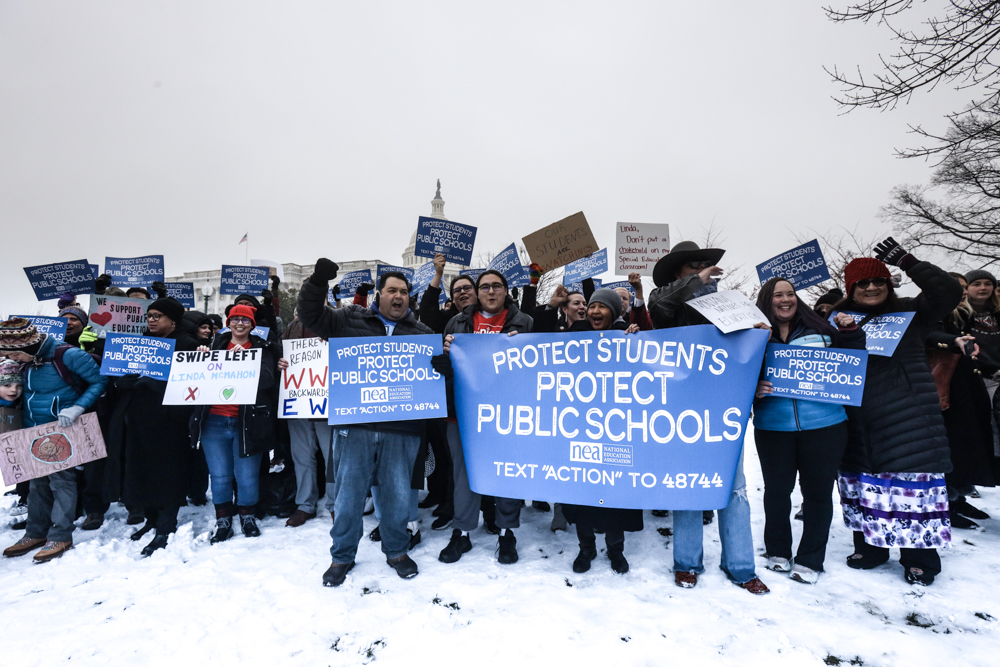
    Public education supporters rally at the U.S. Capitol in early February, speaking out against proposed cuts to the federal education budget, and the possible elimination of the U.S. Department of Education. Members of the Ohio Education Association attended the rally. (Photo by Jati Lindsey, courtesy of the National Education Association.)

    By:  – Ohio Capital Journal

    With state and federal funding up in the air, Ohio teachers are speaking out about what budget cuts would mean to their districts, about the importance of public schools to families and communities, and about how schools need to be strengthened to prioritize students’ futures.

    In her 31 years as a teacher in Cleveland Public Schools, Tracy Radich has never felt the need to fight for public school funding as much as she has this year, with state and federal budgets both giving public schools uncertain futures.

    “Having everything be so up in the air and … how we prepare and think about what might happen next school year, it makes me very fearful and very worried for the future of my school, my students,” said Radich, who has spent her career at Joseph M. Gallagher School, where she currently teaches third grade.

    Radich joins many public school advocates in questioning the funding of private school voucher programs in Ohio at a rate of more than $1 billion last year, while public schools who educate 90% of the state’s student population sit on pins and needles awaiting the fate of their funding.

    The state budget is currently being developed by the state legislature, but debates have been raging about whether or not funding for a model that’s been in place for years, called the Fair School Funding Plan by supporters, will stay in place for it’s last round of phase-in funding.

    Members of the Republican supermajority have questioned whether or not the plan is sustainable, and while Gov. Mike DeWine’s executive budget included the final phase-in of funding, public education advocates criticized the governor’s lack of inflation inputs as part of the final round of funding.

    Even one of the authors of the funding model, former state Rep. John Patterson, spoke out at a League of Women Voters of Ohio event to say leaving out inflation inputs would “create disruption” in the formula, increasing the costs for taxpayers.

    Dan Fray, a middle school English-Language Arts teacher and educational technology instructor with Toledo Public Schools, sees rallies and days of action as ways to raise awareness of what public school teachers do for the vast majority of students in the state.

    “We didn’t become teachers to get rich or to do anything but help students learn,” Fray said. “In this day and age, we didn’t become teachers to get cussed at or told what we’re doing is wrong.”

    To bring more attention to their cause, Radich and Fray will be part of a “day of action” on March 4, when teachers who are members of the their local teachers unions, along with the Ohio Federation of Teachers and the American Federation of Teachers as a whole, will promote education as the spending priority they think it should be.

    GET THE MORNING HEADLINES.


    The action will start first thing in the morning at Radich’s school, with a celebration line of teachers welcoming students at the start of the day, and passing out information to parents about the impacts of funding changes on their child’s education.

    Some teachers will head outside in Toledo, where Fray said signs will inform passersby of their aims, and blue shirts worn by teachers show educators’ desire to “preserve public education.”

    “We’re not protesting to say we hate the governor or we hate the budget or anything like that, it’s more what education is about and where we are in it,” Fray said.

    The view of the role of educators, particularly within the legislature, has “taken a hit” over the years, Fray said. He and Radich agree that despite the varying needs of school districts across the state, standardized testing has become king.

    “These high-stakes tests, by the time any data comes back from that, my students have already moved on to the next grade, so those tests don’t really help,” Radich said. “They inform the state, they punish schools, but they don’t really help the students.”

    In Fray’s view, state testing has impacted education decisions to such a degree that “the world is definitely a teach-to-the-test kind of world,” to the detriment of teaching and education in general.

    Focusing legislation and budgetary decisions on test scores that don’t give a full view of education, and the expansion of private school vouchers not only misses the point of education, the teachers say, but flies in the face of multiple state supreme court decisions ordering the state to bring back a thorough and equal system of learning in the state.

    “From a classroom teacher standpoint, it just seems like that continues to get ignored, and at this point, not only does it seem like it’s ignored, but they’re thumbing their nose at it,” Fray said.

    Disruptions to the federal contribution to the state’s education budget could add even more problems to the system, as Ohio’s school districts receive an average of about 10% of their revenue from the feds.

    “I don’t think people realize how cuts made in Washington, D.C., are going to directly impact thousands of children in Cleveland, Ohio, in rural communities and urban communities, everywhere,” Radich said.

    For some Ohio educators, that meant traveling to D.C. and standing on the steps of the U.S. Capitol earlier this month, to engage with members of Congress and urge rejection of changes or possible elimination of the U.S. Department of Education.

    Those who went to D.C. hoped to sway leaders against proposed cuts to programs within the education department, especially those benefitting lower-income students through Title I funding, and students who qualify for federal career training and college grants and loans.

    According to the Ohio Education Association, more than 800,000 students in the state receive Title I funding, and special education programs in Ohio would lose more than $550 million in proposed federal cuts.

    “Ohio educators and parents expect elected officials to prioritize our students’ futures and strengthen our public schools, so they remain a cornerstone of opportunity and equality,” the Ohio Education Association said in a statement following the D.C. rally.

    YOU MAKE OUR WORK POSSIBLE.

    _____________
    Susan Tebben
    Susan Tebben

    Susan Tebben is an award-winning journalist with a decade of experience covering Ohio news, including courts and crime, Appalachian social issues, government, education, diversity and culture. She has worked for The Newark Advocate, The Glasgow (KY) Daily Times, The Athens Messenger, and WOUB Public Media. She has also had work featured on National Public Radio.

    Ohio Capital Journal is part of States Newsroom, the nation’s largest state-focused nonprofit news organization.

    MORE FROM AUTHOR

  • Another Ohio school district joins EdChoice lawsuit, despite Lt. Gov.’s attempt to dissuade

    Another Ohio school district joins EdChoice lawsuit, despite Lt. Gov.’s attempt to dissuade

    Stock image from Pixabay.

    BY:  Ohio Capital Journal

    The Upper Arlington City Schools Board of Education chose to join a lawsuit seeking to eliminate Ohio’s EdChoice private school voucher program, despite Lt. Gov. Jon Husted telling the group it would be a waste of money.

    Ohio Lt. Gov. Jon Husted threw in his two cents in a letter emailed to the school board as they considered signing on to the suit.

    In the email to the board, Husted said the “case of school vouchers was long ago litigated,” and on the basis of that U.S. Supreme Court case, the EdChoice private school voucher program was “created and structured.”

    “I know because I created it in 2005 when I served as Speaker of the Ohio House of Representatives,” he wrote.

    A spokesperson for Husted confirmed on Tuesday that the statement, which was shared by the conservative advocacy group Ohio Value Voters, was indeed written by him.

    The letter comes as a lawsuit works its way through the Franklin County Court of Common Pleas that would, if plaintiffs are successful, eliminate the private school voucher program in Ohio entirely. Public school advocates who filed the lawsuit argue state funding of the private school vouchers creates an unequal system of education that violates the state constitution’s requirements for a properly supported public education system.

    Husted’s letter

    Husted said joining the lawsuit would “serve as an attempt to deny 348 Upper Arlington families and students currently using a state voucher as their choice of education for their children, many of which are attending other schools because of autism or other special needs.”

    “If after reading this email, you choose to fund this lawsuit, you will knowingly be wasting thousands of dollars on attorney fees for a lawsuit that has no chance of succeeding in an attempt to thwart the will of students and families who pay the property taxes that fund Upper Arlington schools,” Husted wrote.

    A court case cited by Husted was Zelman v. Simmons-Harris, an Ohio case that made its way to the nation’s highest court in 2002 in an attempt to decide whether voucher programs were valid under the U.S. Constitution.

    The split (5-4) decision upheld a state law that allowed Cleveland students to attend public or private schools through the Cleveland Scholarship and Tutoring Program, which the legislature attached to the 1995 budget “as part of a test of the impact of school choice on academic performance,” according to a Case Western Reserve University breakdown of the case.

    Cleveland was the target of the program because the program built under state law was to be used on any district that required “supervision and operational management of the district by the state superintendent,” according to the ACLU of Ohio.

    Ohio’s program was the first to include religious schools, which was part of the reason the program was challenged in court.

    Husted also cited a 1999 Ohio Supreme Court case, in which the state court struck down the school voucher program, but Husted argued it was “good law,” in that the voucher program did not violate provisions of the state constitution regarding school funding.

    The state supreme court in the 1999 case, also involving the Cleveland City School District, ruled that the school voucher program that existed at that time “does not involve the state in religious indoctrination.”

    The court disagreed with one of the “priorities” set forth in Ohio law to dictate the order in which registered private schools could admit students, a priority which allowed students “whose parents are affiliated with any organization that provides financial support to the school.”

    That priority, the court ruled, “provides an incentive for parents desperate to get their child out of the Cleveland City School District to ‘modify their religious beliefs or practices’ in order to enhance their opportunity to receive a school voucher program scholarship,” and was therefore unconstitutional, according to the majority in the 1999 decision.

    The voucher program in 1999 was found to have a “secular legislative purpose, does not have the primary effect of advancing religion, and does not excessively entangle government with religion.”

    The state supreme court ended up striking down the voucher program for a different reason: a violation of the “one subject” provision of the state constitution, in which legislation can only pertain to one issue. In this case, the voucher program was tied into the state budget, which the supreme court found to be a violation of the state constitution.

    For and against

    The Upper Arlington Board of Education was split in their decision to join the lawsuit, with three of the members urging the district to push forward in order to protect the tax dollars of those who elected them, and two other members expressing concern about the time and money a lawsuit would take.

    Board member Liz George Stump disputed “myths” about the aims of the EdChoice voucher program and its expansion to help low-income students avoid underperforming districts, citing Ohio Department of Education and Workforce data in her argument in support of the lawsuit.

    Data from the ODEW show less than 8% of UA’s 2024 voucher recipients for EdChoice are considered low-income, a number that only rises to 17% statewide.

    “As we watch our state funnel this billion dollars into the voucher program, that threatens our state’s ability to meet its constitutional requirement to fully fund our system of common schools,” Stump said in a Tuesday meeting of the board. “Because that voucher money is uncapped and it is tied to the level of public school funding, and as that pot shrinks year over year, which it is, that’s less money (the school district) has to get split two places.”

    Board VP Lou Sauter and fellow member Lori Trent voted against joining the lawsuit, hoping for a different way to change the way funding is distributed and public education is supported.

    “Joining this lawsuit would be an unnecessary distraction from the hard work that we have ahead of us,” Sauter said.

    Trent acknowledged that a GOP state supermajority who generally favors the EdChoice program creates a political climate that “may not be conducive” to legislative changes, but she also said there was “way too much conflicting information out there” to support joining the litigation, like how long the suit would last and whether things would change.

    “With so many unknowns and the complexity of the the situation, I am not in support of joining the lawsuit at this time,” Trent said.

    The group that shared Husted’s letter publicly, Ohio Value Voters, praised the lieutenant governor for supporting the voucher program. The group’s president, John Stover, said in a statement that families across the state “appreciate the opportunity to have their children enrolled in the EdChoice Scholarship program.”

    The group’s website says they also support the “Parent’s Bill of Rights” legislation introduced by Ohio House Republicans to require public schools to inform parents about “sexuality content” in curriculum and which has been likened to Florida’s “Don’t Say Gay” bill.

    They have a separate website called “Protect Ohio Children,” which includes an “indoctrination site map” with the goal of “putting daylight on the darkness of critical race theory, comprehensive sex education and social emotional learning.”

    A coalition supporting the lawsuit against the private voucher program released its own statement about Husted’s letter, calling the information in it “misleading and wrong.”

    “We have worked for more than three years to build a solid case challenging the constitutionality of the harmful EdChoice private school voucher program, and we are prepared to go to trial on Nov. 4 in Franklin County Judge Jaiza Page’s courtroom,” a statement from Eric Brown, chairman of Vouchers Hurt Ohio’s steering committee read.

    The group said the issue of private school vouchers can not be considered “settled,” as Husted argued, because of the active lawsuit in Franklin County.

    Vouchers Hurt Ohio also pushed back on Husted’s claim that those on a voucher for autism or special needs would be impacted, saying the lawsuit “challenges only the universal voucher program known as EdChoice.”

    Motion for dismissal

    Most recently in the case, Ohio Attorney General Dave Yost, the state’s legal counsel, asked the judge to end the case via summary judgment,  which would end the case before it could go to trial. A summary judgment is used in a case “when the law is clear and no factual dispute is material,” according to court documents.

    In his motion for a summary judgment, Yost argued that the challengers of the voucher program “have not shown any constitutional violation that harms them” and that the state supreme court “has already upheld vouchers and the broader school-choice principle that per-pupil funding may follow students to various types of schools.”

    “Plaintiffs’ claims are a repackaging and hybrid of claims under the previous voucher cases, the charter-school case, and the DeRolph school-funding case,” the motion by Yost states.

    The DeRolph case is a reference to the multiple Ohio Supreme Court decisions in which the court found the state did not properly fund its public school education system.

    If challengers want to change the policies on education in Ohio, Yost argues “they need to ask the People’s elected, democratic representatives in the General Assembly – not the courts – to do that.”

    “Ohio’s Constitution allows educational choice, and this Court should tell Ohio’s parents and students that it will not take their choices away,” Yost concluded.


    Susan Tebben
    SUSAN TEBBEN

    Susan Tebben is an award-winning journalist with a decade of experience covering Ohio news, including courts and crime, Appalachian social issues, government, education, diversity and culture. She has worked for The Newark Advocate, The Glasgow (KY) Daily Times, The Athens Messenger, and WOUB Public Media. She has also had work featured on National Public Radio.

    Ohio Capital Journal is part of States Newsroom, the nation’s largest state-focused nonprofit news organization.

    MORE FROM AUTHOR

  • Former state rep, Hamilton County resident sue to keep abortion rights amendment from November ballot

    Former state rep, Hamilton County resident sue to keep abortion rights amendment from November ballot

    Getty Stock Image

    BY:  – Ohio Capital Journal

    A lawsuit has been filed with the Ohio Supreme Court in an attempt to block a proposed abortion rights amendment from going to voters in November.

    Days after the Ohio Secretary of State verified that the campaign to get a reproductive health amendment on the ballot had collected enough valid Ohio voter signatures to be sent to voters, former Republican state Rep. Thomas Brinkman is at the top of a lawsuit to keep that from happening.

    Brinkman is joined by Hamilton County resident Jennifer Giroux, a candidate for House of Representatives’ 27th district and owner of a Catholic shop in Madeira.

    The main arguments in the lawsuit against Secretary of State Frank LaRose, the state and the coalition of groups who created the proposed amendment claim that the petition proposal “failed to comply with all of the statutory requirements for an initiative petition,” including listing existing laws that would be changed or removed if the constitutional amendment is approved by voters.

    The proposed constitutional amendment would codify abortion in the state, and allow pregnancy decisions to be between the pregnant person and a physician, and viability to be determined by medical experts.

    “Even though certain existing statutory provisions would be repealed if the proposed amendment to the Ohio Constitution … is adopted, the initiative petition failed to include the text of such statutory provisions and, thus, the initiative petition violates requirements established by law and must be invalidated,” attorney Curt Hartman wrote in the lawsuit.

    This is the second such lawsuit Hartman has filed regarding the abortion amendment. The first time, he sued the Ohio Ballot Board on behalf of two members of Cincinnati Right to Life, saying the board did not deliberate enough about the issue before approving the measure, opening the door for signature collection.

    In that case, the Ohio Supreme Court unanimously ruled the board had not abused its discretion or disregarded law in approving the petition, and that signature collection could go forward.

    On Saturday, the Ohio Supreme Court set a deadline for 4 p.m. Monday to receive the first filings in the case, and an Aug. 7 deadline for all documentation from both sides.


    Susan Tebben
    SUSAN TEBBEN

    Susan Tebben is an award-winning journalist with a decade of experience covering Ohio news, including courts and crime, Appalachian social issues, government, education, diversity and culture. She has worked for The Newark Advocate, The Glasgow (KY) Daily Times, The Athens Messenger, and WOUB Public Media. She has also had work featured on National Public Radio.

    MORE FROM AUTHOR