Tag: carbon dioxide

  • Ohioans spent $211 million subsidizing two coal plants over last two years

    Ohioans spent $211 million subsidizing two coal plants over last two years

    BY: JAKE ZUCKERMAN – Ohio Capital Journal

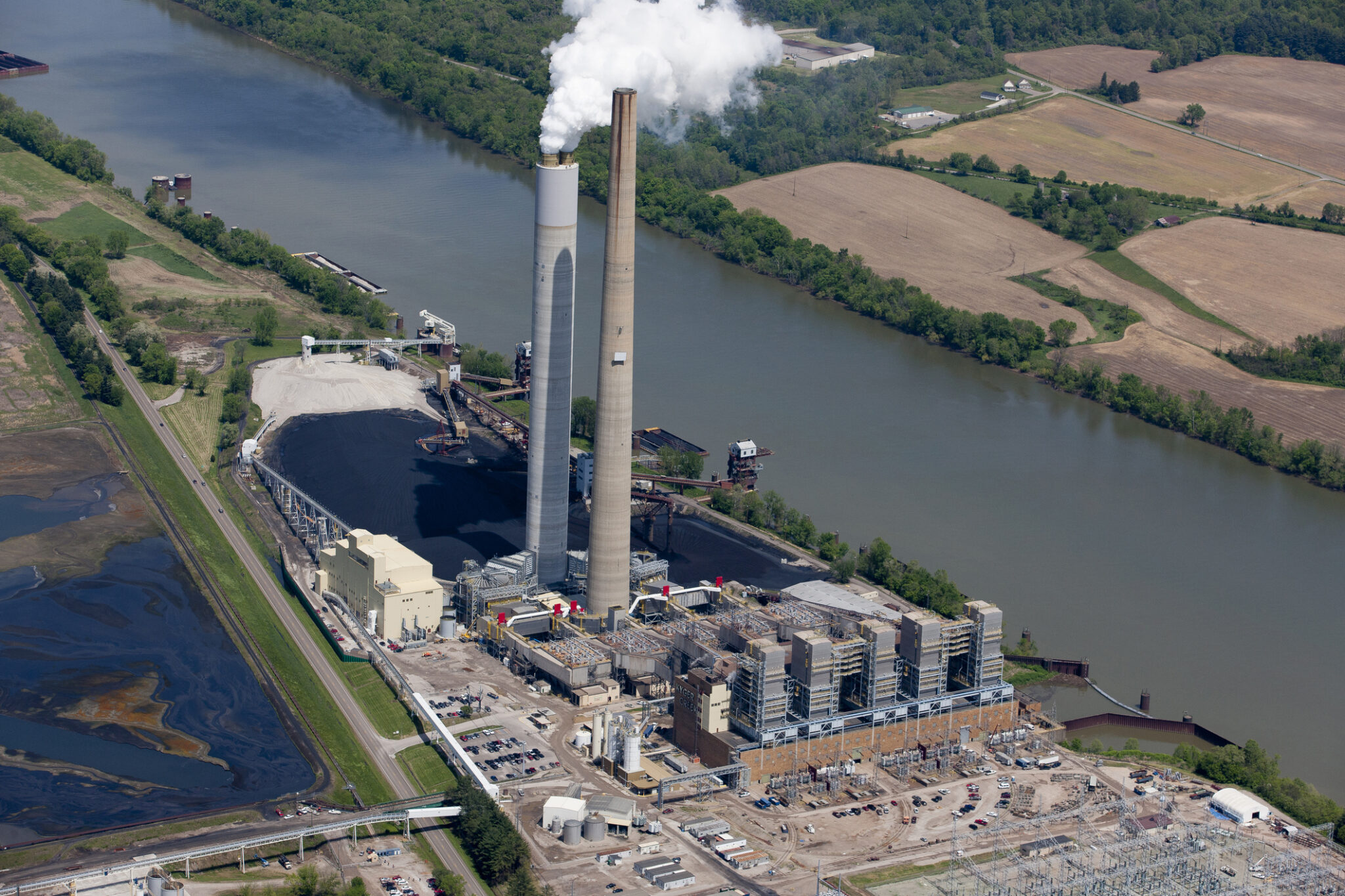
    Electric customers across Ohio collectively spent an estimated $211 million via add-on bill charges over the last two years to cover for losses from two coal-fired power plants that continue to bleed millions annually, according to new data from state regulators.

    The money to the Ohio Valley Electric Corp. (OVEC) — an entity comprised of several investor-owned utilities from multiple states that operates the plants — flows thanks to a 2019 state law now at the center of a criminal bribery prosecution.

    The Public Utilities Commission of Ohio began to allow three of the utilities that own and are contractually obligated to buy power from OVEC — American Electric Power (43% equity stake), Duke Energy (9%), and AES Ohio (4.9%) — to pass on their losses on OVEC to their customers, starting in the mid-2010s. The payments were originally only allowed through 2024. Through 2019, the three utilities’ customers were charged an estimated $159 million on OVEC.

    House Bill 6, a law passed in 2019 that’s now the focal point of what prosecutors have said is the largest political corruption investigation in state history, extended the subsidies through 2030 and spread the three utilities’ (AEP, Duke and AES) losses to electric customers of all Ohio utilities (not just those that own OVEC).

    In 2020, Ohio electric customers statewide paid $115 million to OVEC’s owners to cover their losses on the deal, according to data provided by a PUCO spokesman. In 2021, they paid about $97 million (July through December 2021 costs are estimates). Under the law, residential customers pay a maximum $1.50 per month to utilities to cover their OVEC losses. Industrial customers pay a maximum of $1,500.

    OVEC operates two 1950s-era coal plants in Cheshire, Ohio and Madison, Indiana, originally built to power the federal government’s uranium enrichment facilities near Portsmouth. That agreement ended in 2003. The utility companies that own OVEC last renegotiated their contract in 2011 extending its life through 2040.

    Technically, the OVEC plants could save utility customers money if OVEC could generate and sell electricity at below-market costs. However, a mix of market forces, environmental regulations and recently spending more than $1 billion on a “scrubber” system designed to limit emissions have left the plants selling electricity at costs well above those of PJM, an energy marketplace serving utilities in 13 states including Ohio.

    “[Our] analysis shows that at this time, the OVEC plants cost customers more than the cost of energy and capacity that could be bought on the PJM wholesale markets,” wrote London Economics International, a firm the PUCO commissioned to audit the subsidies, in December.

    A draft version of a 2020 PUCO-commissioned audit by the same firm found that “keeping the plants running does not seem to be in the best interests of the ratepayers.” The line was removed from the final version at the request of a PUCO staffer who asked the auditors to use a “milder tone and intensity of language,” according to emails obtained by the Ohio Consumers’ Counsel (OCC), which represents ratepayers in PUCO cases and has advocated ending the OVEC subsidies.

    In a 2018 bankruptcy filing, FirstEnergy disclosed losing $12 million per year due to its 4.85% equity stake in OVEC. As lawmakers considered HB 6, legislative analysts estimated Ohio utilities paid $94 million above wholesale market costs in 2018 alone to purchase OVEC-generated electricity.

    Along with the raw finances, Ohio consumers are subsidizing plants that have belched nearly 21 million tons of carbon dioxide, 21,000 tons of nitrogen oxide, and 12,000 tons of sulfur dioxide into the atmosphere since January 2020, plus smaller discharges of arsenic, lead, and mercury, according to data from the U.S. Environmental Protection Agency provided by the OCC.

    “Why the hell is this still in place?” said Neil Waggoner, an advocate with the Sierra Club’s Beyond Coal campaign. “I think that this is utility capture in practice. This is the utilities in this state having a death grip on the regulators and people in power to the point that they’re getting exactly what they want.”

     The Clifty Creek Power Plant, in Madison, Indiana, which is operated by OVEC. Photo taken by Rep. Casey Weinstein, D-Hudson, who visited the plant and has called for a repeal of state law forcing Ohio ratepayers to subsidize it.

    A sticky bailout

    FirstEnergy Corp. admitted in July to paying more than $60 million to an account controlled by the former House Speaker and his allies to ensure passage of HB 6. The prosecutors’ allegations have focused in court documents on an estimated $1.3 billion nuclear bailout and other non-coal related provisions of the sweeping bill that are favorable FirstEnergy. Former speaker Larry Householder, accused of using the money to engineer passage of the bill and shore up his own political aims, has pleaded not guilty. Two Householder allies involved in the alleged scheme have pleaded guilty to racketeering.

    State lawmakers in early 2021 passed legislation repealing the nuclear bailout and “decoupling” provision (a ratepayer-backed revenue guarantee for FirstEnergy). However, the OVEC bailout was left intact.

    There are bipartisan efforts in the House and Senate to repeal the OVEC bailout from state law, and the narrower PUCO-approved bailout that preceded them. Neither has come up for a vote and the sponsors are pessimistic on their chances.

    Sen. Mark Romanchuk, R-Ontario, perhaps the plants’ most prominent critic and co-sponsor of the Senate legislation, said he is in negotiations with the utilities that own the plants and is not giving up. He declined an interview.

    “Not sure where things will go but we’re not giving up,” Romanchuk said.

    House Democrats have called for a repeal of the OVEC subsidies, though they only control 34 of 99 seats in the chamber. Rep. Jeff Crossman, a Parma Democrat who recently announced plans to run for attorney general, said the OVEC charges should be repealed but as much is unlikely.

    He said OVEC’s sponsors contribute tens of thousands in campaign contributions per year, mostly to Republicans. AEP, through a middleman, contributed $700,000 to Generation Now, the account prosecutors say Householder used to engineer passage of HB 6 in the first place.

    “There’s probably not a will to undo the OVEC charges,” he said. “They donate gobs of cash to the right folks. There’s just no other reason to support these plants.”

    House Speaker Bob Cupp, R-Lima, said in October he doesn’t believe there’s support in the House Republican caucus to repeal the coal bailout.

    House Majority Leader Bill Seitz, R-Green Twp., has told several state media outlets the bailouts aren’t going anywhere. He did not respond to written questions about the uneconomic nature of the plants, or why ratepayers should cover their owners’ losses on them.

    “We’ve beat this [OVEC] horse to death. It’s not going to change,” Seitz said to Cleveland.com in October. “They’ve introduced God knows how many bills — none of them are going anywhere, in my humble opinion.”

    Michigan takes action

    AEP is by far OVEC’s largest shareholder, with a roughly 43% equity stake in the company, and the two share several executives.

    While repeal efforts in Ohio are at a lull, other states have signaled resistance to allowing utilities to continue to pass OVEC’s owners’ losses to customers.

    The Michigan Public Service Commission in a November order noted that OVEC’s costs exceed the market price of electricity by tens of millions. It warned that AEP’s local utility may not be able to pass on all its OVEC losses to customers that are “incurred because of imprudent” decisions.

    “The order today put I&M [an AEP unit] on notice that the Michigan share of these excess costs are unlikely to be permitted without additional evidence that continuing to purchase power from the units was in the best interest of its customers,” the Michigan regulators said in a news release.

    AEP spokesman Scott Blake said in an email the OVEC plants are “critical resources that help ensure the reliability of the grid and offer protection from increases in the costs of other fuels.” He said AEP Ohio customers for decades benefitted from OVEC’s power via affordable electricity and good jobs. OVEC, he argued, insulates customers from cost spikes caused by things like a surge in natural gas prices or a shortfall of renewable energy supply.

    “AEP Ohio customers benefited for decades from the power provided by OVEC in the form of affordable electricity and good jobs,” he said. “While there may be years where power from OVEC is more expensive than the market, as generation from natural gas and other sources becomes more expensive, customers could see refunds from OVEC in the future.”

    Fitch Ratings determined OVEC’s outlook is “stable” in February — just one step above “speculative.” However, its analysts found that repealing HB 6 wouldn’t necessarily harm OVEC’s prospects. The analysts reasoned that for one, in the event of a repeal, AEP, Duke and AES would still be able to pass on their OVEC losses to customers. For two, the “sponsoring” utilities have already contractually agreed to purchase the power OVEC generates, regardless of who eats the losses.

    Meanwhile, in a Virginia appeal of a public service commission rate case, Virginia Attorney General Mark Herring accused OVEC of charging an AEP utility in Virginia well beyond market costs for electricity. The case is ongoing.
  • Angry Earth

    Angry Earth

    The earth is angry, and rightly so.

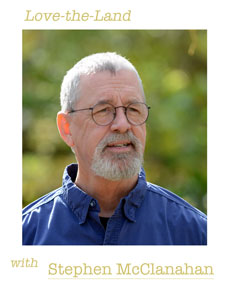
    Columnist Stephen McClanahan is retired from P&G and now active in environmental advocacy, search/rescue and emergency medical/disaster response.

    How much destruction do you have to see before you have seen enough? How angry does the earth need to be before we pay attention? How many lives must be ruined before it’s too many? As these words emerge on my computer screen, I can’t help but recall the lyrics to the folk ballad, and I pray the answers are not “Blowin’ in the wind”.

    In the past few months, I took the opportunity to spend some time in eastern North Carolina and the northern panhandle of Florida; in both places, I was there as part of Team Rubicon to help people try to put their lives back together following hurricanes Florence and Michael, respectively. Team Rubicon is a volunteer disaster recovery organization, mainly but not completely composed of military veterans. Hurricanes (or tropical cyclones as they’re called) are natural storms. We pay attention to the ones coming in off the Atlantic ocean. Pushed along by easterly trade winds in the tropics, warm, moist air near the ocean’s surface naturally rises and is replaced by cooler air aloft. With enough heat at the surface, the process

    Learn more about Team Rubicon

    continues. Throw in the rotation of the earth that induces a spin (counterclockwise in the northern hemisphere). As these get pushed along over the open ocean, they draw energy from the heat of the surface waters. The warmer the surface waters of the oceans, the more energy these storms have available. If atmospheric conditions are favorable for their large-scale formation, a storm emerges. As it grows, we give it names like tropical depression, then a category one hurricane and on up the line. I think one would have to be numb not to stand in awe at the fury and strength of such natural phenomena. Monster storms as these can make one feel very small; their scale and power are enormous. Magnificent, global forces are at play here. And yet, as tiny as we are in comparison, you and I (and many more of us) have a direct and measurable impact on them, because, you see, we’re pretty good at warming the oceans over which they pass. And with that, let me say welcome to global warming.

    Monster storms as these can make one feel very small; their scale and power are enormous.

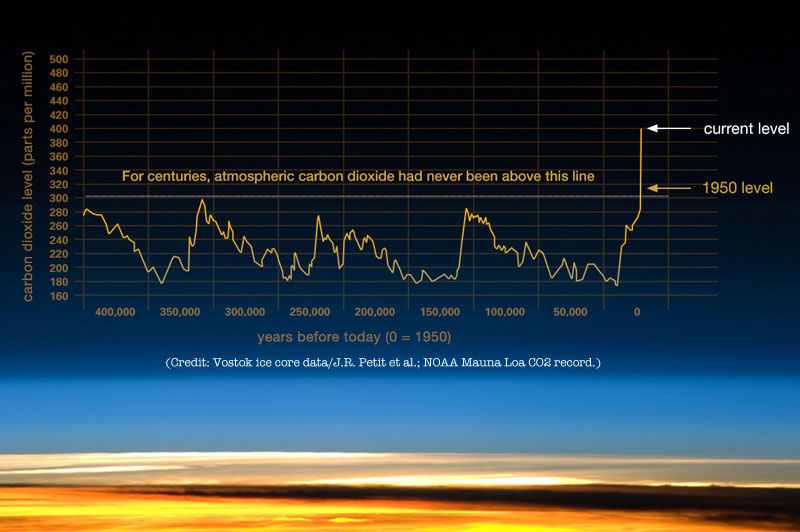
    We are probably familiar with the story by now. The sun heats our earth during daylight hours and at night, the earth cools by radiating some of that heat back into space. We all know that the earth does not cool as much during those nights with cloud cover, since the clouds act as a blanket. Clouds have an immediate and temporary effect; these impact our weather. It turns out that the carbon dioxide we emit into our atmosphere from our consumption of fossil fuels has been building up for decades (look at the graph to see for yourself); it too, acts as a kind of blanket but its impact is long-term. This CO2 blanket has a much slower build time but also a much longer lasting impact on our climate. CO2 traps some of the energy that would normally be radiated into space and holds it close to the earth. And, as we know, water is a great heat sink; it takes a lot of energy to heat water but once warmed, it retains that heat very well. Most (about 95%) of the excess heat that CO2 has trapped is in our oceans. Ergo, charged up hurricanes…natural storms made stronger by human impact on our planet.

    Its easy to read this kind of stuff and have it remain abstract, lifeless with no human touch. So, let’s go to North Carolina and Florida.

    Its easy to read this kind of stuff and have it remain abstract, lifeless with no human touch. So, let’s go to North Carolina and Florida.

    Burgaw sits in the Cape Fear river basin, about 40 miles inland from the Atlantic in eastern North Carolina. I spent a week there helping to muck-out homes in the flood zone of Hurricane Florence that went through in September of last year. One of those homes belongs to 80-year old Robert Ramsey; he lost everything, and I mean everything. Even though he’s 40 miles from the ocean, Florence came in and ever so slowly moved up the river valley; for days, it dumped unbelievable amounts of rain. The river flooded, to put it mildly.

    All but 2 feet of the roof line of Robert’s single-story house disappeared under the waters.

    All but 2 feet of the roof line of Robert’s single-story house disappeared under the waters. The water line was clearly visible on his metal roof. When I arrived, it had been well over a month since his house re-emerged from the flood waters. But his home was still a disaster; the destruction was so wide spread, all the emergency recovery resources that could be mustered were simply too inadequate to fix everyone straight away. I looked into Robert’s eyes as he stood in front of his home and I began to grasp the impacts. You could feel the hole in his heart; it was palpable. The damage to his home was enormous; there was nothing that was not ruined. Stench and mold were in abundant supply and growing worse by the day. Anything not washed away was rotting before your eyes. Everything in his humble home was totally destroyed. The only cure for his and about 4,000 other homes in this area was to gut

    I looked into Robert’s eyes as he stood in front of his home and I began to grasp the impacts. You could feel the hole in his heart; it was palpable. The damage to his home was enormous; there was nothing that was not ruined. Stench and mold were in abundant supply and growing worse by the day.

    them to the frame and try to dry out the bones of the structure. Everything inside is now in a landfill. Imagine, everything in your home being hauled to be buried. And while it has long faded from the news, the impacts of this storm ever present for those who lived it. One thing I heard time and again from the residents in the area was that this was not the first time their homes had been flooded; they do live in a river basin. But for thousands upon thousands of our fellow citizens, Florence was different; its waters were simply too much. And while it was water that Robert had to contend with, for folks in Mexico Beach, Florida, it was Michael’s winds that proved too much.

    Mexico Beach is was your quintessential beach-front tourist community. It sits directly on the Gulf of Mexico. Not far from Tyndall Air Force Base or Panama City, the land is flat and low, just feet about sea level. There is nothing to protect it from storms off the Gulf. 

    With little time for people to prepare, Michael slammed the upper peninsula of Florida near Mexico Beach on October 10 as a high-end category 4 hurricane; 150+ mph winds literally raked the community. Precious little remained standing when it was done.

    Hurricane Michael was kind of a sneaker; it showed up in the Caribbean as low-pressure disturbance. For almost a full week, it only slowly grew to a tropical depression. On October 8, it finally attained category 1 (the lowest) hurricane status. Then it moved northward over the warm waters of the Gulf of Mexico and as it did so, it became super-charged. With little time for people to prepare, Michael slammed the upper peninsula of Florida near Mexico Beach on October 10 as a high-end category 4 hurricane; 150+ mph winds literally raked the community. Precious little remained standing when it was done.

    The place still looked like a nuclear bomb had exploded.

    Team Rubicon volunteers come in for week-long waves; my assignment was for week 9 after Michael and the place still looked like a nuclear bomb had exploded. It’s kind of eerie to see a driveway lead up where a house once stood and literally, the only thing remaining is the concrete slab on which the home once stood; the winds took the rest. Our base of operations was an old warehouse in Panama City; Mexico Beach is about 20 miles down the coast to the southeast. To get there, you drive past Tyndall AFB which is well off the highway.  So mainly, you’re driving through a beautiful pine forest, or I should say, once was a pine forest. Thousands upon thousands now stand like twigs, all completely snapped off about 20 feet off the ground and all laying dead in the same wind-blown direction.

    Increasing the intensity and the patterns of naturally occurring storms are some of the many impacts of a warming world. For any one storm, it’s hard to parse out the exact contribution that a warming planet has had on a naturally-occurring weather event. Keep in mind that altering hurricanes is only one of many changes taking place. What is clear, in the long view of measuring climate, is that things are changing. To quote from NASA: “Global climate change has already had observable effects on the environment. Glaciers have shrunk, ice on rivers and lakes is breaking up earlier, plant and animal ranges have shifted and trees are flowering sooner.” And things will continue

    Keep in mind that altering hurricanes is only one of many changes taking place.

    to change for the worse simply due to the amount of CO2 in the air right now. But we can stop the worse of it, if we act…with urgency. Scientific modeling of future changes very clearly shows that we must stop adding CO2 to the air (i.e., get off fossil fuels). If we don’t, starting in a little over a decade from now, we’re going to be in serious trouble. (Read the latest report from Intergovernmental Panel on Climate Change if you’re into the details.)

    Encouragingly, there are signs that we’re beginning to take this seriously; average citizens and political/community leaders are raising this issue and debating options. And not a minute too soon. The earth is angry, and rightly so. And nature will have the final say in all this. We need bold action and we need it now; otherwise, we’re blowin’ in the wind.


  • Earthrise

    Earthrise

    Among environmentalists, John Muir is like a rock star!

    Columnist Stephen McClanahan is retired from P&G and now active in environmental advocacy, search/rescue and emergency medical/disaster response.

    Perhaps you’ve heard of John Muir.  If you haven’t, you should. He almost single-handedly convinced Teddy Roosevelt to establish the national parks system in the US. His explorations of and writings about helped establish some of our iconic wilderness areas we know and cherish today, including Yosemite, Sequoia, Mount Rainer, Petrified Forest, and the Grand Canyon to name a few. Among environmentalists, he’s like a rock star; he started the Sierra Club. But perhaps his greatest gift was teaching us how connected things in the natural world are to one another.  He’s quoted as saying: “When we try to pick out anything by itself, we find it hitched to everything else in the Universe.”

    “When we try to pick out anything by itself, we find it hitched to everything else in the Universe.” – John Muir

    I think that fundamental truth is a critical one to understand and internalize and celebrate and live by. You and I are completely and irrevocably rooted to the earth.  Always have been and we will die that way. Innumerable connections that are complex, intertwined, interdependent and beautiful. In “The Hidden Life of Trees”, author and forester Peter Wohlleben opens his wonderful little book with a story. He passed by the hollowed-out stump of an ancient tree that had fallen hundreds of years ago and when he took his knife and scraped away a bit of it, he found it was green. Green as in chlorophyll; green as in alive. And as you discover in the pages that follow, the roots of this ‘dead’ stump were being fed by the roots of neighboring trees. They were caring for each other because they were connected!

    They were caring for each other because they were connected!

    Here are a few of the more obvious connects we kind of rely on. Right now, at this very moment, you and I are breathing in air which contains just the right amount of oxygen, thanks solely to photosynthetic plants. As you recall from botany, these chlorophyll-containing creatures possess the amazing ability to capture energy from the sun and use it to power complex chemical reactions to make the sugars they need to live. Conveniently for us, in the process of doing this, they take up the carbon dioxide that you and I have exhaled and provide for us the oxygen we need to live. Not a bad deal.  Take away the oxygen and we won’t last long. We have unbreakable bond with the green side of things; plants need soil with nutrients, microorganisms, worms, leaf litter, water (from regular rains), sunshine to drive photosynthesis, a relatively narrow and controlled temperature range, and so on and so on. Because they need those things, we need those as well.  (Internalize this and you will never view an earthworm the same again!) As the expression goes, we live together, we die together. Connected.

    We have unbreakable bond with the green side of things.

    Everything we have ever consumed for dinner came solely and completely from the earth. 100% of it. Ergo, what’s in the best interests of fruits and grains and vegetables is in my best as well. No bees, no pollination, no food. No food, no life. Connected.  

    These connections extend all the way down to the very atoms that make our bodies. They too have been borrowed from the earth; before us, they existed in some other organism or inanimate object. After us, they will recycle into something else. Connected.

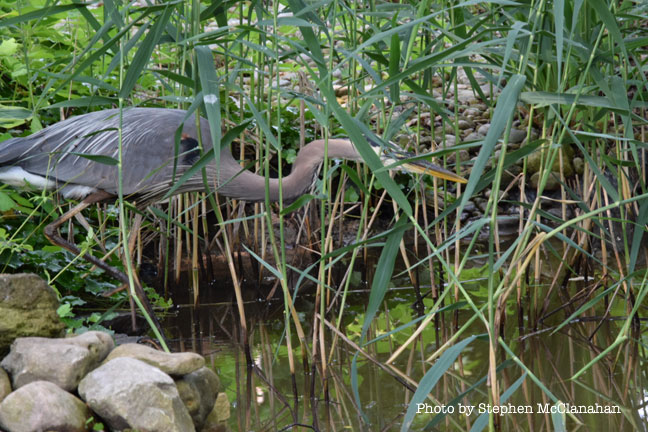
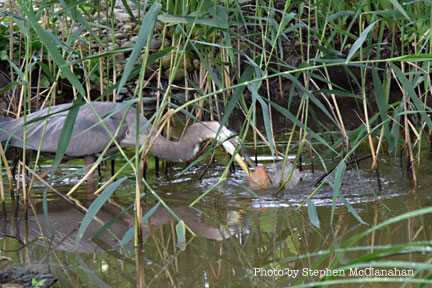
    Every spring, the herons come and fish in Stephen McClanahan’s backyard pond.

    We have a small pond in the backyard that some fish call home. Every spring, the herons come and feed. As I watch this act of nature unfold, I think. One minute, the creature exists as a fish; a few hours later, it is part of a magnificent bird. What will it become next? What was it before it was a fish? Connected.

    Success!

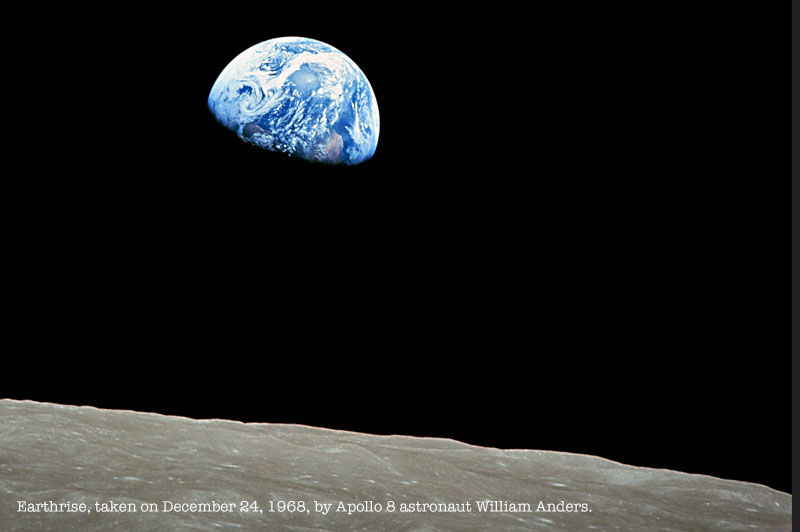
    One of my idiosyncrasies is an interest in words, where they come from, what they really mean. Look up synonyms of ‘connected’ and you find ‘linked, combined, akin, allied, joined, coherent, coupled, banded together’. The word ‘nexus’ (i.e., a joining, tie, link, binding) has a similar Latin root as connect. I think if we could put all these words together and hold them simultaneously in our brains, we might get a glimpse of the real oneness of nature upon which all life depends. And this isn’t just some metaphysical quip – this is the reality of all that is. If there’s one photo or image that drives this home for me more than any other, it is that of Earthrise, taken on Christmas eve, 1968 by astronaut William Anders when Apollo 8 was in lunar orbit. I cannot look at this without deep stirrings; our earth is home and we are firmly rooted in it. Connected.