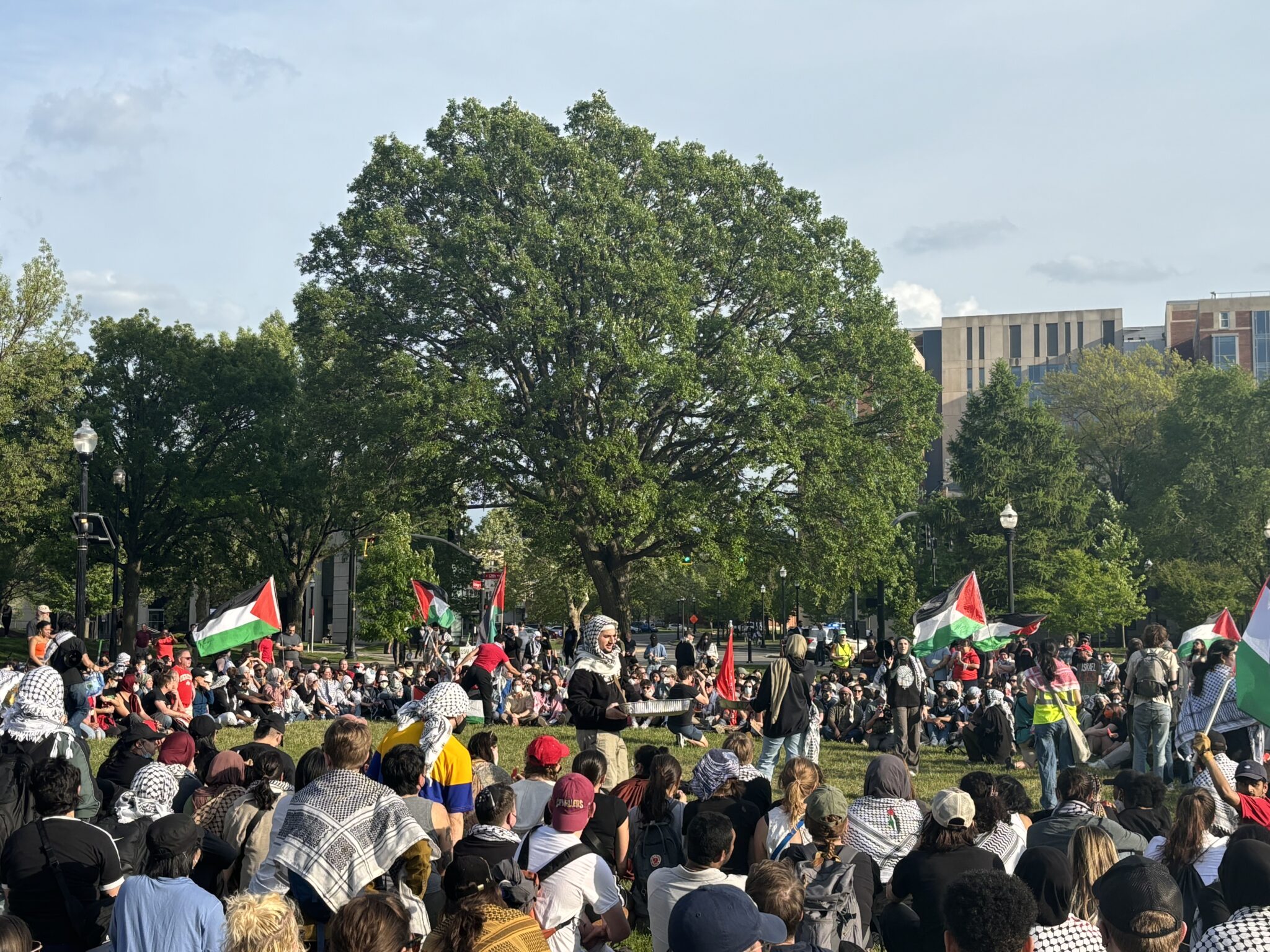
Hundreds of Ohio State University students, faculty and community members protested the ongoing Israel-Hamas war in Gaza on May 1, 2024. (Photo by Megan Henry, Ohio Capital Journal.)
Ohio State University, Case Western Reserve University, Oberlin College, Ohio University, Miami University and Denison University have all had campus protests the past couple of weeks.
Ohio colleges and universities have been the site of recent protests over the Israel-Hamas war in Gaza.
Ohio State University, Case Western Reserve University, Oberlin College, Ohio University, Miami University and Denison University have all had campus protests the past couple of weeks as the semester winds downs.
Kent State University has a protest planned for Saturday — which also happens to be the 54th anniversary of when the Ohio National Guard shot and killed four students on campus who were protesting the Vietnam War.
Protesters are calling for universities to divest their finances from companies and institutions with connections to Israel, transparency over their financial investments and an immediate ceasefire in Palestine.
However, Ohio law stands in the way of some of their demands. Ohio Revised Code Section 9.76 prohibits state agencies like universities from contracting with companies that are boycotting or disinvesting from Israel.
Former Ohio lawmaker Kirk Schuring introduced the bill in 2016 and then-Gov. John Kasich signed it into law later that year. The law was then amended in 2022.
Protests at colleges and universities have ramped up across the nation after more than a hundred protesters at Columbia University were arrested after setting up an encampment on April 18. The University of Southern California canceled its commencement ceremony over safety concerns due to recent protests.
More than 34,000 people have been killed and more than 77,000 have been injured in Gaza since the Israeli invasion after a Hamas-led attack in October that killed nearly 1,200 people in Israel, according to Al Jazeera. Women and children make up nearly three-fourths of those who have been killed in Gaza, according to an update by Gaza’s Government Media Office.
President Joe Biden said he respects the rights of people to express their opinions during the campus protests, but said it must be done without violence or destruction.
“Violent protest is not protected,” he said in a speech Thursday morning. “Peaceful protest is. It’s against the law when violence occurs. Destroying property is not a peaceful protest. It’s against the law. Vandalism, trespassing, breaking windows, shutting down campus, forcing the cancellation of classes and graduation. None of this is a peaceful protest. … To dissent is essential to democracy. But dissent must never lead to disorder, or to denying the rights of others so students can finish a semester and their college education.”
Ohio State University
Hundreds of Ohio State students and faculty as well as community members peacefully protested Wednesday night on the South Oval.
A chorus of chants rang out throughout the protest:
“From the river, to the sea, Palestine will be free.”
“From the river, to the sea, Palestine will live forever.”
“Ohio wants divestment now.”
“Divestment is our demand. No more bloodshed on our hands.”
“Disclose. Divest. We will not stop, we will not rest.”
There were no encampments erected on the South Oval. Ohio State University Police were present as well as Ohio State Highway Patrol cars. An electronic sign near the South Oval read “no overnight events permitted … to include encampments.”
Protesters voluntarily dispersed after a few hours and no arrests were made — a stark contrast to last week when 41 people were arrested at various campus protests. Nineteen of those arrested were Ohio State students, one was an Ohio State staff member and the rest were not affiliated with the university.
Tent camping is not permitted on the lawn of the Oval without prior approval, according to Ohio State’s space rules.
“Encampments are not allowed on campus regardless of the reason for them,” Ohio State University President Ted Carter wrote in a campus-wide letter after last week’s protests. “They create the need for around-the-clock safety and security resources, which takes these resources away from the rest of our community.”
“As a public university, demonstrations, protests and disagreement regularly occur on our campus — so much so that we have trained staff and public safety professionals on-site for student demonstrations for safety and to support everyone’s right to engage in these activities,” Carter went on to write in his letter. “Sadly, in recent days, I have watched significant safety issues be created by encampments on other campuses across our nation. These situations have caused in-person learning and commencement ceremonies to be canceled. Ohio State’s campus will not be overtaken in this manner.”
Ohio House Speaker Jason Stephens, R-Kitts Hill, said he supports Carter’s actions.
“There’s always a challenge whenever you have protests and whatnot,” Stephens said when asked about last week’s arrests at Ohio State. “But, again, I think it’s important for the safety of everyone at a campus that the rules be followed.”
Case Western Reserve University
There have been no arrests so far at any protests at Case Western Reserve University in Cleveland, but about 20 protesters were detained and released from police custody Monday morning, a university spokesperson said.
The private university originally put a 8 p.m. curfew in place, but has allowed students to camp on the university’s Kelvin Smith Library Oval Monday, Tuesday and Wednesday nights, a university spokesperson said.
Oberlin College
More than 100 students at Oberlin College in Lorain County protested Monday night and no arrests were made.
“Oberlin supports the right of our students to gather and demonstrate peacefully,” the university said in a statement. “Oberlin expects all who participate to conduct themselves in ways that are respectful of others, that do not disrupt the day-to-day activities of the school and that uphold our shared values: respect for each other and our community.”
Miami University
Miami University Students for Justice in Palestine organized a walkout on April 19 to support the protesters who were arrested at Columbia University and a march is planned for Thursday night.
Denison University
No arrests were made when about 100 students and faculty members protested Tuesday at Denison University in Granville.
Ohio University
About 100-125 people attended a protest at Ohio University Wednesday night where people chanted up and down the escalators at Baker Center. No one was arrested.
Ohio State University protest photo gallery


Follow OCJ Reporter Megan Henry on Twitter.