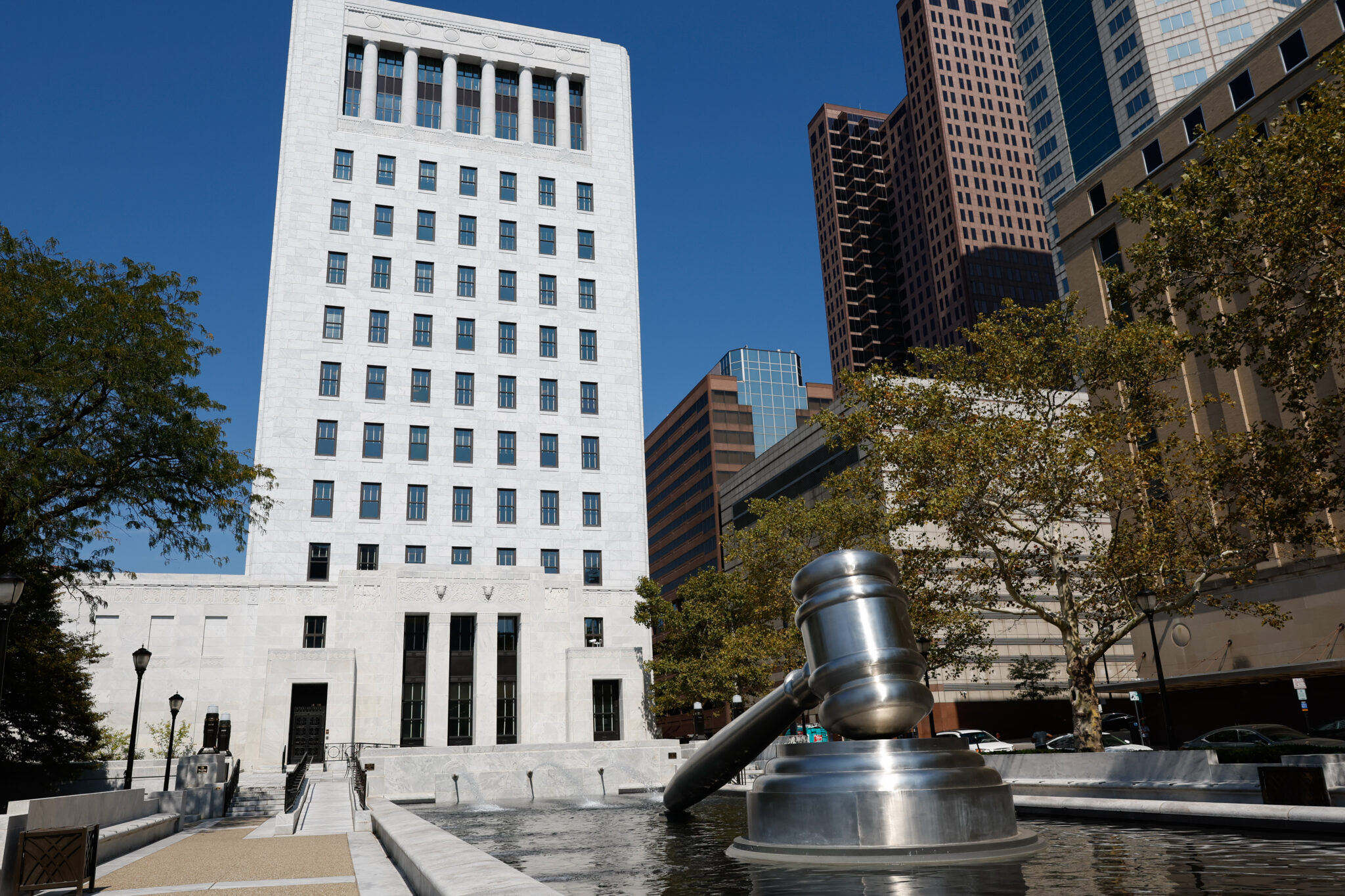
The Gavel outside the Supreme Court of the State of Ohio, September 20, 2023, at 65 S. Front Street, Columbus, Ohio. (Photo by Graham Stokes for Ohio Capital Journal. Republish photo only with original article.)
Ohio’s highest court currently has a 4-3 Republican majority
Three Ohio Supreme Court seats will be up for grabs during the November election. The outcomes will decide the balance of the court and have major impacts on a wide variety of issues that affect the lives of Ohioans, from education and environmental issues to gerrymandering and elections to civil and reproductive rights.
Partisan labels were added to the previously-nonpartisan races by the state legislature in 2021.
This year, incumbent Democratic Justice Michael P. Donnelly is being challenged by Republican Hamilton County Court of Common Pleas Judge Megan Shanahan.
Incumbent Democrat Justice Melody Stewart is being challenged by incumbent Republican Justice Joseph Deters, who opted not to run for his current seat and decided to go up against Stewart.
Vying for Deters’ open seat is Democratic candidate Lisa Forbes, of the Eighth District Court of Appeals, and Republican candidate Dan Hawkins, of the Franklin County Court of Common Pleas.
Deters decided to run for a full-term seat by challenging Stewart, rather than a partial term for the seat Ohio Gov. Mike DeWine appointed him to on Jan. 7, 2023. Because of this, whichever candidate wins Deters’ current seat will have to run again in 2026 for a full six-year term.
Ohio’s highest court currently has a 4-3 Republican majority. If all three Republicans are elected, the Republicans would hold all but one seat on the bench, for a 6-1 majority. On the flip side, if all three Democrats win their elections, the Democrats would hold a 4-3 majority. The Ohio Supreme Court has been under Republican control since 1986.
Democratic Justice Jennifer Brunner’s seat will be up in 2026. Republican Chief Justice Sharon Kennedy, Republican Justice Pat DeWine and Republican Justice Pat Fischer’s seats will be up in 2028.
The Ohio Supreme Court could make decisions on a plethora of critical issues: reproductive rights, gerrymandering, school vouchers, home rule, and environmental issues, among others.
“If there’s a law around it, it could end up in the Supreme Court and have a real, tangible impact on each of our lives,” said Elisabeth Warner, spokesperson for the League of Women Voters of Ohio.
Even though 57% of Ohio voters approved an amendment last year to enshrine reproductive rights in the state’s constitution, the court will inevitably rule on abortion access.
“There are still a lot of anti-abortion laws on the books, so that’s something that the Supreme Court is going to be ruling on,” Warner said.
Ohio’s anti-abortion laws were not automatically nullified when last year’s amendment passed, so abortion advocates are working to undo those laws.
Another lawsuit is currently pending in Hamilton County Court of Common Pleas over whether Ohio’s six-week abortion ban is unconstitutional after voters passed last year’s amendment.
Those lawsuits will likely make their way to the Ohio Supreme Court — meaning the seven justices will end up deciding to what extent reproductive rights are protected.
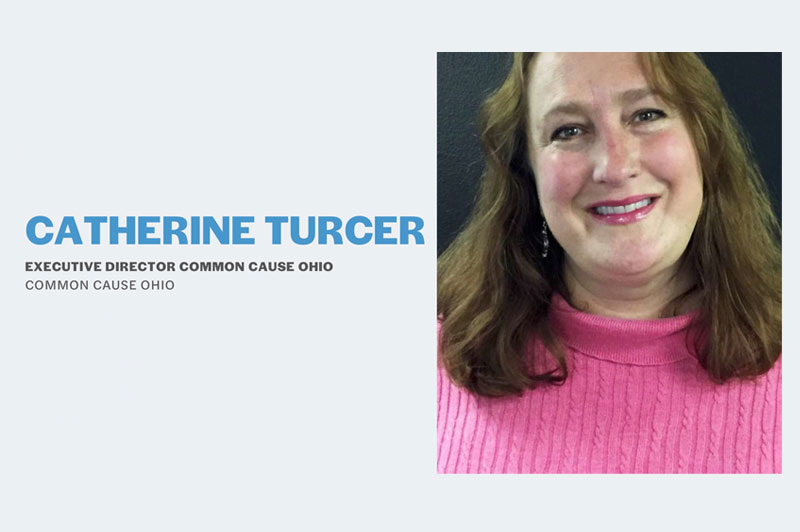
“At the end of the day, the Ohio Supreme Court will determine whatever’s in the Ohio Constitution that voters put into the Ohio Constitution,” said Catherine Turcer, Common Cause Ohio’s executive director. “It is interpreted by the Ohio Supreme Court.”
Turcer and Warner both criticized the 2021 law that requires party affiliation listed on the ballot for Ohio Supreme Court candidates. More than 1 million Ohio voters left the two Supreme Court races blank during the 2020 election.
“We shouldn’t actually be thinking Democrats and Republicans because at the end of the day, what you want is a referee who’s independent and impartial,” Turcer said.
Megan Henry is a reporter for the Ohio Capital Journal and has spent the past five years reporting in Ohio on various topics including education, healthcare, business and crime. She previously worked at The Columbus Dispatch, part of the USA Today Network.
Ohio Capital Journal is part of States Newsroom, the nation’s largest state-focused nonprofit news organization.
Versions of this story were published by Floodlight, Energy News Network and the Ohio Capital Journal.
A surge in FirstEnergy political spending ahead of the utility’s push to secure a legislative bailout for its nuclear power plants included a $1 million dark money contribution to support the campaign of Ohio Gov. Mike DeWine’s eventual running mate.
The previously unreported gift linked to Lt. Gov. Jon Husted’s 2017 primary bid was revealed as part of a raft of documents obtained under Ohio’s public records law by a coalition of news organizations, including Floodlight, Energy News Network, and the Ohio Capital Journal.
Among the documents are company emails describing behind-the-scenes efforts by Husted to persuade DeWine to support House Bill 6, the utility-backed legislation at the heart of the state’s ongoing $60 million public bribery scandal.
Neither Husted nor DeWine, whose campaign also benefited from a previously reported $1 million in dark money from the utility, has been implicated in the scheme in which eight people, including the state’s former House Speaker Larry Householder, have been indicted.
Two of those charged in the multi-million-dollar scandal surrounding the passage of HB 6 may have taken their own lives, including Sam Randazzo, the former chairman of the Public Utilities Commission of Ohio, who was found dead earlier this week of an apparent suicide.
‘Confidential’ email details campaign gift
One of the documents from the Office of the Ohio Consumers’ Counsel Office is a spreadsheet attached to a January 2020 message labeled “confidential.” It shows $1 million went from FirstEnergy to the conservative group Freedom Frontier in 2017, with “Husted campaign” noted as the reason.
That group backed Husted during his 2017 primary campaign for governor. The group then supported DeWine after Husted dropped out of the race to become his running mate.
Husted was also dubbed the “‘Golden Boy’ for FirstEnergy” by lobbyist Neil Clark, a co-defendant with Householder and others in the federal government’s criminal corruption case. Clark died by suicide in 2021.
In several of the recently released records, Husted is mentioned in the same breath as Householder, the convicted House speaker, and Randazzo, the former PUCO commissioner, by FirstEnergy leadership as they sought to pass and then defend HB 6, the nuclear and coal bailout law at the heart of Ohio’s ongoing corruption scandal.
FirstEnergy records released via public records request show how executives at the power company relied on Ohio Lt. Gov John Husted and convicted former House Speaker Larry Householder to help them pass a $1.3 billion nuclear bailout bill.
Husted has maintained that his support for the 2019 law stemmed from his belief that nuclear energy is an important part of Ohio’s energy portfolio. Parties in HB 6-related shareholder litigation have subpoenaed Husted to answer questions under oath, although a new date needs to be set.
FirstEnergy records released via public records request show how executives at the power company relied on Ohio Lt. Gov John Husted and convicted former House Speaker Larry Householder to help them pass a $1.3 billion nuclear bailout bill.
“The Husted campaign never received this donation and is not affiliated with any of these groups,” said spokesperson Hayley Carducci. By law, candidate campaigns are not supposed to coordinate with groups like Freedom Frontier, which can spend unlimited amounts to support or attack them.
The document and others reflect a major commitment by FirstEnergy to Husted’s political future. Before 2017, the company’s reported political spending to support Husted was less than $25,000 per campaign, according to data from OpenSecrets.
Dark money spending rises sharply
More broadly, the document also indicates a major increase in FirstEnergy’s political spending through nonprofit groups exempt from taxes under Section 501(c)(4) of the Internal Revenue Code. Those, along with privately held corporations, are common structures for dark money organizations — groups that aren’t required by law to disclose the ultimate source of their funding.
The company’s giving to such groups jumped to more than $12 million in 2017, after much lower levels of $200,000 in 2016 and $100,000 in 2015, according to the spreadsheet.
Starting in 2014, FirstEnergy had sought bailouts for noncompetitive coal and nuclear plants. And in late 2016, regulators approved a $456 million consumer surcharge that ultimately was held unlawful. Yet the company claimed it needed more.
The document details once-secret contributions to groups supporting “everyone from the mayor of Akron to President Trump that FirstEnergy made to secure bailouts for its soon-to-be bankrupt coal and nuclear plants and to gain influence on other key issues,” said Dave Anderson, policy and communications manager for the Energy and Policy Institute.
A spreadsheet details dark money expenditures by northeastern power company FirstEnergy as it sought to secure a $1.3 billion bailout for its struggling nuclear power plants. The sheet reveals a previously unreported $1 million donation to benefit the candidacy of Ohio Lt. Gov. Jon Husted.
Anderson added that the spreadsheet also “provides some key new evidence for utility regulators and consumer advocates to use to ensure that every dollar of ratepayer money that FirstEnergy misused to fund its secret political spending is publicly disclosed and refunded, with interest and ideally serious financial penalties.”
At the time, the author of the document that details the donations, Kristina Housley, was executive assistant to FirstEnergy’s Mike Dowling, who is now a defendant in a state criminal case along with former CEO Chuck Jones.
Finding out all the details about the dark money spending behind HB 6 is like peeling back the layers of an onion, said Catherine Turcer, executive director of Common Cause Ohio.
“The reason that transparency matters so much is that money that is spent in the shadows influences elections, and it influences really important policy decisions that impact us every day,” Turcer said. “And we have the right to know what is going on in government and how decisions are being made and who’s attempting to influence those decisions.”
The ‘Golden Boy’ for FirstEnergy
A December 2017 email from former FirstEnergy lobbyist Joel Bailey said Husted was working to get DeWine on board with FirstEnergy’s “issues.” FirstEnergy also supported other pro-DeWine/Husted efforts during the election cycle.
Former FirstEnergy CEO Chuck Jones (top left), former FirstEnergy VP Michael Dowling (top right), former PUCO Chair Sam Randazzo (bottom middle). Graphic by WEWS.
After the election, Husted and DeWine dined with Jones and Dowling on December 18, 2018. Later that night, FirstEnergy agreed to pay $4.3 million to energy lawyer Randazzo, who went on to become DeWine’s first pick for chair of the Public Utilities Commission of Ohio. FirstEnergy later identified Jones and Dowling as the two people responsible for paying alleged bribes.
Husted’s office has been evasive about his recollections, despite Jones noting in texts to Randazzo that the PUCO chair position was discussed in at least general terms. Another text by Jones in 2019 said the DeWine/Husted team was forced “to perform battlefield triage” to secure Randazzo’s nomination after a 198-page dossier provided to DeWine’s staff threatened to derail it.
Evidence from last year’s criminal trial of Householder, the former Ohio House speaker, and lobbyist Matt Borges also included messages between former FirstEnergy executives Jones and Dowling about Husted working behind the scenes to build support for the bill. Among the actions were efforts to extend the bailout period for the company’s former nuclear power plants in Ohio.
Husted long a friend of utilities
Husted had been Ohio’s secretary of state immediately before becoming lieutenant governor. Before that, he served as House speaker in the General Assembly. In that role, he played a pivotal part in securing passage of another major energy bill, Senate Bill 221.
At the time, Husted supported the law’s clean energy standards that were ultimately gutted by HB 6. However, SB 221 set the stage for so-called electric security plans. Those have let FirstEnergy and other utilities avoid full rate cases for more than a decade, while allowing cross-subsidies and adding multiple additional charges to consumers’ bills.
“That bill upset the balance” of energy regulation in Ohio, said Ashley Brown, a former PUCO commissioner. “It was a humongous gift for the utilities.”
Lawmakers repealed HB 6’s $1 billion-plus in subsidies for FirstEnergy’s former nuclear power plants and its recession-proofing provisions in 2021, eight months after the arrests of Householder and others.
Earlier this year, Husted told NBC4 in Columbus the rest of HB 6 “needs to be completely removed.” He did not respond to Energy News Network questions this week about whether that includes both the law’s subsidies for two 1950s-era coal plants and its gutting of Ohio’s renewable energy and energy efficiency standards.
FirstEnergy spokesperson Jennifer Young declined to comment on the company’s 2017 donation to Freedom Frontier due to ongoing litigation. However, she added, “FirstEnergy will post information regarding its support of 501(c)(4) social welfare organizations on the company’s website on a quarterly basis.”
Meanwhile, FirstEnergy still has not disclosed its dark money spending for the years 2018 through 2020. And proposals for reforms that would require such disclosures from all electric utilities remain stalled in the General Assembly.
“It’s incredibly frustrating that Ohioans can be aware that dark money impacted decision-making at the statehouse,” Turcer said, “and yet we still haven’t gotten the legislators to create greater transparency.”
The Energy News Network is a nonprofit news site dedicated to keeping influencers, policymakers and citizens informed of the important changes taking place in the transition to a clean energy system. Floodlight is a nonprofit newsroom that investigates the powerful interests stalling climate action.
This article first appeared on Energy News Network and is republished here under a Creative Commons license.
_____________
MARIO ALEJANDRO ARIZA, FLOODLIGHT
Mario Alejandro Ariza is an investigative reporter and a Dominican immigrant. His byline has appeared in publications like the South Florida Sun Sentinel, The New Republic, and The Atlantic. Mario wrote a book called “Disposable City: Miami’s Future on the Shores of Climate Catastrophe,” which was published by Bold Type Books. His essays have been featured in The Believer and selected for Best American Essays. He lives in South Florida with a cat, a dog, and a sturdy pair of waterproof boots.
Kathi is the author of 25 books and more than 600 articles, and writes often on science and policy issues. In addition to her journalism career, Kathi is an alumna of Harvard Law School and has spent 15 years practicing law. She is a member of the Society of Environmental Journalists and the National Association of Science Writers. Kathi covers the state of Ohio.
Columbus, Ohio – In a narrow 7-6 vote, the Ohio House Constitutional Resolutions Committee passed a resolution allowing HJR 1 — a bill that seeks to increase the ballot threshold for amending the constitution from a simple majority to 60% — to a floor vote.
Following the resolution’s passage, a denial of 111 years of direct democracy right, Catherine Turcer, executive director of Common Cause Ohio, made the following statement representing a coalition of 227 organizations in opposition to a 60 percent threshold and an August special election for special interests.
“Since 1912, Ohioans from across the political spectrum have utilized the right to amend our Constitution via the petition process. Direct democracy gives voters the ability to make a real impact and has helped engage Ohioans in the political process. There is no justifiable reason, after over 100 years, to make this already challenging process even harder.
“Today, a sham committee shut down public testimony in opposition. This is not what democracy should look like. Extreme lawmakers turned away over 100 Ohioans who took time from their day to show up and testify in opposition. Committee Chair Phil Plummer clearly did not want to hear from voters. He and an ultra-slim margin of his anti-voter colleagues had already made up their minds, and they bullied this bad idea out of committee.
“We have a growing coalition of 227 organizations representing hundreds of thousands of voters who will not compromise the sacred principle of one person, one vote. In Ohio and this country, a simple majority means 50 plus one equals democracy. We will not allow this undemocratic, unfair, unnecessary, and unpopular attack on voting rights and freedom to stand.”
Additionally, the Ohio Senate passed Senate Joint Resolution 2 this afternoon, which also changes the threshold for passage of amendments to the Ohio Constitution to 60 percent. Similar to HJR 1, this measure makes the citizen initiative process more difficult by requiring 5% of the gubernatorial vote in all 88 counties. These proposals also remove the “cure period” for collecting additional signatures if a campaign falls short.
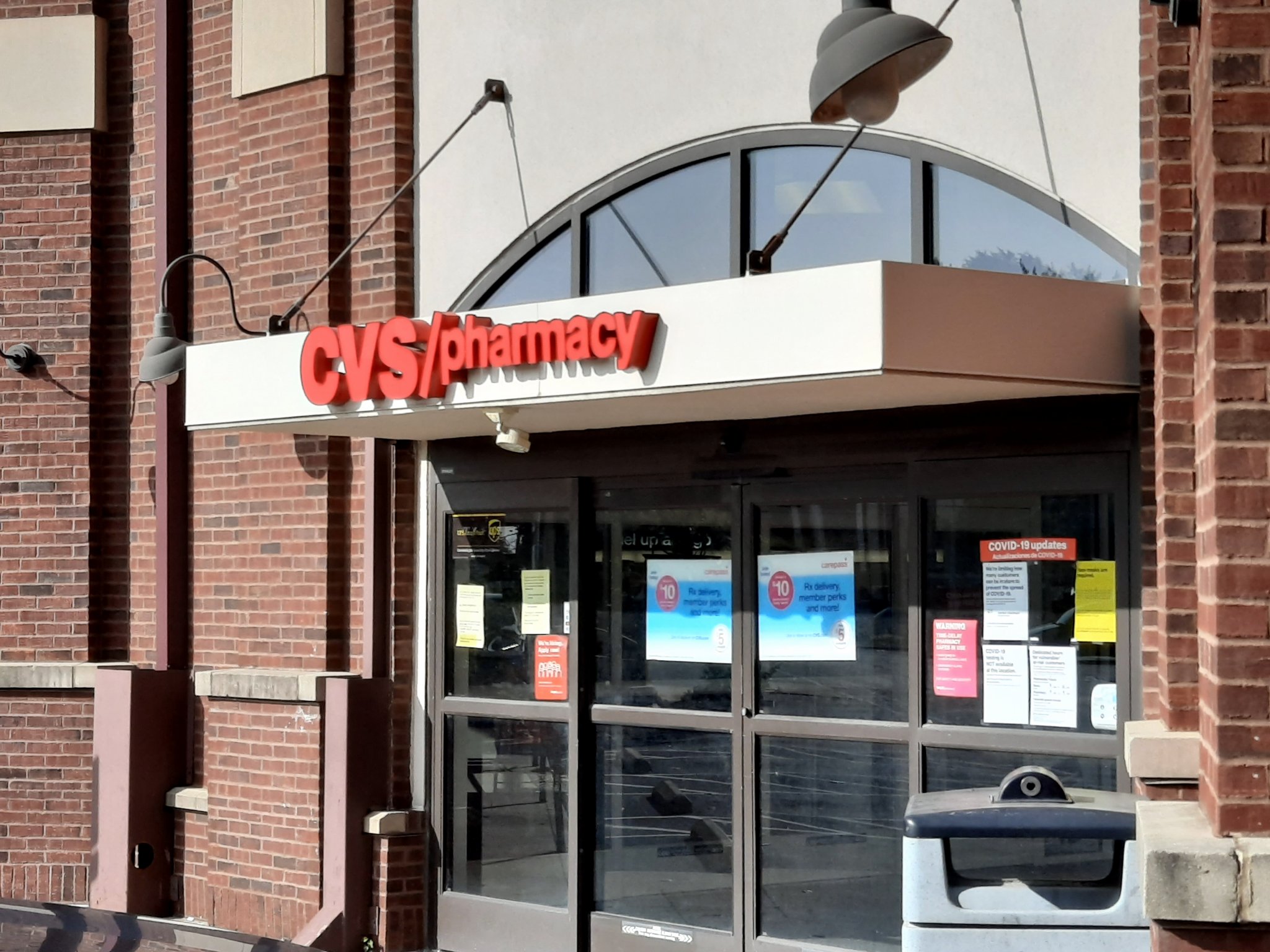
A group representing small pharmacists says large chains, especially CVS, are moving patients’ prescriptions to their own stores without consent. CVS adamantly denies that. Photo by Marty Schladen, Ohio Capital Journal.
It’s unclear if she disclosed potential conflict during massive procurement
Since she became director of the Ohio Department of Medicaid in January 2019, Maureen Corcoran has owned stock in some of the department’s biggest contractors. Given the size of those contracts, they could have increased the value of the stock Corcoran owned.
Ohio Medicaid Director Maureen Corcoran. Official photo.
But while she complied with one set of state disclosure requirements, Corcoran won’t say just how much stock she owns in such companies as CVS Health, UnitedHealth Group and Express Scripts — each of which has done billions of dollars worth of business with the Medicaid department since Corcoran started running it.
In addition, Corcoran won’t say if she filed legally required affidavits disclosing that she had an ownership stake in corporations the department hired earlier this year as part of its $20 billion managed-care re-procurement or the company the state hired to run its $1 billion OhioRISE program. Should they be found, violations of the law could carry criminal penalties and invalidate contracts signed without proper disclosures.
Big money
When Corcoran took the reins of the Medicaid department, she held a stake in some companies that were getting a lot of scrutiny over their business with the state. Two were CVS Caremark and OptumRX, pharmacy middlemen that together were handling more than $2 billion a year in prescription-drug transactions for the department.
Ohio’s independent pharmacists and others accused the companies of several questionable practices — including charging a lot more for drugs than they were paying pharmacists. A state-commissioned analysis showed that in 2017, CVS and Optum charged almost a quarter-billion dollars more for drugs than they reimbursed the pharmacies that had bought and dispensed them.
The findings were still big news — and the companies were suing the Medicaid department — when Corcoran took control just after Gov. Mike DeWine took office at the start of 2019. Even so, Corcoran held onto stocks in CVS Caremark owner CVS Health and in OptumRX owner UnitedHealth.
According to disclosures filed with the Ohio Ethics Commission, Corcoran owned at least $1,000 worth of those companies’ stock.
Given that they were among 180 stocks and mutual funds she disclosed owning as of Jan. 31, 2019, it’s possible that Corcoran wasn’t even aware that she held stakes in companies that did such high-profile business with her agency. Whatever the case, Corcoran held onto shares in the companies through 2019 and 2020, her ethics filings show.
Under Ohio’s aging ethics laws, agency bigwigs like Corcoran are allowed to own stock in companies with which their departments do business so long as their holdings don’t exceed 5% of the company’s outstanding stock. In the case of Medicaid’s big contractors, that would mean the director would have to be one of the wealthiest people in Ohio to violate the provision.
CVS and UnitedHealth are the fourth and fifth-largest corporations in the country by revenue. In order to violate the ethics provision, Corcoran would have to have owned a combined $18 billion worth of the companies’ stock in 2019.
Potential for conflict
That’s a clear sign that the state’s ethics laws need to be updated, said Catherine Turcer, executive director of Common Cause Ohio, a watchdog group.
“Five percent of a company’s stock in the 70s, 80s or even the 90s wasn’t anywhere near what it is now,” Turcer said.
In addition, knowing just how much Corcoran’s investments with Medicaid contractors were worth would go a long way toward showing how big a conflict of interest she has. If it’s just over $1,000, the conflict might seem nominal, but if it’s much more, it would be a lot more serious, Turcer said.
“There are two things Maureen Corcoran could do,” Turcer said. “One would be to publicly identify how much over the $1,000 she owns and allow the public to weigh in. The other thing she could do so the public didn’t worry about the conflict of interest is actually divest herself of these stocks.”
Last Friday, the Medicaid department was asked the value of Corcoran’s investments in CVS, UnitedHealth and Express Scripts, a third pharmacy middleman with which the department has done business.
A spokeswoman for the department said it would respond to those and other questions, but as of Tuesday afternoon, it hadn’t. The spokeswoman also didn’t answer questions about when responses would be forthcoming.
Bigger problem?
Potentially more ominous for Corcoran and her department is another question they haven’t responded to: Whether Corcoran filed affidavits disclosing her interest in companies with whom the department recently entered into huge contracts.
This year, the Medicaid department implemented a big redesign of its managed care program.
To gain more insight into drug transactions, the department will work next year with a single drug middleman contracted directly with the department — instead of being hired by managed-care providers as they have in the past.
But while UnitedHealthcare’s OptumRx might be losing that business, the Medicaid department is hiring UnitedHealthcare Community Plan of Ohio to be one of six companies administering the state’s $20 billion-a-year managed-care program.
The re-procurement has raised other questions. Also hired was a plan owned by managed-care giant Centene, which agreed earlier this year to pay out more than $1 billion to Ohio and 21 other states after being accused by Attorney General Dave Yost of fleecing taxpayers. Corcoran has struggled to explain why her department would keep doing business with the company.
The state also is creating OhioRISE, an ambitious program intended to help 60,000 Ohio children with the most complex behavioral health and other needs. Aetna Better Health of Ohio was selected in April to administer the $1 billion program.
It’s unclear whether Corcoran continues to own stock in UnitedHealth or CVS, or whether she disclosed any ownership when contracts were let this year.
But the state law governing such disclosures spells out potential criminal penalties for violations and it says any contract so made “is void and unenforceable.”
This article is provided by Eye on Ohio in partnership with Energy News Network
Dark money loopholes remain, while people linked to utilities and fossil fuels hold public office or enjoy ongoing access to government officials.
by Kathiann M. Kowalski
Dark money loopholes remain in Ohio law, despite last month’s surgical repeal of part of the law at the heart of a $60 million corruption scandal. Meanwhile, more evidence has emerged in recent months, detailing the flow of money by groups engaged in the House Bill 6 scandal and showing close ties between current and former utility lobbyists and Gov. Mike DeWine, as well as various lawmakers.
“We need to learn from our mistakes,” said Catherine Turcer, executive director of Common Cause Ohio, a group that advocates for more transparency and accountability in politics. She noted that the House Bill 6 case is just the latest in a line of corruption scandals that have rocked state politics in the past two decades.
A federal complaint released last July alleged an unlawful conspiracy to elect lawmakers who would favor Rep. Larry Householder as House speaker, secure passage of House Bill 6 and defend it against a referendum. A court filing by FirstEnergy in March admits that millions of dollars went from one of its subsidiaries either directly or indirectly to Generation Now, the primary dark money group at the center of the alleged scheme, or to other entities alleged to have played roles. Some funds were paid at the direction of FirstEnergy Solutions, the document claims.
In addition to promptly repealing the whole law, legislators should have pursued action to prevent such a situation from happening again, Turcer said. Instead, “there was not any indication in place during the summer of a path of how to make sure we don’t create a space for misdeeds.”
Efforts by FirstEnergy and others to make political contributions through dark money organizations — 501(c)(4) nonprofits and some politicalfor-profits that are not required to disclose their donors — have touched numerous entities with connections throughout the Ohio government, according to data from various sources.
The Accountability Project is a national database that collects records of federal campaign contributions, grants from nonprofits, expenditures by political action committees and more. The database also identifies shared addresses and other links among individuals and organizations.
Among other things, the database reveals that Generation Now’s address shown on a 2017 corporate filing was the same as that for co-defendant Jeff Longstreth and his business JPL & Associates. JPL & Associates was shown as the president and secretary on an October 2019 IRS filing by Generation Now.
In earlier years the same suite address had been used by the Coalition for Growth and Opportunity, which received money from an American Electric Power-funded group. The office suite is unoccupied now, but at some earlier point the suite also had been the office address for a bespoke tailoring business. (The company moved out of the space years ago, Eye on Ohio and the Energy News Network learned.)
Nonetheless, utilities and fossil fuel interests seek to continue to tailor Ohio energy policies to their benefit. Among other things, most candidates elected in 2018 whose campaigns got money from the alleged HB 6 scheme were reelected in 2020. Their incumbent statuses would have given them a bump, according to David Anderson, policy and communications director for the Energy and Policy Institute. Federal filings indicate substantial additional spending for the last election cycle as well, he added.
FirstEnergy and its political action committee reported more than $1.1 million in campaign donations for 2019 and 2020, primarily to Republicans, the National Institute on Money in Politics reports. Nearly half a million of that went to candidates in Ohio.
Those reported amounts don’t include spending by any dark money groups the company or other energy companies with utilities in Ohio might have donated to. The Growth & Opportunity political action committee had spent money in early 2020 to influence several Ohio primaries, Anderson noted.
Close ties
DeWine signed HB 6 into law within hours of its passage in July 2019. Even after HB 6 passed, close ties have remained between utilities and fossil fuel interests, on the one hand, and leadership in Ohio’s legislative and executive branches.
Since the federal complaint was released last July 21, DeWine has stood by Dan McCarthy, whom he appointed as his director of legislative affairs in early 2019. As a lobbyist at the Success Group in Columbus, McCarthy had long been active in state politics and has contributed to a variety of campaigns, as data from the Accountability Project shows.
McCarthy was a registered lobbyist representing FirstEnergy in 2017 and 2018, when the events alleged in the HB 6 conspiracy began, according to data from the Ohio Lobbying Activity Center. He also was president of Partners for Progress, the FirstEnergy-funded “Energy Pass-Through” organization that allegedly funneled millions of dollars into efforts to pass and preserve HB 6.
The bio released by DeWine’s office when he appointed McCarthy in 2019 shows that he had previously managed several political campaigns in addition to working for the Success Group. McCarthy resigned from Partners for Progress before assuming his current government position.
His former Success Group colleague McKenzie Davis was a director for Partners for Progress through at least 2019, according to a November 2020 IRS filing by the group. The report also shows R. Scott Davis as president and secretary, and lawyer Michael Van Buren at Calfee, Halter & Griswold in Cleveland as treasurer.
The IRS filing showed that $13 million went from Partners for Progress to Generation Now in 2019, plus additional amounts to other organizations for “political campaign intervention,” lobbying and “educating the public about utility options.” Funds from two of those dark money groups supported DeWine’s campaign, as well as an unsuccessful campaign by his daughter Alice DeWine, the Cincinnati Enquirer has reported.
Other lawyers at Van Buren’s firm represented FirstEnergy in cases before the Public Utilities Commission of Ohio, including one begun after news of the HB 6 scandal broke, for the purpose of determining if funds from FirstEnergy’s utility ratepayers were spent on HB 6 activities. Attorneys from Jones Day are now counsel in some of those cases.
“It looks a bit different when the lawyers who defend you work for the firm that was part of that political spending,” Anderson said. Van Buren and a colleague did not respond to an inquiry about the reason for the change.
On call
FirstEnergy was not the only utility with ongoing links to the governor’s office. An October 2019 email recently released by Common Cause Ohio last month shows that the DeWine-Husted campaign held a weekly finance call, even though they’re not up for reelection until next year. The call list included multiple people with ties to utilities and fossil fuels, including FirstEnergy lobbyist Josh Rubin of the CJR Group, Duke Energy Business Services lobbyist Chip Gerhardt of Government Strategies Group, and Ohio Coal Association lobbyist Richard Hillis of Governmental Policy Group. The Governmental Policy Group’s address has been used by several political action committees throughout the years, Accountability Project data show.
Also on the DeWine-Husted finance call list was J.B. Hadden, who has been president of Empowering Ohio’s Economy, one of the dark money groups that had also paid money to Generation Now. As of last summer, American Electric Power had contributed a total of $8.7 million to Empowering Ohio’s Economy since 2015, including $700,000 in 2019, according to company spokesperson Scott Blake. “We will continue to legally and ethically advocate on behalf of our customers and our company,” Blake said.
AEP’s vice president for external affairs, Tom Froehle, also has been a board member of Empowering Ohio’s Economy, dating back to 2016, Blake confirmed.
Froehle and AEP Director of Government Affairs Maria Haberman met with Householder in February 2020, after HB 6 was law but before the scandal broke last summer, Anderson noted. Householder’s calendar didn’t indicate what the meeting was about.
As for Empowering Ohio’s Economy, its 2019 tax filing showed more than half a million dollars going to Generation Now. Donations to several other organizations included a $25,000 contribution to the Ohio Governor’s Residence & Office Fund, which is yet another dark money group. It has spent nearly $200,000 on meetings at the residence “to promote better and more efficient government.”
Another $2 million went from Empowering Ohio’s Economy to another dark money group, Open Road Path, in 2019 “to promote economic and business development within Ohio.” Hadden did not respond to a request for additional information for this article.
Regulatory connections
Anne Vogel, former managing director of AEP’s government affairs office, became DeWine’s assistant director for energy and natural resources starting in March 2019. By July, HB 6 was passed.
In December 2020, Vogel became a finalist to replace Sam Randazzo as chair of the Public Utilities Commission of Ohio. Randazzo resigned the day after a FirstEnergy government filing stated that the company had paid $4 million in early 2019 to an entity apparently linked to Randazzo. After criticisms surfaced about last December’s list of PUCO nominees, DeWine ultimately asked for additional names and appointed Jenifer French to the post.
The PUCO nominating council likewise has connections to utilities and fossil fuel interests. Chair Michael Koren was a registered lobbyist for FirstEnergy through 2019. He chaired the committee that nominated Randazzo for the PUCO in 2019. Ohio Lobbying Activity Center data shows Koren also has been a lobbyist for Columbia Gas and Boich Companies, which made its fortune in the coal industry.
Randazzo’s calendar for the time he was PUCO chair shows multiple meetings with people from utility companies or their parent corporations, as well as with coal fleet lobbyist Michelle Bloodworth.
“I am unaware of any meeting in which a commissioner held a discussion of pending proceedings,” said PUCO spokesperson Matt Schilling, noting that meetings otherwise “could have been regarding any number of general energy or commercial transportation matters relative [to] the delivery of adequate, safe and reliable utility service.”
Nonetheless, the Energy and Policy Institute’s Anderson said, the absence of detailed notations in the calendar presents “definitely a lot of potential conflicts.”
Accountability Project data also shows that AEP’s Froehle, Randazzo and Scott Elisar, the PUCO’s current legislative and policy director, all had worked at the same law firm, McNees, Wallace & Nurick. The firm has long represented Industrial Energy Users-Ohio, which has pushed for limiting clean energy standards, and whose members have long enjoyed favorable rates from utilities.
Still ahead
Dark money loopholes made the alleged HB 6 scheme possible. “Dark money is a breeding ground for corruption,” former U.S. attorney David DeVillers said when the indictment was filed last July. The federal investigation continues, although the pandemic delayed some grand jury proceedings, he told the Ohio Consumers’ Counsel Governing Board on March 16. In-person meetings of the grand jury have recently resumed, he noted.
“[For] a lot of these cases that have been on the back burner, you can expect to see a lot more indictments coming,” DeVillers said.
This year, House Bill 13 aims to address some dark money issues. A hearing will be held in the coming week, so there’s at least some potential for lawmakers to take action this session. But so far, Turcer said, “it’s just that they have completely dragged their feet.”
__________________________________
This story is part of a collaborative journalism project produced by the Energy News Network and Eye on Ohio, the Ohio Center for Investigative Journalism. Funding is provided by the Cleveland Foundation, the George Gund Foundation, and the Accountability Project at American University’s Investigative Reporting Workshop.
This article first appeared on Eye on Ohio and is republished here under a Creative Commons license.
Columbus, Ohio – Ohio’s 134th General Assembly opens today, and a key task for 2021 is congressional redistricting.
Voters approved a constitutional amendment in 2018 that creates a multi-step, transparent process for drawing congressional districts. New maps are made every 10 years.
Catherine Turcer, executive director for Common Cause Ohio, said the reforms were badly needed to prevent lines from being manipulated to favor one party.
“Map-making in the past was like the wild, wild West,” Turcer asserted. “They created a district that looks like a duck. The beak is in Lorain County, which is on Lake Erie, and the tailfeathers are on the Indiana border. So, there’s these really unusually-shaped districts.”
State legislative maps will also be redrawn under a new process this year.
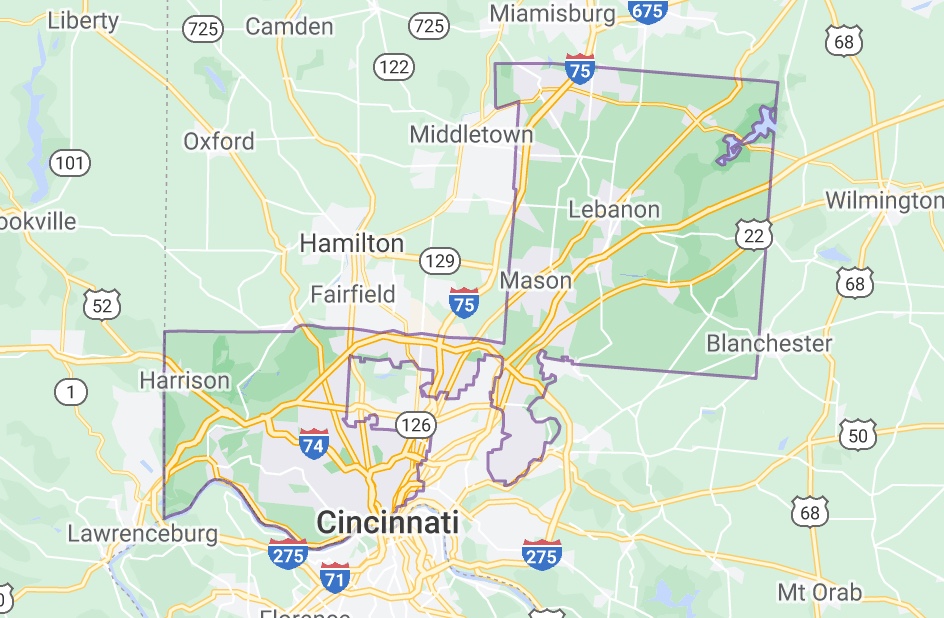
Ohio 1st U.S. Congressional District Map (Chabot)
Voters in 2015 approved creating the Ohio Redistricting Commission, a bipartisan group focused on creating maps that keep communities together and also increasing transparency.
Turcer explained the map-making process will be somewhat delayed, since the U.S. Census Bureau missed a Dec. 31 deadline to turn in the apportionment numbers used to determine congressional seats.
“We don’t have all the information that we would normally have,” Turcer maintained. “As we begin this process, we need to be patient, because we really want the census to do a good job. You want those numbers to be right, so that there’s fair representation across the country.”
Turcer contended gerrymandering has been a powerful political tool since 1812. And while the new rules encourage good behavior, she noted there are no guarantees.
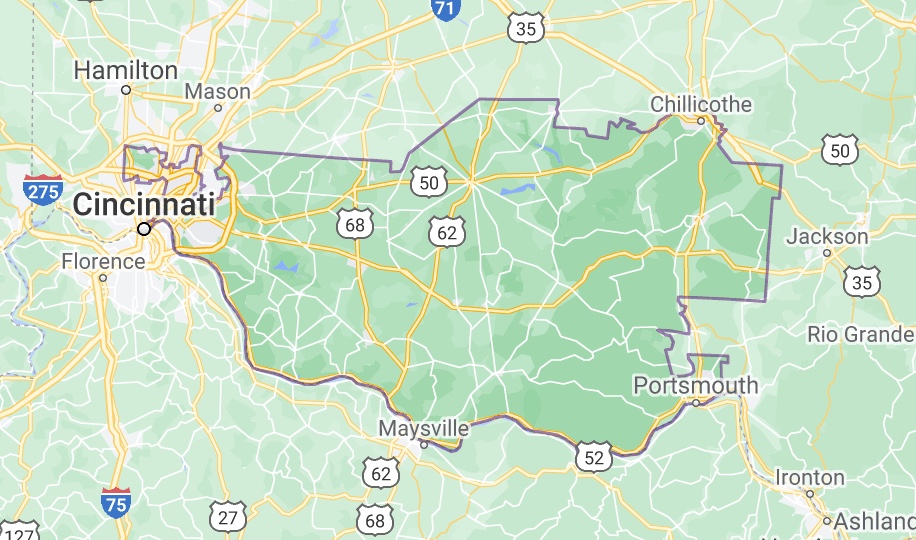
Ohio 2nd U.S. Congressional District Map (Wenstrup)
“We will need to watchdog the process and be as engaged as possible,” Turcer confirmed. “Because it’s much easier to do damage if people are not paying attention.”
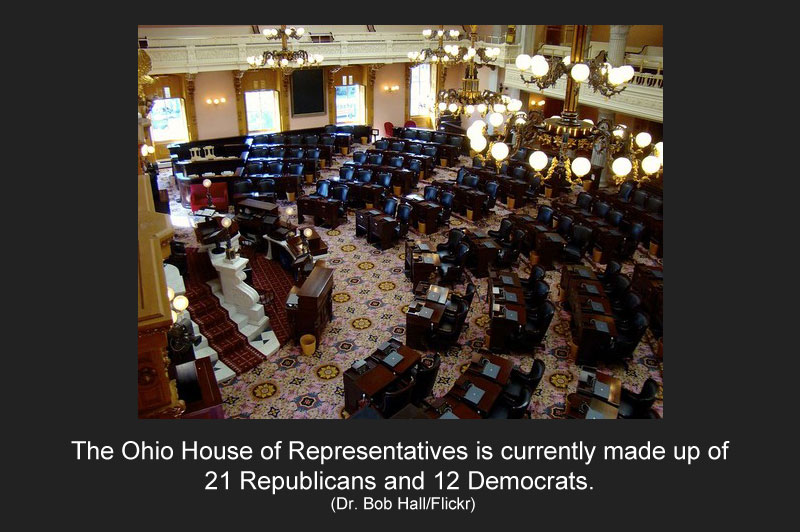
Ohio is expected to lose one of its 16 congressional seats, 12 of which are currently held by Republicans. And at present, the 33 state legislative districts are held by 21 Republicans and 12 Democrats.
This story was produced in association with Media in the Public Interest and funded in part by the George Gund Foundation.
On December 21, a collection of open government and consumer advocates and former Statehouse reporters who championed open and accountable government called on Governor Mike DeWine to require additional financial disclosure from applicants to the Public Utilities Commission of Ohio (PUCO).
Their letter calls for the governor to require all finalists to disclose all work they have done with utilities, their consultants, and lobbyists over the past 10 years including the nature of the work performed and the amount of compensation received.
“Ohio’s financial disclosure requirements are simply inadequate,” said Catherine Turcer, executive director of Common Cause Ohio. “We are urging Governor DeWine to require more robust disclosure for the applicants before he considers appointing one of them to the Public Utilities Commission. Ohioans should be able to ‘follow the money’; such disclosure will help Governor DeWine identify conflicts of interest and could help head off future problems.”
Faith in the PUCO was shaken by last month’s revelation that FirstEnergy made a mysterious payment of $4 million to an official tasked with regulating the company. This filing with the Security and Exchange Commission revealed that this $4 million payment in 2019 was to terminate “a purported consulting agreement” that had been in place since 2013.
Although the November 19th filing did not name the recipient of the money, Sam Randazzo fits the description of someone who “subsequently was appointed to a full-time role as an Ohio government official directly involved in regulating” FirstEnergy. Randazzo was appointed chairman by Gov. Mike DeWine on February 4, 2019. The filing came after the FBI raided Mr. Randazzo’s condo as part of its ongoing investigation into corruption at the Statehouse.
A check of Randazzo’s financial disclosure statements lists no $4 million payment from anyone. It does, however, show that he was paid an unknown amount by the Sustainability Funding Alliance of Ohio, a company he incorporated in 2010. The Sustainability Funding Alliance also turned up in a 2018 bankruptcy filing among the companies used by FirstEnergy’s generation subsidiary, FirstEnergy Solutions. It is precisely these kinds of self-dealings and conflicts of interest that could and should be exposed with more financial stringent disclosure requirements for future PUCO applicants. We should not need the FBI to expose after-the-fact the financial ties and machinations of PUCO applicants.
Signatories to the letter include Douglas Jones, Director Emeritus National Regulatory Research Institute; Tom Roberts, NAACP Ohio Conference; Brandi Slaughter, Ohio Council of Churches; Jen Miller, League of Women Voters of Ohio; Catherine Turcer, Common Cause Ohio; Joe Hallett, Toledo Blade, The Plain Dealer, Columbus Dispatch 1985-2014; T.C. Brown, The Plain Dealer 1989-2006; Ted Wendling, The Plain Dealer 1999-2006; Will Skora, Open Cleveland; Jim Underwood, Horvitz Newspaper, The Plain Dealer 1985-1993.
Former PUCO Commissioners Ashley C. Brown, J. Michael Biddison, and Todd Snitchler also sent a letter today to Gov. DeWine urging the Public Utilities Commission to launch a Commission Ordered Investigation (COI).
Click here for a letter that Common Cause Ohio sent to the current members of the PUCO requesting that they provide additional financial disclosure to the public.
To read the letter from open government and consumer groups and advocates to Gov. DeWine, click here.
To read the letter from former PUCO members to Gov. DeWine, click here.
The arrest of former Ohio House Speaker Larry Householder and others in July revealed how the use of dark money organizations enabled an alleged $60 million conspiracy to sway elections and provide costly bailouts to noncompetitive nuclear and coal plants.
As federal and state court cases move forward, questions remain about what can be done to restore confidence in the legislature and to prevent similar situations in the future.
“Dark money is really how special interests win right now,” said Jay Costa, executive director at Voters’ Right To Know. When corporations use shell groups to hide their political spending, they “gain a level of credibility they wouldn’t otherwise have,” he explained. “I like to think of it as the ‘Wizard of Oz’ effect.”
In other words, voters don’t get to see who’s behind the curtain.
Two months after the federal government’s criminal complaint and indictment in July, Ohio Attorney General David Yost has filed a state court lawsuit. The complaint alleges a “pattern of corrupt activity,” and seeks injunctive relief to prevent FirstEnergy, FirstEnergy Solutions, Energy Harbor and others from reaping benefits from the bailouts under House Bill 6. A hearing on a preliminary motion for that relief is currently scheduled for Friday, Oct. 2.
Meanwhile, it’s unclear whether Ohio lawmakers will actually repeal House Bill 6, the bailout law passed as a result of the alleged conspiracy. Both Democratic and Republican lawmakers called for a swift repeal in late July and early August. However, leadership in the Ohio House has so far refused to allow a full House vote on any pending repeal bills.
‘Dragging their feet’
Rep. David Leland, D-Columbus
“They’re just dragging their feet,” said Rep. David Leland, D-Columbus. “We have 58 members of the legislature who are willing to repeal HB 6 right now.”
Instead, Speaker Robert Cupp, R-Lima, has referred the bill to a House Select Committee on Energy Policy and Oversight. So far, those hearings have largely been a general review of the pros and cons of HB 6, rather than a focused oversight of the alleged corruption that led to its passage and whether it should be repealed in order to repair any claimed harm to public trust in the legislature’s integrity.
“The only way that we can prove that Ohio is not for sale is by repealing HB 6,” Leland said. “The polling we’ve seen shows that people by an overwhelming margin are going to punish those people who have voted for HB 6 and have done nothing to repeal it.” Early and absentee voting in Ohio begins on Oct. 6.
“Our legislators are supposed to act in the public interest,” said political scientist Leah Stokes at the University of California at Santa Barbara. Corporations’ interests may sometimes conflict. But, she adds, “it’s really politicians’ and regulators’ job not to be listening to those special interests. That basic responsibility of democracy has failed in Ohio with House Bill 6.”
A straight repeal would mostly restore Ohio energy law to before HB 6 became effective, subject to some follow-up regulatory matters before the Public Utilities Commission of Ohio. A quick replacement could potentially reenact all or much of the law, which also gutted the state’s clean energy standards.
Advocates say that rushing to ram through anything more than a simple repeal this year would either just repeat bad policy or create more problems, even aside the alleged conspiracy’s past influence on the current makeup of the Ohio House of Representatives. Even at that, a repeal bill would now need either an emergency clause or an injunction sought by the state attorney general in order to stop the nuclear subsidies slated to start in January. The committee adjourned on Sept. 30 and no additional meetings are currently scheduled.
HB 6 “is so questionable at this moment. The vehicle itself and the way it was sold is all just a pack of lies,” said Rachael Belz, executive director of Ohio Citizen Action. “We need them to repeal it, and then we need to go from there.” And that second step will take time, she said.
“It’s complicated and complex legislation and policy. And we have to get it right,” said Chris Neme, a principal and co-founder of Energy Futures Group. “Passing a bill in less than a couple of months like the way HB 6 was just leads us down the road of unintended consequences.”
Shining a light on dark money
The bigger question is how to prevent similar abuses in the future. Utilities and fossil fuel interests have given heavily to Ohio political campaigns since the state enacted a 1999 law calling for competition in electricity generation. And the level of giving went up dramatically once a competitive market actually began to develop in the state.
Utilities’ political spending has continued during this election season. FirstEnergy spokesperson Jennifer Young said that its political action committee has since canceled campaign donations it had originally reported as going out in July shortly before Householder’s arrest.
Campaign donations shown for August have in fact been sent out, Young said. FirstEnergy has denied any wrongdoing in connection with its political donations or the alleged Householder scandal.
Meanwhile, a 2010 Supreme Court case, Citizens United, “really opened up the floodgates of fossil fuel and electric utility influence over politics,” Stokes said. Utilities’ political spending is “particularly pernicious,” in her view, because customers “have to buy from these companies” to get electricity delivered to their homes.
At the same time, reporting requirements currently apply only to immediate spenders on political issues and campaigns. They don’t reach all the way up the chain to the original source of the money.
“It’s basically this Russian nesting doll scenario, where you have one donor giving to another donor, giving to another donor, to get to the person who finally spends the money to influence the voters,” Costa explained.
In the case of HB 6, money flowed into Generation Now from multiple sources, with a lion’s share allegedly originating with Company A — understood to be FirstEnergy — and its subsidiaries, according to the federal complaint.
Some of the money in turn then went to a political action committee. Or, it went to other organizations that directly funded pro-HB 6 ads. One such ad claimed a debunked Chinese conspiracy was behind last year’s failed effort to put a referendum on the law on the ballot this fall. A for-profit group called Ohioans for Energy Security paid for that ad. When asked last year, lawyers at the firm that set up the corporation, Isaac Wiles, would not answer questions about the source of its funding.
“The notion that dark money is something some people don’t like is not part of the elements of the crime,” Mark Weaver, an attorney at that firm, said at a Columbus Metropolitan Club forum after news broke about the Householder arrest.
Asked if there was too much money sloshing around at the statehouse, he said it’s “a lot of money, no doubt,” but it “pales in comparison” to the amount that Americans spend on Halloween candy and costumes every year. And he said that the First Amendment protects the right to conduct political speech anonymously.
“Of course, state and local governments may (depending on how they draft) pass additional 501(c)4 disclosure requirements that could meet constitutional scrutiny,” Weaver later added.
Ian Vandewalker, Ian PHOTO CREDIT: Courtesy of Brennan Center for Justice
“There is no absolute right to anonymous speech,” said attorney Ian Vandewalker at the Brennan Center for Justice at New York University School of Law. Elections are treated differently from general speech, because of the overriding interest in making sure elections function properly, he explained at a panel organized by the League of Women Voters of Ohio.
“That requires informed voters. And it requires policies to not be able to cheat the public,” Vandewalker said. “And so those interests require that there be a level of transparency.”
“No regulation, no law, no set of ethical rules substitutes for American voters paying attention to who’s running for office — pressing them hard on what they stand for, looking closely at the issues, and going into the ballot box having done your homework,” Weaver said.
“The reason that information is important and transparency is important is so that voters are educated,” said Catherine Turcer, executive director of Common Cause Ohio. “You can’t make the argument that voters need to be better educated but you shouldn’t give them actual education. It doesn’t make any sense.”
Moreover, disclosure needs to be timely, said Heather Taylor-Miesle, executive director for the Ohio Environmental Council. In the case of HB 6, Generation Now didn’t report its 2017 spending to the Internal Revenue Service until late 2019. By then, millions more had been spent to influence the 2018 elections, the passage of HB 6, and the failed referendum effort against it.
Pending bills
Several bills introduced by Democratic and Republican lawmakers could make a strong start toward improved disclosure, including HB 737, HB 739, and SB 347. Those bills should be broadened to include digital media, as well as more traditional campaign spending, Turcer said.
The bills should also call for disclosure not only of the name of an organization, but the identity of the top three original donors of funding, Turcer added in her Sept. 16 testimony in support of SB 347. “Otherwise, wealthy special interests will attempt to avoid disclosure by creating pop-up shell groups,” she said.
And while Ohio voters won’t know who’s behind all the groups funding attack ads or other political spending this election season, information is available about how lawmakers voted on HB 6. The Akron Beacon Journal has also compiled some information on how some funds were used in the 2018 Ohio House campaigns.
“People should contact their legislators about HB 6” if they want to speak out about the issue, Stokes said, noting that the law passed with support from a mix of both Republicans and Democrats.
“When the public is outraged about an issue and really shows up, these issues get reversed,” Stokes added. “There’s a lot of leverage right now.”
[Note: the original version of this story took additional comments made by Mr. Weaver and summarized them to help the story flow better and to highlight the most relevant points. Mr. Weaver contacted Eye on Ohio and the Energy News Network after publication expressing his concern that the summary was not an accurate representation of his public comments. While we do not share that view, we are happy to share the full text from which that summary was taken. We know our readers are smart and can draw their own conclusions regarding their meaning. Beneath this article is that text, as well as a link to the entire video.]
Mark Weaver: Blaming Citizens United for this I think is wrongheaded. The New York Times, it’s sort of been proven that their collusion story about Russia has fallen completely apart and yet I don’t blame the First Amendment for the right to print what they printed. I think they had a right to print all that. I think it was substantively wrong, but I wouldn’t go after their ability to print that stuff.
And so what the Supreme Court said in Citizens United was, if a few of us get together and want to form a group to communicate, we ought to have a right to do that under the First Amendment.
And a lot of donors are looking at what’s happening in America right now with the doxxing, or the releasing of personal information and targeting people for shame. So that’s why some donors don’t want to give. Now some may have less noble notions for wanting to keep their money and their name private. But we saw what happened to Amy Acton for example where her personal home was targeted by protesters– that’s just wrong.
The notion that- I disagree with you so I’m going to personally vilify you and show up at your house where your family or your children are- so many donors see that as part of 2020 current affairs and so many of them want to avoid that. And I know not everyone has that reason.
Mike Thompson: But the problem comes in not just that somebody gives $500 to a candidate or a cause they believe in. It’s that somebody gives– $61 million or $35 million, let’s be conservative, and we don’t know that’s happening. Is there a middle ground where we can say, okay I can protect your identity, your First Amendment rights, but you can’t have THAT much influence?
Weaver: Well, not Constitutionally, no. It’s not just Citizens United. There was a case out of Ohio called McIntyre vs. the Ohio Elections Commission. This is the 7-2 Supreme Court case that said it’s legal to keep yourself anonymous when spending politically, based out of Ohio, in Westerville, Mrs. McIntyre. I used to teach the case. This morning I looked at it again and I had forgotten about this quote. This is not a close call. 7-2. This is Supreme court on anonymous speech: “It’s not a pernicious, fraudulent practice but an honorable tradition of advocacy and of dissent.”
And they pointed to the Federalist Papers that were written anonymously, to avoid scrutiny of the authors and focus on the ideas. So this notion of anonymous speech is one that’s protected by Supreme Court precedent.
Thompson: Laura, there are efforts at the statehouse to make it more transparent. Is it just lip service or are they serious efforts?
Laura Bischoff: You know it’s interesting. I do think the conditions are probably better now for reform than they were six months ago. So, there’s a couple of different bills pending. One is House Bill 737, which is sponsored by Gayle Manning, a Republican from North Royalton, and Jessica Miranda, a Democrat from Cleveland. And it’s got the support of the Ohio Secretary of State, Frank LaRose. And it would require, if you’re going to have a 501c(4) that’s spending in Ohio on political matters then it would require reporting through the state. Louis Brandeis said that the best disinfectant is sunshine. And so, this kind of works on that premise– transparency and disclosure will help clean it up.
Thompson: Derrick, It comes down to the Supreme Court. And the courts have said money equals speech. How much money? We have unlimited amounts of Free Speech. We can stand on a street corner, 24 hours a day, 7 days a week, and as long as we don’t yell fire in a crowded theatre we can do all we want. Should that same apply to the amount of money someone can give to a campaign? Or to a political cause?
Derrick Clay: Well you know if you have the money to give it, that’s your discretion whether you want to give that money to a c(4). You know, right now we’re under the law from that Citizens United case where people can give unlimited amounts of money to a c(4) nonprofit. So until that court case is overturned or challenged, then that’s the law of the land that we all have to abide by unfortunately.
Thompson: Is it too much money sloshing around at the statehouse? And you guys [points at Weaver and Clay] have both advocated for groups, and helped raise money and spent money that’s been raised. I mean, you’re part of the system-
Weaver: It’s a lot of money, no doubt. But when you look at what America spends on Halloween candy and costumes every year it pales in comparison. There’s lots of money done for lots of things.
Halloween candy and costumes don’t have the protection of the First Amendment. Remember, the Supreme Court has been very clear: the speech that aggravates us the most gets the most protection. And when you’re laying out what’s protected, political speech is the highest. And so whatever laws get passed, and I’m interested to read the details, and I’m interested in whatever laws are being put out there, they will have to withstand First Amendment scrutiny just like the news organizations represented today.
This article first appeared on Eye on Ohio and is republished here under a Creative Commons license.
In reaction in Ohio’s Speaker of the House Larry Householder being arrested by the FBI as part of a $60 million pay-to-play scheme, Common Cause Ohio Executive Director Catherine Turcer released the following statement:
“This pay-to-play scandal would have been stopped in its tracks if Ohioans were able to see who was behind efforts to influence their opinions and votes — if they could “follow the money.” We shouldn’t need an FBI investigation to connect the dots. If we had strong campaign finance disclosure rules, Larry Householder would not have been able to pervert our political system the way that he did.
This scheme began with his quest for power — his election as Speaker of the Ohio House of Representatives — and revolves around the passage of the nuclear and coal bailout of a FirstEnergy subsidiary, House Bill 6.
Householder allegedly took millions of dollars at the same time he pushed legislation to bail out non-competitive coal and nuclear plants with more than $1 billion in public money, gut subsidies for renewable energy, and roll back clean energy standards.
Ohioans have a right to an accountable government and to know who is trying to influence lawmakers, their votes, and opinions. The federal investigation into Generation Now and today’s arrest of Speaker Householder are just the latest example of why the Ohio legislature needs to take immediate action to increase campaign finance disclosure.
It’s past time for the Ohio legislature to take action to increase transparency of political spending and stop allowing ‘dark money’ to distort the democratic process. The source of campaign funding information helps voters examine the motivation of ads they see on TV and the internet. Shining the light on ‘dark money’ will also encourage those funding these egregious ads to be more accountable.
Common Cause and its members will work with Republican and Democratic allies to find a path for strong money in politics transparency reform. Ohio voters deserve nothing less.”
xxxxx
Common Cause Ohio is a non-profit, non-partisan advocacy organization that works to strengthen public participation in our democracy and ensure that public officials and public institutions are accountable and responsive to citizens. Through a powerful combination of coalition building, lobbying and litigation, grassroots organizing, policy development, research and public education, we spotlight local, state and national issues that affect every Ohioan.