Tag: Central State University

  • Ohio launching $20 million, decade-long study to improve behavioral health outcomes

    Ohio launching $20 million, decade-long study to improve behavioral health outcomes

    Getty Images illustration of therapy session.

    The study seeks to better understand the root causes of mental illness, substance use disorders, and suicide.

    BY:  Ohio Capital Journal

    This story is about suicide. If you or someone you know needs support now, call or text 988 or chat 988lifeline.org.

    The state of Ohio is embarking on a decade-long study to better understand the root causes of mental illness, substance use disorders, and suicide.

    The Ohio Department of Mental Health and Addiction Services is providing a $20 million grant to fund the State of Ohio Action for the Resiliency (SOAR) study, Ohio Gov. Mike DeWine announced during a press conference Friday.

    “Currently, there’s a lot that we don’t know and the SOAR study is a huge step forward in advancing our understanding of mental health and substance use disorders,” said Ohio State University President Ted Carter. “This study will provide key data that will shape the future of mental health across Ohio and beyond.”

    “There’s nobody that is not affected by this,” Carter said. “There’s somebody that you know in your family, your community, your neighborhood that is affected by this.”

    The study will go for at least a decade with the hope it will continue for decades to come and will look at generations of families from all across Ohio who are affected by mental illness and substance abuse disorders, DeWine said. Funding for the SOAR study comes from the state’s two-year operating budget.

    “We know mental illness and substance use disorders are preventable, treatable, and people can and do recover,” said Ohio Department of Mental Health and Addiction Services Director LeeAnne Cornyn.

    The SOAR study has two main projects — the SOAR Wellness Discovery Survey and the SOAR Brain Health Study.

    The wellness study will study as many as 15,000 people across Ohio’s 88 counties to learn how skills may help overcoming adversity. The brain health study will look at 3,600 Ohioan in families to help look at the biological, psychological, and social factors that help people handle adversity.

    “There’s still an awful lot to know about mental health,” DeWine said. “And candidly, the research in this field has not been as robust as it has been in other areas. … It will give us a complete picture of each participant to uncover why, for example, two people in similar circumstances or with similar health have very, very different outcomes.”

    Ohio State University will lead the study and is partnering with hospitals and universities around the state: Bowling Green State University, Central State University, Kent State University, Nationwide Children’s Hospital, Northeast Ohio Medical University, Case Western Reserve University, University Hospital in Cleveland, Ohio University, the University of Cincinnati, Cincinnati Children’s Hospital, University of Toledo and Wright State University.

    The SOAR study will be led by Dr. Luan Phan, chair of the Department of Psychiatry and Behavioral Health at the Ohio State University College of Medicine.

    “Our approach … is to identify the factors that can be modified to reduce risk and build resilience in the face of stress, trauma and adversity,” Phan said. “It’s important to identify what we don’t know — the root causes, the risks, the preventive factors of mental illness, to explain what, I feel, are fairly simple, but fundamental questions: who gets ill? Why did they get ill? How do they get ill? And when do they get ill?”

    Researchers hope this study will do for mental health what the Framingham Heart Study has done for heart disease.

    The Framingham Heart Study was initiated by the United State Public Health Service in 1948 to investigate the risk factors for cardiovascular disease. It has enrolled more than 15,000 study participants.

    “Ohio represents a microcosm of our country,” Phan said. “What we learn here can be disseminated and scaled broadly. Other states will not only copy and adopt what we have done, they will be compelled to do so.”

    Suicide and opioid overdose deaths

    Nineteen Ohioans die prematurely every day from unintentional overdose and suicide, Phan said.

    Opioid overdose deaths increased by more than 300% since 2010 in Ohio, said Dr. John Warner, CEO of Ohio State University Wexner Medical Center.

    Suicide deaths in Ohio increased 8% to 1,766 deaths from 2020 to 2021 — meaning five Ohioans die by suicide every day, according to Ohio Department of Health’s Suicide Demographics and Trends 2021 report.

    The 988 Suicide & Crisis Lifeline received 8,793 calls from Ohio area codes from July 2022 to May 2023, according to the Ohio Department of Mental Health and Addiction Services.

    During that same time, there was an average of 2,014 texts and 2,007 chats per month to 988 from Ohio area codes.

    Follow OCJ Reporter Megan Henry on X.


    Megan Henry
    MEGAN HENRY

    Megan Henry is a reporter for the Ohio Capital Journal and has spent the past five years reporting in Ohio on various topics including education, healthcare, business and crime. She previously worked at The Columbus Dispatch, part of the USA Today Network.

    MORE FROM AUTHOR

  • Reopening begins for Ohio’s colleges: Here’s how it looks

    Reopening begins for Ohio’s colleges: Here’s how it looks

    Susan Tebben

    By Susan Tebben – The Ohio Capital Journal

    Some of Ohio’s colleges and universities have begun moving students in, but the navigation of a school year amid a pandemic is still a balancing act.

    For Miami University, classes began this week, with all undergraduate courses online or remote. The plan is to keep it that way until at least Sept. 21, according to the plan posted to the school’s website. 

    “When we began planning last spring, we had hoped that the COVID-19 pandemic would be in significant decline before classes were scheduled to begin,” Miami president Greg Crawford told students. “Instead, cases are rising in many states. With 40% of our Oxford students coming from outside Ohio, we’ve been monitoring the situation closely.”

    Those that are on campus are required to wear masks, and as students come back, they can be reported to the Office of Community Standards if they repeatedly refuse to comply with an instructor’s direction to use a mask or face covering.

    Mask requirements are the norm among Ohio’s public colleges and universities, as are 14-day quarantines for students coming from states considered COVID-19 hotspots. 

    Also the norm this school year are phased reopenings, like those at The Ohio State University, Ohio University, Kent State University, Shawnee State University, Cleveland State University, and the University of Cincinnati.

    The first move-in dates for UC, Aug. 14 and 15 were considered “drop-off only,” meaning students could bring their stuff to campus, but then had to return home until the 16th. 

    Another regular part of public colleges’ and universities’ schedules is a return to at least some form of in-person class instruction that ends after Thanksgiving break. The last two weeks, including final exams, will be taken remotely at OSU, Central State University, UC, KSU and Wright State University, among others.

    Kent State and the University of Toledo have eliminated their fall break to allow students to receive a full semester despite adjusted opening dates.

    Toledo said they adjusted their Fall semester “based on the possibility of having a second wave of COVID-19 in late fall,” taking into account CDC data on the pandemic and state recommendations for higher education.

    Bowling Green State University went so far as to cancel their Winter 2021 session and provide a $1,500 credit for the first 2,000 students who cancelled their housing assignment before the school year began this week. 

    “It is important you understand that we are HIGHLY encouraging you not to live on campus this fall,” information on the university’s COVID-19 plan page stated.

    BGSU started their staggered move-in this week for those that had no other option than to take up residence, and are set to begin classes on Aug. 31. Students there will also be online only beginning Nov. 30. 

    OU phased in their reopening by allowing certain graduates and undergraduates “in a carefully selected set of academic programs” to begin their time on campus. Most students will begin remotely on Aug. 24, but students like third-year students in the College of Health Sciences and Professions’ nursing program and juniors and seniors in the Army Reserve Officer Training Corps (ROTC) are eligible to participate in the university’s first phase of schooling. 

    Universities throughout the state sticking with in-person instruction have instituted class-size reductions, along with “hybrid-remote” forms of teaching. Central State spelled out a “cohort attendance” model in its reopening plan, which would break large classes into groups, with the cohorts attending classes on alternating days. This model goes along with a 50% reduction in class sizes, something Wright State anticipates as part of its plan as well.

    “At this time, the university conservatively estimates that one-third of classes will have in-person components while the majority of in-person classes will also deliver all content remotely to provide flexibility to students who are unable or do not feel comfortable returning to campus,” said Wright State president Susan Edwards in a letter to the university community.

    Many of Ohio’s public higher education institutions have also created pledges for students connected to prevention of coronavirus, and in some cases can spur disciplinary action if not signed. 

    Testing and contact tracing for COVID-19 are a regular part of all public school plans, though the ways in which the testing is done vary from school to school

    The spring semester plan is still to be determined for most schools. The University of Akron plans to continue hybrid online and in-person instruction into the spring, but others are still watching the success of their fall semesters to plan for the future.

    “Decisions are forthcoming,” stated the UC reopening plan.


    Susan Tebben

    Susan Tebben is an award-winning journalist with a decade of experience covering Ohio news, including courts and crime, Appalachian social issues, government, education, diversity and culture. She has worked for The Newark Advocate, The Glasgow Daily Times, The Athens Messenger, and WOUB Public Media. She has also had work featured on National Public Radio.
  • Lawrence (Larry) Edwin Hamilton: An opportunity to promote The RIGHT Concept

    Lawrence (Larry) Edwin Hamilton: An opportunity to promote The RIGHT Concept

    This is the acceptance speech that Loveland-born Lawrence (Larry) Edwin Hamilton Jr. gave when he was honored as a Distinguished Alumni and inducted into the Loveland Schools Foundation Hall of Fame on September 21. Hamilton was introduced by his son Lawrence Hamilton III.

    James Baldwin wrote, “History is not the past. It is the present. We carry our history with us. We are our history.”  

    Larry Hamilton

    I thank my son for the beautiful introduction and his divinely appointed role as a father and teacher in service to the community as well as the inspiration in part for an inclusive historical heritage. His oldest son is named Omavi which means the Highest gift from GOD and Asali his youngest son’s name means one who honors the ancestors.  I recognize the presence of my uncle the Rev. Ralph Hamilton, the last survivor of the children of Esther Hannon Hamilton who was surrounded by a family of distinguished teachers and preachers and finally I am blessed to have my living history making and loving mother Mary F. Greene Hamilton the oldest surviving elder at a soon to be 94 years young. It is her biological legacy, by way of her mitochondrial DNA that give me historical connection to the Nubians of the Nile Valley and southern Egypt. 

     Larry Hamilton, a native of Loveland, Ohio, is a retired teacher of African American History, World Studies and Current Events from Piqua, OH.

    Larry graduated cum laude with a B.S. in Education in 1971 from Central State University where he was a member of Phi Alpha Theta History Honor Society, Alpha Kappa Mu National Honor Society and President of Delta Xi Chapter of Alpha Phi Alpha Fraternity Inc.

    He earned a Masters Degree in Education from Wright State University in 1979

    When I received the letter from Linda Slusher notifying me of my selection to the Loveland Schools Foundation Hall of Fame, I was humbled that I would be considered and wrote her back that If the LORD is willing I intend to come in recognition of the sacrifice and struggle on behalf of those whose shoulders I have stood upon and who have made a way for me to honor them in Doing the RIGHT Thing.

    Every morning, after I arise and stumble toward the kitchen for my morning cup of coffee, I then sit and turn on my computer and the screensaver is a picture of my great grandmother Cynthia Ann Ross Hannon, whose family had moved to Loveland by 1890 but she returned to Kentucky after attending Berea College to teach black children at the Colored School in Gallatin County, perhaps because she wouldn’t have been allowed to teach in Loveland.

    Linda, I thank you personally and the members of the Loveland Schools Foundation collectively for this surprising recognition and opportunity to promote The RIGHT Concept.

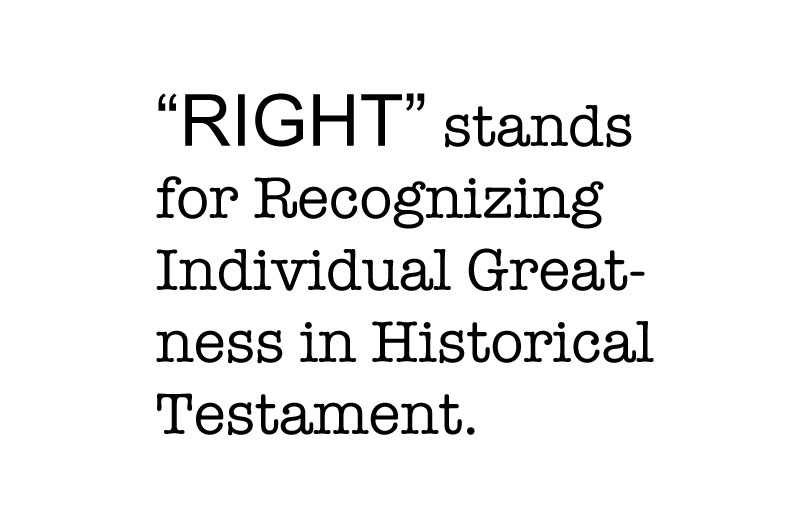
    RIGHT stands for Recognizing Individual Greatness in Historical Testament.

    RIGHT stands for Recognizing Individual Greatness in Historical Testament.  This concept was given to me as an epiphany on the early Sunday morning of Jan. 23, of 2005 and employs a biblical standard that embodies the concern over the historical bias in naming patterns and the contemporary artificial barriers limiting the expansion of ownership identity of public properties, to the least among us.  RIGHT seeks to re-evaluate the standards of heroism and societal acceptance of those who may have been deemed not to be valued or worthy of having their names adorn public facilities.   RIGHT advocates a proactive effort in naming public properties that is more reflective of the diversity within the community and that acknowledges from a historical perspective the merit of greater inclusion with regards to race, gender, ethnic and national origin in expanding ownership identity.

    The declining prospects for saving the Loveland Predestinarian Baptist Church falls within the parameter of Doing the RIGHT Thing.

    The declining prospects for saving the Loveland Predestinarian Baptist Church falls within the parameter of Doing the RIGHT Thing. My personal remembrances and the family legacy associated with that church,  that I had attended as a child, and my father before me, and His mother before him, my grandma Esther, who had been my Sunday School teacher.  Her mother Cynthia the teacher later married John W. Hannon who would pastor the Loveland church for nearly fifty years.  Cynthia’s, mother was Lucy Sams Ross who was born a slave in Kentucky and had weathered many storms of life in the form of personal losses, social indignities and political denials, but her faith was her refuge and shortly after migrating to Ohio she became a founding member of the Loveland Predestinarian Baptist Church in 1892.  https://lovelandmagazine.com/2012/07/a-historic-review-of-chest-street-church.html 

    In the release of Book III of Lucy’s Story the cover painted by wife Linda, depicts two women-one white and one black (Helen Medert & Mary Sidney Wells) two ‘prayer warriors’ during the 1913 Loveland Flood. My great uncle Dee Ross, the son of Lucy and brother to Cynthia, was a hero of that 1913 flood story in Loveland but I believe, he went unrecognized for his heroism due to his skin color, but I am committed to telling his story and OUR Story while ‘keeping the faith’ and doing the RIGHT thing. 

    I have gifted my fellow inductees with a copy of Book II of Lucy’s Story Between Two Suns: The Berean Experience and I wish to donate a copy of Book III of Lucy’s Story to the Loveland High School Library as a donation by Linda Slusher.

    As I prepare to take my seat, I’ll close and ask your consideration of a brief poem titled:

    YOUR ANCESTORS

    If you could see your ancestors all standing in a row.

    Would you be proud of them? Or don’t you really know.

    Strange discoveries are often made, climbing the family tree.

    Sometimes one is found in line who shocks the progeny.

    If you could see your ancestors all standing in a row.

    Perhaps there might be one or two you wouldn’t care to know.

    Now turn the question right about and take another view.

    When you shall meet your ancestors, will they be proud of you?

    (Author unknown)


    Follow this LINK to hear Lawrence Hamilton III introducing his father.