Tag: charter schools

  • DeWine appointee, fellow State Board of Ed incumbent unseated in general election

    DeWine appointee, fellow State Board of Ed incumbent unseated in general election

    BY: SUSAN TEBBEN – Ohio Capital Journal

    Dr. Jenny Shafer Kilgore, a member of the state Board of Education, speaks in support of a bill to eliminate the teaching of “divisive concepts” in schools. Kilgore lost her race for re-election in Tuesday’s general election. Photo from The Ohio Channel

    Two incumbents on the Ohio State Board of Education were not reelected in Tuesday’s general election.

    One unseated member was part of a movement on the board to rescind an anti-racism resolution that mired the state board in controversy, and the other was a governor-appointed member before he sought election to the board.

    Of the 19 members of the board, 11 are elected and the rest are appointed by the governor.

    The school board races were also different this year because of a district shuffle caused by statewide redistricting. Though the changes were spurred by changes in the statehouse and congressional voting districts, decisions on what the school board districts looked like were approved solely by the governor.

    Incumbent Dr. Jenny Kilgore, an elected board member since 2019, lost her bid for reelection, with challenger Katie Hofmann edging past her in a margin just north of 30,000 votes.

    Kilgore was a vocal opponent of an anti-racism resolution passed following the death of George Floyd and social unrest in the country regarding racial issues, though she abstained from the initial vote on the measure. A movement then began to rescind the resolution as conservative outcry for so-called “critical race theory” and “indoctrination” came to a head in Ohio. The resolution was also rescinded amid efforts in the Ohio legislature to put up “divisive concept” bills that would ban discussions of the impact of race on history if it was determined to create “guilt” among white students.

    District 4 board member Kilgore also participated in public protests against “critical race theory” in schools, and testified before a legislative committee, saying House Bill 327 “would allow teachers to teach the subject without the distractions of critical race theory… they would have more opportunity to focus on the subject matter.”

    Fellow incumbent Tim Miller lost his bid to join the board as an elected member to challenger Tom Jackson. Jackson received 44% of the vote in unofficial results from Tuesday. Miller was more than 50,000 votes behind Jackson, also narrowly falling behind a third challenger, Cierra Lynch Shehorn, by just under 600 votes.

    Miller was appointed by Gov. Mike DeWine in 2021 to fill Sarah Fowler Arthur’s District 10 seat left vacant when she joined the Ohio House.

    The outgoing member was instrumental in sending a resolution condemning the Biden administration for changes to anti-discrimination regulations that would include gender identity if accepted on the federal level to executive committee, rather than a full board of ed vote.

    Also elected on Tuesday was former state senator and Toledo-area educator Teresa Fedor, who defeated opponent Sarah McGervey with 56% of the unofficial vote totals in the District 2 race.

    Hofmann said the elections that happened on Tuesday show the need for a different tack on the board of ed.

    “The election of Theresa Fedor, Tom Jackson and (Hofmann) is a clear message that people in Ohio want high quality public schools, not more charters or vouchers,” Hofmann said in a statement to the OCJ. “Ohio public schools must be welcoming, accepting and inclusive where ALL children are respected.”

    Though all state board of ed races are considered non-partisan, the changes to the board are encouraging to the Democratic party as a whole and education associations in the state as well, despite “mixed results” in other general election races.

    “I think having dedicated candidates who are going to reject some of the extremism we’ve seen on the state board of education … is really going going to help change the dynamic in terms of the issue and hopefully refocus the state board on really what students need,” said Scott DiMauro, president of the Ohio Education Association.

    Elizabeth Walters, chair of the Ohio Democratic Party, praised “taking the majority” on the school board, saying the current school board “has become this dysfunctional show of what happens when we elect people who aren’t focused on the things that parents and students care about most.”

    She also said the party worked to bring in candidates, and is prepared to recruit more in the future.

    “We worked hard to recruit strong folks for these seats who have strong backgrounds in education and who can be advocates for what teachers and students really need to be successful here in Ohio,” Walters said in a Wednesday press call.

    Follow Susan Tebben on Twitter.

  • Advocates, legislators want more from governor’s education budget

    Advocates, legislators want more from governor’s education budget

    Students in a classroom. Getty Images

    By Susan Tebben and Ohio Capital Journal

    With no changes planned for the state education funding formula included in Gov. Mike DeWine’s proposed budget, education advocates and some state legislators are left wanting more.

    “The devil is always in the details,” said Scott DiMauro, head of the Ohio Education Association, in a statement after the release of the budget. “Education spending must be a top priority in Ohio to ensure our students, educators and communities receive the resources they need to succeed.”

    Scott DiMauro

    DeWine’s budget proposal brings funding back to pre-pandemic levels and includes a jump in non-academic wraparound services, but saves the bulk of changes to education funding for the legislature to figure out.

    The OEA said they were encouraged by an expansion to broadband access and mental health services as part of the support for schools.

    “However, OEA is disheartened to see the same amount of general revenue fund money is going into the state’s foundation formula as in (fiscal year) 18,” the association wrote in their statement.

    Another of Ohio’s biggest teachers unions, the Ohio Federation of Teachers, agreed that DeWine “chose to punt” on overhauling the school funding system without acknowledging the Cupp-Patterson plan, some of which went into the capital budget last year, but for the most part stays in limbo as the General Assembly begins anew.

    Melissa Cropper

    “Additionally, the governor’s budget maintains the disastrous local funding deductions for charter and private schools that have been draining public school budgets,” said OFT President Melissa Cropper in a statement.

    The non-profit Ohio Children’s Alliance praised the “key investments for Ohio’s children and families” that the governor carried over from the previous biennial budget, and said they were pleased to see more money go toward student wellness and youth services.

    “With the unprecedented challenges COVID-19 has caused to communities and providers, targeting investments in telehealth and the child and family services workforce are critical parts of a comprehensive solution,” said Mark Mecum, CEO of the OCA.

    State Sen. Teresa Fedor

    State Sen. Teresa Fedor, D-Toledo, called the governor’s proposal “shortsighted” when it comes to education and support for children.

    “We should be fixing our unconstitutional funding formula — not continuing to siphon more public school dollars to private education,” Fedor said after the budget proposal was released.

    With the school funding now in the legislature’s hands, House Minority Leader Emila Strong Sykes, D-Akron, said it would be a primary issue as the House Democrats begin their work, including “fully and fairly funding our public schools.”

    “We look forward to digging into the details of the governor’s proposal to see how it makes sense long-term without one time money and that it delivers on the promise of opportunity for all Ohioans,” Sykes wrote.

  • 2018 Community School (charter schools) Sponsor Evaluations Released

    2018 Community School (charter schools) Sponsor Evaluations Released

    Columbus, Ohio – To help ensure accountability and quality in Ohio’s community school system, the Ohio Department of Education today released the 2017-2018 sponsor evaluations.

    What’s a Sponsor? – A sponsor has the authority (ability) to establish a community school. Sponsors ensure that schools adhere to their contracts, and they make important decisions, such as whether to renew contracts with community schools. They also provide oversight and technical assistance.

    What’s a Community School? – Community schools, which are often called charter schools nationally and in other states, are public schools created in Ohio law; are independent of any school district; and are part of the state’s education program. Community schools are public schools of choice and are state and federally funded.

    “High-quality sponsors are the foundation for an effective community school system,” said Paolo DeMaria, superintendent of public instruction. “The sponsor evaluations are an important piece of Ohio’s accountability system, driving continuous improvement and helping to ensure Ohio’s families have quality school choice options.”

    The sponsor evaluation system assists the Ohio Department of Education in its oversight of sponsors and helps increase the quality of sponsor practices. The evaluation framework is made up of three equally weighted components:

    • Academic Performance;
    • Compliance with Rules and Laws; and
    • Quality Practices.

    The Academic Performance component determines how well students are performing academically at sponsors’ schools. The Compliance component rates whether sponsors are compliant with all relevant laws and rules and whether sponsors are monitoring their schools’ compliance with laws and rules. The Quality Practices component, which was created using national standards and input from sponsors, looks at sponsors’ adherence to quality practices.

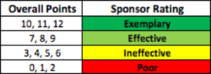
    All three components are scored on a common scale (0-4 points) to allow for simple calculations. Sponsors receive points for each component that, when added together, provide a summative rating. The point scale for 2017-2018 is as follows:

    Sponsor Rating Chart

    Ohio law includes a set of incentives for sponsors rated “exemplary,” as well as a set of consequences for sponsors rated “ineffective” and “poor.” For example, a sponsor rated “exemplary” for two consecutive years is able to take advantage of incentives, including receiving a longer term on its contract with the Department. Any sponsor that receives an “ineffective” overall rating is prohibited from sponsoring any new or additional community schools, and the sponsor is subject to a quality improvement plan. Any sponsor that receives a “poor” rating or three consecutive “ineffective” ratings is subject to revocation of its sponsorship authority. An appeals process is available to sponsors that are subject to revocation of their sponsorship authority.

    The 2017-2018 community school sponsor evaluations can be found online by clicking here.


    Welcome to All About Kids We invite you to come visit one of our convenient locations, talk to our staff and teachers and learn why.